Sunday Poem–Choose


“Most people are about as happy as they

make up their minds to be.”  Abraham Lincoln


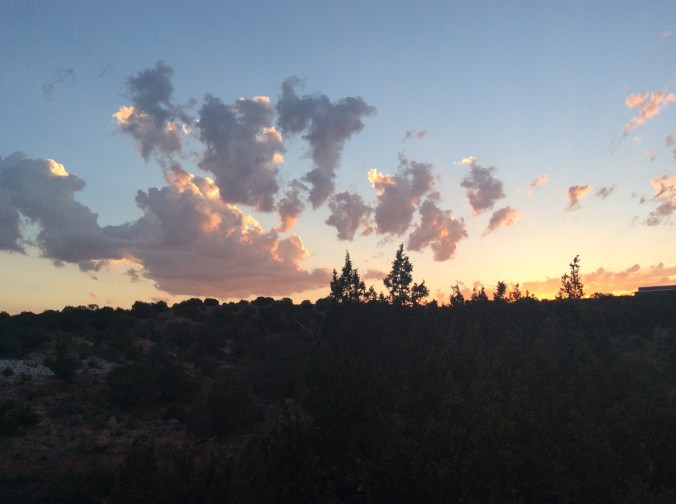
When I was twenty something, I chose happiness, not the sappy, syrupy, cheery, but a deeper joy of cherishing the small, the unique, the everyday, smiling with sunsets, the song of the mockingbird in spring, horses running free, the nearly invisible bobcat climbing the canyon wall, the taste of fine coffee at the first wakeful moments in the morning, cooking for friends, taking a “property walk” with my grandson, laughing with the teenagers I teach.  I am driven to do little–obsessions, compulsions do not run me.  I choose.  Choose life, choose joy, or choose whining, choose lamenting.  Choose!!  Be who you want to be; do what you want to do.

IMG_2817

Note:  this is a poem from my book, “On the Rim of Wonder”.

Sunday Poem


A few years ago Uno Mundo Press published my second book, a book of poems.  Reviewers say it is a memoir.  Oddly, that was not the plan; in retrospect, it seems apt.  The poems’ topics are not chronological but rather via topic with quotations before each topic as a sort of introduction.  For the foreseeable future, while I continue writing another book, I will post one poem from the book every Sunday.

The book begins with this quotation:

“Do something scandalous to give your descendants something

to talk about when you are gone.”  Vanessa Talbot


The first section begins with this quote by Judith Jameson, the famous dancer and choreographer:

“I always tell my dancers.

You are not defined by your fingertips,

or the top of you head,

or the bottom of your feet.

You are defined by you.

You are the expanse.

You are the infinity.”


The first poem in the book goes like this:

I Have Lived

Depression, sad days, melancholy.

Gone!

At 26, I said, “To hell with this!

You control you life, live it!”


I tried forbidden liaisons, trained horses,

Traveled around the world, a cobra wrapped around my neck,

Walked the Shalimar Gardens in Kashmir,

Stood before the Jama Masjid in Old Delhi,

Watched the Taj Mahal reflected in still waters,

Walked the streets of Katmandu,

Talked to monks at Shwedagon Pagoda,

Bargained with sticks in dirt, math our only common language,

Downed raw turtle eggs in Costa Rica,

Danced on table tops, sang “Adonai”,

Roamed empty roads across the Navaho Nation,

Divorced four times,

Raised two talented children.


I have lived, running on the rim of wonder.

IMG_2675


September 30–Morning


Silence sits

like a wet, grey rag

no bird song

no insects or frogs singing

junipers unmoving

yesterdays footprints

impressions in adobe mud

Silence sits

like a wet, grey rag


IMG_1591


Own Everything


Checked my Facebook today and this quote showed up–posted by a fellow friend and author. It is from Ann Lamont:

“You own everything that happened to you.  Tell your stories.  If people wanted you to write warmly about them, they should have behaved better.”


Note:  In spite of a few men having referred to me as a scandalous woman after reading my book, “On the Rim of Wonder”, I still have not been sued for slander.  It has been a few years.  I think I am safe.  Always tell your truth.  Be open to adventure.  Live your life.  Be the best you that you can be.


IMG_2801


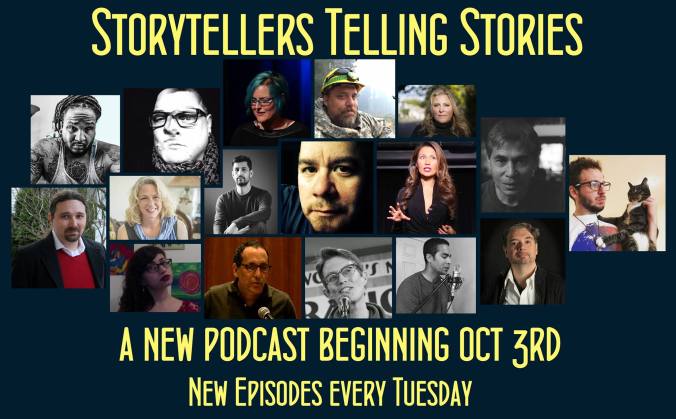
Storytellers Telling Stories podcast


For those of you who enjoy different types of stories and their authors, here is a weekly Podcast to explore.

Samuel Snoek-Brown's avatarSamuel Snoek-Brown

I am profoundly excited to announce that I’ll be joining a new podcast series, hosted by author Jude Brewer, called Storytellers Telling Stories. The series will consist of writers sharing their work and their craft in a new version of the oldest tradition: oral storytelling.

21246316_10213146534685437_7215545624481597062_o

You can check out the teaser trailer online now.

I’d be excited to join this series anyway, especially since I’m a fan of Jude’s work in general and am honored he invited me to come aboard. But the lineup he has in place for season one includes some of my favorite writers and dearest friends: Jason Arias, David Ciminello, Sean Davis, Daniel Elder, Zach Ellis, Jenny Forrester, DeAngelo Gillispie, Kate Gray, Rios de la Luz, Gina Ochsner, Kate Ristau, Domi J Shoemaker, Davis Slater, and Reema Zaman.

My own…

View original post 51 more words

White Trash and Rednecks


Nearly everyone lies about an important aspect of US history even historians. School history books avoid the discussion totally, this significant part of US history, much of which explains past and current racism.

Americans pretend that social class does not matter, that anyone can rise to the top given enough effort.  This myth depends on the continuation of a very selective historical memory, indeed, a lie.

It began with the British and those who intentionally left there to come here.  Even colonists divided the classes with poor people and criminals at the bottom–whores, discharged English soldiers, robbers, highwaymen; the saddest of the lot were the orphans, rounded up, loaded on ships bound for America, sold as indentured servants. Often these contracts were repeatedly resold with no routes for the individuals to escape.  The rigid English class conditions continued here.  People of higher classes in the colonies referred to the poor as waste, rubbish, and trash.

John Locke, often considered the father of constitutional government, favored slavery and aristocratic society.  He endorsed an aristocratic constitutional government and called the poor, landless, lazy lubbers. Because the southern colonies lacked sufficient land lubbers and land owners believed Africans more suitable for hot, humid swamp clearance, they petitioned for slaves–previously illegal in Georgia, for example.  These wealthy landowners also viewed poor whites as too lazy to work.

Even the esteemed Ben Franklin believed in the concept of class as inevitable.  Both he and Jefferson saw expansion westward as the solution to potential class conflict.  Franklin thought the new colonies needed more people and advocated for the freedom of slave women who bred many children and for white women to be allowed to gain property rights for the same.  More people would move west and alleviate class conflict. Franklin was not an advocate for the poor, whom he considered lazy, slothful.  He even endorsed their forced migration westward and referred to them as “the meaner Sort, i.e. the Mob, or the Rable”.

If this sounds shocking, Jefferson went even further, calling the poor, “rubbish”.  He did feel they could improve, given land and education.  He did not include slaves in this theory.

If you ever wondered about the origin of the term “cracker”, look back to the era of Andrew Jackson, the era of “squatters” in a log cabin in the thickly forested frontier, people who squatted on land they did not even own.  Many saw them in both positive and negative terms:  half strong, hard working pioneers and half robbers.  Two terms applied to these people, “cracker” and “squatter”, none of whom legally owned the land where they lived, troublemakers with no hope of upward mobility, people who championed crudity, distrust of civil society and city dwellers, and held on to a kind of crude arrogance.  Both terms came from England where such people were considered lazy vagrants.  The more educated and “civilized” viewed them as degenerate, low class fornicators.  These squatters saw Andrew Jackson as their champion and Davy Crockett as their hero.

The phrase “white trash” became common in the 1860s and after.  These were the southern poor with dirty faces, ragged clothing, distended bellies without possibility of improvement, who for a brief time were viewed as even lower than slaves.  Southern aristocrats pushed the concept of bloodlines for people as well as livestock.  They advocated a criteria for human as well as livestock breeding to justify slavery and Anglo-Saxon superiority.  Native Indians were a biologically inferior, degraded race, doomed to extinction.  Later Texans used similar arguments to deter intermarriage with Mexicans.  Sam Houston championed this cause apparently ignoring his own personal history.  He had lived with Natives and married two of them.  In the long run these beliefs did not help poor whites or raise their status.  They lived off the worst land and were continually referred to in derogatory terms, e.g. white trash, sand eaters.

Just before the Civil War some elite Southerners advocated to keep certain classes ignorant.  They defended the planter class as having the best bloodlines, whose destiny was to rule over poor whites and black slaves. When they realized they needed poor white support to secede, and that many did not support them, they convinced them the war was necessary to save them from a state worse than slavery.  Some were promised land and other rewards.  Since most were illiterate, they remained unaware that they were referred to as “perfect drones”, “the swinish multitude”, and other pejorative terms; and that some saw them as trash who contaminated whatever they touched. It was not the Southern elite who died in masses during the Civil War; it was the poor, recruited with Davis’ rhetoric about the superiority of the white race.

Later, during Reconstruction, William Percy wrote a description of poor whites as those who lynch Negroes, lack intelligence, attend religious revivals then fornicate in the bushes afterwards.  He also explicitly referred to them as Anglo-Saxons.  Teddy Roosevelt saw this a bit differently.  He wanted Anglo-Saxons to work, to join the military, and breed, but he excluded poor whites from this group and his plan.

The term “rednecks” came into use in the South during the 1890s.  It referred to people who lived in the swamps and mill towns, wore overalls, heckled at political rallies.

The Great Depression exacerbated the situation for poor whites and increased their numbers dramatically.  Those who had never been considered white trash joined the ranks of the poor.  Many Southern writers went back to discussions about the Civil War and argued about the current poverty and how to solve the problem.  One, Jonathan Daniels, even wrote that Rebel pride blindfolded all classes.

Later, one way to overcome the prejudices against the poor was through music and TV shows, e.g. Elvis Presley and “The Beverly Hillbillies”.  It allowed the country to feel better about prejudices and pretend they did not exist.

Today this manifests itself through politicians who “pretend” to be white trash and rednecks to gain votes, but in reality live the lifestyle of the upper class.


Note:  For those who wish to read more about class and the writings of the individuals mentioned above here is a partial list.


Writings and speeches of Benjamin Franklin and Thomas Jefferson

Sherwood Anderson’s “Poor White”

Writings of John Locke

Works of James Agee

“White Trash:  The 400-Year Untold History of Class in America”

Speeches of Jefferson Davis


Quote for the day


Sadly, this quote seems appropriate given the events in Virginia.  I had hoped we were beyond this but apparently not.


“If you can convince the lowest white man he’s better than the best colored man, he won’t notice you picking his pockets.  Hell, give him somebody to look down on, and he’ll empty his pockets for you”.  Lyndon Johnson, 1970.

Religion


Recently, while reading a novel about a woman in Shakespeare’s time, I came across this statement by one of the characters.  It rings so true for many eras of human history, I feel compelled to share it:


“Religion is not only about men’s souls.  It is about who rules us, what laws we obey, how and why we are punished, and by whom.”

Predetermined?


IMG_2676

Today at the bookstore browsing, I picked up a book nestled among the magazines.


This question appeared on page 41:  “If you were given a book on the story of your life,

would you read the end?”


I asked my grandson.  He immediately said, “No!”


I wonder.


Remain unsure.


If I read it, could I change it?


Are lives predetermined, choiceless?


Are we unwittingly predetermined and just victims?


If I read it, could I change it?


Eat something different,

sing a varied song,

laugh more,

spend more time with sunsets, sunrises,

read less, more,

love someone new,

say words now lost,

write a contrary story,

choose an opposing path,

challenge?


Whitney Plantation Visit


Whitney Plantation resides on the River Road about one hours drive from New Orleans.  A recent visit there provided much enlightening information about the slave trade, crops grown near New Orleans, and the history of this area. Tours can be scheduled all days of the week except Tuesday.  It is unique in that many different types of plantation buildings still exist there, including old slave cabins, a foundry,  and the outside kitchen.

A German immigrant started the plantation in the late 1700s.  At Habitation Haydel, its original name, he grew indigo.  After his death, his youngest son converted the main crop grown to sugar cane, which is still grown there today.  Both indigo and sugar cane required intensive labor for profitability.

Although, according to population data, only ten blacks lived in Louisiana in 1712, by the end of the century slavery was the main source of labor.  In 1795, there were 19,926 slaves in Louisiana.  Under Spanish rule the slave population steadily increased.  Although many were imported from Haiti, those from Africa came from what are now the countries of Senegal, Bissau, and Guinea.  After the initial importation of slaves, the United States imported few compared to islands in the West Indies and Latin America, e.g. Brazil.  The preferred method in the United States to obtain slaves was breeding.  Women and men were forced to breed.  Their owners specifically chose certain people to produce certain types of progeny just like in breeding livestock.  One woman complained of having 16 children by 16 different men.

IMG_2729

After leaving the visitor center, the first building on the tour is the church.  Inside the church are statues of various children who were the products of the breeding program at the plantation.

IMG_2728

The artist created these statues from specific information about the children.  The plantation owners maintained detailed inventories of all slaves and their value.  This particular plantation often owned as many as 100 slaves.

IMG_2731

From this inventory a memorial has been created with the names of the slaves.  Included are various statements made by the slaves themselves as recorded in slave narratives.

IMG_2733

The above tells the story of a child fathered by his owner and one of the slave women and how his father treated him.

IMG_2734

Even pregnant women could not escape beatings.

IMG_2735Because the area around New Orleans receives 60 inches of rain a year, the landscape everywhere is lush.  This is one of several pools at the plantation.

IMG_2736

These containers cooked the sugar cane.  Starting with the largest, the cane was boiled repeatedly until it cooked down and poured into increasingly smaller containers.  This was especially dangerous work due to the fires, the heat, and the boiling sugar cane. Sugar cane production was much more dangerous than cotton which was grown farther north in Louisiana.  The cane itself was cut with large machetes and the edges of the cane are also sharp.  Many people were severely injured.  The life expectancy of a sugar cane slave who worked in the fields or cooking the cane was approximately ten years from the time he or she went to work, often as young as ten. Although field slaves had a much harder life in terms of labor, they had less exposure to their owners and their families and therefore, in some ways, more freedom to talk and interact. House slaves were constantly watched and the women especially subject to sexual abuse.

IMG_2737

Slave cabins like this one contained four rooms.  Like the main plantation house, most buildings were built off the ground.  No levees existed then and the largest plantations were often built within sight of the Mississippi River and thus prone to flooding.

IMG_2738

This building housed the foundry.  Skilled slaves, like blacksmiths, were very valuable and received better treatment, e.g. enough food.  When the movie, “Django Unchained” was filmed, part of the movie was filmed here because the adjoining plantation did not have a blacksmith shop.  The branding portion was filmed at Whitney Plantation.

IMG_2741

The walkway, looking from the front of the main plantation house, is lined with giant oak trees.  Before the levees were built, the Mississippi River could be seen from the house.

IMG_2742

Originally, there was no first floor due to the flooding.  Later, after it will built and used for dining, an office, and a living area, whenever the floods came, the slaves were required to carry everything to the second floor until the water subsided. Then they would clean the first floor of mud and debris and return the furniture there.  Whitney Plantation possesses some unique characteristics, e.g. finely painted European style ceilings.

Cooking was not done inside the main house at any of the plantations due to the heat and fire danger. The cook, another skilled and valuable slave, was required to know how to cook various popular cuisines typical of the area, e.g. creole, European–French, Spanish.

IMG_2743

The various ferns and mosses growing from the limb of this large oak trees demonstrates the lushness and humidity typical of this area and why it is still used for sugar cane production.

IMG_2744

A short distance down the road is Evergreen Plantation where the main portion of “Django Unchained” was filmed.  It, too, still produces sugar cane and a family lives here.  Tours are available as well.