Like Tequila, Love Bats


Tequila is made from a specific species of agave plants that grow in certain areas of Mexico and Southwestern United States.  Did you know:  no bats, no tequila?

The Mexican long-nosed bat (Leptonycteris nivalis) remains crucial for tequila production because they pollinate tall, column-like cactuses and the blue agave from which tequila is made.  No bats, no agave, no tequila.

Every year these bats migrate from Central and Northern Mexico into the southern areas of Texas, Arizona, and New Mexico and they are endangered.  These bats have been listed as an endangered species since 1988 in the US and since 1991 in Mexico.  Researchers at New Mexico State in Las Cruces are part of a conservation network working with Mexican counterparts to save these bats.  And tequila.


Whitney Plantation Visit


Whitney Plantation resides on the River Road about one hours drive from New Orleans.  A recent visit there provided much enlightening information about the slave trade, crops grown near New Orleans, and the history of this area. Tours can be scheduled all days of the week except Tuesday.  It is unique in that many different types of plantation buildings still exist there, including old slave cabins, a foundry,  and the outside kitchen.

A German immigrant started the plantation in the late 1700s.  At Habitation Haydel, its original name, he grew indigo.  After his death, his youngest son converted the main crop grown to sugar cane, which is still grown there today.  Both indigo and sugar cane required intensive labor for profitability.

Although, according to population data, only ten blacks lived in Louisiana in 1712, by the end of the century slavery was the main source of labor.  In 1795, there were 19,926 slaves in Louisiana.  Under Spanish rule the slave population steadily increased.  Although many were imported from Haiti, those from Africa came from what are now the countries of Senegal, Bissau, and Guinea.  After the initial importation of slaves, the United States imported few compared to islands in the West Indies and Latin America, e.g. Brazil.  The preferred method in the United States to obtain slaves was breeding.  Women and men were forced to breed.  Their owners specifically chose certain people to produce certain types of progeny just like in breeding livestock.  One woman complained of having 16 children by 16 different men.
IMG_2729

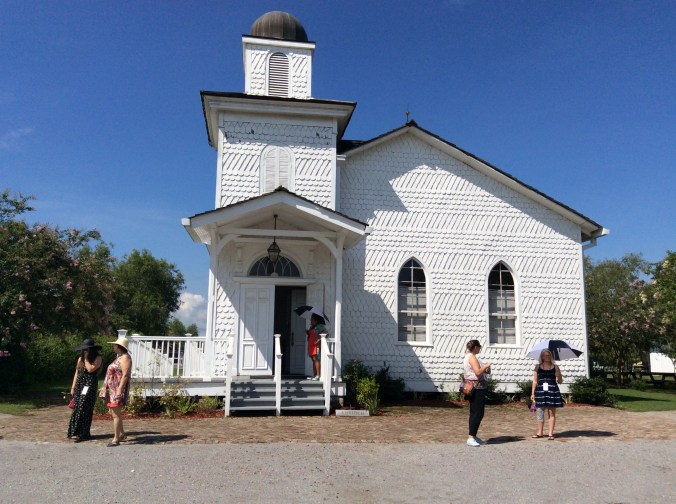
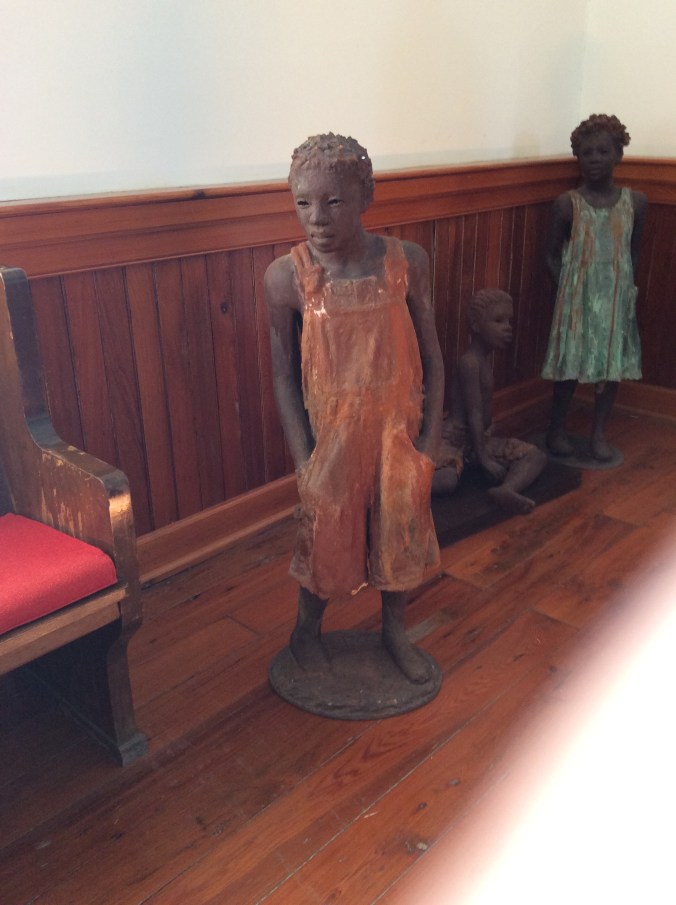
After leaving the visitor center, the first building on the tour is the church.  Inside the church are statues of various children who were the products of the breeding program at the plantation.
IMG_2728

The artist created these statues from specific information about the children.  The plantation owners maintained detailed inventories of all slaves and their value.  This particular plantation often owned as many as 100 slaves.
IMG_2731

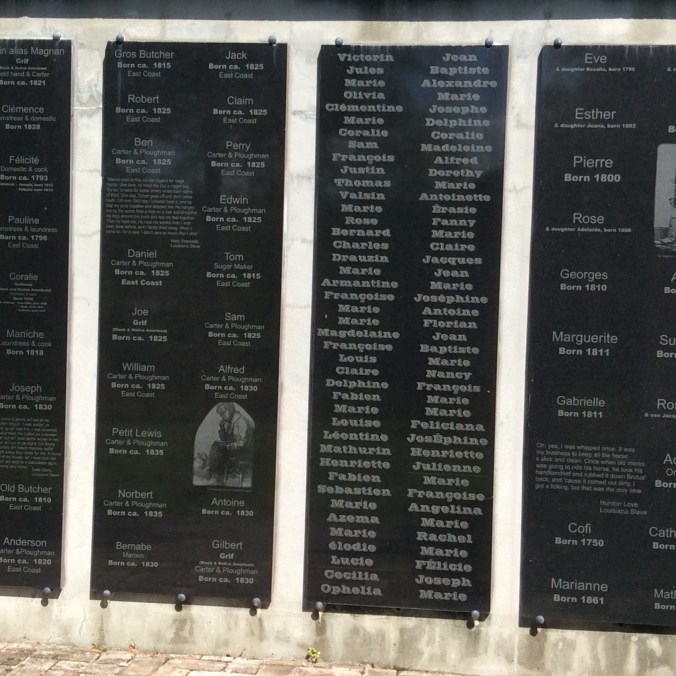
From this inventory a memorial has been created with the names of the slaves.  Included are various statements made by the slaves themselves as recorded in slave narratives.
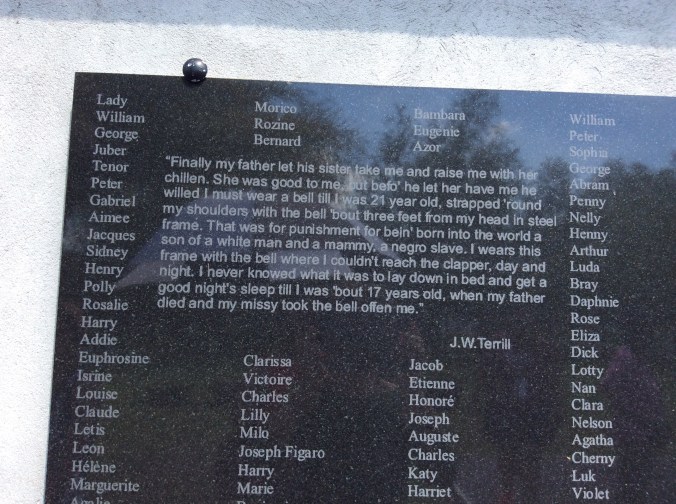
IMG_2733

The above tells the story of a child fathered by his owner and one of the slave women and how his father treated him.
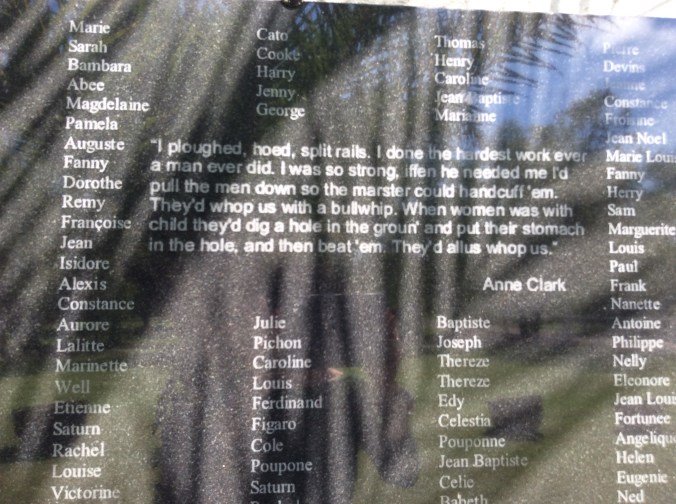
IMG_2734

Even pregnant women could not escape beatings.
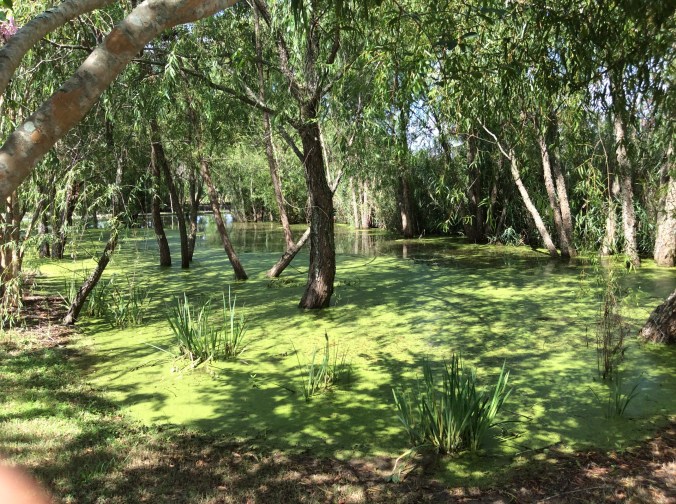
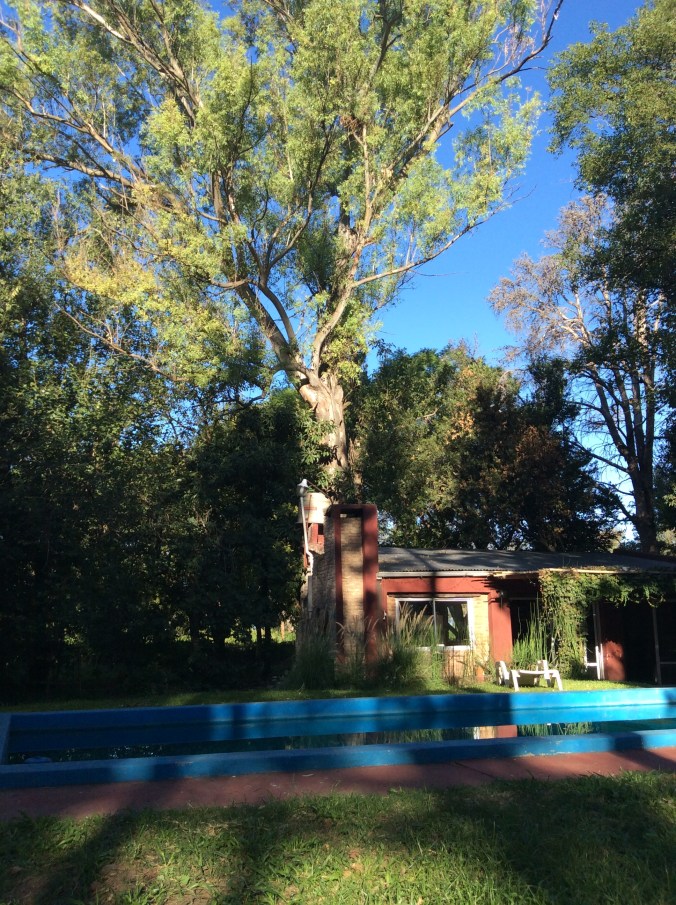
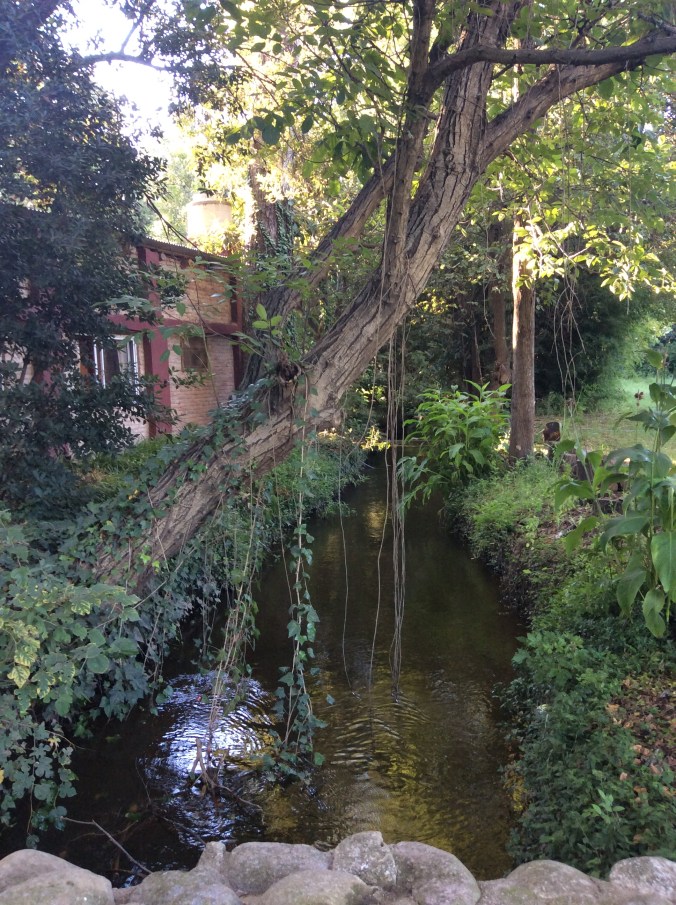
IMG_2735Because the area around New Orleans receives 60 inches of rain a year, the landscape everywhere is lush.  This is one of several pools at the plantation.
IMG_2736

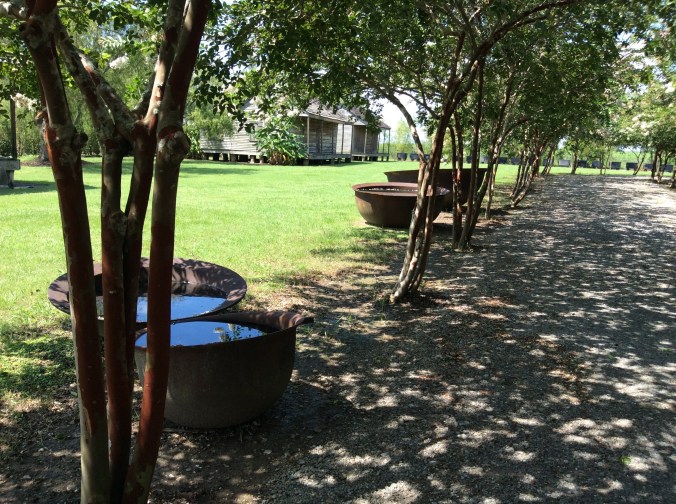
These containers cooked the sugar cane.  Starting with the largest, the cane was boiled repeatedly until it cooked down and poured into increasingly smaller containers.  This was especially dangerous work due to the fires, the heat, and the boiling sugar cane. Sugar cane production was much more dangerous than cotton which was grown farther north in Louisiana.  The cane itself was cut with large machetes and the edges of the cane are also sharp.  Many people were severely injured.  The life expectancy of a sugar cane slave who worked in the fields or cooking the cane was approximately ten years from the time he or she went to work, often as young as ten. Although field slaves had a much harder life in terms of labor, they had less exposure to their owners and their families and therefore, in some ways, more freedom to talk and interact. House slaves were constantly watched and the women especially subject to sexual abuse.
IMG_2737

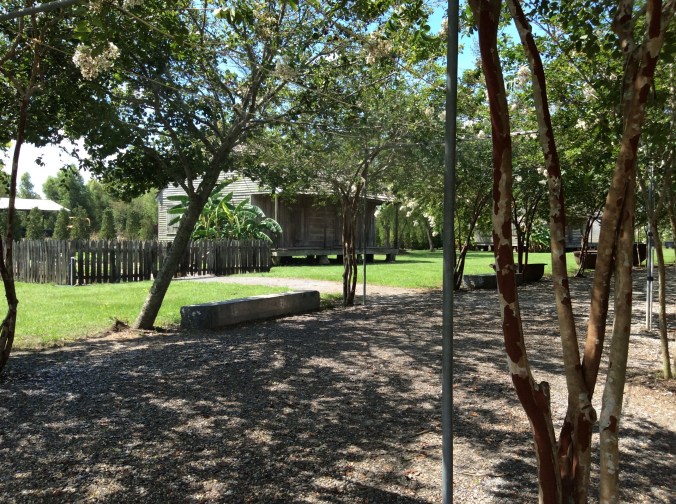
Slave cabins like this one contained four rooms.  Like the main plantation house, most buildings were built off the ground.  No levees existed then and the largest plantations were often built within sight of the Mississippi River and thus prone to flooding.
IMG_2738

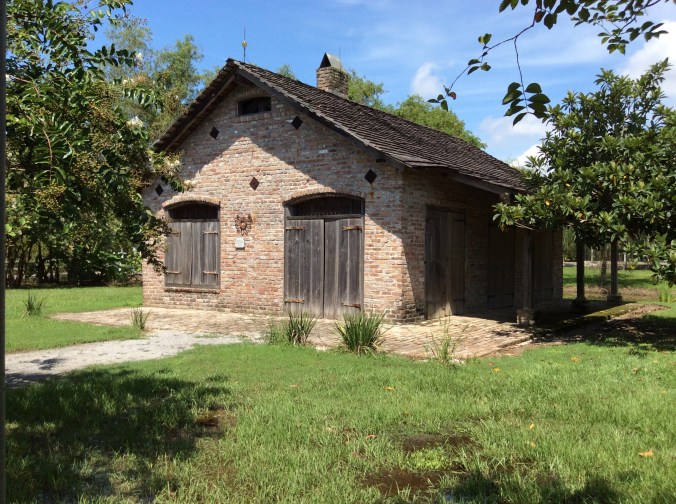
This building housed the foundry.  Skilled slaves, like blacksmiths, were very valuable and received better treatment, e.g. enough food.  When the movie, “Django Unchained” was filmed, part of the movie was filmed here because the adjoining plantation did not have a blacksmith shop.  The branding portion was filmed at Whitney Plantation.
IMG_2741

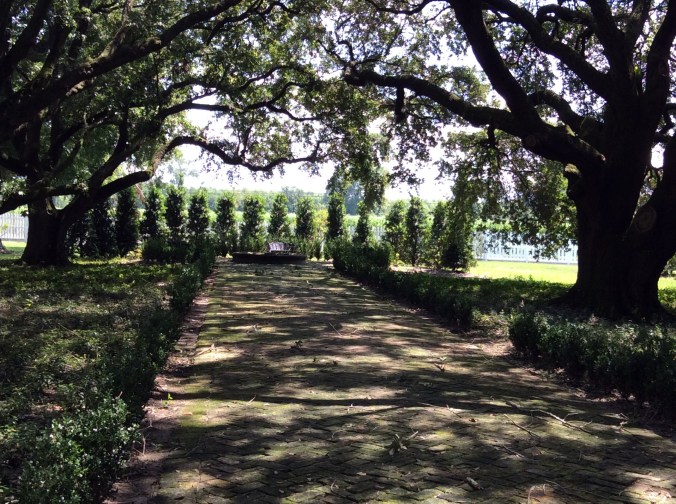
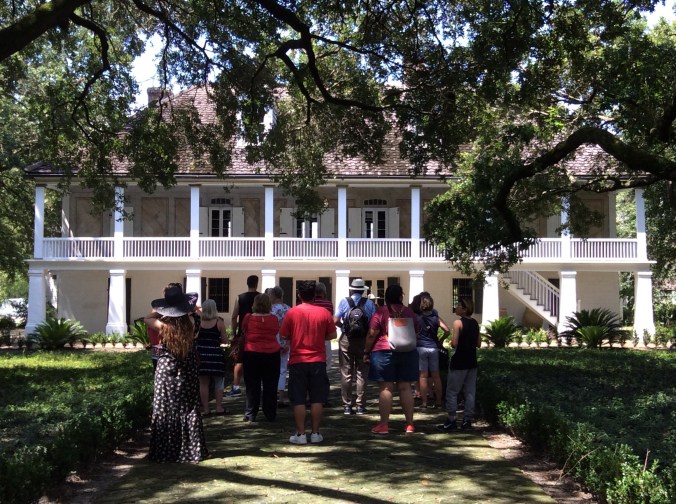
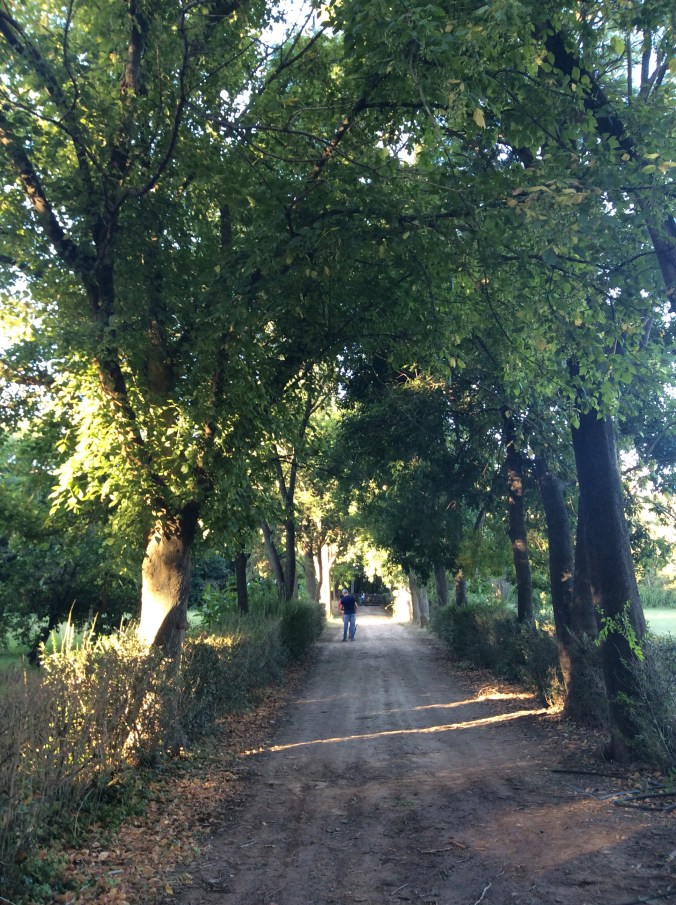
The walkway, looking from the front of the main plantation house, is lined with giant oak trees.  Before the levees were built, the Mississippi River could be seen from the house.
IMG_2742

Originally, there was no first floor due to the flooding.  Later, after it will built and used for dining, an office, and a living area, whenever the floods came, the slaves were required to carry everything to the second floor until the water subsided. Then they would clean the first floor of mud and debris and return the furniture there.  Whitney Plantation possesses some unique characteristics, e.g. finely painted European style ceilings.

Cooking was not done inside the main house at any of the plantations due to the heat and fire danger. The cook, another skilled and valuable slave, was required to know how to cook various popular cuisines typical of the area, e.g. creole, European–French, Spanish.
IMG_2743

The various ferns and mosses growing from the limb of this large oak trees demonstrates the lushness and humidity typical of this area and why it is still used for sugar cane production.
IMG_2744

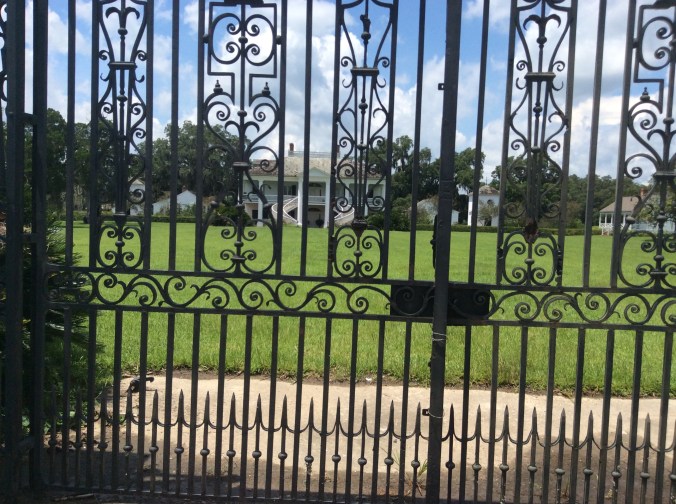
A short distance down the road is Evergreen Plantation where the main portion of “Django Unchained” was filmed.  It, too, still produces sugar cane and a family lives here.  Tours are available as well.


Rita Blanca National Grassland


Today, three of us drove up into the northwest corner of the Panhandle of Texas to visit this national grassland which adjoins the Kiowa National Grassland in New Mexico.  The two grasslands together equal more than 200,000 acres.  Originally, created after the Dust Bowl in an attempt by the government to mediate the destruction caused by the giant Dust Bowl storms, the grasslands are now managed by the US Forest Service.  The US acquired much of the land when its owners gave up and left the land owing money to banks.  As a consequence these national grasslands are interspersed with privately owned grassland.  Ranchers, some of whom refer to themselves as grass farmers, can lease this land and graze it along with their adjoining property.  Moderately grazed land often supports a more diverse wildlife and plant population than overgrazed or ungrazed land.

To reach the Rita Blanca we drove past Dalhart, Texas, and turned on a Farm to Market road which led to an area with camping and picnic tables plus restrooms.  Campers and picnickers must bring their own water.  The only trees are those deliberately planted in days long past.  We saw or heard many birds there, including orioles.  Below is the entrance to the Thompson Grove camping and picnic area.

IMG_2719

After a comprehensive briefing from the park ranger, a wildlife biologist, and a range specialist, we took a hike across the grassland.

IMG_2721

While this may look like a boring green sea to some, upon close inspection, this land teams with many species of grasses and flowers.  Flowers I saw today include Fineleaf Woolly-White, which is not white but bright yellow, Prairie Zinnia, Broomweed, Sundrops, Engelmann Daisy, Mexican Hat, Winecup, Tansey Aster, all of which I have at my own place an hour and 1/2 away.  However, I saw two flowers I have never seen before, White Pricklepoppy and a native Morning Glory which has huge hot pink flowers. While the Pricklepoppy has spectacular, large white flowers with gold centers, the plant looks like a very prickly grayish thistle.

Although I knew some of the species of grasses there, I could not identify the others.  However, the park ranger knew them all.  I might remember some with the help of a book.  Many I have around my land but still cannot identify all of them.  I do know blue grama, side oats grama, buffalo grass, and a few others.

Many grassland and wildlife research projects done there produce useful information.  One current project deals with seismic activity.

If you are driving cross country anywhere near Dalhart, Texas, or Clayton, New Mexico, take a short break and head to these grasslands.

IMG_2720


You, yes, you can make a difference


Many tell me or believe that one person, him or herself, cannot do much to change the world, to make a difference.  This short movie tells about a man in northeastern India who transformed a wasteland into a forest by planting one tree at a time over many years.  Now elephants, deer, and even tigers live there.  Take a look for yourself.  Look for the youtube video called “Forest Man”.  The web address is :

It won awards at several different film festivals including Cannes.


Top predators like wolves, bears, lions and tigers have declined dramatically around the world over the past century


Some parts of Eastern Europe have worked at figuring out how to balance saving predators and protecting farmers and herders. Spain has programs to reimburse herders.

Rachel Tilseth's avatarWolves of Douglas County Wisconsin Media

Conservationists widen toolkit for predator management

Source:Berkeley News
By Brett Israel, 12/13/16

Top predators like wolves, bears, lions and tigers have declined dramatically around the world over the past century. One major driver of these declines is retaliatory killing by people following predator attacks on domestic livestock. This lethal approach to predator management is increasingly controversial not only because of ethical concerns, but also the role predators can play in healthy ecosystems. A new UC Berkeley study shows that many non-lethal methods of predator control can be highly effective in protecting livestock from predators and in turn, saving predators from people.
A tiger drags a cow at Jennie Miller’s study site in India

The Berkeley study examined 66 published, peer-reviewed research papers that measured how four categories of lethal and non-lethal mitigation techniques — preventive livestock husbandry, predator deterrents, predator removal, and indirect management of land or wild prey…

View original post 752 more words

Romania bans trophy hunting of brown bears, wolves, lynx and wild cats


Wolf is my Soul's avatarWolf Is My Soul

October 5, 2016  Source

Unexpected move reverses a trend that has seen increasing numbers of large carnivores shot by hunters each year since Romania’s accession to the European Union.

In 2016, the largest hunting quotas yet gave hunters the mandate to shoot 550 bears, 600 wolves and 500 big cats over 12 months. Photograph: Radu Sigheti/Reuters

Romania has banned all trophy hunting of brown bears, wolves, lynx and wild cats in a surprise decision that gives Europe’s largest population of large carnivores a reprieve from its most severe and immediate threat.

The move on Tuesday reverses a trend which has seen the number of large carnivores being shot by hunters grow year on year since Romania’s accession into the European Union in 2007. In 2016, the largest hunting quotas yet gave hunters the mandate to shoot 550 bears, 600 wolves and 500 big cats over 12 months.

Over the…

View original post 771 more words

Seed Banks–the Genetic Future


IMG_0877

Most of us think minimally about our food, where it comes from, the seed.  With a rapidly growing world population the genetic diversity of the seed from which we grow food becomes increasingly crucial.

The United States contains 20 gene banks:  three in California, one in each of the following states, Oregon, Washington, Idaho, Colorado, Hawaii, Texas, Iowa, Arkansas, Illinois, Wisconsin, Georgia, Ohio, New York, Maryland, Florida, and Puerto Rico and Washington D.C.  This system holds about 600,000 varieties.  The seed bank in Ames, Iowa, contains 53,000 genetic lines of maize (corn) and other crop seeds–1400 species.  The Illinois bank grows more than 2000 varieties of seeds per year.

Maintaining genetic integrity can be difficult.  Some crops like corn are particularly difficult because corn easily cross pollinates.  Researchers use these seeds to develop certain types of new varieties, e.g. varieties more resistant to disease, to drought.

Gene banks remain crucial to the future of agriculture and food even with the current controversies over GMO.  Some farmers note that any hybrid whether deliberate or by accident is genetically modified.  These modifications have existed since the beginning of agriculture.

A possibly more dire issue is the lack of wild relatives of key crops.  Global gene banks lack many of these.  The online journal, “Nature Plants” notes 1076 wild relatives of 81 crops were insufficiently safe-guarded.  Up to 300 species could not be located in any gene bank.  The lack of tropical crops in gene banks is particularly worrisome.  This is important for the future of agriculture and the world food supply.  Seed banks create safety nets for the future.

Perhaps the most remote and “safe” bank lies in Norway 800 miles from the North Pole.  The Svalbard Global Seed Vault can store seed for 25 years without power.  This vault stores seeds at -18 C and contains 825,000 crop varieties.


Note:  the photo is corn close to the Nile Falls near Bahir Dahr, Ethiopia


Slow and Steady Wins Big on a Cocoa Farm in Costa Rica


This illustrates how it is possible to farm profitably and sustain the environment including wildlife.

Ethiopian Journey–Ancient Churches of Lalibela


In the 12th century the king of Ethiopia decided to build a New Jerusalem.  Eleven churches were carved out of solid rock on the mountain top in the village of Lalibela.  A UNESCO World Heritage site, these churches remain intact and in use.

IMG_0428

They were all carved from the rock top of the mountain down into the earth so that they remain invisible unless the person is only a few feet away.  This protected them from the vision of potential invaders, usually Muslims from what is now Sudan.  The above is probably the most photographed of these churches and stands separate from the others.

IMG_0429

My friend is standing near where the stairs lead down to the bottom where visitors and worshippers can enter the church.  Visiting all these churches in one day is not an activity for the faint of heart or for one terrified of heights.

IMG_0401

This is the first church we visited.  It still mystifies many as to how such incredibly intricate structures could me carved by hand out of solid stone.  Even these columns are carved out of the rock.  The “official” Ethiopian Orthodox Christian story relates how angels helped the builders.

IMG_0402

This and most of the other churches are connected by “waterways” where in the rainy season a sophisticated system of drainage keeps all of them from flooding and makes it possible for visitors and worshippers to walk along from church to church.

IMG_0407

Everything in the Christian churches in Ethiopia  symbolizes something related back to Jerusalem and the Bible.  Even though the guide explained it all in detail, keeping up with all the symbolism proved a daunting task.  Notice the swastikas.  They are ancient symbols of the eternal circle of life and death.  Hitler turned them backwards and into a totally different meaning.  There are also many different styles of crosses there, two of which can be seen in the windows of this church.

IMG_0408

This is a fertility pool.  In the past a priest got in the water–it is very deep–with a woman who could not conceive and bless her in the water.  At one point when it began to fill too much, they cleaned out the bottom and found many treasures buried there, apparently dumped into the pool to protect them from enemy invaders.
IMG_0412

The inside of the churches are intricately carved and sometimes painted.

IMG_0417

Two types of basalt exist on this mountain, soft and hard.  Churches carved out of the soft basalt have begun to deteriorate and as a consequence are covered.  As can be seen here, people still come to these churches to pray and attend services.

IMG_0419

Our guide lead us from church to church through these narrow passageways which are, as previously mentioned, used to drain water away from them in the rainy season.  If Ethiopia had a national color, it would be white.  It is not only worn to go to church and for religious purposes but in daily life as well.  It mystifies me as to how they keep whites so very white.
IMG_0430

The slit dug in the rock is part of the system of drainage.  The grass in the foreground grows out of a pool of holy water.  While we were there, a boy filled a plastic bottle with the water and left.

IMG_0435

St. George and the dragon are everywhere, not only in churches but also on beer.  He is the patron saint of the country, symbolizing the triumph of Christianity over paganism as symbolized by the dragon.

IMG_0448

The carving in many of the churches reveal a sophisticated knowledge of how to work in stone.  It is difficult to believe that this was carved by hand downward into solid basalt centuries ago.

IMG_0491

The road to Lalibela is rather daunting, climbing  higher and higher with no guard rails, nothing.  As you can see from this photo, patchwork quilt  fields cover even the mountainsides.


To learn more about Lalibela, see detailed information and explanations of their River Jordan and other religious symbolism, go to my blog posts from August 2014.

Ethiopian Journey–From Addis Ababa to Debre Birhan


Addis is the second highest capital in the world.  Only La Paz, Bolivia, is higher.  To a large extent, altitude determines climate in Ethiopia.  Addis and the surrounding area, much of which is high altitude farmland, receives a lot of rain this time of year and looks totally unlike what a lot of people think of when they hear the word Ethiopia–not desert but rather miles and miles of green.

IMG_0248

IMG_0249

We had not driven far from Addis when we crossed a river, an area of which is considered healing.  Many people had come for priests to bless them and to experience the healing power of the water.

IMG_0246

I saw only three tractors in ten days of criss crossing farmland.  Why so few?  One reason is rocks.  Many of the fields remain rather full of rocks in spite of many having been removed.

IMG_0258

Therefore, they farm the “old fashioned” way; horses or cattle pulling plows with a human behind.

IMG_0251

Houses in the villages in the farming areas demonstrate old ways alongside new.

IMG_0257

IMG_0259

Winnowing the way we did in the USA a century ago.

IMG_0253

IMG_0261

Much of the farmland is a picturesque patchwork quilt of browns and greens.

IMG_0266

Before dropping down to lower country, we drove by Menelik’s Window.   The drop off here is steep and far.  I did not go near it–I had not yet become used to the endless drop-offs or even realized that I would need to do so.  This is one of four places in Ethiopian where you can see gelada baboons.  They are extinct elsewhere. Menelik was an Ethiopian emperor.  This “window” allows one to look from the high country for miles and miles to the landscape beyond.

IMG_0262

The large tufts of grass provide food for the gelada which are grass eating herbivores, the last of the grass eating primates.  All others are extinct.  This same grass is used by the locals for roofing material so boys stay in these areas all day chasing off the baboons.

IMG_0264

To keep themselves busy they weave woolen baskets and hats to sell which they display in the grass.

IMG_0267

This ten year old boy happily donned the hat he had made.  I bought it for my grandson who was the same age when I took the trip.

IMG_0268

Except for the different vegetation, driving down the mountain looked a lot like driving through Colorado.

IMG_0271

IMG_0272

IMG_0276

Down from the mountain the landscape appears quite different and considerably drier.  We drove through several smaller towns on our way to Debre Birhan where we stayed the first night.

IMG_0279

Driving in Ethiopia requires navigating around animals.  Everyone drives their cattle, camels, horses, all livestock down the road whenever possible.  The roads are generally very good.  Many, built by the Italians, have stood the test of decades.

IMG_0282

Along the road we saw many of these “apples”.  My friend told us how they played with them as a child.  However, the adults all warned the children not to touch their eyes when they did–it will make you blind.  They are called Apples of Sodom–so many things in Ethiopia have symbolic meaning.

IMG_0283

These fruit could be seen all along the road and even on the road.  After driving through this drier area we rose above a huge valley with miles and miles of grass.

IMG_0285

A semi-nomadic group brings their immense herds of cattle here in the rainy season to graze.  When we drove further on above the valley, I saw the first tractor working a field as big as this grazing land.