Religion, Politics, and the RNC: Separation of Church and State Anyone? by Marie Cartier


This blog post provides a number of well thought out issues and arguments to ponder regarding the upcoming election. Somehow a civil discourse needs to occur but sadly seems less and less likely.

Marie Cartier's avatarFeminism and Religion

MarieCartierforKCETa-thumb-300x448-72405When you read this Feminism and Religion community, we will have just finished the televised portion of the Republican National Convention (RNC), which as I write this Wednesday, July 20 has announced that Donald Trump is the presumptive nominee for president of the United States.

Last night the first night of the RNC we witnessed the emerging platform of the party going far to the right.

From the New York Times:

Republicans moved on Tuesday toward adopting a staunchly conservative platform that takes a strict, traditionalist view of the family and child rearing, bars military women from combat, describes coal as a “clean” energy source and declares pornography a “public health crisis.”

The platform demands that lawmakers use religion as a guide when legislating, stipulating “that man-made law must be consistent with God-given, natural rights.”

It also encourages the teaching of the Bible in public schools because, the amendment…

View original post 1,180 more words

“All Children Are Our Children” by Carol P. Christ


This is a rather long read the gist of which is this: what if “we were taught to love and nurture and be generous to others” and these were the primary values in the world rather than the current values. “What if we were taught to open our hearts to the world? Would domination, violence, and war be possible?”

Carol P. Christ's avatarFeminism and Religion

Carol P. Christ by Michael Bakas high resoultion“All children are our children.” As I was posting my recent blog about the shooting of black men by the police, these words came into my mind with the force of revelation. At the time I was looking at a photograph of Philando Castile, taken at his place of work. Yes, I thought, my heart opening: “he is my child too.” This widening of the heart is at the center of the maternal values of ancient and contemporary matriarchal cultures around the world. It is a feeling some of us who were mothered well enough or who mothered children—including children not our own—carry within us. Is this the healing balm our world needs today?

Maternal  values?  So many of us turn up our noses at such a “gendered” term. Perhaps we were not mothered enough in our families of origin. Perhaps we still feel un-mothered. Perhaps we don’t want…

View original post 814 more words

Ethiopian Journey–Ancient Churches of Lalibela


In the 12th century the king of Ethiopia decided to build a New Jerusalem.  Eleven churches were carved out of solid rock on the mountain top in the village of Lalibela.  A UNESCO World Heritage site, these churches remain intact and in use.

IMG_0428

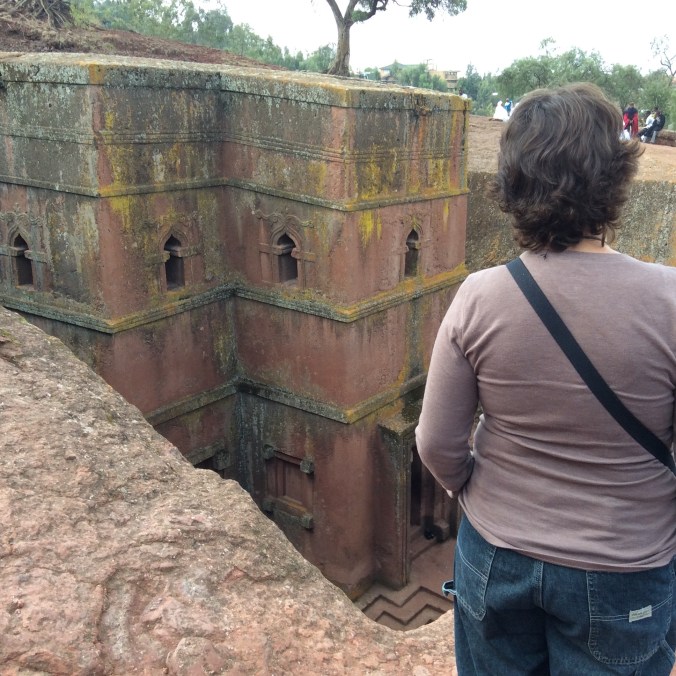
They were all carved from the rock top of the mountain down into the earth so that they remain invisible unless the person is only a few feet away.  This protected them from the vision of potential invaders, usually Muslims from what is now Sudan.  The above is probably the most photographed of these churches and stands separate from the others.
IMG_0429

My friend is standing near where the stairs lead down to the bottom where visitors and worshippers can enter the church.  Visiting all these churches in one day is not an activity for the faint of heart or for one terrified of heights.

IMG_0401

This is the first church we visited.  It still mystifies many as to how such incredibly intricate structures could me carved by hand out of solid stone.  Even these columns are carved out of the rock.  The “official” Ethiopian Orthodox Christian story relates how angels helped the builders.

IMG_0402

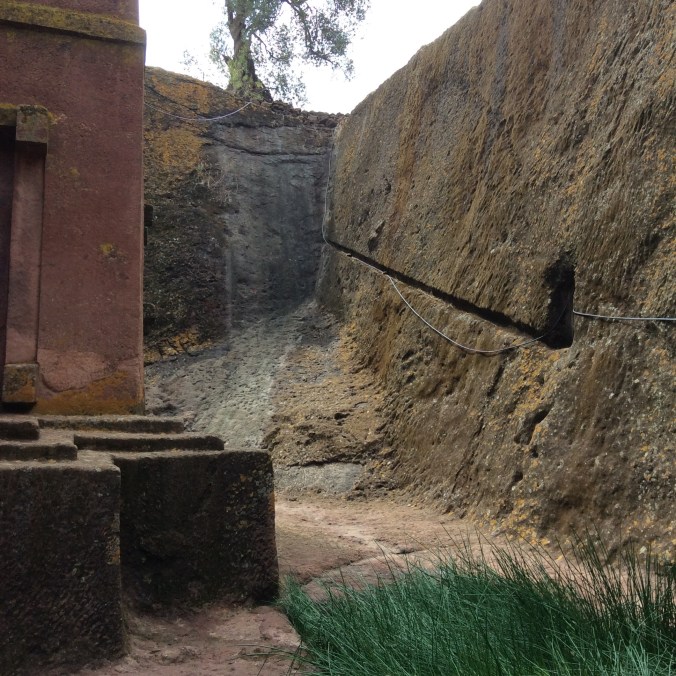
This and most of the other churches are connected by “waterways” where in the rainy season a sophisticated system of drainage keeps all of them from flooding and makes it possible for visitors and worshippers to walk along from church to church.
IMG_0407

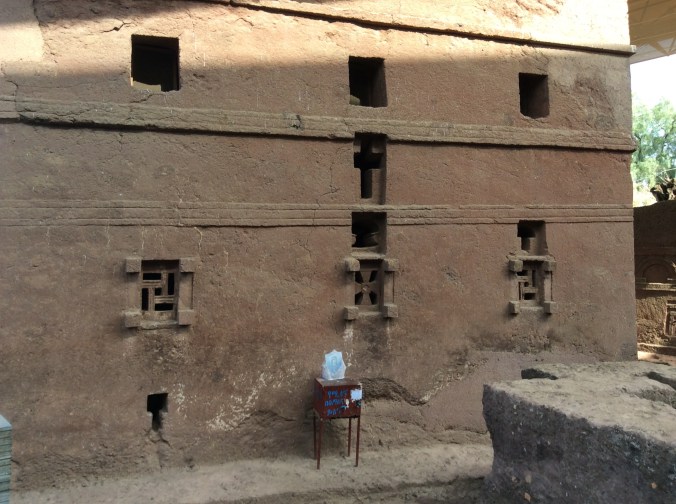
Everything in the Christian churches in Ethiopia  symbolizes something related back to Jerusalem and the Bible.  Even though the guide explained it all in detail, keeping up with all the symbolism proved a daunting task.  Notice the swastikas.  They are ancient symbols of the eternal circle of life and death.  Hitler turned them backwards and into a totally different meaning.  There are also many different styles of crosses there, two of which can be seen in the windows of this church.

IMG_0408

This is a fertility pool.  In the past a priest got in the water–it is very deep–with a woman who could not conceive and bless her in the water.  At one point when it began to fill too much, they cleaned out the bottom and found many treasures buried there, apparently dumped into the pool to protect them from enemy invaders.

IMG_0412

The inside of the churches are intricately carved and sometimes painted.
IMG_0417

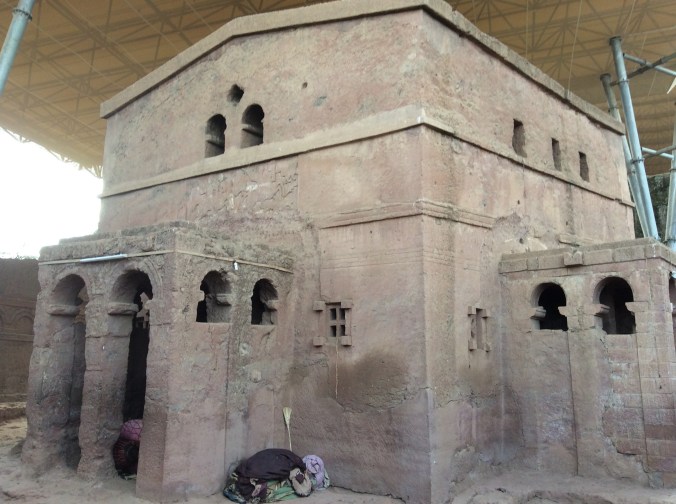
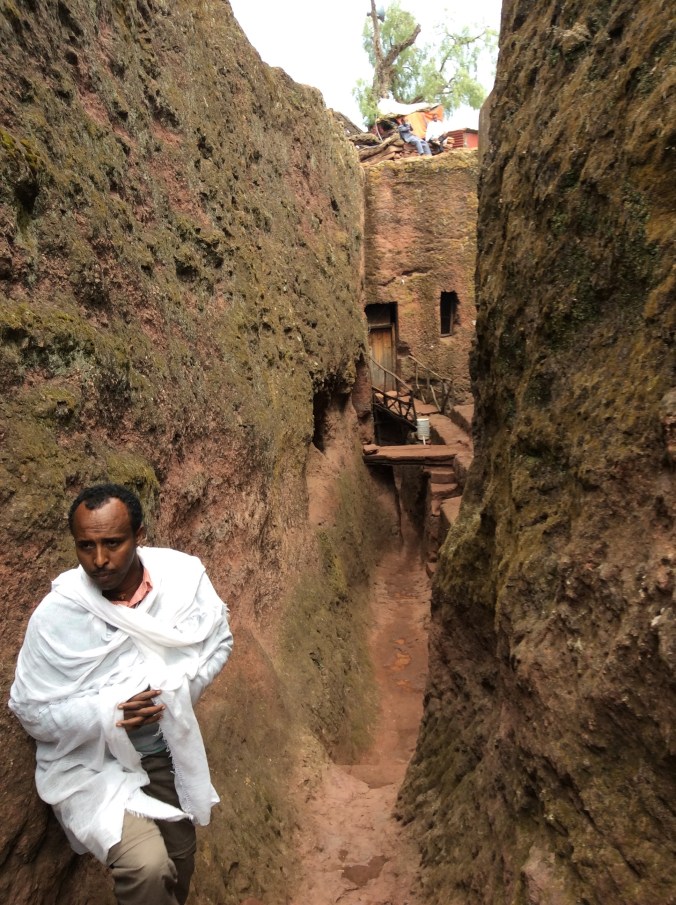
Two types of basalt exist on this mountain, soft and hard.  Churches carved out of the soft basalt have begun to deteriorate and as a consequence are covered.  As can be seen here, people still come to these churches to pray and attend services.
IMG_0419

Our guide lead us from church to church through these narrow passageways which are, as previously mentioned, used to drain water away from them in the rainy season.  If Ethiopia had a national color, it would be white.  It is not only worn to go to church and for religious purposes but in daily life as well.  It mystifies me as to how they keep whites so very white.
IMG_0430

The slit dug in the rock is part of the system of drainage.  The grass in the foreground grows out of a pool of holy water.  While we were there, a boy filled a plastic bottle with the water and left.
IMG_0435

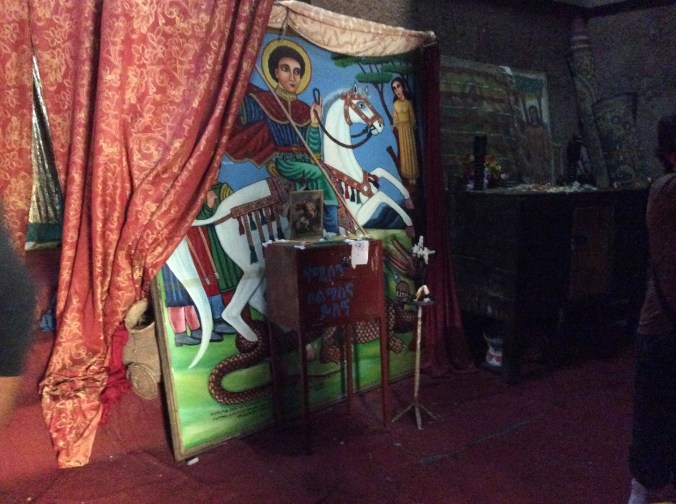
St. George and the dragon are everywhere, not only in churches but also on beer.  He is the patron saint of the country, symbolizing the triumph of Christianity over paganism as symbolized by the dragon.

IMG_0448

The carving in many of the churches reveal a sophisticated knowledge of how to work in stone.  It is difficult to believe that this was carved by hand downward into solid basalt centuries ago.

IMG_0491

The road to Lalibela is rather daunting, climbing  higher and higher with no guard rails, nothing.  As you can see from this photo, patchwork quilt  fields cover even the mountainsides.


To learn more about Lalibela, see detailed information and explanations of their River Jordan and other religious symbolism, go to my blog posts from August 2014.

Book Review by Mary Sharratt: ESTHER by Rebecca Kanner


I am reblogging this because it fits with my next book project: poems from the viewpoint of the ancient mother goddess and others from the viewpoint of women in the Bible.

Mary Sharratt's avatarFeminism and Religion

esther

We have been lost to each other for so long. My name means nothing to you. My memory is dust. This is not your fault or mine. The chain connecting mother to daughter was broken and the word passed into the keeping of men, who had no way of knowing. That is why I became a footnote, my story a brief detour between the well-known history of my father and the celebrated chronicle of my brother.

-Anita Diamant, The Red Tent

To a large extent, women have been written out of history. Their lives and deeds have become lost to us. To uncover the buried histories of women, we must act as detectives, studying the clues left from ages lost.

At its best, historical fiction can write women back into history and challenge our misconceptions about women in the past. Anita Diamant’s novel, TheRed Tent, became such an…

View original post 777 more words

Gratitude by Esther Nelson


Here in the USA I hear so much complaining even about trivia and so little gratitude. I have also come to realize that gender still defines so much, limits what girls in particular think they can accomplish; girls still try to, as this essay notes, “make nice”, often failing to accomplish all they can be. It remains remarkable and a puzzle, as this essay notes, how some people can rise above negative circumstances while it destroys others.

Esther Nelson's avatarFeminism and Religion

esther-nelsonI’ve been in the midst of moving for almost a year, yet am still not finished with that onerous task.  My youngest son and family recently moved into the place I’ve called home since 1980.  I bought a small house in the vicinity and have just settled in after spending four months painting, cleaning, and hauling box after box to my new dwelling.  At the same time, I’ve been traveling back and forth to New Mexico busy with painting, cleaning, and remodeling my “retirement house.”

I’m tired.  Am also experiencing emotions that I thought I was impervious to.  I never perceived myself as somebody having an attachment to place, but a month or so before moving out of my old home, I began to feel nostalgic.  There was so much I didn’t want to leave behind–the woods, birds nesting in bushes around the property as well as on top of…

View original post 965 more words

Garden of Eden Retold by Trelawney Grenfell-Muir


A delightful, grown-up retelling of the old story.

Trelawney Grenfell-Muir's avatarFeminism and Religion

Trelawney bio pictureToday, I came up with a less patriarchal Garden of Eden story:

Endelyn (age 7): “When I think of my soul, in my name “fire-soul,” I think of a powerful wind.”

Me: “That makes sense, since one of the names in the Bible for God/ess is Ruach, which means “breath” or “wind”, but we call it the Holy Spirit. God/ess is also symbolized by the other elements: fire, air, and earth – like when she shaped Eve and Adam out of clay.”

Endelyn, “What? I don’t remember that story.”

Me: “Oh, ok, I’ll tell you.” ……

Here’s the part where I froze momentarily, thinking “how can I tell my children that misogynist failed mentor story? how? how?” <deep breath>

View original post 787 more words

Feministing Sarah and Hagar by Vanessa Rivera de la Fuente


This resonates with me in part because I am working on a set of poems written from the viewpoint of these and other Biblical women rather than from the viewpoint of the males who “wrote” the Bible.

Vanessa Rivera de la Fuente's avatarFeminism and Religion

sarah_hagarOne story that has marked my life as a feminist is that of Sarah and Hagar. This is a story of pain and enmity among women under patriarchy that despite its age, is still relevant to illustrate the negative effects of the androcentric socialization. But it can also hold an inspirational feminist reading that leads us towards a reflection on the amazing possibilities of a shift in the way we women look at each other.

Feminism is a political practice, an ethics for living based in an option for women. It is not or should not be a Diploma, a chair where to work from 9:00am to 5:00pm, or an excuse to act from our own privileges against other women. In private and in public, in academia or in the street, in sexual, cultural, intellectual and religious affairs, a feminist is a feminist, without excuses or regrets.

This year I was part of…

View original post 867 more words

Four Reasons We Need To Reclaim The Power of the Divine Feminine Now by Mary Petiet


Why is the divine feminine so important? What does it promote that values others, our planet? This says everything I could have said myself.

Guest Contributor's avatarFeminism and Religion

Mary Petiet photo(Spoiler alert:  She’s already here)

The power of the divine feminine taps into the power of life. The power is accessible to everyone as the equal opportunity energy surrounding and connecting all living things. The power is ancient, and meditative practices such as yoga, which in Sanskrit means linking to the divine, can connect us to this power. When we make the connection, we find the balance we need to realize our highest selves, and through that balance we can realize the highest self of the larger society.  To reclaim the divine feminine, we need only remember, and as more and more of us remember, we heal first ourselves, and ultimately the planet.

1. She is the route back to the self.

In her mother aspect the divine feminine offers a route back to the self and She is all-inclusive. She embraces all of creation, men, women and nature, and we…

View original post 501 more words

Jesus and Easter


Yesterday, I learned several new aspects of the religious debates surrounding the teachings of Jesus, Christianity, Mormonism., and how Easter is viewed.  Mostly, it followed a discussion on a post about Jesus, Good Friday, and Christian politics.  Whether most modern Christians want to believe it, Jesus’ teachings were radical, revolutionary.  However, most modern Christians pay much more attention to the teachings of the misogynist Greek, Paul.  The debate centered on comments after this particular post about the politics of Christianity.

It centered on Mormon beliefs about Easter.  According to the comments, Mormons do not use crosses because they focus on the teachings of Jesus and his life.  They use these teachings and his life as a guide.  I thought to myself:  what a good idea.  If the whole world followed his teachings, the world would be a much better place full of peace, equality for all, not just the powerful few, tolerance, understanding–the list is long.

The contention of many of the so-called Christians commenting is that true Christianity focuses on the death of Jesus and his subsequent rising from the dead, that what matters is that he died for their sins, and rose on the third day, that Mormons are not Christians because they focus on his life.  Really??  Not only did I find this information new–and perhaps this is what many Christians believe–but astonishing.  Although my family celebrated Easter in a big way, I was always taught that Jesus’ teachings held the center of belief.

I will admit that although I grew up in a mainstream Protestant, Christian denomination, I no longer consider myself a Christian.  I firmly think (notice I did not use the word believe) the world would be a much better place if everyone followed the teachings of Jesus!!!!  Religion, as most practice it, is ruining the world.  Perhaps if everyone focused on Jesus’ teachings instead of arguing over who is right, we could attain some sort of mutual respect and peace.  As Jesus taught:

-respect one another

-love one another

-share

-treat others as you hope to be treated

May your day be filled with joy and peace!!!


The Nine Maidens by Deanne Quarrie


In my quest to learn something new daily, this fulfilled today’s goal. I thought I knew quite a bit about the ancient goddess religion but apparently not.

Deanne Quarrie. D. Min.'s avatarFeminism and Religion

Deanne Quarrie, D.Min.Many years ago, in the group of women I work with, we all had a marvelous epiphany. It was spontaneous combustion that fueled our collective desire to learn about the “Nine Maidens.” It was as though some unknown force was driving all of us to seek out and to know.

I would like to share what we collected:

“… My poetry, from the cauldron it was uttered. From the breath of nine maidens it was kindled….”
“… ygkynneir or peir pan leferit. O anadylnawmorwyngochyneuit.”
(Preiddeu Annwn or The Spoils of Annwyn from ‘Llyfr Taliesin’ 9th to 12th c. CE.)

Anadyl = breath
Naw= nine
Morwen= maiden

These lines are from the poem, the Spoils of Annwyn, where Arthur and seven knights raid the rotating island fortress of Caer Sidi in the Otherworld for possession of the Cauldron of the Head.

View original post 1,824 more words