My Ethiopian Journey–Simien Mt. Natl. Park


No way was I prepared for these mountains.  Do you think of numerous peaks over 13,000 feet when you think of Ethiopia?  Probably not. There are even a few over 14,000 feet.  The whole area is often referred to as the Roof of Africa.
IMG_0573

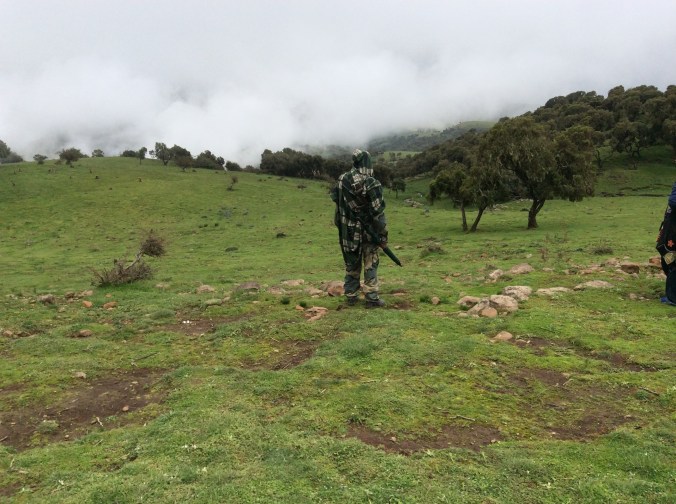
There is only one road into the park.  To get in, a tourist must stop at the park office, sign in, passport number, address, etc.  Plus, you will be assigned a guard and a guide.  Our guard in the photo above carried an assault rifle.  No, it is not to protect people, it is to protect their rare animals from people, from poachers.  Wonder why he is wearing all these clothes?  It is cold at 12,000 feet even if you are near the Equator.
IMG_0577

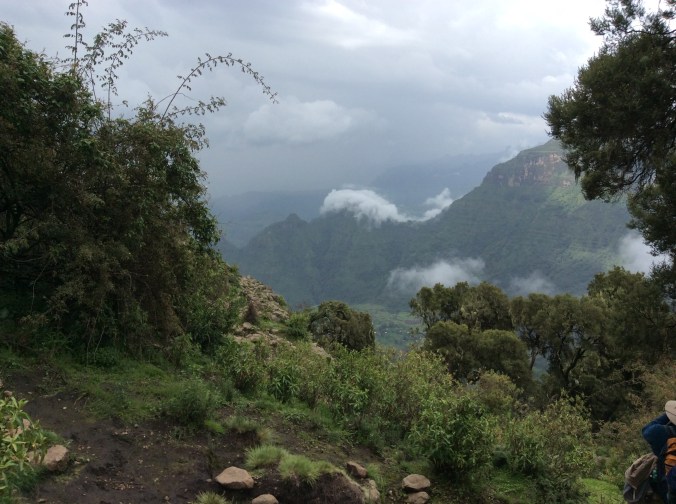
The drop offs are terrifying, thousands of feet, the vistas endless.  Even though I have lived and been all over the Rocky Mountains and been to the Himalayas in both Kashmir and Nepal, I have never seen anything like these mountains for beauty, green, and endless vistas.

IMG_0579

My friends near the cliff are much braver than I.  In the foreground stands our guide, Michael, who spoke excellent English and was super funny.  He had us laughing all the time. People live and farm in these mountains–if you look closely in the middle of the photo, you can see fields.  However, the government is slowly relocating people in order to make the park a refuge for rare wildlife.

IMG_0582

The above photos were all taken on a hike early one morning.  Everything was wet because it was either raining or misty or we were in the clouds.

IMG_0592

Because I kept slipping and sliding, I decided not to walk along the cliff with my friends and the guard, who spoke the same Ethiopian language as my friend.  Michael and I took off across a meadow and suddenly here we were in the middle of all these gelada baboons, who paid no attention to us at all.  They were very afraid, however, of a predatory bird that decided to fly over. How do I know?  They suddenly started “talking” to each other in frightened voices.  Experts now think these primates actually have a language and do talk to each other.  Gelada are the last primates that are herbivores.  They eat grass.  All other herbivorous primates are extinct.  Gelada live only in the high mountains of Ethiopia and no where else on earth, a reason for a guard.  At night they climb down the cliffs into caves to protect themselves from hyenas and leopards.
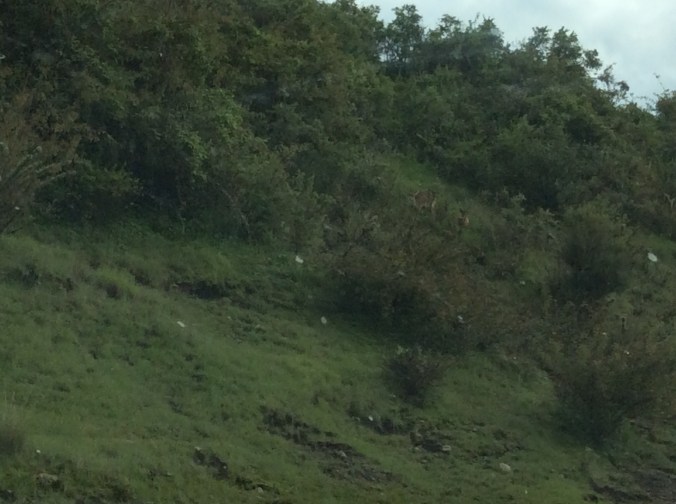
IMG_0603

If you look very carefully in the middle of this photo, you can see several duiker which are considered so common it seems no one thought to stop to really take a look so I took the photo as we drove along.
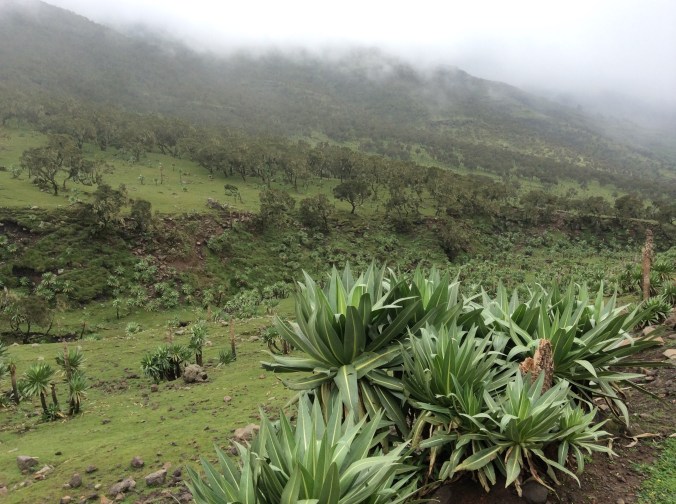
IMG_0614

Here we are above the timberline where some very unusual plants thrive.

IMG_0625

And some exceedingly rare animals whose camouflage makes them almost invisible until they move.  At this point we are about 14,000 feet just under one of the highest peaks in Africa.  Look carefully in the middle and you will see walia ibex.  People come from all over the world to see these endangered animals that live only in this park.  Sometimes the fog rolls in and no one sees anything.  We were lucky; we saw more than twenty of them. And then the fog rolled in.

IMG_0630

These giant lobelia thrive above timber line.  Some were considerably taller than I am.

IMG_0632

If you grow red hot pokers in your flower beds and think they are semi-arid flowers, think again.  Here they are growing wild.

IMG_0633

You can see red hot pokers in the middle of this photo by the stream.  These mountain streams run down to and often across the road, making the road a muddy mess.  Without 4-wheel drive and an expert driver we would have gone nowhere.  In fact, at one point we did have to stop because two stuck trucks blocked the road, one of which had a flat tire.

IMG_0635

The highest waterfall in Ethiopia is hard to hike to unless you are not at all afraid of heights.  My friends did hike there. Look a bit to the right of the groove through which the water actually falls.  You will see a sort of flat area.  It is only a few feet wide with a drop-off on each side.  Yes, that is where you hike.  When I saw this view, I was rather glad I decided to wait, look for birds, and chat with the driver.

IMG_0595

The fire pit at the highest bar in Africa is a very popular place on a cold night.  Even though we had beautiful rooms, with no heat at 12,000 feet it is not exactly warm.  Even the guides and guards were bundled up.  The only people who seemed toasty were Scandinavian tourists with their heavy wool sweaters.  The hotel staff gave us hot water bottles to put in bed with us at night.  Actually, it works.  Nevertheless, when you get up in the morning, it is really cold.

IMG_0609

The guards and guides live near the park.  We dropped off the guard here and watched him walk toward his house down where the trees are.  We dropped off the guide near his house in the town when we left the park.


Religion, Politics, and the RNC: Separation of Church and State Anyone? by Marie Cartier


This blog post provides a number of well thought out issues and arguments to ponder regarding the upcoming election. Somehow a civil discourse needs to occur but sadly seems less and less likely.

Marie Cartier's avatarFeminism and Religion

MarieCartierforKCETa-thumb-300x448-72405When you read this Feminism and Religion community, we will have just finished the televised portion of the Republican National Convention (RNC), which as I write this Wednesday, July 20 has announced that Donald Trump is the presumptive nominee for president of the United States.

Last night the first night of the RNC we witnessed the emerging platform of the party going far to the right.

From the New York Times:

Republicans moved on Tuesday toward adopting a staunchly conservative platform that takes a strict, traditionalist view of the family and child rearing, bars military women from combat, describes coal as a “clean” energy source and declares pornography a “public health crisis.”

The platform demands that lawmakers use religion as a guide when legislating, stipulating “that man-made law must be consistent with God-given, natural rights.”

It also encourages the teaching of the Bible in public schools because, the amendment…

View original post 1,180 more words

“All Children Are Our Children” by Carol P. Christ


This is a rather long read the gist of which is this: what if “we were taught to love and nurture and be generous to others” and these were the primary values in the world rather than the current values. “What if we were taught to open our hearts to the world? Would domination, violence, and war be possible?”

Carol P. Christ's avatarFeminism and Religion

Carol P. Christ by Michael Bakas high resoultion“All children are our children.” As I was posting my recent blog about the shooting of black men by the police, these words came into my mind with the force of revelation. At the time I was looking at a photograph of Philando Castile, taken at his place of work. Yes, I thought, my heart opening: “he is my child too.” This widening of the heart is at the center of the maternal values of ancient and contemporary matriarchal cultures around the world. It is a feeling some of us who were mothered well enough or who mothered children—including children not our own—carry within us. Is this the healing balm our world needs today?

Maternal  values?  So many of us turn up our noses at such a “gendered” term. Perhaps we were not mothered enough in our families of origin. Perhaps we still feel un-mothered. Perhaps we don’t want…

View original post 814 more words

Ethiopian Journey–Ancient Churches of Lalibela


In the 12th century the king of Ethiopia decided to build a New Jerusalem.  Eleven churches were carved out of solid rock on the mountain top in the village of Lalibela.  A UNESCO World Heritage site, these churches remain intact and in use.

IMG_0428

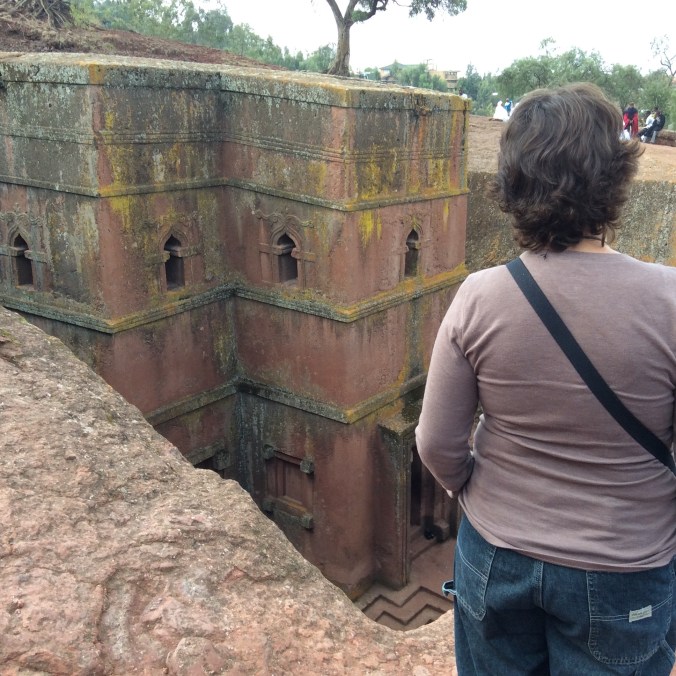
They were all carved from the rock top of the mountain down into the earth so that they remain invisible unless the person is only a few feet away.  This protected them from the vision of potential invaders, usually Muslims from what is now Sudan.  The above is probably the most photographed of these churches and stands separate from the others.

IMG_0429

My friend is standing near where the stairs lead down to the bottom where visitors and worshippers can enter the church.  Visiting all these churches in one day is not an activity for the faint of heart or for one terrified of heights.

IMG_0401

This is the first church we visited.  It still mystifies many as to how such incredibly intricate structures could me carved by hand out of solid stone.  Even these columns are carved out of the rock.  The “official” Ethiopian Orthodox Christian story relates how angels helped the builders.

IMG_0402

This and most of the other churches are connected by “waterways” where in the rainy season a sophisticated system of drainage keeps all of them from flooding and makes it possible for visitors and worshippers to walk along from church to church.

IMG_0407

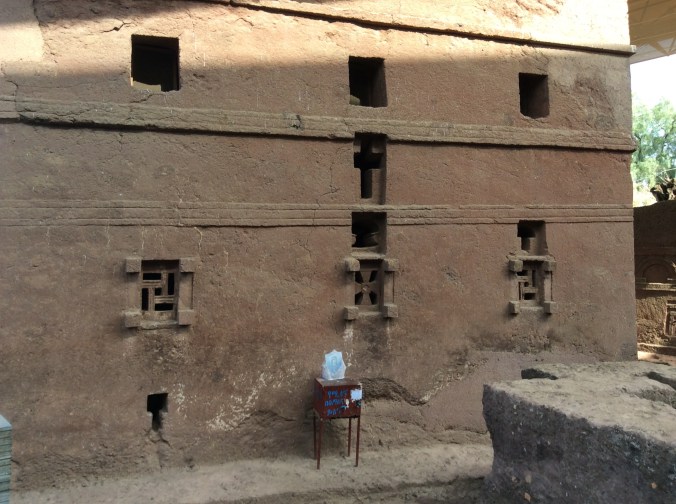
Everything in the Christian churches in Ethiopia  symbolizes something related back to Jerusalem and the Bible.  Even though the guide explained it all in detail, keeping up with all the symbolism proved a daunting task.  Notice the swastikas.  They are ancient symbols of the eternal circle of life and death.  Hitler turned them backwards and into a totally different meaning.  There are also many different styles of crosses there, two of which can be seen in the windows of this church.

IMG_0408

This is a fertility pool.  In the past a priest got in the water–it is very deep–with a woman who could not conceive and bless her in the water.  At one point when it began to fill too much, they cleaned out the bottom and found many treasures buried there, apparently dumped into the pool to protect them from enemy invaders.

IMG_0412

The inside of the churches are intricately carved and sometimes painted.

IMG_0417

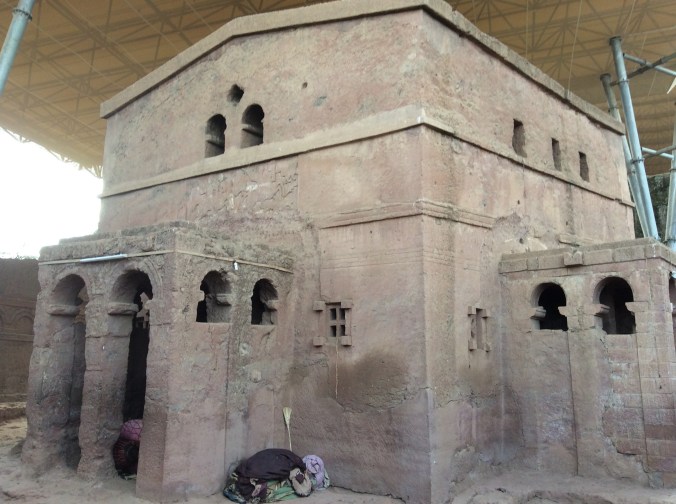
Two types of basalt exist on this mountain, soft and hard.  Churches carved out of the soft basalt have begun to deteriorate and as a consequence are covered.  As can be seen here, people still come to these churches to pray and attend services.

IMG_0419

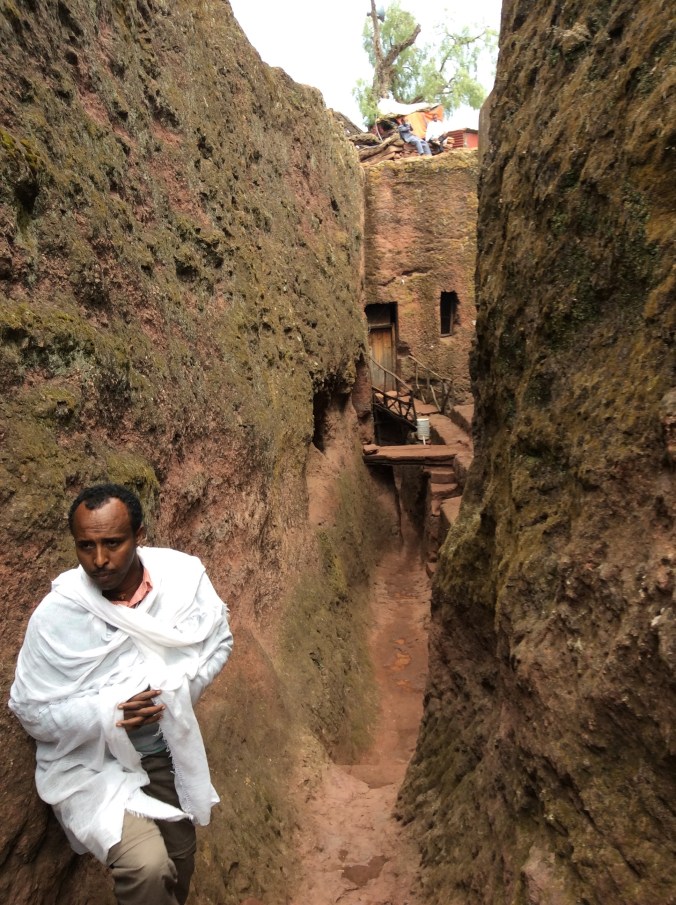
Our guide lead us from church to church through these narrow passageways which are, as previously mentioned, used to drain water away from them in the rainy season.  If Ethiopia had a national color, it would be white.  It is not only worn to go to church and for religious purposes but in daily life as well.  It mystifies me as to how they keep whites so very white.

IMG_0430

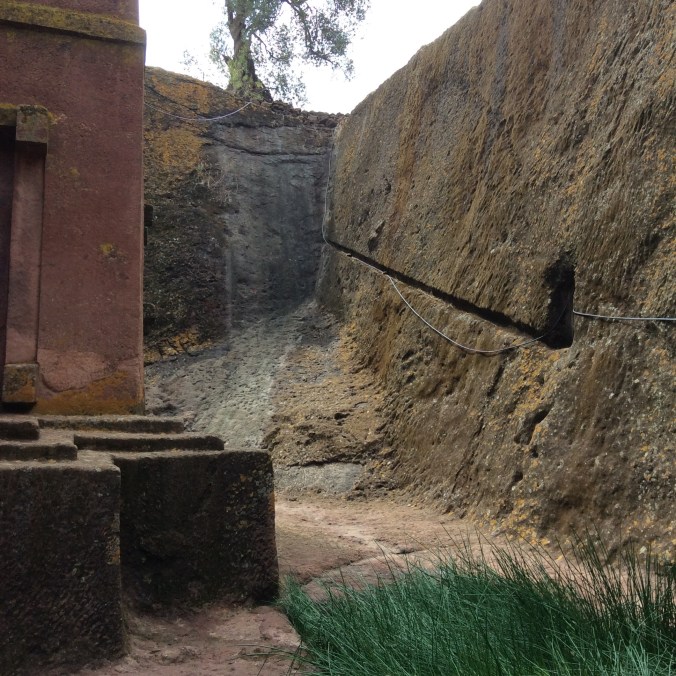
The slit dug in the rock is part of the system of drainage.  The grass in the foreground grows out of a pool of holy water.  While we were there, a boy filled a plastic bottle with the water and left.

IMG_0435

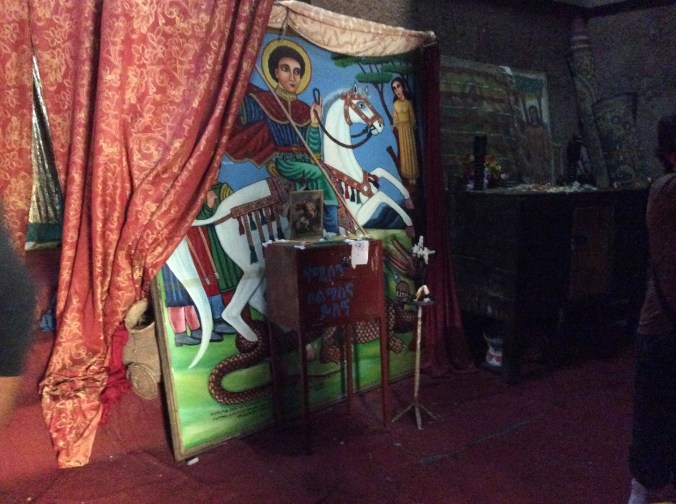
St. George and the dragon are everywhere, not only in churches but also on beer.  He is the patron saint of the country, symbolizing the triumph of Christianity over paganism as symbolized by the dragon.

IMG_0448

The carving in many of the churches reveal a sophisticated knowledge of how to work in stone.  It is difficult to believe that this was carved by hand downward into solid basalt centuries ago.

IMG_0491

The road to Lalibela is rather daunting, climbing  higher and higher with no guard rails, nothing.  As you can see from this photo, patchwork quilt  fields cover even the mountainsides.


To learn more about Lalibela, see detailed information and explanations of their River Jordan and other religious symbolism, go to my blog posts from August 2014.

Book Review by Mary Sharratt: ESTHER by Rebecca Kanner


I am reblogging this because it fits with my next book project: poems from the viewpoint of the ancient mother goddess and others from the viewpoint of women in the Bible.

Mary Sharratt's avatarFeminism and Religion

esther

We have been lost to each other for so long. My name means nothing to you. My memory is dust. This is not your fault or mine. The chain connecting mother to daughter was broken and the word passed into the keeping of men, who had no way of knowing. That is why I became a footnote, my story a brief detour between the well-known history of my father and the celebrated chronicle of my brother.

-Anita Diamant, The Red Tent

To a large extent, women have been written out of history. Their lives and deeds have become lost to us. To uncover the buried histories of women, we must act as detectives, studying the clues left from ages lost.

At its best, historical fiction can write women back into history and challenge our misconceptions about women in the past. Anita Diamant’s novel, TheRed Tent, became such an…

View original post 777 more words

Meet the Artist–the Writing Process and Poetry


This evening I am the artist at a local Meet the Artist event in Amarillo, Texas.  This event occurs bimonthly and past presenters have included musicians, photographers, and painters.  While I sing and take photos, my presentation will include reading poems from my book, “On the Rim of Wonder” and new, unpublished poems and talking about the writing process.  While I honestly thought few would be interested in the latter, several people have asked me specifically to discuss this.

Although I consider myself a writer, I do not sit down on schedule and write every day like many writers.  Inspiration, thoughts, come to me sporadically.  I write creatively exactly like I used to write college papers, magazine articles, etc.; I look like I am doing nothing, but in reality, all these ideas run through my head and finally gel.  Then I sit down and write it all at once.

The following is one of the poems from my book which I plan to read this evening:


Aging

Rage, rage against the dying of the light.”  Dylan Thomas

Custom says, “Age gracefully.”

Are they crazy, dumb.

Who wants to look

old

wrinkled

grey?

They lie.

All of them.

Who wants a broken mind

confused

unfocused

lost?

Shoot me!

Burn my bones.

Scatter them

in the desert sands

to feed

desert willow where

rattlesnakes lie

searching for shade.

Dealing with Despair by Carol P. Christ


This blog post also notes that cities and small towns use traffic tickets for minor violations to fund their governments. Immediately, I thought of a tiny town on the highway from Amarillo to Dallas that rakes in huge amounts of money this way. Then this morning I just read of another incident where police killed a black man who, instead of having a gun as police claimed, had his hands up in the air–from a surveillance camera nearby. The police officers in question had on body cameras–that footage has not yet been released. I am quite sure we will hear more about that one even if it has not been on the national news yet.

Carol P. Christ's avatarFeminism and Religion

Philando Castile, school cafeteria worker, killed driving while black Philando Castile, school cafeteria worker, killed driving while black

In a state of shock after the police shootings of Alton Sterling and Philando Castile, I turned to my Facebook feed, looking for community in my grief and hoping to make sense of what had happened. The statement, “He would not have been shot if he had been white,” referring to Philando Castile, appeared several times. The first time I saw it, I responded, “He would not even have been stopped if he had been white.” Think about it if you are white: how many times have you been pulled over by the police?

I can answer that question: in the United States, only once, and that was because I made a second illegal U-turn at the same stop-lighted intersection as a teenager.  The policeman issued me two tickets, stating that he had been willing to let the first offence go…

View original post 780 more words