Brilliant books by brilliant writers


In case you are looking for something new to read. I would add any book by Leslie Marmon Silko. My all time favorite book, “Storyteller”, written by her contains a story I must have read 50 times, “Yellow Woman”.

Samuel Snoek-Brown's avatarSamuel Snoek-Brown

And all these writers are women.

I spotted this list of 30 books by women in my Facebook newsfeed — the always-glorious Lidia Yuknavitch shared it — and I loved the first line of the intro:

“Let’s be real: You should be reading books, and books by women, every month of the year.”

Amen!

But yes, it’s Women’s History Month here in the states, and while Emily Temple, author of this listicle, claims, “That women have contributed just as much to our literary culture as men doesn’t even need to be said,” I think, sadly, it does. We need to say it again and again, not just this month but every month.

So read a bunch of books by women. And the ones you don’t finish? Well, there’s always next month, and the month after that, and the rest of the year.

Need a hint of where to start? There are a bunch…

View original post 352 more words

Apocalyptic Planet-Part Five: Civilizations Fall


Whether it is my innate ambition, something my parents instilled in me, or something else unknown, I try to learn something new every day.  Craig Childs starts this chapter of his book by talking about a Phoenix landmark.  Back when I travelled to Phoenix regularly, I knew this place as Squaw Peak.  Now its name Is Piestewa Peak.  The name change is probably a good thing.  I never knew before reading this how dreadfully pejorative the word squaw is.  Basically, it means Indian bitch as well as other things related to the privates of women.  All languages seem to possess an accumulation of dreadful words geared to putting women down one way or another.  Slang words for the private parts of a man rarely mean anything pejorative, at least not that I know of.  The new name, a Hopi name, a blessing word, is a word that calls water to this place.  Not a bad idea in Phoenix or most of the Southwest for that matter.

The name Phoenix fits.  Underneath modern day Phoenix, an ancient city lays buried, a quite sophisticated city with ball courts, temples, irrigation canals.  This city existed at least a thousand years ago.  Its inhabitants grew corn, cotton, beans, and agave.  Farmers, hunters, carvers, all sorts of artisans and merchants apparently lived there.  Now they are called Hohokam taken from an O’odham word meaning “ancestors”, the “ones who have gone”.  We find forgotten cities all over the world, Palmyra, Machu Picchu, Angkor Wat.  What causes these sophisticated civilizations to fall?  If you read a bit, look further, you find common themes:  environmental decay, resource depletion, conflict, disease, social problems.  Angkor Wat fell because it could not maintain its complex irrigation network.  Ur in Iraq fell because a drought caused its port to dry up.  Usually, the demise of particular civilizations occur over time, e.g.Rome.

Childs notes that human patterns often follow animal patterns, or at least mammalian patterns.  For example, when over population occurs, behavior changes.  Parental care and cooperation become replaced with aggression, violence, competition for resources, dominant behaviors.  These types of behaviors are particularly detrimental to females and the young without whom the society (or animal population) cannot replace itself.  Generally, in animal populations, when this occurs, reproduction slows for several generations and the imbalance corrects itself.  For humans, it is not so simple.  Hohokam bones indicate mass starvation and malnutrition.  Other civilizations, e.g. the Anasazi, seem to have disappeared without a trace.

Today, most of the world’s largest cities have immense infrastructures that keep them going, miles of underground sewage tunnels, water mains, etc.  Here in the US in our oldest cities, much of what we take for granted is very old and deteriorating.  New York City and Chicago have water main systems that some experts claim are near collapse or at the very best badly in need of repair.  Doubtless such conditions exist in old cities throughout the world, most of which are much older and larger than the majority of cities in the US.  Yet, they continue to prosper.  Have we passed a point when civilization cannot fall?

Childs completes this discussion by describing his visit with his wife to Guatemala.  They visited all the best known Mayan sites, visited with natives.  His wife managed to get invited to a Mayan fire ceremony, a renewal ceremony.  History books tell us the Mayan civilization is dead, ended.  But it is not.  The Mayan culture still exists.   At least six million still live in the Central America.  What would have happened to Mayan cities if the Europeans had not brought epidemic diseases and better fire power?  We will never know, of course, but no matter how many civilizations rise and fall, change continues and humans continue to inhabit the earth.

The new question is this:  can this planet we live on sustain the ever increasing numbers of humans who inhabit it??

The Story Circle Network


This month, January 2014, is the anniversary of my becoming a STAR BLOGGER with the Story Circle Network, an organization of women writers from all over the world headquartered in Austin, Texas.  This month, I became a member of their board.  Every other year they hold a conference in Austin, Texas.  This year the conference will be April 11-13 at the Wyndham Hotel in Austin.  You do not have to be a writer to attend the conference.  I attended for the first time nearly two years ago and it changed my life.  Yes, I had published a book previously, a book about preventing sexual harassment, co-authored with an attorney–written years ago when sexual harassment was a particularly “hot” topic in corporate America.  It was even translated into Spanish.  I had been paid to write technical manuals, paid to speak at a technical conference, that sort of thing.  I wanted to write something different, something creative.  This conference lead me to a new writing path for which I am very grateful.

The Story Circle Network provides all sorts of classes as well, memoir writing, travel writing, poetry, flash fiction, blogging, as well as editing services and advertising.  First, I took a blogging course and started this blog–that anniversary will be next month–two years blogging.

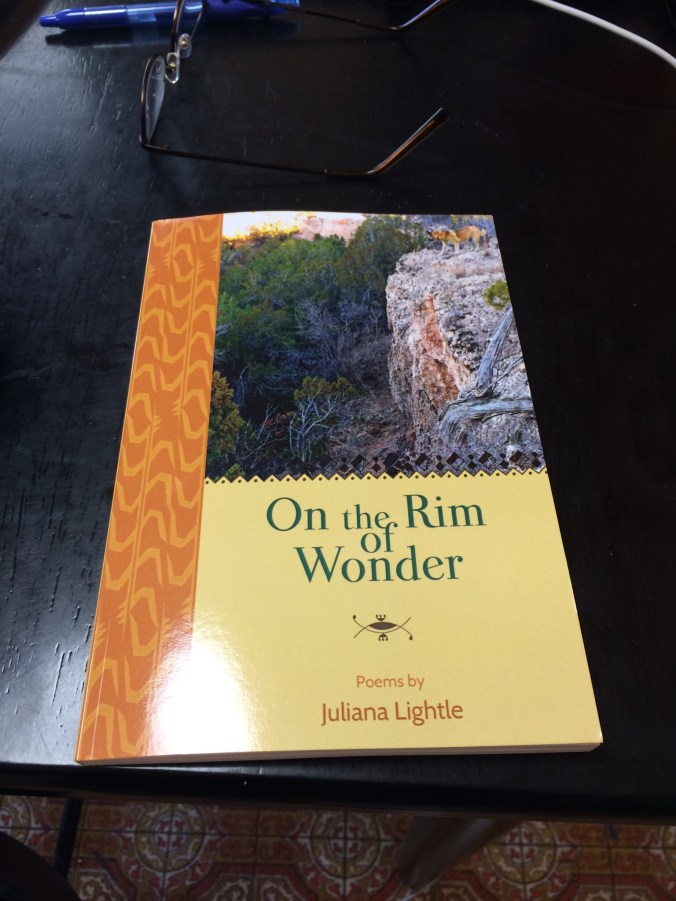
Now to the big news:  within the next couple of months my book of poetry, On the Rim of Wonder, will be published.  Some of the poems or versions thereof were first published right here on this blog.  Do you want to become inspired, change your life, meet fantastic women writers, visit Austin?  Attend this conference!!!  You will not regret it.

ad_scnconf

This Morning


It’s almost gone:

Time.

I must print poems for inspiration

before the website goes down.

The early morning sun filters

through windows, warms my back.

The printer prints.

I smear even complexion mask

over my aging face.

Where did my beautiful skin go?

Can I fix it?

Arid climate, too much suntime, what?

Must I admit to aging?

Must I see grey roots

beneath the dye?

I walk by the photo when I was 37.

What happened to that face?

I want it back!

The printer prints.

I look in the mirror, distressed.

In my family, I can expect

another twenty years.

Twenty years?

If I don’t do something to this face,

in twenty years…

The printer prints.

Fun, Food, and Community with Vegetarian Enchiladas


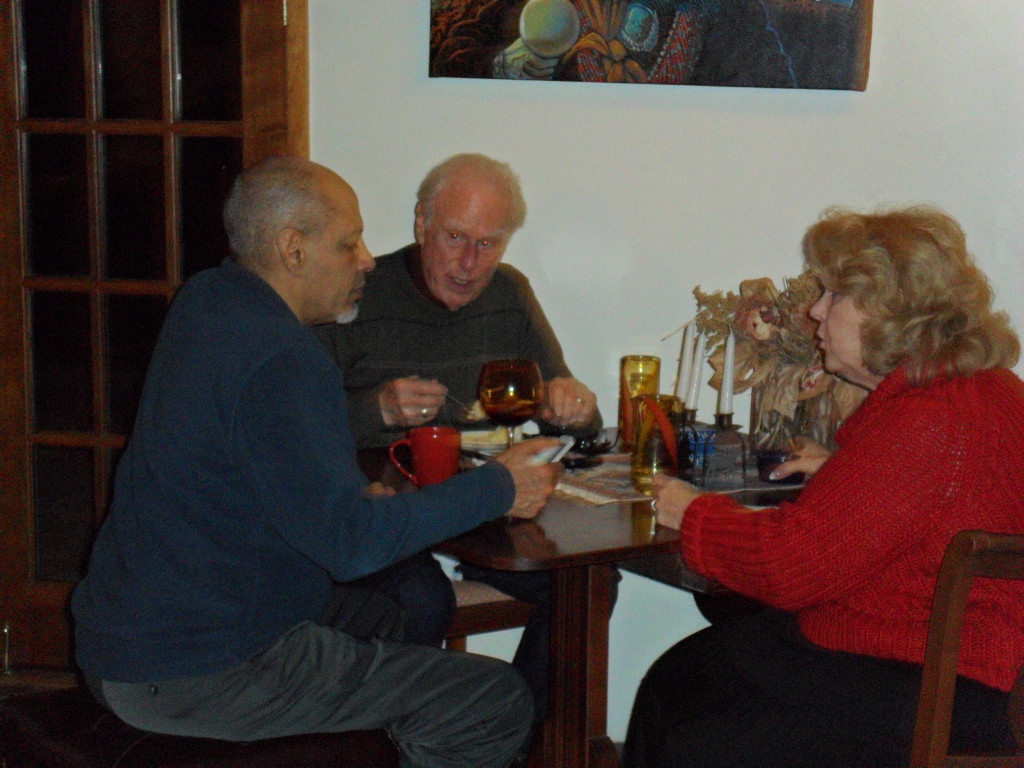
A couple of weeks ago, one of the blogs I follow, getsetandgo, created a post about “community” with photos of an Indian festival where all sorts of people come together to celebrate–a community.  She requested others post photos of their community events.  After reading her blog post,  I decided to tell about my attempt to start a monthly “community” :

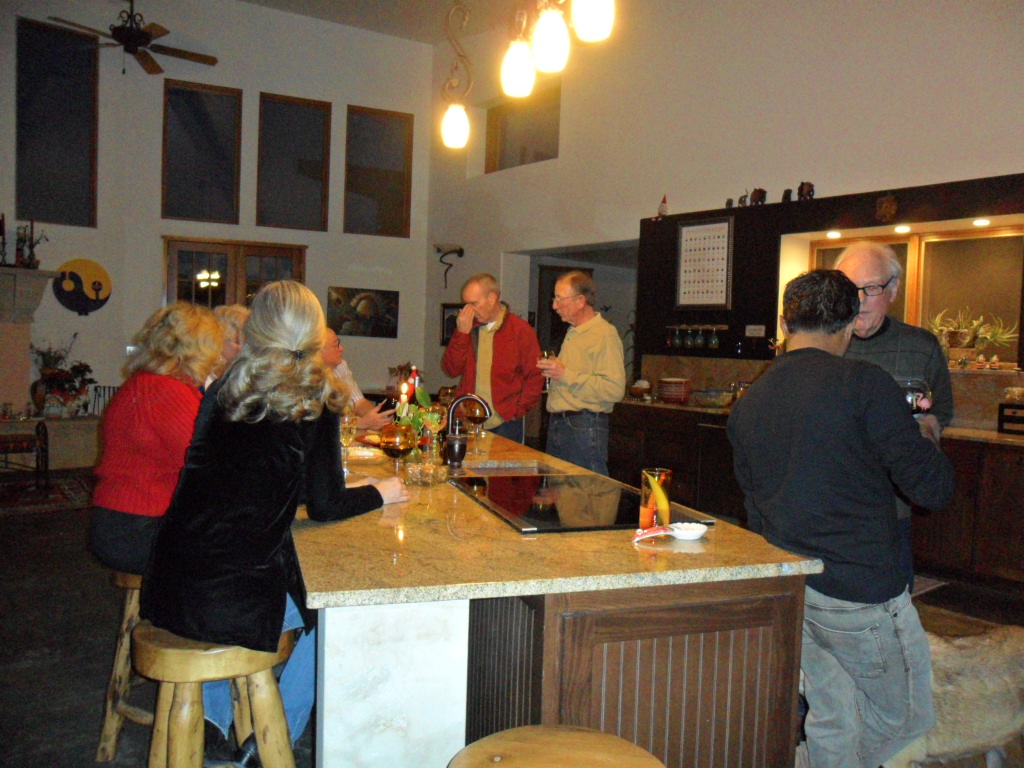
Several months ago, I reached way out of my comfort zone and started a monthly potluck.  When and where I grew up, inviting people over for a potluck was socially unacceptable.  If you invited people over, you cooked everything yourself.  If people wanted to bring something, insisted, well, ok, but otherwise, no, no, no.  Because of work, writing, and singing, I invited a number of friends over only every few months.  In September, I decided it would be far nicer to see people  more often and invited some friends over for potluck.  They asked if we could do this regularly so a monthly ritual began.  More and more friends keep asking to join.  It remains a type of hit and miss thing.  Sometimes 16 people show up, sometimes only five.  My most recent event was a week ago.  Because some of these friends are vegetarian, I invented a recipe, vegetarian enchiladas, just for them.  I also made pork roast and chicken enchiladas.  The vegetarian enchiladas disappeared quickly and everyone wanted the recipe.

Vegetarian Enchiladas

Six tortillas (I used whole wheat)

1/2 purple onion, chopped finely

1 large poblano pepper, chopped finely

1/2 medium sized red bell pepper chopped finely

1 package cream cheese

Olive oil

1 tsp Mexican spice mix

1/2 tsp chipotle pepper, ground (I used Spice Appeal-adjust to hotness desired)

Shredded monterey jack cheese

Red enchilada sauce–I used canned because my cooktop is awaiting repair

Saute onions and pepper in just enough olive oil so they will not stick or become too dry.  Mix in cream cheese and spices until thoroughly blended.  Fill the tortillas, roll up, and place in an 8 inch casserole dish.  Cover with a light layer of enchilada sauce.  Sprinkle enough shredded cheese on top to cover.  Cover with aluminum foil.  Place in a 350 degree oven for 30-40 minutes.

In the spirit of the getsetandgo blog, I took photos of my friends as we talked and ate.  The enchiladas were all gone before it occurred to me that it would be nice to have a photo.

SAM_1385

SAM_1387

SAM_1388

SAM_1392

Additionally, I regretted not taking a photo of three of my women friends with long hair.  Another friend who has spectacular, very dark grey, long hair and just turned 70 recently told me a story about how a mutual acquaintance came up to her and told her no woman over 60 should have long hair.  It annoyed me so much in an odd sort of way that I now wear my hair longer than usual.

The Girl and The Woman


The Girl

She stands alone by the train tracks.

Watching and waiting and dreaming.

Hobos no longer exist.

She remembers reading stories of life

when her great grandmother lived:

hobos begging for food, gypsies stealing

children and telling fortunes, long days

working in the corn fields, chopping weeds.

Her own family praises:

tractors, riding lawn mowers, herbicides, pesticides,

electricity, TVs, dishwashers, muscle cars, MacDonalds,

diet Coke, cell phones, computers, DVDs, iPADs.

Now the only excitement lays in Grand Theft Auto,

guns, and sex.  She watches and waits and dreams.

Canyon photo 1 anabel

The Woman

She stands alone on the rim,

watching the moon rise,

wondering.

Life flies by on wings

outstretched.

She remembers rich years

filled with long joys, living,

loving,

and temporary sadness, divorces,

moving here and there,

Narrangansett Bay, Utah mountains,

Veracruz,

babies held to breast,  blond

and chubby, cafe con leche.

She remembers girlhood longings

for far horizons, traveling

around the world, lovers,

husbands, shades of brown

beauty.

She’s learned to make

her own excitement,

singing Goddess songs,

dancing on the rim of wonder.

SAM_0901

Photograph by Anabel McMillen and Painting by Lahib Jaddo

Bedtime Reading or Not–the Hazara


A lifelong habit that helps me settle down to sleep remains reading.  However, occasionally I delve into a book that turns out not to be so wonderful to read just before going to bed.  The topic turns to the disturbing and then, suddenly, my mind churns.  By that time, it is too late to go back.  Or, like the book I am reading now, parts of it consist of stories inspiring, amusing, enlightening, parables for life.  Then there are the other parts:  the abuse of an entire people by the other ethnicities surrounding them, genocide, turmoil, invasion.  I remain a lifelong lover of libraries.  Recently, while browsing through new books, I found this one:  The Honey Thief  by Najaf Mazari and Robert Hillman.  Mazari grew up in a Hazara village in the northern part of Afghanistan, the area known as Hazarajat, became a master rug maker and fled from the Taliban to Australia in 2000 where he met his now close friend and coauthor.  For several days now, it has been my bedtime reading.

The Hazara people speak a dialect of Farci, the language of Iran.  Data varies, but they number approximately seven million in Afghanistan and remain one of the largest ethnic groups there.  Nevertheless, in spite of this, other groups discriminate against them for various reasons, including the fact that most Hazara are Shia Muslims surrounded by Sunnis.  Until 1893, they were the majority when half were massacred and many fled to live in Iran, Pakistan, and India.  Some believe the Hazara are the descendants of Genghis Khan’s warriors.  Many resemble the people who live in Mongolia today and in many ways parts of their culture resemble that of Mongolia, e.g. their tents look like yurts; no one knows for sure.  They have lived in what is now known as Afghanistan for hundreds of years.  They are people of the mountains who have learned to cultivate beauty and farm in high, inaccessible places.  They are famous for poetry and story telling.  Unlike other women in Afghanistan, they shunned burkas, fought along side men as soldiers, and believed in education for women.  These attributes fueled discrimination by other groups there.

Now back to bedtime reading.  Several stories in particular contain what I consider the necessary qualities for bedtime perusal:  entertaining and instructive without gore, controversy.  They also hold an unusual quality of something you cannot quite quantify, a hint of the mystery of life, of a particular kind of not quite describable beauty.  Hoping that at least some of you will find the book and actually read it, I will first list the stories to read without dread or worry if you want to read at bedtime:  “The Wolf Is the Most Intelligent of Creatures”, “The Music School”, and the “Snow Leopard”.  Under no circumstances read “The Life of Abdul Khaliq” and “The Death of Abdul Khaliq”.  You will, indeed, learn a considerable amount of Afghan history, but unless you are quite heartless and insensitive, you probably will not be able to drift off to a pleasant dreamland for hours.

If all this stokes your curiosity, here are two websites to learn more about the Hazara:  www.joshuaproject.net and http://www.hazarapeople.com.

Barbie Doll


Barbara Lewis Duke, pretty, petite, blue-eyed and blond, my mother, one

fearless, controlling woman.  Long after Mom’s death, Dad said, “Barbara was

afraid of absolutely no one and nothing!”  They married late:  34 & 38.  He

adored her unconditionally.  She filled my life with horses, music, love,

cornfields, hay rides, books, and ambition.  Whatever she felt she had missed,

my sister and I were going to possess:  books, piano lessons, a college

education.  Her father, who died long before I was born, loved, fancy,

fast horses.  So did she.  During my preschool, croupy years she quieted my

hysterical night coughing with stories of run away horses pulling her in a

wagon.  With less than one hundred pounds and lots of determination, she

stopped them, a tiny Barbie Doll flying across the Missouri River Bottom,

strong, willful, and free.

The Gift


On the wall for forty years,

a copy of some famous painting.

Almost everything a strange dark

shade of blue, a blue not quite

blue, the merest hint of green:

antique cupboard, curved table

base, ladder back chair, window

frame, even the tree outside.

The only exceptions:

white table cloth,

newspaper in the lady’s hands,

her pale pink floral dress with tiny

darker pink flowers,

large copper antique teapot

in the cupboard, the black and copper

pots on top.  Her teacup, saucer, plate

of toast, white and blue, an old Danish pattern.

I’ve kept this gift,

hung on too many walls to count.

My college roommate, the giver, said,

“This reminds me of you.”

I look at it; all these years

have wondered why.

We’re still friends.

I’ve never asked.

Variety is the Spice of Life


Here I go again taking classes.  This one is Part III of the series on modern women poets taught by Lorraine Mejia-Green through the Story Circle Network.  We read poems by a variety of women and use their works and related assignments for inspiration.  This week features Julia Alvarez and even though I have already read all her novels, etc. and a book of prose poetry, the selected poems are new to me.  It seems I always take a different route from a lot of the others enrolled in the class.  The following show cases draft two of my first assignment:

I keep coming to this part

where I’m happy

95 per cent of the time.

It’s my story

dictated by

ME.

“Variety is the Spice of Life.”

Cliche?

Yes, but true.

Four marriages

Lovers-I lost count

Activist in “love” with

Che and other South American

Revolutionaries.

Feminist for forty years

Up to maybe four careers.

Big city apartments

Ranches

Old houses by the bay

Bricks with arched windows

A tree lined street.

Can I settle?

For what, with whom, where?

Variety is the Spice of Life.