Naked and Unafraid: Mahasveta Devi (1926-2016)


A powerful story of the power of woman and in this case of “right”.

Vibha Shetiya's avatarFeminism and Religion

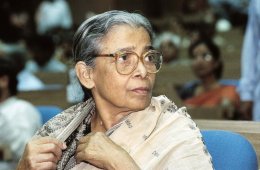
03devi-obit-master768 Photo credit: The New York Times

Mahasveta Devi died last month at the age of 90 in Kolkata, India. A widely acclaimed Bengali writer, she identified as an activist first, clearly evident in her meticulously researched “fiction.” Most of her stories champion the cause of those living on the margins of society, particularly the Adivasis or original inhabitants of India; poor, unemployed and itinerant, they traditionally subsisted off the land, and continue to struggle against exploitative upper caste landowners.

I cannot claim to be an expert on Devi or her activism, but there is a story I read a few years ago, which never fails to haunt me, whether because of the rawness with which she describes the harsh reality faced by tribal people or because of what can be seen as the violent but ultimate triumph of its female protagonist, I cannot tell. Perhaps because of both, or because…

View original post 1,120 more words

Making a Difference: Kiva Loans


To honor the death of a best friend’s father, I did as she asked, made a Kiva loan.  After looking through dozens of potential individuals and groups, I loaned 100 dollars to a group of women in the Democratic Republic of Congo to help fund their poultry raising operation.  Even though it has been less than six months, they have paid back more than half, paid on time regularly.

Some loan opportunities require even less money.  People often think their efforts don’t count, they are too small to make a difference.  Everything each person does makes a difference for better or worse.  Make a difference, act, speak out, contribute however you can to make our world a better place for all of us.

Garden of Eden Retold by Trelawney Grenfell-Muir


A delightful, grown-up retelling of the old story.

Trelawney Grenfell-Muir's avatarFeminism and Religion

Trelawney bio pictureToday, I came up with a less patriarchal Garden of Eden story:

Endelyn (age 7): “When I think of my soul, in my name “fire-soul,” I think of a powerful wind.”

Me: “That makes sense, since one of the names in the Bible for God/ess is Ruach, which means “breath” or “wind”, but we call it the Holy Spirit. God/ess is also symbolized by the other elements: fire, air, and earth – like when she shaped Eve and Adam out of clay.”

Endelyn, “What? I don’t remember that story.”

Me: “Oh, ok, I’ll tell you.” ……

Here’s the part where I froze momentarily, thinking “how can I tell my children that misogynist failed mentor story? how? how?” <deep breath>

View original post 787 more words

Human Trafficking


Slaves today outnumber all the past,

more than thirty million.

Eleven year old girls,

locked in motel rooms, never see light,

told you’re a whore, worthless, until

they believe it.

Respectable hotels, brothels in disguise.

Senegalese boys chained in hovels, fake

madrassas, sent to beg on streets.

Texas parents of three daughters, forcing them

into prostitution for drugs. Everyone knows;

no one can catch them.

Famous men running sex slave rings, immune

from prosecution.

Young women who think all men watch

pornography; it’s normal.

Innocence promised, endlessly betrayed.

People as commodities.


The Mabel Dodge Luhan House in Taos


For years I had read and heard about this place, even attended a lecture by a descendent of one of her frequent guests who actually knew her when he was a child.  This past weekend good friends from Rociada took me there with my best friends from college years, friends from long ago, visiting from California.

I already knew something about Mabel and her friends, famous people who frequented her salon, created the artistic mystique that still hangs over Taos.  When I returned home, I wanted to know more.  Born into Buffalo, NY, high society, she had been married and widowed by the age of 23.  As a young woman she was openly bisexual; her memoir, “Intimate Memories”, provides a frank discussion of this part of her life.  Several years after her first husband’s death, she married the architect Edwin Dodge.  They lived near Florence, Italy, for seven years where she entertained such notables as Gertrude Stein, Alice B. Toklas, and Andre Gide.  After affairs and two suicide attempts, she separated from her husband and moved to Greenich Village.  Eventually, she married her third husband, the painter Maurice Sterne and became a patron of the arts.

In 1917, she and her husband moved to New Mexico.  This changed her life; she lived there until she died 45 years later.  She preferred Taos to Santa Fe, finding the latter “too civilized”.  She found New Mexico “alive” and fell in love with Pueblo culture eventually even cutting her hair to mimic Pueblo style.  Sterne did not find New Mexico to his liking and left.  After their divorce she married her long standing love, Antonio Luhan, a Taos Pueblo man.  They remained married 40 years.

Mabel entertained a nearly endless array of famous artists, writers, and intellectuals:  D.H. Lawrence, Georgia O’Keefe, Willa Cather, Ansel Adams, Carl Jung, Emma Goldberg, Margaret Sanger, the founders of the Taos Society of Artists.  She introduced New York and the east coast to New Mexico through her columns in “The New York Journal”.  Mabel died in 1962.

IMG_2284

A view of the main entrance and the largest portion of the house and grounds.
IMG_2274

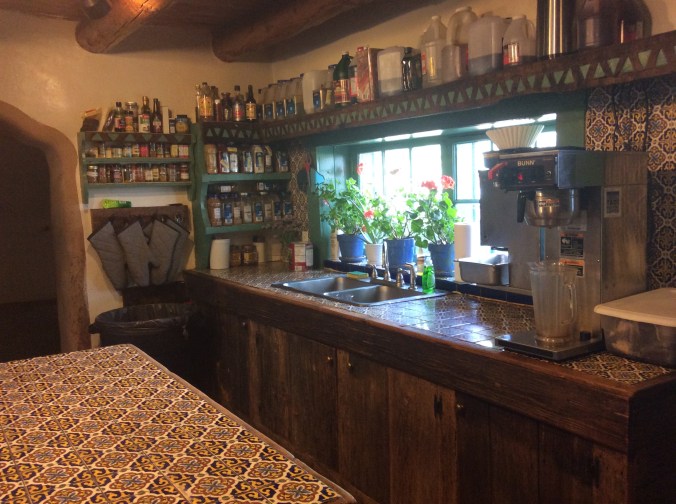
A small portion of the kitchen.  Cookies, coffee, fruit infused water, and tea were available in the dining room for hotel guests. Books with historical photos lay out for visitors to read in an adjoining room.

Dennis Hopper bought the house in 1970 and recreated her “salon” hippie style.  In 1977, he sold it to George Otero.  Because of years of neglect, it required extensive restoration.  The Oteros turned it into a non-profit where they held workshops.  The Attiyeh Foundation, its current owners, purchased it in 1996 and run it as a hotel and conference/retreat center.  It costs nothing to visit and wander around.

IMG_2281

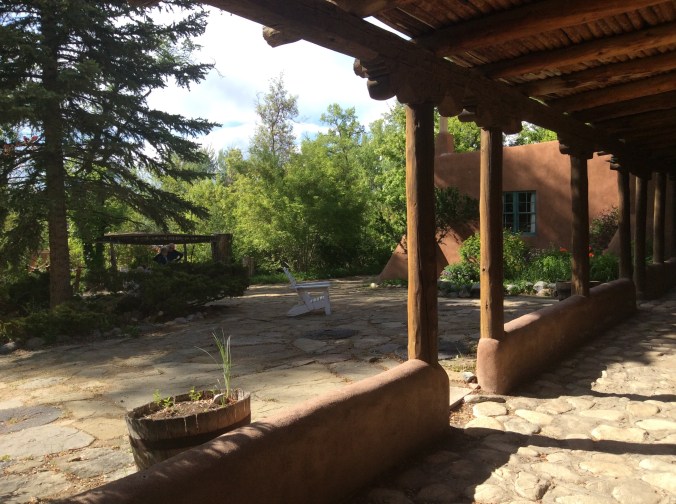
This photo was taken from the same spot as the first one, looking to the right instead of toward the entrance.
IMG_2282

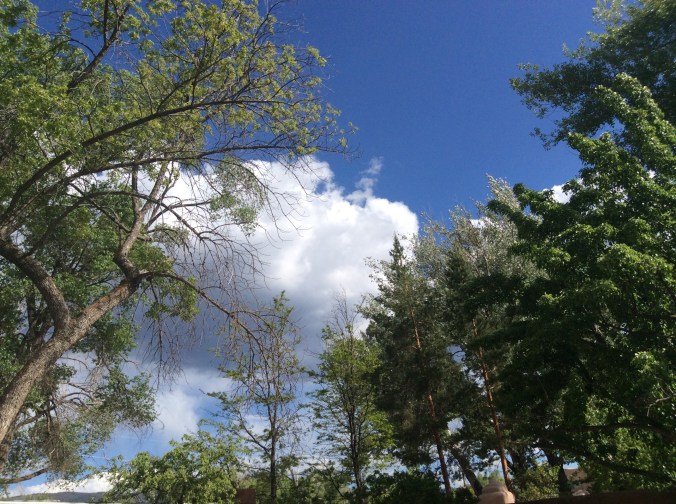
While standing there, I looked up into that incredible New Mexico sky.
IMG_2279

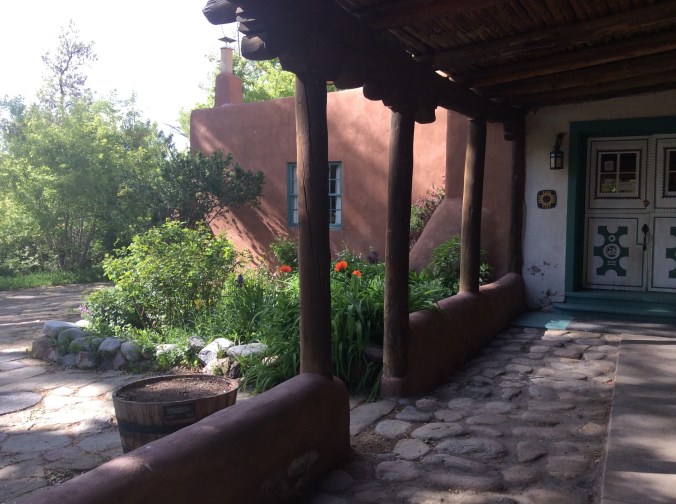
A close up view of the entrance.

IMG_2276

Look at all the bird houses.

IMG_2275

Beside the kitchen, out a side door–patio and horno (traditional clay oven) shaded from the afternoon sun.
IMG_2277

IMG_2280

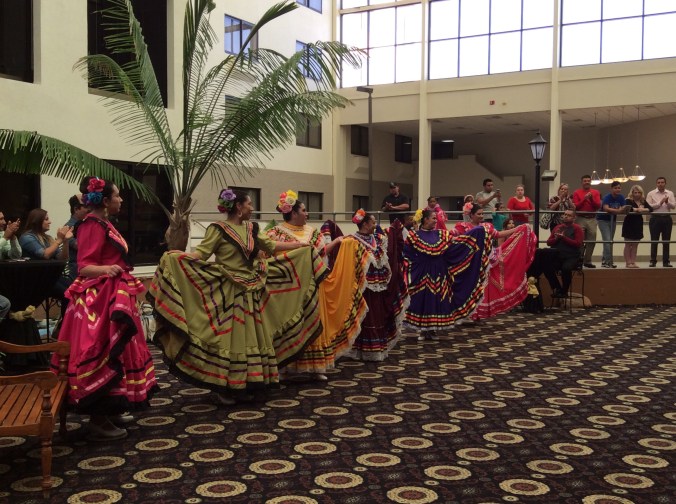
Friends chit chatting while I wander around taking photos.

For more details, go to:   http://www.mabeldodgeluhan.com.  This includes history, accommodations, workshops, etc.  The accommodations portion even tells the site visitor who slept in each room when visiting Mabel.



Woman Is Not Anonymous by Vanessa Rivera de la Fuente


Vanessa Rivera de la Fuente's avatarFeminism and Religion

Vanessa Rivera Virginia Woolf

Lately I have been reflecting on this quote of Virginia Woolf: “For most of history, Anonymous was a woman.” Here she points out the deliberate invisibilization of women’s contribution in all areas of human endeavors.

Patriarchy always takes these contributions for granted. For centuries, domestic labor has been invisible and not considered work. It has put beauty over intelligence, even with women of outstanding intelligence. And in terms of knowledge and intellectual production, patriarchy has appropriated women’s ideas and in presenting them as “anonymous,” presents them as it’s own.

Thanks to the feminist reclaiming of history, and proving the accuracy of the premise that “Anonymous is woman,” we have learned of the long list of inventions that were made possible due to women’s ideas who were kept invisible, unnamed, unquoted,  and erased;  after all, she was “just” a “woman.”

View original post 867 more words

Four Reasons We Need To Reclaim The Power of the Divine Feminine Now by Mary Petiet


Why is the divine feminine so important? What does it promote that values others, our planet? This says everything I could have said myself.

Guest Contributor's avatarFeminism and Religion

Mary Petiet photo(Spoiler alert:  She’s already here)

The power of the divine feminine taps into the power of life. The power is accessible to everyone as the equal opportunity energy surrounding and connecting all living things. The power is ancient, and meditative practices such as yoga, which in Sanskrit means linking to the divine, can connect us to this power. When we make the connection, we find the balance we need to realize our highest selves, and through that balance we can realize the highest self of the larger society.  To reclaim the divine feminine, we need only remember, and as more and more of us remember, we heal first ourselves, and ultimately the planet.

1. She is the route back to the self.

In her mother aspect the divine feminine offers a route back to the self and She is all-inclusive. She embraces all of creation, men, women and nature, and we…

View original post 501 more words

#ImWithHer: Excuse Me, I’m Listening—to Her by Marie Cartier


This post states about everything I myself could say on this subject. People vote how they vote for a wide variety of reasons. I vote on social issues. Often voters fail to realize that, like it or not, we are intricately part of a global economy. What occurs even in some remote part of the world affects everyone else, economically as well as socially.

Marie Cartier's avatarFeminism and Religion

marie kimMy wife and I attended a panel discussion last Sunday with Chelsea Clinton, the daughter of the Democratic nominee presidential hopeful, Senator Hillary Rodham Clinton. Chelsea was accompanied by the famous and beloved Superstore and former Ugly Betty star, America Ferrera and also uber- television entrepreneurial juggernaut, Lena Dunham , creator and star of Girls. The event was meant to highlight that millennials, particularly female millennials, are supporting Hillary Clinton. Obviously the event was meant to counteract the prevailing media notion that millennials are not supporting Hillary—whether or not they are female. And certainly some millennials are not—but, as this event pointed out, many are.

Ferrera opened and talked about her immigrant parents saying that she would not have been able to receive an arts education if not for someone like Hillary fighting for better public schools. She was one of the children who needed the free lunches, coming…

View original post 1,865 more words

Women Writers and the Story Circle Network


More than twenty years ago, I coauthored a book with an attorney.  Not only did it get published, it was also translated into Spanish.  The topic, the momentum for its topic, seems basically gone now.  Some technical and business magazines published a few articles I wrote.  I wrote some safety manuals, other technical stuff, rather boring, uninspiring.  Then I discovered the Story Circle Network.

The Story Circle Network inspired me to write creatively again–once upon a time in high school my poetry was published.  Then I quit writing for years.  When I started again, it was technical or business writing.  If you want to write your stories, read other women’s stories, just explore fiction, poetry, travel writing, you name it, join this organization.  It changed not only my writing life, but my life in a broader sense.  Through it I met not only other writers, I also became a board member, made new friends who write and share. This inspiring organization not only provides classes, publishes, but also hosts various writing contests and a biannual conference.  In the middle of April, I will head to Austin for the conference.  The keynote speaker is no other than Brooke Warner, the woman who founded She Writes Press.  Go to http://www.storycircle.org to learn more about the conference and the just announced winners of the Sarton Women’s Literary Awards, become inspired, create, publish, grow.  Without this organization, I seriously doubt I would have written my book of poetry, published by Uno Mundo Press in April 2014.

10285598_10201564553698114_927164360_o

Because of comments from readers of this book, inspiration from friends, and personal interests, I am now working on another book.

I offer thanks to the Story Circle Network for renewing my writing life.


Rewriting Religion: the radical poetry of Aemilia Bassano Lanier by Mary Sharratt


This illustrates how recently in history English speaking women have gained the right to openly display their talents, how hard won these gains have been. These rights can just be as easily be lost unless we remain vigilant.

Mary Sharratt's avatarFeminism and Religion

Sharratt_DarkLady-hi

Aemilia Bassano Lanier (also spelled Lanyer) is the heroine of my new novel The Dark Lady’s Mask.  Born in 1569, she was the highly educated daughter of an Italian court musician—a man thought to have been a Marrano, a secret Jew living under the guise of a Christian convert. She may have also been the mysterious, musical Dark Lady of Shakespeare’s sonnets, although most academic scholars dispute this. What we do know for a fact and what really matters is that she was the first woman in England to pursue a career as a published poet.

In Italy women such as Isabella Andreini published plays and poetry on a wide variety of secular subjects, but in England Lanier effectively had only one option—to write devotional Protestant verse. Her English literary predecessors, Anne Locke and Mary Sidney, wrote poetic meditations on the Psalms.

But Lanier turned this…

View original post 636 more words