Spring Break Adventure–5


On the fourth day of the adventure we went to Marfa, Texas.  My friends from college, David and Suzy, had booked a tour of the Chinati Foundation.  No photos of that because none allowed.  This foundation is the dream of its founder, Donald Judd.  His art and almost all the rest of the art housed here is not for display in houses.  All but a few consist of grand studies of space and light. An abandoned, refurbished military base, purchased by Judd, houses most of the exhibits.  Judd’s main interest it seems relates to the relationship between light and space.  First, the tour guide takes you to a couple of large buildings where the only changes made were to install new windows and a ceiling.  These buildings house Judd’s large, polished, stainless steel rectangular boxes.  While this may sound boring, I assure you it is not.  Light reflects off these boxes, makes shadows, etc. in all sorts of ways and the entire effect changes with the angles of the sunlight.

Another quite astonishing display can be seen in a series of U-shaped buildings, painted and repaired, in which eight foot long fluorescent light tubes in four colors, pink, green, yellow, and blue, have been installed in the corners of the U.  Depending on where a person stands, other colors appear, not just the four mentioned.  It became apparent to me that the artist, Dan Flavin, knew every scientific detail of the color spectrum and its effects on the human eye and brain.

I also enjoyed a smaller display by artist and poet, Carl Andre.  Even though his fame rests in sculpture, it is mainly his poetry displayed here.  I wanted to read all of it but everyone else went on so I quit.

There are other exhibits, including a lot of smashed and welded vehicles which I liked the least.  The final exhibit displays giant fabric sheets in black and white in a building specially designed by the artist, Robert Irwin.  If you think this sounds boring, take a trip there and look for yourself.  I assure you it is not.  Irwin actually worked on the exhibit himself at the age of 88.  He lives on now at 89.

IMG_2603

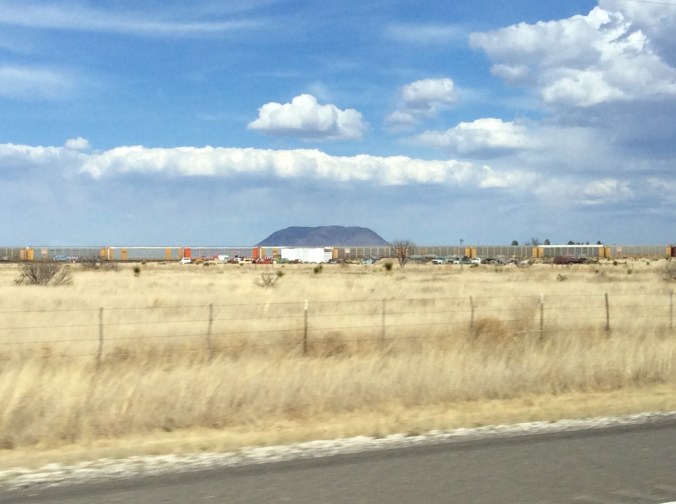
The only photos I managed in the area show the Marfa Courthouse which is, believe it or not, even a brighter pink than this photo and a photo from the vehicle window on the highway to Alpine. The second photo shows a mesa we managed to view on one day or another from nearly all sides.  It looms large in the middle of flat land. Here one of the endless trains slides by.
IMG_2604

On our last day we decided to drive to Presidio and take the river road which goes through Rio Grande Ranch State Park. While the road goes either along or down to the river in a few places (for people to put some sort of water craft into the river or to camp), most of it is way above the river on cliffs.  This landscape is not for the faint of heart.

IMG_2605

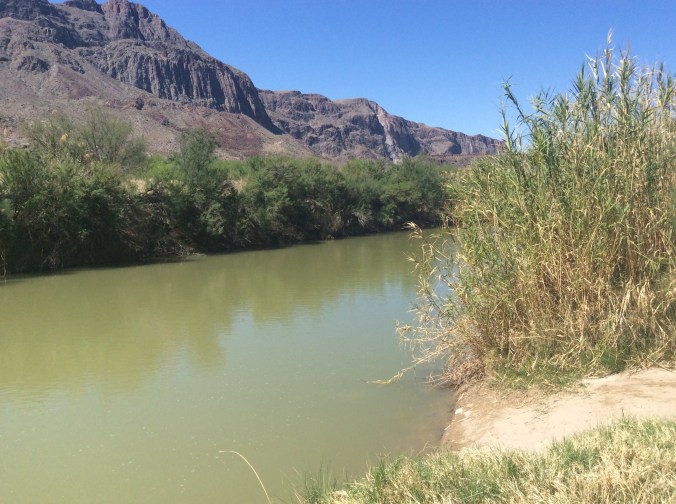
US on the right and Mexico on the left.  The fields and pasture in the distance are in Mexico.

IMG_2606

Looking into Mexico.

IMG_2607

IMG_2609

IMG_2611

Unusual rock formations near one of the small drives down to a campground by the river.

IMG_2613

IMG_2617

Cliffs in Mexico.

IMG_2619

Apparently, in my efforts not to fall in the river while taking this, my finger got in the way.

IMG_2620

IMG_2621

Yes, the river is down there between those cliffs.

IMG_2622

IMG_2623

In case you wonder why the Rio Grande seems so small here, consider that by the time it gets here, 95% of the water has been removed for irrigation and other purposes.

IMG_2624

We drove back through Terlingua to Alpine.  Not much exists in Terlingua except a rather pathetic supposed ghost town area.  The river road is not conducive to speed; we were hungry and stopped for a very late lunch.  It was St. Patrick’s Day and many of the clientele had a good start on the festivities.  On Saturday I learned that Terlingua is a famous biker town.  However, apparently not that day.

Ethiopian Journey–The Castles of Gondar


When my friend told me we were going to visit the Castles of Gondar, I thought he was kidding.  It sounded too much like a movie title, plus castles in Ethiopia?  Seriously.  Then I looked it up and sure enough, there are a lot of them, built by a series of kings, fathers and sons, and a queen.  Some remain in reasonably good repair at least on the outside.  Others crumble in the rain and humidity.  All are in a sort of compound arranged together.

IMG_0677

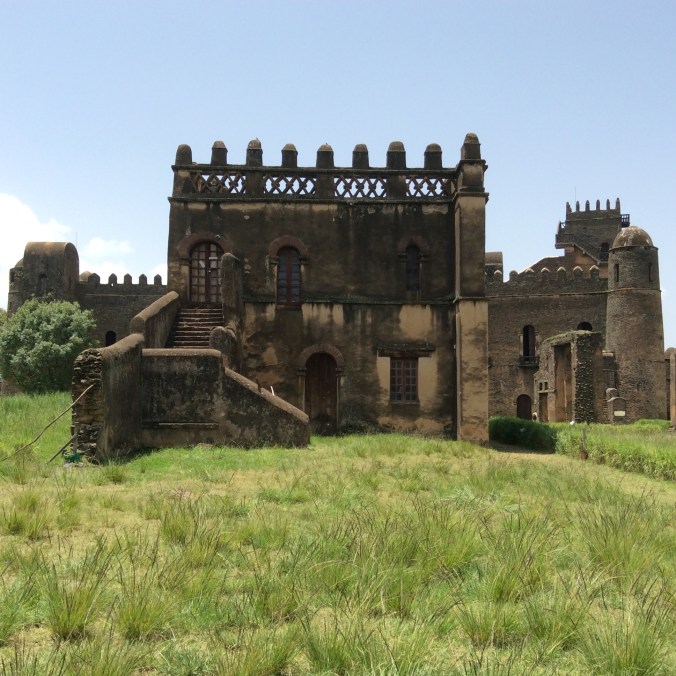
This castle is near the entrance and in rather good condition.  Restoration work is most complete here so it is safe to walk to the second floor.

IMG_0684

The view from a second floor window.  Because of the altitude and moisture–contrary to popular opinion, a large portion of Ethiopia is mountainous and green–especially during the rainy season, upkeep is not easy.

IMG_0688

The same castle, looking out the door onto the balcony which can be seen in the first photo.  The floors have been restored.

IMG_0685

Looking in the opposite direction from the first castle, several castles and the ruins of others show the layout of the compound.  Our hotel was near the top of the mountain in the distance. Many locals roamed around when we were here.  It is popular to take wedding, anniversary, etc. photos here.

IMG_0707

This photo shows the first castle–in the background–from another side.

IMG_0715

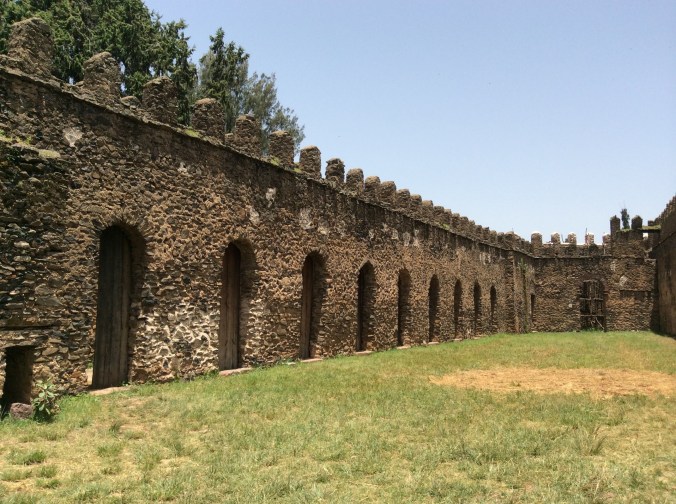
The style of some of the castles, like this one, is more intricate than others.

IMG_0725

This building housed the royal lions.  Tradition for keeping lions goes back several centuries.  The last Ethiopia emperor, Hailie Selassie, was often referred to as the Lion of Judah, the latter referring to the Ethiopia tradition of believing that they are descendants of Solomon and Sheba.  Ethiopian lions are a different sub-species than other African lions, smaller with darker, sometimes black, manes and tails.

IMG_0731

These castles provide a perfect venue for photography.  You can see my friends sitting on the stone wall.

IMG_0743

The royal stables obviously housed many horses.

IMG_0747

The royal dining hall currently receiving restoration work.

IMG_0755

The path to the exit.

The news the last couple of weeks from Gondar has not been pleasant.  Many people have been protesting the government which they view as tyrannical and favoring one ethnic group over the others.  More than ten protesters were killed during the first protest.  Just this past week thousands came out in another peaceful protest.

Gondar (sometimes spelled Gonder) is a business, commercial, and education center.  It is a main route for commerce between Ethiopia and Sudan.  For more detailed information about Gondar, the castles, and the surrounding area, see my blog posts from Aug-Sept. 2014.


Santa Ana Pueblo, New Mexico


At Tamaya Resort, this past week I attended a regional conference of the Alpha Delta Kappa teachers’ sorority.  Run by Hyatt, this resort resides on Santa Ana Pueblo land near Bernalillo, New Mexico.  Although the word pueblo is Spanish for town, in New Mexico its meaning extends far beyond town.

There are 19 pueblos in New Mexico.  Several are near Albuquerque:  Santa Ana, Santa Domingo, Sandia, and farther to the north, Taos Pueblo near the town which bears its name.  Many  pueblos have been inhabited for many centuries, e.g.Santa Ana since the 1500s and Acoma since the 1200s.  Each pueblo is synonymous with a particular American Indian tribe.

Santa Ana Pueblo land borders the Rio Grande River.  Tribal members number approximately 900.  Their children attend public school in Bernalillo.  The tribe’s income comes primarily from the Tamaya Resort and a casino. Employees at the resort come from all over the United States as well as other countries.  Our waiter at one of the four restaurants came from a small town in Yucatan, Mexico.

IMG_2350

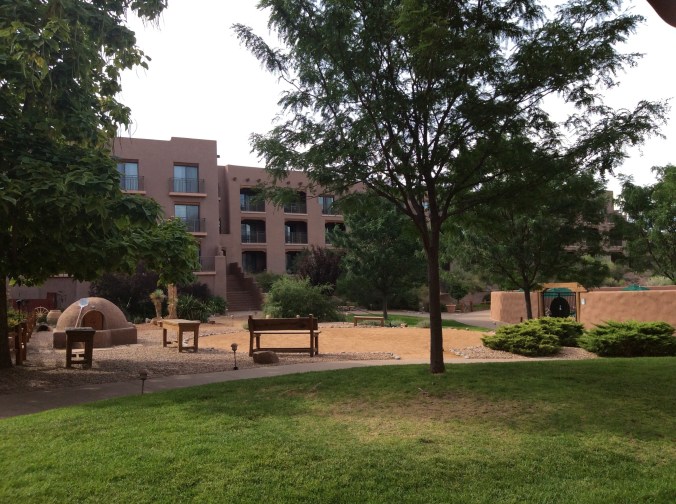
All the buildings show the traditional pueblo style.  The horno–oven–on the left in this photo is actually used.  The courses and activities for guests are extensive, including making bread and baking it in this horno.  Golf, horse back riding, hiking to the Rio Grande, swimming–there are four pools, jewelry making, bike riding, creating your own dream catcher, and many others options keep guests busy.  Their horse rescue center is the largest in New Mexico.

IMG_2351

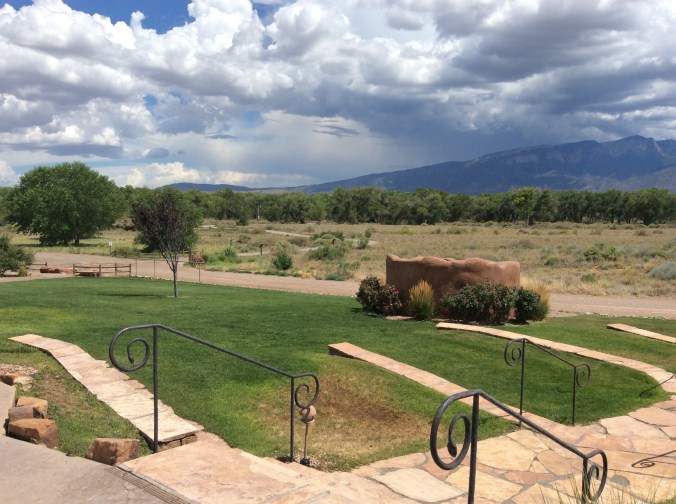
The trail to the bosque and river start just below the lounging and grill area.  Bosque (forest or woods) is another one of those Spanish words, here used specifically in relation to the forested area along the Rio Grande.  Like in most of the West, rain is always welcome.  It rained several times while we were there.

IMG_2353

IMG_2356

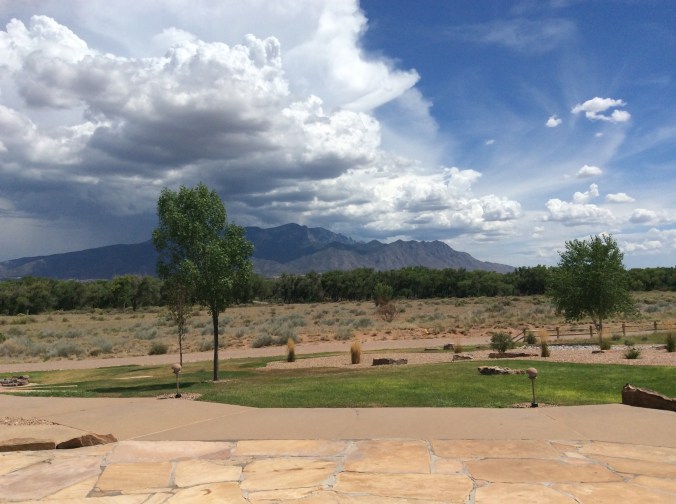
The intense blue of the New Mexico sky mixed with storm clouds make for perfect photos.

IMG_2357

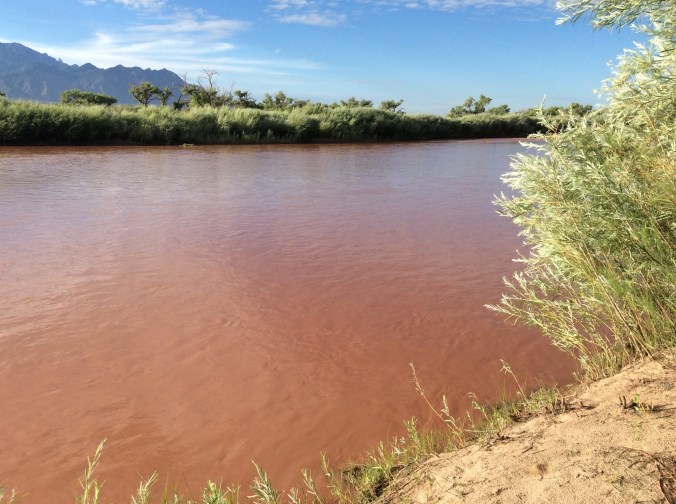
After approximately a mile of walking, the hiker arrives at the Rio Grande.  Because of the rains, it became higher and higher.

IMG_2358

Looking down river.  The river was moving so fast that I could hear it rolling along.

IMG_2359

Looking slightly up river.  Seeing this, it is hard to believe that by the time it arrives at the Gulf of Mexico, it is a mere trickle.

IMG_2360

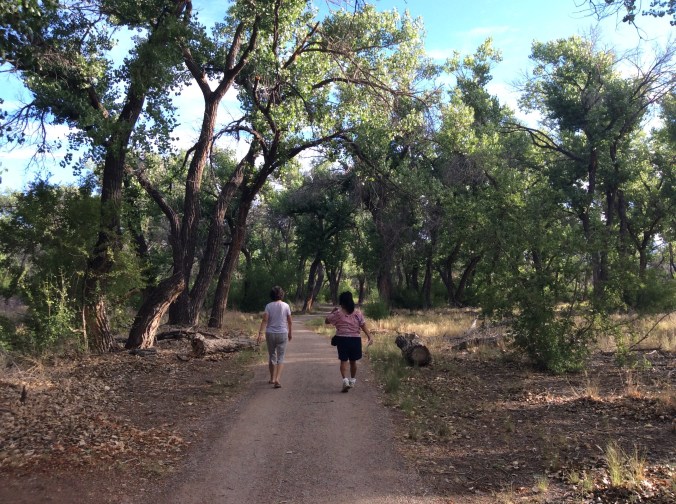
Early morning hikers on the bosque trail.

IMG_2361

While hiking, I looked up and could not help it; I had to photograph the famous New Mexico sky which Georgia O’Keefe loved to paint.

My Ethiopian Journey–Simien Mt. Natl. Park


No way was I prepared for these mountains.  Do you think of numerous peaks over 13,000 feet when you think of Ethiopia?  Probably not. There are even a few over 14,000 feet.  The whole area is often referred to as the Roof of Africa.

IMG_0573

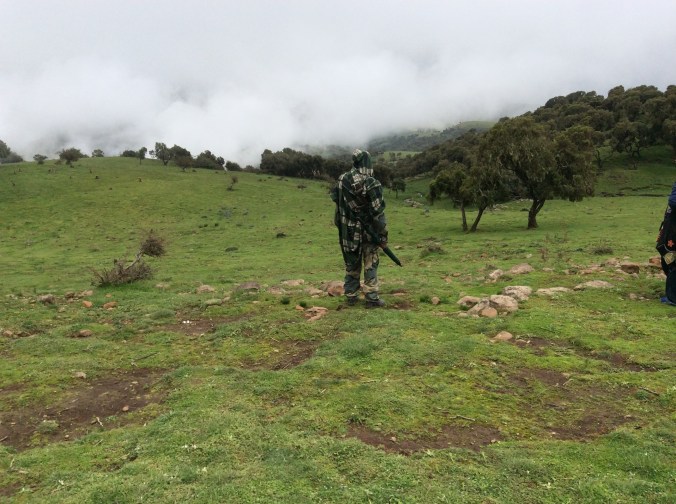
There is only one road into the park.  To get in, a tourist must stop at the park office, sign in, passport number, address, etc.  Plus, you will be assigned a guard and a guide.  Our guard in the photo above carried an assault rifle.  No, it is not to protect people, it is to protect their rare animals from people, from poachers.  Wonder why he is wearing all these clothes?  It is cold at 12,000 feet even if you are near the Equator.

IMG_0577

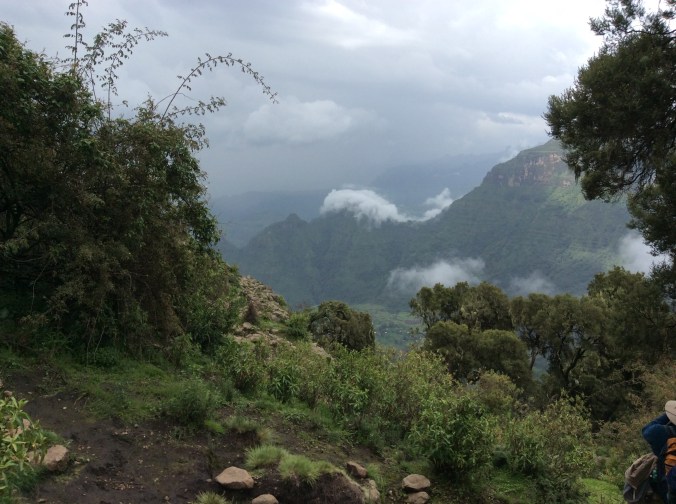
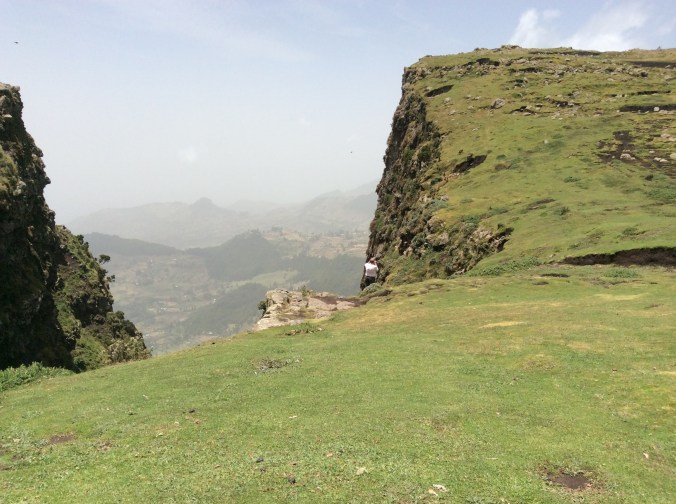
The drop offs are terrifying, thousands of feet, the vistas endless.  Even though I have lived and been all over the Rocky Mountains and been to the Himalayas in both Kashmir and Nepal, I have never seen anything like these mountains for beauty, green, and endless vistas.

IMG_0579

My friends near the cliff are much braver than I.  In the foreground stands our guide, Michael, who spoke excellent English and was super funny.  He had us laughing all the time. People live and farm in these mountains–if you look closely in the middle of the photo, you can see fields.  However, the government is slowly relocating people in order to make the park a refuge for rare wildlife.

IMG_0582

The above photos were all taken on a hike early one morning.  Everything was wet because it was either raining or misty or we were in the clouds.

IMG_0592

Because I kept slipping and sliding, I decided not to walk along the cliff with my friends and the guard, who spoke the same Ethiopian language as my friend.  Michael and I took off across a meadow and suddenly here we were in the middle of all these gelada baboons, who paid no attention to us at all.  They were very afraid, however, of a predatory bird that decided to fly over. How do I know?  They suddenly started “talking” to each other in frightened voices.  Experts now think these primates actually have a language and do talk to each other.  Gelada are the last primates that are herbivores.  They eat grass.  All other herbivorous primates are extinct.  Gelada live only in the high mountains of Ethiopia and no where else on earth, a reason for a guard.  At night they climb down the cliffs into caves to protect themselves from hyenas and leopards.

IMG_0603

If you look very carefully in the middle of this photo, you can see several duiker which are considered so common it seems no one thought to stop to really take a look so I took the photo as we drove along.

IMG_0614

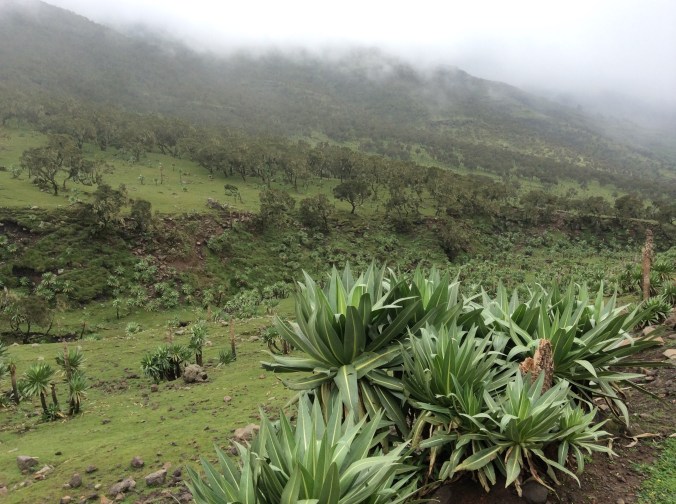
Here we are above the timberline where some very unusual plants thrive.

IMG_0625

And some exceedingly rare animals whose camouflage makes them almost invisible until they move.  At this point we are about 14,000 feet just under one of the highest peaks in Africa.  Look carefully in the middle and you will see walia ibex.  People come from all over the world to see these endangered animals that live only in this park.  Sometimes the fog rolls in and no one sees anything.  We were lucky; we saw more than twenty of them. And then the fog rolled in.

IMG_0630

These giant lobelia thrive above timber line.  Some were considerably taller than I am.

IMG_0632

If you grow red hot pokers in your flower beds and think they are semi-arid flowers, think again.  Here they are growing wild.

IMG_0633

You can see red hot pokers in the middle of this photo by the stream.  These mountain streams run down to and often across the road, making the road a muddy mess.  Without 4-wheel drive and an expert driver we would have gone nowhere.  In fact, at one point we did have to stop because two stuck trucks blocked the road, one of which had a flat tire.

IMG_0635

The highest waterfall in Ethiopia is hard to hike to unless you are not at all afraid of heights.  My friends did hike there. Look a bit to the right of the groove through which the water actually falls.  You will see a sort of flat area.  It is only a few feet wide with a drop-off on each side.  Yes, that is where you hike.  When I saw this view, I was rather glad I decided to wait, look for birds, and chat with the driver.

IMG_0595

The fire pit at the highest bar in Africa is a very popular place on a cold night.  Even though we had beautiful rooms, with no heat at 12,000 feet it is not exactly warm.  Even the guides and guards were bundled up.  The only people who seemed toasty were Scandinavian tourists with their heavy wool sweaters.  The hotel staff gave us hot water bottles to put in bed with us at night.  Actually, it works.  Nevertheless, when you get up in the morning, it is really cold.

IMG_0609

The guards and guides live near the park.  We dropped off the guard here and watched him walk toward his house down where the trees are.  We dropped off the guide near his house in the town when we left the park.


Ethiopian Journey–From Addis Ababa to Debre Birhan


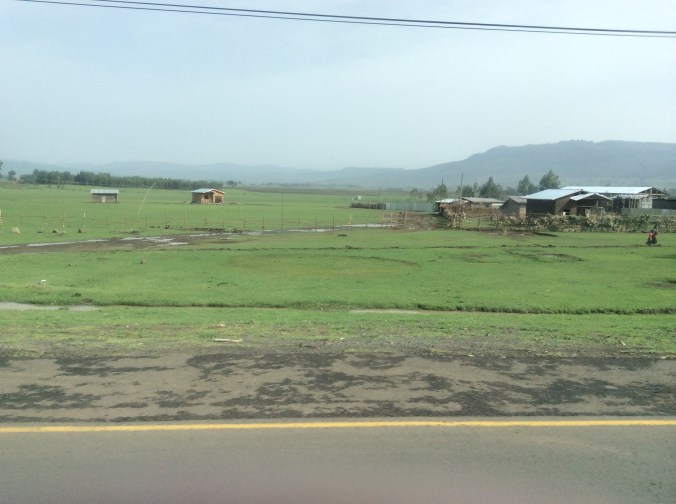
Addis is the second highest capital in the world.  Only La Paz, Bolivia, is higher.  To a large extent, altitude determines climate in Ethiopia.  Addis and the surrounding area, much of which is high altitude farmland, receives a lot of rain this time of year and looks totally unlike what a lot of people think of when they hear the word Ethiopia–not desert but rather miles and miles of green.

IMG_0248

IMG_0249

We had not driven far from Addis when we crossed a river, an area of which is considered healing.  Many people had come for priests to bless them and to experience the healing power of the water.

IMG_0246

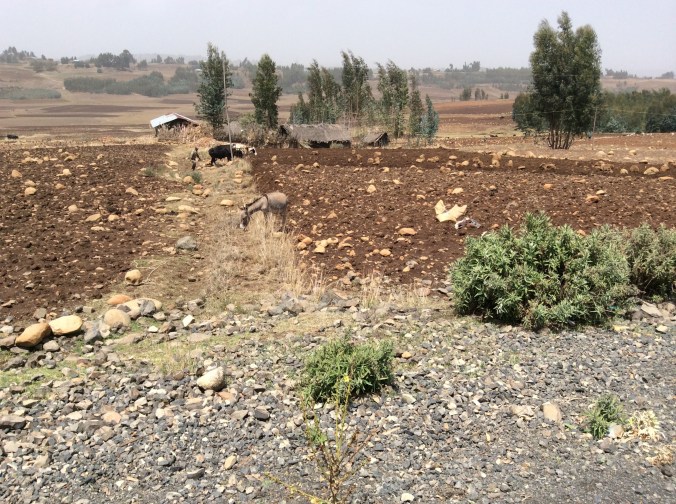
I saw only three tractors in ten days of criss crossing farmland.  Why so few?  One reason is rocks.  Many of the fields remain rather full of rocks in spite of many having been removed.

IMG_0258

Therefore, they farm the “old fashioned” way; horses or cattle pulling plows with a human behind.

IMG_0251

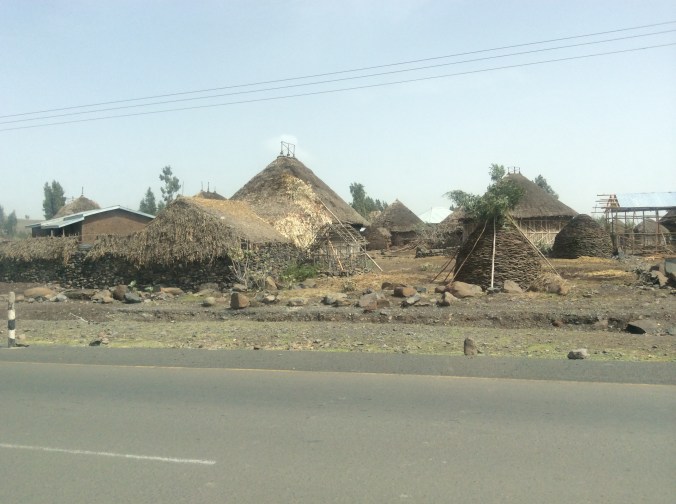
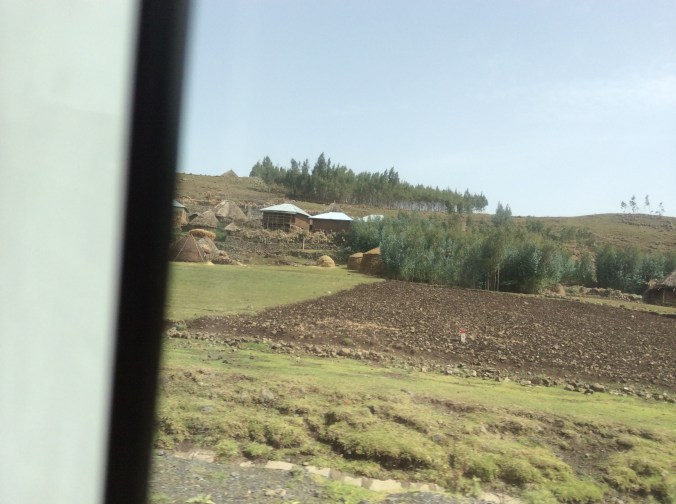
Houses in the villages in the farming areas demonstrate old ways alongside new.

IMG_0257

IMG_0259

Winnowing the way we did in the USA a century ago.

IMG_0253

IMG_0261

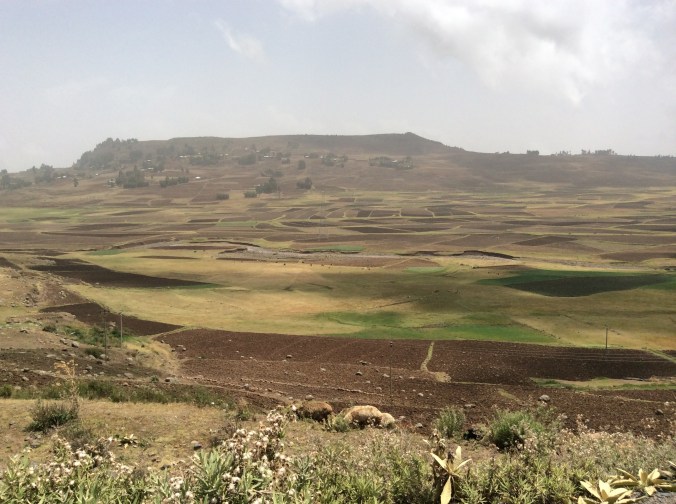
Much of the farmland is a picturesque patchwork quilt of browns and greens.

IMG_0266

Before dropping down to lower country, we drove by Menelik’s Window.   The drop off here is steep and far.  I did not go near it–I had not yet become used to the endless drop-offs or even realized that I would need to do so.  This is one of four places in Ethiopian where you can see gelada baboons.  They are extinct elsewhere. Menelik was an Ethiopian emperor.  This “window” allows one to look from the high country for miles and miles to the landscape beyond.

IMG_0262

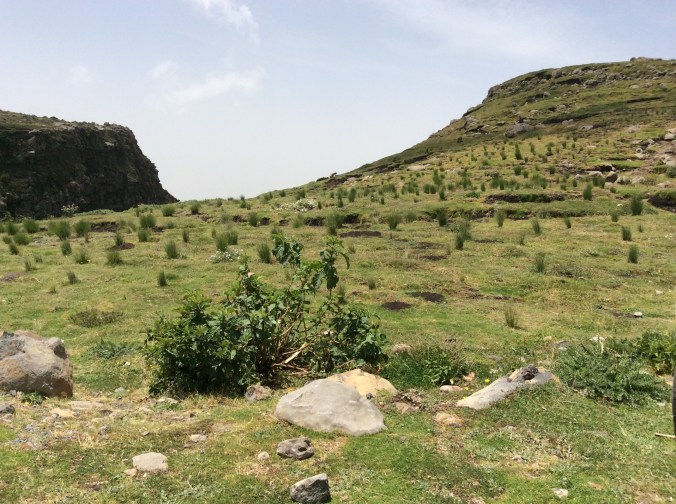
The large tufts of grass provide food for the gelada which are grass eating herbivores, the last of the grass eating primates.  All others are extinct.  This same grass is used by the locals for roofing material so boys stay in these areas all day chasing off the baboons.

IMG_0264

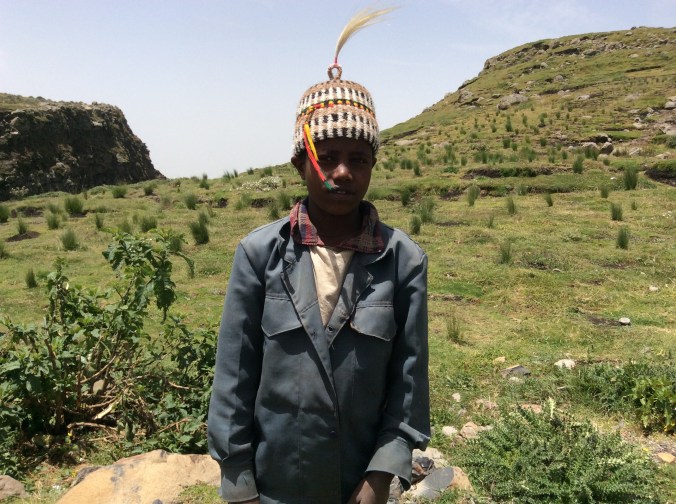
To keep themselves busy they weave woolen baskets and hats to sell which they display in the grass.

IMG_0267

This ten year old boy happily donned the hat he had made.  I bought it for my grandson who was the same age when I took the trip.

IMG_0268

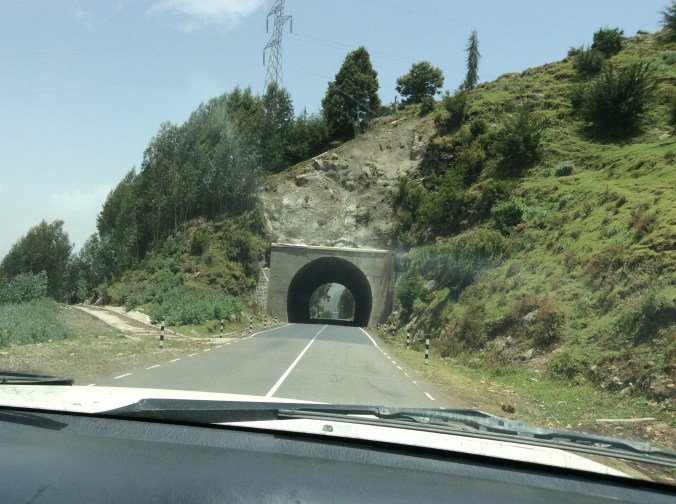
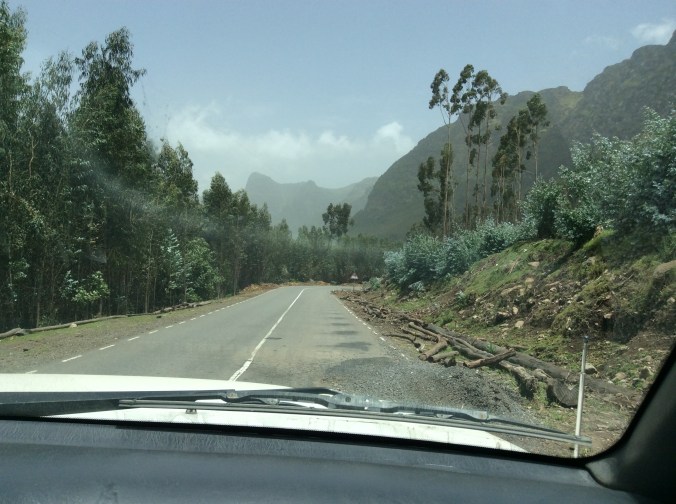
Except for the different vegetation, driving down the mountain looked a lot like driving through Colorado.

IMG_0271

IMG_0272

IMG_0276

Down from the mountain the landscape appears quite different and considerably drier.  We drove through several smaller towns on our way to Debre Birhan where we stayed the first night.

IMG_0279

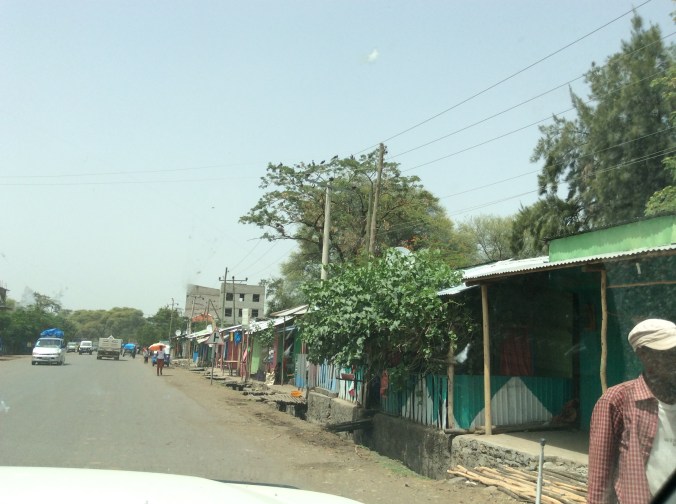
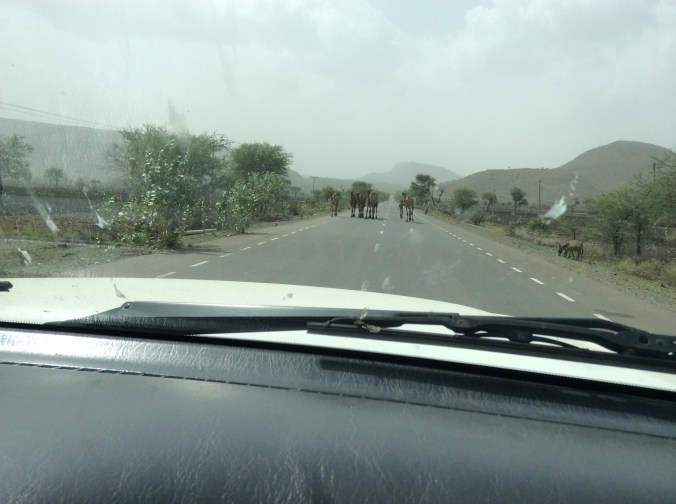
Driving in Ethiopia requires navigating around animals.  Everyone drives their cattle, camels, horses, all livestock down the road whenever possible.  The roads are generally very good.  Many, built by the Italians, have stood the test of decades.

IMG_0282

Along the road we saw many of these “apples”.  My friend told us how they played with them as a child.  However, the adults all warned the children not to touch their eyes when they did–it will make you blind.  They are called Apples of Sodom–so many things in Ethiopia have symbolic meaning.

IMG_0283

These fruit could be seen all along the road and even on the road.  After driving through this drier area we rose above a huge valley with miles and miles of grass.

IMG_0285

A semi-nomadic group brings their immense herds of cattle here in the rainy season to graze.  When we drove further on above the valley, I saw the first tractor working a field as big as this grazing land.


Ethiopian Journey–Addis Ababa


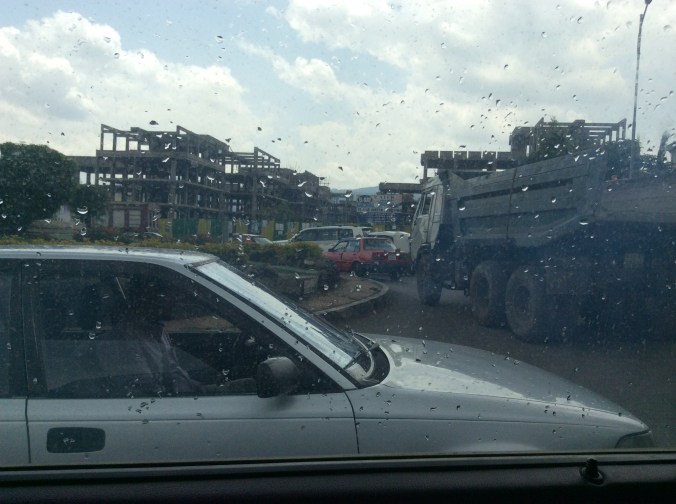
We spent a couple of days in Addis staying with my friend’s sister who lives there.  Addis traffic is incredible.  In a city with millions of people I saw only one traffic light and it was not working.  Most intersections are giant traffic circles and getting through them is a rather daunting task.  On the way to my friend’s brother’s house one day, we sat stuck for nearly one half hour–we could not get through the circle.  Finally, the passenger in the car to the right of us jumped out and stopped the traffic so we and his driver could get through.

IMG_0211

Additionally, it rained often, streets and buildings were under construction, and mud and potholes showed up everywhere.  This is a nice traffic circle.

IMG_0212

A nice day with little traffic.

IMG_0213

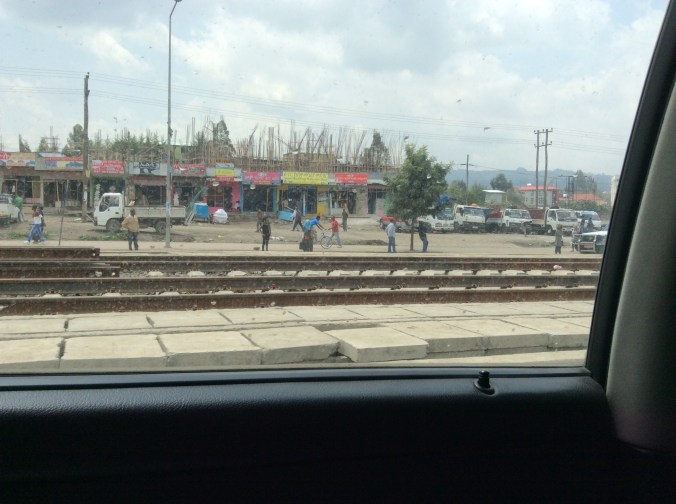
They were building a new rail line across the city hoping people would use the train instead of driving.

IMG_0214

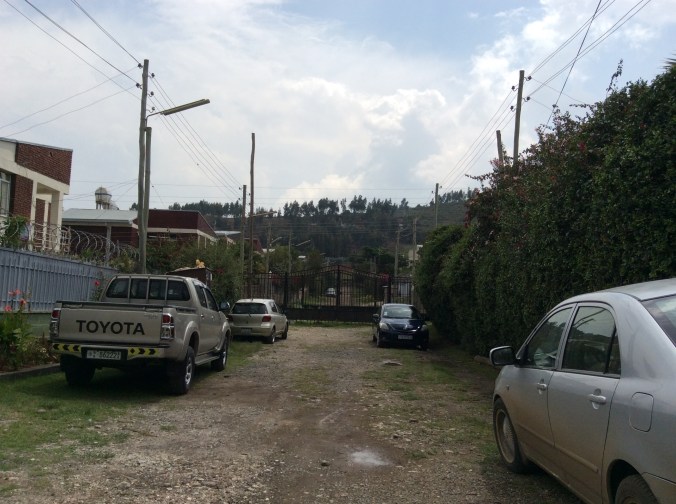
This is a typical residential street in a newer part of the city.  A gate with a guard can be found at each end of the street.

IMG_0215

In other parts of the city, houses have walls around them and you back your vehicle out into a street like this, then go to the main street.

IMG_0207

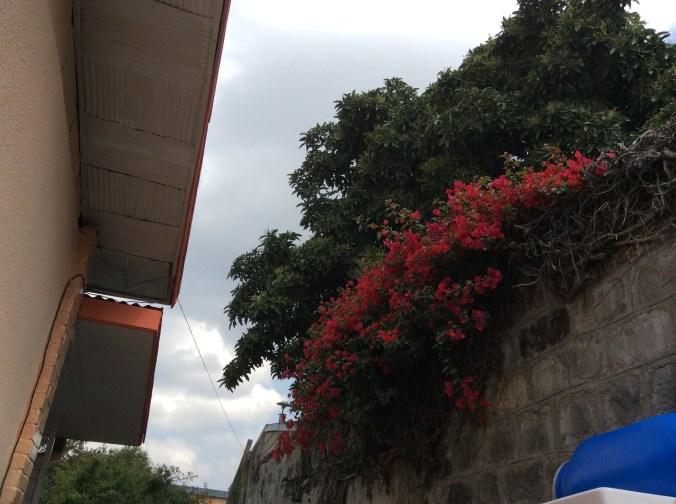
Walls around houses are not bare.  Lush tropical vines and flowers cover many of them.

IMG_0218

Many of the fancier, famous hotels, like the Hilton here, contain fountains and gardens. My friend and I could not resist a photo in front of the pool and fountains.

IMG_0219

After wandering around the Hilton we drove to see the grounds of another famous hotel where foreign diplomats often stay.  The plants in the foreground are papyrus.
IMG_0220

IMG_0222

These extensive gardens take a while to walk around.  Many of the plants and trees are labelled.  From here we could see the Addis skyline.

IMG_0227

We stayed in Addis a couple of days.  Before we left on a ten day road trip, my friend’s sister took us to a traditional restaurant.  I expected it to be filled mostly with tourists–was I ever wrong.

IMG_0240

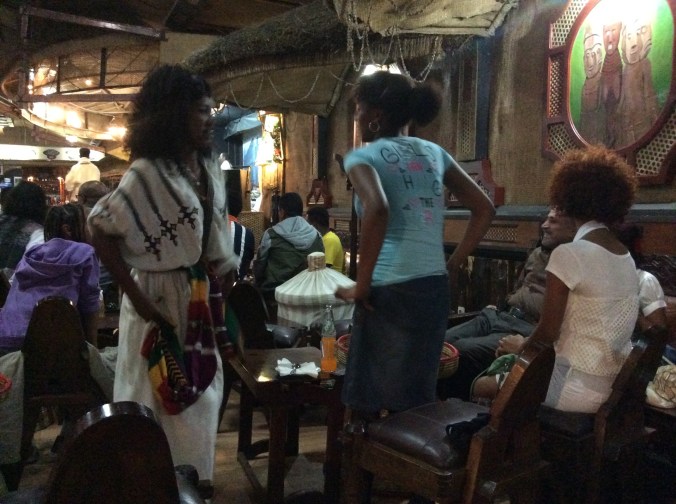
In addition to traditional food, this restaurant features traditional dancing.  Many locals came to compete, to try to out-dance the professional dancers.

IMG_0242

The lady on the left, one of the professional dancers, and the lady on the right having a little competition.  The lady on the left is dressed in traditional dress.

IMG_0243

In the background locals try to out-dance the professionals.


Ethiopian Journey, Dubai


If you have a long enough layover in Dubai, they put you up in their Emirates hotel and feed you in the cafeteria free.  The hotel is nice, the food excellent–quite a nice perk.  From the hotel it is easy to walk to several places as well as take a van tour around the city.  We did both.
IMG_0167

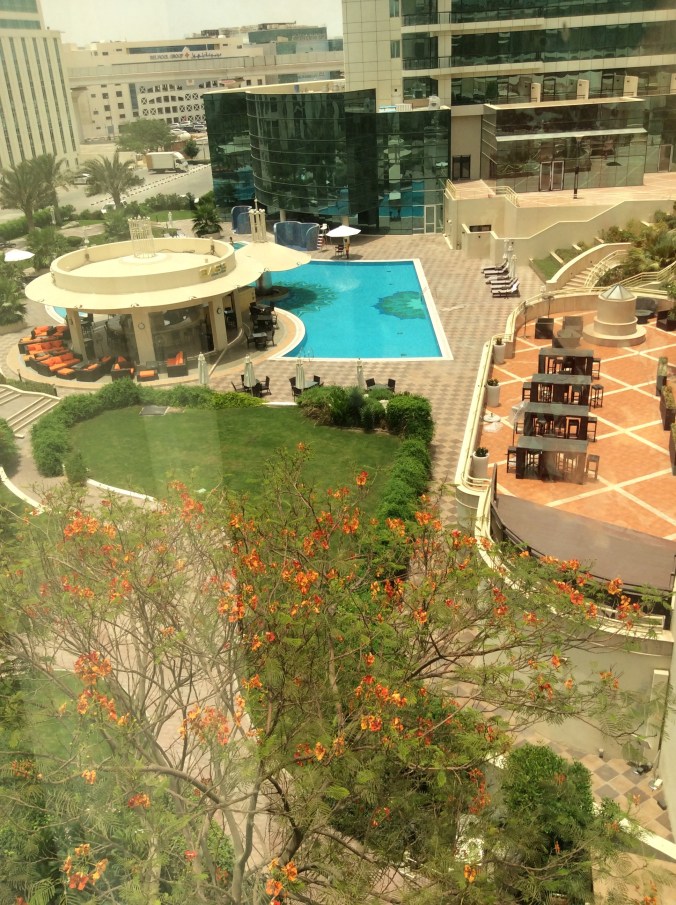
The view from my room.  The pool has a swim up bar but it is not open during Ramadan which was occurring two years ago when we were there.  Alcohol is available in some restaurants and bars but you must imbibe inside.

IMG_0169

One of the first places we visited on the tour was this mosque, designed to look like the famous mosque in Istanbul.  The following photos are of typical houses near the mosque.

IMG_0170

IMG_0171

IMG_0172

IMG_0180

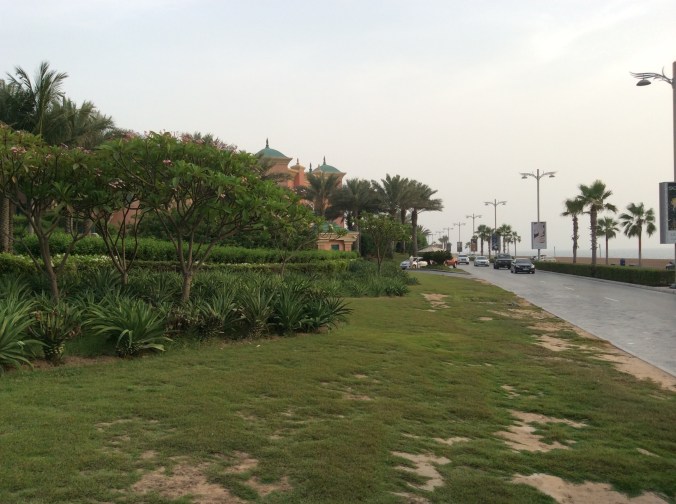
Then we arrived at the beachfront of the Persian Gulf.  The water is warm, like lukewarm soup.  In the background two of the most expensive hotels in the world tower above the water.

IMG_0184

The street goes along the waterfront with luxury hotels on the left.  Many of these areas are fill–manmade peninsulas.

IMG_0185

You can visit the sister hotel in the Bahamas.

IMG_0189

Because of the fill, the fake peninsulas, it is easy to get a bit disoriented.  Plus during the summer there is so much haze, it is rather difficult to determine directions.

IMG_0190

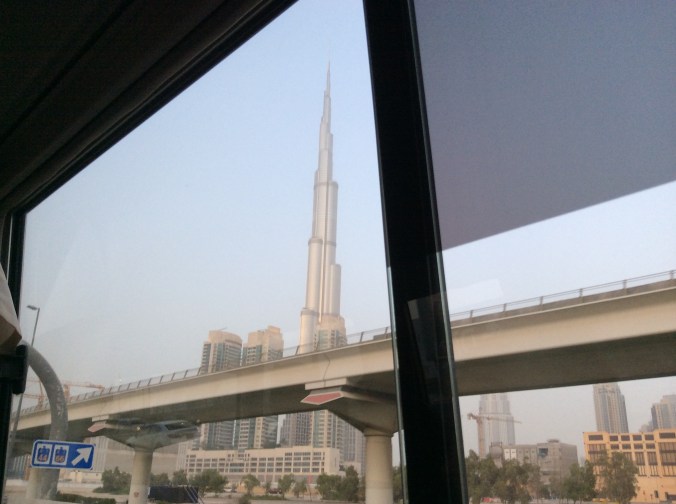
The tallest building in the world.

IMG_0191

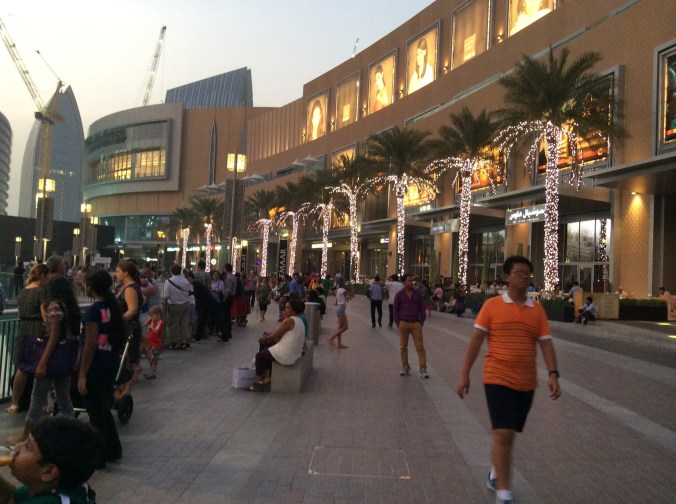
After visiting several smaller shopping areas, we arrived here, the famous Dubai mall.  This is the largest aquarium in a mall in the world. Here you see people from everywhere in the world dressed in every way imaginable.

IMG_0192

A children’s store across from the aquarium contained this lollipop tree with giant lollipops.

IMG_0194

In spite of high heat–it was 108 when we arrived–no wind and high humidity (yes, because on the Gulf, even though it is desert, the humidity is stifling), many people were outside awaiting the fountain show.

IMG_0198

One part of the skyline reflected in the lake.  The fountain show, synchronized with music, is worth the wait even in the heat.

IMG_0202

On to the gold and silver souk.

IMG_0203

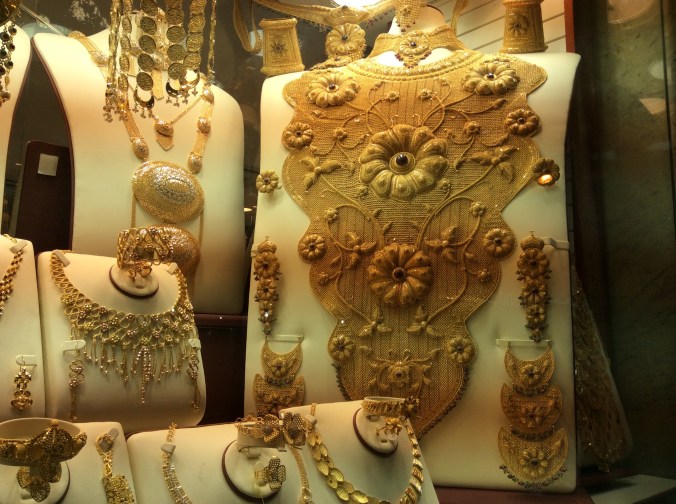
Gold and silver are sold by weight.  You can also buy gold in shops at the airport; however, nothing quite has heavy and exotic as some of this.

IMG_0204

We did actually shop in the food shops and bought nuts covered in various spices to take along for snacks.

IMG_0205

Ethiopian Journey–The Beginning


Two years ago today, two friends and I flew from here to Dallas to Dubai.  The final destination:  Ethiopia, where I spent nearly three weeks with them and my friends’s family plus a road trip through the north.  Ethiopia was nothing like what one sees in the news, in famine photographs, nothing like the image most people in the USA have of it.  My main goal when I returned home was to show people photos and inform them what it really looks like, how incredibly beautiful it is there.  This mission continues two years hence.  For the next several weeks I plan to relive this journey and share it on my blog here.

It is a short trip from Amarillo to Dallas via air.  In order to carry the baggage allowed on Emirate Airlines, we first flew via Southwest to Love Field, then took a taxi to Dallas International.  If you plan to fly long distances, I highly recommend Emirates Airlines.  Compared with all the others I have experienced even coach class is wonderful:  bigger seat room, more than a hundred movies to watch, good food, an area where you can help yourself to fruit and snacks, unlimited wine and beer, and an international group of flight attendants.

From Dallas to Dubai is fifteen hours of flying.

IMG_0155

IMG_0163

People wonder why they fly over Greenland, Iceland, northern Europe to get to Dubai.  Do not look at a flat map.  Get a globe and trace the route.  It is the shortest way to go.  Dubai is not like many think here.  No, I did not see endless lines of Lamborghinis and Ferraris.  In fact, I do not recall seeing any at all.  Tomorrow, photos of Dubai before heading on to Addis.

The Mabel Dodge Luhan House in Taos


For years I had read and heard about this place, even attended a lecture by a descendent of one of her frequent guests who actually knew her when he was a child.  This past weekend good friends from Rociada took me there with my best friends from college years, friends from long ago, visiting from California.

I already knew something about Mabel and her friends, famous people who frequented her salon, created the artistic mystique that still hangs over Taos.  When I returned home, I wanted to know more.  Born into Buffalo, NY, high society, she had been married and widowed by the age of 23.  As a young woman she was openly bisexual; her memoir, “Intimate Memories”, provides a frank discussion of this part of her life.  Several years after her first husband’s death, she married the architect Edwin Dodge.  They lived near Florence, Italy, for seven years where she entertained such notables as Gertrude Stein, Alice B. Toklas, and Andre Gide.  After affairs and two suicide attempts, she separated from her husband and moved to Greenich Village.  Eventually, she married her third husband, the painter Maurice Sterne and became a patron of the arts.

In 1917, she and her husband moved to New Mexico.  This changed her life; she lived there until she died 45 years later.  She preferred Taos to Santa Fe, finding the latter “too civilized”.  She found New Mexico “alive” and fell in love with Pueblo culture eventually even cutting her hair to mimic Pueblo style.  Sterne did not find New Mexico to his liking and left.  After their divorce she married her long standing love, Antonio Luhan, a Taos Pueblo man.  They remained married 40 years.

Mabel entertained a nearly endless array of famous artists, writers, and intellectuals:  D.H. Lawrence, Georgia O’Keefe, Willa Cather, Ansel Adams, Carl Jung, Emma Goldberg, Margaret Sanger, the founders of the Taos Society of Artists.  She introduced New York and the east coast to New Mexico through her columns in “The New York Journal”.  Mabel died in 1962.

IMG_2284

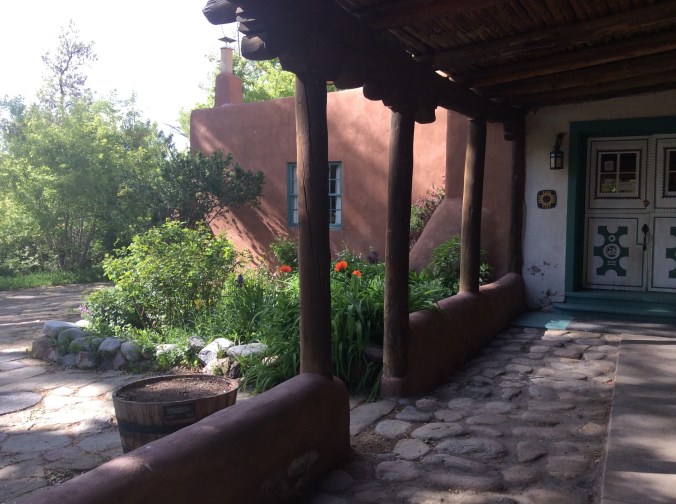
A view of the main entrance and the largest portion of the house and grounds.

IMG_2274

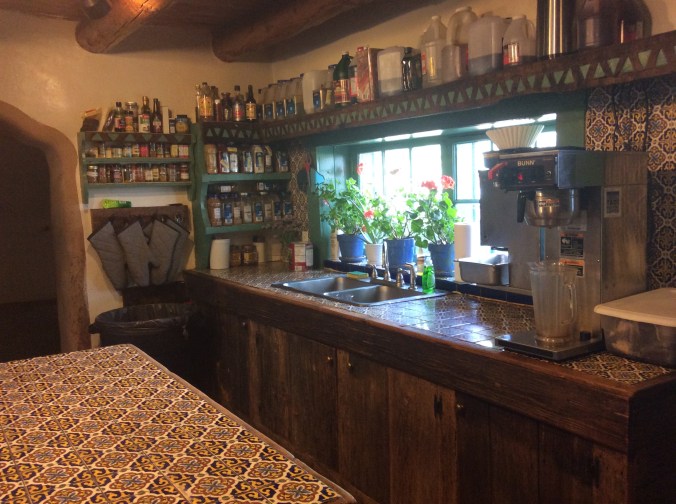
A small portion of the kitchen.  Cookies, coffee, fruit infused water, and tea were available in the dining room for hotel guests. Books with historical photos lay out for visitors to read in an adjoining room.

Dennis Hopper bought the house in 1970 and recreated her “salon” hippie style.  In 1977, he sold it to George Otero.  Because of years of neglect, it required extensive restoration.  The Oteros turned it into a non-profit where they held workshops.  The Attiyeh Foundation, its current owners, purchased it in 1996 and run it as a hotel and conference/retreat center.  It costs nothing to visit and wander around.

IMG_2281

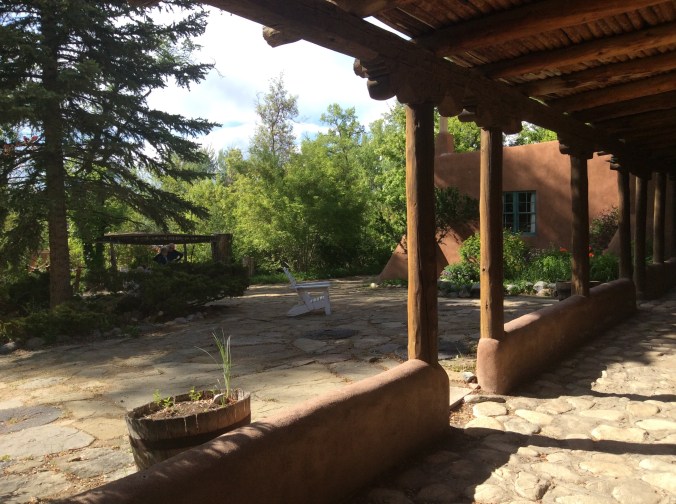
This photo was taken from the same spot as the first one, looking to the right instead of toward the entrance.

IMG_2282

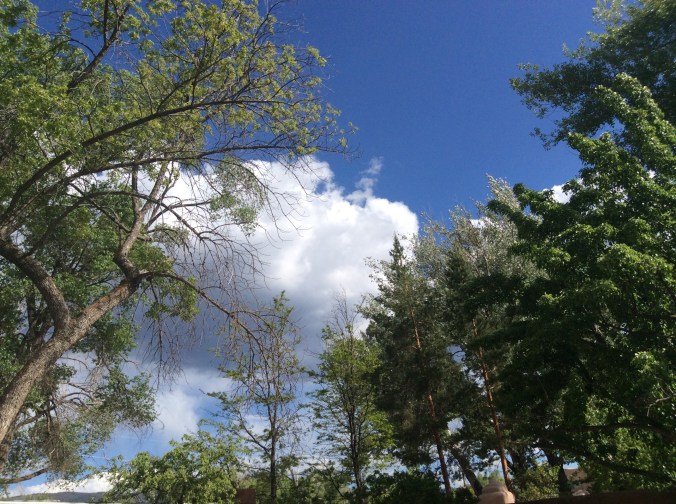
While standing there, I looked up into that incredible New Mexico sky.

IMG_2279

A close up view of the entrance.

IMG_2276

Look at all the bird houses.

IMG_2275

Beside the kitchen, out a side door–patio and horno (traditional clay oven) shaded from the afternoon sun.

IMG_2277

IMG_2280

Friends chit chatting while I wander around taking photos.

For more details, go to:   http://www.mabeldodgeluhan.com.  This includes history, accommodations, workshops, etc.  The accommodations portion even tells the site visitor who slept in each room when visiting Mabel.


Driving on Your Own in Costa Rica–Hotel Playa Negra


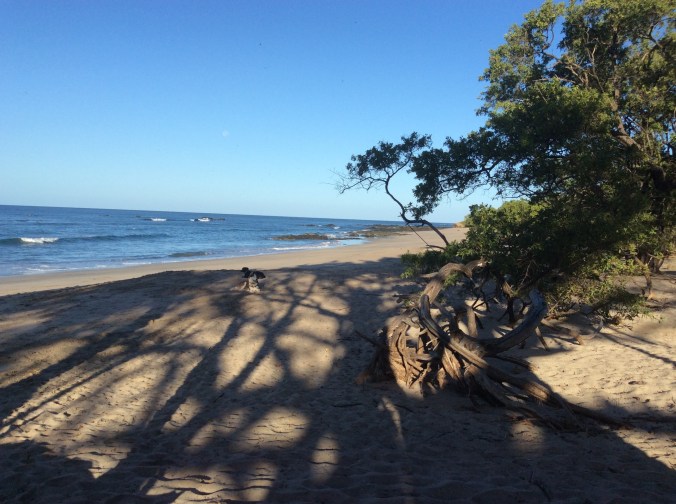
On March 17, I related the story of having to leave the first hotel in this area after dark with nowhere to go–see first post on driving on your own.  It was not until I awakened the next morning, dressed, and went in search of coffee, that I realized just how lucky we were.  I left my daughter and grandson asleep and ventured toward the restaurant indicated by a small sign.  I had not walked far when this scene greeted my eyes.

IMG_2068

Horses right by the beach.  Perhaps these were the horses one could ride–I had just seen a sign indicating horse back riding was available.  Then I walked a bit further and these scenes welcomed me.

IMG_2069

IMG_2070

IMG_2071

Except for the two dogs you can see here, no one was at the beach.  The tranquility amazed me.

IMG_2072

I walked back inside the restaurant–here I am standing at its edging looking toward the beach–ordered cafe con leche and luxuriated in our incredibly good karma.  This place exceeded all expectations considering our experience the previous night.

IMG_2074

This photo was taken from the beach looking back at the restaurant.  Except in colder areas like San Jose and Monteverde, I never saw or ate in any enclosed restaurants.  Even the fanciest are open air like this one.  Hotel Playa Negra is the only hotel near Playa Negra next to the beach.  It is a quiet, peaceful place with yoga, horse back riding, surf boarding lessons–the surf here is for beginners.  The restaurant serves a wide variety of food, but since I especially like the typical cuisine, it seemed perfect–more gallo pinto, platanos fritos, cafe con leche.