Make America Great Again?


Although few argue with the spirit of the Declaration of Independence, few look long and hard at the history and life then.  Unless you owned land, were male, were white, nothing for you.  Most of the founding fathers still held, tacitly or openly, to the old English class system.  Many owned slaves even when they claimed to dislike it.  Throughout United States history,  a small group of high status, white men have controlled the country.

More recently during WWII, we imprisoned Japanese Americans but not Germans.  The Japanese were often seen as ruthless, barbaric while the Aryan German remained quite close to the idealized, white, patriotic American ideal.

Today when people read about white men murdering large numbers of people, the news and the comments indicate that most think these people are abnormal, not like the rest of us.  This is a country fascinated with hate.  For many in the last couple of years this has taken the form of hatred of outsiders, refugees, dark people.  This has brought a new wave of tough on crime mentality.  People who think differently, more welcoming, more critical, are seen as subversive, anti-patriotic.  Much of the public sees certain groups, e.g. black men, as criminals, wicked, violent, groups to be feared.  Any research contrary to these prevalent views tends to be hidden, pushed away, unreported.  One example is a report by Homeland Security in 2009 which warned law enforcement agencies about the dangers of right-wing conservatism.  Certain conservative groups demanded the withdrawal of this report and succeeded.

Certain Christian groups push for a return to Christian values not realizing perhaps the origin of some of these values.  The word, evil, provides an excellent example.  This word goes back to Saint Augustine who defined it as a refusal to act morally, a refusal to do good.  While Hitler, the Holocaust, and Nazism have been associated with evil, interestingly fascism has not. Franco in Spain escaped the evil label probably because the Vatican, the US government, and US businesses supported him.  The word evil is rarely used to describe state sanctioned violence as in the US support of the Shah of Iran, Pinochet in Chile.  It appears we pick and choose the evil label to suit certain purposes.  Powerful groups are rarely labeled evil and therefore do not become targets of general hatred.

Fear relates to hate.  People hate what they fear.  Some media play on these fears to incite hate to suit their own goals and philosophies.  Certain talk radio hosts use their rants to further their goals in this manner.  They want people who do not think like they do to incite fear which leads to hate. These media can easily inflame the public fears about crime, refugees, drug usage.  They also rely on the often hidden preexisting prejudices that many deny they have, e.g. racism, fear of outsiders, fear of differences.

The ultimate end of these prejudices is war.  The often popular belief remains:  justice and goodness can be attained via violence, force.  We are good and everyone against us is evil and therefore to be hated.  The war vocabulary remains part of common everyday language:  War on Women, Drug War, War on Poverty.  Our language remains full of these types of communications.  It expresses a common worldview. Problems can be solved by force.  This continues in spite of enormous evidence that it does not work.  The War on Drugs never attained success, our economic and social problems remain.  Even efforts at containment frequently fail, e.g. the current opioid epidemic.  Many schools currently hire police officers and sometimes students are arrested for relatively minor infractions.  Often those arrested are students with certain types of disabilities or from certain minority groups.  Our prison population has increased by 500% over the last thirty years with the increased imprisonment of women double that of men, mainly due to drug related crimes.  Obviously, these “wars” are failing. Because of the “cult” of individuality and freedom, people in the US often see these failures as the result of individuals acting irresponsibly rather than societal failures.  Although these factors do not force an individual to behave in certain ways, they do affect a person’s psychological makeup, opportunities for betterment, and mental and physical health.

We have become a society possessed with fear and hatred caused by a profound mistrust of others.  Contrary to what many wish to believe this nation has a long history of obsession with perceived enemies and evil.  Some see threats everywhere, liberals hate conservatives and vice versa, some fear and hate those with different sexual orientations, the list seems endless.  Many see the solution as one form of war or another either through violence, incarceration, or laws.

Mass rallies on both sides further incite this sort of mass mentality.  History remains full of disastrous consequences of such behavior.  The Nazis came to power this way and killed millions of Jews via such strategies.  The genocide in Rwanda is another example. We see the perpetrators of such as monsters, but common, ordinary men and women made the Holocaust possible.  Good, decent people engage in horrible crimes.  The Ku Klux Klan continues with membership of otherwise ordinary, upstanding citizens. Doctors in Nazi Germany rationalized their help with exterminations and experimentations as part of German nationalism to save their country.

In the US racism is not the sole purview of white bigots.  Just recently someone commented to me about being colorblind.  Such is a form of denial.  When people see another person, they notice how they look, eyes, height, etc.  Most white people in the US today never choose to recall, if alive then, and acknowledge, if not,  the millions of black people (mostly men) lynched, most of whom were raped, tortured and castrated before they were killed.  When someone commits these types of atrocities today, we often refer to him as a monster.  We conveniently forget the long history of atrocities against all people of color in this country, atrocities deemed perfectly normal at the time.

As noted in the examples above, much of the violence and hatred and injustice currently seen in this country has a long history.  We have not been able to even come close to the ideals espoused in the Declaration of Independence. Instead of talking about Making American Great Again, we need to change the conversation into a future vision of making the US like the vision detailed in this document, a place where justice and the hope of equality can be attained by all, regardless of color, ethnicity, gender, sexual preference, religion.


Note:  Recommended readings include “Considering Hate” by Kay Whitlock and Michael Bronski and “White Trash:  the 400-Year Untold History of Class in America” by Nancy Isenberg.


Star Tree – Star Goddess by Judith Shaw


See the paintings. With deforestation affecting so much of the world, the idea of trees as sacred is especially appealing and meaningful.

Judith Shaw's avatarFeminism and Religion

judith shaw photo

In a world where humans were small and nature was big, surrounded by forests of trees of immense size and stature, it’s not surprising that the ancient Celts came to hold trees as sacred. Like many others, the Celts revered the World Tree or the Tree of Life as the mythic bridge between heaven and earth. The roots reach down and ground with the Earth while the branches spread their canopy up to the heavens.

View original post 745 more words

Religion and Politics


The two things some of us were taught never to discuss in social situations.  Reading The Silk Roads, A New History of the World, simply reaffirms why those who wrote the United States Constitution insisted on separating religion and politics.  Mixing the two leads to tyranny, war, misunderstanding, and a host of other ills. When did this mixture start?  Prehistory or at least the early recorded history.

Constantine, the Roman emperor,  converted for political purposes.  The Persians tolerated a wide variety of religions until it was no longer politically expedient; then they decided to persecute Christians and declare Zoastrianism as official.  When the barbarian hoards from the steppes started to overrun both the Roman and Persian Empires, they decided to cooperate–a huge change–and actually built a wall between the Black and Caspian Seas to stop the uncivilized.  Roman soldiers guarded the wall.  This helped Rome little, however, because the Visigoths sacked Rome.  The barbarians won.

And then there was Constantine’s Counsel of Nicea, held in 410, 420, 424.  The “eastern” bishops were not invited.  Therefore, the results applied only to what later became known as Roman Catholicism. Infighting among bishops, arguments over who was right and wrong continued, and on and on.  Eastern bishops saw the western teachings as heresy. The arguments mainly centered on the divinity, or lack thereof, of Jesus.

The western church focused on rooting out unofficial religious views, while the east focused on missionary activity.  The king of Yemen even became a Christian. Rulers converted, shifted allegiances, persecuted or tolerated, according to political expediency.

Little seems to have changed in 1500 years.


Meeting Phrike: Feminist Theology and the Experience of Horror by Jill Hammer


Today, I planned to write my own blog post this evening after work. Just before I read this post, I mulled over topics, whether I wanted to share a recipe or write about so many disturbing as well as inspiring events I experienced or watched in the past week. Then today a student in one of my classes loudly questioned whether the Holocaust even occurred. This was followed by another student announcing that Jews are not people. As I read through my emails, this blog post appeared. It seemed especially telling given that experience. I refuse to tolerate comments that denigrate the religion, race, ethnicity, gender, sexual preference of anyone.

Jill Hammer's avatarFeminism and Religion

Myself, I saw the numb pools amidst the shadows; myself, the wan gods and night in very truth.  My frozen blood stood still and clogged my veins.  Forth leaped a savage cohort… Then grim Erinys (Vengeance) shrieked, and blind Furor (Fury), and Horror (Phrike), and all the forms which spawn and lurk amidst the eternal shades.

Seneca, Oedipus (trans. Frank Justus Miller)

Horror is not a cognitive but a physiological or affective extra-discursive state of being. Not unlike the state of, say, feeling nausea, horror is a state of being, whose manifestation, based on the etymologies of the Greek φρiκη [phrike] and the Latin horror, may be described, as Adriana Cavarero writes, as “a state of paralysis, reinforced by the feeling of growing stiff on the part of someone who is freezing,” and further, through her mythological reference to the prototypical figure of horror, Medusa, as a state of “petrification”…

View original post 1,420 more words

The Chandravati Ramayana: A Story of Two Women by Vibha Shetiya


Although I do write many original blog posts, many times I see something that I think needs to be shared with others, something new, enlightening. This post tells a story I had not previously heard, an important story.

Vibha Shetiya's avatarFeminism and Religion

vibpicAlthough “the” Ramayana is a fluid narrative, scholarship has traditionally recognized the Sanskrit Valmiki Ramayana as the most authoritative of Ramayanas. But recent studies have brought to light the hundreds of regional stories of Rama and Sita which are more popular with the masses. These would include Krittibasa’s Ramayana in Bengal, Kamban’s Tamil Iramavataram in South India, notably in the state of Tamil Nadu, Tulsidas’s Ramcharitamanas among the Hindi-speaking belt of northern India, and so on. But even here, a pattern seems to emerge; all the above-mentioned authors are male. Within this scenario, a rather unique text stands out, and that is Chandravati’s sixteenth century Bengali Ramayana, for its author was a woman. Even more fascinating is the double-toned nature of the narrative – through Chandravati’s own voice and through the voice of its tragic heroine, Sita.

Chandravati (ca.1550-1600) was born in a village in eastern Bengal, today in…

View original post 1,122 more words

The Fringe is Our Stronghold by Oxana Poberejnaia


Women and historically other oppressed persons will often create their own spiritual traditions to stay sane, feel valued, survive.

Oxana Poberejnaia's avatarFeminism and Religion

oxanaRecently I have come across several stories of women’s fringe spiritual movements or practices. This made me think about the role of outsiders’ or minority views in religions and society.

Patriarchy pushes women and their issues to the margins of society and religion. It seems that there women sometimes invent their own spiritual practices. These allow women to stand their own ground in religious matters, to preserve self-respect and to keep the hope of the highest spiritual attainment.

Quite often these beliefs and practices seem shocking in their bizarreness and their stubbornness not to accept orthodox norms.

View original post 940 more words

Naked and Unafraid: Mahasveta Devi (1926-2016)


A powerful story of the power of woman and in this case of “right”.

Vibha Shetiya's avatarFeminism and Religion

03devi-obit-master768 Photo credit: The New York Times

Mahasveta Devi died last month at the age of 90 in Kolkata, India. A widely acclaimed Bengali writer, she identified as an activist first, clearly evident in her meticulously researched “fiction.” Most of her stories champion the cause of those living on the margins of society, particularly the Adivasis or original inhabitants of India; poor, unemployed and itinerant, they traditionally subsisted off the land, and continue to struggle against exploitative upper caste landowners.

I cannot claim to be an expert on Devi or her activism, but there is a story I read a few years ago, which never fails to haunt me, whether because of the rawness with which she describes the harsh reality faced by tribal people or because of what can be seen as the violent but ultimate triumph of its female protagonist, I cannot tell. Perhaps because of both, or because…

View original post 1,120 more words

“All Children Are Our Children” by Carol P. Christ


This is a rather long read the gist of which is this: what if “we were taught to love and nurture and be generous to others” and these were the primary values in the world rather than the current values. “What if we were taught to open our hearts to the world? Would domination, violence, and war be possible?”

Carol P. Christ's avatarFeminism and Religion

Carol P. Christ by Michael Bakas high resoultion“All children are our children.” As I was posting my recent blog about the shooting of black men by the police, these words came into my mind with the force of revelation. At the time I was looking at a photograph of Philando Castile, taken at his place of work. Yes, I thought, my heart opening: “he is my child too.” This widening of the heart is at the center of the maternal values of ancient and contemporary matriarchal cultures around the world. It is a feeling some of us who were mothered well enough or who mothered children—including children not our own—carry within us. Is this the healing balm our world needs today?

Maternal  values?  So many of us turn up our noses at such a “gendered” term. Perhaps we were not mothered enough in our families of origin. Perhaps we still feel un-mothered. Perhaps we don’t want…

View original post 814 more words

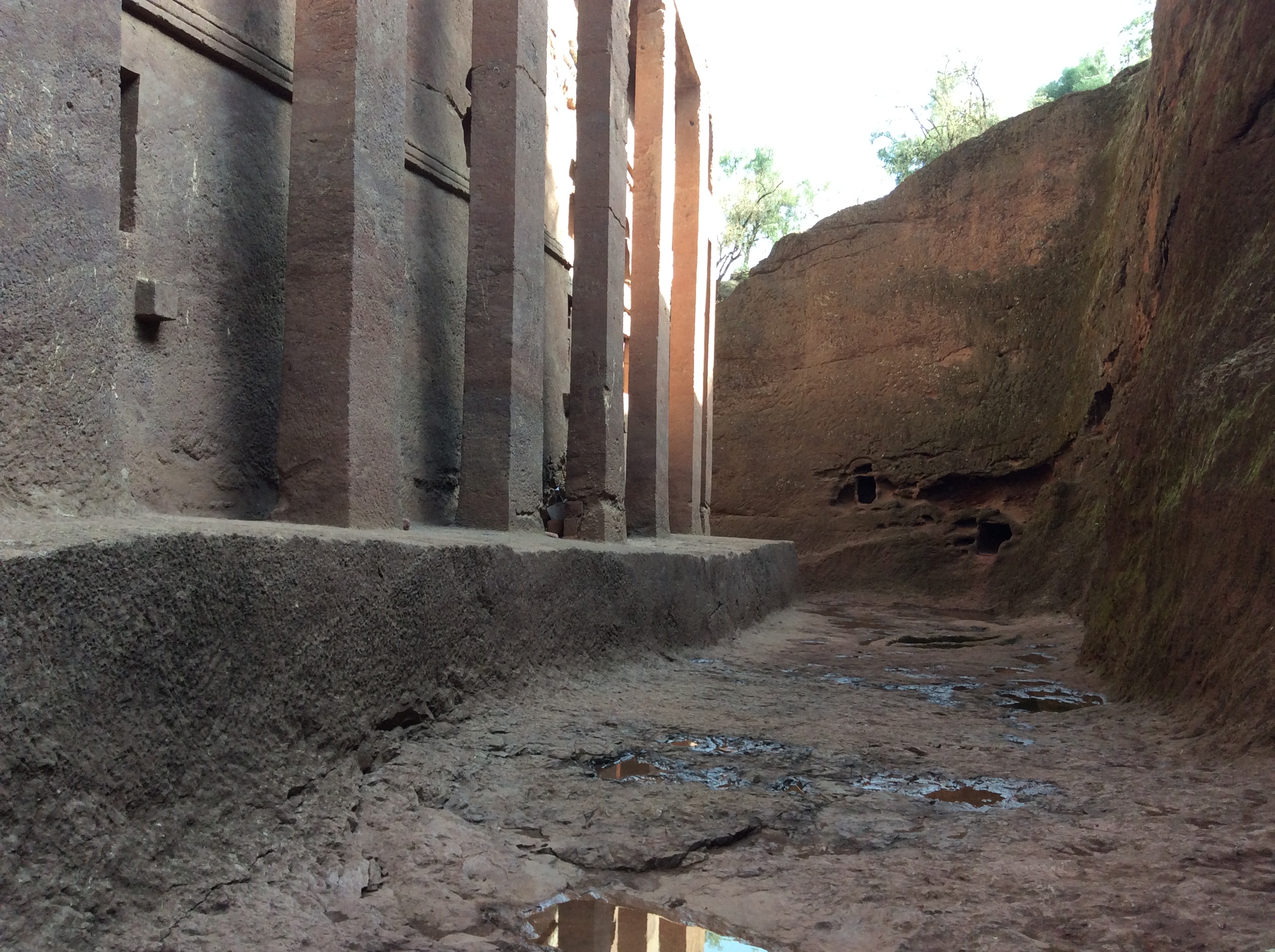
Ethiopian Journey–Ancient Churches of Lalibela


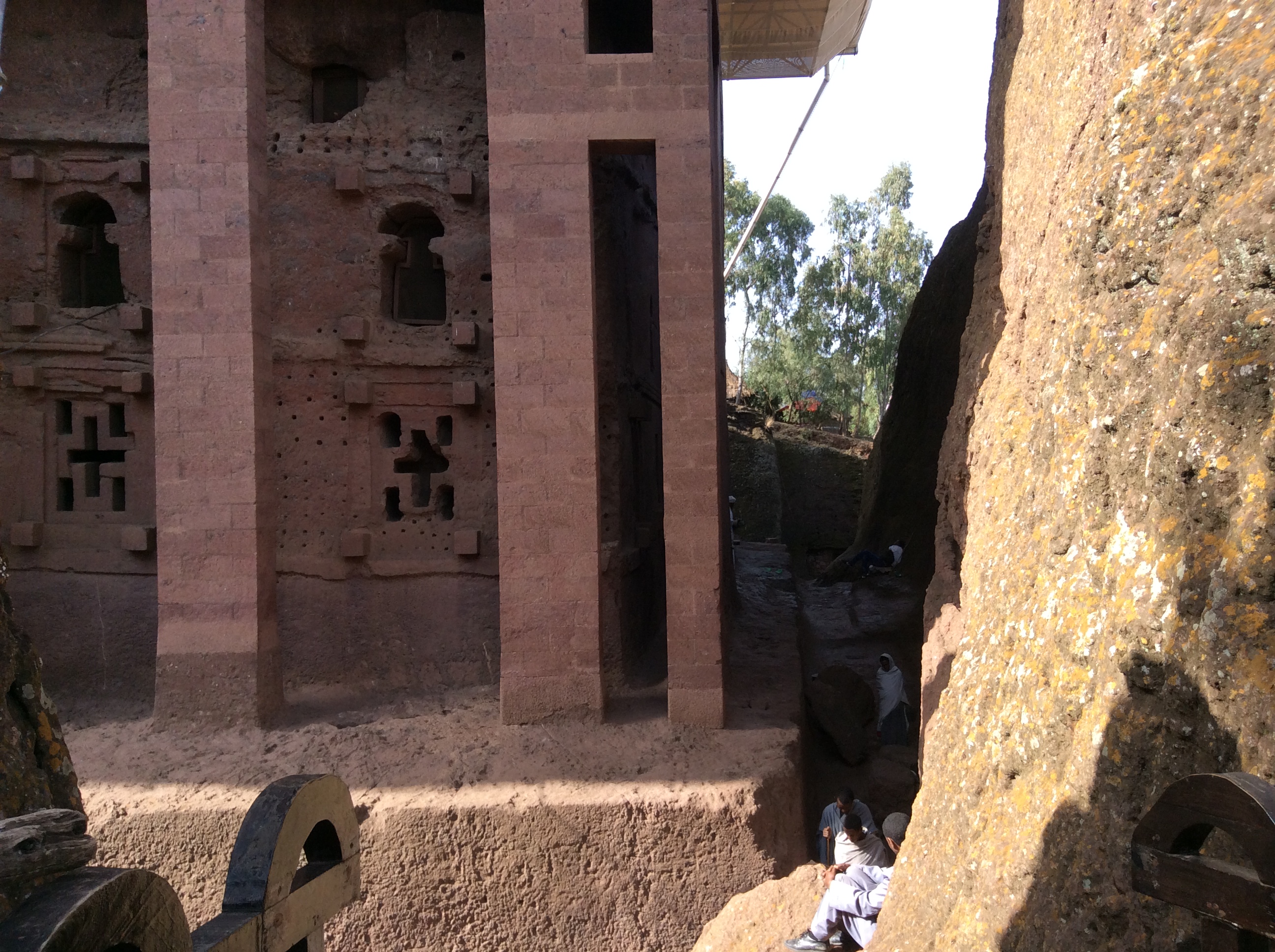
In the 12th century the king of Ethiopia decided to build a New Jerusalem.  Eleven churches were carved out of solid rock on the mountain top in the village of Lalibela.  A UNESCO World Heritage site, these churches remain intact and in use.

IMG_0428

They were all carved from the rock top of the mountain down into the earth so that they remain invisible unless the person is only a few feet away.  This protected them from the vision of potential invaders, usually Muslims from what is now Sudan.  The above is probably the most photographed of these churches and stands separate from the others.

IMG_0429

My friend is standing near where the stairs lead down to the bottom where visitors and worshippers can enter the church.  Visiting all these churches in one day is not an activity for the faint of heart or for one terrified of heights.

IMG_0401

This is the first church we visited.  It still mystifies many as to how such incredibly intricate structures could me carved by hand out of solid stone.  Even these columns are carved out of the rock.  The “official” Ethiopian Orthodox Christian story relates how angels helped the builders.

IMG_0402

This and most of the other churches are connected by “waterways” where in the rainy season a sophisticated system of drainage keeps all of them from flooding and makes it possible for visitors and worshippers to walk along from church to church.

IMG_0407

Everything in the Christian churches in Ethiopia  symbolizes something related back to Jerusalem and the Bible.  Even though the guide explained it all in detail, keeping up with all the symbolism proved a daunting task.  Notice the swastikas.  They are ancient symbols of the eternal circle of life and death.  Hitler turned them backwards and into a totally different meaning.  There are also many different styles of crosses there, two of which can be seen in the windows of this church.

IMG_0408

This is a fertility pool.  In the past a priest got in the water–it is very deep–with a woman who could not conceive and bless her in the water.  At one point when it began to fill too much, they cleaned out the bottom and found many treasures buried there, apparently dumped into the pool to protect them from enemy invaders.

IMG_0412

The inside of the churches are intricately carved and sometimes painted.

IMG_0417

Two types of basalt exist on this mountain, soft and hard.  Churches carved out of the soft basalt have begun to deteriorate and as a consequence are covered.  As can be seen here, people still come to these churches to pray and attend services.

IMG_0419

Our guide lead us from church to church through these narrow passageways which are, as previously mentioned, used to drain water away from them in the rainy season.  If Ethiopia had a national color, it would be white.  It is not only worn to go to church and for religious purposes but in daily life as well.  It mystifies me as to how they keep whites so very white.

IMG_0430

The slit dug in the rock is part of the system of drainage.  The grass in the foreground grows out of a pool of holy water.  While we were there, a boy filled a plastic bottle with the water and left.

IMG_0435

St. George and the dragon are everywhere, not only in churches but also on beer.  He is the patron saint of the country, symbolizing the triumph of Christianity over paganism as symbolized by the dragon.

IMG_0448

The carving in many of the churches reveal a sophisticated knowledge of how to work in stone.  It is difficult to believe that this was carved by hand downward into solid basalt centuries ago.

IMG_0491

The road to Lalibela is rather daunting, climbing  higher and higher with no guard rails, nothing.  As you can see from this photo, patchwork quilt  fields cover even the mountainsides.


To learn more about Lalibela, see detailed information and explanations of their River Jordan and other religious symbolism, go to my blog posts from August 2014.

Book Review by Mary Sharratt: ESTHER by Rebecca Kanner


I am reblogging this because it fits with my next book project: poems from the viewpoint of the ancient mother goddess and others from the viewpoint of women in the Bible.

Mary Sharratt's avatarFeminism and Religion

esther

We have been lost to each other for so long. My name means nothing to you. My memory is dust. This is not your fault or mine. The chain connecting mother to daughter was broken and the word passed into the keeping of men, who had no way of knowing. That is why I became a footnote, my story a brief detour between the well-known history of my father and the celebrated chronicle of my brother.

-Anita Diamant, The Red Tent

To a large extent, women have been written out of history. Their lives and deeds have become lost to us. To uncover the buried histories of women, we must act as detectives, studying the clues left from ages lost.

At its best, historical fiction can write women back into history and challenge our misconceptions about women in the past. Anita Diamant’s novel, TheRed Tent, became such an…

View original post 777 more words