Although few argue with the spirit of the Declaration of Independence, few look long and hard at the history and life then. Unless you owned land, were male, were white, nothing for you. Most of the founding fathers still held, tacitly or openly, to the old English class system. Many owned slaves even when they claimed to dislike it. Throughout United States history, a small group of high status, white men have controlled the country.
More recently during WWII, we imprisoned Japanese Americans but not Germans. The Japanese were often seen as ruthless, barbaric while the Aryan German remained quite close to the idealized, white, patriotic American ideal.
Today when people read about white men murdering large numbers of people, the news and the comments indicate that most think these people are abnormal, not like the rest of us. This is a country fascinated with hate. For many in the last couple of years this has taken the form of hatred of outsiders, refugees, dark people. This has brought a new wave of tough on crime mentality. People who think differently, more welcoming, more critical, are seen as subversive, anti-patriotic. Much of the public sees certain groups, e.g. black men, as criminals, wicked, violent, groups to be feared. Any research contrary to these prevalent views tends to be hidden, pushed away, unreported. One example is a report by Homeland Security in 2009 which warned law enforcement agencies about the dangers of right-wing conservatism. Certain conservative groups demanded the withdrawal of this report and succeeded.
Certain Christian groups push for a return to Christian values not realizing perhaps the origin of some of these values. The word, evil, provides an excellent example. This word goes back to Saint Augustine who defined it as a refusal to act morally, a refusal to do good. While Hitler, the Holocaust, and Nazism have been associated with evil, interestingly fascism has not. Franco in Spain escaped the evil label probably because the Vatican, the US government, and US businesses supported him. The word evil is rarely used to describe state sanctioned violence as in the US support of the Shah of Iran, Pinochet in Chile. It appears we pick and choose the evil label to suit certain purposes. Powerful groups are rarely labeled evil and therefore do not become targets of general hatred.
Fear relates to hate. People hate what they fear. Some media play on these fears to incite hate to suit their own goals and philosophies. Certain talk radio hosts use their rants to further their goals in this manner. They want people who do not think like they do to incite fear which leads to hate. These media can easily inflame the public fears about crime, refugees, drug usage. They also rely on the often hidden preexisting prejudices that many deny they have, e.g. racism, fear of outsiders, fear of differences.
The ultimate end of these prejudices is war. The often popular belief remains: justice and goodness can be attained via violence, force. We are good and everyone against us is evil and therefore to be hated. The war vocabulary remains part of common everyday language: War on Women, Drug War, War on Poverty. Our language remains full of these types of communications. It expresses a common worldview. Problems can be solved by force. This continues in spite of enormous evidence that it does not work. The War on Drugs never attained success, our economic and social problems remain. Even efforts at containment frequently fail, e.g. the current opioid epidemic. Many schools currently hire police officers and sometimes students are arrested for relatively minor infractions. Often those arrested are students with certain types of disabilities or from certain minority groups. Our prison population has increased by 500% over the last thirty years with the increased imprisonment of women double that of men, mainly due to drug related crimes. Obviously, these “wars” are failing. Because of the “cult” of individuality and freedom, people in the US often see these failures as the result of individuals acting irresponsibly rather than societal failures. Although these factors do not force an individual to behave in certain ways, they do affect a person’s psychological makeup, opportunities for betterment, and mental and physical health.
We have become a society possessed with fear and hatred caused by a profound mistrust of others. Contrary to what many wish to believe this nation has a long history of obsession with perceived enemies and evil. Some see threats everywhere, liberals hate conservatives and vice versa, some fear and hate those with different sexual orientations, the list seems endless. Many see the solution as one form of war or another either through violence, incarceration, or laws.
Mass rallies on both sides further incite this sort of mass mentality. History remains full of disastrous consequences of such behavior. The Nazis came to power this way and killed millions of Jews via such strategies. The genocide in Rwanda is another example. We see the perpetrators of such as monsters, but common, ordinary men and women made the Holocaust possible. Good, decent people engage in horrible crimes. The Ku Klux Klan continues with membership of otherwise ordinary, upstanding citizens. Doctors in Nazi Germany rationalized their help with exterminations and experimentations as part of German nationalism to save their country.
In the US racism is not the sole purview of white bigots. Just recently someone commented to me about being colorblind. Such is a form of denial. When people see another person, they notice how they look, eyes, height, etc. Most white people in the US today never choose to recall, if alive then, and acknowledge, if not, the millions of black people (mostly men) lynched, most of whom were raped, tortured and castrated before they were killed. When someone commits these types of atrocities today, we often refer to him as a monster. We conveniently forget the long history of atrocities against all people of color in this country, atrocities deemed perfectly normal at the time.
As noted in the examples above, much of the violence and hatred and injustice currently seen in this country has a long history. We have not been able to even come close to the ideals espoused in the Declaration of Independence. Instead of talking about Making American Great Again, we need to change the conversation into a future vision of making the US like the vision detailed in this document, a place where justice and the hope of equality can be attained by all, regardless of color, ethnicity, gender, sexual preference, religion.
Note: Recommended readings include “Considering Hate” by Kay Whitlock and Michael Bronski and “White Trash: the 400-Year Untold History of Class in America” by Nancy Isenberg.

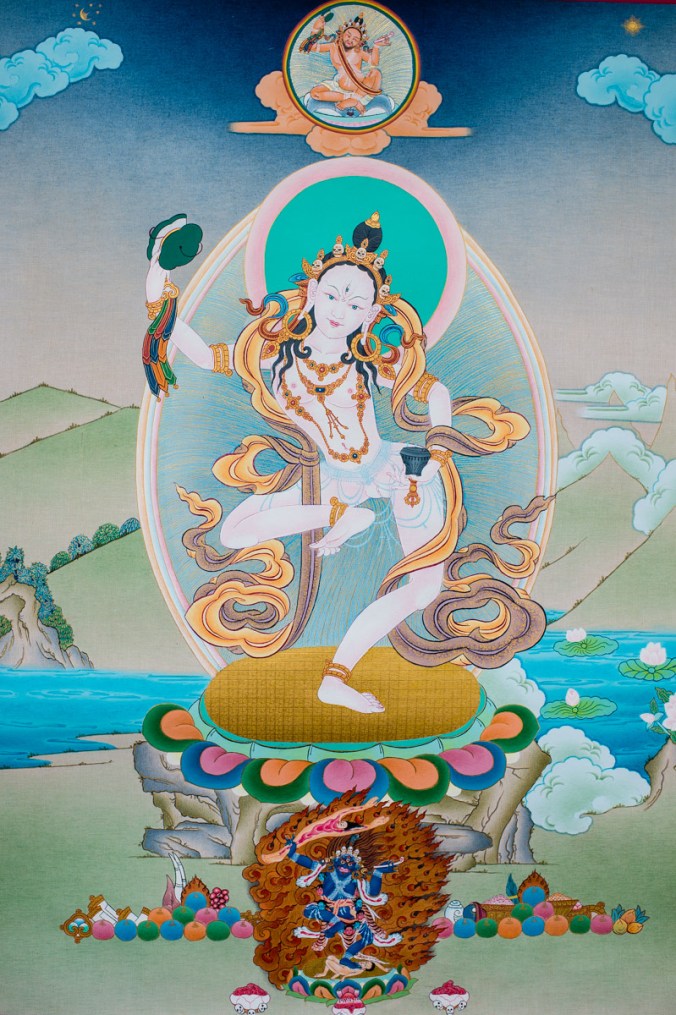 Machig Lapdron, female Tantric Buddhist mystic and lineage founder

 Doing a recent talk on pioneering woman writers, I like to do the Before Jane Austen test with my audience. Who can name a single woman writer in the English language before Jane Austen? Alas, because woman have been written out of history to such a large extent, most people come up blank. Then we talk about pioneering Renaissance authors, such as Aemilia Bassano Lanier, the subject of my recent novel,


 Although “the” Ramayana is a fluid narrative, scholarship has traditionally recognized the Sanskrit Valmiki Ramayana as the most authoritative of Ramayanas. But recent studies have brought to light the hundreds of regional stories of Rama and Sita which are more popular with the masses. These would include Krittibasa’s Ramayana in Bengal, Kamban’s Tamil Iramavataram in South India, notably in the state of Tamil Nadu, Tulsidas’s Ramcharitamanas among the Hindi-speaking belt of northern India, and so on. But even here, a pattern seems to emerge; all the above-mentioned authors are male. Within this scenario, a rather unique text stands out, and that is Chandravati’s sixteenth century Bengali Ramayana, for its author was a woman. Even more fascinating is the double-toned nature of the narrative – through Chandravati’s own voice and through the voice of its tragic heroine, Sita.
