The World in One Room


Four jaguar heads stare at me,

Mexican, Costa Rican.

A third guards the mantel,

partially hidden in tropical plants,

attack ready, tail raised, jaws open,

teeth bared.


My feet rest on a coffee table

carved in Kashmir.  I look at the photo

of the young man whose family made it.

He took me home to meet his mom,

to the floating market.

Once peace reigned there.

Now I wonder if he is safe, alive.


The Hoop Dancer raises his arms,

the Acoma pot exudes ancient

black on white beauty, painted

by the tips of yucca stems.

The Thai Spirit House begs

to appease evil spirits.

I should put food and flowers there;

I never do.


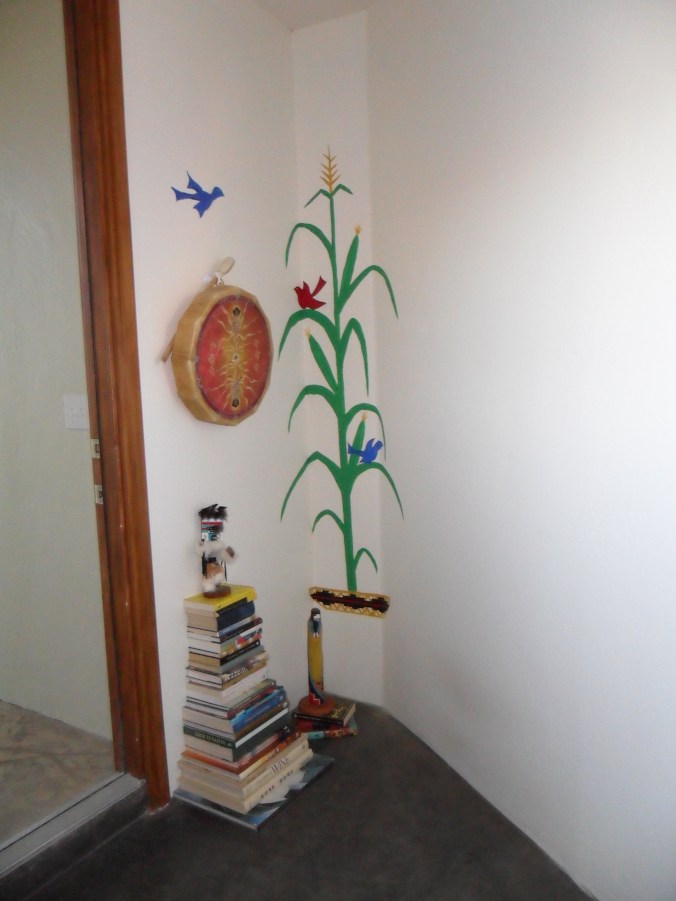
Corn plant of life–for Navaho, Hopi,

me, painted, growing up my wall,

blue and red birds flitting through

the stalks, singing ancient songs.

Corn Maiden rug hanging on the wall;

an Isleta Pueblo girl won a contest

with its design.  Four Corn Maiden

Kachinas watch the room.

Corn everywhere–Sacred Corn.


Three Ethiopian crosses, St. George

and the Dragon, Frida Kahlo doll,

Argentinian Madonna, Tohono O’odham

baskets, a painted cow skull, Nigerian carved

wooden elephants, including a Chieftains chair,

the stained glass transom window from the house

where my dad lived from birth to ten.


In a room filled with windows, there

is little room for paintings, yet–

purple bison glide across the prairie,

an Iraqi woman flies through an azure

sky filled with dark blue birds,

a 15th century mystic, Kabir, tells

a tale in poetry, Navaho spirits,

pumas walking toward me–

my obsession.


Rugs scattered–Kerman,

an unknown Persian city, Afghani,

Egyptian, Indian, Zapotec, scraps of old

Turkish rugs sewn together.


In one cabinet, Grandmother’s china,

Mom’s Czech crystal–a wedding present

decades ago, Grandson’s painted art,

the silverware Dad gave Mom on their

first wedding anniversary,  Mom’s

everyday dishes–flowers blooming.

I use them every day.


These objects–a testament to who I am:

World wanderer, seeker, citizen.

SAM_0912

SAM_0035


Summer Reading


IMG_3957Last year I joined Now Read This, the online bookclub sponsored by PBS and The New York Times.  Why did I join?  To expand my exposure to books I might not otherwise read, to learn, to explore, to interact with others reading the same books.
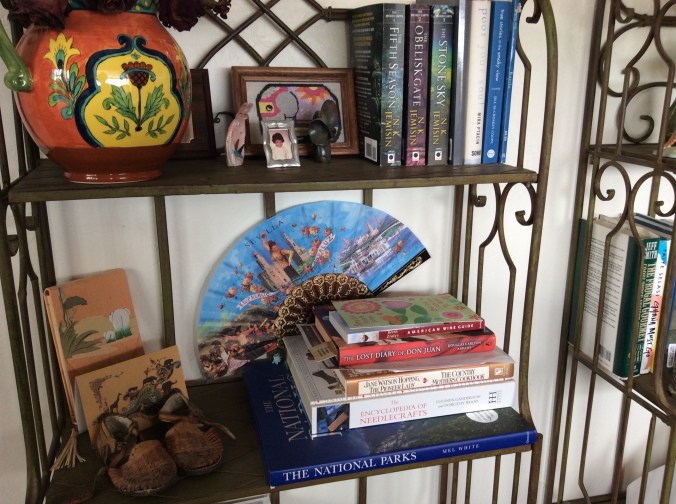
I rarely read fantasy or science fiction.  This summer has become an exception.  The June choice, The Fifth Season by Jemisin, won the Hugo in 2016.  The other two books in the trilogy won in 2017 and 2018.  I wanted to know what happened to the characters so I read them all.  The spine says Fantasy.  I think they are more science fiction.  Even people who claimed they did not like either fantasy or science fiction became like me and read them all.  This series tells a futuristic tale extremely applicable to events, both social and political, in the world today, how prejudice kills both overtly and covertly,  how fear of those who are different affect everyone, what it costs to live in a world where certain attitudes exist.

It took me two days to finish the July title even with chores, touchup house painting, all the things teachers attempt to do during summer break.  Although I had previously read at least three books by Luis Alberto Urrea, I had not read this one, The House of Broken Angels about a family who lives back and forth across the border–San Diego and Tijuana.  It is a tragic-comedy about the endurance, hopes, dreams, cooking, living of several generations.  His non-fiction book, The Devil’s Highway, is a must read for those who want to understand what occurs along the US-Mexico borderlands.

In the midst of all this, I went back and reread Ursula LeGuin’s The Left Hand of Darkness.  Wow, no wonder it caused a stir when it was published in the 1960s: a whole country where everyone switches back and forth between male and female and those who cannot do this are considered perverts.  Additionally, the main character is described as having very dark brown skin and those who do not behave exactly as they should or politically protest are sent off to a stark camp where they work in excessive cold and eventually die.

Then I read an article about Toni Morrison and authors who do not write for people based on a certain audience, e.g. black, white.  They write about what they know, what they feel, for a different purpose. One book listed was Children of Blood and Bone by Tomi Adeyemi, a fantasy, all of which takes place in what we now think of as Nigeria. It has not one single white character in it.  I kept thinking, wow.  I read a lot of literature from Africa, Middle East, and Latin America.  Most of the time, for better or worse, characters from other cultures show up, usually European and usually for the worse.  Not in this one.  If you go to a book store looking for it, look in Young Adult.  Jemisin’s can be found in Adult Science Fiction/Fantasy.  When I mentioned to someone I could not tell why some are categorized one way and some another, I was told there is less graphic sex in YA.  Really?  I cannot tell the difference.

Next on my list?  I annually act as a judge in a literary contest.  Three novels arrived in yesterday’s mail.  Guess I need to get busy.


Thoughts on New Year’s Day


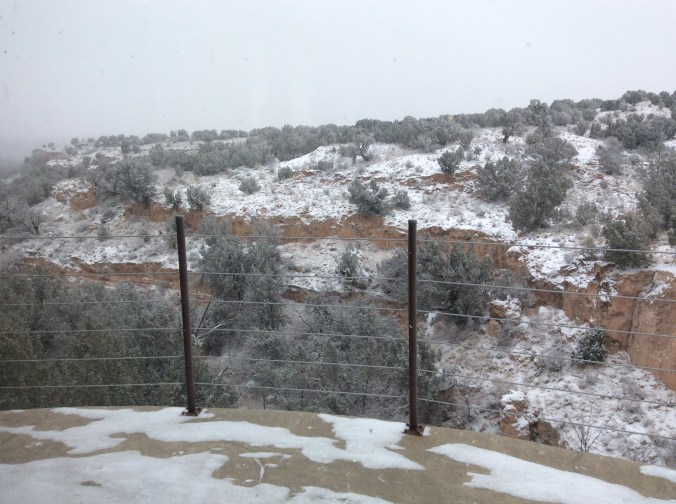
16 degrees, windchill 2, flurries.

Keep warm, reflect, remember, don’t relive,

forgive, move on.

Work hard to become the change you want to see worldwide:

-Empathy

-Kindness

-Love

-Patience

-Understanding


IMG_2908

A Season of Gratitude


It started Thursday with the Winter Solstice and the full moon:  the love, the presents, my astonishment.  You cannot go wrong with moonlight hanging over a canyon.  It never disappoints.

Then on Friday, astonishment.  Teachers never expect what I received.  I expect excellence and hope most learn something new, learn that books they will like exist, that they can do more than they ever dreamed.  We do not expect presents.

By ten on Friday, my classroom was covered with gifts and food.  Here is a list of some of the presents I received from my students:

frankincense and myrrh soap

a book about wine–yes, it seems they know me

a 4 by 4 black block that says Love, Smile, Enjoy, Laugh, Sing, Live

two gifts cards from a brother and sister for renting movies along with popcorn

a Picasso scarf

a thermal cup full of almonds–I received lots of almonds

all sorts of homemade candies, cookies, and other goodies

To top it all off, a mother walked into my room and handed me a bottle of red wine with this written on it:  “Our child might be the reason you drink so enjoy this bottle on us, Merry Christmas.”  I am still chuckling about this one.

My daughter and grandson are on a cruise and will get to see several ancient Mayan temples, my son is on his way here and will arrive around noon or early afternoon, I attended a beautiful Christmas Eve service last night, then came home and continued reading a fascinating book until late, and shortly I will make pumpkin bread using Mom’s old recipe.

The moon still shines, hanging in the Western horizon.  I feel grateful.

Happy Holidays to everyone.

Juliana


IMG_3530

Note:  The Christmas tree my parents gave me decades ago with a skirt, simple fabric brought from Africa many years ago.


The Christmas Tree


In childhood, no fake tree for us.

Just after Thanksgiving, the family search transpired.

Mom and Dad preferred Douglas fir, six feet tall.

Dutifully, we kept the tree holder filled with water,

never used real candles.  We put on lights, big ones,

blue, green, red, an inch long, then carefully hung on delicate,

colorful, round balls.  The most difficult task: the icicles,

long, silver, reflective.  They had to go on just so.

Years later, children gone, Mom and Dad bought an

artificial tree, fake Douglas fir, incredibly real in appearance.


When they left Missouri for Arizona every winter after harvest,

they abandoned Christmas trees, gave me the fake Douglas fir.

I still have it.  How long?  Decades, several at least.  State of the art

when they bought it, it requires work, assembly, strings of lights.

Every year, I tell myself it is time to get one of those new trees with lights

already installed, so much easier to take up and down.  I never buy one.

I cannot bear to part with Mom and Dad’s tree.  One year, annoyed with

putting on lights, I decorated it lightless.  I missed the lights.  Now every year,

decades later, I assemble it, take the time to string the lights.  Some of the lower

branches no longer stay, but I work around that, hang the colorful, delicate

Christmas ornaments I love, collected over years and years, wrap the base in

the red and white cloth given to me from Africa. On cold evenings, like this one,

I turn off the other lights, drink tea like my mother did, and remember my

childhood.

IMG_3526

IMG_3530

IMG_3534


A Litany of Thanks


I heard this poem by Max Coots recited on Sunday and saved it to share today.


Let us give thanks:


For generous friends…with hearts…and smiles as bright as their blossoms;

For feisty friends as tart as apples;

For continuous friends, who, like scallions and cucumbers, keep reminding us we’ve had them;

For crotchety friends, as sour as rhubarb and as indestructible;

For handsome friends, who are as gorgeous as eggplants and as elegant as a row of corn, and the others, plain as potatoes and as good for you;

For funny friends, who are a silly as Brussel spouts and as amusing as Jerusalem artichokes, and serious friends, as complex as cauliflowers and as intricate as onions;

For friends as unpretentious as cabbages, as subtle as summer squash, as persistent as parsley, as delightful as dill, as endless as zucchini, and who, like parsnips, can be counted on to see you throughout the winter;

For old friends, who wind around us like tendrils and hold us, despite our blights, wilts, and witherings;

And, finally, for those friends now gone, like gardens past that have been harvested, and who fed us in their times that we might have life hereafter.

For all these we give thanks.


IMG_2714


Missouri Roadtrip-the Home Place


6CC097FA-6B1F-4C37-8170-6026A42B8C30This is he house where I grew up north of Fillmore, Missouri.  My dad lived here in this house from 10 year old to 90. He died in the month after his 90th birthday.  The house stands on the land my great grandfather established after he arrived from Switzerland in the mid 1800s.

3A97C88F-30A5-4A32-99E3-5E4D8E1172F5This is the only building left at the site of my grandparents original house and barns.  It is an old carriage house.  In this photo my daughter and grandson are taking a look.  One of the original stained glass transome windows from the house hangs in my own house. My grandparents were Lilliebelle Werth and Pleasant Lightle.
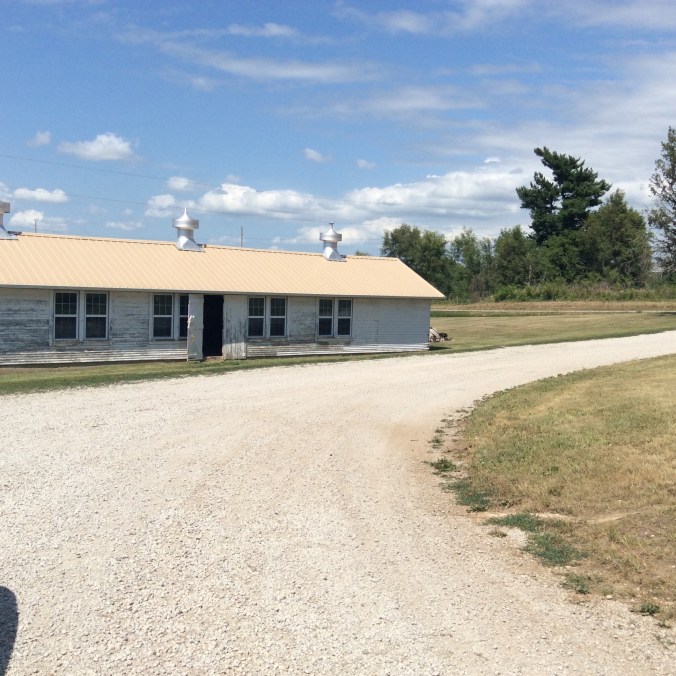
 

D44A6726-4FF1-4FB0-9F89-47F7E7C98391When I was a child, this was once a chicken house but mostly the farrowing house for our registered Hampshire hogs.  Later I learned that when first built during Prohibition, Dad held dances here which the sheriff checked to make sure there was no alcohol.
5776CE1A-1C1F-4232-BFE4-50F8B1387533

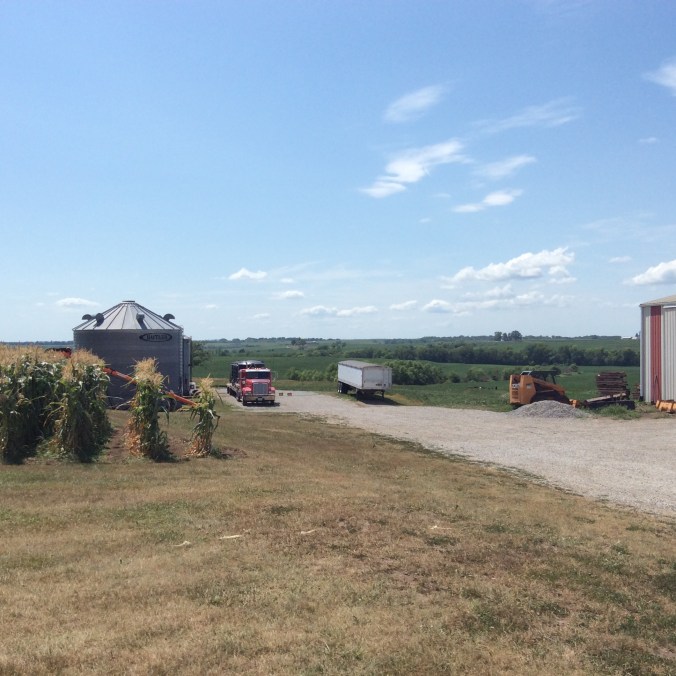
This is corn and soybean country. The view reaches across the land from the back of the home place.  We met the young couple who own the house now. They keep everything spic and span just like my parents did.  I am grateful.


050EC16C-195A-4404-8DF0-81DF5434F71E

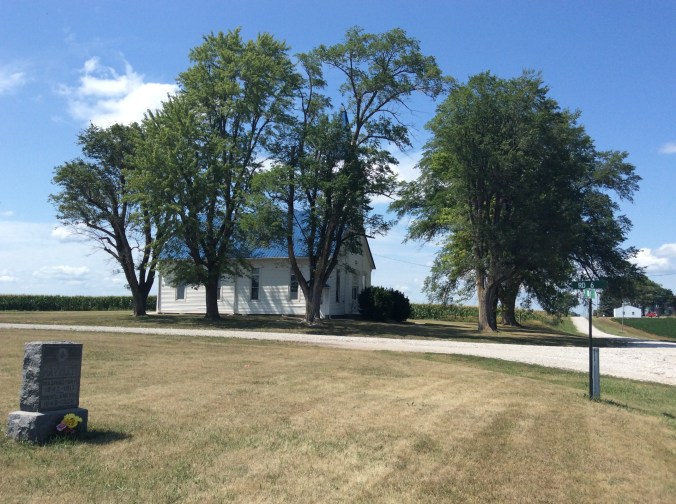
Antioch Christian Church where we attended church when I was a child.  My mom’s fruit pies were famous here.

A Letter to the Man I Loved the Most


Today is your birthday, June 6.  I cannot wish you Happy Birthday because you fell into a coma a year and 1/2 ago and died several months later.  Our daughter came over and over to see you, unconscious, eyes staring into empty space.  She drove the five hours back and forth repeatedly.  Sometimes I came with her.

What happened to you?  Your mahogany hands and arms looked as they did when I first met you decades ago.  I looked at the signs of aging on my own; yours seemed so young, ageless.  But not your face.  I wonder if I would have recognized you on the street.  I remember the first time I saw you, sitting on a sofa–fancy, engraved silver tipped cowboy boots, shirt open half way down your chest, and your smile radiating across the room.  I knew immediately I had to have you.

What happened to you?  How could I have guessed I could be so wrong, decades of believing you just left, no explanation, nothing.  Then after you are comatose and I cannot talk to you, I learn a far different truth, a truth that never leaves me, a truth from which I will never totally recover.

What happened to you?  Charming, laughing, the man so many loved.  That you.  Did the other you finally dominate–the sad, disappointed, angry you?  The you few knew, the hidden you, the one I often held, tried to protect. Now I talk to your cousin, the one you forbade to tell me the truth I never knew, the friend I thought I had lost forever.  Yesterday we talked.  Today she left me a message.  She and I will never be the same, she filled with irreparable loss, your company, your mutual love, and I with a hole in my heart that can never be filled because I cannot talk to you.

What happened to you?  A decade ago when you came to see our daughter, it was like I had seen you only yesterday, in so many ways as if we had never been apart.  It haunted me.  You could have told me then, the truth.  But no, I had to learn it by accident from our daughter.  She thought I knew, that you had told me.

What happened to you?  I look at photos of us, young, filled with hope and love and promise, smiling brightly toward a camera.  I wonder how different my life might have been.  I will never know.


My Mother–Barbie Doll


Barbara Lewis Duke, pretty petite, blue-eyed and blond, my mother, one fearless, controlling woman.  Long after Mother’s death, Dad said, “Barbara was afraid of absolutely no one and nothing.”  They married late:  34 and 38.  He adored her unconditionally.  She filled my life with horses, music, love, cornfields, hay rides,      books, ambition.  Whatever she felt she had missed, I was going to possess:  piano lessons, a college education.  Her father, who died long before I was born, loved                 fancy, fast horses.  So did she.  During my preschool, croupy years, she quieted my hysterical night coughing with stories of run aways horses pulling her in a wagon.      With less than one hundred pounds and lots of determination, she stopped them,               a tiny Barbie Doll flying across the Missouri River Bottom, strong, willful, free.

Note:  this poem is in my book “On the Rim of Wonder” and was also recently published in “Inside and Out”, a collection of writings by women.  It is available on Amazon and published by the Story Circle Network.

Addendum:  My mother loved horses and flowers.  When I look at the flowers around my house I think of my mother.  And, yes, I have horses.  The following photos are dedicated to my mother’s memory.


IMG_2230 (1)

IMG_2866

IMG_2373

IMG_2318

IMG_2304

SAM_0947

My mother’s mother and father.


Blood Quantum: A Poem for Our Time


My grandson cuts himself into 16 equal pieces:

4/16 Urhobo from Africa

3/16 Spanish from Spain

4/16 European–two Swiss German great, great-grandfathers

(Werth and Kaiser), Irish, English and who knows what

3/16 Mexican–whatever mixtures that may be

2/16 Navaho


Who am I? What am I?

Who are you? What are you?

Do we really know?

Who sets the rules?

white men

black

Indian

Native American

Irish

English

German

from where and for whom?


He looks Navaho:

-blue black straight hair

-pale brown skin

-obsidian eyes.

One four year old girl asks him,

“Are you American Indian?”

His six year old self says nothing.

She repeats,

“Are you American Indian?”

He says, “It’s complicated.”


The Navaho won’t claim him, too little blood.

He needs 1/4, not 1/8.

Caddy and Fort Sill Apache allow 1/16, not Navahos.

1/4 blood is for

-Sioux

-Cheyenne

-Kiowa

-Navaho

1/8 works for Comanche and Pawnee.

Some Cherokees only want a Cherokee ancestor.


But he is none of those.

Is he Navaho?

Is he white?

The old South goes by the one drop rule:

one drop of Negro…

Is a person with 99/100 per cent white

and 1/100 black, black?

Who says?

Kids at school ask, “What are you?”

He tells them.

They say, “You’re lying.”


I only know specifically about two ancestors,

the Swiss Germans.

Another great grandfather disappeared during the Civil War.

I don’t even know his name.

Who am I?

Who are you?

I think I’ll get a DNA test.

Then I’ll know how many pieces I need to cut myself into.


Note:  This was originally published in my book “On the Rim of Wonder”.  I had a cousin send me 75 pages of ancestry information.  I looked up more myself.  That one great grandfather remains a mystery.  I had my DNA done.  It did not match what I expected from the ancestry work.

Blood quantum is the term the US government used to determine whether a person would be qualified as an Indian.  Now many Indian Nations use it to decide who can be on the tribal rolls and who cannot.