Amazon


His milk chocolate, heavy lidded eyes stare at me from the

front of the magazine.

His cheeks display charcoal tattoos, a criss cross

design, tiny Xs on top, stopping where his nostrils flare.

His straight hair barely touches his shoulders.

not the black I expected, but the color of mahogany.

His eyebrows grow thin and wide,

no visible eyelashes.

His skin, color of morning coffee with two teaspoons of milk,

looks clear, smooth.

His full lips only slightly darker than his skin

do not smile.

He, a Kayapo Indian, continues staring.

He lives in Kayapo Territory, Brazil, land the size of

Great Britain and Ireland.

He plans to save it from the rest of us.

He plans to save us from our own worst selves.


SAM_1502


The Kayapo and other indigenous Amerindians have lived in the rainforest for millennia.  They and most environmentalists view their rainforest as a priceless haven for biodiversity.  Their Amazon remains a major defense in the fight against global warming and habitat destruction.  Fifteen per cent of greenhouse emissions, more than all the trucks, cars, buses, and planes combined, come from deforestation.  Although Brazil has slowed the deforestation rate by 70 per cent in the last nine years, last year saw a reversal with an sudden increase of 30 per cent.  Brazil also began construction of a network of canals, dams, and a huge hydroelectric project on the Xingu River in the middle of Kayapo territory.  The Kayapo and other Amerindians defeated a larger project in the 1990s. They intend to defeat this one.

The chief of the Kayapo, Megaron, knows what is at stake, not only for his tribe, but also for the rest of us, long term survival.  One  National Geographic article noted, “It is one of the richest ironies of the Amazon that the supposedly civilized outsiders who spent five centuries evangelizing, exploiting, and exterminating aboriginal people are now turning to them to save ecosystems recognized as critical to the health of the planet–to defend essential tracts of land from the outside world’s insatiable appetite.”

Kayapo success can be attributed to their ability to embrace some of the best of the modern world while retaining a strong sense of identity, culture, and traditions, all of which come from the forest.  As Megaron notes, “Before the white man, we were always fighting other tribes.  Not anymore.  We stopped hitting each other over the head and united against a bigger threat.”  For our own long term health and success, we can support them and hope they succeed.


If Antarctica Thaws


Recently, my posts discuss a lot about Ice Ages, climatology,  and global warming. Most of it focused on the Arctic.  Apparently researchers in Norway and Germany think another vulnerable area is East Antarctica specifically the Wilkes Basin.  It stretches over 600 miles (1,000 km) inland and is vulnerable to thawing because only a tiny rim of ice on bedrock holds it in place.  If oceans warm and this rim of ice melts, the Wilkes Basin could break lose and melt.  Because the Wilkes Basin slants and this small rim of ice lays below sea level, once unplugged, it cannot reverse.
Antarctica is the size of the United States and Mexico combined.  If it ever melts, sea levels would rise 188 feet (57 meters).  Do not worry.  It will take 200 years for this plug to the Wilkes Basin to melt.  Those of us alive now won’t have to worry about seas rising that high.  However, it does not take much sea level rise to decimate many of our current large cities.  Already, in recent years New York City, Miami, and New Orleans have experienced immense economic flood costs.  Even if the seas rise a little more than seven inches by 2050, the following cities are expected to suffer huge economic losses:  Havana, Houston, Santo Domingo, Port au Prince, Baranquilla, Mumbai, Kolkata, Marseille, Istanbul, Athens, Beirut, Tel Aviv, Naples, Alexandria, Athens, Algiers, and five cities in China, including Shanghai.  The latter may explain why suddenly China has taken an increased interest in global warming and how to curtail it.

Commitments, Hosting Benefits, and What We Take for Granted


Shortness of post is necessitated by the time.  Why bother?  Nearly three weeks ago, I committed to writing daily.  Blogging seemed like a logical means to accomplish this.  I expect others and myself to follow through on commitments.  So here I am writing in the middle of the night.

Tonight I hosted a fund raiser for the Hilltop Senior Center here in Amarillo.  We tried to sell tickets in advance but not all that many sold.  The Director of the Center and I became a bit worried, but continued with planning, hoping some would show up even if at the last minute.  They did.  We had great Mexican food donated by Braceros on Sixth Avenue, wine, my wonderful well water, cheeses, fruit, and cakes.  Even the silent auction proved to be a great success.  However, nature became the real star of the event, nature and my dog Isabella.  Unlike earlier in the week when the wind shrieked to 6o miles an hour creating several days of endless dust, today the wind laid low, the sun shone, and it was hot.  This morning the heat went on and this afternoon the air conditioning as it rose to past 90.  Thirty degrees difference between night and day is rather typical here and some days, like to day, this difference increases to nearly forty.

At dark the stars seem so much brighter out here in the country.  Many of the guests walked back and forth on the patio, looking for different constellations.  People came inside for a while only to go back out and look at the stars and the crescent moon.  What I take for granted daily, became a wonder for my company.  As I write this, I think about all the things each of us take for granted, things we eat, experience, feel daily.  How often do we really take the time to appreciate these things, to realize that although they may be ordinary for us, for others they would be incomparable blessings.  So now as I finish this, get ready for bed, and snuggle into my cool sheets, I will meditate and give thanks to the universe for the wonder of the stars.


The Sound of Silence


For years I puzzled over what this phrase means.  This evening I discovered the answer.  Unlike the first part of the week, today was sunny, little wind, high 70s, what most consider a perfect day weather wise.  I ran home from work, gave Rosie, my horse, some food, let Isabella, my dog out for a bit, and then ran back to town to see my grandson perform.  He attends Wolflin Elementary School.  The physical education teacher selected a group of students called the SWAT Team who perform at different functions.  The last time I saw them, they performed at a local high school’s basketball tournament.  Today they executed four routines at their school’s annual gala, a fund raiser with games, food, a silent auction, dunking in the water, that sort of thing.  It really astonished me.  I have no idea how much they practiced, but these routines were not short and everything was perfectly choreographed.  First, the boys performed using basketballs to do various tricks and movements in unison to music.  Then  the girls did this complicated sort of dance over these long bamboo poles that other students clicked together.  The only other place where I have seen anything like this is in Thailand at the Rose Garden near Bangkok.  The third routine included both boys and girls and they used this giant circle of multicolored cloth to dance around, in and out, make the cloth into a sort of yurt like shape.  I have no idea how they kept it up like a giant circular tent one minute and flat the next.  Finally, they competed with hoola hoops to see who could keep going the longest.
After I returned home, I hosed off the front entryway, planted some flowers in pots, and watered other flowers, all in preparation for a fund raiser tomorrow night at my house–to raise money for a local senior citizens center.  Rosie is shedding her winter coat and seemed miserable itching so I brushed her.  Now tufts of pale rose colored hair lay everywhere in her corral.  Finally, a bit after eight I came inside for a late dinner.  Then I noticed.  No sounds, no wind, no appliances humming, no coyotes howling, no birds singing, no dogs barking, no sounds at all.  Nothing.  The patio doors are open; I walked outside a few minutes ago.  Nothing.  I sit here before the computer and hear the sounds the keys make when I hit them.  When I stop, nothing.

Rosie


Rosie


SAM_0301


Isabella on the patio in winter.

SAM_0160


They started blooming today.

Apocalyptic Planet-Part Six: Cold and Ice


In spite the current global warming, Earth’s past and perhaps distant future is ice.  This past winter, much of the Midwestern and Eastern United States thought it had already returned.  A friend, forced to attend a mandatory training session, reported that the trainer from Minnesota made fun of those who claim we are warming.  Even though it was March, Minnesota remained a frozen land.  I kept thinking to myself, wait until the heatwave hits this summer.  Then what will he think.

Craig Childs likes adventures most of us would avoid even if we feel rather adventurous.  He flies into a camp in Greenland where scientists, all men, study ice.  Ice does not encourage a lot of life.  No animals, no plants, nothing here–the Greenland Ice Sheet.  The weather remains dreadful most of the year.  On the few days when they can leave camp, these scientists go out to take readings on remote sensors stuck in the ice.  These sensors enable them to determine how the ice changes.  They get to the camp by ski plane during the windows of clear weather which sometimes do not occur for days.  What kind of scientists go here?  Physicists, chaos researchers–yes there is such a thing as chaos research, climate change scholars, ice climate researchers, and an occasional adventurer.  The chaos guy’s interests focus on what cannot be predicted.  He records creaks, snaps, ice sounds.  These giant glaciers emit considerable noise.

This Greenland Ice Sheet is nothing like the ordinary ice we think of.  It’s dry and hard.  Shovels do not work very well.  They use chisels to break off big chunks.  The wind shrieks over the ice, sometimes at 80 miles per hour. It is twenty below in the summer.  Not twenty below Fahrenheit, twenty below Celsius.  To urinate, a guy has to wear parka, mittens, the works, and goes out to the pee pole far enough from camp not to contaminate the drinking water made from melted ice.  Now and then some poor bird gets lost or blown off course.  They don’t last long usually.  Here holes drilled find bedrock thousands of feet below the ice sheet.  One drill came up with spruce tree needles.  Once this very same location was a forest.  Greenland was green!

What happened?  One driver is solar radiation changes caused by the earth’s tilt.  Over tens of thousands of years, Earth swings away from the sun and then back.  These are nearly imperceptible changes.  It takes only a little.  The opening and closing of the Bering Strait also affects climate change.  Current warming aside, Earth’s recent past  (the last 60 million years) is an ice age, partly caused by teutonic plates moving and mountain building which reduced carbon dioxide in the atmosphere, making it colder.  All this points to human behavior as a factor in the current change to warmer. When Childs asked these scientist if they thought another ice age was on the way, they all laughed.  One noted that change in and of itself is unpredictable.  As one of my students might say, “Duh!”  On its own Earth makes quick climate jumps.  They did make a point to say , “We are tinkering to the point we could initiate a jump on our own.” Some computer models say global warming can lead to another ice age by disrupting climates.  One scientist indicated that humans may be preventing or delaying the next ice age by warming the earth.

Who knows what the future may bring even one thousand years from now.  In the long distant past the entire Earth was covered with ice.  At other times the poles were forests.  Maureen Raymo, a paleoclimatologist at Columbia University says, “My feeling is that there is never going to be another ice age as long as there are humans on the planet.”  Some scientists think we will develop a technology to control the level of carbon dioxide in the atmosphere.  Raymo notes, “If they (meaning humans) were smart, they’d get their act together.”

Gratitude and Dust


Initially, I planned to continue my Apocalyptic Planet series, but today’s events caused me to choose otherwise.  As I sit here writing this, I can see the endless blowing dust through the spotted window.  Sometime today, while I was at work, it sprinkled while the dust blew.  Now every window on the east and north side of my house appears as if someone had thrown handfuls of nearly dry mud at it.  My black car looks the same.  The wind whistles in the flue of the wood burning stove in my bedroom.  This storm  blows harder and longer than the one we experienced last week.  Tomorrow they forecast more of the same.

Saturday I stopped by two greenhouses to purchase some hanging baskets and native flowers.  The mesquite trees kept telling me, “Wait, wait.  Cold will come again. Wait!”  Normally, I obey what the mesquite trees tell me.  They never come out until they know without a doubt the cold is over and they feel safe.  I bought the flowers anyway.  This coming Saturday, Hilltop Senior Citizen Center in Amarillo has their Gala at my house to raise money–complete with a silent auction, food, and drink to raise some much needed money.  I want everything to look springlike and pretty.  I heard the weather forecast on the radio coming home from work.  I just looked again on the Internet.  Frost predicted tonight and even colder tomorrow night.  After I fed Rosie, placing the alfalfa as much out of the wind as I could, I brought the hanging baskets inside and poured a bunch of water on the other new plants. The native plants, tough, worry be little.  The others will not survive 33 degree weather.  Later, I will go out and cover them with old towels, hoping the wind relents and does not blow them off.

Everyone here posts photos of the dust on the Internet and gripes about this horrid weather.  Although I certainly dislike it, I refuse to complain.  This, too, is tornado country.  I listened to the news this morning and again coming home from work.  Thirty four dead, whole towns destroyed, a new school flattened.  Here I see no devastation, only the endless, depressing, annoying dust and wind.  My friends, family, and I are alive, our houses intact.  Rosie huddles behind the barn, still healthy, neighs when she hears me coming.  Gratitude engulfs me.


Rosie


Rosie


SAM_0461


The iris I was hoping for.

Volunteering at Palo Duro Canyon


424908_2650517636082_1731467384_n

In front of the Visitor’s Center with Eduardo and Gaston, exchange students who lived with me several years ago.


Occasionally, I volunteer in the gift shop at Palo Duro Canyon, the second largest canyon in the United States.  If  individuals drove through Amarillo on I-40 through the endless flat prairie land and never ventured far, they would not even be able to dream up this canyon only twenty miles away.  To get there, you have to drive through more flat land, covered in wheat pasture, corn, milo, and the few remaining pastures of native grass.  You can see for miles; you can even see the taller buildings in Amarillo which are not all that tall.  Then, unexpectedly the land opens up, cliffs appear.  The first time you see it, you feel astonishment.  Nothing you see on the way there prepares you.  Years ago Battelle Memorial Institute sent me on a business trip to Amarillo.  People told me I should go see the big canyon.  I laughed to myself, thinking they must be just talking about a large arroyo.  When I finally did drive down, my mouth gaped in shock.  How could this be?

Palo Duro Canyon is still being created by water erosion.  The Prairie Dog Town Fork of the Red River (no I did not make this name up) runs through it.  Barely a running stream now with the drought, when a big summer thunderstorm blasts it fury, this river can rise ten feet almost immediately.  When it does this, campers remain stranded inside the park until the river calms down because to get into the park, depending how far in you go,  you have to literally cross the river repeatedly.  Because of this, they have decided to build bridges across the five water crossings.  Some of us who love driving through the water find this innovation unacceptable.

Today, I volunteered from 1-5.  People came in from Indiana, Minnesota, Ecuador, south Florida–on a trip to Californian and back, Ohio, Germany–a young woman working as a nanny here.  Usually, I meet even more people from other countries, especially European countries.  When I ask the Germans in particular how they know about this place, they tell me Palo Duro Canyon and its history is featured on the Internet there.  Here come all these people from far away and I have students who live a mere 25 miles away and have never seen it.  The family from Indiana came because their daughter wants to attend West Texas A & M University in Canyon, Texas–named after the canyon of course.  She told me she wants to bring her horse and WT is one of the few universities in the country where you can major in agriculture and participate in an extensive horse program.  She exuded excitement and enthusiasm.

In the midst of chatting with all these visitors, I noticed the unusual behavior of one woman in particular.  She had medium grey hair pulled back in a ponytail with hair a lighter shade of grey framing her face. All her clothes were dark grey.  She walked to the book area–we sell a lot of books, and started flipping slowly through several of them.  She picked them up as if they were delicate flowers or fragile glass.  She held them as if she thought they might break if she held them tight.  When she put one up to look at another, it appeared as if she barely touched them.   She never smiled, just looked and looked and looked.  She did not buy a book.

Water, Water, Where?


Today, I drove about fifty miles to watch a play especially produced by my friend, King Hill, for the Gem Theatre in Claude.  I almost did not go because of high winds and blowing dust.  Between 8 and 10 this morning visibility was so low  it was impossible to see the horizon.  High wind and blowing dust warnings started yesterday.   Now, as I write this, these warnings have continued for more than 24 hours.  Red flag warnings flash across the TV screen. Thankfully, not quite the dust bowl extremes, not yet anyway.

Originally, a green sea of grass covered all the land where I live in the Panhandle of Texas, the Llano Estacado. Immense herds of buffalo roamed free.  This prairie grass protected the land from erosion.  Rivers and an occasional canyon interrupted this endless sea, including the Canadian River, Palo Duro Canyon and the network of canyons running into it.  Once the Spanish brought horses, Kiowa and Comanche ruled this sea for more than a hundred years.  Under a full moon, the Comanche reigned by night raids from Nebraska to Mexico.

What happened?  Plows brought by people from the East dug up the grass.  These people planted the crops they knew, wheat, corn.  They settled in towns and homesteaded the country. They brought cattle and in some areas developed gigantic ranches.  Hunters killed all the buffalo except a few the famous rancher Charlie Goodnight and his wife managed to save.  Remnants of this southern herd now live at Caprock Canyons State Park near the tiny town of Quitaque, Texas.  Those who farmed dry land farmed.  In a normal year crops grew, the people prospered.  In dry years dust blew because there was no grass to hold the dirt.

Today, giant pumps pull water from the aquifers, the Ogallala, the Santa Rosa. My well is 400 feet deep, some are nearly 900.  More and more people move here from other parts of the United States.  They want lawns like the ones they had where it rains forty inches a year.  It does not rain much here, twenty in a good year, ten in a bad year.  These aquifers lose much more water to irrigation in a year than are replenished by rain.  Farmers grow corn,wheat, cotton, and milo, all irrigated.  In some places where  the water became to saline for crops, the pumps sit abandoned.

Today, I drove by miles and miles of dry, thirsty grass, perfect fuel for the wind driven wildfires which sometimes start this time of year.  In other places irrigation pivots rained water on immense emerald fields of wheat.  I could not help but wonder how much of this water evaporated in the sixty mile an hour wind.  As I finish writing this with the TV on  weather watching, I see Fire Weather Watch, High Wind Warning, Red Flag Warning flash across the screen. I hear the wind roar and heavy outdoor furniture slide across the patio.  I’ve seen wildfires, had a half mile of cedar post fence burned down.  All it takes is a tiny piece of cigarette thrown from a truck or car, a flash of dry lightning.  They predict three more days of this.

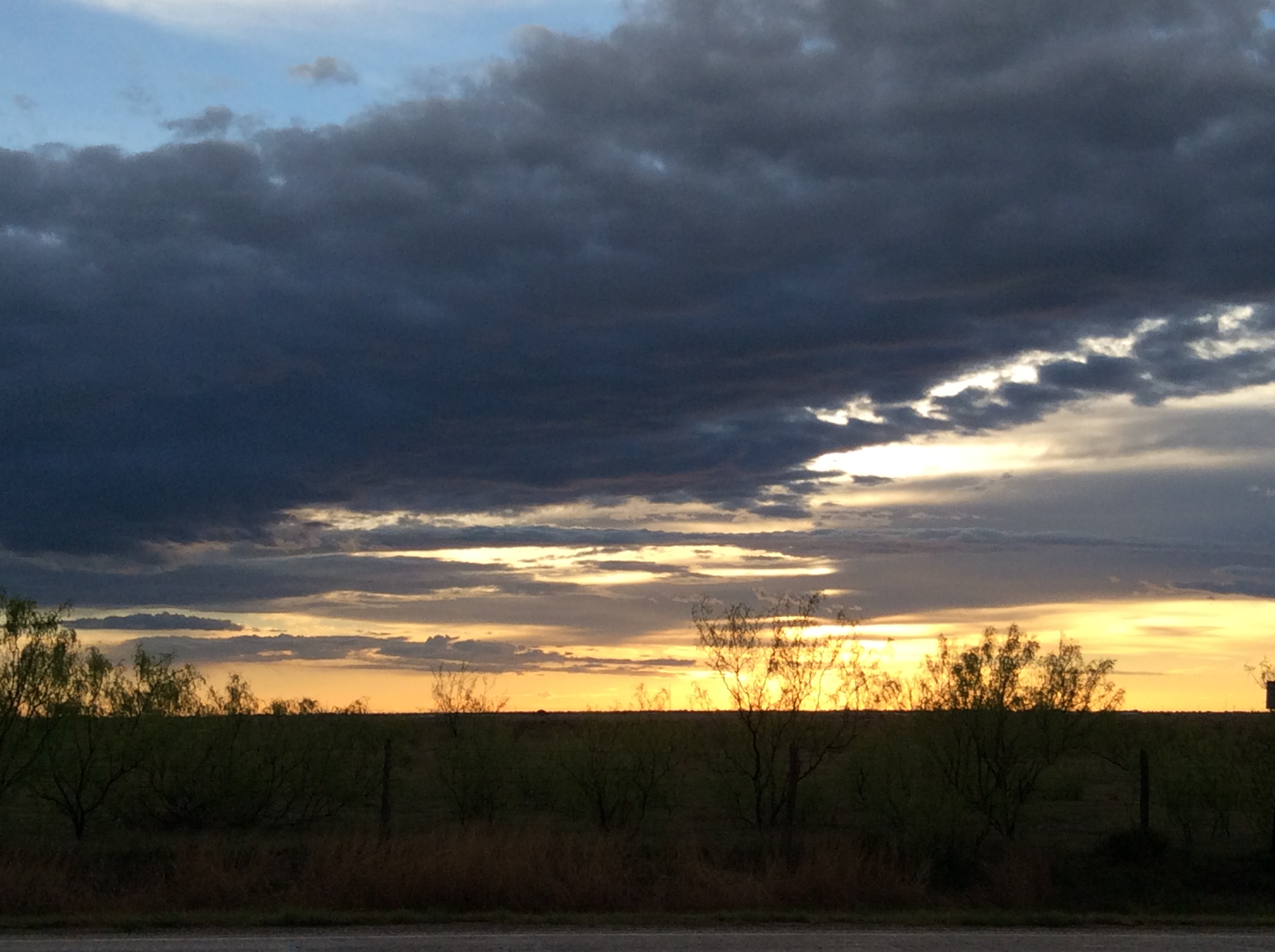
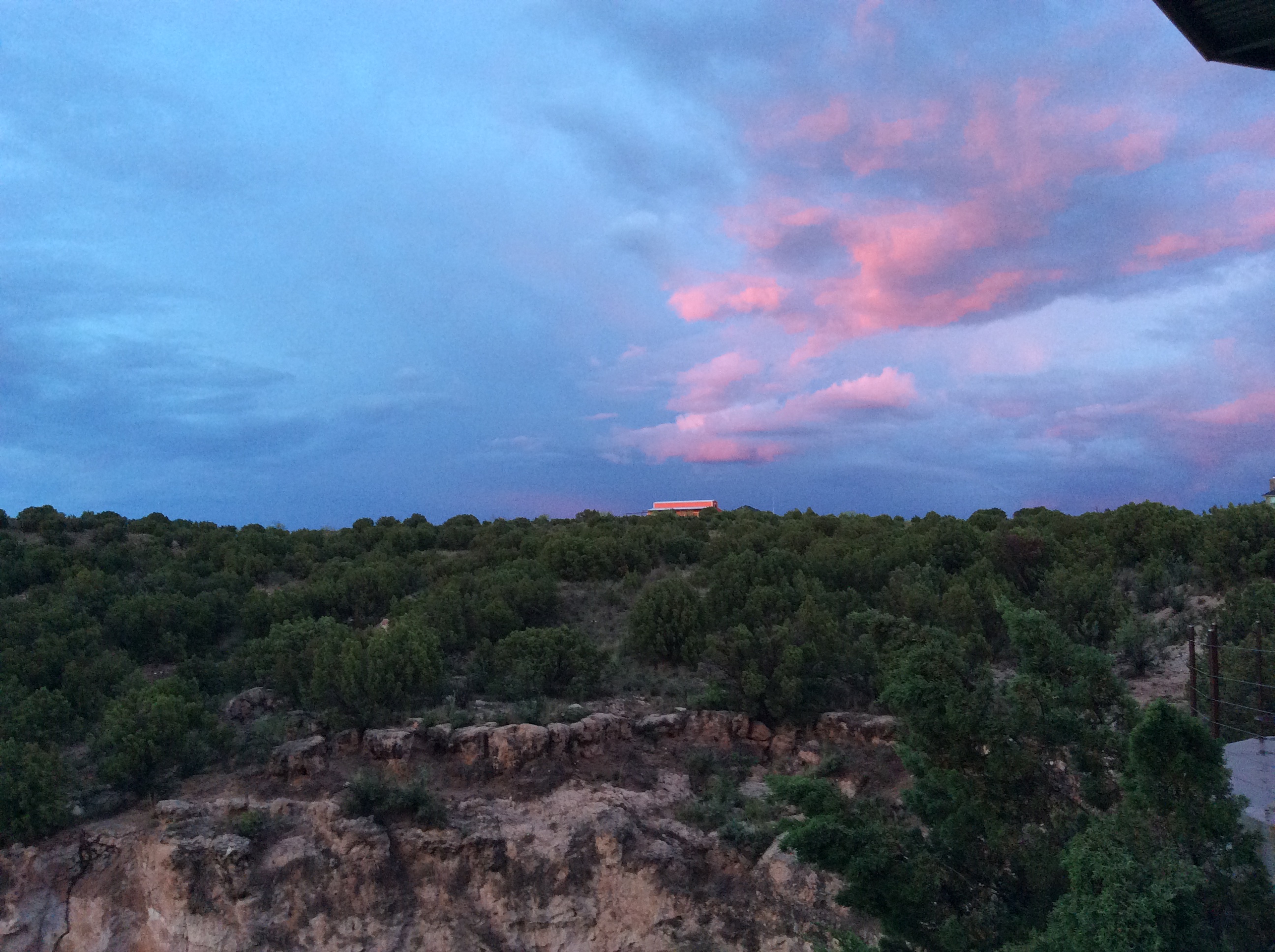
I love the space, the vermillion sunsets, the intense blue of the sky.  I watch my neighbors water, water, water their new houses in the country.  I think about those pivots irrigating in the wind, and I wonder what will happen when all the water’s gone.


SAM_1369


Intelligent Beings


Tonight the program Nature on PBS asked questions about animal intelligence as compared to humans.  This list portrays some of the things I learned, some new, some I remembered from past readings or other Nature programs:

-A few other animals besides humans recognize themselves in a mirror.  This list includes elephants, dolphins, and chimps.  Actually, humans do not demonstrate this ability until they are about 18 months old.

-Only a few species studied demonstrate a sense of social justice.  If they think they are being treated unfairly, they get mad and sometimes have a little fit.  This includes monkeys and dogs.

-Only one species studied demonstrated overt altruistic behavior and a sense of social justice toward others, the bonobo.  Of course, others may but have not been studied yet. Notably this is the same species that resolves social tension and conflict with sex rather than fighting.

-Humans grieve.  Many other mammals grieve immediately after the deaf of a loved one, e.g. their own young offspring, but few recognize the bones of long deceased members of their species.  The exception is elephants.  Elephants not only recognize the bones of other elephants, they frequently nuzzle them with their trunks and stay with them a while.

-Dolphins may seek out help when they need help.  The program showed a diver who was not looking for dolphins at all.  A dolphin who had a fish line and hook stuck in his side approached the diver and managed to stay very still while the diver removed the hook.  This took nearly ten minutes.  Of course, no one knows whether the dolphin was actually seeking help or simply stayed still when help was available.

-Chimps possess another behavior similar to humans, the ability to purposefully deceive.  A less dominant chimp was shown where a banana was hidden from a window outside an enclosure.  She and a more dominant female chimp were released into the enclosure at the same time.  The first chimp did not rush to the food.  Oh,no.  She waited and watched, played it cool,  and when the other chimp wandered off to the other side,  ran and ate the banana.

It is difficult to get inside of the mind of other animals.  Anyone who has pets thinks they are smart or at least dogs and cats seem to demonstrate considerable intelligence.  Horses do as well.  And yes, I have seen horses grieve.  When one of my horses died in a terrible and rather bizarre accident a few years ago, the other horses stood for hours in the place where the deceased horse had died.  They did not even leave to eat their alfalfa, a food they loved and always ran to.

I even think animals, in particular mammals,  know when they are headed to slaughter.  I think those who kill them know this but to admit it would be too painful.  They certainly know the smell of blood.  It incites terror.  Certainly animals can suffer at the hands of cruel humans.  Do animals besides us deliberately hurt others for the sheer, sick pleasure of it?  If there is a study regarding this topic, I have yet to see it.  I wonder.


Earth Day


Sometimes when you love nature, the environment, wildlife, wild places, it is easy to become extremely discouraged.  News about the dramatic increase in poaching in Africa condoned by some governments there does little to help.  Data illustrating how the United States is a hub for wildlife trafficking, the push to kill wolves, big oil’s persistence to explore and open fields in the Arctic and other more delicate environments, water waste, climate change denial, a seemingly endless lists of negatives, can make one think about giving up.  The Colorado River is under siege.  The drought ridden Southwest of which I am a part has too many people fighting over too little water. The EPA just approved a new pesticide known to kill bees which are already disappearing, posing a huge threat to our food supply (see a previous blog highlighting how our food supply depends on these same rapidly disappearing bees).  Another mountain top removal coal mine is being proposed in Kentucky and it is next to a school.  The US Army Corps of Engineers issued the permit.  I could probably spend this entire evening adding to this list of negatives.  I could give up, but I never do.  I keep looking for positives and for changes created by people who care.


In honor and praise for those who care and for the positives occurring, I am creating another list:

-Ralph Maughan, an Idaho native, continues to work on the saving the pristine wilderness of the River of No Return Country.  He wants to save wolves in a state where politicians have proposed a law to kill 60 per cent of the state’s wolves.  The Idaho Department of Fish and Game plans to professionally exterminate them so there will be more elk for hunters.  No, I did not make this up.  Maughan says, “the wilderness is supposed to be a place where large carnivores, like wolves, grizzly bears, and mountain lions can exist as they did before humans arrived.”  Now the agency wants to come into a proclaimed wilderness to suit their own purposes. This fight continues.

-In Hawaii many housetops and businesses now glitter with solar panels.  Isaac Moriwake’s consumer advocacy efforts support consumers who want to generate their own electricity through clean energy.  Solar panels totally cover the roof of the new parking garage at the Kapl’olani Medical Center in Oahu.  Hawaii has been able to create a clean energy framework with considerable solar success in spite of traditional utilities’ efforts against it.

-In more remote places like Nepal the WWF helped locals replace wood burning stoves with biogas burners so they would not have to cut down their forests for fuel.

-As Myanmar develops economically and joins the international stage, huge areas of prime forests and native animals are at risk.  Conservationists work with the new government to create national parks and other areas to preserve Myanmar’s rich biodiversity and to listen to local wishes as to how to preserve their valuable natural heritage.

If I wanted to stay up half the night, obviously I could add more and more to each list.  And it is easy to wonder just what can one person do.  For starters, use less water, get rid of all the junk mail that arrives–a later post will describe methods to do this–so it will not add to the landfill and the demise of trees, do not buy furniture made from slow growing tropical wood, adjust your thermostat to warmer in summer and cooler in winter, carry your own bags so you won’t have to use the plastic ones at the store, become politically vocal about conservation.  If you wonder is all this effort worth it, take a walk in the woods, along a beach, through the jungle, on a desert path; fill yourself with wonder.