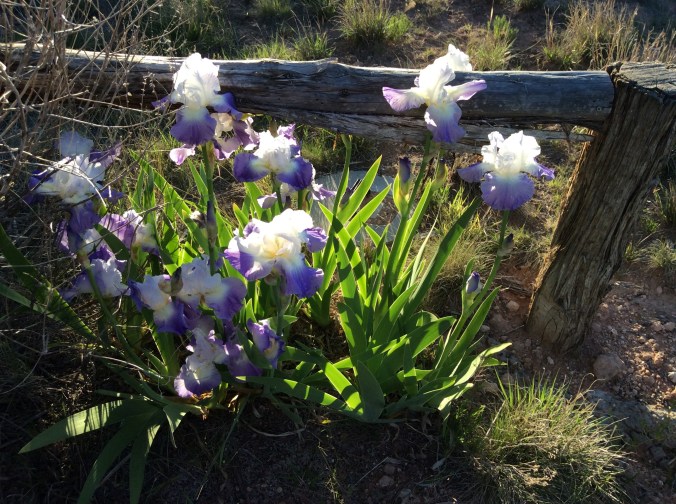
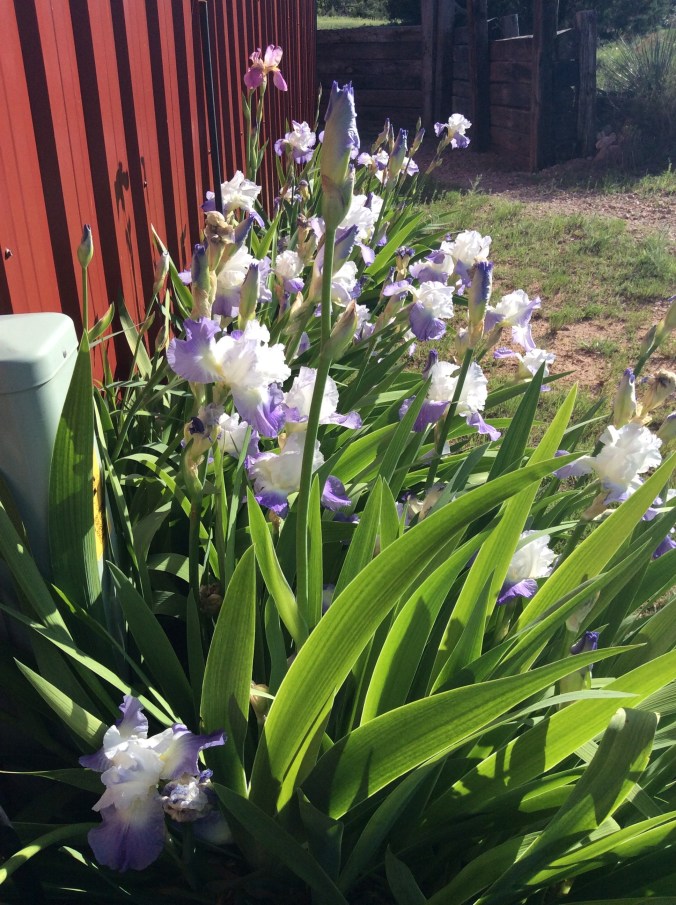
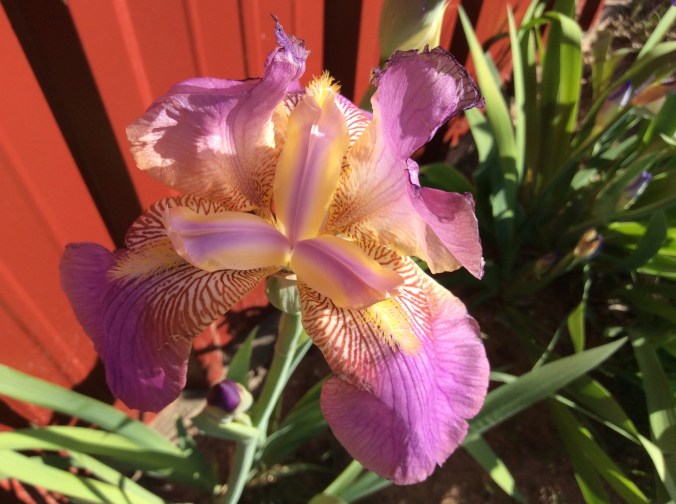
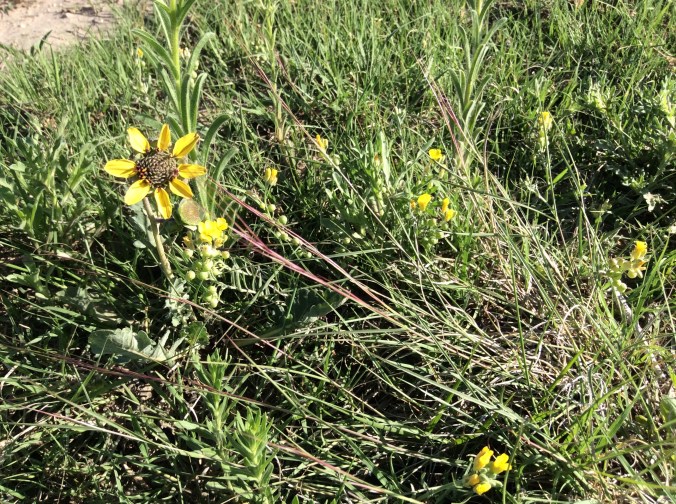
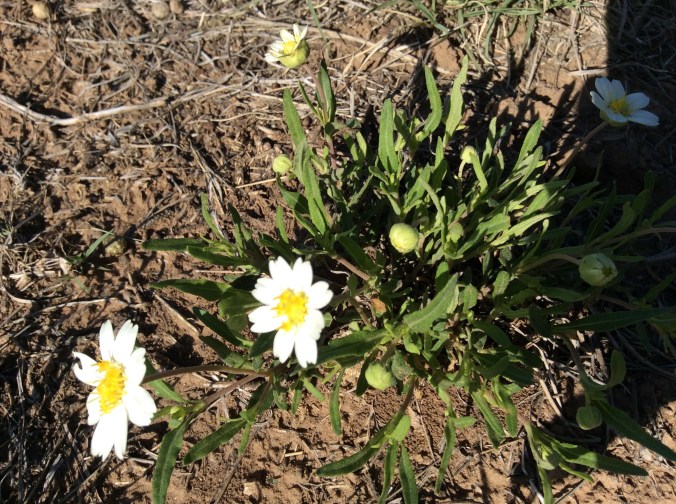
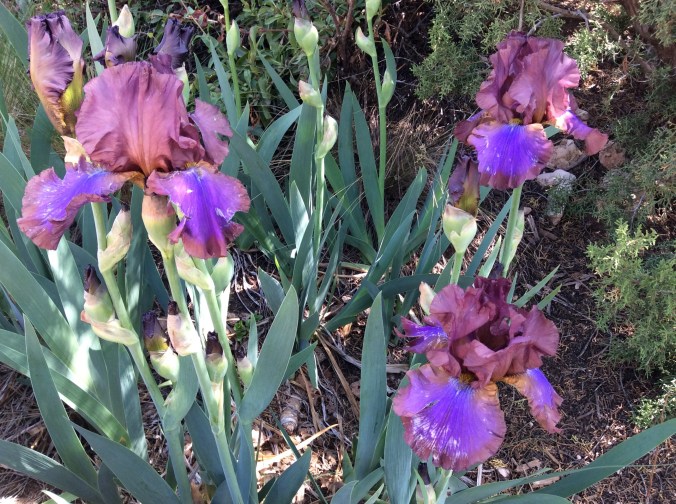
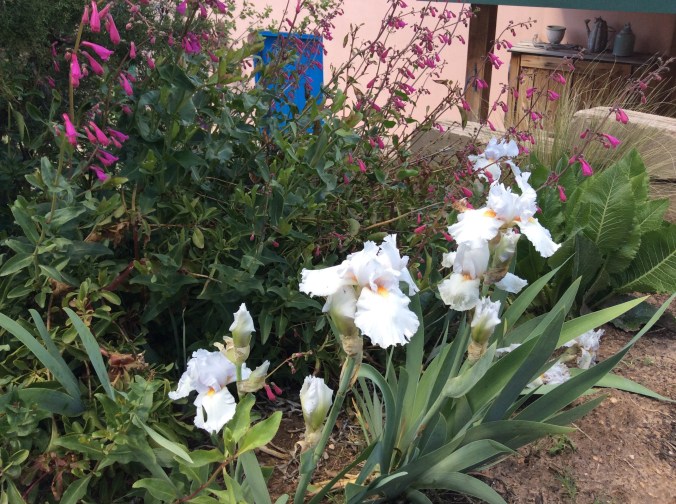
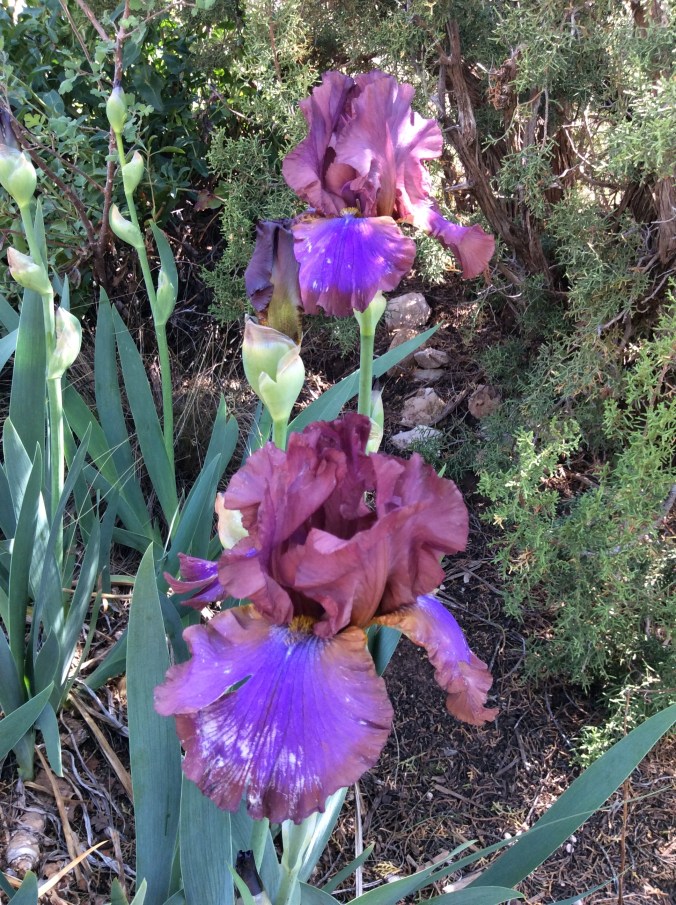
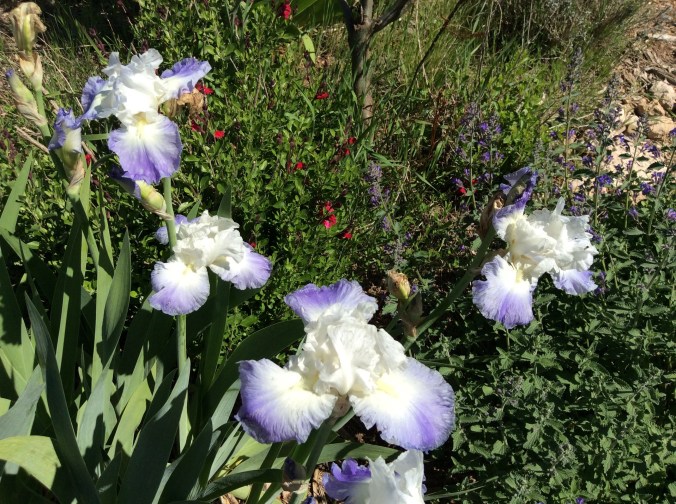
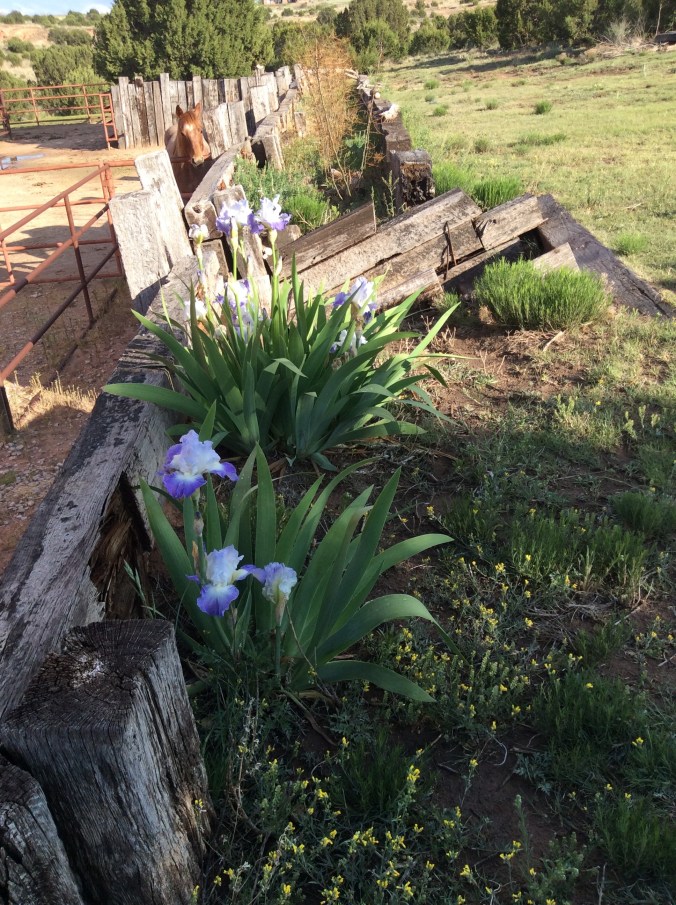
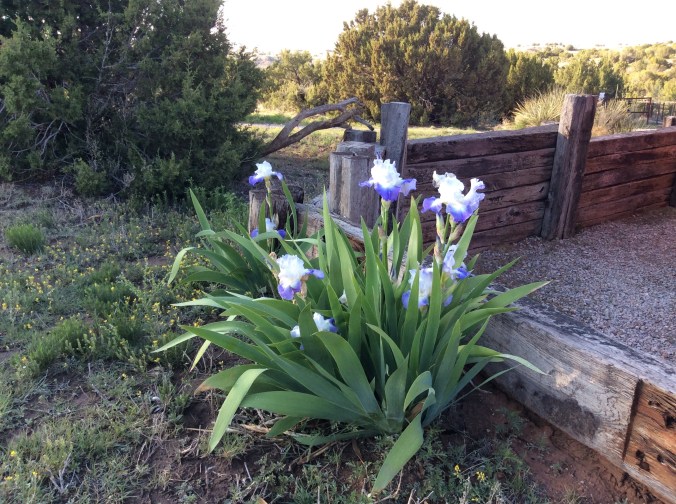
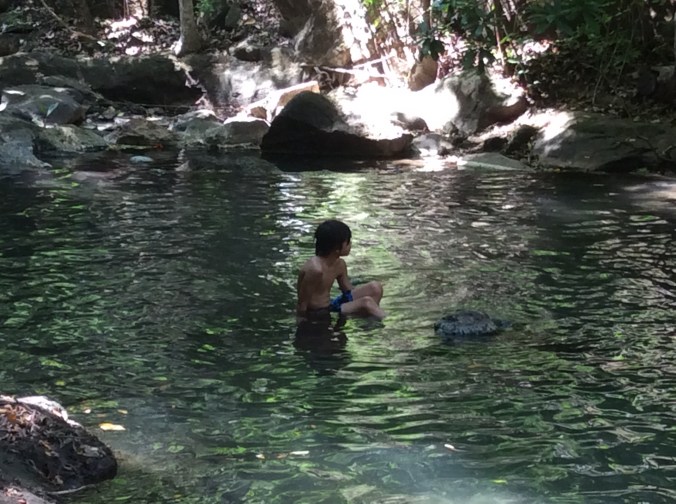
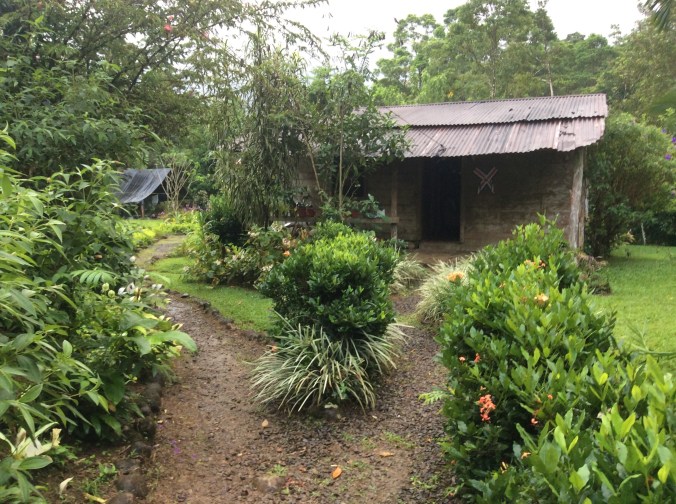
walk slowly on the rim of wonder
throw rocks into the abyss
feel snow melting on your perfect face
In the last two days it has rained over two inches in a place where the annual rainfall averages approximately 18 inches. Rain is predicted all week. The rain ceased briefly at dusk and the sun radiated across the landscape as more rain clouds gathered providing a quiet, intense beauty here on the rim of wonder.

Although wonderful paved roads exist in most of the northern half of Ethiopia, the government forbids a good paved road throughout Simien Mountains National Park. Since we went during the rainy season, a muddy mess prevailed. At times I thought, “This is hopeless; we will never make it through.” I was so wrong! Alemu persisted; we always arrived where we were headed in spite of the roads, the trucks, and the mud.
We came up on one of the first obstacles on the road here. We parked, got out, and watched. The Al-Qaeda truck had a flat tire–the truck in the front. The Obama truck, after unloading the passengers, tried to pass with this result.
It slid into the Al-Qaeda truck. The women passengers and we climbed up to the grass and waited. The men surveyed the situation and decided to solve the problem.
They attached a rope to the front of the Obama truck and pulled successfully. Everyone climbed back in the truck and headed on down the road. This allowed us to continue on our journey. As we drove along, the guide noted the duikers along the road.
See the two brown spots in the middle? Duikers. I admire real wildlife photographers. With the exception of the gelada baboons, getting good wild animal photos seemed quite a task. Either they moved too fast or they blended so well into the landscape, you could only see them when they moved.
Here we stopped to hike to the highest waterfall in Ethiopia. Once the guide explained where we would walk, I decided to hang out with Alemu and the driver of another vehicle stopped here with four people from New York, some of the few people we met from the US. Most travelers to Ethiopia appear to be Europeans. The other driver liked to talk and regaled me with stories, one of which was about a German woman who decided to trek (visitors can elect to go on either 3 or 10 day treks here). It was cold, they camped in a heatless (what else is new!!) building. She requested her guide sleep with her because she was so cold. This continued for days. Apparently, she became very cuddly and the guide misinterpreted, etc. etc. Luckily for the trekkers, depending on how “primitive” they want to trek, men like those in this photo, take food and other supplies from one camp spot to another. The other driver knew a lot about Ethiopian birds and pointed out one called a bone crusher. A raptor, it captures its prey in its talons, flies high, drops it on a rock to kill it, waits until something else eats off the meat, and finally gets the bones, flies high again, and drops the bones on a rock to break them open. It eats only bone marrow.
Because people lived and farmed in these mountains long before they became a park, visitors see villages and farms in various areas of the park. We were told that the government planned to eventually move everyone out of the park. Our guard lived in the park in an area like this one. We dropped him off on our way out. I also noted electric lines in areas where it looked impossible to build. The guide informed me that a lot of Chinese died building the lines.
Here and there gelada baboons appear. This photo shows a typical view of the muddy road we traversed.
Another stop waiting on Al-Qaeda and Obama trucks. I never quite figured out why Obama trucks are called this. They haul people from place to place but not long distances–buses do that. I never saw an Obama truck wrecked. Al-Qaeda trucks haul goods, supplies, anything commercial. Like here in the US, apparently time is money so those drivers hurry. If something is in the way on the road, drivers may drive off the road to get around it and if the load shifts, over they go. We saw Al-Qaeda trucks wrecked everywhere–they are the terrorists of the road.
Above timberline, the landscape changes to this. The plants in the foreground are giant lobelia. Ethiopia contains the fourth and fifth highest peaks in Africa. Much of the time we drove above 12,000 feet.
Frequently, we drove through thick fog, but truly lucked out when we reached the area immediately under the fifth highest peak in Africa where rare walia ibex reside. Alemu and the guide told us often visitors come here to see the ibex and see nothing.
If you look closely, you can see several ibex in the middle of this photo. We counted 23 on this mountainside above 14,000 feet just a few hundred feet below the fifth highest peak in Africa. Ibex blend into the landscape so well, they are extremely difficult to see unless they move.
By the mountain stream red hot pokers (see middle of photo) thrive. I was shocked to see them growing wild here, having always thought they are desert flowers.
Finally, on the way back out of the park, we stopped so I could see the highest waterfall in Ethiopia.
Saying goodbye to Addis at 8 in the morning, we headed northeast and later north toward Kombolcha–spelling differs, depending on whose map you view. The official Ethiopian map spells the town as Kombolch. Addis is high, the second highest capital in the world. We drove northeast all morning across rivers and through green fields.
Not far outside Addis we saw this scene, a river with many people near it. Our driver, Alemu explained this river contains holy, healing water and all those people you see through the window are pilgrims coming to be blessed by the resident priest and hopefully healed by the river waters.
Who would know this is Ethiopia if no one told you? Not what I expected at all honestly.
Most of the farmland is very rocky. Farmers gather rocks, in some places make fences out of them or just pile them up. Even with these efforts fields remain full of rocks.
We drove for hours through this type of farmland.
This is a typical country village which appeared off and on continuously along the highway. Traditional buildings are usually round with thatched roofs. More and more people have begun to use metal roofs which forces the building shape to rectangular rather than round. We heard a story about a thatched roof house that caught on fire. Nothing but the thatch burned because underneath the thatch was a meter of mud.
Most Ethiopian farming is done the old way: either horses or cattle pull the plow with a man guiding it usually through a lot of rocks. I commented about seeing no tractors so then every time we saw one everyone shouted, “Juliana, there’s a tractor.” I think I saw only five of them in ten days and only one was actually working in a field. It became obvious rather quickly how totally impractical a tractor and its equipment would be in much of the farmland: too many rocks and as you will soon see, too steep. The tractor would fall over.
Eventually we started climbing higher and higher. To the left was one of Ethiopia’s high peaks near or over 4000 meters–13 to 14 thousand feet.
And then, there it was, Menelik’s Window. This was the first area we saw with numerous gelada baboons. However, these ran away unlike the ones later in Simien National Park.
That’s Dino down on the edge. At this point in the trip, I was still quite horrified by all the steep cliffs and stayed way back. He was trying to get a good photo of the baboons. Menelik II, the last Ethiopia leader to be able to claim himself as a direct male descendant of King Solomon, found this place special, a view into the real Ethiopia across miles of mountains. He is known for defeating the Italian invaders, expanding the kingdom, and especially for modernizing Ethiopia.
My grandson now owns this hat. This boy and his friends spend their days chasing the baboons away from the tufts of grass, which their families use to make the thatched roofs, and making hats for sale.
You can see the selection of different styles of hats on display on the grass. On the mountainside in the back lots of herbs grew, including thyme. The boys also sold packets of herbs they had gathered and dried.
We dropped down on a winding mountain road through eucalyptus forests. Eucalyptus is not native to Ethiopia, but grows everywhere there. It is used as a basic material for building their houses, for scaffolding to build tall city buildings, for just about everything. Several different species grew along the road.
Ethiopia’s main highways are excellent. Many were built years ago by the Italians, more recent ones by the Chinese. Ethiopians make jokes about how long the Chinese roads might last.
Eventually, we dropped down out of the mountains into an area that was much drier.
A typical town with all sorts of shops right along the road. When driving in Ethiopia, dodging people, cattle, camels, horses, burros, and goats is the norm. Everything it seems likes these good roads.
A boy driving camels down the highway. Loose animals, like the burro on the right, roam seemingly unattended. I saw few fences.
In the small towns in this semi arid area, we saw several totally veiled women, faces covered totally except for their eyes. Alemu informed us that this was a new thing, not seen until the last few years. He seemed to think it had become fashionable to copy Saudi women.
We stopped to look at certain plants beside the road.
Dino recalled playing with these pretty green balls as a child with this forewarning, “Do not eat them, do not touch your eyes or you will go blind.” They are called the Apples of Sodom.
At this juncture near the beginning of this adventure, I had not yet realized how everything in Ethiopia possesses symbolic meaning.
We drove along this immense, lush valley for miles. Alemu said this huge herd of cattle belonged to a semi nomadic group who brought their cattle here during the rainy season to graze and fatten. A bit farther down the road the land belonged to one of the richest men in Ethiopia, indeed the world, Al Amoudi. It was the only place where I saw a tractor actually used in a field.
Arriving in Kombolcha, we saw this new college in the process of creation. This became a common sight–new buildings, new schools, construction everywhere.
My first hotel room in Ethiopia at the Sunny Side Hotel in Kombolcha complete with mosquito netting–the blue blob above the bed. At least it had a shower and toilet. Many places use the style of accommodations one finds in a lot of Asia. Forget toilets as you know them–just a tiled area with a hole in the ground and the ever present water with which to wash. We carried our own toilet paper just in case. However, many places had both so customers could choose.
I spent yesterday evening and today here in Bahir Dar, Ethiopia, looking at, riding across or around on Lake Tana and the Blue Nile. The out flow of Lake Tana is the beginning of the Blue Nile, the world’s longest river. I crossed the Nile three times today in a relatively small motor boat. Due to a diversion of water for hydroelectric power, the Nile falls are only a fraction of what they used to be. Fishermen still fish Lake Tana in boats made from papyrus, scarves are still woven on hand looms, and corn, beans, and sugar cane are cultivated by hand, The following photos were all taken today, including the exquisite gardens at the restaurant where we ate lunch.
Early, in that land between wakefulness and dreams, it started to rain. It rarely rains here in the morning; I thought I was dreaming. Several hours later it is still raining. Last night the weather forecaster said we are actually a little ahead of normal for the year, an unheard of event in recent years when endless drought reigned. Because I am thinking none of you who read my blog posts will believe it is really raining that much after reading numerous posts about drought, I decided to take some photos of the cloudiness and wet.
The following poem was written when it had not rained in a long time like this spring when it had not rained for months. Now that is has started raining, it cannot seem to stop, certainly a better situation than several months ago when 50 houses in a nearby town burned down because of a giant wildfire.
It’s raining! It’s raining!
It has not rained in more than a month.
I run out the door,
spreading my arms skyward.
I laugh out loud, dancing in the rain.
A smile smears joyfully across my face.
I run across the patio,
rain drops pelleting my face, my arms.
I laugh out loud, dancing in the rain.
My dog stands, rivulets of rain running off her.
Usually she hates rain.
Lightning explodes, thunder booms bass,
the steel roof plays staccato music.
I laugh out loud, dancing in the rain.
Off and on the last month, I’ve posted about various issues on climate change and related topics. Today, Life Science published an article entitled “Extinction Rates Soar to 1,000 Times Normal (But There’s Hope)”. What causes this enormous spike? You guessed it. Humans.
Before recently, the extinction rate was one per every ten million annually. Now it is 100-1000 every million. Where do researchers and scientists find hope in this adverse increase? Let’s look at Earth’s history for a moment before answering that question. Since life began on our planet, five mass extinctions have occurred, leaving only half of living organisms each time. Reasons for these extinctions vary from Earth’s shifting axis to asteroids–see previous posts related to effects of changes in the Earth’s axis. The big question: how do humans affect the current extinction? Yes, we caused the demise of the passenger pigeon, the Tasmanian tiger, and the dodo bird. And human poaching and habitat destruction now endanger elephants, rhinos, and all subspecies of tigers, among others. One problem in accurately determining human effects is that new species are discovered annually so we are not even sure how many species currently exist. Using what we do know about current species, DNA, and some rather sophisticated techniques, scientists come up extinction rates.
Where is the hope? The most endangered species tend to range in small areas in poorer countries lacking resources to protect them. Modern technology can help, using satellite imagery, biodiversity mapping, as well as other methods. Drones have been used in Africa to track both animals and poachers. We can focus efforts on the areas where the most endangered species live.
How can you help? Become a citizen scientist. Use your smartphone camera and report your findings to scientific conservation groups. A site called iNaturalist allows ordinary individuals to upload photos of plants and animals, tagging date, location, etc. This site links to an international organization that tracks endangered and threatened species.
What else can you do: don’t buy anything with ivory in it, don’t buy anything with the fur or body parts of endangered animals. Spread the word. Become more informed, read articles and books related to these topics. Care. This is the only Earth; help save it.
Arrived home from work and fed Rosie. Looked at the dry native grass around my house and decided to water a bit of it even though I loathe wasting water. Green is probably safer than winter brown. The recent giant wildfire raised my concerns about the fire danger in this drought. I cannot remember when it rained and the next ten days show no rain in sight. As soon as I finish writing this or shortly thereafter, I get to run back to town and join probably 100 plus other people at friends’ house to taste the wine and food brought by Market Street. These friends run a bed and breakfast with a spectacular garden complete with koi pond and just about every kind of flower you can grow in this area. It’s cool, nearly froze last night, so I will wear the black turtle neck and slacks I wore to work. It’s hard to believe that it was just above freezing last night and is supposed to hit 100 next Monday–the desert has now reached here apparently.
Thinking about this leads me to think about some of my favorites, especially when it comes to wine: zinfandels, especially from Lodi, California. The moderately priced one I buy most often is OVZ. It frequently goes on sale here which is even better. I also like Seven Deadly Zins–unfortunately I have never seen it on sale. Basically, I love red wines and almost never drink white. A moderately priced nice blend is Apothic Red. Market Street had a super sale so I bought several–ten percent off if you buy six at a time. The best malbec I ever drank came directly in baggage from Argentina, a present to me from my Argentinian exchange student when he arrived. You can’t get it here and when his mom tried to ship me some, she was not allowed.
The students at school kept commenting on my black attire today. They asked if I was going to a funeral or something. I laughed. I like black; I look good in black. It also shows off my turquoise jewelry. My most favorite color is orange. Turquoise looks good with it too. Red and green are ok. Finally after decades I have learned to like hot pink, but really I am not a pink person–see my poem about Hot Pink Toenails–on an old blog. It remains one of my blog posts that people look at most–I have no clue why. The one color I really do not like is blue, especially pale blue. Perhaps tomorrow I will post about favorite books. I really would like readers to comment about their favorites. It fascinates me what people perceive and feel about this and that. Often I am the only person I know who reads what I read.
Off to taste some new wines and maybe find a new favorite.
We all know extinction occurs. Nearly everyone knows different species of dinosaurs at varied times roamed the earth for millennia. Bones of all sorts of animals and various hominids are dug up off and on. Scientists study them, determine their age, where and how they lived. Scientists and sometimes even average persons develop theories about why they went extinct. Regardless of which theory a person decides is accurate, these ancient extinctions generally took thousands of years. Recent extinctions are different, e.g. carrier pigeons. Millions existed a couple of hundreds of years ago; now they are gone. Why? Humans.
Various causes exist for the extinctions of ancient species. A major cause is the climate change caused my the changing tilt of the earth’s axis. These changes occur over thousands and thousands of years. What is different now? Let’s take corn. Native Americans cultivated rainbow colors of corn in small, frequently irrigated fields. Where is most corn grown now? Giant fields of GMO corn grow from horizon to horizon in the Midwest. And if Monsanto had its way, no other corn would continue to exist for long. Iowa is a good example. Wherever this corn is grown, native grasses and other native plants totally disappear, in part due to cultivation. A bigger issue is herbicides–to have clean fields, nothing and I mean nothing but corn must grow there. A farmer’s expertise as a farmer is measured my just how super clean his fields are. The only way to get these totally weedless fields is to use herbicides. Biodiversity is a key to environmental health. Little biodiversity exists in giant fields of crops like corn and soybeans. Fertilizers to obtain huge yields wash downstream and in the Midwest eventually end in the Gulf of Mexico and cause giant marine algae blooms which pulls oxygen from the water to create a dead zone where no marine animals or fish can live.
Perhaps readers have heard of the plight of monarch butterflies. Compared to just ten years ago, the population has dropped dramatically. What happened to them? Roundup. Over 100,000 tons of Roundup and other brands of glyphosate herbicides are annually applied to crops in the US. What do monarchs eat? Milkweed. Since 1999, 58 per cent of the milkweed has disappeared. Recently, monarchs experienced a 30 per cent reduction in their numbers in one year. Are we headed toward a mass extinction? Some scientists think so. These scientists are not talking about tigers, elephants, and rhinos being killed at an ever increasing rate for their body parts, but rather about the less noticeable extinctions of various plants and less obvious animals like frogs. And then there is the problem with bees. Bees are disappearing at an ever increasing rate due to not only diseases but due to herbicides and pesticides. Without bees to pollinate the giant fields of almonds and various fruits in California, for example, those foods won’t exist. See a previous post for more discussion on the importance of bees. So why care about frogs? Scientists consider frogs and amphibians in general an indicator of the health of an ecosystem. Certain more tropical species of frogs are especially subject to the effects of climate change and they are disappearing.
Where I live big bluestem, blue grama, buffalo grass, and other native species grew from horizon to horizon. This is the high plains. Root systems of some plants grow twelve feet deep. It has not rained in over a month. Where the native grass once grew, crops are now grown. This time of year finds open fields. Without rain, with the recent endless high winds, dust fills the sky. To safely return home from town Sunday, I had to turn on the car lights to see. The dryness fuels wildfires. Earlier this week, over one hundred homes burned down in a wildfire north of Amarillo. Drought.
Many human inventions are wonderful and make many lives better, but for some of them, I cannot help but wonder at what cost.
Travel the World 4 Less
A Glimpse into My Life & Passions
Ceto-Magoism, the Whale-guided Way of WE in S/HE
Exploring the F-word in religion at the intersection of scholarship, activism, and community.
ANCESTRAL FOOD. HERBAL WISDOM. MAGICAL COOKERY. SEASONAL CELEBRATION.
inesemjphotography
politics, engineering, parenting, relevant things over coffee.
Food is the best expression of every emotion. Explore through my reviews, recipes, events and more.
Smile! A Site for Friends Wherever You Are!
inspiring personal growth through poetry and writing
Combining atheism with whimsy. This is a Fair and Balanced blog based on opinion unencumbered by fact.
Odds and ends ~ My Life
Original poetry, commentary, and fiction. All copyrights reserved.
bripike@gmail.com
A wildlife filmmaker in Africa
A Geeky Feminist's Musings On Pop Culture
"5 minute walks"