Costa Rican Adventure–Rio Perdido


Rio Perdido is both the name of a hotel and a river.  We stayed several days here in the middle of a reserve in the dry tropical forest (definitely not a rain forest) about 1 1/2 hours from Liberia.  The hotel gets all its electricity from the Miravalles Geothermal Power Plant which we actually passed on our way to the cacao plantation (see the last two Costa Rican posts).  They use their own water and do not chlorinate it.  The name comes from a river which flows through the reserve.  Their goal includes protection of the forest and sustainability.

Rio Perdido itself is a hot springs river.

IMG_2043

We hiked up and down small cliffs on the river sides to get here.

IMG_2047

IMG_2048

IMG_2049

This river is famous for its volcanic mud.  To obtain its benefits those who wanted dug the mud from the bottom of the river and painted it on faces, arms, etc. with the provided brushes.  Here one of the group paints mud on the guide’s face and neck.  Some attached leaves above their ears.

IMG_2050

I wandered on another path down river to watch for wildlife and take photos.

IMG_2052

IMG_2053

IMG_2055

IMG_2057

The reserve contains numerous hiking and bike trails some of which are as long as six or more miles.  This bridge crosses the river and leads to several hiking trails.  The main building in the background houses a reception area, restaurant, bar, spa and gift shop with three swimming pools.  They provide bicycles for those who want to try the trails, some of which are quite long and difficult. Rooms are separate cabins scattered throughout the forest. A shuttle provides transportation from cabins to the main area for those who choose not to walk.  The staff is welcoming, chatty, and creative.  When the staff cleaned our room, made beds, etc, we came back to find my grandson’s stuffed sloth sitting on his pillow, reading a book.  For those who want to relax, escape the world, this provides a perfect place.


Costa Rica Adventure, Day Five–Hidden Treasures in the Rainforest


After we left the little village of Colonia Liberatad, we headed down another unpaved road to a tiny little building in a large garden for coffee and dessert.  Costa Rica is heaven for flower and plant lovers, a true botanists’ paradise.

IMG_2035

A pebbled path led from the road to the “restaurant”.  No one rushed; we were too enthralled with the flowers, the humidity, the total intenseness of the surroundings and atmosphere.

IMG_2036

Although I have been to Costa Rica twice now, ten days each time, and love flowers, still I can only recall the names of a few.

IMG_2037

Hundreds, sometimes, thousands, of species reside within only a few square yards.

IMG_2038

IMG_2039

IMG_2040

Everyone stopped along the way to look.  Some of the children wanted to hunt for reptiles. They were warned because the deadly fear-de-lance lives here.  A few assured everyone they knew exactly what they look like.  Knowing them, it was probably true.

IMG_2041

A wood building is a rare sight anywhere I have been there–too much rain.  All roofs are either metal or tile for the same reason.  Other types of roofing rot.  Some have totally given up trying to add color because it disappears quickly apparently.  This area of Costa Rica on the Caribbean side of the mountains receives rain daily.  It rained off and on all day.

I have no idea the name of the dessert they served us with coffee.  It resembled Indian Fry Bread (from New Mexico and Arizona–I love the stuff), super crispy, soaked in honey.

IMG_2042

The road just outside this hidden gem.

79-Year-Old Bird Watcher Takes Down Oregon Militant With Old High School Wrestling Move


For those of you who have been following the illegal occupation of the refuge in Oregon, this is perfect. Whenever I see how they treat those who disagree with them, how they violate the rights of the rest of us who pay taxes that fund those lands, how they violate and destroy American Indian sites and artifacts, I become increasingly dismayed, well, actually angry. Perhaps all the birdwatchers in the country should show up there. Would they shoot them? Oh, I forget, most people, unlike the occupiers, actually have to work.

Unknown's avatarWolves of Douglas County Wisconsin Film Company

Source: The LapineJANUARY 10, 2016

BURNS, OREGON — Grandfather of four Robert Saunders says he was just out to check on some young burrowing owls at the crack of dawn this morning when he was confronted by a “red-faced pudgy man with a big gun”.
And things got physical when Saunders refused the barked orders to halt and identify himself.
But it wasn’t the retired teacher who ended up on the ground.


Well heck, one second he was warming his hands by this kind of puny little fire and the next second he was running at me and shouting to get down on the ground,” Saunders told reporters gathered nearthe Malheur National Wildlife Refuge.

“Made me mad really. It’s public property and here this guy is acting all big and tough and pushy.”
“I don’t swear much at all but I told him to screw right off and…

View original post 287 more words

Costa Rica Adventure, Day Four-Part Three


Yes, Part Two of Day Four is missing–it will show up later.  After floating down Rio Tenorio (the missing photos) and eating lunch by another river just off the Pan American Highway, we went a short distance off the Pan American highway to Las Pumas, a wildlife rescue center.  This photo was taken on the way–a very common sight in this area, grazing cattle.

IMG_1992

The center rescues various animals but mostly wild cats, including puma, jaguar, ocelot, jaguarundi–a long bodied, grey cat with short legs and a tiny head, margay, and tigrillo which is the size of a house cat.  Their goal is to eventually release the animals back into the wild.  However, the only place open to visitors is an area where none of the animals can be released back into the wild.

I mostly photographed the pumas–one of my obsessions.

IMG_1996

See if you can find the puma.

IMG_1997

Now you can.  He kept moving.

IMG_1998

Most of their stories went like this:  mom was killed or caught by a rancher for stealing livestock; baby was found and rescued and had become too familiar with people to release.  Another common story dealt with injuries where the animal had been caught in a trap and suffered too much of an injury to ever be self sufficient in the wild.  The smaller cats knew how to either hide themselves or hunker down where it was too dark for a good photo.  In the largest enclosure a jaguar lay right next to the fence.  Once he had been returned to the wild without success.  He did not seem particularly pleased with all us humans so close.  He arose, suddenly turned his butt toward the fence, and sprayed.  One unfortunate (or fortunate if she wanted a good story) girl was the recipient.  She took it well.  How often does one get sprayed by a jaguar!

Eventually, after twisting and turning on various unpaved roads through the dry tropical forest (a totally different type of forest than one usually thinks of when hearing the word tropical), we arrived at Rio Perdido early enough for some relaxation, a bit of exploring, and swimming.


Costa Rica Adventure, Day Four–Part One


People love food.  One of the fun things about travel is exploring the food.  My two favorite, traditional Costa Rican foods are gallo pinto and platanos fritos.  Fruit shows up everywhere too.

IMG_1954

Breakfast at El Establo just before heading down the mountain to the Pan American Highway on the way to Rio Tenorio.  The plate in the background contains gallo pinto and platanos fritos.  I have made gallo pinto three times since I returned.  See recipe at end of post.

IMG_1955

The final view of El Establo as we drove away.

The following photos were all taken riding along the highway, dropping altitude dramatically all the way from Monteverde to the Pan American Highway.  The beauty one passes going to and from Monteverde remains unrivaled anywhere–miles of green vistas, colorful mountain homes, cattle grazing.

IMG_1957


IMG_1958

IMG_1959

IMG_1960

IMG_1961

Typical country houses along the side of the road painted colorful hues.  Even here the houses have electricity and running water. Most of the way the road was gravel.  In spite of all the green in these photos, this is the dry side of the mountains, the Pacific side.

IMG_1962 (1)

IMG_1963 (1)

IMG_1964

IMG_1965

IMG_1966

A lot of Costa Rica is cattle country.  In the lowlands all the cattle have Brahma blood in evidence.  In the high country it varies.  Frequently, they look exactly like the common dairy cattle in the United States.

IMG_1971

IMG_1975

IMG_1977

IMG_1979

The farther we drove down the mountain, the drier the foliage and grasses became. Finally, we arrived at a paved road and a town.

IMG_1980

IMG_1982

Most places, even small towns, in Costa Rica are clean.  People take pride in the appearance of their houses no matter how small. Flowers bloom brilliantly throughout the country.

IMG_1983

Streams run everywhere even through towns.

IMG_1989

Finally, we headed north on the Pan American Highway.  In all of Costa Rica living fences surround fields.  In this area it appeared the major commercial endeavor is cattle, all distinctively Brahma or at least part Brahma.

IMG_1990

Looking at these photos it seems hard to believe this is the dry season.  We saw large irrigation ditches bringing water all the way from Arenal, a huge lake on the other side of the mountains, a place I visited on my previous trip.

Recipe for gallo pinto:

Enough vegetable oil to lightly cover bottom of a skillet

1 1/2 cups day old, cooked  rice

1 cup day old, cooked, black beans

1 medium onion, finely diced

1 small, sweet red pepper, finely diced

2 Tbls. chopped cilantro (optional)

2 Tbls. salsa (optional)

Add chopped vegetables to the skillet.  Saute until onions are clear.  Then add the beans and salsa.  Finally, add the rice and heat through while stirring constantly.  The mixture should be moist but not wet.  There should be enough juice from the beans to color the rice.  Experiment to see what you prefer.  I use garlic instead of onion and poblano peppers instead of the red.


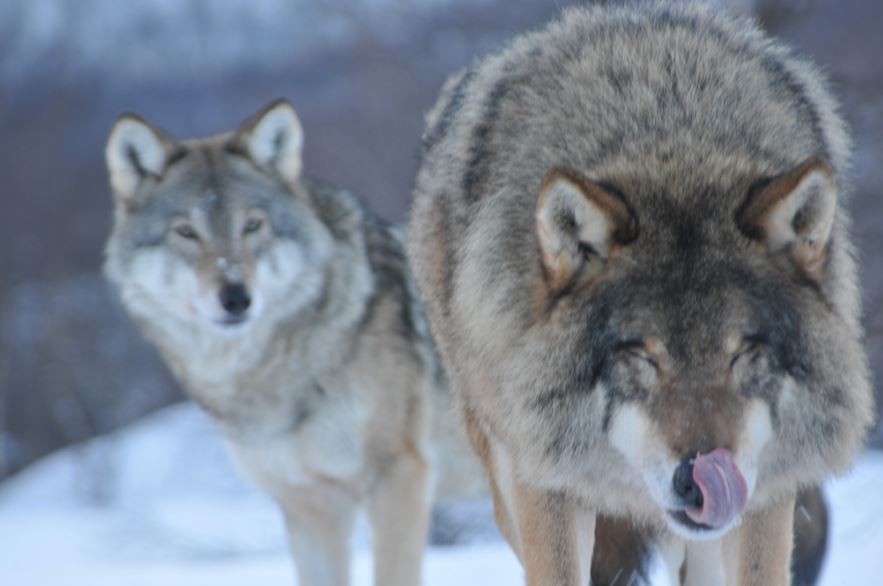
#JoinThePack: Will you howl fight for a future with wolves? Ooowwwwoooooooooooooooooooooooo!!!!!!


As a fan of wolves and other predators, e.g. pumas, I want to share this.  Predators help maintain a healthy ecosystem.  Also see my other posts about wolves.

The wolf’s return to Yellowstone restored an ecological balance which had been lost. Watch the animated film, “The Fable of the Wolf.” Will you howl + fight for wolves? Ooowwwwoooooooo!

Source: #JoinThePack: Will you howl fight for a future with wolves? Ooowwwwoooooooooooooooooooooooo!!!!!!

Costa Rica Adventure, Day Three–Part One


After lunch at the National Theatre we headed to Monteverde, a small town with only one unpaved road in and out.  One big change since I was there three years ago is the road.  It has been widened considerably and apparently plans to pave it are in the works.  The original reason for not paving was to prevent hoards of tourists from invading.  Apparently, that failed; tourists came anyway.

This town’s origination grew out of Costa Rica’s decision to disband its military in 1948, a practice which continues today.  Quakers from Canada moved here for that reason and created Monteverde, now famous for its cheese and, of course, the nearby Cloud Forest.  The hotel, where I have now stayed twice, El Establo, is owned in part by Quakers and serves a favorite of mine, fried cheese.

SAM_0640

Nine buildings up and down the mountain house rooms.  Previously, I stayed in one of the lower buildings; this time we were near the top way above this lake.

SAM_0641

The views from all the rooms provide a vista all the way to Nocoya Bay.  After we put luggage in our rooms, we headed out for a night walk in the forest, the reason we had been instructed to bring flashlights on the tour.  We saw spiders, birds sleeping, a mouse, all sorts of insects, but nothing too exciting.  Probably some of the group members were too scared and too noisy.

The next day breakfast occurred at 7 just before we took off for the Cloud Forest and a hike to the Continental Divide–all six miles or so.  I had hiked here before but on a different trail and in a huge downpour.  Luckily, it rained only a little.  However, if you are in the clouds, you get wet.

Lush does not even begin to describe the Cloud Forest, a huge reserve with numerous indigenous species of everything from hummingbirds to insects to all sort of plants that exist nowhere else on earth.

IMG_1923

Every tree, branch, every living things is covered with other living things.  This must be botanist heaven.

IMG_1924

IMG_1926

Looking up into the branches of a tree fern.  Yes, that is a fern. So much to see, it is hard to keep up with the guide, a native Quaker whose father was one of the founders of Monteverde.

IMG_1929

IMG_1927

It is difficult to know what photos to take; everything holds some kind of fascination and lots of beauty.

IMG_1931

Another tree fern right by the trail.

IMG_1934

In the clouds at the Continental Divide it’s incredibly windy yet the clouds stay and you get wetter and wetter even though it is not raining.  Water dripped off my slicker, the trail oozed mud and water, it was hard to keep my footing on slopes.

IMG_1935

IMG_1936

On the way back we crossed several streams.  Everywhere in Costa Rica signs in both Spanish and English instruct people to save water.  They made me chuckle.  Streams run everywhere in much of the country, especially on the Caribbean side.  Here I live in a semi-arid environment where I see wasted water running down streets in town and in Costa Rica they conserve water and recycle things I did not even know were recyclable.  Hotels provide recycling bins and some even turn off lights automatically when you are not in the room.

IMG_1937

The name for this flower translates from Spanish as hot lips.

IMG_1938

This looks like a tree but it is not.  A giant, parasitic fig plant surrounded the tree, eventually killed it, and this is the result.

After we finished the hike, we walked over to a shop that feeds hummingbirds, hundreds of species of which live in Costa Rica, many only in the Cloud Forest. Took a video of them, but it refuses to upload here.  Some were incredibly iridescent and much larger than any I had ever previously seen.


Evening After the Rain


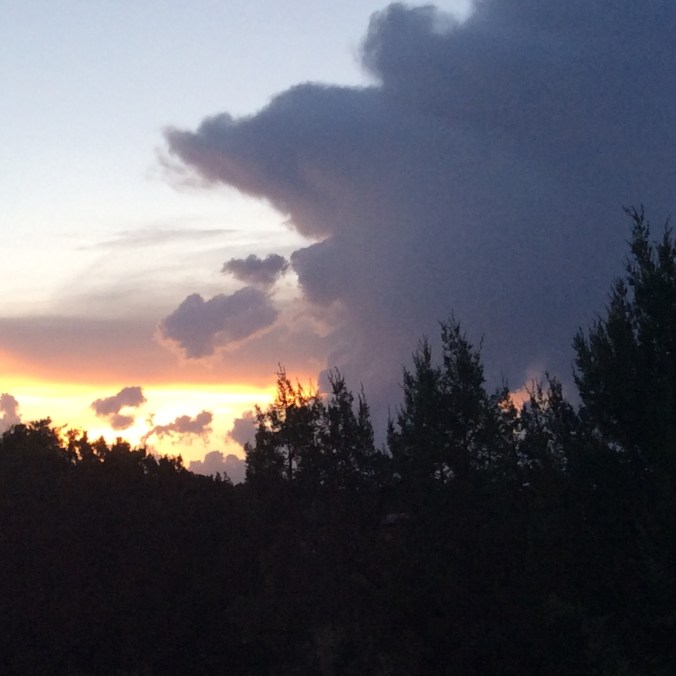
In the last two days it has rained over two inches in a place where the annual rainfall averages approximately 18 inches.  Rain is predicted all week.  The rain ceased briefly at dusk and the sun radiated across the landscape as more rain clouds gathered providing a quiet, intense beauty here on the rim of wonder. IMG_1578   IMG_1579   IMG_1580   IMG_1581

My Ethiopian Adventure: The Roof of Africa, Part Two


Although wonderful paved roads exist in most of the northern half of Ethiopia, the government forbids a good paved road throughout Simien Mountains National Park.  Since we went during the rainy season, a muddy mess prevailed.  At times I thought, “This is hopeless; we will never make it through.”  I was so wrong!  Alemu persisted; we always arrived where we were headed in spite of the roads, the trucks, and the mud.

IMG_0599

We came up on one of the first obstacles on the road here.  We parked, got out, and watched.  The Al-Qaeda truck had a flat tire–the truck in the front.  The Obama truck, after unloading the passengers, tried to pass with this result.

IMG_0600

It slid into the Al-Qaeda truck.  The women passengers and we climbed up to the grass and waited.  The men surveyed the situation and decided to solve the problem.

IMG_0601

They attached a rope to the front of the Obama truck and pulled successfully.  Everyone climbed back in the truck and headed on down the road.  This allowed us to continue on our journey.  As we drove along, the guide noted the duikers along the road.

IMG_0603

See the two brown spots in the middle?  Duikers.  I admire real wildlife photographers.  With the exception of the gelada baboons, getting good wild animal photos seemed quite a task.  Either they moved too fast or they blended so well into the landscape, you could only see them when they moved.

IMG_0604

Here we stopped to hike to the highest waterfall in Ethiopia.  Once the guide explained where we would walk, I decided to hang out with Alemu and the driver of another vehicle stopped here with four people from New York, some of the few people we met from the US.  Most travelers to Ethiopia appear to be Europeans.  The other driver liked to talk and regaled me with stories, one of which was about a German woman who decided to trek (visitors can elect to go on either 3 or 10 day treks here).  It was cold, they camped in a heatless (what else is new!!) building.  She requested her guide sleep with her because she was so cold.  This continued for days.  Apparently, she became very cuddly and the guide misinterpreted, etc. etc.  Luckily for the trekkers, depending on how “primitive” they want to trek, men like those in this photo, take food and other supplies from one camp spot to another.  The other driver knew a lot about Ethiopian birds and pointed out one called a bone crusher.  A raptor, it captures its prey in its talons, flies high, drops it on a rock to kill it, waits until something else eats off the meat, and finally gets the bones, flies high again, and drops the bones on a rock to break them open.  It eats only bone marrow.

IMG_0609

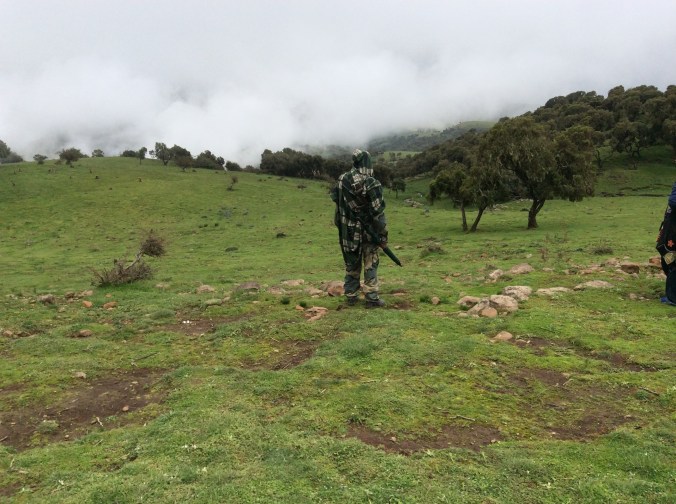
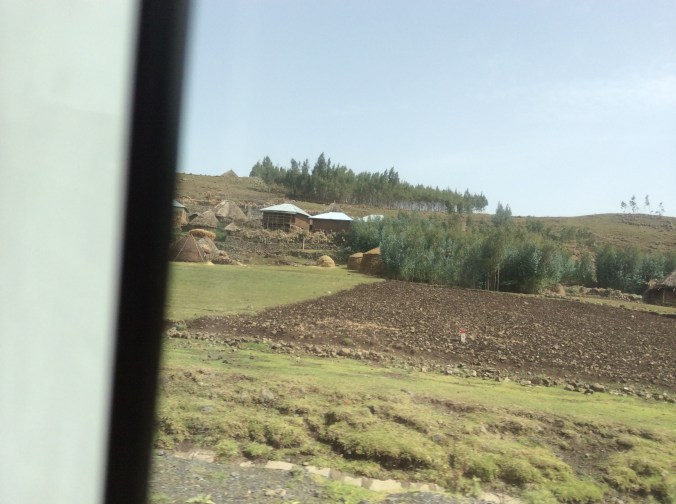
Because people lived and farmed in these mountains long before they became a park, visitors see villages and farms in various areas of the park.  We were told that the government planned to eventually move everyone out of the park.  Our guard lived in the park in an area like this one.  We dropped him off on our way out.  I also noted electric lines in areas where it looked impossible to build.  The guide informed me that a lot of Chinese died building the lines.

IMG_0610

Here and there gelada baboons appear.  This photo shows a typical view of the muddy road we traversed.

IMG_0613

Another stop waiting on Al-Qaeda and Obama trucks.  I never quite figured out why Obama trucks are called this.  They haul people from place to place but not long distances–buses do that.  I never saw an Obama truck wrecked.  Al-Qaeda trucks haul goods, supplies, anything commercial.  Like here in the US, apparently time is money so those drivers hurry.  If something is in the way on the road, drivers may drive off the road to get around it and if the load shifts, over they go.  We saw Al-Qaeda trucks wrecked everywhere–they are the terrorists of the road.

IMG_0614

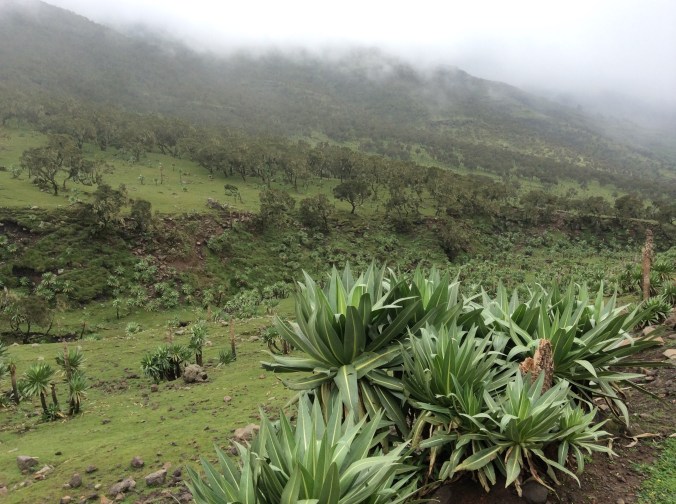
Above timberline, the landscape changes to this.  The plants in the foreground are giant lobelia.  Ethiopia contains the fourth and fifth highest peaks in Africa.  Much of the time we drove above 12,000 feet.

IMG_0617

IMG_0629

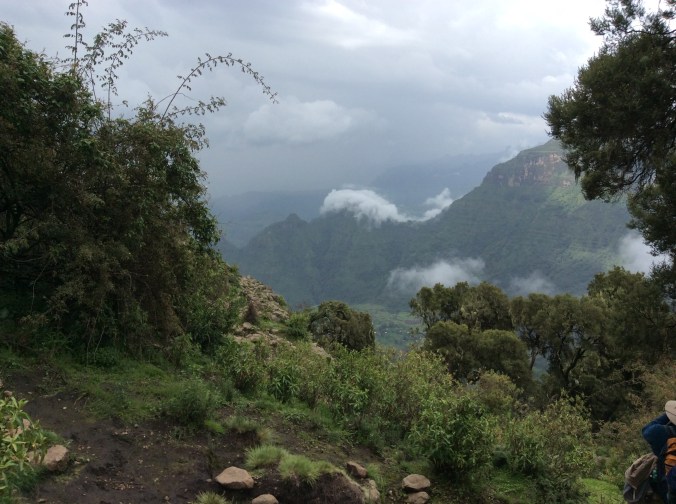
Frequently, we drove through thick fog, but truly lucked out when we reached the area immediately under the fifth highest peak in Africa where rare walia ibex reside. Alemu and the guide told us often visitors come here to see the ibex and see nothing.

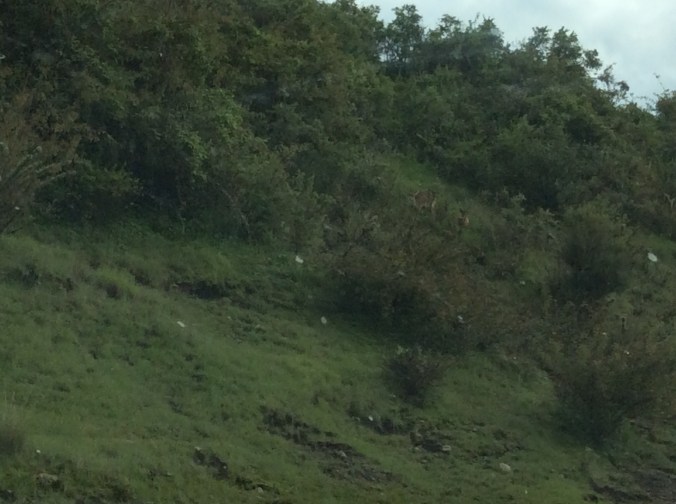
IMG_0625

If you look closely, you can see several ibex in the middle of this photo.  We counted 23 on this mountainside above 14,000 feet just a few hundred feet below the fifth highest peak in Africa.  Ibex blend into the landscape so well, they are extremely difficult to see unless they move.

IMG_0633

By the mountain stream red hot pokers (see middle of photo) thrive.  I was shocked to see them growing wild here, having always thought they are desert flowers.

IMG_0632

Finally, on the way back out of the park, we stopped so I could see the highest waterfall in Ethiopia.

IMG_0635