This speaks for itself.
Commit Random Acts
This speaks for itself.
This speaks for itself.
For those who want to explore movies, musicians, and writers many of you may never have heard of, here is a lengthy list with photos.

It’s 1pm and I’m planning my trip to Abeokuta – I leave on Wednesday. Yessss, the 2016 edition of Ake Arts and Book Festival is loading…. I’m so excited, I have butterflies, the pit of my stomach is always warm because
 That is me up there, scheduled to host a book chat with NoViolet Bulawayo and Jennifer Makumbi! Ms. Makumbi is the author of Kintu, which qualifies as the most recent addition to my all time list of favorite African fiction ever. I’m so stoked.😆😆😆.
I will also moderate this:
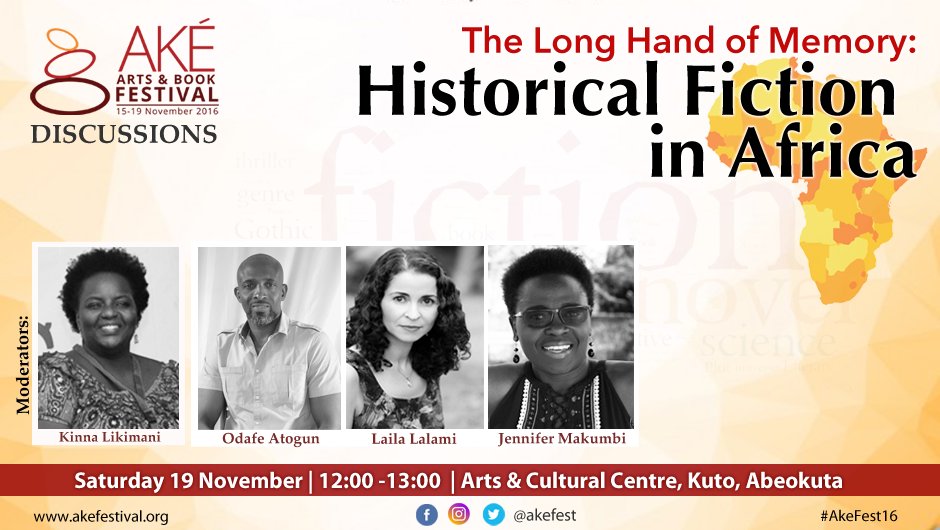 Laila Lalami, fellow book lovers!
Finally, I’m also on this:
 It’s all very glorious!
#AkeFest16 comprises 12 panel discussions, including:
 (I get to meet Sarah Ladipo Manyika (InDependence) finally…
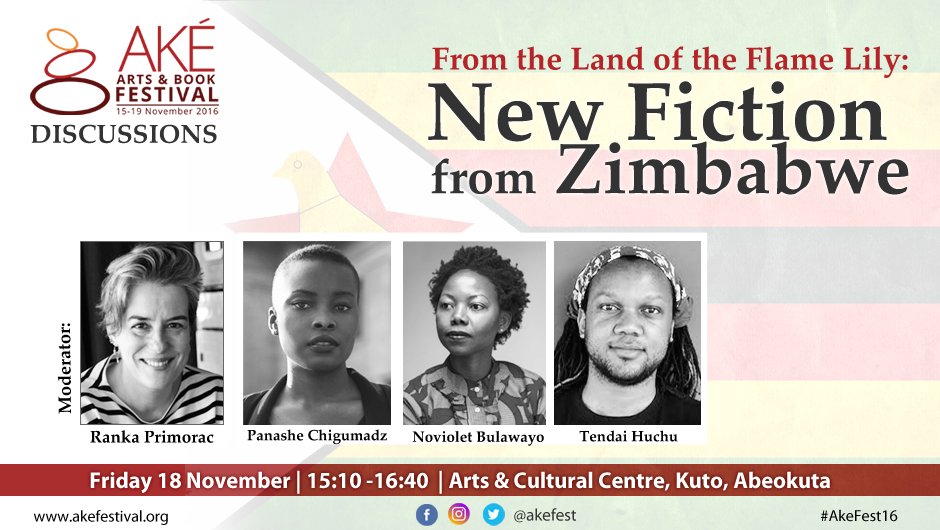
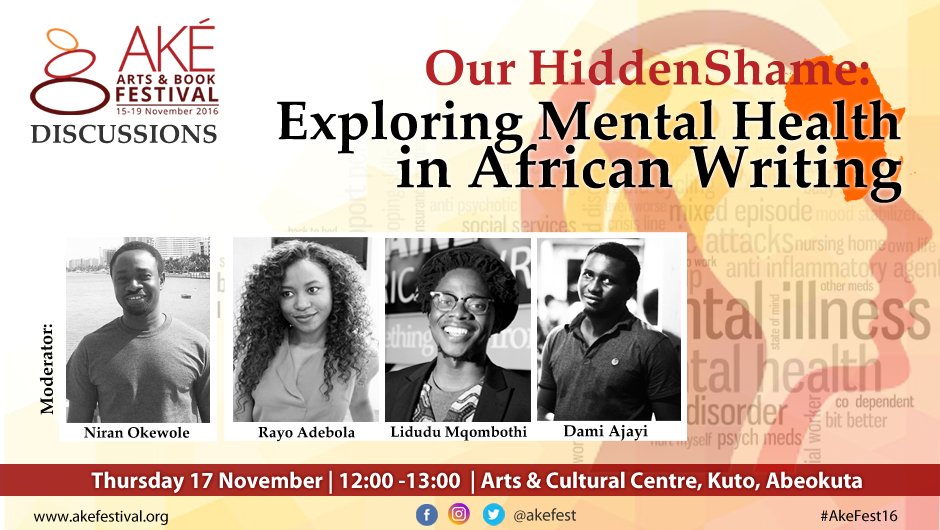

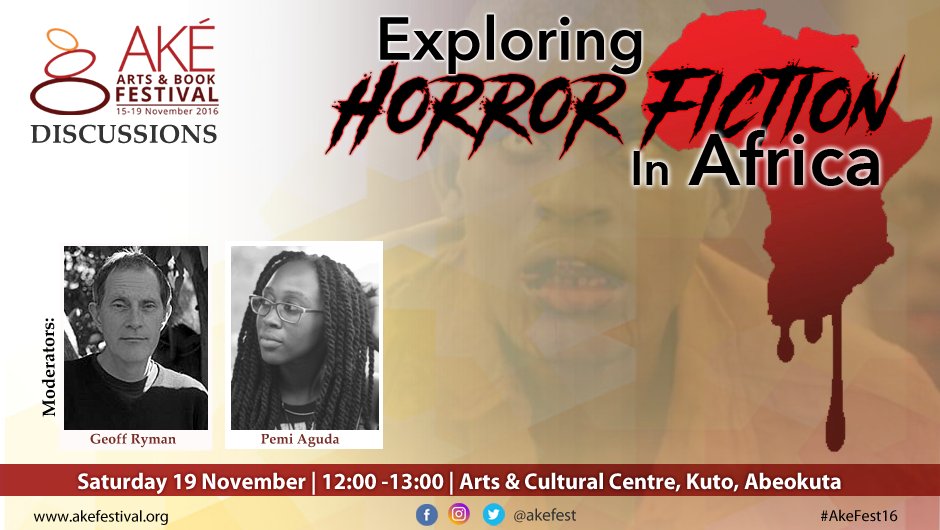
9 Book chats such as:




 Also on the schedule are film screenings, a play and a concert:


 Ngũgĩ wa Thiong’o will headline. In boxing parlance, he is the…
View original post 168 more words
A powerful story of the power of woman and in this case of “right”.
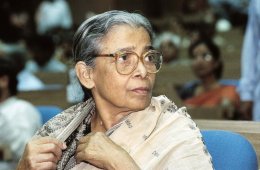 Photo credit: The New York Times
Mahasveta Devi died last month at the age of 90 in Kolkata, India. A widely acclaimed Bengali writer, she identified as an activist first, clearly evident in her meticulously researched “fiction.” Most of her stories champion the cause of those living on the margins of society, particularly the Adivasis or original inhabitants of India; poor, unemployed and itinerant, they traditionally subsisted off the land, and continue to struggle against exploitative upper caste landowners.
I cannot claim to be an expert on Devi or her activism, but there is a story I read a few years ago, which never fails to haunt me, whether because of the rawness with which she describes the harsh reality faced by tribal people or because of what can be seen as the violent but ultimate triumph of its female protagonist, I cannot tell. Perhaps because of both, or because…
View original post 1,120 more words
I am reblogging this because it fits with my next book project: poems from the viewpoint of the ancient mother goddess and others from the viewpoint of women in the Bible.
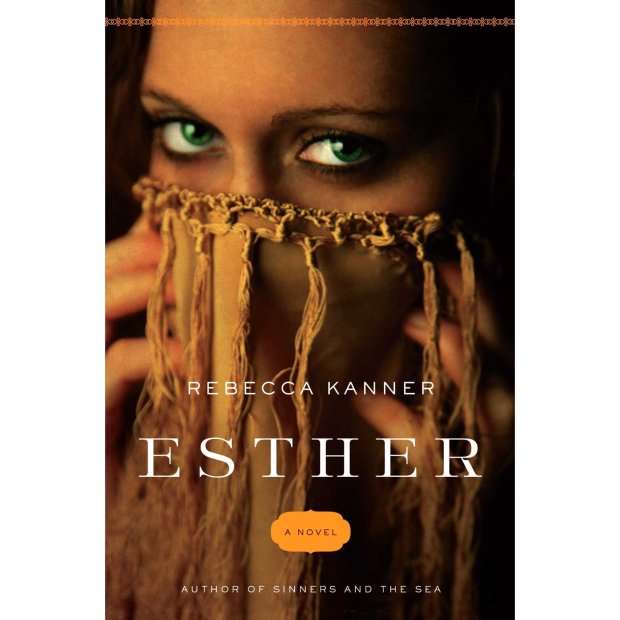
We have been lost to each other for so long. My name means nothing to you. My memory is dust. This is not your fault or mine. The chain connecting mother to daughter was broken and the word passed into the keeping of men, who had no way of knowing. That is why I became a footnote, my story a brief detour between the well-known history of my father and the celebrated chronicle of my brother.
-Anita Diamant, The Red Tent
To a large extent, women have been written out of history. Their lives and deeds have become lost to us. To uncover the buried histories of women, we must act as detectives, studying the clues left from ages lost.
At its best, historical fiction can write women back into history and challenge our misconceptions about women in the past. Anita Diamant’s novel, TheRed Tent, became such an…
View original post 777 more words
Gaden’s quiet. Normally he is shouting, asking questions to which he knows the answers.
I’m thinking, “He must be sick.”
Today he is sitting quietly, feet splayed out, short ginger hair sticking out exactly like Alfalfa’s, chin balanced on his left hand, staring at the silver Apple laptop open on his desk.
We’re reading modern stories in English, stories by Kelly Link, Kevin Barry, Adam Marek, Sarah Hall, Jon McGregor, Jennifer Egan.
Ghosts, robot boyfriends, fake lovers, bull semen distributors.
Astonished reactions, “We get to read adult stories with cuss words!”
They’re seniors in high school, 17, 18, 19.
Two are pregnant; one’s a dad.
For years I had read and heard about this place, even attended a lecture by a descendent of one of her frequent guests who actually knew her when he was a child. This past weekend good friends from Rociada took me there with my best friends from college years, friends from long ago, visiting from California.
I already knew something about Mabel and her friends, famous people who frequented her salon, created the artistic mystique that still hangs over Taos. When I returned home, I wanted to know more. Born into Buffalo, NY, high society, she had been married and widowed by the age of 23. As a young woman she was openly bisexual; her memoir, “Intimate Memories”, provides a frank discussion of this part of her life. Several years after her first husband’s death, she married the architect Edwin Dodge. They lived near Florence, Italy, for seven years where she entertained such notables as Gertrude Stein, Alice B. Toklas, and Andre Gide. After affairs and two suicide attempts, she separated from her husband and moved to Greenich Village. Eventually, she married her third husband, the painter Maurice Sterne and became a patron of the arts.
In 1917, she and her husband moved to New Mexico. This changed her life; she lived there until she died 45 years later. She preferred Taos to Santa Fe, finding the latter “too civilized”. She found New Mexico “alive” and fell in love with Pueblo culture eventually even cutting her hair to mimic Pueblo style. Sterne did not find New Mexico to his liking and left. After their divorce she married her long standing love, Antonio Luhan, a Taos Pueblo man. They remained married 40 years.
Mabel entertained a nearly endless array of famous artists, writers, and intellectuals: D.H. Lawrence, Georgia O’Keefe, Willa Cather, Ansel Adams, Carl Jung, Emma Goldberg, Margaret Sanger, the founders of the Taos Society of Artists. She introduced New York and the east coast to New Mexico through her columns in “The New York Journal”. Mabel died in 1962.

A view of the main entrance and the largest portion of the house and grounds.
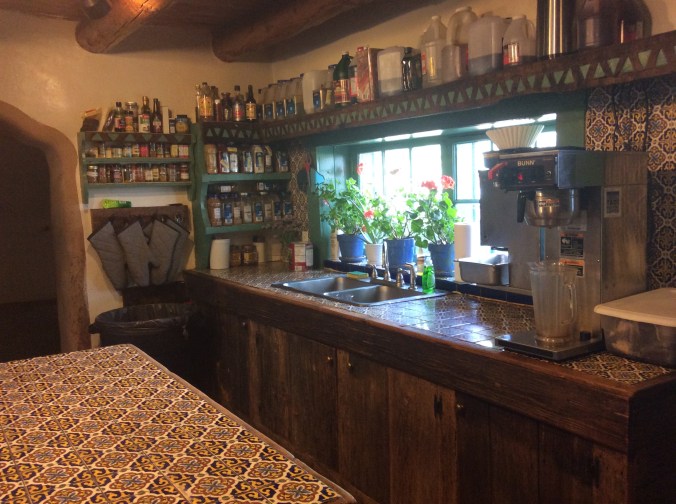
A small portion of the kitchen. Cookies, coffee, fruit infused water, and tea were available in the dining room for hotel guests. Books with historical photos lay out for visitors to read in an adjoining room.
Dennis Hopper bought the house in 1970 and recreated her “salon” hippie style. In 1977, he sold it to George Otero. Because of years of neglect, it required extensive restoration. The Oteros turned it into a non-profit where they held workshops. The Attiyeh Foundation, its current owners, purchased it in 1996 and run it as a hotel and conference/retreat center. It costs nothing to visit and wander around.

This photo was taken from the same spot as the first one, looking to the right instead of toward the entrance.
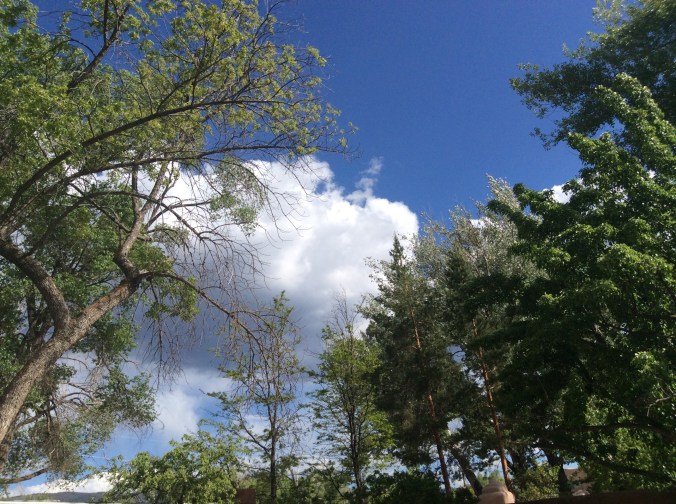
While standing there, I looked up into that incredible New Mexico sky.
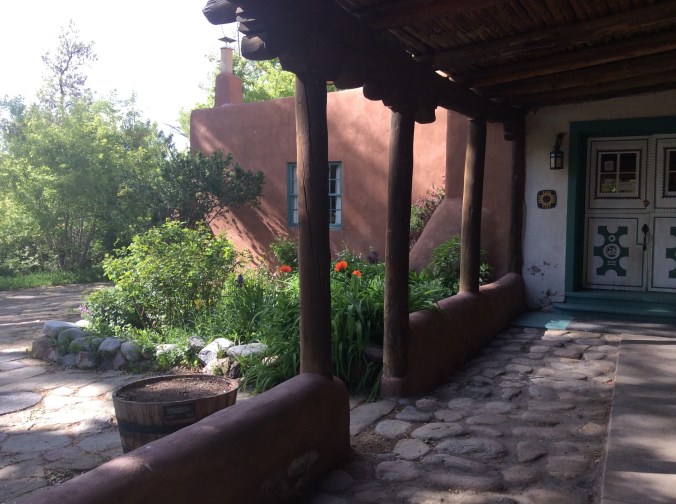
A close up view of the entrance.

Look at all the bird houses.

Beside the kitchen, out a side door–patio and horno (traditional clay oven) shaded from the afternoon sun.
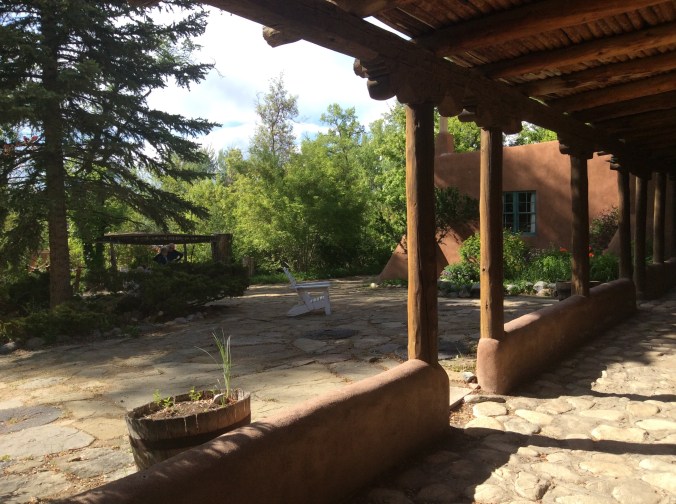

Friends chit chatting while I wander around taking photos.
For more details, go to: http://www.mabeldodgeluhan.com. This includes history, accommodations, workshops, etc. The accommodations portion even tells the site visitor who slept in each room when visiting Mabel.
Who would think that a Mexican woman who wrote poetry more than three hundred years ago would have anything applicable to today’s political arena? About one and one half years ago, my daughter returned from a business trip with a little gift, a translation of Sor Juana’s work. It is not the sort of literature I sit down and read all the way through. It is deep, questioning, the sort of literature you savor here and there. A few minutes ago I opened the book once again to read one of her ballads–typically referred to as romances. However, this is not exactly a romance. It reads:
“One who is sad criticizes
the happy man as frivolous;
and one who is happy derides
the sad man and his suffering.
The two philosophers of Greece
offered perfect proofs of this truth;
for what caused laughter in one man
occasioned tears in another.
The contradiction has been framed
for centuries beyond number,
yet which of the two ways was correct
has so far not been determined;
instead, into two factions
all people have been recruited,
temperament dictating which
band each person will adhere to.”
This is only a small portion of the ballad. It is ballad 2 in the translation by Edith Grossman. The introduction to the book is by one of my favorite authors (I have read all her books published to date), Julia Alvarez.
Read two pages,
“Ghana Must Go”.
The wife’s Nigerian,
Yoruba, Igbo.
She sells flowers,
not in Nigeria.
The author’s name
Ethiopian?
Sip zinfandel
flowered glass.
Take a bite
chocolate filled
peppermint,
lick peppermint
fingers.
Read two pages:
“Africans…the indifference of the abundantly blessed…
who can’t accept, even with evidence, that anything native,
occurring in abundance, is exceptional without effort,
has value.”
Does anyone?


Lately I have been reflecting on this quote of Virginia Woolf: “For most of history, Anonymous was a woman.” Here she points out the deliberate invisibilization of women’s contribution in all areas of human endeavors.
Patriarchy always takes these contributions for granted. For centuries, domestic labor has been invisible and not considered work. It has put beauty over intelligence, even with women of outstanding intelligence. And in terms of knowledge and intellectual production, patriarchy has appropriated women’s ideas and in presenting them as “anonymous,” presents them as it’s own.
Thanks to the feminist reclaiming of history, and proving the accuracy of the premise that “Anonymous is woman,” we have learned of the long list of inventions that were made possible due to women’s ideas who were kept invisible, unnamed, unquoted, and erased; after all, she was “just” a “woman.”
View original post 867 more words
Inspired by a friend’s poem, I decided to take a look at some of my book stacks and write a poem from their titles–in honor of National Poetry Month.

Now Is the Time to Open Your Hearts
the tongue’s blood does not run dry
The Mambo Kings Play Songs of Love
A Simple Havana Melody
Alejandro Blue
The Spirit of Indian Women
Still Life With Bread Crumbs
Ring of Fire
Gardens in the Dunes
Daughters of Fortune
The Way to Paradise
The Bingo Palace
Uppity Women
How We Became Human
Close Range
Native Guard
Things Fall Apart
Gone Home
Travel the World 4 Less
A Glimpse into My Life & Passions
Ceto-Magoism, the Whale-guided Way of WE in S/HE
Exploring the F-word in religion at the intersection of scholarship, activism, and community.
ANCESTRAL FOOD. HERBAL WISDOM. MAGICAL COOKERY. SEASONAL CELEBRATION.
inesemjphotography
politics, engineering, parenting, relevant things over coffee.
Food is the best expression of every emotion. Explore through my reviews, recipes, events and more.
Smile! A Site for Friends Wherever You Are!
inspiring personal growth through poetry and writing
Combining atheism with whimsy. This is a Fair and Balanced blog based on opinion unencumbered by fact.
Odds and ends ~ My Life
Original poetry, commentary, and fiction. All copyrights reserved.
bripike@gmail.com
A wildlife filmmaker in Africa
A Geeky Feminist's Musings On Pop Culture
"5 minute walks"


 writingontherim