Ethiopian Journey–Ancient Churches of Lalibela


In the 12th century the king of Ethiopia decided to build a New Jerusalem.  Eleven churches were carved out of solid rock on the mountain top in the village of Lalibela.  A UNESCO World Heritage site, these churches remain intact and in use.

IMG_0428

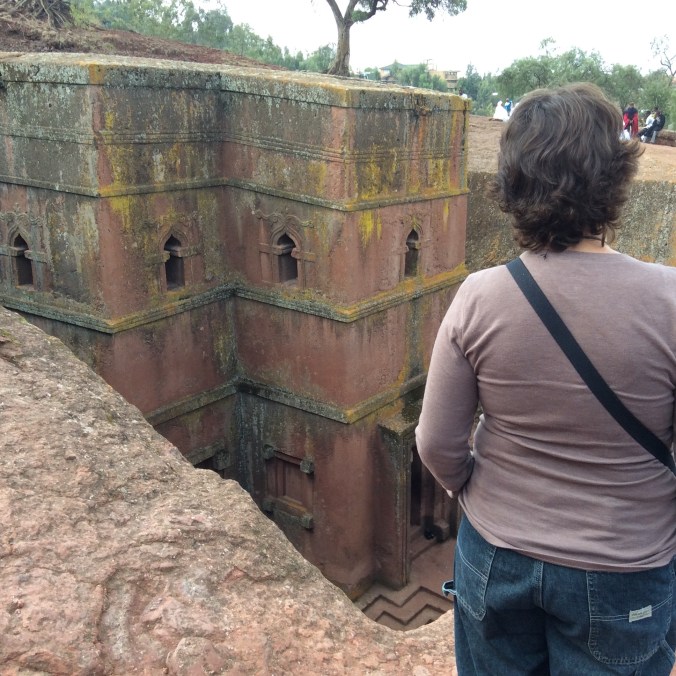
They were all carved from the rock top of the mountain down into the earth so that they remain invisible unless the person is only a few feet away.  This protected them from the vision of potential invaders, usually Muslims from what is now Sudan.  The above is probably the most photographed of these churches and stands separate from the others.

IMG_0429

My friend is standing near where the stairs lead down to the bottom where visitors and worshippers can enter the church.  Visiting all these churches in one day is not an activity for the faint of heart or for one terrified of heights.

IMG_0401

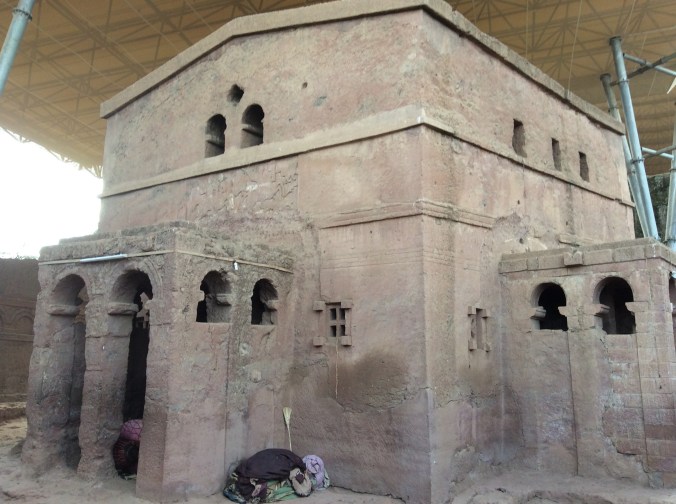
This is the first church we visited.  It still mystifies many as to how such incredibly intricate structures could me carved by hand out of solid stone.  Even these columns are carved out of the rock.  The “official” Ethiopian Orthodox Christian story relates how angels helped the builders.

IMG_0402

This and most of the other churches are connected by “waterways” where in the rainy season a sophisticated system of drainage keeps all of them from flooding and makes it possible for visitors and worshippers to walk along from church to church.

IMG_0407

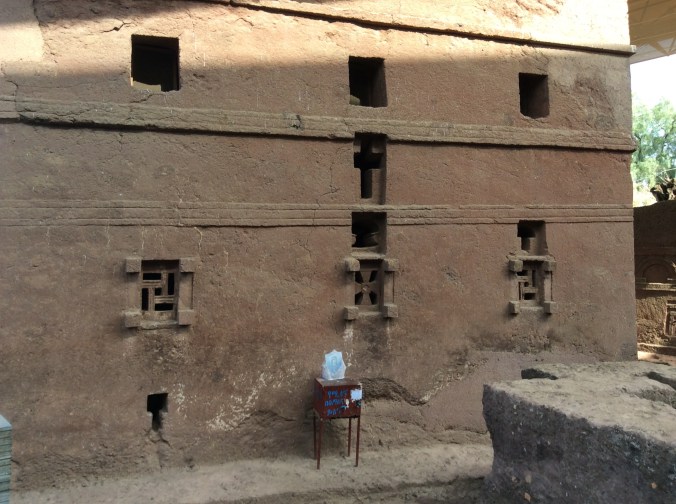
Everything in the Christian churches in Ethiopia  symbolizes something related back to Jerusalem and the Bible.  Even though the guide explained it all in detail, keeping up with all the symbolism proved a daunting task.  Notice the swastikas.  They are ancient symbols of the eternal circle of life and death.  Hitler turned them backwards and into a totally different meaning.  There are also many different styles of crosses there, two of which can be seen in the windows of this church.

IMG_0408

This is a fertility pool.  In the past a priest got in the water–it is very deep–with a woman who could not conceive and bless her in the water.  At one point when it began to fill too much, they cleaned out the bottom and found many treasures buried there, apparently dumped into the pool to protect them from enemy invaders.

IMG_0412

The inside of the churches are intricately carved and sometimes painted.

IMG_0417

Two types of basalt exist on this mountain, soft and hard.  Churches carved out of the soft basalt have begun to deteriorate and as a consequence are covered.  As can be seen here, people still come to these churches to pray and attend services.

IMG_0419

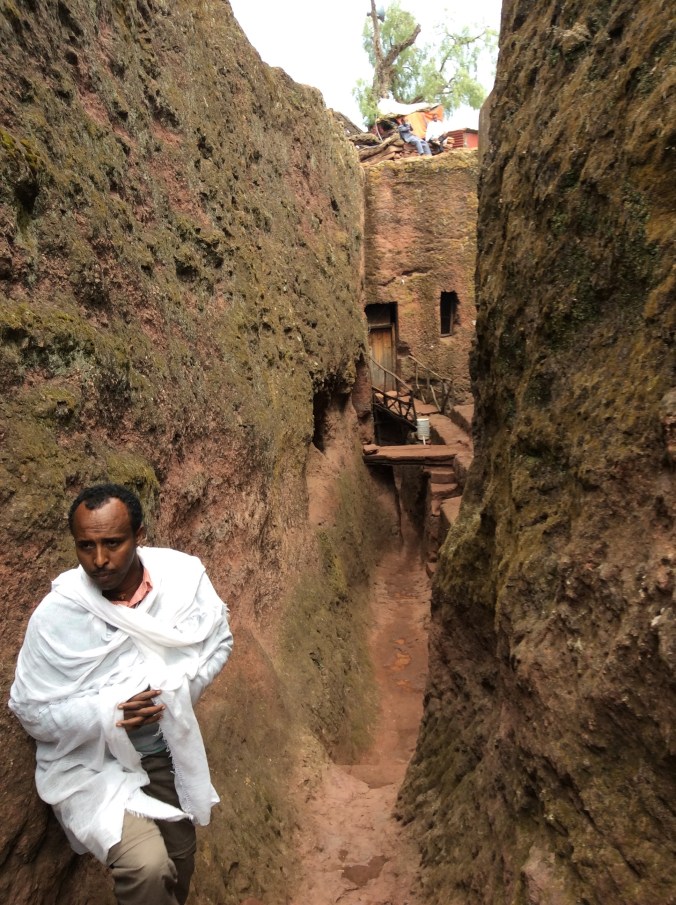
Our guide lead us from church to church through these narrow passageways which are, as previously mentioned, used to drain water away from them in the rainy season.  If Ethiopia had a national color, it would be white.  It is not only worn to go to church and for religious purposes but in daily life as well.  It mystifies me as to how they keep whites so very white.
IMG_0430

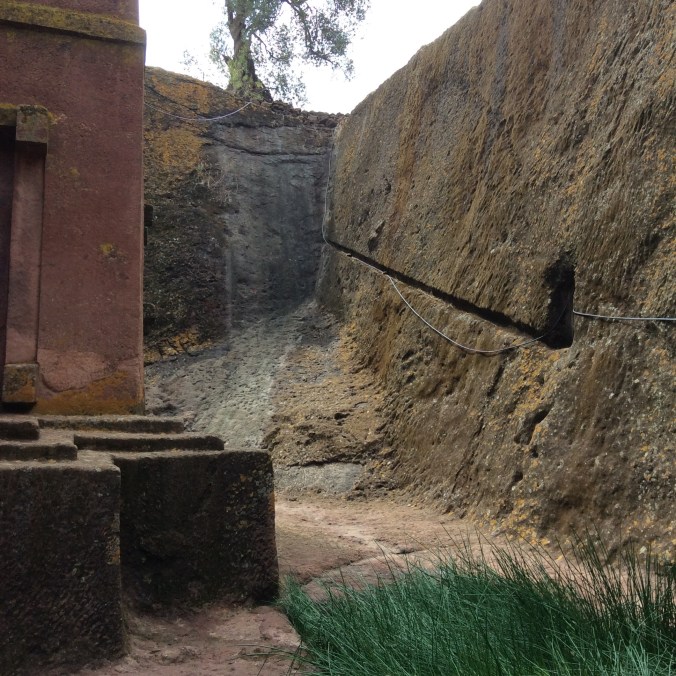
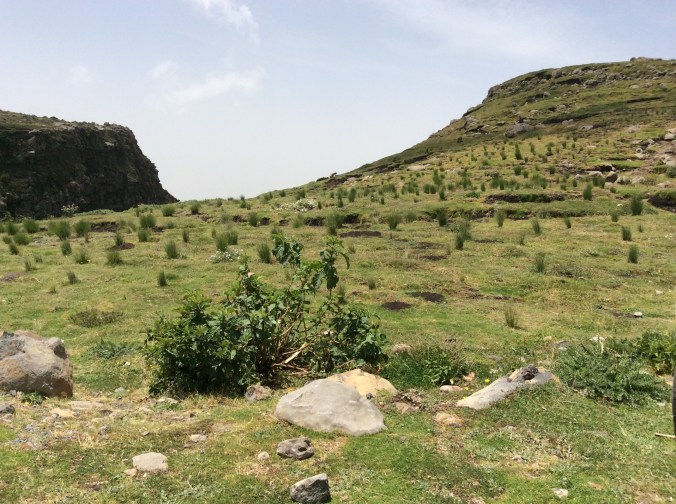
The slit dug in the rock is part of the system of drainage.  The grass in the foreground grows out of a pool of holy water.  While we were there, a boy filled a plastic bottle with the water and left.

IMG_0435

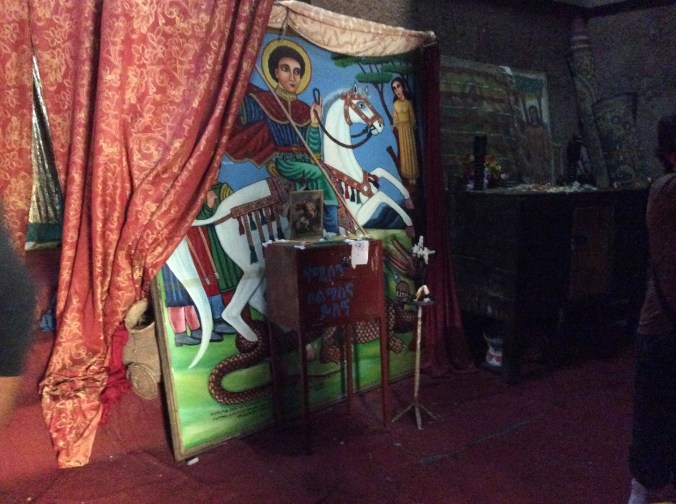
St. George and the dragon are everywhere, not only in churches but also on beer.  He is the patron saint of the country, symbolizing the triumph of Christianity over paganism as symbolized by the dragon.

IMG_0448

The carving in many of the churches reveal a sophisticated knowledge of how to work in stone.  It is difficult to believe that this was carved by hand downward into solid basalt centuries ago.

IMG_0491

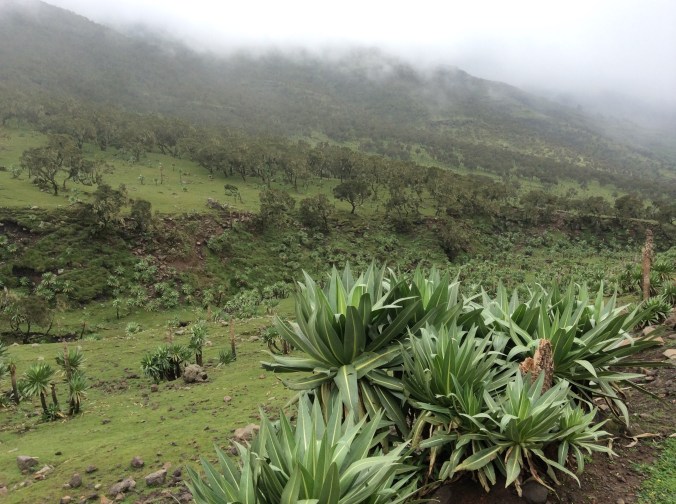
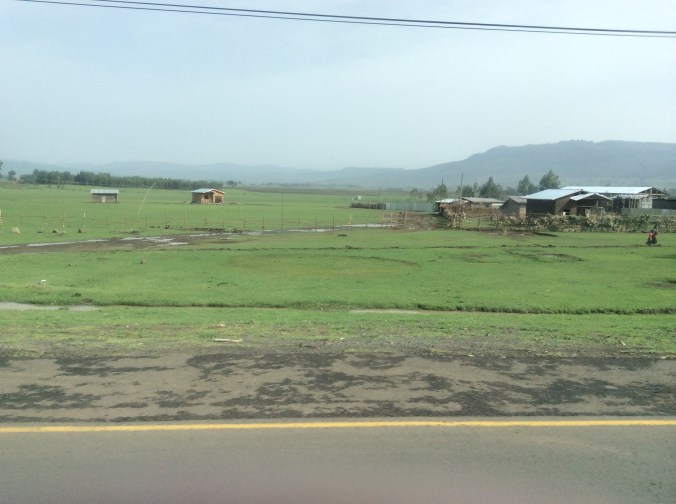
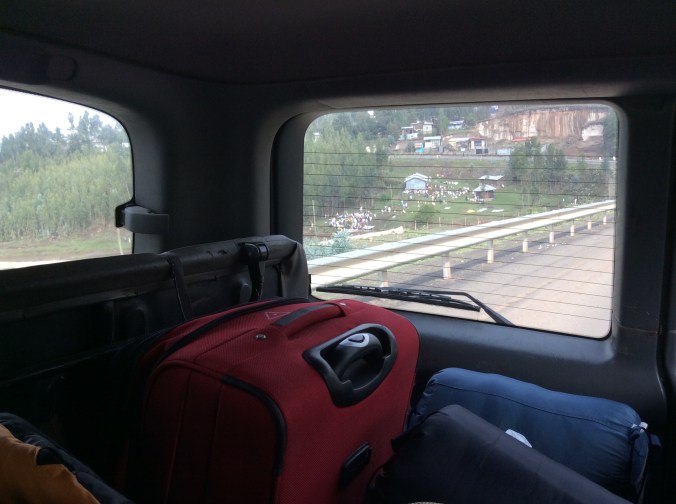
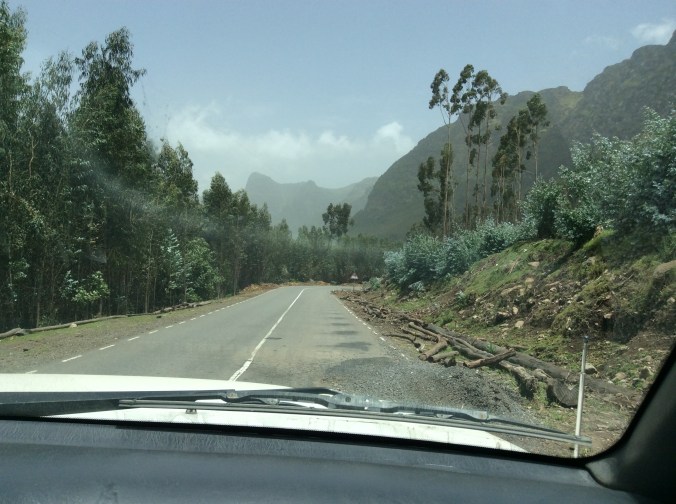
The road to Lalibela is rather daunting, climbing  higher and higher with no guard rails, nothing.  As you can see from this photo, patchwork quilt  fields cover even the mountainsides.


To learn more about Lalibela, see detailed information and explanations of their River Jordan and other religious symbolism, go to my blog posts from August 2014.

Ethiopian Journey–From Addis Ababa to Debre Birhan


Addis is the second highest capital in the world.  Only La Paz, Bolivia, is higher.  To a large extent, altitude determines climate in Ethiopia.  Addis and the surrounding area, much of which is high altitude farmland, receives a lot of rain this time of year and looks totally unlike what a lot of people think of when they hear the word Ethiopia–not desert but rather miles and miles of green.

IMG_0248

IMG_0249

We had not driven far from Addis when we crossed a river, an area of which is considered healing.  Many people had come for priests to bless them and to experience the healing power of the water.

IMG_0246

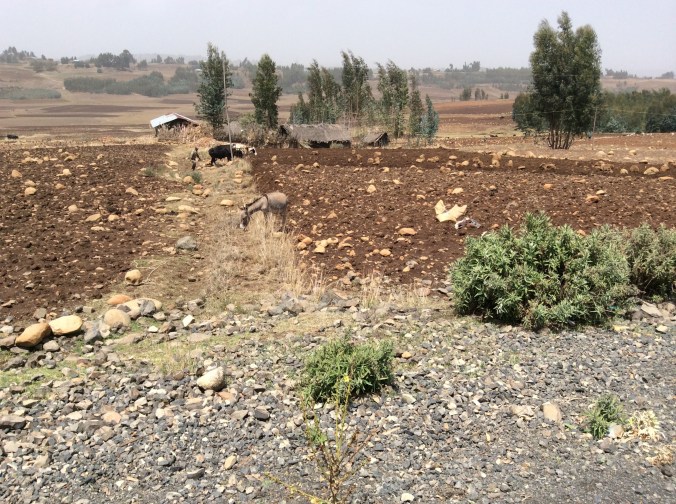
I saw only three tractors in ten days of criss crossing farmland.  Why so few?  One reason is rocks.  Many of the fields remain rather full of rocks in spite of many having been removed.

IMG_0258

Therefore, they farm the “old fashioned” way; horses or cattle pulling plows with a human behind.

IMG_0251

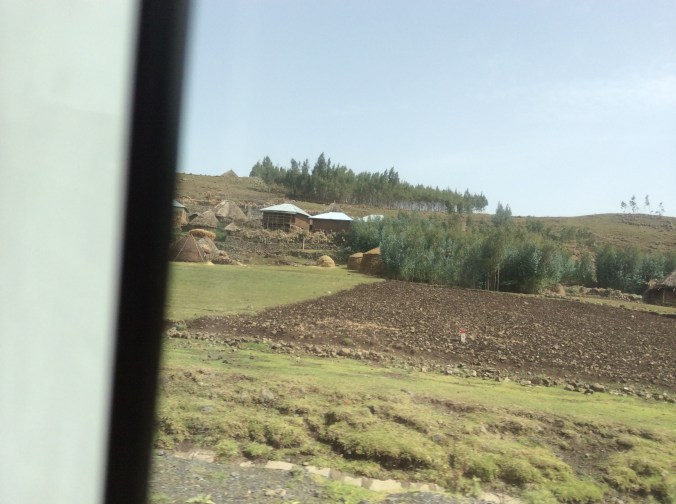
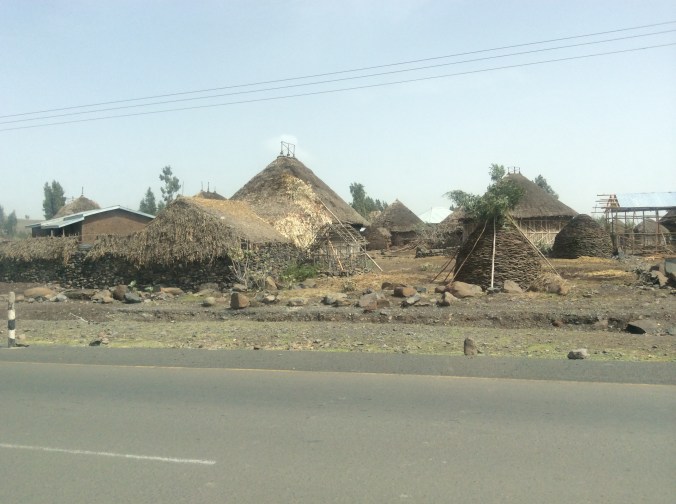
Houses in the villages in the farming areas demonstrate old ways alongside new.

IMG_0257

IMG_0259

Winnowing the way we did in the USA a century ago.

IMG_0253

IMG_0261

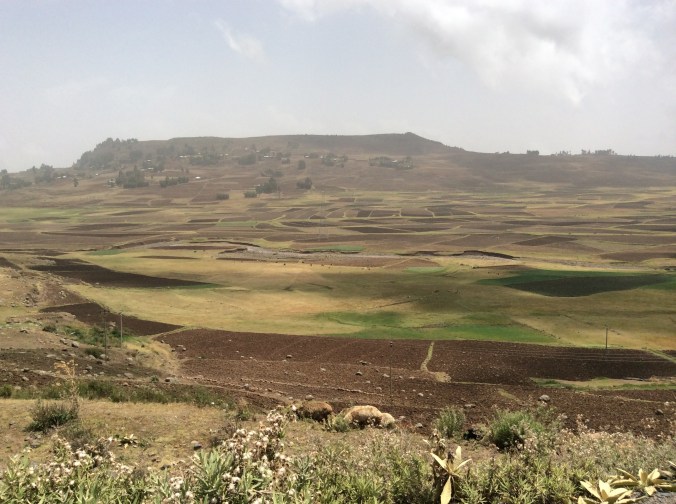
Much of the farmland is a picturesque patchwork quilt of browns and greens.

IMG_0266

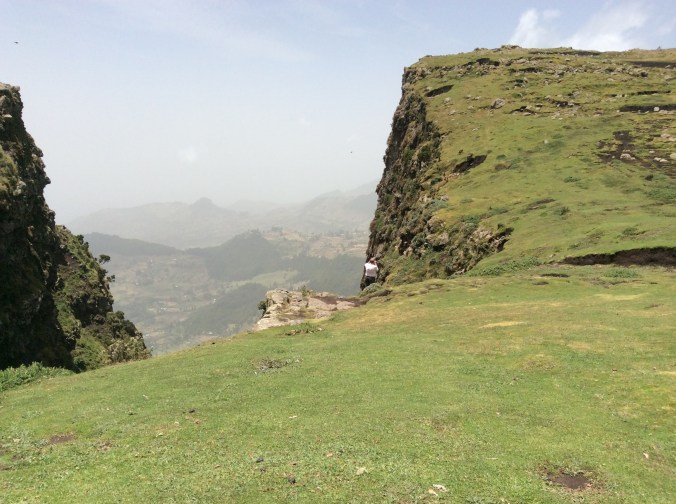
Before dropping down to lower country, we drove by Menelik’s Window.   The drop off here is steep and far.  I did not go near it–I had not yet become used to the endless drop-offs or even realized that I would need to do so.  This is one of four places in Ethiopian where you can see gelada baboons.  They are extinct elsewhere. Menelik was an Ethiopian emperor.  This “window” allows one to look from the high country for miles and miles to the landscape beyond.

IMG_0262

The large tufts of grass provide food for the gelada which are grass eating herbivores, the last of the grass eating primates.  All others are extinct.  This same grass is used by the locals for roofing material so boys stay in these areas all day chasing off the baboons.

IMG_0264

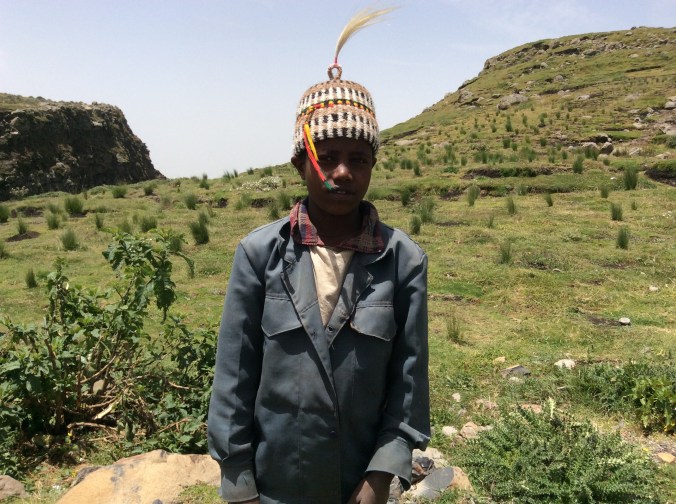
To keep themselves busy they weave woolen baskets and hats to sell which they display in the grass.

IMG_0267

This ten year old boy happily donned the hat he had made.  I bought it for my grandson who was the same age when I took the trip.

IMG_0268

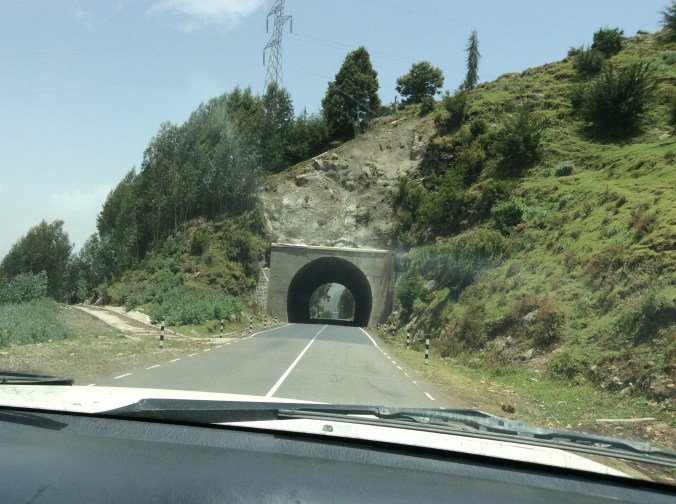
Except for the different vegetation, driving down the mountain looked a lot like driving through Colorado.

IMG_0271

IMG_0272

IMG_0276

Down from the mountain the landscape appears quite different and considerably drier.  We drove through several smaller towns on our way to Debre Birhan where we stayed the first night.

IMG_0279

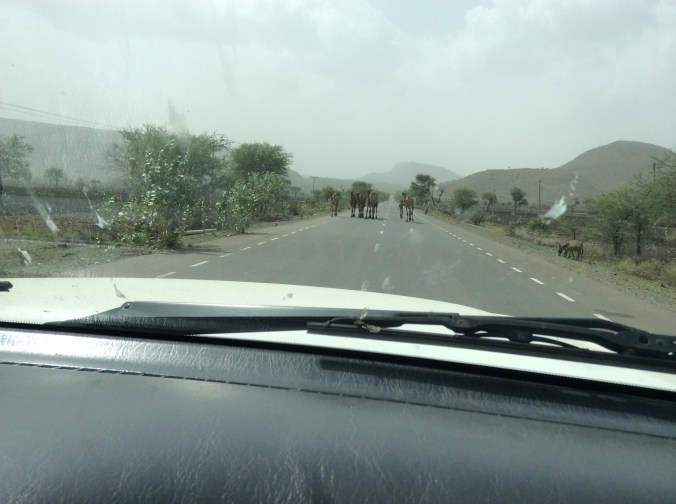
Driving in Ethiopia requires navigating around animals.  Everyone drives their cattle, camels, horses, all livestock down the road whenever possible.  The roads are generally very good.  Many, built by the Italians, have stood the test of decades.

IMG_0282

Along the road we saw many of these “apples”.  My friend told us how they played with them as a child.  However, the adults all warned the children not to touch their eyes when they did–it will make you blind.  They are called Apples of Sodom–so many things in Ethiopia have symbolic meaning.

IMG_0283

These fruit could be seen all along the road and even on the road.  After driving through this drier area we rose above a huge valley with miles and miles of grass.

IMG_0285

A semi-nomadic group brings their immense herds of cattle here in the rainy season to graze.  When we drove further on above the valley, I saw the first tractor working a field as big as this grazing land.


Ethiopian Journey–Addis Ababa


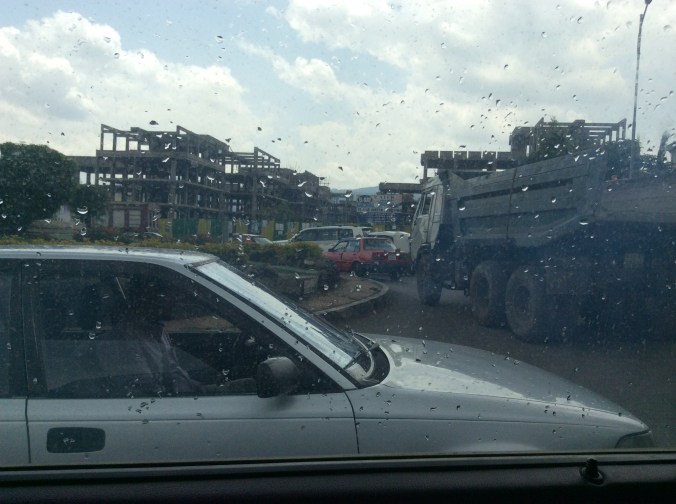
We spent a couple of days in Addis staying with my friend’s sister who lives there.  Addis traffic is incredible.  In a city with millions of people I saw only one traffic light and it was not working.  Most intersections are giant traffic circles and getting through them is a rather daunting task.  On the way to my friend’s brother’s house one day, we sat stuck for nearly one half hour–we could not get through the circle.  Finally, the passenger in the car to the right of us jumped out and stopped the traffic so we and his driver could get through.

IMG_0211

Additionally, it rained often, streets and buildings were under construction, and mud and potholes showed up everywhere.  This is a nice traffic circle.

IMG_0212

A nice day with little traffic.

IMG_0213

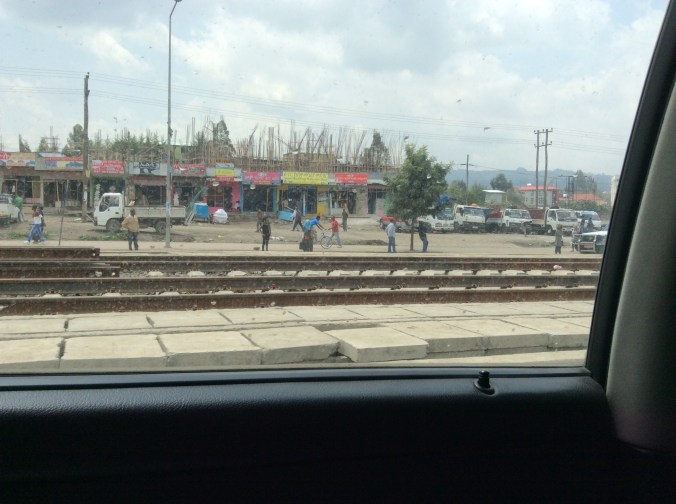
They were building a new rail line across the city hoping people would use the train instead of driving.

IMG_0214

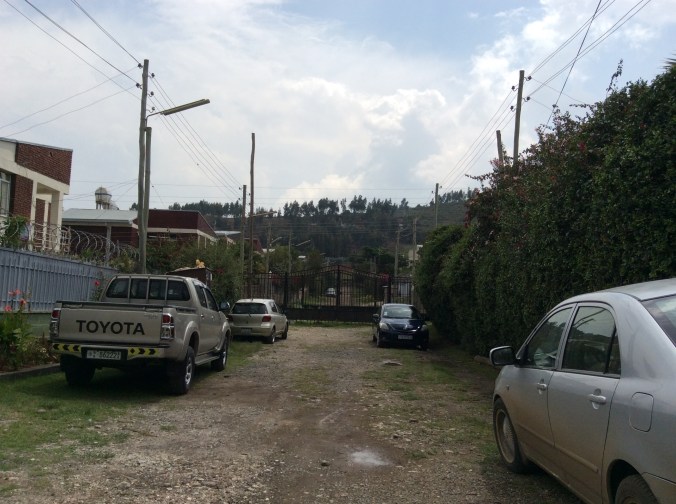
This is a typical residential street in a newer part of the city.  A gate with a guard can be found at each end of the street.

IMG_0215

In other parts of the city, houses have walls around them and you back your vehicle out into a street like this, then go to the main street.

IMG_0207

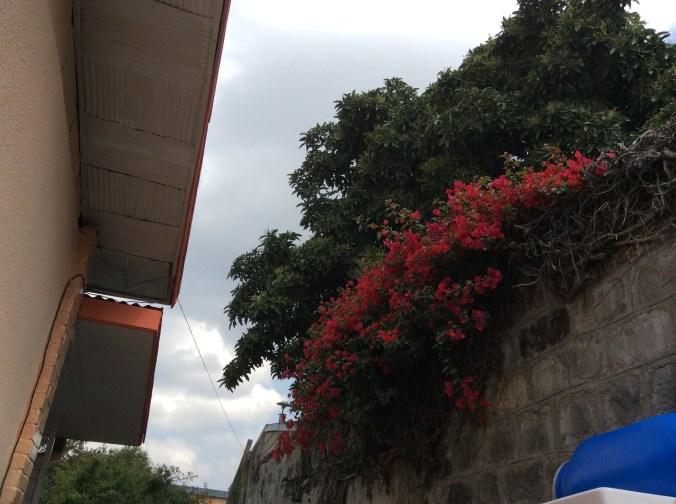
Walls around houses are not bare.  Lush tropical vines and flowers cover many of them.

IMG_0218

Many of the fancier, famous hotels, like the Hilton here, contain fountains and gardens. My friend and I could not resist a photo in front of the pool and fountains.

IMG_0219

After wandering around the Hilton we drove to see the grounds of another famous hotel where foreign diplomats often stay.  The plants in the foreground are papyrus.

IMG_0220

IMG_0222

These extensive gardens take a while to walk around.  Many of the plants and trees are labelled.  From here we could see the Addis skyline.

IMG_0227

We stayed in Addis a couple of days.  Before we left on a ten day road trip, my friend’s sister took us to a traditional restaurant.  I expected it to be filled mostly with tourists–was I ever wrong.

IMG_0240

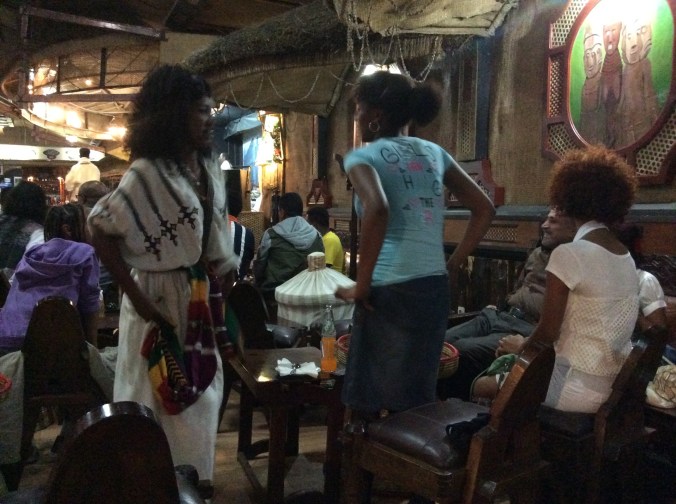
In addition to traditional food, this restaurant features traditional dancing.  Many locals came to compete, to try to out-dance the professional dancers.

IMG_0242

The lady on the left, one of the professional dancers, and the lady on the right having a little competition.  The lady on the left is dressed in traditional dress.

IMG_0243

In the background locals try to out-dance the professionals.


Ethiopian Journey, Dubai


If you have a long enough layover in Dubai, they put you up in their Emirates hotel and feed you in the cafeteria free.  The hotel is nice, the food excellent–quite a nice perk.  From the hotel it is easy to walk to several places as well as take a van tour around the city.  We did both.

IMG_0167

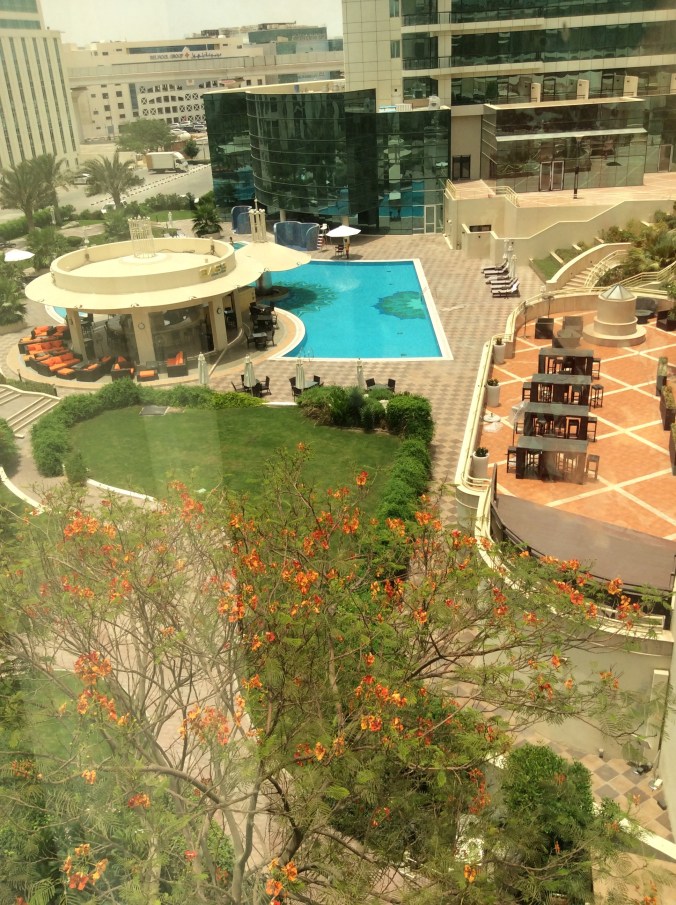
The view from my room.  The pool has a swim up bar but it is not open during Ramadan which was occurring two years ago when we were there.  Alcohol is available in some restaurants and bars but you must imbibe inside.

IMG_0169

One of the first places we visited on the tour was this mosque, designed to look like the famous mosque in Istanbul.  The following photos are of typical houses near the mosque.

IMG_0170

IMG_0171

IMG_0172

IMG_0180

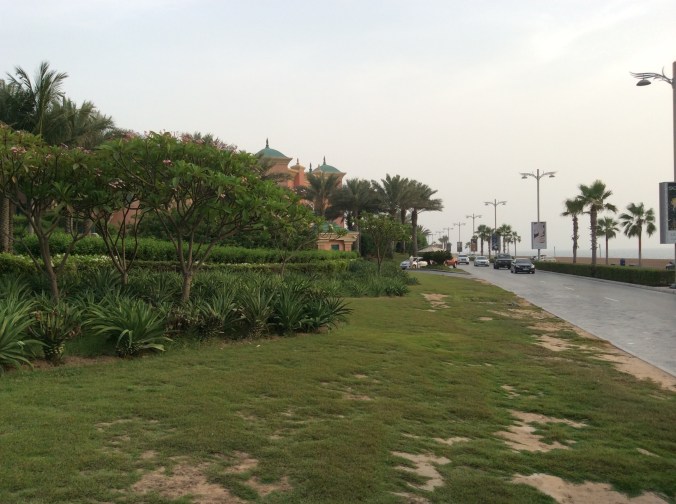
Then we arrived at the beachfront of the Persian Gulf.  The water is warm, like lukewarm soup.  In the background two of the most expensive hotels in the world tower above the water.

IMG_0184

The street goes along the waterfront with luxury hotels on the left.  Many of these areas are fill–manmade peninsulas.

IMG_0185

You can visit the sister hotel in the Bahamas.

IMG_0189

Because of the fill, the fake peninsulas, it is easy to get a bit disoriented.  Plus during the summer there is so much haze, it is rather difficult to determine directions.

IMG_0190

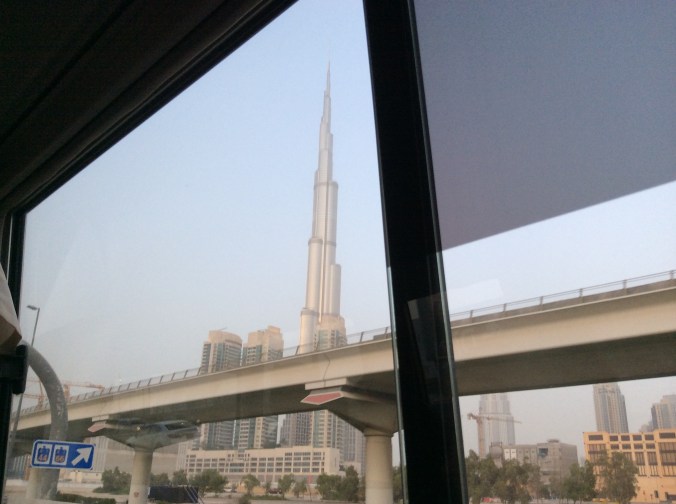
The tallest building in the world.

IMG_0191

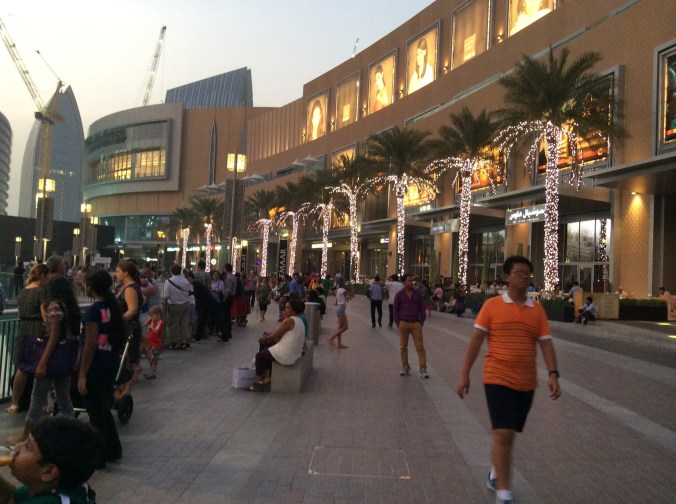
After visiting several smaller shopping areas, we arrived here, the famous Dubai mall.  This is the largest aquarium in a mall in the world. Here you see people from everywhere in the world dressed in every way imaginable.

IMG_0192

A children’s store across from the aquarium contained this lollipop tree with giant lollipops.

IMG_0194

In spite of high heat–it was 108 when we arrived–no wind and high humidity (yes, because on the Gulf, even though it is desert, the humidity is stifling), many people were outside awaiting the fountain show.

IMG_0198

One part of the skyline reflected in the lake.  The fountain show, synchronized with music, is worth the wait even in the heat.

IMG_0202

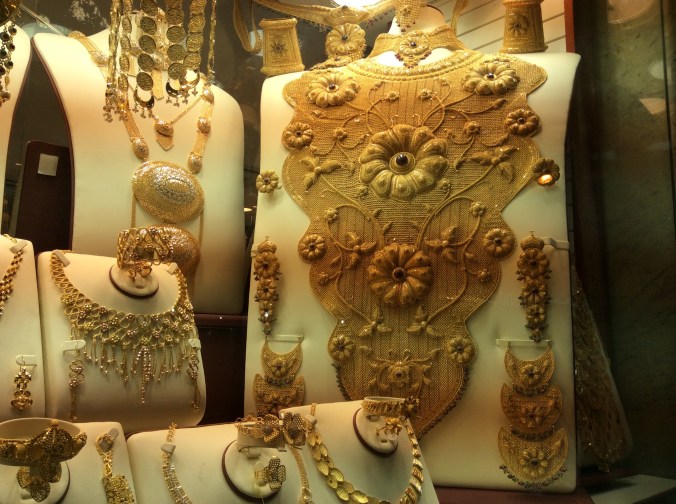
On to the gold and silver souk.

IMG_0203

Gold and silver are sold by weight.  You can also buy gold in shops at the airport; however, nothing quite has heavy and exotic as some of this.

IMG_0204

We did actually shop in the food shops and bought nuts covered in various spices to take along for snacks.

IMG_0205

Ethiopian Journey–The Beginning


Two years ago today, two friends and I flew from here to Dallas to Dubai.  The final destination:  Ethiopia, where I spent nearly three weeks with them and my friends’s family plus a road trip through the north.  Ethiopia was nothing like what one sees in the news, in famine photographs, nothing like the image most people in the USA have of it.  My main goal when I returned home was to show people photos and inform them what it really looks like, how incredibly beautiful it is there.  This mission continues two years hence.  For the next several weeks I plan to relive this journey and share it on my blog here.

It is a short trip from Amarillo to Dallas via air.  In order to carry the baggage allowed on Emirate Airlines, we first flew via Southwest to Love Field, then took a taxi to Dallas International.  If you plan to fly long distances, I highly recommend Emirates Airlines.  Compared with all the others I have experienced even coach class is wonderful:  bigger seat room, more than a hundred movies to watch, good food, an area where you can help yourself to fruit and snacks, unlimited wine and beer, and an international group of flight attendants.

From Dallas to Dubai is fifteen hours of flying.

IMG_0155

IMG_0163

People wonder why they fly over Greenland, Iceland, northern Europe to get to Dubai.  Do not look at a flat map.  Get a globe and trace the route.  It is the shortest way to go.  Dubai is not like many think here.  No, I did not see endless lines of Lamborghinis and Ferraris.  In fact, I do not recall seeing any at all.  Tomorrow, photos of Dubai before heading on to Addis.

Driving on Your Own in Costa Rica–Hotel Playa Negra


On March 17, I related the story of having to leave the first hotel in this area after dark with nowhere to go–see first post on driving on your own.  It was not until I awakened the next morning, dressed, and went in search of coffee, that I realized just how lucky we were.  I left my daughter and grandson asleep and ventured toward the restaurant indicated by a small sign.  I had not walked far when this scene greeted my eyes.

IMG_2068

Horses right by the beach.  Perhaps these were the horses one could ride–I had just seen a sign indicating horse back riding was available.  Then I walked a bit further and these scenes welcomed me.

IMG_2069

IMG_2070

IMG_2071

Except for the two dogs you can see here, no one was at the beach.  The tranquility amazed me.

IMG_2072

I walked back inside the restaurant–here I am standing at its edging looking toward the beach–ordered cafe con leche and luxuriated in our incredibly good karma.  This place exceeded all expectations considering our experience the previous night.

IMG_2074

This photo was taken from the beach looking back at the restaurant.  Except in colder areas like San Jose and Monteverde, I never saw or ate in any enclosed restaurants.  Even the fanciest are open air like this one.  Hotel Playa Negra is the only hotel near Playa Negra next to the beach.  It is a quiet, peaceful place with yoga, horse back riding, surf boarding lessons–the surf here is for beginners.  The restaurant serves a wide variety of food, but since I especially like the typical cuisine, it seemed perfect–more gallo pinto, platanos fritos, cafe con leche.


Driving on Your Own in Costa Rica


We left Rio Perdido with several of our fellow tour travelers, were dropped off at the Liberia airport, went down the road, and picked up our rental vehicle, a brand new roomy SUV. We stopped at an outdoor restaurant–in most of Costa Rica the restaurants are outdoors with only a roof. Much to my delight they had my favorite Costa Rican beverage, cas, which seems to be served randomly here and there. I love the stuff–pale green, neither sweet nor sour, a type of guava.

We headed down Highway 21 toward Santa Cruz. This is cattle and sugar cane country with miles of lush green pastures along the way.

IMG_2059

IMG_2061

Throughout the countryside living fences delineate one pasture or field from another.  Initially, when first built, they look like any other fence posts.  The difference is this:  they grow into trees.

IMG_2062

Looking at these photos, it seems hard to believe that we were there in the dry season.  Costa Rica is easy driving with good highways, speed limits, and very little of the mad, crazy driving one experiences in many countries.

IMG_2064

Even this far from the mountains, look to the east, and there they are under a canopy of clouds.  After arriving in Santa Cruz, we turned off onto a smaller highway (160) headed toward the tiny town of Paraiso where we had a near hotel disaster.  In September, I booked a hotel farther south on the Pacific Coast only to be notified one month before leaving that a mistake had been made and they had no room available.  Desperately I searched and searched and found one near Playa Negra.  Online it looked ok, not luxurious but ok.

IMG_2065

It even looked nice from the outside as you can see above.  Since there was no restaurant onsite, we headed out for dinner.  We had already passed through the little town and had seen several places.

IMG_2067

Here we ate some of the best pizza I have ever eaten.  When the waiter asked where we were staying, we told him.  At the time we never thought too much about his rather gloomy, “Oh!”

We went to the tiny local grocery down the road and bought food, shampoo, coffee, enough to tide us over for three days, and returned to our room.  The owners, a French couple, initially seemed ok.  Certainly, the woman did.  She had successfully started the air conditioner, welcomed us, was friendly.  His English was questionable, we do not speak French, and he refused to speak Spanish.  Unfortunately upon our return, the air conditioner no longer worked, there were no windows on one side for a breeze, and little ants were biting quite actively.  I went to talk to the couple.  He was not only uncooperative but eventually started screaming at my daughter, “Get out, just leave!” over and over and over.  He refunded my money; we left.

Here we were in the dark with nowhere to go.  I had visions of spending the night in the SUV, thinking at least we have a really nice vehicle to sleep in if we have to.  My daughter kept saying we would find something.  She had noticed a place down the road.  I kept thinking there would be no place because this is top tourist season.  We headed down the unpaved road, drove down a drive that indicated a hotel, and stopped by the reception area.  I went in but no one was there.  When I walked back out, my daughter noticed a young man walking up the drive.  Thankfully, I know enough Spanish to explain to him what we needed–he did not speak English.  I could not believe the good news:  they had a room for two nights (we needed three, but at that point who cared).  His key to the room did not work, he called the manager who appeared, let us in the room, and actually told me not to worry, I could pay the next morning.  It was the largest, nicest room of the entire trip.  Just wait for the next post to see how incredibly beautiful this place truly is–talk about luck, good karma…


Costa Rican Adventure–Rio Perdido


Rio Perdido is both the name of a hotel and a river.  We stayed several days here in the middle of a reserve in the dry tropical forest (definitely not a rain forest) about 1 1/2 hours from Liberia.  The hotel gets all its electricity from the Miravalles Geothermal Power Plant which we actually passed on our way to the cacao plantation (see the last two Costa Rican posts).  They use their own water and do not chlorinate it.  The name comes from a river which flows through the reserve.  Their goal includes protection of the forest and sustainability.

Rio Perdido itself is a hot springs river.

IMG_2043

We hiked up and down small cliffs on the river sides to get here.

IMG_2047

IMG_2048

IMG_2049

This river is famous for its volcanic mud.  To obtain its benefits those who wanted dug the mud from the bottom of the river and painted it on faces, arms, etc. with the provided brushes.  Here one of the group paints mud on the guide’s face and neck.  Some attached leaves above their ears.

IMG_2050

I wandered on another path down river to watch for wildlife and take photos.

IMG_2052

IMG_2053

IMG_2055

IMG_2057

The reserve contains numerous hiking and bike trails some of which are as long as six or more miles.  This bridge crosses the river and leads to several hiking trails.  The main building in the background houses a reception area, restaurant, bar, spa and gift shop with three swimming pools.  They provide bicycles for those who want to try the trails, some of which are quite long and difficult. Rooms are separate cabins scattered throughout the forest. A shuttle provides transportation from cabins to the main area for those who choose not to walk.  The staff is welcoming, chatty, and creative.  When the staff cleaned our room, made beds, etc, we came back to find my grandson’s stuffed sloth sitting on his pillow, reading a book.  For those who want to relax, escape the world, this provides a perfect place.


Costa Rica Adventure, Day Five–Hidden Treasures in the Rainforest


After we left the little village of Colonia Liberatad, we headed down another unpaved road to a tiny little building in a large garden for coffee and dessert.  Costa Rica is heaven for flower and plant lovers, a true botanists’ paradise.

IMG_2035

A pebbled path led from the road to the “restaurant”.  No one rushed; we were too enthralled with the flowers, the humidity, the total intenseness of the surroundings and atmosphere.

IMG_2036

Although I have been to Costa Rica twice now, ten days each time, and love flowers, still I can only recall the names of a few.

IMG_2037

Hundreds, sometimes, thousands, of species reside within only a few square yards.

IMG_2038

IMG_2039

IMG_2040

Everyone stopped along the way to look.  Some of the children wanted to hunt for reptiles. They were warned because the deadly fear-de-lance lives here.  A few assured everyone they knew exactly what they look like.  Knowing them, it was probably true.

IMG_2041

A wood building is a rare sight anywhere I have been there–too much rain.  All roofs are either metal or tile for the same reason.  Other types of roofing rot.  Some have totally given up trying to add color because it disappears quickly apparently.  This area of Costa Rica on the Caribbean side of the mountains receives rain daily.  It rained off and on all day.

I have no idea the name of the dessert they served us with coffee.  It resembled Indian Fry Bread (from New Mexico and Arizona–I love the stuff), super crispy, soaked in honey.

IMG_2042

The road just outside this hidden gem.

The Haunting of the Mexican Border


If you have any interest whatsoever as to how times have changed along the border, the culture of the people of Sonora and Chihuahua, this is a must read. I need to go visit my friends who live there.

Dawn Wink's avatarDawn Wink: Dewdrops

Cowboy and flowers on grave © Cowboy and flowers on grave © Tim Fuller

coverThe Haunting of the Mexican Border

I had no idea the blessing I was about to receive when I was asked to review The Haunting of the Mexican Border: A Woman’s Journey by Kathryn Ferguson for Story Circle Book Reviews. I said yes, since how could I possible resist that title? I spent the next few weeks savoring the experiences, ideas, and prose of this book. This is not a book that I read fast. I found myself re-reading sentences for the sheer beauty of the prose and scenes for the powerful experiences conveyed.

Mostly, I was taken with the melding of past and present, as my own experiences growing up on a ranch along the San Pedro River, a vein for Mexican migrants coming to the US, sent me reeling between the intimate familiarity of the rhythms of migration in this region…

View original post 2,156 more words