Book 51 for 2025: “The Shadow Land”, Elizabeth Kostova


A young woman, Alexandra, travels to Sofia, Bulgaria, for a job as an English teacher in part to help her recover from the strange disappearance (and probably death) of her brother. She has barely arrived when she helps an elderly couple and the man with them. By accident she ends up with an urn of ashes in a bag when her luggage and theirs gets a bit mixed up. The ashes are inside an ornately and unusually carved box with the name Stoyan Lazarov engraved on it. She sets out to find them with the help of a young cab driver.

As they set out on this journey, they discover they are being followed but have no idea why. The cab driver whom she calls Bobby has keen observation skills which mystify her at first. They find part of the family and then unfortunate things occur to many they meet who are relatives or are connected to the man whose name is on the box. Without initially realizing it, they become involved in Bulgarian politics and political corruption as they try to unravel the story of the box and the man whose ashes it contains.

As I read this novel, which is both a lesson on the horrible Soviet occupation of Bulgaria and human determination and resilience, I became entranced with the history and culture of Bulgaria. If you want a glimpse into another culture and its history and the beauty of the Bulgarian landscape, I highly recommend this book. It is also a mystery story that keeps the reader going.

The author also wrote an earlier book called “The Historian” which is a novel about the history of Vlad the Impaler who is the real person behind the Dracula stories. I plan to read that novel as well.

Book 44 for 2025: “Kafka on the Shore”, Haruki Murakami


This is my first Murakami novel; it will not be my last. It’s fascinating and profound. A 15 year old boy, Kafka, runs away from home. His mother and older sister disappeared when he was four. He does not remember them. His father, a famous sculptor, ignores him. Although they live in the same house, they rarely see each other. After running away, he finds a private (but open to the public) library in another city and is taken in by the two people in charge of the library.

Nakata, another main character who is an elderly man, is not very bright due to a bizarre event that sent him to the hospital in a coma when he was a child. He talks to cats and makes fish and eel fall from the sky like rain. He becomes friends with another principal character, a young truck driver, who helps him out because Nakata reminds him of his grandfather.

The novel portrays the lives of these characters through their actions, dreams, and fantastical events. The unreal becomes real and people learn about their true selves through these events.

Book 22 for 2025: “The Wind Knows My Name”, Isabel Allende


This novel details the lives of several immigrants fleeing violence in their own countries. One is a five year old boy in Austria whose father disappeared during the beginning of the Holocaust and whose mother put him on one of the Kindertransport trains from Nazi-occupied Austria to eventually reach England. He never sees her again. All he was allowed to take is one change of clothes and his violin.

Another is Leticia who is now a US citizen; she was carried on her father’s back across the Rio Grande after they escaped the El Mozote massacre in El Salvador, only because they were out of town when when paramilitary men came and killed everyone in their village.

The third is Anita, a blind, eight year old girl whose mother brought her to the US from El Salvador to escape threats on her life from a former military officer who was dismissed because of his behavior. She is separated from her mother by US officials and taken first to a detention center and then later to various “foster” shelters for such children.

Other characters include Selena, a woman working for a non-profit that helps such children and Frank, the high powered attorney she convinces to help her with Anita’s case. The novel illustrates how so many lives intersect and inter-relate in ways no one ever expected.

Adventures in Argentina– Teatro Colon


IMG_2950

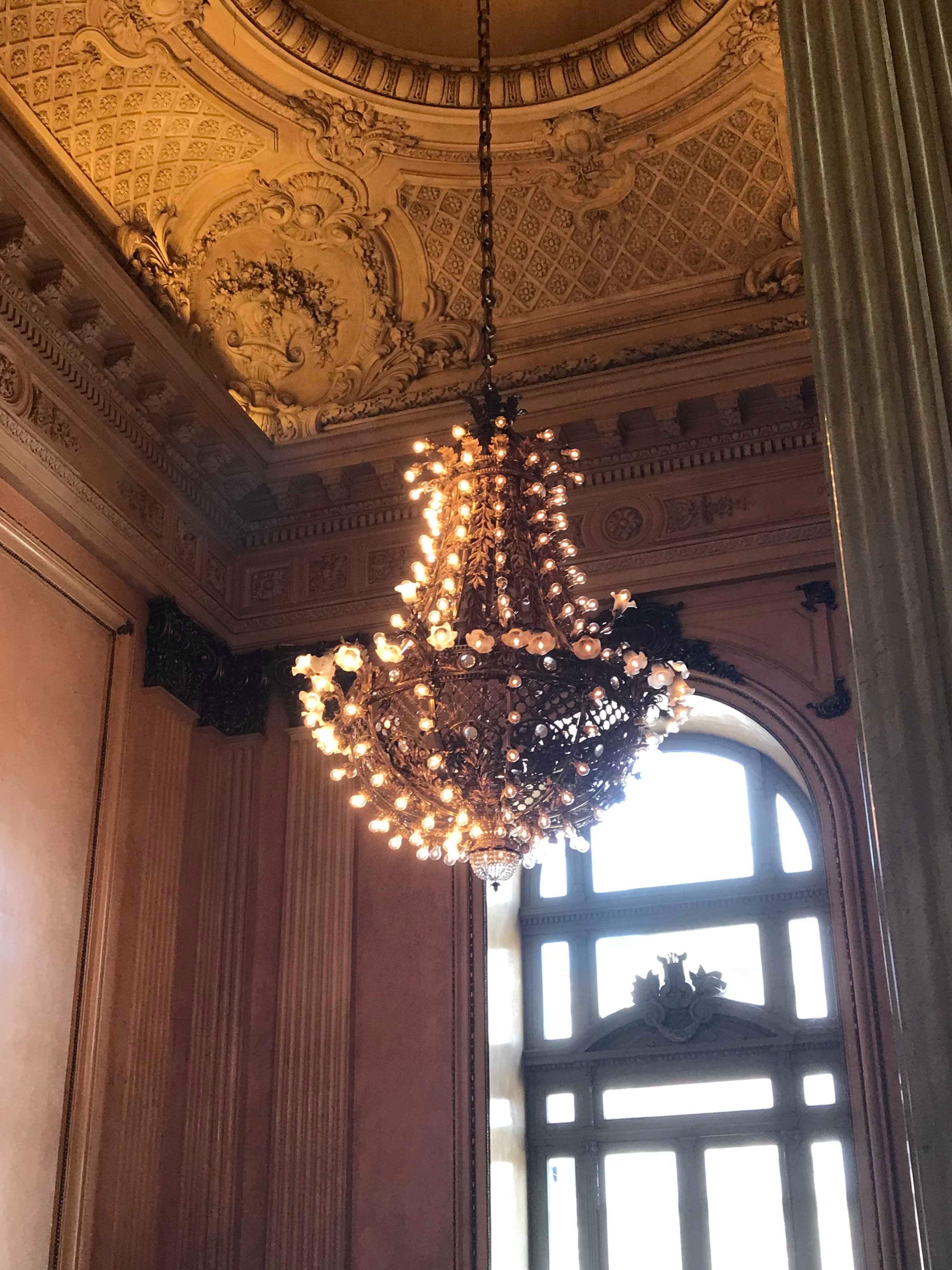
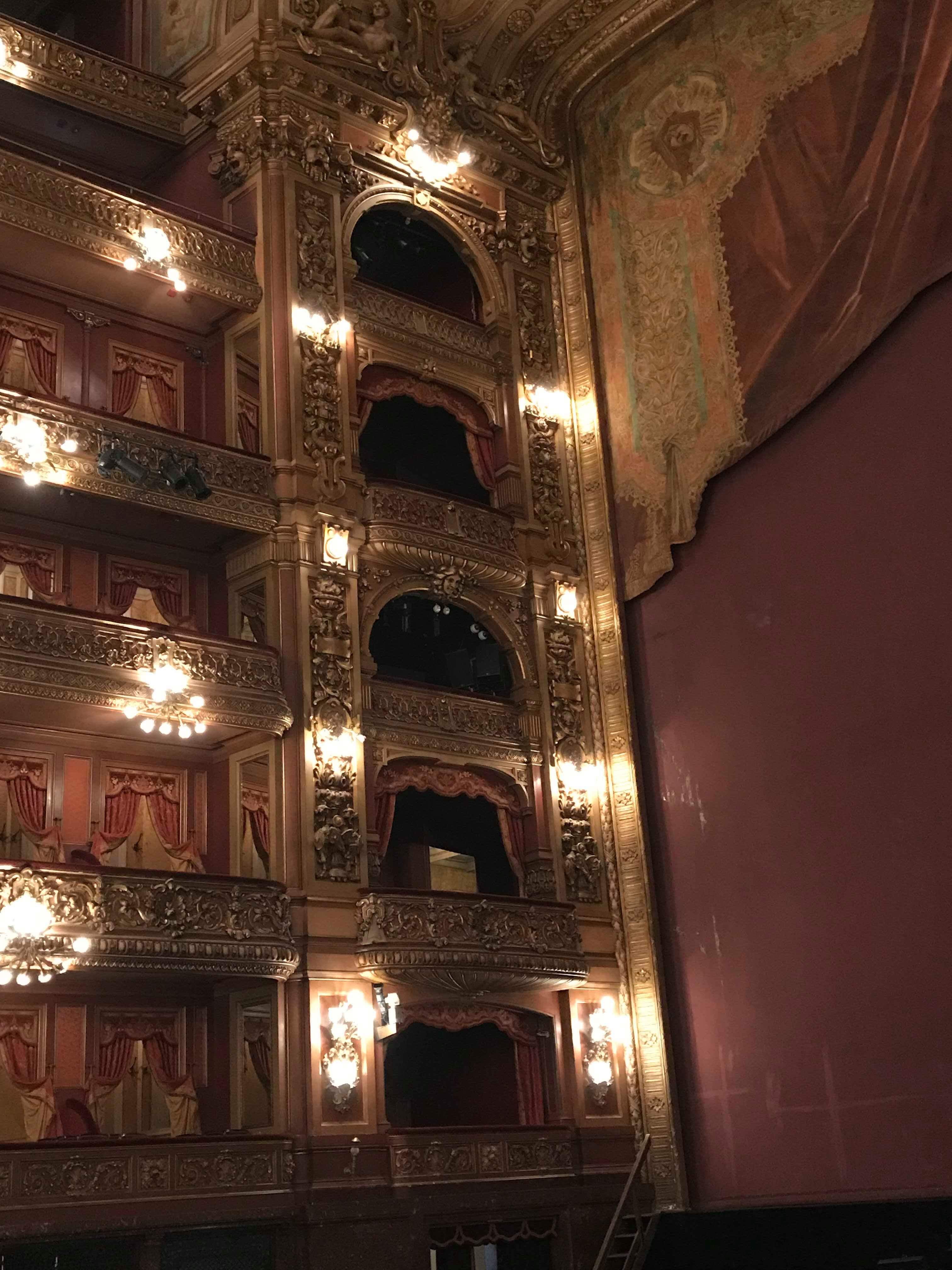
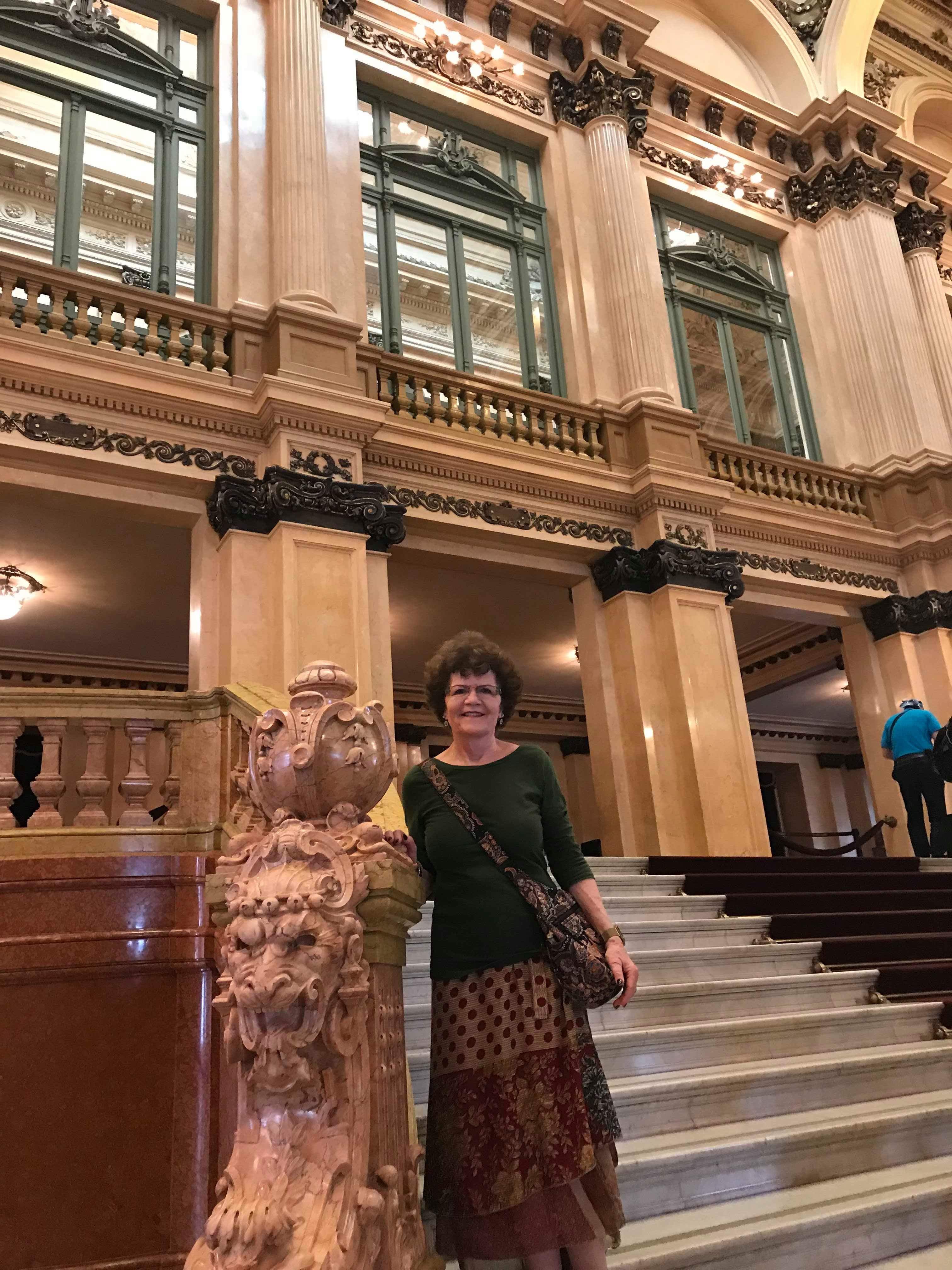
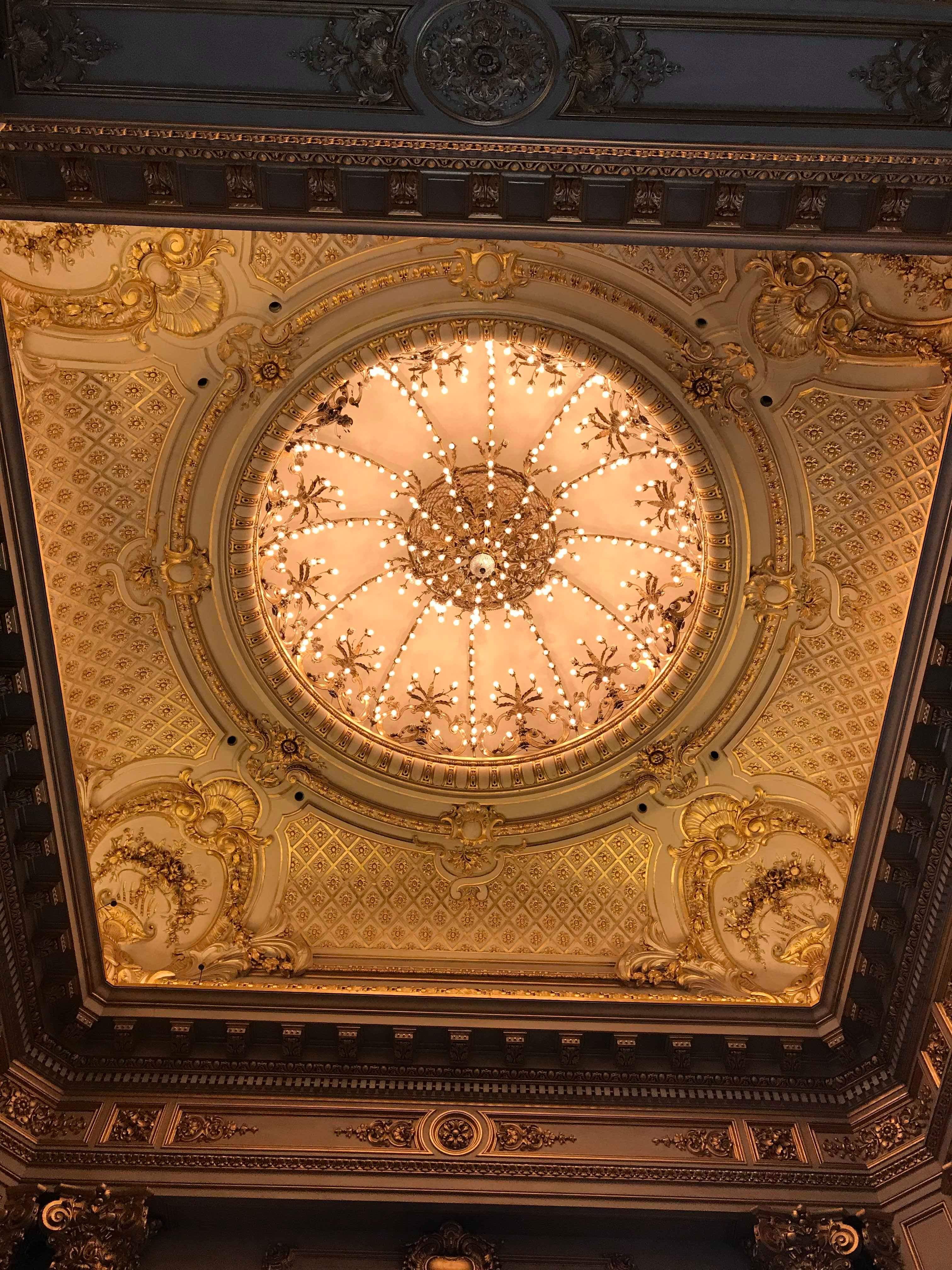
Teatro Colon, considered one of the world’s great theaters, began on May 25, 1908, with a performance of Verdi’s Aida.  This theatre replaced the original theatre which began operation in 1857.  Teatro Colon’s construction took twenty years even though its original cornerstone was laid in 1890.  The original architect, Francesco Tamburini, died in 1891.  His partner took over but also died.  The final architect, Jules Dormal, completed the theatre.

IMG_2943

IMG_2957

IMG_2951

Theater Colon is huge–originally 8,202 square meters, 3,196 of which is underground. Later 12,000 more meters were added.  The total floor space equals 58,000 square meters.  The design includes French and Italian styles, and includes dressing and practice rooms, rooms to design sets and create scenery, etc.–this part of the theatre is underground.  Everything used in the productions here are created on site.

IMG_2945

This is the curtain area.  The actual curtain used during performances remains behind what you see here.

IMG_2942

IMG_2955

Marble, gold, other precious stones and metals are everywhere.

IMG_2953

Due to design, its acoustics are known worldwide as one of the best.  Every famous opera singer you have ever heard of performed here.  This holds true for ballet dancers and orchestras as well.

Currently, the theatre provides a venue for operas, symphonies, ballet, choral music, and contemporary dance among other artistic endeavors. During this March alone, fifteen  different performances of varying types occurred here. When we arrived the lines were long, some for buying tickets for performances, others for tours.

IMG_2954

IMG_2963

IMG_2939


A Week of Gratitude


Negatives emerged lately in my life,  the events in the last two posts, two good friends with health issues and a lot of pain.  Nevertheless, yesterday, I started thinking of so many things for which I feel grateful.  Then I said to myself, I am going to work on a week of gratitude, a week where everyday I make a list of things for which I feel grateful.  Out of years of habit, I make a mental gratitude list every night as I drift off to sleep.  This is more formal, a list I write down.

Yesterday’s list includes these:

-pure water from a deep well

-healthy food I cook myself

-children who live good, productive lives

-my own good health

Today’s list includes:

-a job I really enjoy in spite of paper grading tasks

-students who make me laugh and tell me they love me–who knows whether they mean it and honestly it’s ok either way

-outside chores, e.g feeding horses morning and evening.  I cannot imagine life without this even when it is cold and miserable

-singing–after I post this, I will head to my weekly chorale practice.  Currently, we are singing all these touching songs, poems by Octavio Paz and Pablo Neruda put to music.

-taxes–crazy, I know.  I recall someone once telling me he was happy to pay taxes because it meant he was making decent money and was not poor.


IMG_2337


Listening to a Band


Yesterday my second daughter arrived from Thailand.  Biologically she is not my daughter, but rather my first exchange student six years ago.  We have kept in touch over the years and she is now here with me for a month.  Her best friend from high school here is also with us.  Tonight we went to the Palace Coffee in Canyon, Texas, to listen to a trio because the band leader is a friend of the friend.  This poem attempts to describe the music.

Long hair flying

except the drummer

Wild strumming

No picking

Guitar and bass

percussion not strings

Three percussion instruments

vibrating sound

until

suddenly

guitar becomes synthesizer

haunting, electronic

other dimensional.

Then

back to

three percussion instruments

vibrating sound

voices lost

Besame Mucho


Since I heard Besame Mucho twice in one night eight days ago, I cannot get this song out of my head.  First, a young opera singer sang it in a passionate, operatic style and later Trio Ellas sang it light heartedly.  Both sounded fine; not sure I even have a preference.  I translated for the young man I took with me, my grandson’s older brother who is Hispanic.  Students and parents in the United States seem to often ask why they need to know anything but English.  Once when I informed my students that Spanish was spoken here where we live before English and native languages before that, one student seemed shocked.  Guess he thought the natives spoke English before the English even arrived here.  He probably didn’t even think.  Thinking has become a lost art.

Here is a list of singers whose version of Besame Mucho you can find online.  I just listened to all of them; yes, it took a while.  Now what I want is a part-time boyfriend who likes to dance.

Andrea Bocelli

Pedro Infante

Consuelo Velasquez

Julio Iglesias

Julie Zorilla

Arturo Fuerte

Tino Rossi

Placido Domingo

Cesaria Evora

Il Divo

Yolanda Sanchez


Oh, and by the way, Besame Mucho means kiss me a lot.


http://www.youtu.be/OxkS8KQhBLI

Gaston Luis Zulaica del Sueldo


Gaston Luis Zulaica del Sueldo walks toward me after disembarking from the plane.  Although I have never met him, I know exactly who he is.  Tallish, thin body; long, handsome, light tan face; smiling, perfect teeth; arms open.  A teenage Latin Lover, bouncing on the balls of his feet, rushing to me.  Those arms wrap around and squeeze me tight.  My new son has arrived from Argentina.

Every night while I fix dinner, he sits at the brown Kanabe piano my parents gave me thirty years ago and plays and plays:  Beethoven, the theme from Twilight, Chopin…I look up from chopping onions and see the short, dark ringlets on the back of his neck and watch his gliding, long-fingered hands.  He plays until salad making time arrives.  He tells me he makes salads for his grandmother back home.  Now he makes them for us:  layers of emerald lettuce, red peppers, black olives, orange carrots, green onions, a kaleidosope of appetizing color.

Gaston Luis Zulaica del Sueldo.  It curls around my tongue when I introduce him.  Images of tango dancers, gauchos–he is a champion rider, malbec wine–at seventeen he brought me some in his luggage, snow capped mountains where he skis, and cattle grazing on the endless grass his family owns.  We speak Spanlish at home, we laugh, we cook.  On my birthday he insists on paying for everyone.  When I tell him I did not expect that, he looks at me as if to say, “What kind of man do you think I am?”

Gaston Luis Zulaica del Sueldo.

Note:  One of the assignments in the prose poetry class was to write about a name, real or imagined.  This one is real.  Gaston lived with me a couple of years ago and I still keep in touch with him and his family.