
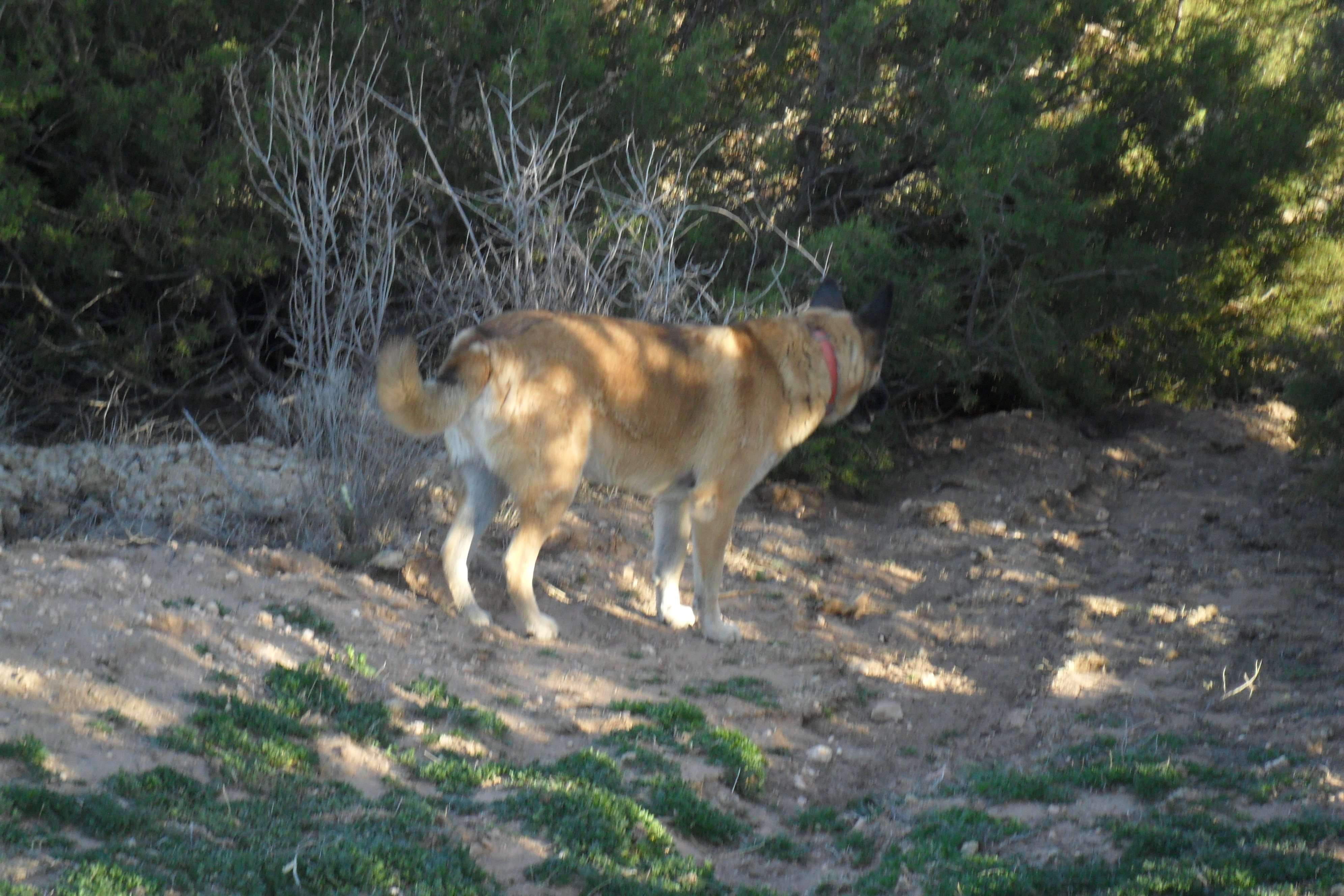
 I own a wolf dog. I did not set out to get a wolf dog. In 2004, I went to PetSmart to buy a fish for my grandson. The Humane Society had puppies there. My daughter said to me, “Mom, you just have to look at these puppies. They are gorgeous.” I looked; I was smitten. Isabella is ¼ wolf. She was seven weeks old when I took her home. She is smart, loves people, guards my 15 or so acres, and was incredibly easy to train. She weighs 80 pounds. Sometimes people think she is a German Shepard, but she is taller and heavier even though she is also ¼ German Shepard. Even people who do not like dogs love her. When I first got her, I researched wolf dogs on the Internet. The information seemed incredibly complex and sometimes contradictory. I trained her the way that seemed right to me. She will not live forever and on the rare occasions I think about this, I realize I will never be able to find another Isabella or even come close.
Isabella leads me to the topic of wolves. One of my long term goals is to research and study why so many people feel such an intense hatred of wolves. This intensity is lacking in the way people view other big predators in the US, e.g. pumas, bears. Why wolves?? What is it that makes ranchers and hunters in states where wolves still exist so intent on destroying them? As a one time rancher who raised cattle and horses and a person who still owns a farm and grew up on one, I know it is not only because wolves occasionally kill a calf or two. Something else drives this hatred. What is it??
Recently, I had the occasion to have a discussion on this topic with a biologist friend. He said, “People hate wolves because they are so very human. Wolves remind them of themselves, especially the willingness to kill, the survival instinct, the wild.” He also told me that he had read a research article on ancient hunters and the domestication of wolves, the precursor to all dogs. Some researchers believe that ancient humans and wolves hunted together to maximize their hunting success.
Strangely, I came home, opened a book of essays, and there lay Sherry Simpson’s essay, Killing Wolves. I read it. I read some of it twice. I have reread parts a third time. She says, “The unknowable wolf hunts along the edge of our vision, never allowing a clear view of himself. Imagination, fear, and longing fulfill what experience cannot. And so a wolf is no longer just a wolf. It’s a vicious, wasteful predator. Or it’s the poster child of the charismatic mammals, the creature that stands for all that’s noble, wild, and free. A wolf is social, family-oriented, intelligent, and communicative—like humans. A wolf kills because it can—like humans. It’s either-or, the sacred or the profane. Inevitably, the wolf becomes a distorted reflection of the human psyche, a heavy burden for one species to carry. We can hardly bear the burden of being human ourselves.”

