Tis The Season


Tis the season to…

Feel joy when the morning

sun caresses your face;

Laugh when you hear

children playing in the

street;

Give thanks for being alive,

having friends and family;

Walk down your street or

take a hike, touch a flower,

a tree and appreciate nature’s

simple bounties;

Remember the time your

loved one took your face

in gentle hands and smiled;

Give the gift of kindness,

peace, and compassion to everyone,

strangers, friends, family,

the unknown;

Promise yourself to live your

best self in the year to come,

to never forget that life

is a gift.

A Tribute to My Mother


Barbie Doll

Barbara Lewis Duke, pretty, petite, blue eyed and blond, my

mother, one fearless, controlling woman. Long after Mom’s

death, Dad said, “Barbara was afraid of absolutely no one

and nothing.” They married late, 34 and 38. He adored her

unconditionally. She filled my life with horses, music, love,

cornfields, hay rides, books, ambition. Whatever she felt she

had missed, my sister and I were going to possess: books,

piano lessons, a college education. Her father, who died long

before I was born, loved fancy, fast horses. So did she. During

my preschool, croupy years, she quieted my hysterical night

coughing with stories of run away horses pulling her in a wagon.

With less than one hundred pounds and lots of determination,

she stopped them, a tiny Barbie Doll flying across the Missouri

River Bottom, strong, willful, free.

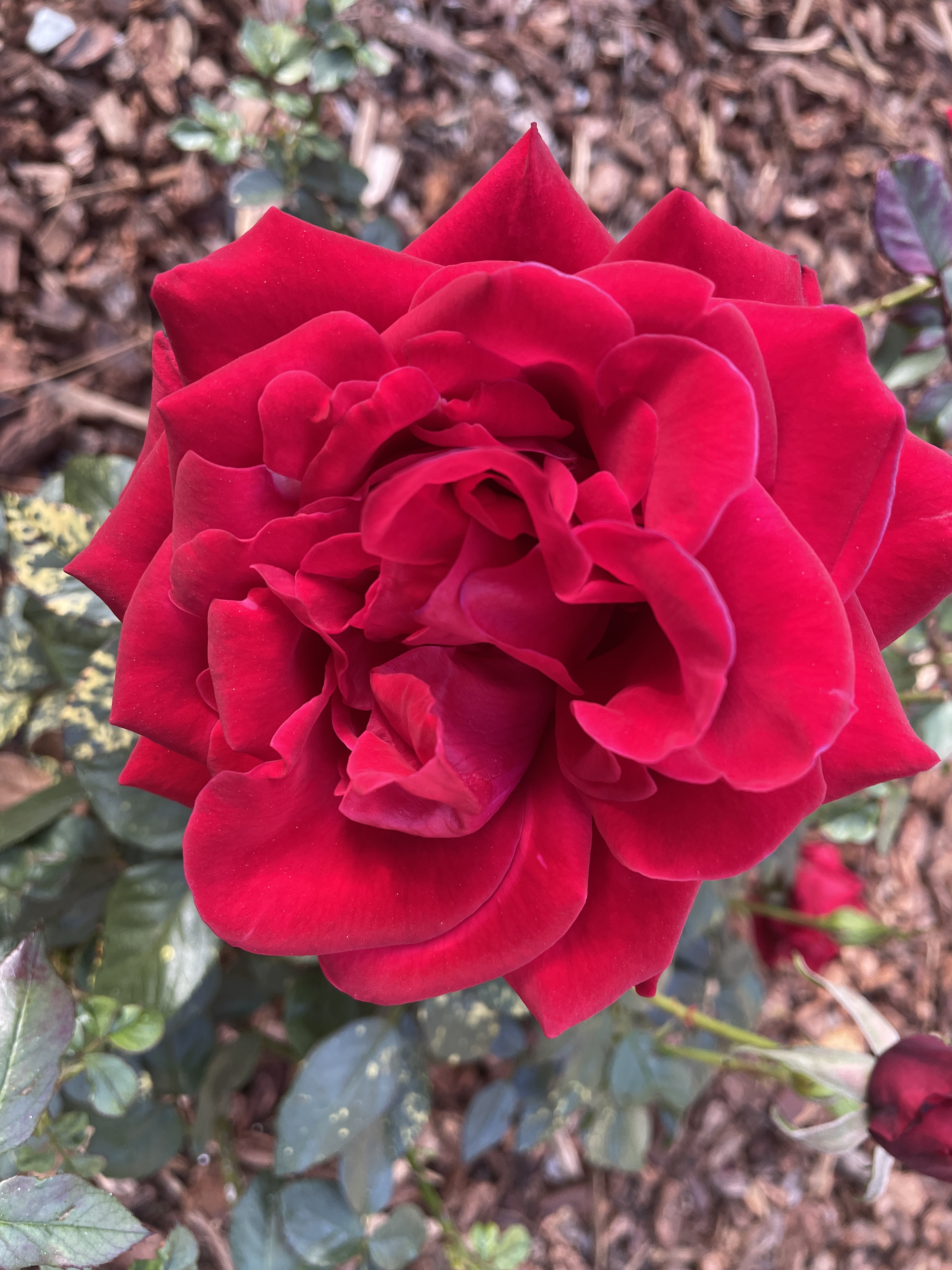
Note: This poem about my mother has been published in at least one anthology and my book of poetry. My mother loved roses, had a rose garden. I now grow roses too.

Book 20 for 2024: “The Midnight Library”, Matt Haig


Regrets and depression seem to have overwhelmed the main character, Nora. She’s lost her job, a car ran over her cat, she thinks she has failed at everything, and she says she wants to die. But does she really. Through a series of parallel universe experiences she gets to try out many different lives based on her long list of regrets. None really work because none of them exemplify her real self. She thinks she might like this new life or that new life, but none fulfill her, reflect her true self. She learns that money, fame, riches are not necessarily the answer. But what is the answer? What is the best way to live?

Red Roses


He’s very good at wooing:

gifts–chocolate cherries,

red roses, delicate lingerie,

I love you.

He wears his mask well,

keeps calm, a handsome spider,

weaving a silken web.

She laughs, tells her friends

just how very special she’s

sure he is.

He wears this mask for months,

finds them the perfect apartment,

swimming pool, gym, marble,

granite, luxury appliances.

She’s sure he loves her:

the gifts, the perfect apartment,

fancy restaurants, luxury weekends.

She’s late, heavy traffic, an

emergency at work. He

screams, wants to know

why; no explanation matters.

He hits her for the first time, her

torso, knocks her down.

Tomorrow 24 red roses

arrive at work. He begs

forgiveness. She’s sure

he’s sorry; it won’t happen

again.

Two months later, she’s

late again. Real reasons he

does not want to hear. He

screams, he hits, he knocks

her down.

She dreads red roses.

Note: This is part of my writing a poem per day for National Poetry Month. Regarding this poem, 34% of female homicides are women who have been killed by intimate male partners. Often when women kill a man attacking them, they are convicted of murder even when trying to defend themselves.

Book 15 for 2024: “The Elegance of the Hedgehog”, Muriel Barbery


Before reading this book, I thought of French society as relatively egalitarian. Apparently, it is not if this book mirrors reality. One main character Renee, 54, lives and works as a concierge in a high class building containing eight, large, luxury apartments which the residents own. As she tells her story, she notes that this is her 27th year at this job. She describes herself as “short, ugly, plump”. She rarely says anything nice about herself or any of the residents. She notes she is uneducated, insignificant. She has one friend, Manuela, a cleaning woman originally from Portugal. Renee thinks it is her duty, her lot in life, to pretend to be something she is really not, a person totally lacking in intellectual and artistic acumen. She runs the television to make the residents think she watches mindless melodramas when she is actually reading Tolstoy as well as all sorts of literature and Marx, history, well every genre. After all, her cat is named Leo for a reason. She goes to art galleries, listens to all sorts of classical music, is basically an intellectual in the true meaning of the word, but works very hard to hide this, because she thinks she must stick to her station in life as she sees it. This works until one resident dies and a wealthy Japanese man buys the deceased man’s apartment. Both he, who notes her cat is named Leo, and a young girl, the other main character who lives in one of the apartments and plans to commit suicide and set their apartment on fire, suspect Renee is not as she appears to be. I do not want to give it all away, but this is a book with many life lessons, including that adage about not judging a book by its cover.

Book 14 for 2024: “The Invisible Hour”, Alice Hoffman


This is a book for those who believe in the power of books to transform life, who are fans of Alice Hoffman, and who like time travel. It also about how a charismatic man can ruin the lives of many, especially women, by controlling everything around him through fear and coercion. In his Community books and contact with the rest of the world are banned. Mia is a young woman who sneaks into a local library and finds Hawthorne’s “The Scarlet Letter”. She realizes the life she is living in the Community is like the lives in the book. Through this book she manages to attain the courage to escape such a man, the man who destroyed her mother, Ivy. She makes her way back in time to the period in the book, has a love affair with Hawthorne, and finally escapes the horrible man who tracks her everywhere she goes.

Superstores


Masses of US residents apparently find superstores, or as an acquaintance calls them, big box stores, Costco, Walmart, Target, the perfect places to shop. The only positive aspect I can think of is that they are the only places, except for some giant supermarkets, where you can find people of every ethnicity and age in the same place at the same time. Nevertheless, there are differences. For example, Costco, a store I loathe, attracts people with more money than the people who shop at Walmart, even though income level of Walmart shoppers does vary some depending on the location of the store. I used to occasionally shop at a Walmart in a college town. Its clientele were obviously different from those at another Walmart located in one of the poorer neighborhoods in a medium-sized Texas city. I have only been to one Walmart in California. It seemed dingy, even a bit dirty, dismal, did not have what I needed. I left.

My son and two of my neighbors appear to love Costco and shop there often. The one time I went with my son, I could not leave fast enough. Who wants to buy all that stuff stacked so high no one can reach it anyway? They believe Costco has bargains. Really? My observation is, well, maybe, if you own a business or have a giant family and can buy masses of stuff at once. Thankfully, and, yes, I mean it, I live alone, have zero desire to hoard stuff so why would I ever want to shop there.

Occasionally, I have to go to Target to purchase copy paper and printer cartridges. I could get the latter online, but then it comes in this plastic wrapping that is not especially recycle friendly which haunts me. I hate waste. Target’s variety of shoppers is noticeable; even the checkout people are of obviously varying ethnicities. My favorite is this smiling middle-aged woman wearing a headscarf. She engages with customers, says something friendly, smiles even when the line is long and I’m certain she’s worked for hours. I wonder how she does it.

It occurs to me that I could go to Target–one is close to my house and I find it tolerable–pretend to shop, walk around, observe, and write an essay about everyone and everything I see. Since the nearest CVS drugstore shut down and moved to Target, I might even have a legitimate excuse to go there.

Books 3-5 for 2024: “Happening”, “The Young Man”, “Simple Passion”, Annie Ernaux


In the last few days, I’ve read three books by Annie Ernaux who won the Nobel Prize for literature in 2022. Although she is a major writer in France, I had never previously heard of her. Since the local library possessed none of her books, I drove to Claremont and checked out all of her books that were available. The publication dates range from 1974 to 2022.

Most of her books defy categorization. The librarian helped me find them because some were in fiction and some nonfiction. From just reading them, it is impossible to determine whether what I’m reading is real or imaginary or a combination. She writes about women’s lives mostly and issues that only women experience.

“The Young Man”, copyright 2022, tells a detailed account of a love affair between a young male student and a 50 something woman, thirty years older than he. They meet on weekends often at his apartment, make fervent love, visit sidewalk cafes, wander. The narrator notes that people sometimes look askance at them in a way they never view an older man and a younger woman. She finds love making helps her write, “Often I have made love to force myself to write.” At the end of the book are photos of Ernaux over the years (she was born in 1940) and a detailed biography.

Next I read “The Happening”, (2001) a detailed account of a young female student seeking an abortion when it was illegal in France. She manages to hide her state from most people including her parents. She finally finds an elderly nurse, but later experiences complications and ends up in the hospital where a young doctor, who thinks she is just some poor woman off the street, treats her badly. When he discovers she is a university student, he finds her and apologizes. It seems mistreating the poor is okay but not someone from his own class status.

Then I read “Simple Passion” (1991), a short (64 pages) detailed account an illicit love affair between a young, married man from Eastern Europe and the narrator. The telling part of this story is the narrator’s (the author?) obsession with this man she calls A. She waits for his calls 24/7. She thinks about him every waking moment and dreams about him at night. I kept thinking of myself and many women I know who have become obsessed with some man to their own detriment.

A a writer, I find her work totally fascinating in its extreme courage. She writes in detail about experiences few would dare to even talk about, but many experience and keep silent. Much of it is autobiographical, an even great demonstration of bravery. Who dares tell the truth of many of our own experiences? Very few of us.

One Book a Week-49: “Anything Is Possible”, Elizabeth Strout


Her books are deceptively simple with so much to say about people and life. This is the fourth book I have read of hers this year. It interweaves many of the characters in the books I previously read back to the towns where they were born and grew up. One part of the book discusses one family who were so poor the children dug food out of dumpsters and everyone made fun of them at school. Only one truly escapes and finds success. One lives a lonely life at the home place, and the other is filled with anger and resentment. Much of the book is about how even if persons escape a horribly poor and dysfunctional family and find success later in life, the terrible things that happen to them as children are always there lurking in the shadows. This includes a lot of resentment and anger from some family members who do not manage to escape. Other parts of the book detail the lengths to which people will go to find solace often secretly with few or no one having a clue about how their lives really are. How well can we really know another person?

One Book a Week-31: “Miracle At St. Anna”, James McBride


The third novel I’ve read by McBride in the last year, “Miracle At St. Anna” brings to life a little know part of WWII. Toward the end of the war, the US sent the Army’s Negro 92nd Division to Tuscany. Due to the ineptitude of one of their superiors, several soldiers find themselves behind enemy lines. This is their story–they sneak through dangerous mountain passes and ravines and find themselves in the tiny village of St. Anna di Stazzema where the peasants take them in and treat them more respectfully than they had been treated at home. It is also the story of this village, the residents there, and an orphan boy one of the soldiers rescues, a story of the tragedies of life and war and the miracles the villagers, the soldiers, and the boy experience.

While heart wrenching, it also inspires.

Note: I read this book last week and started on two others, one of which is the original “The Little Review ‘Ulysses'” which is how the first copies of James Joyce’s “Ulysses” were published. From March 1918 to December 1920, the Little Review published chapters of “Ulysses” in serial form. They had to quit because the material was considered obscene and censored. My reading of this is a long work in progress. This copy is not edited; the original spelling and other mistakes remain.