The characters in the eight stories of this collection are people touched by violence of one sort or another, reflective of the violence that has occurred in Colombia’s history. A photographer’s obsession for a woman with a traumatic past, a writer’s fascination with the history of a woman whose grave is outside the official cemetery, two people whose own personal shared histories meet at a grandiose ceremony pretending they do not know each other–are examples of all the tales of complexity found in life and how morals change over time. These are not stories for the faint of heart. They do reveal how traditions of the past harmed people in ways that do not occur today, how lies can catch up with the liar, and how often pretending to be someone you are not often fails.
The subtitle of this book is “The War of Brothers That Shattered an Empire and Made Medieval Europe”.
The empire to which they are referring is the empire created by Charlemagne which was at the height of its power in the early 800s. He had managed to combine the territories of almost all of what we now consider Europe except for the far north and southern Italy and Spain and Greece. He managed to do this through cooperation among the nobles and the elite and it held throughout his life. He helped the spread of Christianity throughout what was previously pagan areas, e.g. the Saxons. Then not long afterward chaos ensued.
This history book details what occurs when fissures develop in what was once a stable social and political network and the bloody consequences of disagreeing on facts and reality. What happened?
For some time after Charlemagne’s death one of his son’s was able to hold the empire together by deftly giving bits of power to various sons and relatives. Once he died, a chaotic blood bath arose. Fathers and sons, brothers, uncles, nephews, everyone was killing or maiming each other for power. If they felt it was too unChristian to kill you, they just blinded you and sent you off to a monastery. If that did not work, then they would declare a female relative to be a witch and we all know what happened to witches. Meanwhile while jockeying for power, all these men declared they were doing what they were doing in the name of Christianity. If one brother won a battle, then he declared himself to be a better Christian than the one that lost. Even monks and bishops and the Pope became involved.
Then came the Battle of Fontenoy in what is now a part of France. Brothers against another brother with each leading more than 10,000 troops and in some cases as many total as 100,000. Watching was a noble who also commanded a huge army, but mostly he decided to just watch. The end result was a total bloodbath with one side violating the then current rules of battle. Normally, battles before this did not include a huge amount of killings in spite of what we now see in movies. This battle left thousands dead for the wolves, vultures, and other scavengers to eat, and the nearby streams ran red with blood. None of the warring brothers were killed so their fighting continued but no one ever really won and the great Frankish Empire created by Charlemagne fell totally apart. Some claim this battle was the beginning of the separation of a lot of Europe into what we now call France and Germany. Currently there is a marker at the place where the battle occurred. Regardless, Europe was never the same again for many centuries.
Note: Many find the world a very violent place today. Currently, wars and revolutions of one kind or another are occurring in many places in the world. Generally speaking, however, we do not find fathers and sons and brothers killing each other for power. We are seeing the consequences of what was once a relatively unified populace disagreeing on the facts and reality. Will we too fall into a dark ages like Europe did?
I finished this book on New Year’s Eve, missing my goal of reading a book a week all this past year, but not by much. No excuses except one book I read was nearly 800 pages which took a bit longer.
This last book was full of surprising information. I had no idea that Teddy Roosevelt and Booker T. Washington were friends. This book is very detailed with loads of historical information about the lives of both of these men. Born worlds apart in terms of freedom, economics, and race, they both had a goal to further the status of Black people. In terms of his political future, Roosevelt made a big mistake when he invited Washington to the Whitehouse for a family dinner. Once this event became known, white people in the South were outraged. Jim Crow incidents, e.g. lynching, increased. Roosevelt felt he had to backtrack some to save himself and this included one his worst decisions in terms of racial equality. Meanwhile, they tried to hide their relationship more, did not visit each other as often, and Washington had to go to great lengths to appease some whites in the South to keep Tuskegee growing and flourishing. W.E.B. Du Bois viewed Washington negatively and thought he went too far to appease white people and did not do enough for his own race. Du Bois who had grown up free in the North did not understand Washington’s viewpoints and did not know what he did secretly to help Black people. If you are interested in the actual history of this period and how these three men affect the present, I highly recommend this book. There are 35 pages of references, notes, and documentation at the end of the books for those who want to read further on this topic and time period.
What would your life be like if you did not age like everyone else? How would others treat you, your family? Would they kill your mother because they think she is a witch? Could you love someone who grew old while you stayed young? Would you have to move all over the world to avoid detection?
These are the issue the narrator faces because unlike ordinary people, he does not age normally. At the beginning he is living in London as a forty-one year old history teacher but has been alive for centuries. He’s met Shakespeare, travelled the oceans with Captain Cook, and played piano at clubs in Paris.
One organization, the Albatross Society, hunts down and “protects” people like him. Their leader has one rule: do not fall in love. He is also convinced that certain groups want to find these non-agers and imprison them for research. What is factual, real? Does life have meaning without love?
Johnson, a columnist for The Washington Post, notes that the US was founded on a set of ideals but for much of its history agreement on what those are ideals are has not existed. What are these ideals, who are they for? Today there is little agreement on much of this. There seems to be a lack of a common vision on what a democratic system is and should be and for whom. The essays in this book address these questions both today and from the origins of the country when only white men who owned land could vote. This book also discusses how different races in the country and the changing predominance of cultures affects the ideals people hold and the kind of country they envision for themselves.
As a Black man who is a retired Navy Commander, he also discusses his own experience, extensive research, and personal views. This short book is an excellent primer on how different races and cultures experience living in this country and their varying visions of the meaning of democracy.
A tale based on a Bengali legend about a merchant called the Gun Merchant, Bonduki Sadagar, this novel not only takes place in the mangrove swamps of the Sundarbans but also in Venice. It has nothing to do with guns but demonstrates how differences in language use among languages and translations can lead to total mistranslation. The narrator is an older, male, Bengali, rare book dealer who grew up in Kolkata but now lives in Brooklyn most of the year and goes back “home” occasionally. When he meets a distant relative by chance at a party, he finds himself enmeshed in the Gun Merchant tale and finds himself in search of a remote shrine where a king cobra lives. His adventure leads him to meet two young men and reconnect with an old friend, an Italian woman who is a famous historian.
What fascinated me most about this novel was learning all about the immense number of historical connections between the Bengali part of India and Venice especially related to trade and persons of Jewish descent. It is also filled with lessons in relationships among languages and history. For example, I learned the origin of the word ghetto. During the 17th century a part of Venice, Getto, was where their large and prosperous Jewish population was forced to live, Venice being one of few European cities where Jews were safe. Thus the word designating a part of the city became the word ghetto.
It is also a story about the risks and dangers of immigrants trying to get to Europe. I learned many Bengalis, mostly from Bangladesh, live in Venice and the numerous historical connections between the Bengali speaking areas of the world and Venice.
Starting with ancient Egypt and later with the ancient Greeks and Romans and ending in current times, this highly researched book (there are 15 pages of Bibliography) details millennia of lies told about and attacks against women in power. Ridiculous things have been attributed to women, powers that no human has, in order to control them. Here is an example: Pliny the Elder (23-79 CE) wrote that menstruating women caused hailstorms, lightning, and whirlwinds. And worse yet, demons come from this blood (various medieval medical authorities) and it can shrivel the penis.
Then there is the whole thing about raging hormones. The word hysteria, which supposedly is an ailment of women, comes from the Greek word for uterus. During the 2020 presidential campaign, Marco Rubio, currently a possible candidate for vice president, tweeted a photo of ten missiles exploding and asked if you want a woman a heartbeat away from the presidency.
During the Middle Ages millions of women were put to death in various horrible manners after being accused of witchcraft. Even in current times various male political candidates and media announcers (a Newsmax journalist, Zinke of Montana, Ben Carson, Chris Matthews–list is almost endless) have called powerful political women witches. The victims of these pejorative rantings even include Margaret Thatcher when she held office.
Marie Antoinette never said, “Let them eat cake”. Various forms of this phrase had been around for over one hundred years. Ann Boleyn originally wanted to marry the love of her life who also wanted to marry her but the powers at the time, including Henry VIII, forbade this. Many of the ridiculous stories about Cleopatra can be easily disproven, e.g her being so rich she dissolved a giant pearl in vinegar to prove her wealth. Unless powered, pearls do not dissolve in vinegar. Catherine de Medici was attacked as some sort of sex pervert when she was 42, obese, and anything but a sexy seductress.
The documented lives of many powerful women for the last three thousand years contains endless abuse of all sorts. How is this possible? Because there is an informal Misogynist Handbook that has been used for millennia to control women. The above is only a smattering of what you will learn about this Handbook if you read this book. In the last chapter, the author does provide recommendations for overcoming this abuse of women. However, she also notes currently there is a “furious backlash against this long-delayed crawl toward justice, resulting in the increasing viciousness of sexist tweets and memes, more violent threats, more savage abuse.”
Several weeks ago, I spent a day wandering around the ancient sites where native peoples gathered over a thousand years ago.
This explains the extensive influence this place, located in the northwestern New Mexico desert, held for people from as far away as Central America. To reach this park, you have to drive on a dirt/gravel, rough road for more than 25 miles north of Crownpoint, NM. It is definitely worth the effort. However, it is impassable in rainy or snowy weather. The rangers who care for the park live there.
One of the first things you see as you get closer to the park is this rock tower, Fajada Butte.
Archeologists climbed to the top and discovered petroglyphs, “Sun Daggers”. Created between rock slabs, they align with each solstice and equinox and at these events the light projects to other sites, e.g. Pueblo Bonito. Other petroglyphs on a section of the canyon wall represent a supernova that occurred in 1054 CE.
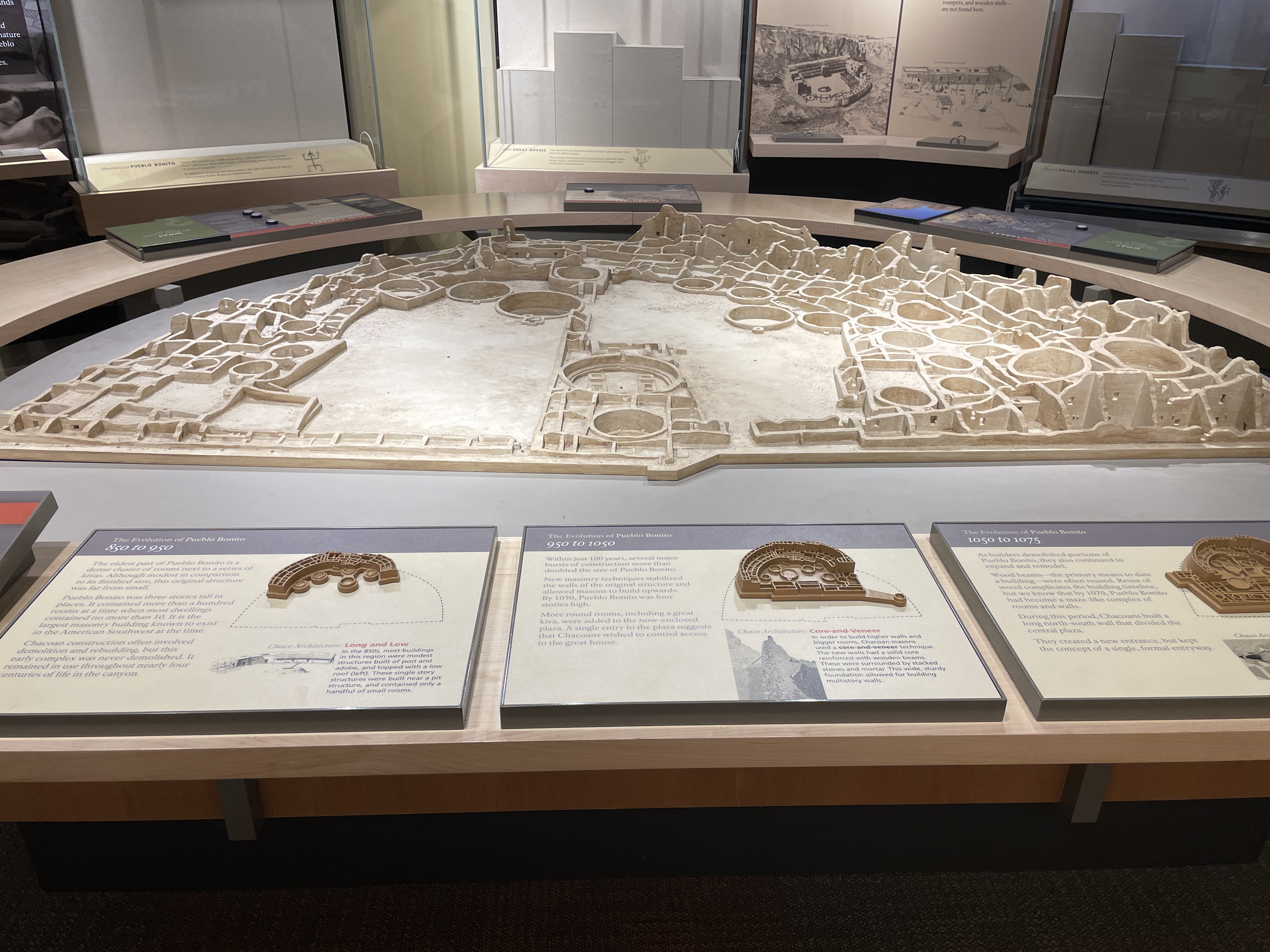
The following depicts an overview of the site as it would have been in the past. In the 1940s part of the wall of rock behind the site collapsed onto it and destroyed some of the buildings.
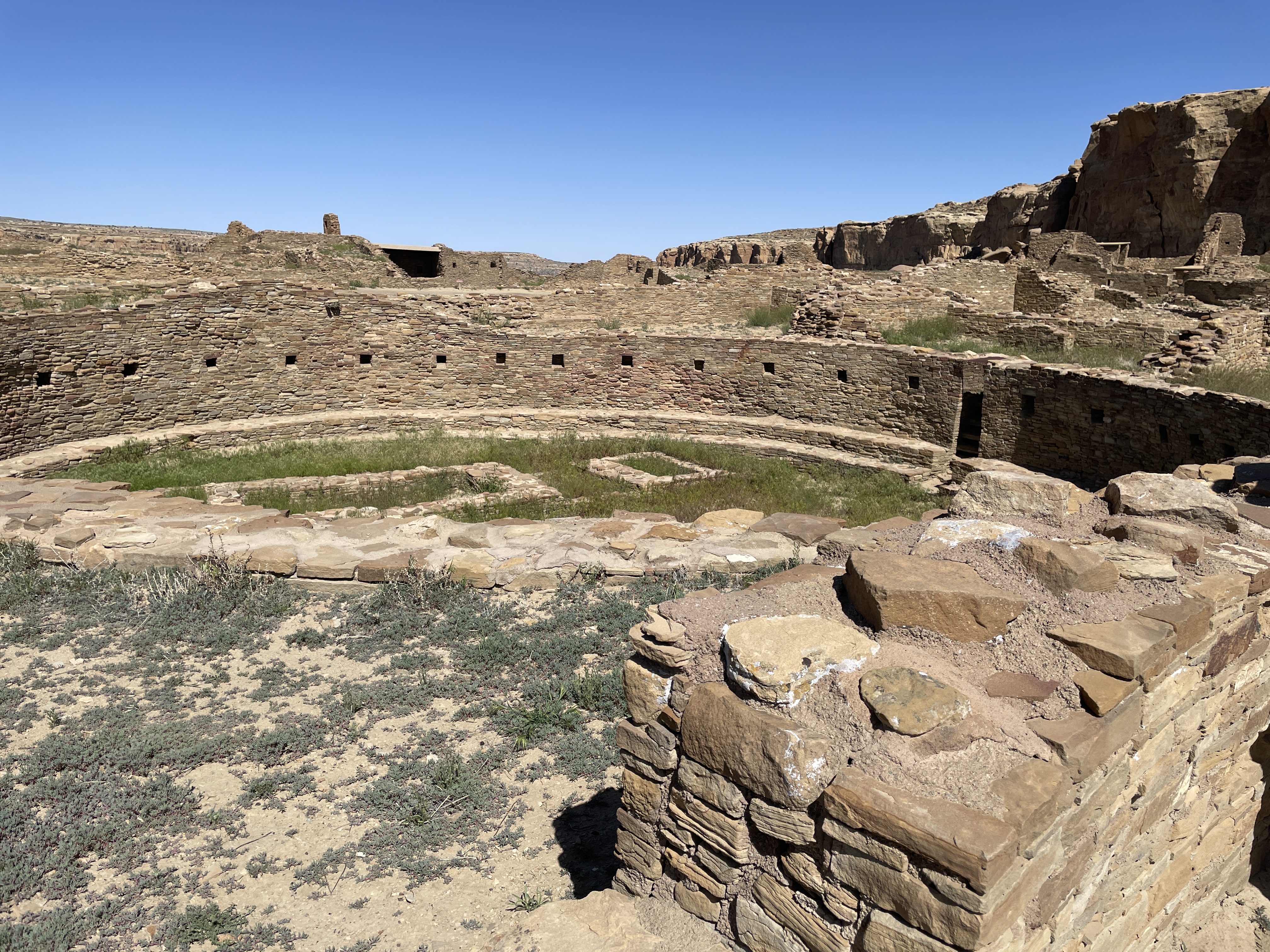
Here is how it looks today. Many of the doors and windows align with astronomical events, e.g. solstices, the two equinox, and astronomical events that occur only every 17 years.
All sites here contain many kivas, many of which are very large. It is speculated that these were used for various sorts of ceremonies, including religious events.
In this view you can see how the rocks that fell from the cliff have destroyed parts of the structures.
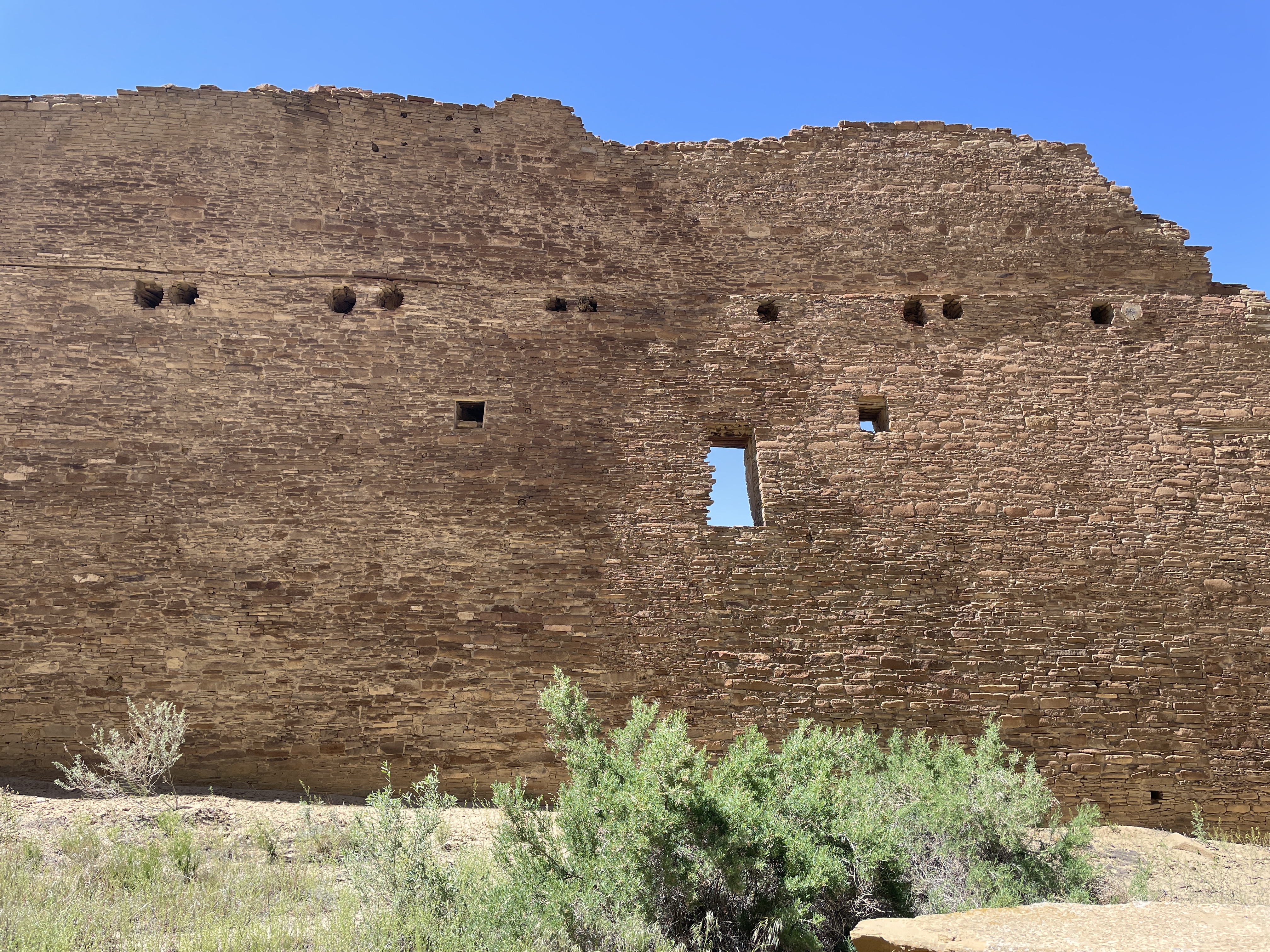
Many of the buildings were several stories high. In their heyday, they did not look like this. They were covered with something like stucco and painted white. What an impressive site they must have been–large white structures in the middle of the brown desert. Archeologists think few people lived here. It was a place for gathering, for ceremonies, for trade, for people from long distances to meet.
Across from Pueblo Bonito is the largest kiva found in the area.
Behind the bars on the far side of the photo is an area that was used for ceremonial dancers to don their costumes. At the bottom you can see a depression with a small door. Before centuries of sand filled it in, this place would have be large enough for the ceremonial dancers to enter through it.
If you follow a trail along the cliff from Pueblo Bonito, you will find another area built at different times hundreds of years ago.
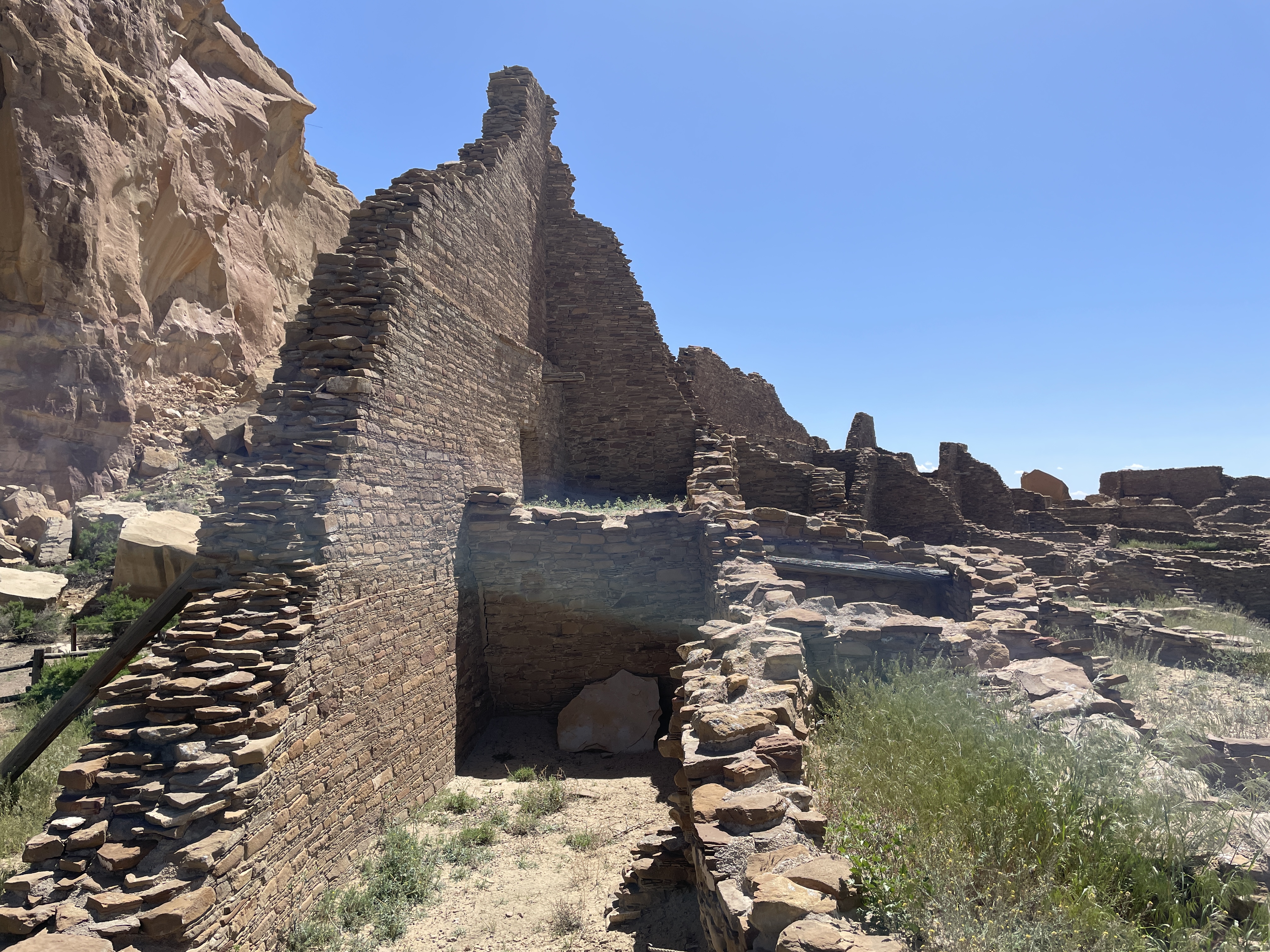
Another large kiva and many smaller ones are located at this site, including this famous long wall built at two different times.
The following shows where at some point the wall stopped, then later it was continued using somewhat different building material and techniques.
The top photo is considered the newer part of the wall.
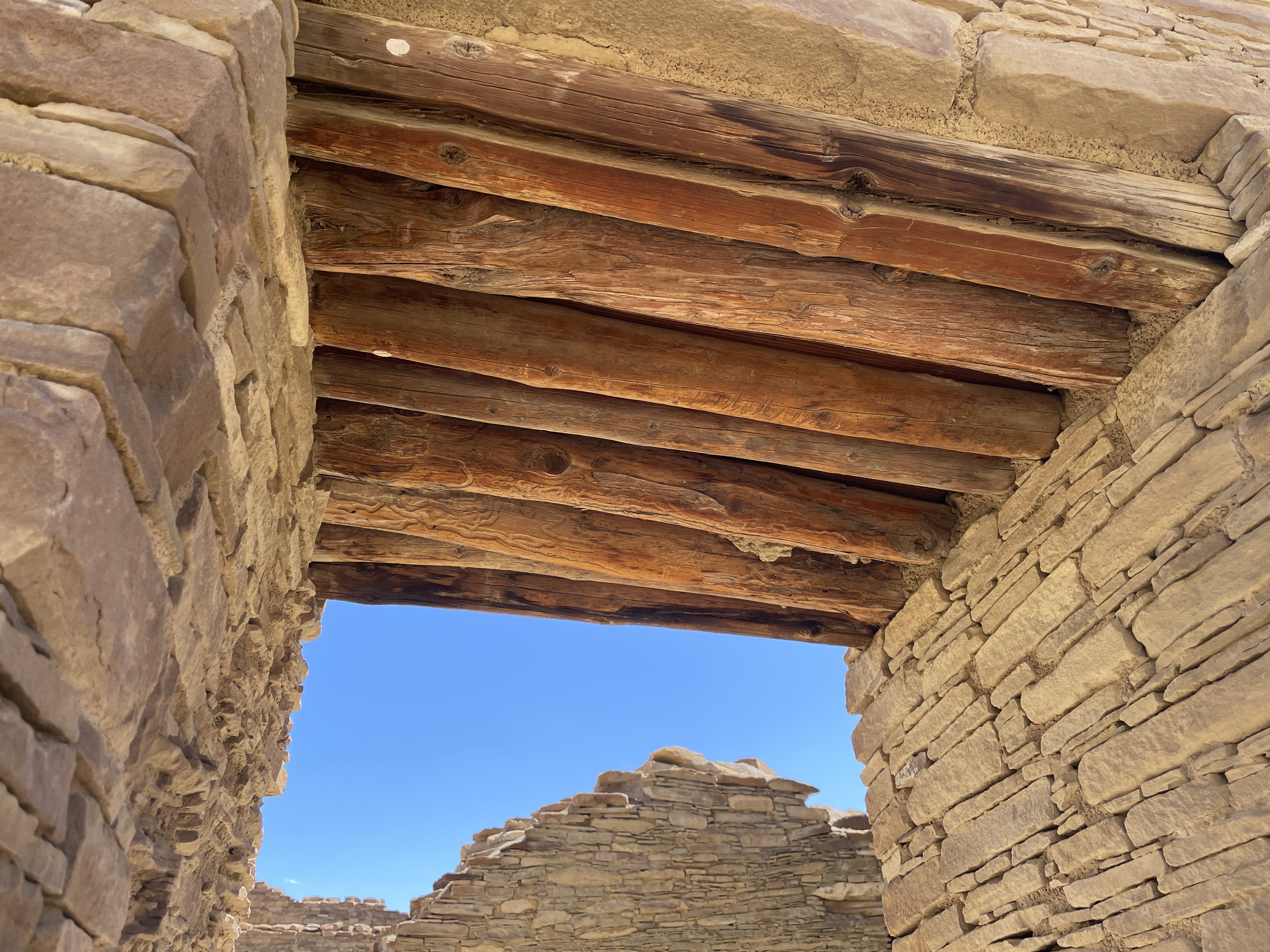
The wood used for tops of windows and doors was brought from forests hundreds of miles away. The desert air has enable it to be preserved.
When you walk the trails, you see wild flowers and native plants. This is desert rhubarb and it is edible.
While these are photos of the more impressive structures at Chaco Canyon, more than two hundred ceremonial and meeting sites can be found in this area of NM and AZ.