The characters in the eight stories of this collection are people touched by violence of one sort or another, reflective of the violence that has occurred in Colombia’s history. A photographer’s obsession for a woman with a traumatic past, a writer’s fascination with the history of a woman whose grave is outside the official cemetery, two people whose own personal shared histories meet at a grandiose ceremony pretending they do not know each other–are examples of all the tales of complexity found in life and how morals change over time. These are not stories for the faint of heart. They do reveal how traditions of the past harmed people in ways that do not occur today, how lies can catch up with the liar, and how often pretending to be someone you are not often fails.
Given the nature of the previous book I read by this author and this novel, I have come to the conclusion that she likes to create seriously disturbed, dysfunctional characters. The setting helps with the “mystery”–a somewhat remote island which really is not an island except when the tide comes in. Only one house with only one inhabitant, a steep wooded slope that ends in a rock outcrop with a long plunge to the sea, the disappearance twenty years before of the philandering husband of the famous artist who lived there, and now a lonely, strange, old woman living there alone add to the atmosphere. The relationships among several other characters reveal the continued class structure of British society, its effects. and add to the unsettling nature of the story. To top it all off, a gruesome discovery is made about an art exhibit of the deceased, famous artist who once lived on the island. Although not classified as a mystery, this really is several bizarre mysteries combined. If you like British stories, art, and mystery novels, you will like this novel.
Last year I read her novel “Gilead” which takes place in fictional, small, Iowa town in which the main character is the father of the main character in this novel, “Jack”. John Ames Boughton, Jack, is the wayward son of a Presbyterian minister. Previously, he has been wrongly imprisoned for a theft he did not commit. He loves literature, especially poetry. He lives off of odd jobs, drinks too much, smokes, and is somewhat of a lost soul who continuously philosophizes about live, religion, and societal rules. One day he sees a woman walking in the rain. When she drops her bundles on the sidewalk, he helps her. She thinks he is a preacher because of the way he is dressed and invites him in for tea. She is Della Miles, a teacher and the daughter of a Black Methodist minister. This is the story of interracial love when it was still illegal in the US, the lengths they go to resist and hide it, and the reactions of her family. Reading this, one realizes how it was not that long ago that most of the US was not only segregated, but sometimes even talking to someone on the sidewalk from another race could get a person into trouble with the police.
Can you call yourself a creative writer if you have not written a word in months? I have a friend who promotes 20 minutes of writing per day, telling people to just write, forget quality, just write. Really?! I care about quality. Perhaps too much? I make sure to read quality writing 99.99% of the time. Is this just words I am writing here or is it quality or garbage? You tell me!
One thing I can do is read. I’m good at reading. And singing. And gardening. I talk to plants; that’s why they grow for me. I truly care. They bring me peace and joy.
In the last two months, I’ve read three collections of short stories, two by Anthony Doerr and one by Gayle Jones. Normally, I am not a short story reader, but here I am reading these. Talk about different. It’s almost like these two famous writers inhabit different planets. Doerr’s stories seem intensely emotional, often a bit fantastical and heart wrenching with a lush, descriptive, poetic style even though Doerr is not a published poet. Jones is a published poet, yet her stories are blunt, conversational, often first person and sometimes short–one page short.
In many, a character is telling his or her (most of the stories are her) story about where they are, some experience, somebody they knew, what they did or said. In one story the narrator says she’s an angel, explains where she’s been, whom she’s known, and ends up by asking readers if they’ve seen her near the Seine. I doubt anyone mistakes me for an angel.
Note: Book 13 for 2025 is “Butter”, Gayle Jones. A collection of short stories.
I was not looking for this, but rather accidentally found it while strolling through the stacks at the local library. What an informative and entertaining book. When it was first published in Lebanon in 2005, it sort of shocked the Arab world causing public debates about the subject matter and story both pro and con. The novel centers on the lives of four upper class Saudi young women who have known each other for years and are friends. Because the book openly discusses the difficulties young educated Saudi women have pursuing education and careers while also trying to find suitable men to marry, the religious conservatives found the novel blasphemous and wanted it banned. Others said it disrespected Saudi women. Black market copies showed up everywhere and the author became an overnight sensation.
The book focuses on the difficulties these women experience as they navigate the modern world while still living in a society founded in very conservative patriarchal cultural conditions. They want to believe in love and hope they will find someone to marry they also love. However, traditions get in the way of this goal more often than not. Some of them find someone they love and who loves them but families forbid it–the person is not high enough status or has been divorced, or…the barriers seem endless, focused on family connections. Love is considered a frivolous, unhealthy distraction.
Contrary to what I believed before reading this, most of these higher class Saudi young women are going to college, often in subjects like medicine and dentistry, and plan to pursue careers in their fields. Many have travelled to Europe where they are freer to roam, not dress conservatively, etc. Yet they return home because of close family ties and love of country. Several of the fathers in this novel are considerably more liberal than the girls’ mothers. Like any society the view of progress and tradition vary greatly by family and individual.
Because as a reader you get to “know” these young women, I found myself reading nonstop because I really wanted to know what was going to happen, whether any of them would be allowed to marry someone they loved or would be heartbroken and forced into unwanted situations. The latter never occurred thankfully. None were forced to marry someone they disliked. It is a great read for those who are curious about other cultures and how women navigate their lives in a place dramatically different from what is more common in Europe and the US.
Two young heroines dominate this fascinating novel which switches back and forth between the Syria of 2011 and the 12th century. The latter is a girl who disguises herself as a boy to join the quest of a famous mapmaker. Nour, the first girl, lost her father to cancer in NYC. Then her mother, a mapmaker, decides to move herself and the three daughters back to Homs, Syria. They barely settle into their new life when the civil war breaks out and a bomb destroys their house. They become refugees. This is the tale of their harrowing journey from Syria to Jordan to Egypt to Libya to Algeria, then Morocco and finally to Cuenta, the Spainish city on the north coast of Africa, where their uncle lives.
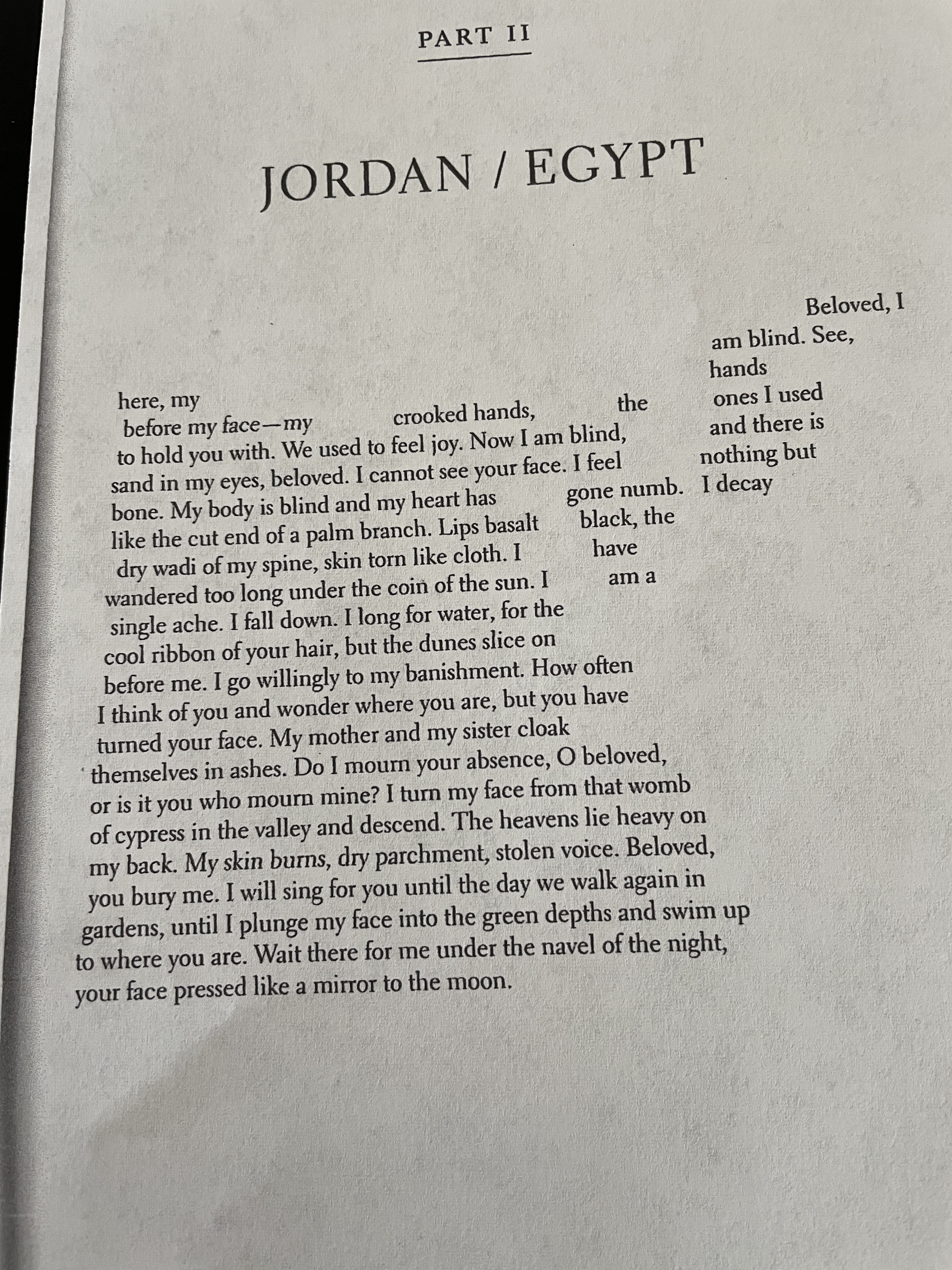
To keep sane, Nour repeatedly tells herself the story of Rawiya, the disguised girl who is an apprentice to the map maker. When he was alive, this was the favorite traditional story her father told her. The book alternates between what is really occurring to Nour and her refugee family and this ancient story. At the beginning of the section for each country through which they travel, there is a touching and beautifully written poem in the shape of the map of that country. The poem for Jordan/Egypt is printed below.
The Puerto Rican Ramirez family lives on Staten Island. The book begins years after one of the three daughters, Ruthy, disappears at the age of 13 while on her way home after her school track practice. Twelve years later while watching TV, Jessica, the oldest daughter, sees someone on a reality show who looks like Ruthy. The woman on the TV has red hair like Ruthy and the same birthmark mole. Jessica tells her younger sister, Nina. They concoct a plot to go to the reality show site and bring Ruthy (if she is really Ruthy) home. They avoid telling their mother, Delores, who has never ceased struggling over Ruthy’s disappearance. Delores discovers their plot and insists on not only joining them, but also bringing her older Pentecostal friend who frequently falls into spiritual spells on the floor at church. Eventually, they all head to Boston where the show is located and all kinds of turmoil occurs.
The novel is told from the viewpoint of each sister and their mother, providing endless details about their Puerto Rican culture, their jobs, their views, and how they feel about each other, all done with dialogue. Sometimes it is loving, sometimes snarky as it deals with their experiences with racism, sexism, family secrets, and violence. As a reader, I, too, wanted to know what happened to Ruthy. Definitely worth the read.
This fictional work is based on the life of the author’s great grandmother. Written as a diary with specific dates, the narrator is not yet a teen when the novel starts. Her parents are wanderers, always looking for a better, new place. Sarah’s character is that of a tough, pioneer girl and then a woman. She can ride horses, shoot to kill, manage a ranch, do whatever it takes to survive. Much of it includes a rather accurate portrayal of life in Arizonan territories as well as Texas at the time including the prejudices of many of the white inhabitants toward the Spanish speaking people already there, fights with Apaches, and the hunt for Geronimo. It is not just the story of her own life, including her relationship with the Army Captain whose job initially is to protect a wagon train, but also portrays other people living in the Southwest during that time period.
I read this as part of a book club. Reactions to the book varied widely from those of us who thoroughly enjoyed the book to at least one person who insisted it is poorly written and viewed it as a romance novel. The rest of us did not. She used an audio book edition. After her descriptions, it appears the audio book does not correctly follow the book itself and is poorly done which may have contributed to her view of this work. I borrowed this novel from the public library and it was obviously well read because it was not in the best condition.
Shafak is a popular Turkish writer. One of my all time favorite books is her novel about the life of Rumi.
“Three Daughters of Eve” takes place one evening in Istanbul in 2016. Peri, one of the daughters from the title, is on her way to a fancy party when a thief snatches her purse out of the back seat of her car which is stalled in traffic. She parks the car and chases him through back alleys. As she fights him for her purse, an old photo falls to the ground. It portrays three young women and their university professor. This photo jars her mind, takes her back to her time at Oxford University when she was a student there in 2000-2002, her childhood in Istanbul in the 1980s and 90s, and her life. She thinks back to her life with her two friends, Shirin, an adventurous Iranian young woman, and Mona, a devout Egyptian Muslim who word a headscarf out of choice. And then there is the famous professor Azur, whose class on God either makes students hate or love him and the scandal that caused Peri to return to Istanbul.
Until her daughter, who was in the car and eventually chases her mother down in the alley, sees the photo, no one, except her husband, seems to have known Peri even went to Oxford. Her daughter mentions it at the party while everyone is arguing about East and West and politics and who has the most money and how they acquired it. Peri tries to deflect questions, changes the subject, and keeps remembering her past: her parents, a father quite irreligious, her mother a devout Muslim, their endless arguments and hostility, her brothers, her childhood and her stint at Oxford.
Through the story of Peri’s life, this novel explores personal identity, East-West history and politics, the meaning of marriage and friendship.