My 27-Book Haul from @AkeFestival #AkeFest15


This perfectly fits my goal to expand awareness of literature from non-western cultures. Reading remains one of the best ways to expand intercultural awareness especially if you cannot travel there.

Kinna's avatarKinna Reads

I didn’t do badly this first time at Aké; I come home with 27 books!

Books I Bought:
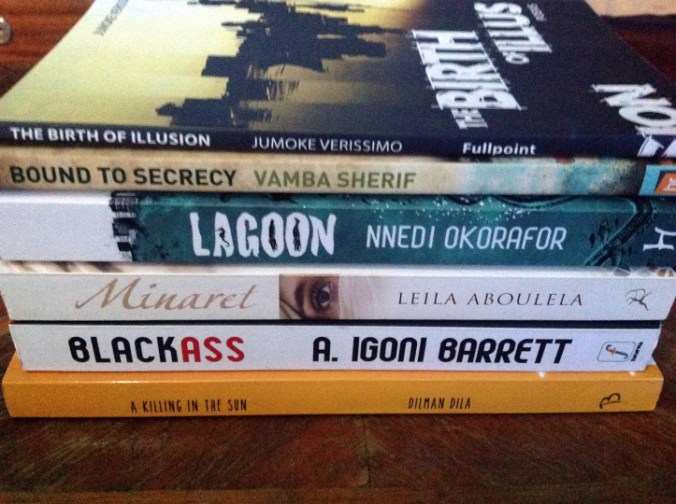
Ake Books I bought

  • The Birth of Illus by Jumoke Verissimo. This is Jumoke’s second collection of poetry. I’m a fan of her work.
  • Bound to Secrecy by Vamba Sherif. A detective novel set in Liberia. A new-to-me writer.
  • Lagoon by Nnedi Okorafor. The first of Okorafor’s books that I own. It’s been a long time coming.
  • Minaret by Leila Aboulela. She has a new book, The Kindness of Enemies, out. I’m trying to catch up.
  • Blackass by A. Igoni Barrett. I”m behind on my reviews but I loved Igoni’s Love is Power or Something Like That.  This is his newest book.
  • A Killing in the Sun by Dilman Dila.  Speculative fiction.  I first came across his work in Jalada’s Afrofutures issue.

(In a special category) The Etisalat Prize Longlisted Books

Etisalat Prize-longlisted books

View original post 429 more words

Relaxing Into an All-Encompassing World by Oxana Poberejnaia


I found the part about the history and current culture of the women of Ukraine and big surprise. Who knew.

Oxana Poberejnaia's avatarFeminism and Religion

oxanaI believe that as feminists what we are striving towards is not just equality between women and men, although this aspect is crucial. Feminism has contributed to developing of such disciplines and practices as deconstruction, environmentalism, LGBT rights, and animal rights.

Feminism walks in step with all the movements for more justice and freedom in the same way as patriarchy goes along with capitalism, exploitation and environmental degradation.

View original post 818 more words

The Mother of Socrates: Priestess, Pharmacist, Obstetrician by Stuart Dean


I never knew anything about Socrates’ mother before, never even heard of her. Fascinating.

Stuart Dean's avatarFeminism and Religion

ParthenonBecause the dates for the life of Socrates are certain, it is safe to conclude his mother, Phaenarete, was born about 500 BCE.  She seems to have lived well past menopause and thus was certainly alive to see the start of construction of the Parthenon (447 BCE) and probably its completion (432 BCE).  As was traditional for many Greek mothers, after menopause she became a priestess, pharmacist and obstetrician.

The relevance of the chronology for Phaenarete requires some context to appreciate.  Writing had yet to be widely adopted during her life (the alphabet was not standardized until about 400 BCE).  Literary evidence in particular for the practice of medicine before and during her life is scarce. Although Hippocrates was a contemporary of her son, nothing survives of medical writings from antiquity that can confidently be attributed to him.  Parmenides and Empedocles (contemporaries of Phaenarete) appear to have been medical practitioners…

View original post 1,015 more words

Inanna’s Autumn Gift: Fearless Spirituality by Carolyn Lee Boyd


Take the time to read all the way, especially the last few paragraphs.

Carolyn Lee Boyd's avatarFeminism and Religion

Carolyn Lee BoydFall, the time of the Day of the Dead and All Souls Day, is a perfect season for us to contemplate “fearless spirituality” as we face our most essential fear, that of death. Though humans have celebrated these days for millennia, fear with a religious veneer pervades our culture, whether in hate towards women and the LGBTQ community, lies that demonize followers of other religions, terror of eternal punishment and spiritual unworthiness, and more.
When I seek guidance for cultivating spiritual fearlessness, I look to ancient Sumer’s Inanna and her willing descent into death. Her story cycle begins in fear of the Sky and Air gods and her desire to destroy her huluppu-tree, Earth’s first life. Gilgamesh hacks it apart to rid it of a serpent, a bird, and Lilith. The tree’s remains are made into Inanna’s throne and bed. In the next story she takes all the divine powers…

View original post 918 more words

Is it harmful to assign positive qualities to women? by Oxana Poberejnaia


Another take on how male dominated society affects women and men.

Oxana Poberejnaia's avatarFeminism and Religion

oxanaI have recently learnt about features assigned to women and men by a Tibetan Lama. Women are seen as having better access to qualities of space and therefore holding special kinds of wisdom that lead to Enlightenment. Men, on the other hand are better suited to create and act within space, and this they are rightful owners of the actions that lead to Enlightenment.

In popular Goddess spirituality it is also normal to find distinction between women and men’s core traits. The properties assigned to the “feminine” and the “masculine” usually follow the same pattern: Goddess stands for interconnectedness, and thus relations and caring for others. God (if there is a place for him) is about protection and action.

restroom-304986_640I am afraid to say that to me, this approach only embeds patriarchal order by putting women firmly in the sphere of domesticity, even if in the elevated role of “Domestic…

View original post 939 more words