Costa Rica Adventure, Day Five–Hidden Treasures in the Rainforest


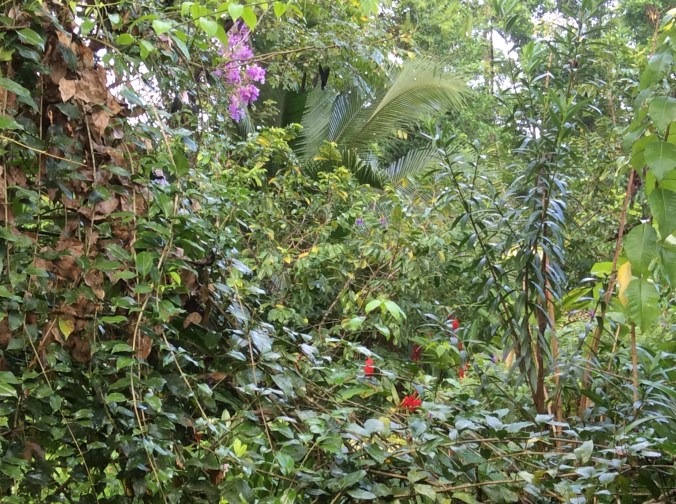
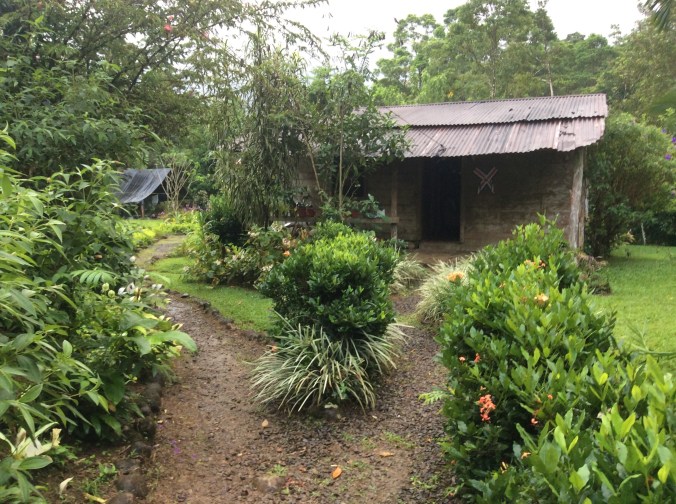
After we left the little village of Colonia Liberatad, we headed down another unpaved road to a tiny little building in a large garden for coffee and dessert.  Costa Rica is heaven for flower and plant lovers, a true botanists’ paradise.

IMG_2035

A pebbled path led from the road to the “restaurant”.  No one rushed; we were too enthralled with the flowers, the humidity, the total intenseness of the surroundings and atmosphere.

IMG_2036

Although I have been to Costa Rica twice now, ten days each time, and love flowers, still I can only recall the names of a few.

IMG_2037

Hundreds, sometimes, thousands, of species reside within only a few square yards.

IMG_2038

IMG_2039

IMG_2040

Everyone stopped along the way to look.  Some of the children wanted to hunt for reptiles. They were warned because the deadly fear-de-lance lives here.  A few assured everyone they knew exactly what they look like.  Knowing them, it was probably true.

IMG_2041

A wood building is a rare sight anywhere I have been there–too much rain.  All roofs are either metal or tile for the same reason.  Other types of roofing rot.  Some have totally given up trying to add color because it disappears quickly apparently.  This area of Costa Rica on the Caribbean side of the mountains receives rain daily.  It rained off and on all day.

I have no idea the name of the dessert they served us with coffee.  It resembled Indian Fry Bread (from New Mexico and Arizona–I love the stuff), super crispy, soaked in honey.

IMG_2042

The road just outside this hidden gem.

I Am Queen by Vibha Shetiya


I am always looking for ways to expand my mental and cultural horizons. Here is a movie to watch.

Vibha Shetiya's avatarFeminism and Religion

VibahI started this post just after getting back from an India trip, always very challenging because of memories that haunt me not only through their high negative recall value, but also in that I often find myself reverting to the diffident, fearful person I used to be while living there. In fact, palpitation is the first to greet me at Bombay airport even now after nearly seventeen years of being an expat. But with every trip, I also find myself evolving as a person, as a woman. And of course, it is always fun to meet up with family and old friends, all of whom I hold very dear. But the highlight of this trip was Queen.

Queen is a Bollywood movie unlike any other I’ve seen. As mentioned in a previous post, B-wood cinema if you can call it that, is made mostly of predictable, formulaic themes centering…

View original post 922 more words

Tips for a Healthier You-2


Given the response I received from the last set of tips, it seems a good cause to periodically add more.  Essential oils hold a special place in my health routine.  I use them for so many things. I have found several especially useful to diffuse at night for prevention of allergy symptoms and to facilitate better sleep.  Although I generally prefer doTerra, I use other brands as well.  However, I have found that since I started using doTerra Breathe at night in a diffuser, my allergy symptoms remain minimal compared to what they were before.

Here are two formula I use at night.  I suggest individuals experiment to see what works for them.  I combine Breathe with other oils.  One formula is approximately 7 drops Breathe and seven drops Cedarwood.  Cedarwood is particularly good to facilitate deep, relaxing sleep.  It helps prevent sinusitis and reduces stress.  I have a large diffuser so you may want to experiment to see what works for you.

The other formula I use at night is Breathe as above combined with equal amounts of lavender and melaleuca (tea tree).  Melaleuca has so many others uses, it seems nearly limitless.  It is especially good for teenage acne and treating infections.  However, I myself have never used it for those purposes.  It is one of those “cure all” oils and reduces inflammation and boosts the immune system.


Lucy Pick’s Pilgrimage by Mary Sharratt


I will add this to my list of must reads.

Mary Sharratt's avatarFeminism and Religion

mary sharrattIn medieval Europe, religious devotion provided an alternate narrative for women’s lives in a male-dominated culture. Defiant women who stood up for themselves in the face of rape, incest, and murder were hailed as virgin martyrs. Religious vocations, such as becoming a nun or a beguine, provided a viable and esteemed alternative to forced marriage.

Even women who were married with children could escape their domestic entanglements and conjugal duties by taking an oath of celibacy as 15th century English mystic Margery Kempe did, leaving behind her husband and 14 children to go on pilgrimage to Santiago de Compostela, Rome, and Jerusalem. Her Book of Margery Kempe, the tale of her travels, reads like a kind of late medieval Eat, Pray, Love and is the first autobiography written in the English language.

Though it might seem surprising to us today, women of the European Middle Ages possessed more…

View original post 370 more words

Costa Rica Adventure, Day Three–Part Two


After the six mile hike through the Cloud Forest and visiting the hummingbirds, we arrived a bit messy and muddy at a local Italian restaurant which surprisingly served some of the best Italian food I have eaten anywhere.  After this leisurely lunch we headed back to hotel to ready ourselves for the afternoon activities.  Some chose zip lining while the rest of us headed to a local organic coffee farm or remained at the hotel.  For me it was no choice really; I love coffee.

Our guide at the farm had to be one of the most entertaining guides I have experienced anywhere in the world.  He was not only informative but also extremely witty; we chuckled all the way.  After a brief introduction we headed to the coffee plants, tasted raw coffee fruit, and picked coffee.

IMG_1943

Here I am picking coffee as instructed–only the ripe, red berries.

IMG_1946

He also instructed us to taste them.  They were surprisingly sweet.

IMG_1947

Here is the basket where we all put the berries we picked.  Then we headed to the processing area.

IMG_1951

First he showed us the old way, how they used to get the fruit on the outside off with only the seeds, the beans left to dry.

IMG_1952 (1)

For good coffee, they spread the beans out and sun dry them.  The roof here shelters them but allows natural drying. These beans have just begun the drying process.  When they are ready, they are a darker, more golden color.

IMG_1953

The next part of the tour involved chocolate.  Here he is hand grinding chocolate into relatively fine pieces.  Yes, in a mortar.  He added a little hot water and raw cane sugar, whisked it around, and gave us all a little cup.  Luckily, it was not a big crowd so most of us received seconds.  When I run out of the chocolate I have here at home, I will consider doing it this way myself.  The difference in taste from this and that which we get ready mixed here in the US is remarkable.

They had sugar cane growing here but only ornamentally.  Sugar cane requires heat.  We were too high in the mountains; it was too cold to produce cane for sugar.  Later, near the coast in Guanacaste, we saw mile after mile of commercially grown sugar cane.  He had some and gave us all a taste.  Yes, we sucked on pieces of sugar cane.  I expected to dislike it, to find it excessively sweet.  Actually, it seemed only mildly sweet and quite tasty.

It was a full day.  We returned to the hotel rather late and experienced an even later dinner at the Tree House, a restaurant in Monteverde built around a large tree.  The live band played a lot of reggae music.  Many of the residents of the east coast of Costa Rica are the descendants of Jamaicans who came many, many years ago to help build the railroad.

The last time I visited Monteverde we had time to wander around the town, shop, and eat ice cream.  I sorely missed not having the time to hang out there a bit and especially eat the ice cream.  Both the cheese and ice cream in Monteverde are, well, yummy and different.  I also missed going to the club next to the Tree House where you find people of all ages hanging out and dancing.  Maybe next time.

#JoinThePack: Will you howl fight for a future with wolves? Ooowwwwoooooooooooooooooooooooo!!!!!!


As a fan of wolves and other predators, e.g. pumas, I want to share this.  Predators help maintain a healthy ecosystem.  Also see my other posts about wolves.

The wolf’s return to Yellowstone restored an ecological balance which had been lost. Watch the animated film, “The Fable of the Wolf.” Will you howl + fight for wolves? Ooowwwwoooooooo!

Source: #JoinThePack: Will you howl fight for a future with wolves? Ooowwwwoooooooooooooooooooooooo!!!!!!

Costa Rica Adventure, Day Three–Part One


After lunch at the National Theatre we headed to Monteverde, a small town with only one unpaved road in and out.  One big change since I was there three years ago is the road.  It has been widened considerably and apparently plans to pave it are in the works.  The original reason for not paving was to prevent hoards of tourists from invading.  Apparently, that failed; tourists came anyway.

This town’s origination grew out of Costa Rica’s decision to disband its military in 1948, a practice which continues today.  Quakers from Canada moved here for that reason and created Monteverde, now famous for its cheese and, of course, the nearby Cloud Forest.  The hotel, where I have now stayed twice, El Establo, is owned in part by Quakers and serves a favorite of mine, fried cheese.

SAM_0640

Nine buildings up and down the mountain house rooms.  Previously, I stayed in one of the lower buildings; this time we were near the top way above this lake.

SAM_0641

The views from all the rooms provide a vista all the way to Nocoya Bay.  After we put luggage in our rooms, we headed out for a night walk in the forest, the reason we had been instructed to bring flashlights on the tour.  We saw spiders, birds sleeping, a mouse, all sorts of insects, but nothing too exciting.  Probably some of the group members were too scared and too noisy.

The next day breakfast occurred at 7 just before we took off for the Cloud Forest and a hike to the Continental Divide–all six miles or so.  I had hiked here before but on a different trail and in a huge downpour.  Luckily, it rained only a little.  However, if you are in the clouds, you get wet.

Lush does not even begin to describe the Cloud Forest, a huge reserve with numerous indigenous species of everything from hummingbirds to insects to all sort of plants that exist nowhere else on earth.

IMG_1923

Every tree, branch, every living things is covered with other living things.  This must be botanist heaven.

IMG_1924

IMG_1926

Looking up into the branches of a tree fern.  Yes, that is a fern. So much to see, it is hard to keep up with the guide, a native Quaker whose father was one of the founders of Monteverde.

IMG_1929

IMG_1927

It is difficult to know what photos to take; everything holds some kind of fascination and lots of beauty.

IMG_1931

Another tree fern right by the trail.

IMG_1934

In the clouds at the Continental Divide it’s incredibly windy yet the clouds stay and you get wetter and wetter even though it is not raining.  Water dripped off my slicker, the trail oozed mud and water, it was hard to keep my footing on slopes.

IMG_1935

IMG_1936

On the way back we crossed several streams.  Everywhere in Costa Rica signs in both Spanish and English instruct people to save water.  They made me chuckle.  Streams run everywhere in much of the country, especially on the Caribbean side.  Here I live in a semi-arid environment where I see wasted water running down streets in town and in Costa Rica they conserve water and recycle things I did not even know were recyclable.  Hotels provide recycling bins and some even turn off lights automatically when you are not in the room.

IMG_1937

The name for this flower translates from Spanish as hot lips.

IMG_1938

This looks like a tree but it is not.  A giant, parasitic fig plant surrounded the tree, eventually killed it, and this is the result.

After we finished the hike, we walked over to a shop that feeds hummingbirds, hundreds of species of which live in Costa Rica, many only in the Cloud Forest. Took a video of them, but it refuses to upload here.  Some were incredibly iridescent and much larger than any I had ever previously seen.


Costa Rica Adventure, Day Two–Part Two


The problem with tours is that they think you need to get your money’s worth and the best way to do that is to pack as much as possible into the shortest about of time possible.  When some of us complained a bit after a couple of days, we were informed that we should not confuse vacations and tours.  They are not the same thing.  We were on a tour, not a vacation.  Nevertheless, the tour did have some advantages like getting us into places we might have missed or never found on our own.  However, that was not really the case for Day Two.  That whirlwind morning in San Jose not only included the National Theatre and the Gold Museum, but also the Metropolitan Cathedral.  It does not have lighting conducive to photography with a “normal” camera, cell phone, etc.  Therefore, my attempts to photograph the endless and lovely stained glass windows proved futile.  Here is what I was able to photograph.

IMG_1908

This is a large church.  Yes, we were there as tourists, but many others were there praying, sitting silently, worshipping.

IMG_1911

I could not find a place where the chandelier did not interfere with the view where I could take a really good photograph.  Nevertheless, hopefully those of you who read this can get the feeling for this really wonderful place.

On a totally separate but perhaps related note, I watched Public Television for a while tonight about finding ones roots.  I keep thinking somehow my DNA results must be a bit screwy because the places where I feel most at home, the cultures in which I have an interest, the literature I love to read, and the music to which I usually listen have no relationship whatsoever with the places from which the majority of ancestors came.  I have been to Costa Rica twice now and to one particular town (besides San Jose)  twice–others were new this trip.  What concerns me is that all the tourists and people buying up property there who are from Europe, the US, and Canada will totally ruin its values and beauty.

Costa Rican Adventure, Day Two–Part One


After a buffet breakfast of traditional foods, e.g. gallo pinto and plantanos fritos–my favorites, we headed to the central part of San Jose which is only foot traffic, no vehicles.

IMG_1912

We strolled to El Mercado where my grandson bought a stuffed sloth–I love bargaining so we got it for a good price.  My only disappointment was the rush so we could see everything–the disadvantage of being on a tour. Eventually, we ended up at the National Theatre.

Located in the central section of San Jose, it is considered the finest historical building in the capital and remains relatively unchanged since it was built in 1897–it opened on Oct. 21 of that year.  Most of its opulent furnishing were imported from Europe.  At the time of its opening fewer than 20,000 people inhabited San Jose.  It was financed via a coffee tax which was then and still is the major export and cash crop.

This theatre remains in use today and houses a small, cosy restaurant next to the main lobby.  We ate our first Tico lunch there.

IMG_1913

This and the following photos were taken in the lobby of this theatre.

IMG_1914

IMG_1915

IMG_1916

I took this and the following photo while seated in the main seating area looking up to the ornate ceiling.  Originally, the theatre was designed for multipurpose use so the main floor has seating than can be removed and the floor risen to the level of the stage and consequently transformed into a dance floor.  Rarely is this aspect used today.

IMG_1918

We left this area and climbed the stairs to the balcony where the president and cabinet still sit for performances.  Neither the president nor any of the cabinet have body guards.  We were reminded that in 1948, the country disbanded its army and still has no military. The following two photos were taken from the stairwell.

IMG_1919

IMG_1920

IMG_1921

This area is a large reception room across from the balcony level.  The incredibly intricate parquet floor has been covered by carpet for protection  so you can see only portions of it as you walk around.

We also visited what is know as the Gold Museum, my favorite.  It houses a huge collection of pre-Columbian gold artifacts and other antiquities. No cameras, purses, backpacks, iPads, nothing can be taken in so no photos.  It is literally underground.  Visitors are directed to lockers in which to put all these belongings, lock them, take the key with you as you browse the incredible collection.  There is an excellent gift shop where you can purchase copies of these artifacts, painted wood jaguar heads, and other handcrafts.  This is not our typical, touristy gift job.  As a result I now own four jaguars, three heads (two from Mexico and the one I bought here) and an entire jaguar from Mexico for a total of four.