Book 32 for 2025: “My Name Is Emilia del Valle”, Isabel Allende


The last two books of hers that I read were set in the more recent times when Salvador Allende and later Pinochet were presidents of Chile. This one dates back to the 1800s and the Chilean Civil War. In 1866 a nun of Irish descent living in San Francisco has a passionate affair with a Chilean aristocrat and becomes pregnant. He abandons her; their daughter becomes the woman in the title of this novel. She is raised by a loving step father, an intellectual teacher from whom she learns to be independent and defy societal norms. At a young age she becomes the writer of short pulp fiction novels using a fake male name. The income from these helps her family live a reasonably good life.

Bored with writing these lucrative little books, she convinces a San Francisco newspaper to hire her as a journalist where she works along with a more seasoned journalist, Eric Whelan. Eventually, the two are sent to Chile to cover the civil war and violence occurring there. She sees this as not only an opportunity to satisfy her adventurous spirit but also an opportunity to find her biological father. She encounters dangers, almost gets killed, and sets off to find herself in the far southern reaches of the Chilean wilderness, learning from the indigenous people who live there how to survive in remote mountains.

Note: One of the places she goes was nearly impossible for non indigenous people to find during the 1800s and many never made it. Today, it is a popular area for hiking, camping, and exploring nature.

Book 31 for 2025: “Cold Kitchen: A Year of Culinary Journeys”, Caroline Eden


What a delightful, entertaining book! The title refers to her basement kitchen in Edinburgh, Scotland, where she lives when she is not wandering the globe. Each chapter highlights a certain place in her travels, in this case Ukraine, various countries in Central Asia, e.g. Uzbekistan, Russia, and the city of Istanbul, which she says is one of her favorite cities to visit especially in winter when tourists are gone. In one chapter, “Russian Railway Pies”, she and her husband ride the train from Moscow to the eastern shore of Russia–the Trans Siberian Railway journey. They did this in winter when the temperature in some places they stopped were as low as 50 below zero.

Each chapter contains her experiences in an individual country or city. She describes the places in detail, the people she meets, the food she eats. She also relates her feelings regarding these places, many of which she had previously visited, how they have changed over the years for better or worse–worse in the case of Russia, what they mean to her. In each chapter she always goes back to her kitchen, her dog, hiking the Scottish highlands, and her cooking, usually a recipe where she is trying to re-create a food she ate in one of these places she loves.

This is her most recent book, published in 2024. She also has a series of books about particular places where the entire book is dedicated to that particular place. Mostly, she has travelled in Central Asia, Russian, the Balkans, Turkey. I enjoyed this book so much, I plan to read another one about her other adventures. She is not just on these adventures for fun but also as a career so she knows many journalists, diplomats, officials in these places.

Book 18 for 2025: “The Great Hippopotamus Hotel”, Alexander McCall Smith


After reading 17 serious books to date this year, I decided it was time to read something lighter and found this latest in the No. 1 Ladies Detective Agency series at the library. If you are looking for lighter reading, sort of mystery stories without murders, and insights into a different culture, Botswana, this series is for you. Start with at least several near the beginning of the series so you get to know all the main characters to fully appreciate what occurs and who’s who.

This novel gets its name from a traditional hotel located way out in the countryside far from city. It is a relaxing place with a lovely veranda and native gardens full of flowers and succulents. Strange things begin to occur–food poisoning, scorpions in rooms, laundry disappearing from the clothes line–too many for it to be by accident. The hotel manager comes to see Mma Ramotswe and Mma Makutsi for help. At the same time Mr. J.L.B. Matekoni has a male client who asks him to find him a fancy, red, Italian sport car without his wife knowing anything about it. With their customary good humor and kindness, these characters set out to solve the problems of the hotel and deal with the sports car issue.

As usual in this series, one learns that quite often people accuse the wrong person, that things are often not as they seem, and that your own prejudices and inclinations can lead you totally astray.

The Angel


Can you call yourself a creative writer if you have not written a word in months? I have a friend who promotes 20 minutes of writing per day, telling people to just write, forget quality, just write. Really?! I care about quality. Perhaps too much? I make sure to read quality writing 99.99% of the time. Is this just words I am writing here or is it quality or garbage? You tell me!

One thing I can do is read. I’m good at reading. And singing. And gardening. I talk to plants; that’s why they grow for me. I truly care. They bring me peace and joy.

In the last two months, I’ve read three collections of short stories, two by Anthony Doerr and one by Gayle Jones. Normally, I am not a short story reader, but here I am reading these. Talk about different. It’s almost like these two famous writers inhabit different planets. Doerr’s stories seem intensely emotional, often a bit fantastical and heart wrenching with a lush, descriptive, poetic style even though Doerr is not a published poet. Jones is a published poet, yet her stories are blunt, conversational, often first person and sometimes short–one page short.

In many, a character is telling his or her (most of the stories are her) story about where they are, some experience, somebody they knew, what they did or said. In one story the narrator says she’s an angel, explains where she’s been, whom she’s known, and ends up by asking readers if they’ve seen her near the Seine. I doubt anyone mistakes me for an angel.

Note: Book 13 for 2025 is “Butter”, Gayle Jones. A collection of short stories.

Book Ten for 2025: “Four Seasons in Rome”, Anthony Doerr


If you have ever felt enchanted by a trip to Rome, you will find this memoir delightful and informative. It made me want to return just to stay a while, wander around, visit the more obscure places Doerr describes, people watch, eat, and drink local wine.

In 2007, Anthony Doerr, the 2015 Pulitzer Price Winner, won the Rome Prize to become a fellow at the American Academy in Rome. He and his wife, Shauna, moved to Rome with their newborn twins, Owen and Henry. This memoir memorializes the four seasons they spent living there. They learn to care for babies; wander throughout Rome visiting tourist sites, local restaurants, the butcher, the baker, the toy store; learn enough Italian to acknowledge all the Italians who stop to admire the babies; and attend the vigil for the dying Pope John Paul II.

While there intending to write his later novel (the one that eventually won the Pulitzer) and failing to do so, he does manage to write a short story which I have read in one of his collections and to read everything by Pliny the Elder. His discussions about his readings makes me want to read some of Pliny the Elder myself. As in his short stories and novels, Doerr’s descriptions, language, and observations delight and enchant. This is a wondrous book about one of the world’s oldest and most fascinating cities which he calls, “a Metropolitan Museum of Art the size of Manhattan with no roof, no display cases…

Book Seven for 2025: “The Map of Salt and Stars”, Zeynab Joukhadar


Two young heroines dominate this fascinating novel which switches back and forth between the Syria of 2011 and the 12th century. The latter is a girl who disguises herself as a boy to join the quest of a famous mapmaker. Nour, the first girl, lost her father to cancer in NYC. Then her mother, a mapmaker, decides to move herself and the three daughters back to Homs, Syria. They barely settle into their new life when the civil war breaks out and a bomb destroys their house. They become refugees. This is the tale of their harrowing journey from Syria to Jordan to Egypt to Libya to Algeria, then Morocco and finally to Cuenta, the Spainish city on the north coast of Africa, where their uncle lives.

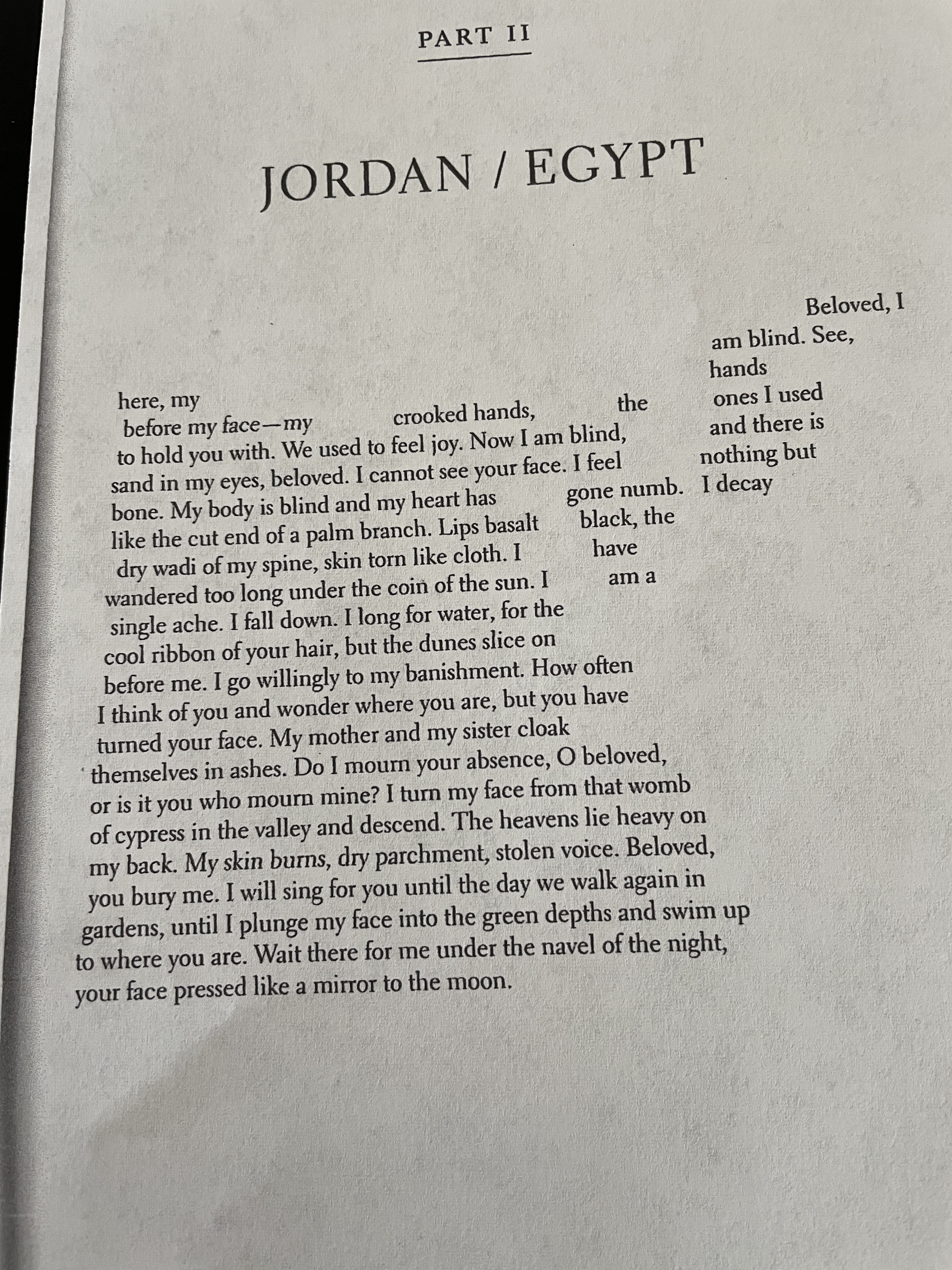
To keep sane, Nour repeatedly tells herself the story of Rawiya, the disguised girl who is an apprentice to the map maker. When he was alive, this was the favorite traditional story her father told her. The book alternates between what is really occurring to Nour and her refugee family and this ancient story. At the beginning of the section for each country through which they travel, there is a touching and beautifully written poem in the shape of the map of that country. The poem for Jordan/Egypt is printed below.

Book Three for 2025: “”A Psalm for the Wild-Built”, Becky Chambers


This book is part of a group read at the church where I sing. Classified as science fiction because it occurs in a society on the moon of a different planet far into the future, it is the cheeriest science fiction I have ever read. One of the main characters, Sibling Dex, is a tea monk who travels from town to town, village to village, dispensing the right herbal tea and “advice” to the people who come to see him. He becomes frustrated and bored with this life and decides to head out into the countryside, out into the untouched nature where all the old roads are overgrown or now non-existent.

Due to past experiences, these humans have freed all the robots after they became sentient, and they have an agreement as to where each lives. In addition, humans have decided to live very differently, leave a lot of nature to nature and so live only in certain areas, in bigger towns and small villages with some nature here and there, but most of nature is now untouched and left to do whatever nature does.

Dex heads out in his tea house wagon which he pedals to generate electricity. It is self containing and he has everything he needs for at least two weeks. At one campsite not too far into the wilderness, a robot named Mosscap appears. Mosscap has volunteered to go into human territory per the ancient agreement between humans and robots and learn about humans. Dex finds this a mixture of frightening, intriguing, and confusing. Yet he agrees to allow Mosscap to accompany him on his adventure. The rest of the book is about what they discover, what they learn from each other, and the future they plan.

Book 35 for 2024: “Woman of Interest: A Memoir”, Tracy O’Neill


In 2020, the author, Korean, adopted as a child, nearly 30, decides she needs to find her biological mother before her mother dies. Finding few leads, clues, she hires a private detective who disappears. Then she takes the task of investigating on her own. This book details her investigation, her long relationship with a Serbian furniture mover, life with the parents who adopted her, and her career as a writer, plus going to South Korea to meet her biological family.

Her writing style is a bit different and somewhat rambling. However, for those who have experienced the same sort of search, this book provides details on how to go about finding “the lost”.

Langston Hughes in Uzbekistan


It’s 1932.

Movie roles promised to 22 Black Americans.

“Black and White” in the

Uzbek Soviet Socialist Republic.

Treated like royalty, wined, dined, at

their own expense.

Hughes–ridiculous script. All went

home except Hughes. He stayed,

traveled, saw cotton grown from Aral

Sea water–now no water, desolate

desert.

In Tashkent, Uzbeks, Turkmen, Tartars

honored him, flowers, fruit.

No English.

He met a Red Army Captain from

high Pamir Mountains. Hughes

described him, Black with Oriental eyes.

Hughes called him Yeah Man.

He called Hughes Yang Zoon.

Weeks together never understanding

each other’s words.

Hughes’ poetry book

“The Weary Blues” first

American book translated to

Uzbek. Original English version

lost. He describes this new place:

“Look: here

Is a country

Where everyone shines.”

Note: You can find a version of this book translated into English from Uzbek by Muhabbat Bakeava and Kevin Young.

Book 34 for 2024: “The White Mosque”, Sofia Samatar


This memoir tells the tale of an unusual tour for a specific purpose, to follow the path of Mennonites who left Europe to escape conscription into the army since the Mennonites are pacifists. The author’s own life is unusual. Her mother was a Swiss Mennonite missionary to Somalia. Her Muslim Somali father taught the Mennonite missionaries Swahili. The two met and married. Samatar grew up and lives as a Mennonite. She teaches African and Arabic literature at James Madison Un. She is most famous for her fantasy novels and short stories which is how I discovered her writing.

In the late 19th century a group of German speaking Mennonites left Russia for Central Asia where their leader believed Christ would return. They suffered many hardships, rejection, abuse, but finally found a place that welcomed them in the Muslim Khanate of Khiva in what is now Uzbekistan. There they built a white church which the locals called Ak Metchet, the White Mosque. Their village lasted 50 years.

If you go online, you can find tours today that follow the route of these Mennonite travelers, trace their route. This book details Samatar’s experiences on the tour, the tour guides, the food, the architecture, the culture and the history: a 15th century astronomer king, the first Uzbek photographer, Mennonite martyrs. She also discusses her own unique upbringing, local beliefs and culture, how people develop their own personal identity, and the surprising interconnections people sometimes discover.