Frozen


Two weeks ago today, the sickening news came:  my daughter’s father, my ex-husband, suffered a massive heart attack while working.  Rushed to the hospital, resuscitated, then open heart surgery. He never regained consciousness, not yet.  He lies there, part of his brain not working, tube-fed, not breathing on his own.

She drove all night, six hours to get there.  She thought they had taken her to the wrong room, unrecognizable.  Last week end, I drove with her.  Except for his hands, I would not have recognized him myself, so thin, so aged. How could someone change that much in the ten years since I had last seen him?  She went back again late this week, returned late last night.  Moved to a longterm care facility, he remains the same except he no longer even opens his eyes, no more staring into the void.

I feel frozen.  This morning I delivered my grandson to my daughter–he stayed with me this trip.  Checking on her father’s apartment, my daughter found his photos, some from when we were young.  She showed a few to me.  I stared, shocked, dismayed.  My today’s to-do list just sits here.  I force myself to work at it bit by bit, write two peer review assignments for a class I am taking–I do not want to disappoint, vacuum and dust one room at a time, tell myself I need to go out on this 20 degrees warmer than normal day and garden, write this blog post.   I feel frozen.

He had plans neither she nor I knew about, plans to perhaps make him happier, return to the land of his birth.  Will some miracle occur, will he awaken, recover?  Is there some appropriate time for which we wait?

I feel frozen.  When will I thaw?


Ethiopian Journey–The Castles of Gondar


When my friend told me we were going to visit the Castles of Gondar, I thought he was kidding.  It sounded too much like a movie title, plus castles in Ethiopia?  Seriously.  Then I looked it up and sure enough, there are a lot of them, built by a series of kings, fathers and sons, and a queen.  Some remain in reasonably good repair at least on the outside.  Others crumble in the rain and humidity.  All are in a sort of compound arranged together.

IMG_0677

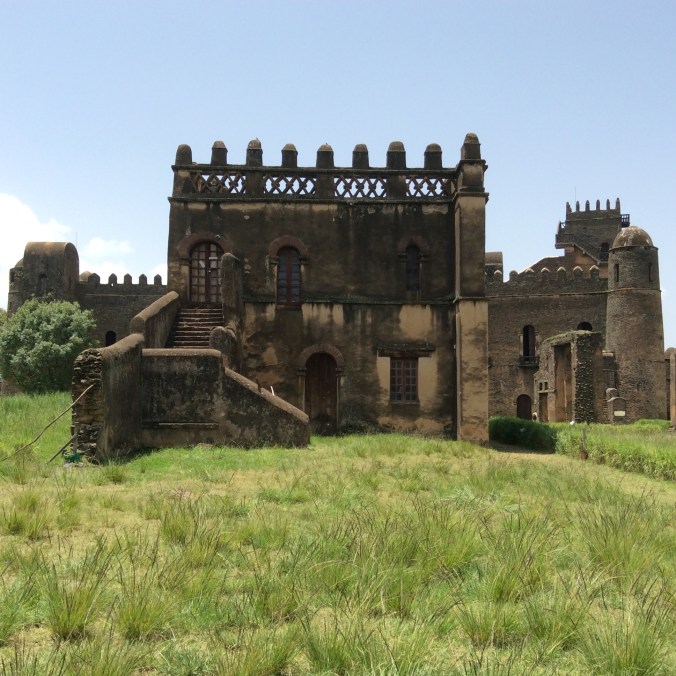
This castle is near the entrance and in rather good condition.  Restoration work is most complete here so it is safe to walk to the second floor.

IMG_0684

The view from a second floor window.  Because of the altitude and moisture–contrary to popular opinion, a large portion of Ethiopia is mountainous and green–especially during the rainy season, upkeep is not easy.

IMG_0688

The same castle, looking out the door onto the balcony which can be seen in the first photo.  The floors have been restored.

IMG_0685

Looking in the opposite direction from the first castle, several castles and the ruins of others show the layout of the compound.  Our hotel was near the top of the mountain in the distance. Many locals roamed around when we were here.  It is popular to take wedding, anniversary, etc. photos here.

IMG_0707

This photo shows the first castle–in the background–from another side.

IMG_0715

The style of some of the castles, like this one, is more intricate than others.

IMG_0725

This building housed the royal lions.  Tradition for keeping lions goes back several centuries.  The last Ethiopia emperor, Hailie Selassie, was often referred to as the Lion of Judah, the latter referring to the Ethiopia tradition of believing that they are descendants of Solomon and Sheba.  Ethiopian lions are a different sub-species than other African lions, smaller with darker, sometimes black, manes and tails.

IMG_0731

These castles provide a perfect venue for photography.  You can see my friends sitting on the stone wall.

IMG_0743

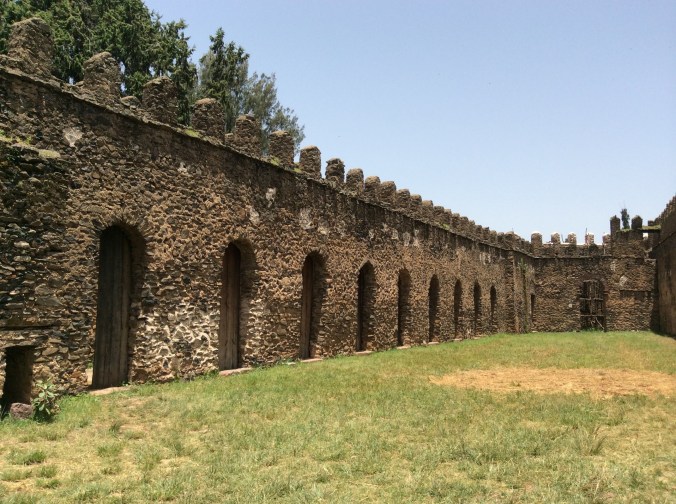
The royal stables obviously housed many horses.

IMG_0747

The royal dining hall currently receiving restoration work.

IMG_0755

The path to the exit.

The news the last couple of weeks from Gondar has not been pleasant.  Many people have been protesting the government which they view as tyrannical and favoring one ethnic group over the others.  More than ten protesters were killed during the first protest.  Just this past week thousands came out in another peaceful protest.

Gondar (sometimes spelled Gonder) is a business, commercial, and education center.  It is a main route for commerce between Ethiopia and Sudan.  For more detailed information about Gondar, the castles, and the surrounding area, see my blog posts from Aug-Sept. 2014.


Isabella–En Memorium


477729_3059472219691_1596792929_o

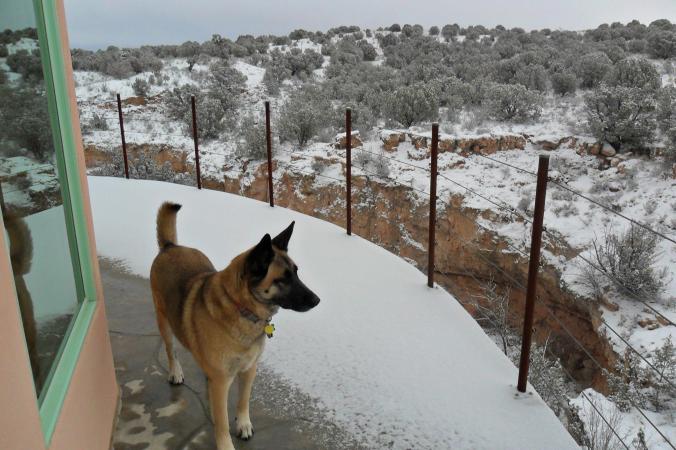
The crematorium handed me the 6″ by 4 ” dark brown wooden box.  I knew it would be heavy; Isabella was an eighty pound wolf dog. I thought I was prepared.

Driving home, memories:

March 2006, daughter calls; two year old grandson wants a beta. I drive to PetSmart.  Daughter tells me I must see these unusual, incredible seven-week-old puppies.  Alert brown eyes look at me.  Too big, black ears wiggle.  The label says wolf, German Shepard, Blue Heeler.  The two remaining puppies look like light colored German Shepherds or Belgium Malinois.  I had not planned to get a dog, not yet.

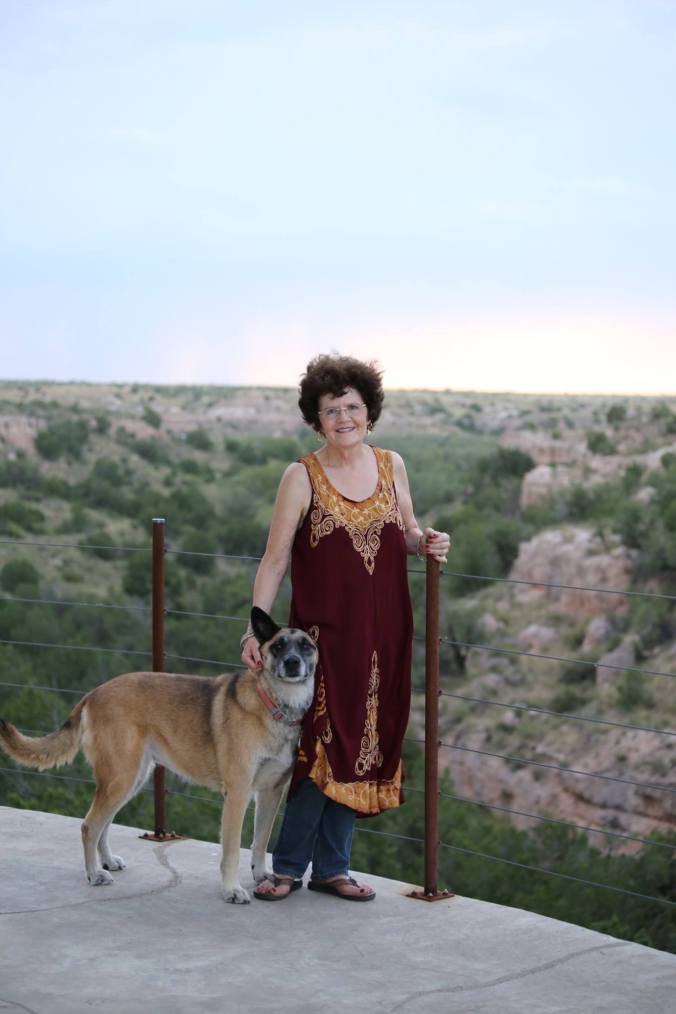
Two years later I move into my new house:  canyon edge, horses, bobcats, coyotes, foxes, road runners, mockingbirds, rattlesnakes.  Isabella guards her property, sits on the patio where she can check for invaders.  She rarely barks, growls.  When she does, high alert–I check.  Neighbor dogs, coyotes, foxes, chased off–not bobcats.  She watches them.

I remember the day she dismembered a skunk, drug the carcass everywhere.  After eleven baths at PetSmart, the skunk smell remained.  The one day she growled, I shocked, investigated–a man walking down the arroyo toward the house.  Growls became increasingly loud.  Out on the patio, she stands, the man sees her, turns and runs.  I feel safe, Isabella guarding, telling me if something unusual occurs.  She’s mixed breed; I think she’ll live long.

Every morning, evening, she completes horse chores with me, chases bunnies, roadrunners.  Two months ago, I, mesmerized, watch her catch, gobble two half-grown bunnies in less than one minute–nothing left.  Mixed breed; I think she’ll live long.

Friday morning she helps me with chores, chases bunnies.  Friday afternoon she can hardly move.  At the vet, blood work like a four year old; x-ray shows a little something wrong.  They give her two shots, schedule an ultra-sound for Saturday morning at another vet’s.  Meds working, Saturday morning she’s her usual lively self, eager to travel in the truck, nose wet and cold.

Ultrasound vet tells me there’s little hope.  Shocked, I stand there.  “If she were your dog, what would you do?”

“Put her to sleep.  She’s not in pain.  She has a tumor the size of your small fist on her intestines–might be cancer, hard to operate.”

I look at the vet, frozen.

At 8:00 Wednesday evening, I open the box, take out the bag of Isabella’s steel grey ashes, walk out to her patio spot, the place where she guarded her kingdom, toss a handful of ashes into the wind, watch them float and scatter down into the canyon, tears tracking down my face.  I close the bag, walk to the place where our long yearling colt, Star, is buried, dig an eight inch hole, bury another handful of ashes.  I take the one tablespoon of ashes left back to the house, put them back in the black velvet bag and into the box with the card with her paw print, the crematorium certificate, the sympathy card signed by all the employees where they euthanized her, place it on top of a stack of old magazines in the Chinese cabinet.

At bedtime, I forget, go to call her in.  This morning I find her hairs–she shed so much, wolf undercoat.  Evidence of her presence permeates.

It will never end.

11999567_10203872023954904_7742039751577593507_o


My Ethiopian Journey–Simien Mt. Natl. Park


No way was I prepared for these mountains.  Do you think of numerous peaks over 13,000 feet when you think of Ethiopia?  Probably not. There are even a few over 14,000 feet.  The whole area is often referred to as the Roof of Africa.

IMG_0573

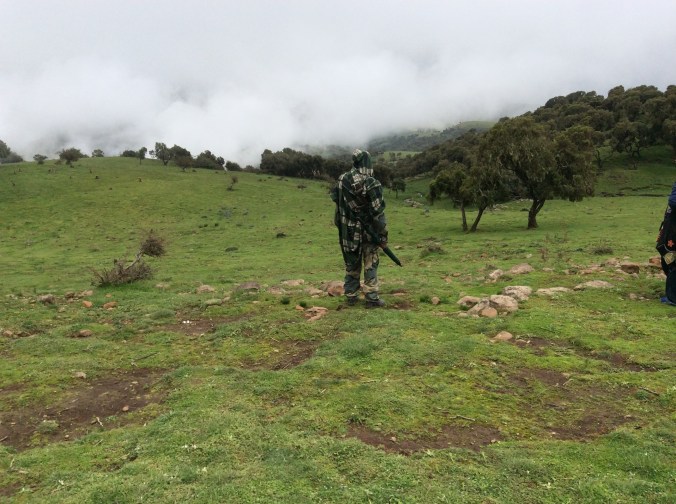
There is only one road into the park.  To get in, a tourist must stop at the park office, sign in, passport number, address, etc.  Plus, you will be assigned a guard and a guide.  Our guard in the photo above carried an assault rifle.  No, it is not to protect people, it is to protect their rare animals from people, from poachers.  Wonder why he is wearing all these clothes?  It is cold at 12,000 feet even if you are near the Equator.

IMG_0577

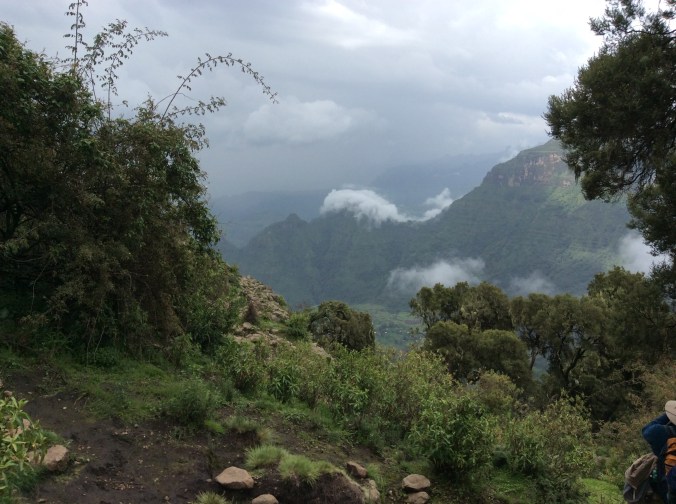
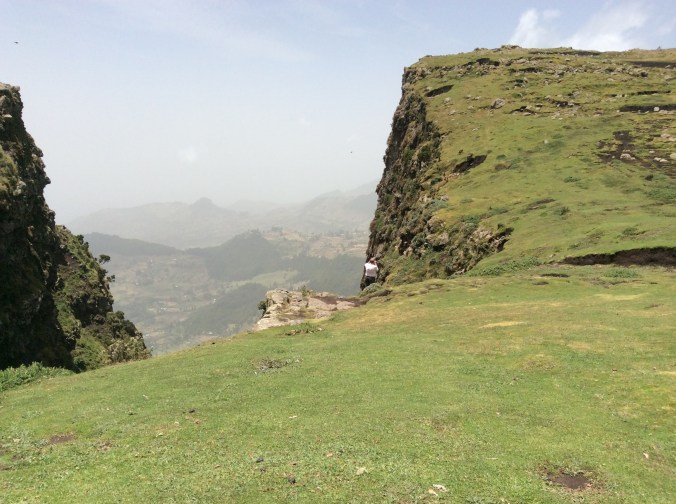
The drop offs are terrifying, thousands of feet, the vistas endless.  Even though I have lived and been all over the Rocky Mountains and been to the Himalayas in both Kashmir and Nepal, I have never seen anything like these mountains for beauty, green, and endless vistas.

IMG_0579

My friends near the cliff are much braver than I.  In the foreground stands our guide, Michael, who spoke excellent English and was super funny.  He had us laughing all the time. People live and farm in these mountains–if you look closely in the middle of the photo, you can see fields.  However, the government is slowly relocating people in order to make the park a refuge for rare wildlife.

IMG_0582

The above photos were all taken on a hike early one morning.  Everything was wet because it was either raining or misty or we were in the clouds.

IMG_0592

Because I kept slipping and sliding, I decided not to walk along the cliff with my friends and the guard, who spoke the same Ethiopian language as my friend.  Michael and I took off across a meadow and suddenly here we were in the middle of all these gelada baboons, who paid no attention to us at all.  They were very afraid, however, of a predatory bird that decided to fly over. How do I know?  They suddenly started “talking” to each other in frightened voices.  Experts now think these primates actually have a language and do talk to each other.  Gelada are the last primates that are herbivores.  They eat grass.  All other herbivorous primates are extinct.  Gelada live only in the high mountains of Ethiopia and no where else on earth, a reason for a guard.  At night they climb down the cliffs into caves to protect themselves from hyenas and leopards.
IMG_0603

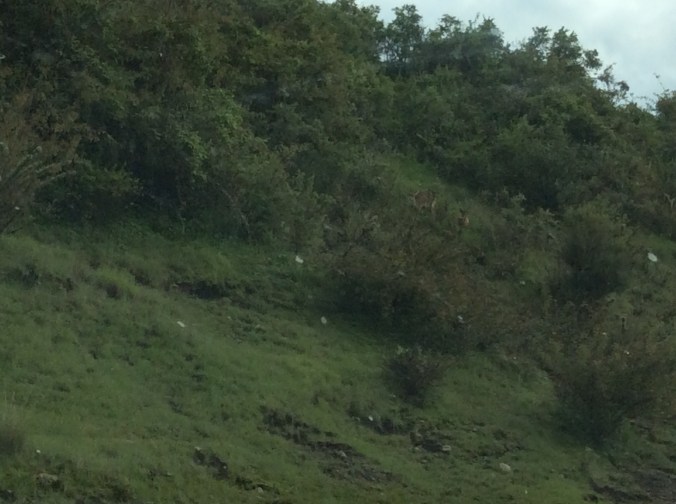
If you look very carefully in the middle of this photo, you can see several duiker which are considered so common it seems no one thought to stop to really take a look so I took the photo as we drove along.

IMG_0614

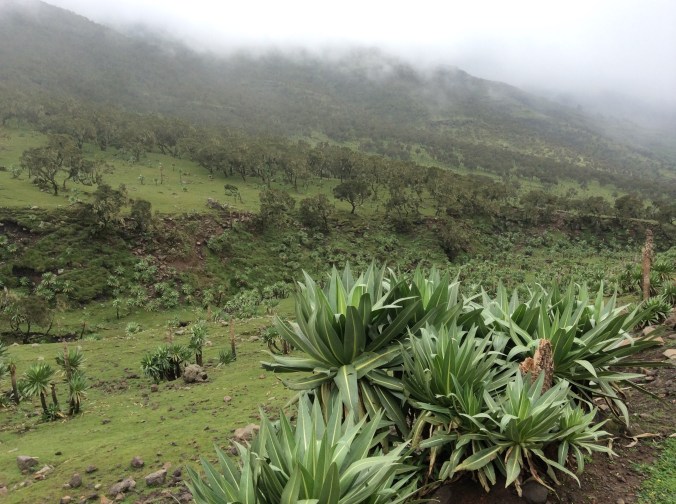
Here we are above the timberline where some very unusual plants thrive.

IMG_0625

And some exceedingly rare animals whose camouflage makes them almost invisible until they move.  At this point we are about 14,000 feet just under one of the highest peaks in Africa.  Look carefully in the middle and you will see walia ibex.  People come from all over the world to see these endangered animals that live only in this park.  Sometimes the fog rolls in and no one sees anything.  We were lucky; we saw more than twenty of them. And then the fog rolled in.

IMG_0630

These giant lobelia thrive above timber line.  Some were considerably taller than I am.

IMG_0632

If you grow red hot pokers in your flower beds and think they are semi-arid flowers, think again.  Here they are growing wild.

IMG_0633

You can see red hot pokers in the middle of this photo by the stream.  These mountain streams run down to and often across the road, making the road a muddy mess.  Without 4-wheel drive and an expert driver we would have gone nowhere.  In fact, at one point we did have to stop because two stuck trucks blocked the road, one of which had a flat tire.

IMG_0635

The highest waterfall in Ethiopia is hard to hike to unless you are not at all afraid of heights.  My friends did hike there. Look a bit to the right of the groove through which the water actually falls.  You will see a sort of flat area.  It is only a few feet wide with a drop-off on each side.  Yes, that is where you hike.  When I saw this view, I was rather glad I decided to wait, look for birds, and chat with the driver.

IMG_0595

The fire pit at the highest bar in Africa is a very popular place on a cold night.  Even though we had beautiful rooms, with no heat at 12,000 feet it is not exactly warm.  Even the guides and guards were bundled up.  The only people who seemed toasty were Scandinavian tourists with their heavy wool sweaters.  The hotel staff gave us hot water bottles to put in bed with us at night.  Actually, it works.  Nevertheless, when you get up in the morning, it is really cold.

IMG_0609

The guards and guides live near the park.  We dropped off the guard here and watched him walk toward his house down where the trees are.  We dropped off the guide near his house in the town when we left the park.


Ethiopian Journey–Ancient Churches of Lalibela


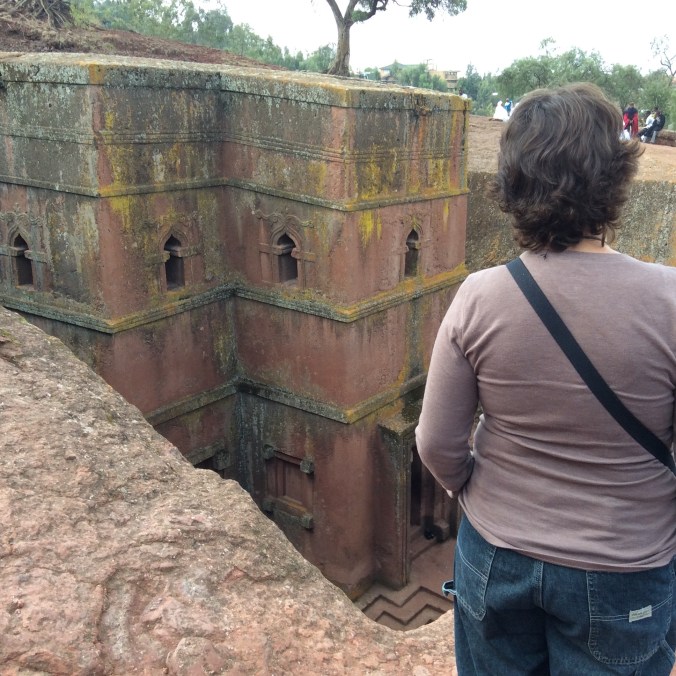
In the 12th century the king of Ethiopia decided to build a New Jerusalem.  Eleven churches were carved out of solid rock on the mountain top in the village of Lalibela.  A UNESCO World Heritage site, these churches remain intact and in use.

IMG_0428

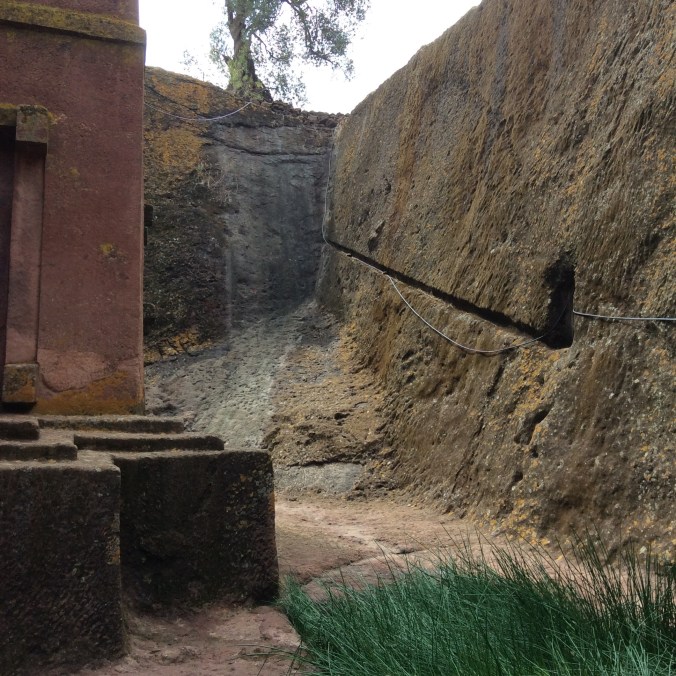
They were all carved from the rock top of the mountain down into the earth so that they remain invisible unless the person is only a few feet away.  This protected them from the vision of potential invaders, usually Muslims from what is now Sudan.  The above is probably the most photographed of these churches and stands separate from the others.

IMG_0429

My friend is standing near where the stairs lead down to the bottom where visitors and worshippers can enter the church.  Visiting all these churches in one day is not an activity for the faint of heart or for one terrified of heights.

IMG_0401

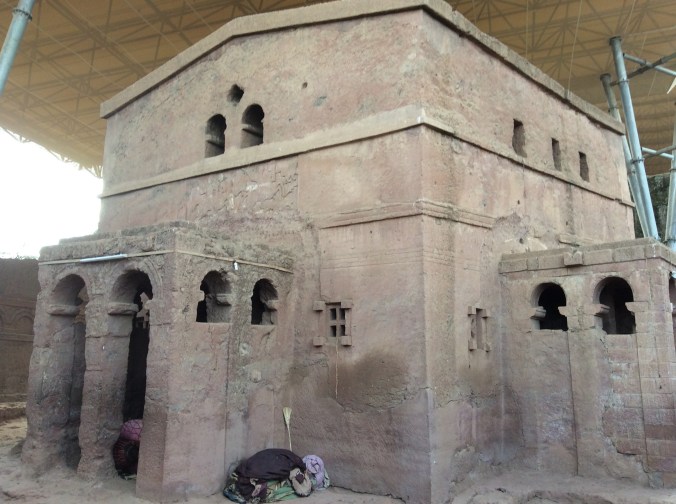
This is the first church we visited.  It still mystifies many as to how such incredibly intricate structures could me carved by hand out of solid stone.  Even these columns are carved out of the rock.  The “official” Ethiopian Orthodox Christian story relates how angels helped the builders.

IMG_0402

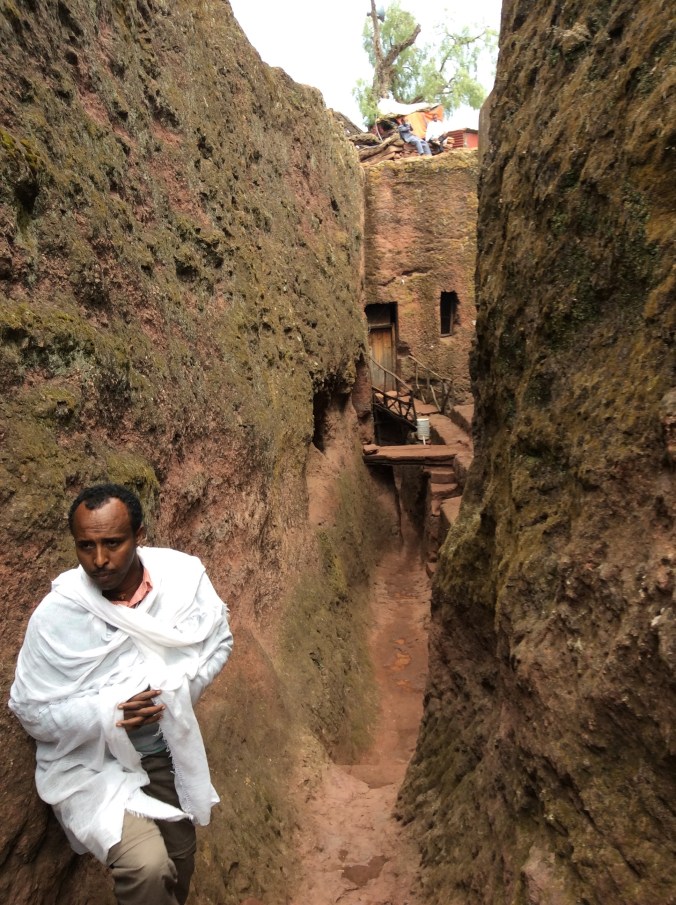
This and most of the other churches are connected by “waterways” where in the rainy season a sophisticated system of drainage keeps all of them from flooding and makes it possible for visitors and worshippers to walk along from church to church.

IMG_0407

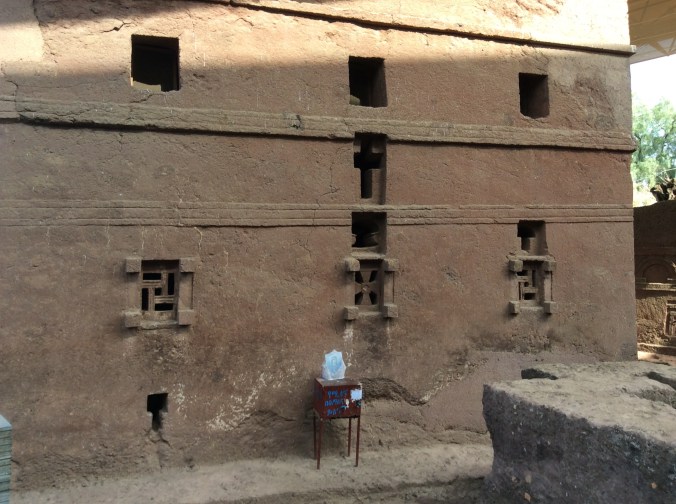
Everything in the Christian churches in Ethiopia  symbolizes something related back to Jerusalem and the Bible.  Even though the guide explained it all in detail, keeping up with all the symbolism proved a daunting task.  Notice the swastikas.  They are ancient symbols of the eternal circle of life and death.  Hitler turned them backwards and into a totally different meaning.  There are also many different styles of crosses there, two of which can be seen in the windows of this church.

IMG_0408

This is a fertility pool.  In the past a priest got in the water–it is very deep–with a woman who could not conceive and bless her in the water.  At one point when it began to fill too much, they cleaned out the bottom and found many treasures buried there, apparently dumped into the pool to protect them from enemy invaders.

IMG_0412

The inside of the churches are intricately carved and sometimes painted.

IMG_0417

Two types of basalt exist on this mountain, soft and hard.  Churches carved out of the soft basalt have begun to deteriorate and as a consequence are covered.  As can be seen here, people still come to these churches to pray and attend services.

IMG_0419

Our guide lead us from church to church through these narrow passageways which are, as previously mentioned, used to drain water away from them in the rainy season.  If Ethiopia had a national color, it would be white.  It is not only worn to go to church and for religious purposes but in daily life as well.  It mystifies me as to how they keep whites so very white.

IMG_0430

The slit dug in the rock is part of the system of drainage.  The grass in the foreground grows out of a pool of holy water.  While we were there, a boy filled a plastic bottle with the water and left.

IMG_0435

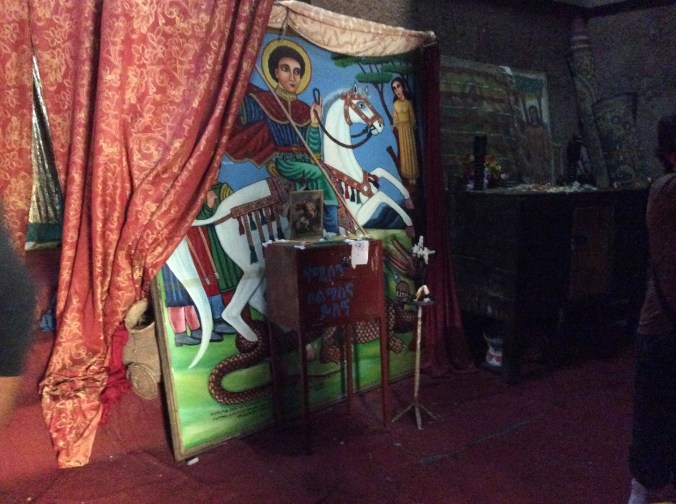
St. George and the dragon are everywhere, not only in churches but also on beer.  He is the patron saint of the country, symbolizing the triumph of Christianity over paganism as symbolized by the dragon.

IMG_0448

The carving in many of the churches reveal a sophisticated knowledge of how to work in stone.  It is difficult to believe that this was carved by hand downward into solid basalt centuries ago.

IMG_0491

The road to Lalibela is rather daunting, climbing  higher and higher with no guard rails, nothing.  As you can see from this photo, patchwork quilt  fields cover even the mountainsides.


To learn more about Lalibela, see detailed information and explanations of their River Jordan and other religious symbolism, go to my blog posts from August 2014.

Ethiopian Journey–From Addis Ababa to Debre Birhan


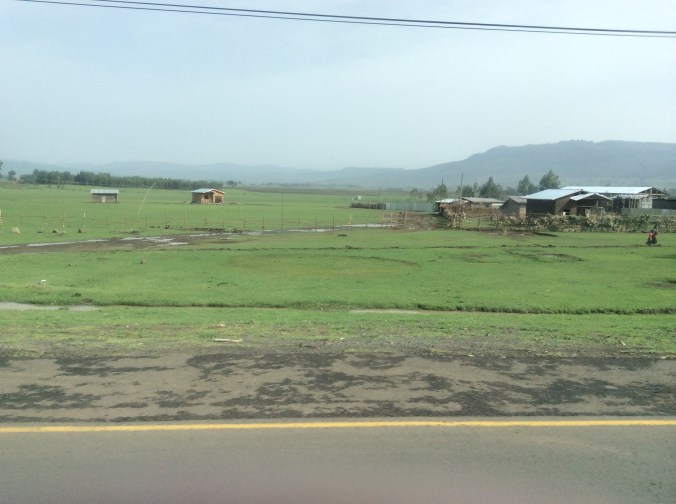
Addis is the second highest capital in the world.  Only La Paz, Bolivia, is higher.  To a large extent, altitude determines climate in Ethiopia.  Addis and the surrounding area, much of which is high altitude farmland, receives a lot of rain this time of year and looks totally unlike what a lot of people think of when they hear the word Ethiopia–not desert but rather miles and miles of green.

IMG_0248

IMG_0249

We had not driven far from Addis when we crossed a river, an area of which is considered healing.  Many people had come for priests to bless them and to experience the healing power of the water.

IMG_0246

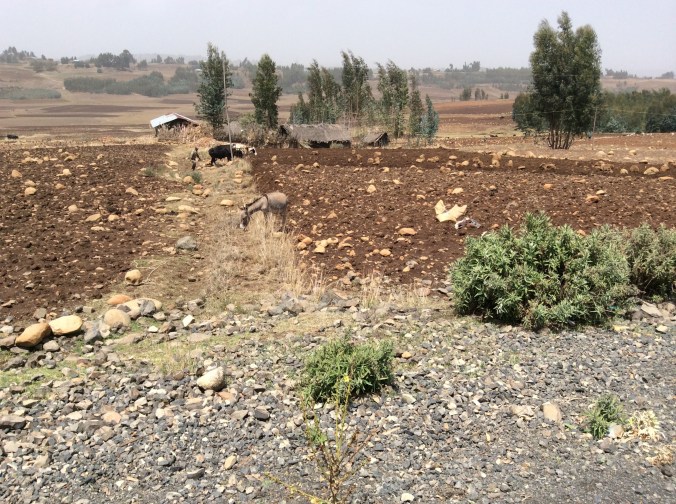
I saw only three tractors in ten days of criss crossing farmland.  Why so few?  One reason is rocks.  Many of the fields remain rather full of rocks in spite of many having been removed.

IMG_0258

Therefore, they farm the “old fashioned” way; horses or cattle pulling plows with a human behind.

IMG_0251

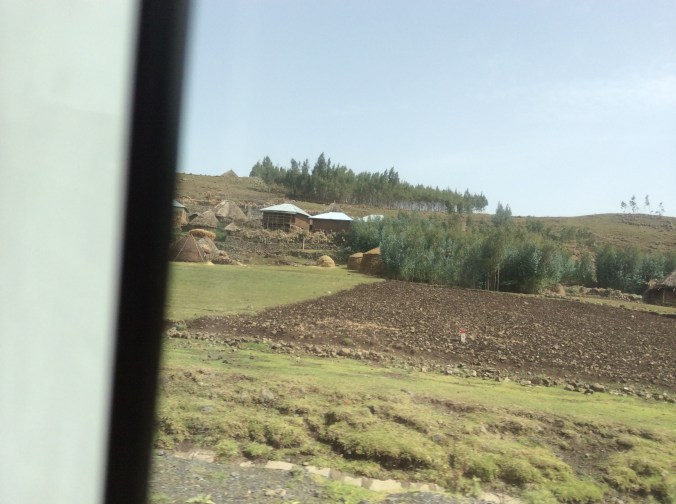
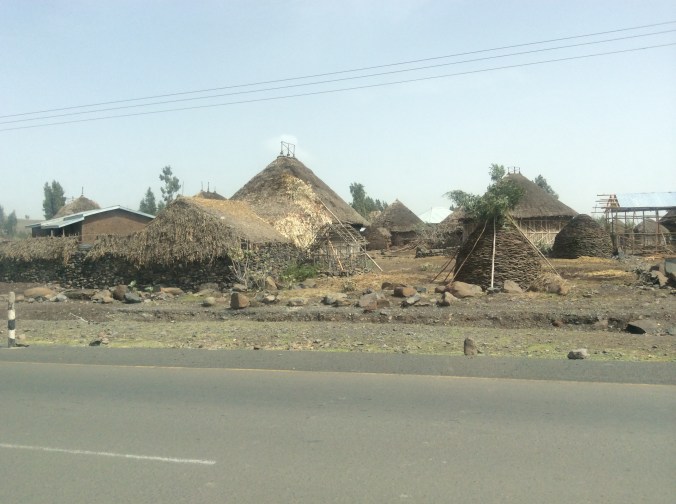
Houses in the villages in the farming areas demonstrate old ways alongside new.

IMG_0257

IMG_0259

Winnowing the way we did in the USA a century ago.

IMG_0253

IMG_0261

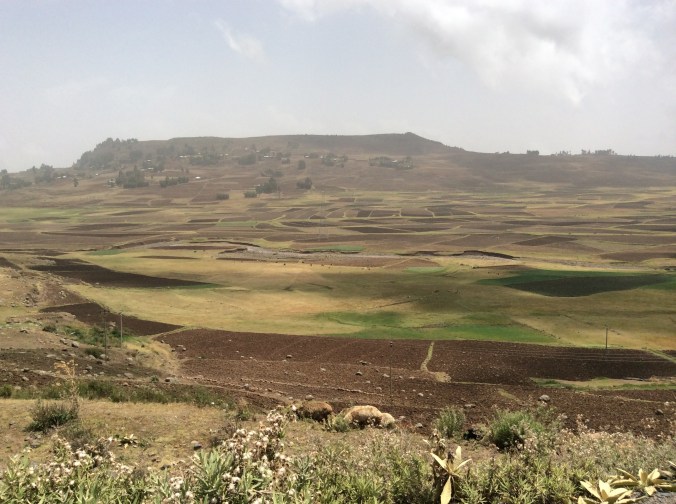
Much of the farmland is a picturesque patchwork quilt of browns and greens.

IMG_0266

Before dropping down to lower country, we drove by Menelik’s Window.   The drop off here is steep and far.  I did not go near it–I had not yet become used to the endless drop-offs or even realized that I would need to do so.  This is one of four places in Ethiopian where you can see gelada baboons.  They are extinct elsewhere. Menelik was an Ethiopian emperor.  This “window” allows one to look from the high country for miles and miles to the landscape beyond.

IMG_0262

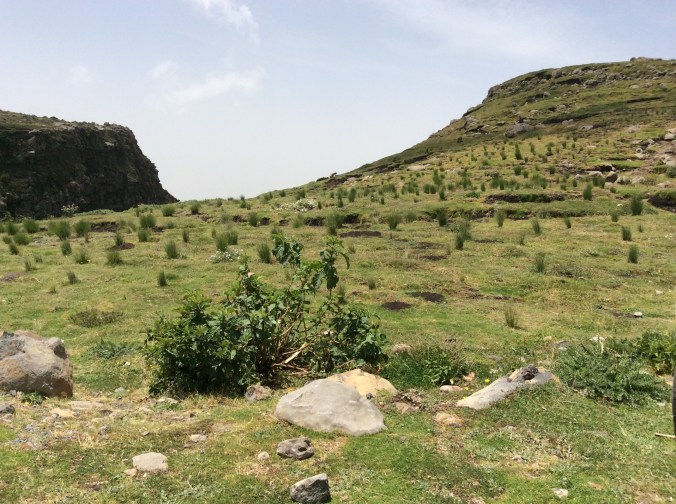
The large tufts of grass provide food for the gelada which are grass eating herbivores, the last of the grass eating primates.  All others are extinct.  This same grass is used by the locals for roofing material so boys stay in these areas all day chasing off the baboons.

IMG_0264

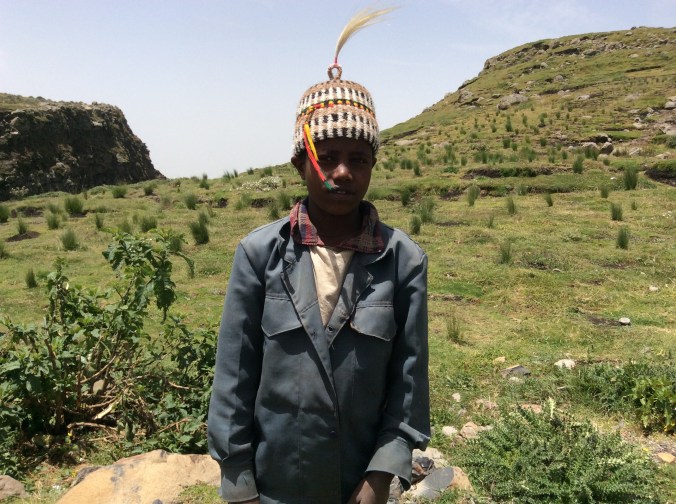
To keep themselves busy they weave woolen baskets and hats to sell which they display in the grass.

IMG_0267

This ten year old boy happily donned the hat he had made.  I bought it for my grandson who was the same age when I took the trip.

IMG_0268

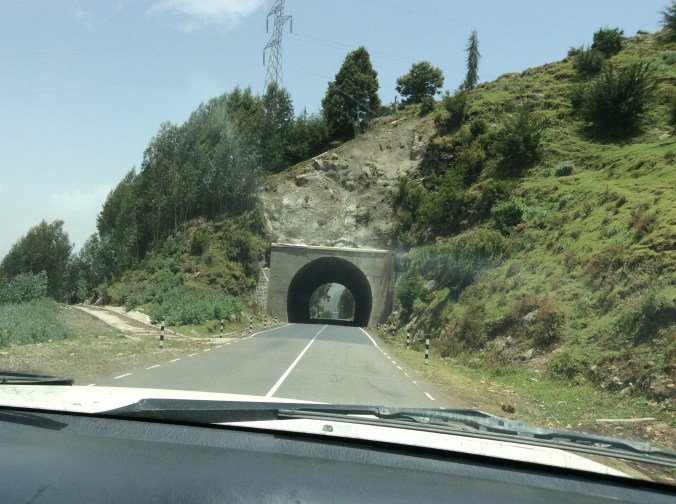
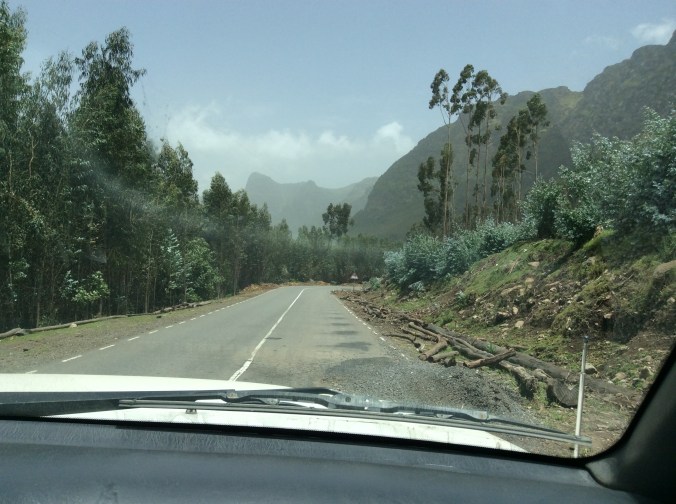
Except for the different vegetation, driving down the mountain looked a lot like driving through Colorado.

IMG_0271

IMG_0272

IMG_0276

Down from the mountain the landscape appears quite different and considerably drier.  We drove through several smaller towns on our way to Debre Birhan where we stayed the first night.

IMG_0279

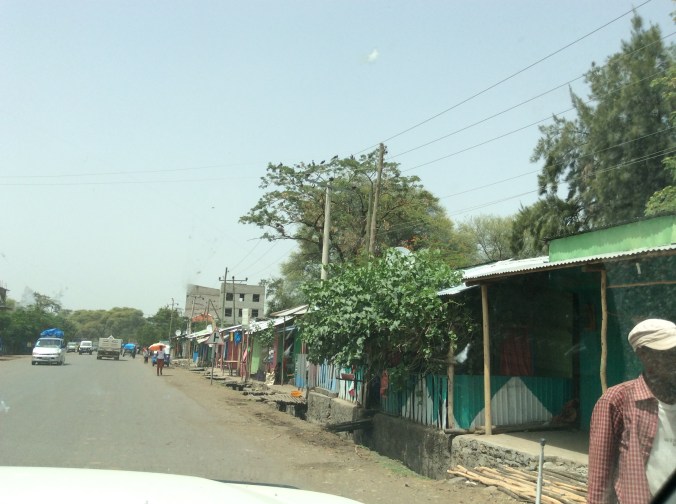
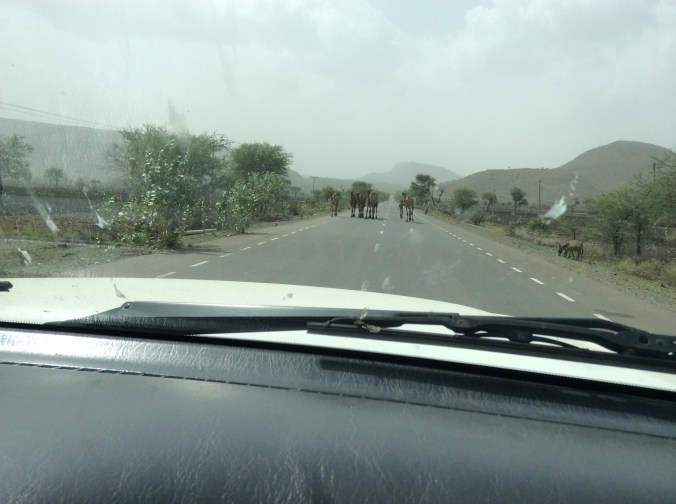
Driving in Ethiopia requires navigating around animals.  Everyone drives their cattle, camels, horses, all livestock down the road whenever possible.  The roads are generally very good.  Many, built by the Italians, have stood the test of decades.

IMG_0282

Along the road we saw many of these “apples”.  My friend told us how they played with them as a child.  However, the adults all warned the children not to touch their eyes when they did–it will make you blind.  They are called Apples of Sodom–so many things in Ethiopia have symbolic meaning.

IMG_0283

These fruit could be seen all along the road and even on the road.  After driving through this drier area we rose above a huge valley with miles and miles of grass.

IMG_0285

A semi-nomadic group brings their immense herds of cattle here in the rainy season to graze.  When we drove further on above the valley, I saw the first tractor working a field as big as this grazing land.


Ethiopian Journey, Dubai


If you have a long enough layover in Dubai, they put you up in their Emirates hotel and feed you in the cafeteria free.  The hotel is nice, the food excellent–quite a nice perk.  From the hotel it is easy to walk to several places as well as take a van tour around the city.  We did both.

IMG_0167

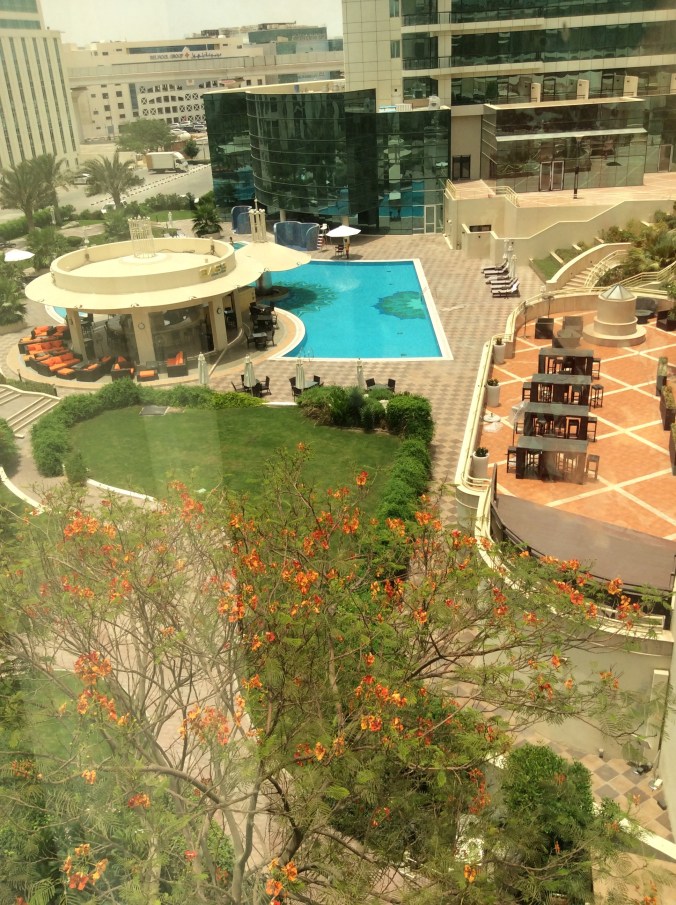
The view from my room.  The pool has a swim up bar but it is not open during Ramadan which was occurring two years ago when we were there.  Alcohol is available in some restaurants and bars but you must imbibe inside.

IMG_0169

One of the first places we visited on the tour was this mosque, designed to look like the famous mosque in Istanbul.  The following photos are of typical houses near the mosque.

IMG_0170

IMG_0171

IMG_0172

IMG_0180

Then we arrived at the beachfront of the Persian Gulf.  The water is warm, like lukewarm soup.  In the background two of the most expensive hotels in the world tower above the water.

IMG_0184

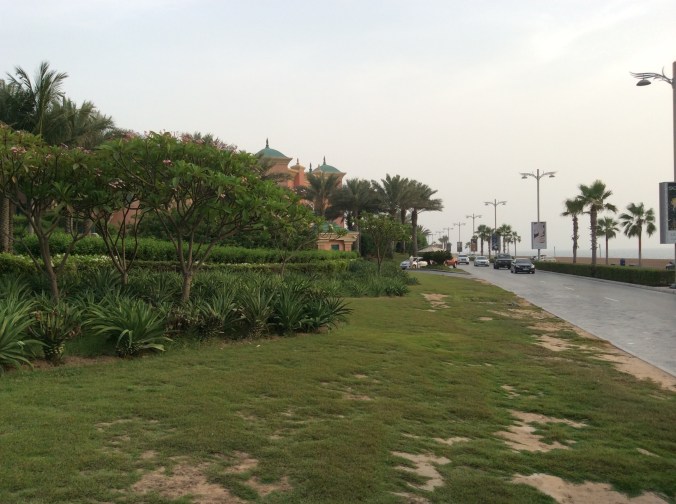
The street goes along the waterfront with luxury hotels on the left.  Many of these areas are fill–manmade peninsulas.

IMG_0185

You can visit the sister hotel in the Bahamas.

IMG_0189

Because of the fill, the fake peninsulas, it is easy to get a bit disoriented.  Plus during the summer there is so much haze, it is rather difficult to determine directions.

IMG_0190

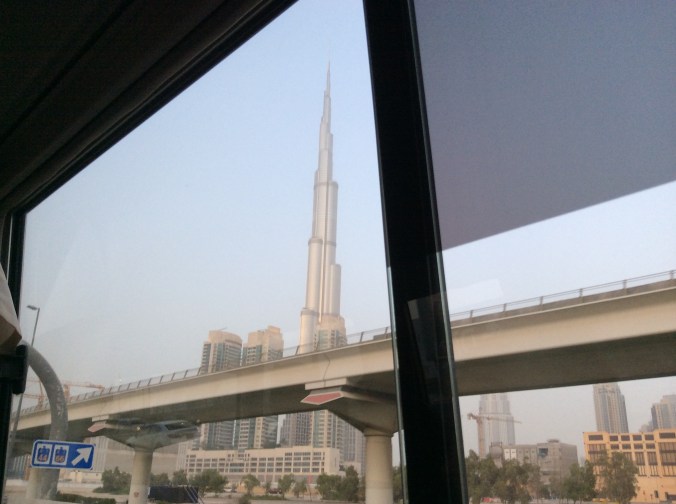
The tallest building in the world.

IMG_0191

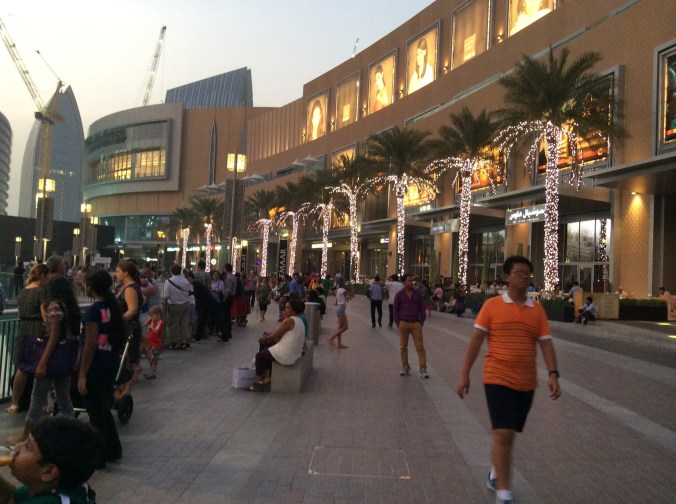
After visiting several smaller shopping areas, we arrived here, the famous Dubai mall.  This is the largest aquarium in a mall in the world. Here you see people from everywhere in the world dressed in every way imaginable.

IMG_0192

A children’s store across from the aquarium contained this lollipop tree with giant lollipops.

IMG_0194

In spite of high heat–it was 108 when we arrived–no wind and high humidity (yes, because on the Gulf, even though it is desert, the humidity is stifling), many people were outside awaiting the fountain show.

IMG_0198

One part of the skyline reflected in the lake.  The fountain show, synchronized with music, is worth the wait even in the heat.

IMG_0202

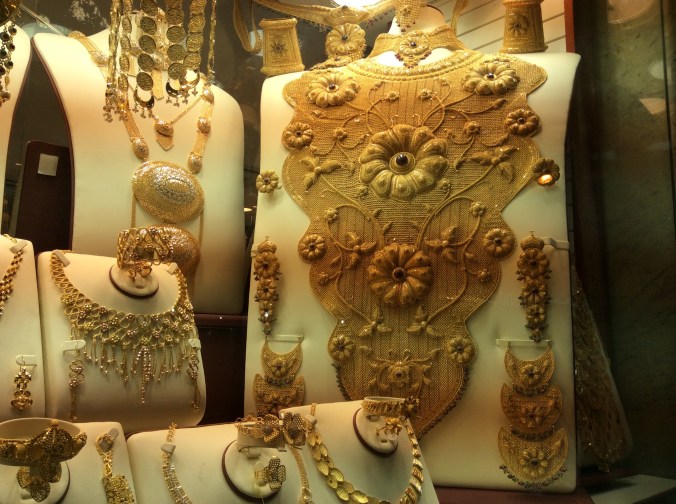
On to the gold and silver souk.

IMG_0203

Gold and silver are sold by weight.  You can also buy gold in shops at the airport; however, nothing quite has heavy and exotic as some of this.

IMG_0204

We did actually shop in the food shops and bought nuts covered in various spices to take along for snacks.

IMG_0205

Ethiopian Journey–The Beginning


Two years ago today, two friends and I flew from here to Dallas to Dubai.  The final destination:  Ethiopia, where I spent nearly three weeks with them and my friends’s family plus a road trip through the north.  Ethiopia was nothing like what one sees in the news, in famine photographs, nothing like the image most people in the USA have of it.  My main goal when I returned home was to show people photos and inform them what it really looks like, how incredibly beautiful it is there.  This mission continues two years hence.  For the next several weeks I plan to relive this journey and share it on my blog here.

It is a short trip from Amarillo to Dallas via air.  In order to carry the baggage allowed on Emirate Airlines, we first flew via Southwest to Love Field, then took a taxi to Dallas International.  If you plan to fly long distances, I highly recommend Emirates Airlines.  Compared with all the others I have experienced even coach class is wonderful:  bigger seat room, more than a hundred movies to watch, good food, an area where you can help yourself to fruit and snacks, unlimited wine and beer, and an international group of flight attendants.

From Dallas to Dubai is fifteen hours of flying.

IMG_0155

IMG_0163

People wonder why they fly over Greenland, Iceland, northern Europe to get to Dubai.  Do not look at a flat map.  Get a globe and trace the route.  It is the shortest way to go.  Dubai is not like many think here.  No, I did not see endless lines of Lamborghinis and Ferraris.  In fact, I do not recall seeing any at all.  Tomorrow, photos of Dubai before heading on to Addis.

Barbie Doll


This poem praises my mother.  It is page 17 of my memoir in poems, “On the Rim of Wonder”.  It seems appropriate to republish it here for Mother’s Day.


Barbara Lewis Duke, pretty, petite, blue-eyed, and blond, my mother,

one fearless, controlling woman.  Long after Mom’s death, Dad said,

“Barbara was afraid of absolutely no one and nothing.”  They married

late:  34 and 38.  He adored her unconditionally.  She filled my life

with horses, music, love, cornfields, hay rides, books, ambition.  Whatever

she felt she had missed, I was going to possess:  books, piano lessons, a

college education.  Her father, who died long before I was born, loved fancy,

fast horses.  So did she.  During my preschool, croupy years, she quieted my

hysterical night coughing with stories of run away horses pulling her

in a wagon.  With less than 100 pounds and lots of determination, she

stopped them, a tiny Barbie Doll flying across the Missouri River Bottom,

strong, willful, free.

The Haunting of the Mexican Border


If you have any interest whatsoever as to how times have changed along the border, the culture of the people of Sonora and Chihuahua, this is a must read. I need to go visit my friends who live there.

Dawn Wink's avatarDawn Wink: Dewdrops

Cowboy and flowers on grave © Cowboy and flowers on grave © Tim Fuller

coverThe Haunting of the Mexican Border

I had no idea the blessing I was about to receive when I was asked to review The Haunting of the Mexican Border: A Woman’s Journey by Kathryn Ferguson for Story Circle Book Reviews. I said yes, since how could I possible resist that title? I spent the next few weeks savoring the experiences, ideas, and prose of this book. This is not a book that I read fast. I found myself re-reading sentences for the sheer beauty of the prose and scenes for the powerful experiences conveyed.

Mostly, I was taken with the melding of past and present, as my own experiences growing up on a ranch along the San Pedro River, a vein for Mexican migrants coming to the US, sent me reeling between the intimate familiarity of the rhythms of migration in this region…

View original post 2,156 more words