Sunday Poem–“Hair”


No females in my family had long hair.

Dad did not like it,

said it showed male domination

over women.

Once when grown and gone

from home, I began to grow mine

out, experiment.

When he saw it, he told me

he thought it unbecoming.

I cut it.

Mom said she had long hair

when she was young.

Her dad forbade her to cut it.

In her twenties she chopped her golden locks

off, flapper style, then hid her head

in a scarf, afraid.


Note:  This poem is from the family section of my book, “On the Rim of Wonder”.


Sunday Poem–Choose


“Most people are about as happy as they

make up their minds to be.”  Abraham Lincoln


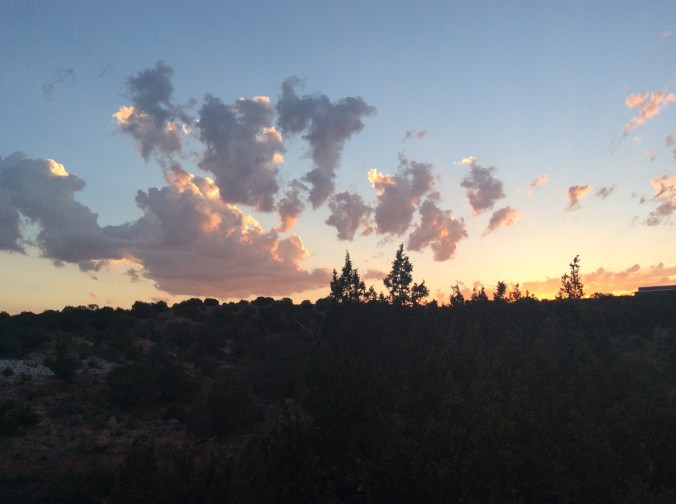
When I was twenty something, I chose happiness, not the sappy, syrupy, cheery, but a deeper joy of cherishing the small, the unique, the everyday, smiling with sunsets, the song of the mockingbird in spring, horses running free, the nearly invisible bobcat climbing the canyon wall, the taste of fine coffee at the first wakeful moments in the morning, cooking for friends, taking a “property walk” with my grandson, laughing with the teenagers I teach.  I am driven to do little–obsessions, compulsions do not run me.  I choose.  Choose life, choose joy, or choose whining, choose lamenting.  Choose!!  Be who you want to be; do what you want to do.

IMG_2817

Note:  this is a poem from my book, “On the Rim of Wonder”.

Sunday Poem


A few years ago Uno Mundo Press published my second book, a book of poems.  Reviewers say it is a memoir.  Oddly, that was not the plan; in retrospect, it seems apt.  The poems’ topics are not chronological but rather via topic with quotations before each topic as a sort of introduction.  For the foreseeable future, while I continue writing another book, I will post one poem from the book every Sunday.

The book begins with this quotation:

“Do something scandalous to give your descendants something

to talk about when you are gone.”  Vanessa Talbot


The first section begins with this quote by Judith Jameson, the famous dancer and choreographer:

“I always tell my dancers.

You are not defined by your fingertips,

or the top of you head,

or the bottom of your feet.

You are defined by you.

You are the expanse.

You are the infinity.”


The first poem in the book goes like this:

I Have Lived

Depression, sad days, melancholy.

Gone!

At 26, I said, “To hell with this!

You control you life, live it!”


I tried forbidden liaisons, trained horses,

Traveled around the world, a cobra wrapped around my neck,

Walked the Shalimar Gardens in Kashmir,

Stood before the Jama Masjid in Old Delhi,

Watched the Taj Mahal reflected in still waters,

Walked the streets of Katmandu,

Talked to monks at Shwedagon Pagoda,

Bargained with sticks in dirt, math our only common language,

Downed raw turtle eggs in Costa Rica,

Danced on table tops, sang “Adonai”,

Roamed empty roads across the Navaho Nation,

Divorced four times,

Raised two talented children.


I have lived, running on the rim of wonder.

IMG_2675


Own Everything


Checked my Facebook today and this quote showed up–posted by a fellow friend and author. It is from Ann Lamont:

“You own everything that happened to you.  Tell your stories.  If people wanted you to write warmly about them, they should have behaved better.”


Note:  In spite of a few men having referred to me as a scandalous woman after reading my book, “On the Rim of Wonder”, I still have not been sued for slander.  It has been a few years.  I think I am safe.  Always tell your truth.  Be open to adventure.  Live your life.  Be the best you that you can be.


IMG_2801


A Tribute to My Dad, Doyle Lightle


Dad lived his entire life, 90 years, on the farm which my great grandfather, Gottlieb Werth, homesteaded in the middle 1800s.  Gottlieb Werth came to the United States from Switzerland when he was 18.  Even though Dad lived in the same place all his life, he liked road trips.  The first occurred when I was three.  He drove us all the way from Northwest Missouri to Monterey, Mexico.  I still have photos of us wading in the Gulf in Texas before we crossed into Mexico.  Thereafter, we almost never missed at least one road trip a year between wheat harvest and the start of school.  Sometimes instead of a summer trip we took one around Christmas, like the year we went to Florida when I was in elementary school.  I skipped school a couple of weeks, took my work along, and came home ahead because the flu, which I missed, put everything behind.

By the time I was six, I had probably covered half the continental United States and, of course, been to Mexico.  I do not remember some of those first trips but the later ones I remember well, like the summer we spent in Crested Butte, Colorado, when it was still a mining town, and another in Placerville, Colorado, down the road from Telluride.  Then it was just a nowhere place, filled with the Victorian houses of its mining heyday.  Dad joked later that he should have bought one of those houses when it was cheap.

One year, the year between my junior and senior year in high school, we took a one month trip and drove 6,000 miles, from home to the Black Hills, where we had relatives, to Vancouver, to Vancouver Island and then to Victoria.  We visited every national park along the way,  Grand Tetons, Yellowstone, Glacier, Olympic, then drove up the Columbia and cut back across Rocky Mountain National Park and through Colorado. On an earlier trip we went to every park in Utah and Northern Arizona and Mesa Verde.

Dad’s interest in and curiosity about everything seemed endless.  He tried the latest agricultural methods in his farming, was an avid conservationist, wanted to check everything out on these trips, talked to people about what they were doing.  At home he read National Geographic and Scientific American and endless books.

Because of these trips, his sense of wonder, his propensity for intellectual activity, my friends in college were always shocked to find out he was a farmer.  They often thought, originally, that he was a college professor.

He moved into this house where I grew up when he was ten.  After Mom died, Dad and I were at her grave on Memorial Day when a man came up and starting talking with Dad.  I learned that the building in the foreground of this photo, before it was used for livestock and storage, was used for dancing during the Depression. The sheriff would send out deputies to make sure no illegal alcohol was consumed. I took this photo four years ago when I took a trip back.

12193406_10204105678156113_6043720938154804167_n

There used to be woods to the right of this photo but someone bought the land and bulldozed down all the huge oak trees.  The tall douglas fir tree in the middle was tiny when we brought it home on one of our trips out West.

I will forever be thankful to Dad for instilling in me a love of exploration, wonder, and curiosity.


Sunday Poem–A Life


IMG_1645

I wrote the first blog post about this in February, a second a few weeks later.  The following poem I wrote a week ago but never posted:  too upset, too sad, too filled with regrets I could have no way fixed because I did not even know all the story.  He remained unconscious for two months from late January until March 22.  It seems strange that the memories of a life I lived so long ago, mostly forgotten, could surge into so many waking moments now years later.  Life:  always filled with wonder, surprises.

yesterday we put his body in the ground

the wind blew through the trees

whispering green spring, beauty

yesterday we put his body in the ground

the man I loved, beautiful mahogany velvet

dazzled the world with his smile

yesterday we put his body in the ground

my daughter’s father, standing with family

some we had never seen before, worldwide

yesterday we put his body in the ground

watched a life flash by, slides from baby

to our life long ago, other lives and children

yesterday we put his body in the ground

family, friends, two of his children

a life struck down, too suddenly, too soon

In honor of the life of Kenneth A. Mowoe

You will not be forgotten, your memory lives on with me, your family, your children and grandchildren, your friends.  Peace.  Love.

IMG_2666

I Watched Movers Box Up a Life


Saturday, February 18, 2017

I watched movers box up a life today, a life I thought left me thirty some years ago.  I was wrong.

When our daughter and I cleaned out the refrigerator, we found a large pot filled with egusi stew, remnants of the last meal he cooked. I took the footlong, hand carved, wooden spoon, scraped the dry bits clinging to the sides of the silver pot.  Scrubbing it clean, smells of memory flooded my nostrils–cayenne, bitter leaves. It took me ten minutes, ten memory laden minutes.  Even after scrubbed and dried, the pot’s cayenne smell filled my nostrils, the distinct smell of West African food.

I watched movers box up a life today, a life I thought left me thirty some years ago.  I was wrong.

Our daughter and I found papers and photos, items her father kept all these years, detailed memories of our life together.  I could barely look at them, throat constricting, tears welling in the eyes of this woman who never cries.  Our daughter, dismayed, told me to go outside.  I walked down the quiet street, brown leaves scattered from autumn, unraked, a strange street both urban and rural inside a city of nearly half a million residents.  Is this where he walked, attempting to improve his health?  Was I walking in his footsteps?

I watched movers box up a life today, a life I thought left me thirty some years ago.  I was wrong.

Frozen


Two weeks ago today, the sickening news came:  my daughter’s father, my ex-husband, suffered a massive heart attack while working.  Rushed to the hospital, resuscitated, then open heart surgery. He never regained consciousness, not yet.  He lies there, part of his brain not working, tube-fed, not breathing on his own.

She drove all night, six hours to get there.  She thought they had taken her to the wrong room, unrecognizable.  Last week end, I drove with her.  Except for his hands, I would not have recognized him myself, so thin, so aged. How could someone change that much in the ten years since I had last seen him?  She went back again late this week, returned late last night.  Moved to a longterm care facility, he remains the same except he no longer even opens his eyes, no more staring into the void.

I feel frozen.  This morning I delivered my grandson to my daughter–he stayed with me this trip.  Checking on her father’s apartment, my daughter found his photos, some from when we were young.  She showed a few to me.  I stared, shocked, dismayed.  My today’s to-do list just sits here.  I force myself to work at it bit by bit, write two peer review assignments for a class I am taking–I do not want to disappoint, vacuum and dust one room at a time, tell myself I need to go out on this 20 degrees warmer than normal day and garden, write this blog post.   I feel frozen.

He had plans neither she nor I knew about, plans to perhaps make him happier, return to the land of his birth.  Will some miracle occur, will he awaken, recover?  Is there some appropriate time for which we wait?

I feel frozen.  When will I thaw?


Ethiopian Journey–The Castles of Gondar


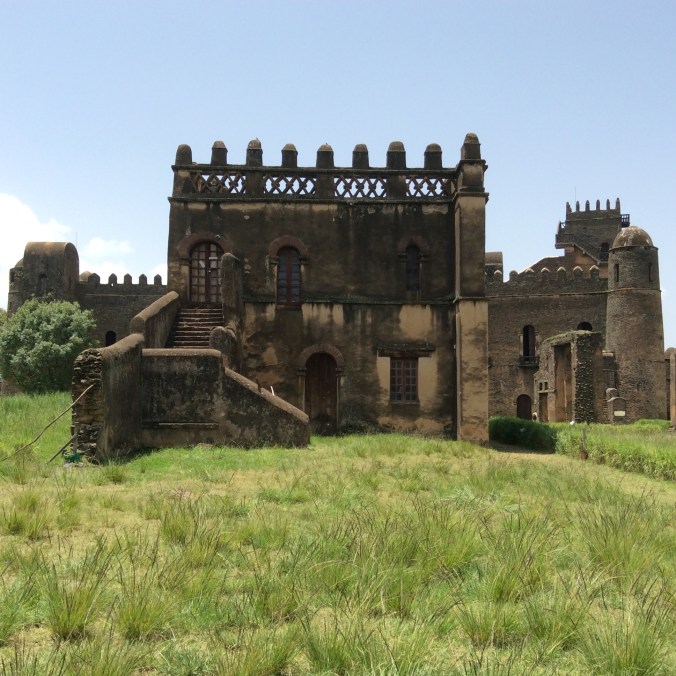
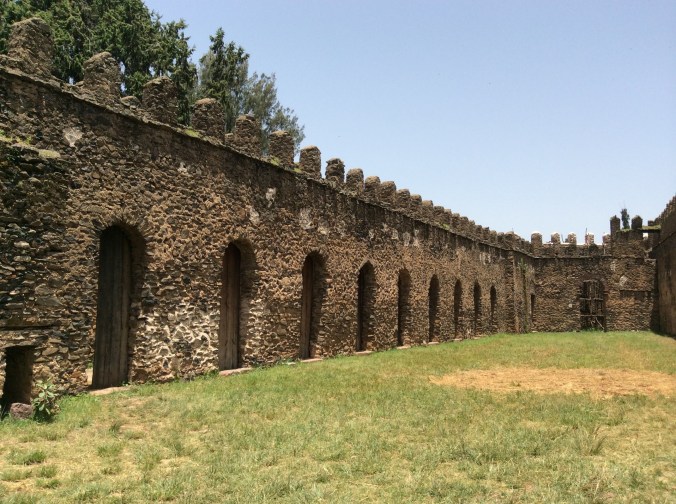
When my friend told me we were going to visit the Castles of Gondar, I thought he was kidding.  It sounded too much like a movie title, plus castles in Ethiopia?  Seriously.  Then I looked it up and sure enough, there are a lot of them, built by a series of kings, fathers and sons, and a queen.  Some remain in reasonably good repair at least on the outside.  Others crumble in the rain and humidity.  All are in a sort of compound arranged together.

IMG_0677

This castle is near the entrance and in rather good condition.  Restoration work is most complete here so it is safe to walk to the second floor.

IMG_0684

The view from a second floor window.  Because of the altitude and moisture–contrary to popular opinion, a large portion of Ethiopia is mountainous and green–especially during the rainy season, upkeep is not easy.

IMG_0688

The same castle, looking out the door onto the balcony which can be seen in the first photo.  The floors have been restored.

IMG_0685

Looking in the opposite direction from the first castle, several castles and the ruins of others show the layout of the compound.  Our hotel was near the top of the mountain in the distance. Many locals roamed around when we were here.  It is popular to take wedding, anniversary, etc. photos here.

IMG_0707

This photo shows the first castle–in the background–from another side.

IMG_0715

The style of some of the castles, like this one, is more intricate than others.

IMG_0725

This building housed the royal lions.  Tradition for keeping lions goes back several centuries.  The last Ethiopia emperor, Hailie Selassie, was often referred to as the Lion of Judah, the latter referring to the Ethiopia tradition of believing that they are descendants of Solomon and Sheba.  Ethiopian lions are a different sub-species than other African lions, smaller with darker, sometimes black, manes and tails.

IMG_0731

These castles provide a perfect venue for photography.  You can see my friends sitting on the stone wall.

IMG_0743

The royal stables obviously housed many horses.

IMG_0747

The royal dining hall currently receiving restoration work.

IMG_0755

The path to the exit.

The news the last couple of weeks from Gondar has not been pleasant.  Many people have been protesting the government which they view as tyrannical and favoring one ethnic group over the others.  More than ten protesters were killed during the first protest.  Just this past week thousands came out in another peaceful protest.

Gondar (sometimes spelled Gonder) is a business, commercial, and education center.  It is a main route for commerce between Ethiopia and Sudan.  For more detailed information about Gondar, the castles, and the surrounding area, see my blog posts from Aug-Sept. 2014.


Isabella–En Memorium


477729_3059472219691_1596792929_o

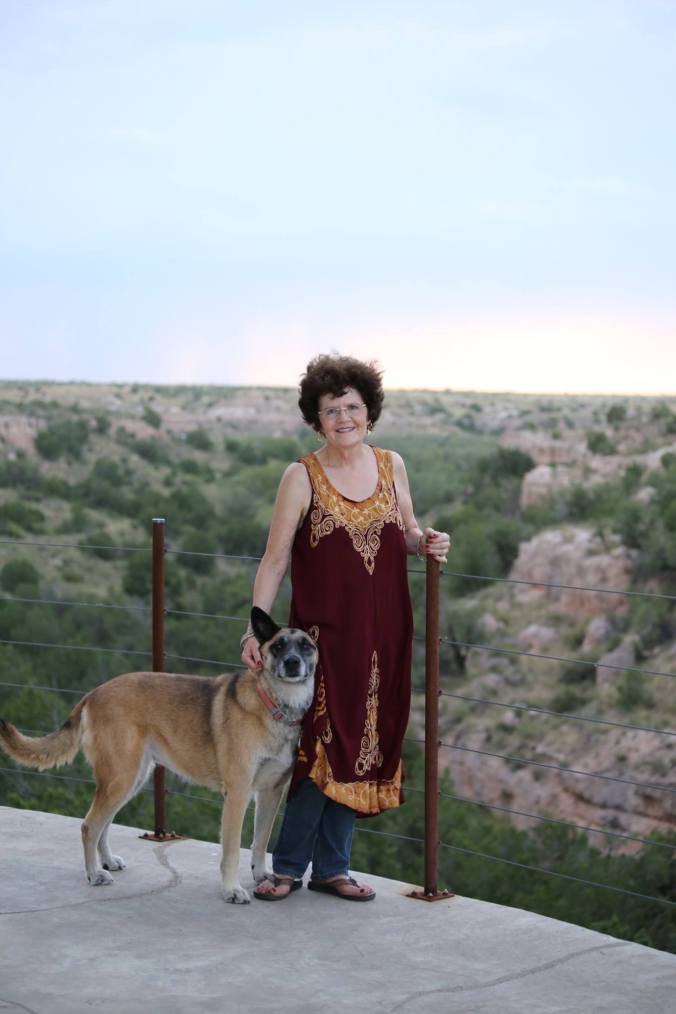
The crematorium handed me the 6″ by 4 ” dark brown wooden box.  I knew it would be heavy; Isabella was an eighty pound wolf dog. I thought I was prepared.

Driving home, memories:

March 2006, daughter calls; two year old grandson wants a beta. I drive to PetSmart.  Daughter tells me I must see these unusual, incredible seven-week-old puppies.  Alert brown eyes look at me.  Too big, black ears wiggle.  The label says wolf, German Shepard, Blue Heeler.  The two remaining puppies look like light colored German Shepherds or Belgium Malinois.  I had not planned to get a dog, not yet.

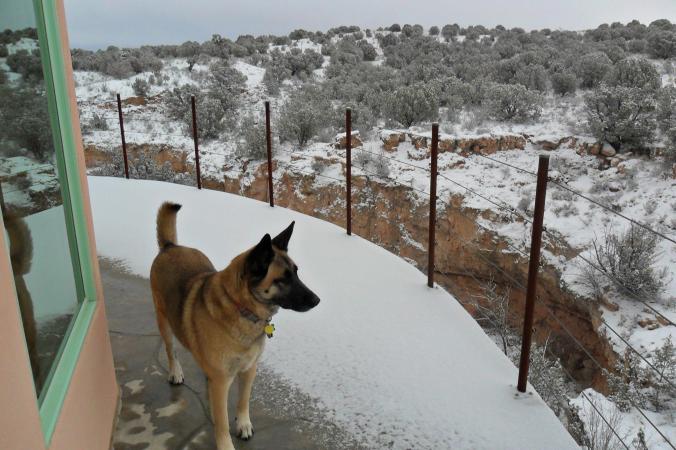
Two years later I move into my new house:  canyon edge, horses, bobcats, coyotes, foxes, road runners, mockingbirds, rattlesnakes.  Isabella guards her property, sits on the patio where she can check for invaders.  She rarely barks, growls.  When she does, high alert–I check.  Neighbor dogs, coyotes, foxes, chased off–not bobcats.  She watches them.

I remember the day she dismembered a skunk, drug the carcass everywhere.  After eleven baths at PetSmart, the skunk smell remained.  The one day she growled, I shocked, investigated–a man walking down the arroyo toward the house.  Growls became increasingly loud.  Out on the patio, she stands, the man sees her, turns and runs.  I feel safe, Isabella guarding, telling me if something unusual occurs.  She’s mixed breed; I think she’ll live long.

Every morning, evening, she completes horse chores with me, chases bunnies, roadrunners.  Two months ago, I, mesmerized, watch her catch, gobble two half-grown bunnies in less than one minute–nothing left.  Mixed breed; I think she’ll live long.

Friday morning she helps me with chores, chases bunnies.  Friday afternoon she can hardly move.  At the vet, blood work like a four year old; x-ray shows a little something wrong.  They give her two shots, schedule an ultra-sound for Saturday morning at another vet’s.  Meds working, Saturday morning she’s her usual lively self, eager to travel in the truck, nose wet and cold.

Ultrasound vet tells me there’s little hope.  Shocked, I stand there.  “If she were your dog, what would you do?”

“Put her to sleep.  She’s not in pain.  She has a tumor the size of your small fist on her intestines–might be cancer, hard to operate.”

I look at the vet, frozen.

At 8:00 Wednesday evening, I open the box, take out the bag of Isabella’s steel grey ashes, walk out to her patio spot, the place where she guarded her kingdom, toss a handful of ashes into the wind, watch them float and scatter down into the canyon, tears tracking down my face.  I close the bag, walk to the place where our long yearling colt, Star, is buried, dig an eight inch hole, bury another handful of ashes.  I take the one tablespoon of ashes left back to the house, put them back in the black velvet bag and into the box with the card with her paw print, the crematorium certificate, the sympathy card signed by all the employees where they euthanized her, place it on top of a stack of old magazines in the Chinese cabinet.

At bedtime, I forget, go to call her in.  This morning I find her hairs–she shed so much, wolf undercoat.  Evidence of her presence permeates.

It will never end.
11999567_10203872023954904_7742039751577593507_o