Recipe for Life


Yesterday, I attended the memorial service for an extraordinary woman, Paula Porterfield.  As a young woman she exhibited remarkable intelligence and leadership skills.  She attended college and became a nurse.  Then without warming, schizophrenia struck. She kept on going and attained a second degree.  She never gave up.  Her generosity and kindness remain legendary.  She both loved and wrote poetry, created hand made gifts for friends, and gave endlessly, never complaining no matter how bad her health, how distressing her living conditions, or how badly her hands shook.  She never spoke ill of others. She modeled how to live life well in spite of awful odds.  Here is her recipe for life:

3 c. Love

1 c. Understanding

2 tbsp. Concern

2 tsp. Emotional Security

2 tbsp. Joy

4 tbsp. Hope

1 c. Loyalty

3/4 c. Committment

Pinch of Support

Cream Love and Understanding.   Mix Concern and Emotional Security.  Fold in Joy and Hope.  Sift Loyalty and then blend in pinch of Support and Commitment.  Sprinkle with Humor and cover with Dreams.

Put into a beautiful Being and share with the world.

Paula will be missed.

Firsts


Recently, I took a writing class about finding your voice.  Mostly, I took it not because I needed to find my “voice”, but rather to force me to really get serious and write.  One assignment was about firsts in our lives, e.g. first kiss, first love, first…You get the idea.  It was difficult for me because suddenly I realized I neither remembered nor even cared much about firsts.  My response to the assignment is this.

Memories of the future.

These are the memories that matter,

These and memories of the present.

Bold, fearless, fun, beautiful, wild,

Dancing, singing, writing, loving, laughing

memories now and tomorrow.

The past—gone, dead.

Fly free and clean!!

I don’t remember many firsts.  First dance, first communion, first love, first hand holding, first lie, first kiss.   Nothing.  I am not all that fond of kissing anyway.  I do remember first sex as a rather boring disappointment.  Good sex requires experience.

I have never been lost in my life.  I have never thought I really might die, not soon, but when I do I would rather die by puma than in a car wreck.

This is how you…


In preschool I had a few duties I remember, well maybe not remember—this story is part of family lore so old I cannot remember whether I remember only the lore or the occurrence itself.  At four, one chore involved walking from the house, across the backyard, across the drive, past the rose garden, then on the path between the big white barn and the huge vegetable garden to the chicken house behind the barn.  Each evening I took this trip before dark and shut the hen house door so the raccoons, skunks, and possums could not get in and eat the hens.  One night I forgot.  The night was dark, moonless.  Dad ordered me to the hen house.  He handed me a flashlight.  I refused, terrified.  He tried talking; I refused.  He tried force; I refused.  My mom understood my terror and finally intervened.  She told Dad, “You had better never ever do anything like that again!”  He didn’t.

By twelve, the terror had changed to pleasure.  I knew how to walk through the woods in the dark without a flashlight.  I knew how to walk through the woods in the dark silently so I could hear the animal sounds.  I knew how to walk through the woods in the dark happy and alone, free.  I still like to walk in the dark.

At twelve, I knew how to load a 22 rifle, to shoot raccoons and rabbits on the run, to clean the rifle afterwards.

I knew how to practice the piano for two hours straight.

I knew how to sing in front of a crowd of people.

I knew how to sew blouses, skirts, and dresses all by myself even though my mom could only sew on buttons.

I knew how to make fancy bows for the Christmas presents.

I knew how to fry chicken almost as well as my mom:

-this is how to check for pin feathers

-this is how you fill the paper sack with flour and salt

-this is how you fill the skillet with just the right amount of oil

-this is how you take the pieces out of the sack and put them in the hot

oil

-this is when and how you turn the pieces

-this is how you know when they are done

-this is how you drain the pieces on paper towels so it won’t be too

greasy.

I have not made or eaten fried chicken in years.

From six until I earned my Ph.D., this is how you make straight A’s in school:

-get organized

-be determined

-fill your soul with drive.

It helps if you are smart.

This is how you meet your parents’ expectations:

-keep your room neat

-keep your room clean

-keep your room perfect

-complete chores on time

-complete chores perfectly

-complete chores cheerfully

-study hard

-complete all homework

-make perfect grades

-dress nicely

-dress modestly, but not too prim

-dress in clean underwear in case you get in a car wreck.

I still get straight A’s.  I still have an overdose of drive.  I still write, play the piano, cook, ride horses, and sing.

It helps if you are smart.

As a rancher years later, I learned how to work cattle without my father’s help:

-this is how you “cut” or “band” yearling bulls

-this is how you give shots

-this is how you brand

-this is how you drive cattle on horseback down a road full of traffic

-this is how you save a  newborn, freezing calf:

-be brave and get it away from its mother

-carry it into the house or pickup truck

-wipe it down with towels

-blow it dry with your hair dryer.

This is how you train a horse to send to the race track:

-teach it to lead as a baby

-handle it every day if possible

-pick up its feet repeatedly

-rub your hands all over its body, especially on sensitive spots

-brush and comb it

-after it is older, rub a saddle blanket all over it and flap it in the wind

-hang plastic bags on its corral

-jump around a lot and desensitize it

-when it is a long yearling, put a saddle on it

-put a bridle or hackamore on it

-get long lines

-string them through the stirrups and teach it to drive in a round pen

-teach it to stand still

-get a flat saddle

-get on and ride

-do not teach it to neck rein

-ride often but for short periods of time.

Today as a teacher:

-this is how you solve for X and Y

-this is how you solve quadratic equations

-this is how you solve exponent problems

-this is how you solve word problems

-this is how you rationalize radicals

-this is how you determine how many grams are in one mole of a

chemical compound

-this is how you balance chemical equations

-this is how you conjugate common Spanish verbs

-this is how you write a sentence in Spanish

-this is how you translate a Mexican folk tale

-this is the date of the Magna Carta, the….

-this is how you write an essay

-this is how you learn new words from the context

-this is how you read for layers of meaning

-this is how…

It helps if you are smart.

Writer’s Block


A wall of black, oozy, Missouri River mud looms in front of me,

sticky, impossible to even walk through.

When I push, it gives only a little.

Then it creeps into my nostrils, suffocating.

I back off, walk this way and that way, trying to find an entrance.

None!

I push again; the mud engulfs.

So I back off, play it safe, read a book, play the piano,

go boutique shopping, sing, hike, brush the horses.

I walk back; the mud wall looms still.

I write up to the mud wall.

It starts to ooze onto the paper, into my brain.

Wolves


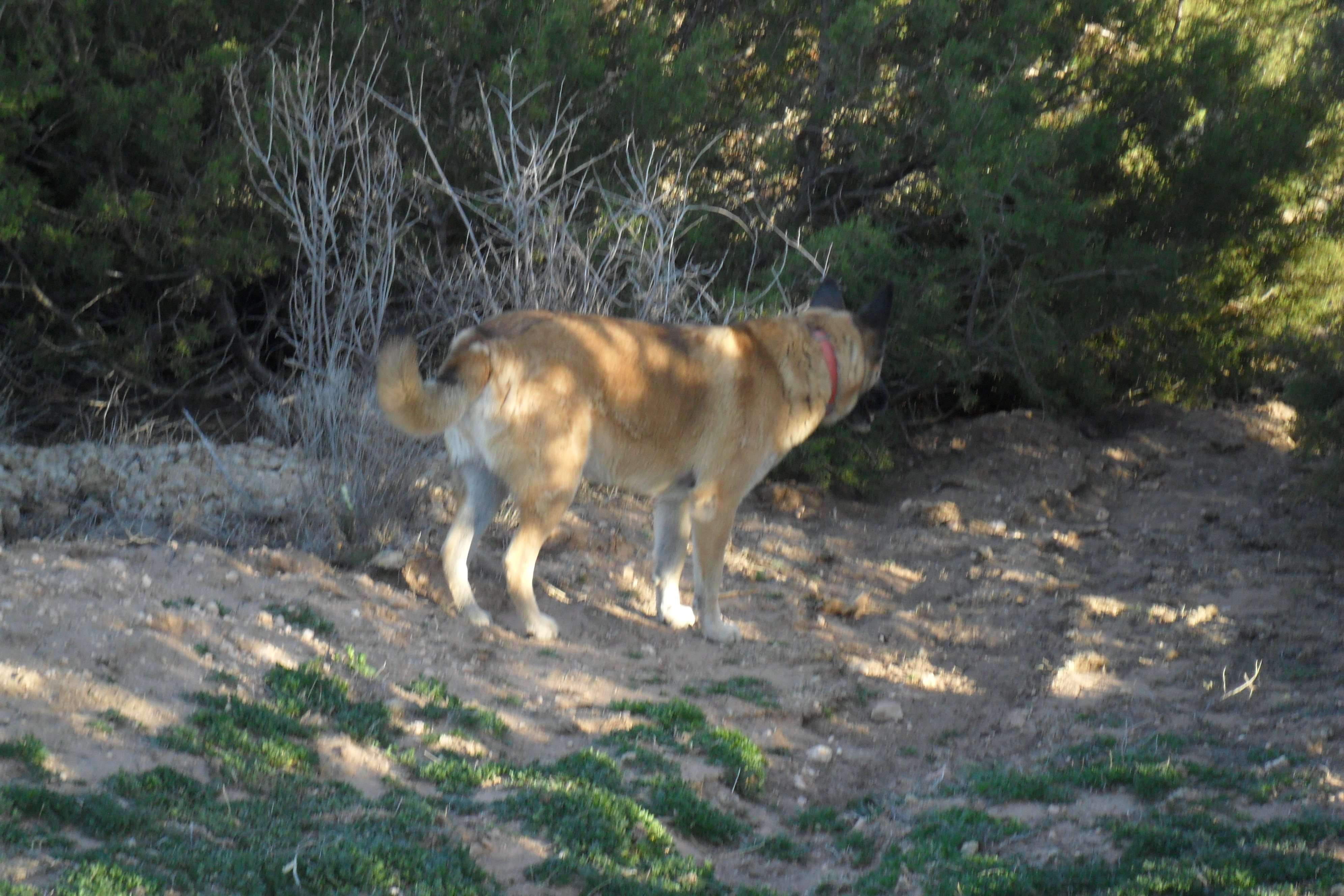
I own a wolf dog.  I did not set out to get a wolf dog.  In 2004, I went to PetSmart to buy a fish for my grandson.  The Humane Society had puppies there.  My daughter said to me, “Mom, you just have to look at these puppies.  They are gorgeous.”  I looked; I was smitten.  Isabella is ¼ wolf.  She was seven weeks old when I took her home.  She is smart, loves people, guards my 15 or so acres, and was incredibly easy to train.  She weighs 80 pounds.  Sometimes people think she is a German Shepard, but she is taller and heavier even though she is also ¼ German Shepard.  Even people who do not like dogs love her.  When I first got her, I researched wolf dogs on the Internet.  The information seemed incredibly complex and sometimes contradictory.  I trained her the way that seemed right to me.  She will not live forever and on the rare occasions I think about this, I realize I will never be able to find another Isabella or even come close.

Isabella leads me to the topic of wolves.  One of my long term goals is to research and study why so many people feel such an intense hatred of wolves.  This intensity is lacking in the way people view other big predators in the US, e.g. pumas, bears.  Why wolves??  What is it that makes ranchers and hunters in states where wolves still exist so intent on destroying them?  As a one time rancher who raised cattle and horses and a person who still owns a farm and grew up on one, I know it is not only because wolves occasionally kill a calf or two.  Something else drives this hatred.  What is it??

Recently, I had the occasion to have a discussion on this topic with a biologist friend.  He said, “People hate wolves because they are so very human.  Wolves remind them of themselves, especially the willingness to kill, the survival instinct, the wild.”  He also told me that he had read a research article on ancient hunters and the domestication of wolves, the precursor to all dogs.  Some researchers believe that ancient humans and wolves hunted together to maximize their hunting success.

Strangely, I came home, opened a book of essays, and there lay Sherry Simpson’s essay, Killing Wolves.  I read it.  I read some of it twice.  I have reread parts a third time.  She says, “The unknowable wolf hunts along the edge of our vision, never allowing a clear view of himself.  Imagination, fear, and longing fulfill what experience cannot.  And so a wolf is no longer just a wolf.  It’s a vicious, wasteful predator.  Or it’s the poster child of the charismatic mammals, the creature that stands for all that’s noble, wild, and free.  A wolf is social, family-oriented, intelligent, and communicative—like humans.  A wolf kills because it can—like humans.  It’s either-or, the sacred or the profane.  Inevitably, the wolf becomes a distorted reflection of the human psyche, a heavy burden for one species to carry.  We can hardly bear the burden of being human ourselves.”

Spiders


Spiders crawled everywhere.  In my hair, on my arms, across my mouth.  Tiny, baby spiders.  I screamed, ran to the school restroom without permission.  In the mirror I could see them, running everywhere.  I washed my arms and hands,  shook my hair over and over and over, trying to get them out, tore my blouse, frantically brushing them off my body.  Still they crawled.  I ran to the teacher and begged to call  my mother.  She said, “No, just go back to the restroom and get them off the best you can.  Lunch is almost over.”  I started crying, trying hard not to become hysterical.  Baby spiders skittered everywhere across my arms, my belly, even my face.  I would think I had most of them off me and more appeared.

Sixth grade had not been too bad, at least not compared to the other years.  Often if I could convince the teacher, I stayed in at lunch to read because I did not want to swing and get sick or play softball.  As I quietly read, two boys, whose names I cannot recall, ran into the classroom with a bag that houses baby spiders, broke it open, and dumped it on my head.  They ran back outside, laughing, leaving the bag of baby spiders on my desk. Lunch ended, I sat at my desk, tried to be good and do my work.  Plop, another baby spider on the desk.  The day drug on, endless.

Still years later,  spiders cause goose bumps on my skin.  But I am getting braver.  Recently, I rescued a brown and black tarantula, using a long stick to lift her away from the road to safety.  When tarantulas appear on my patio, I brush them off with the broom. I kill black  widows even though I feel I shouldn’t.  I spray them from a distance.  Bullies from my childhood will not control me.


When I first posted this, apparently some people thought it was a joke, e.g. untrue.  This definitely happened to me; it is true, sadly.  However, it no longer affects my life very much, except perhaps for the fact that I could not bring myself to allow my grandson to keep a pet tarantula in my house.

Writing on the Rim


The canyon edge looms out my bedroom windows,

pale adobe, stark.

Fall to death or serious injury!

I will not fall; I love living on the edge.

Rain brings a one hundred foot deluge,

a roar of water, cascading, screaming.

Someone said my house is pink; it is not pink!

It is the color of the canyon, the worldwide color,

Moroccan, pueblo, Saudi, Mali, Navaho, Timbuktu,

Desert, alive and lovely.

Three bucks watch me through my bedroom windows.

They see me move; they stare.

Isabella stands rigid, watching.

I kneel to her level; follow her eyes.

The bobcat casually climbs the canyon wall, impervious.

He marks the cedar tree, walks a deer path, disappears.

He is a secret, rarely seen.

The huge hoot owl’s voice echoes down the canyon,

drifting through my dreams.

A young road runner calls, scratchy,

running across the patio–on the edge.

In the spring the mocking bird sings all night,

“This is my territory.”

I sing all year, full of joy.

I live in beauty on the rim.

I decided to reblog this because it is the season for giving thanks, and I am eternally grateful for the privilege of living in such a beautiful place.  Yesterday, my family and I took a hike here, saw deer, lovely colorful rocks, bunnies, and native plants the names of which I do not know.  I live in beauty on the rim of wonder!!  I feel blessed!!