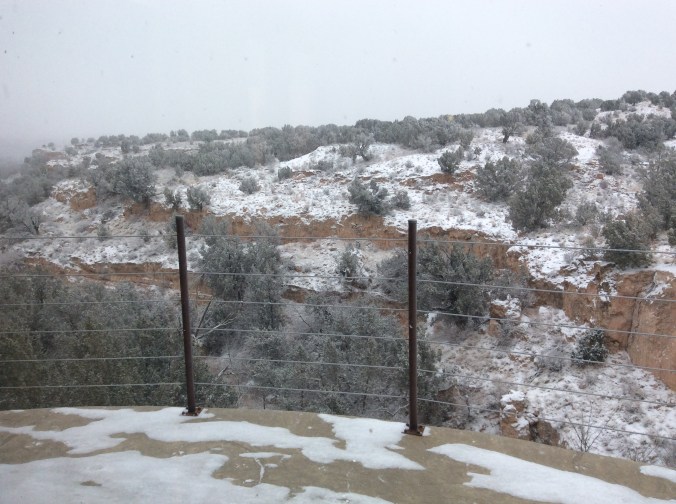
Six days ago a huge storm struck, including eight inches of hail, a rain deluge, and high winds. While the hail denuded many plants and bushes, the deluge made my drive a mess.

Although it may be hard to determine the depth of the gravel and dirt and rocks from this photo, many of the rocks are bigger than the size of the fists of both my hands together, large enough to not want car tires to drive over them. The gravel and dirt on the far side of the photo were at least eight inches deep. Luckily I have a small tractor with a bucket and a helpful grandson. He picked up the larger rocks and hauled all of them to the ditch created either side of the steep incline above the cement. The rain had created a trench a foot deep in some places and exposed a pipe to the septic system. He filled parts of these trenches with the bigger rocks.
The next morning I used the tractor bucket to scoop up dirt and rocks and haul them to washed out places in the upper drive. It was impossible to get it all with the bucket given some of the space is not very big or where it was possible to maneuver the tractor. Therefore, I had to scoop it up and remove it with a shovel. It took several tractor buckets full to get rid of what I had to shovel. Finally, this morning I finished sweeping the rest of the fine sandstone off the cement.
After all this, why am I grateful? There was no damage to my house. The hail broke windows in some houses not far away, the wind blew light weight buildings into neighbors’ yards, and some people nearby had roof damage. I only have some tiny damage to the barn roof. It could have been a lot worse. I feel grateful to have escaped with just a messed up driveway.
Why do I feel even more grateful? It occurred to me that I was able to clean up most of this except for my grandson’s help with the rocks–which I could have done but it was helpful. I can still shovel gravel and dirt, a lot of it, lift and carry 50 pounds of horse feed from the vehicle across the barn–about 40 ft or more–and dump it in the container. I can work for hours doing this sort of stuff and feel fine afterwards. Yes, I feel grateful that I can continue to do all these things myself and what is more, usually enjoy doing them, feeling productive and independent.
When people ask me how I do all this, I usually tell them two things, yoga (as well as lots of other exercise mandatory if you live in the country and have animals) and heathy food. My yoga practice began decades ago; I never stopped. I practice it at least three times a week, sometimes more. I stand on my head in the middle of the room several times a week. My favorite foods are mostly vegetables. The only carb I really like is rice. One of my dad’s sayings was, “You are what you eat.” He still ran a farm at 90. Yes, I admit, genes probably help, but without the exercise and self discipline, it probably is not enough. I also meditate daily which does not require lots of time unless you want to spend lots of time doing it. Even 15-30 minutes a day matter. Exercise, yoga, healthy eating, meditating will all make for a happier person. I promise.

The concept of divine omnipotence is the ultimate expression of male dominance as control. Divine omnipotence is the view that everything that happens in the world happens according to the will of a divinity, who is in control of everything that happens in the world. When someone dies or great suffering occurs, we are told, “everything happens for a purpose,” “it was meant to be,” or “everything happens according to the will of God—or Goddess.” In our recent book 


Although “the” Ramayana is a fluid narrative, scholarship has traditionally recognized the Sanskrit Valmiki Ramayana as the most authoritative of Ramayanas. But recent studies have brought to light the hundreds of regional stories of Rama and Sita which are more popular with the masses. These would include Krittibasa’s Ramayana in Bengal, Kamban’s Tamil Iramavataram in South India, notably in the state of Tamil Nadu, Tulsidas’s Ramcharitamanas among the Hindi-speaking belt of northern India, and so on. But even here, a pattern seems to emerge; all the above-mentioned authors are male. Within this scenario, a rather unique text stands out, and that is Chandravati’s sixteenth century Bengali Ramayana, for its author was a woman. Even more fascinating is the double-toned nature of the narrative – through Chandravati’s own voice and through the voice of its tragic heroine, Sita.