Sunday Poem–Choose


“Most people are about as happy as they

make up their minds to be.”  Abraham Lincoln


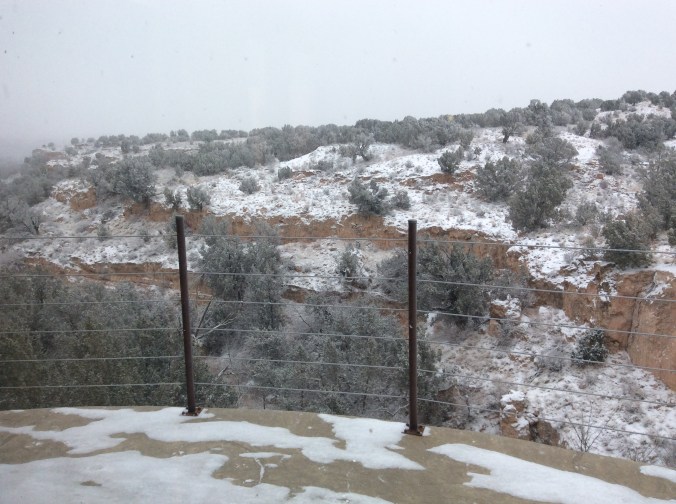
When I was twenty something, I chose happiness, not the sappy, syrupy, cheery, but a deeper joy of cherishing the small, the unique, the everyday, smiling with sunsets, the song of the mockingbird in spring, horses running free, the nearly invisible bobcat climbing the canyon wall, the taste of fine coffee at the first wakeful moments in the morning, cooking for friends, taking a “property walk” with my grandson, laughing with the teenagers I teach.  I am driven to do little–obsessions, compulsions do not run me.  I choose.  Choose life, choose joy, or choose whining, choose lamenting.  Choose!!  Be who you want to be; do what you want to do.

IMG_2817

Note:  this is a poem from my book, “On the Rim of Wonder”.

Sunday Poem


A few years ago Uno Mundo Press published my second book, a book of poems.  Reviewers say it is a memoir.  Oddly, that was not the plan; in retrospect, it seems apt.  The poems’ topics are not chronological but rather via topic with quotations before each topic as a sort of introduction.  For the foreseeable future, while I continue writing another book, I will post one poem from the book every Sunday.

The book begins with this quotation:

“Do something scandalous to give your descendants something

to talk about when you are gone.”  Vanessa Talbot


The first section begins with this quote by Judith Jameson, the famous dancer and choreographer:

“I always tell my dancers.

You are not defined by your fingertips,

or the top of you head,

or the bottom of your feet.

You are defined by you.

You are the expanse.

You are the infinity.”


The first poem in the book goes like this:

I Have Lived

Depression, sad days, melancholy.

Gone!

At 26, I said, “To hell with this!

You control you life, live it!”


I tried forbidden liaisons, trained horses,

Traveled around the world, a cobra wrapped around my neck,

Walked the Shalimar Gardens in Kashmir,

Stood before the Jama Masjid in Old Delhi,

Watched the Taj Mahal reflected in still waters,

Walked the streets of Katmandu,

Talked to monks at Shwedagon Pagoda,

Bargained with sticks in dirt, math our only common language,

Downed raw turtle eggs in Costa Rica,

Danced on table tops, sang “Adonai”,

Roamed empty roads across the Navaho Nation,

Divorced four times,

Raised two talented children.


I have lived, running on the rim of wonder.

IMG_2675


Own Everything


Checked my Facebook today and this quote showed up–posted by a fellow friend and author. It is from Ann Lamont:

“You own everything that happened to you.  Tell your stories.  If people wanted you to write warmly about them, they should have behaved better.”


Note:  In spite of a few men having referred to me as a scandalous woman after reading my book, “On the Rim of Wonder”, I still have not been sued for slander.  It has been a few years.  I think I am safe.  Always tell your truth.  Be open to adventure.  Live your life.  Be the best you that you can be.


IMG_2801


Taking a Knee?


When I read this post, I kept think the other times in life when people as he puts it, “take the knee”: when men propose, when people pray. No one see those as signs of disrespect or do they? For all those who think it is disrespectful, try reading every verse of the national anthem. Hint: the author was a pro-slavery slave owner.

danielwalldammit's avatarnorthierthanthou

Institute of American Indian Arts (Photo compliments of Moni)

Not everyone really appreciates just how powerful the ritual of standing for the National Anthem really can be. I got a real sense of this when I was 14. My Jr. rifle team won the Wyoming-state BB-Gun finals, which earned our way to the International BB-Gun Championship in Bowling Green, Kentucky. …on July 4th. As the child of a career military officer, I was always happy to stand for the Star-Spangled Banner or to recite the Pledge of Allegiance, but standing there during the final ceremonies, the whole thing took on a whole new layer of meaning for me. That time, I had my heart in my throat. That time, the whole ritual moved me nearly to tears. I loved my country so much, and at that moment, putting my hand over my heart for that beautiful song was absolutely the…

View original post 1,498 more words

Religion


Recently, while reading a novel about a woman in Shakespeare’s time, I came across this statement by one of the characters.  It rings so true for many eras of human history, I feel compelled to share it:


“Religion is not only about men’s souls.  It is about who rules us, what laws we obey, how and why we are punished, and by whom.”

No Offense by Esther Nelson


This blog will be of special interest to university professors and anyone who teachers in a college or public school at a higher level or those concerned about the state and future of education.

Esther Nelson's avatarFeminism and Religion

What a pleasant surprise to become acquainted with Samar Habib when she appeared on my newsfeed the other day.  According to her biography, she “is a writer, researcher and scholar” as well as “[a] tireless advocate of human rights.” She is also “an expert of international standing on Gender and Sexuality in the Arab world, with unparalleled publications on same-sex love and desire among women and the juncture of Islam and homosexuality.”  The Ted Talk I stumbled upon, titled “Let the Scholar Speak, Even if it Scares You,” explores the modern university’s difficulty navigating that murky space between academic freedom (based on scholarship and inquiry) and giving offense (based on fear of decimating a student’s belief system).

Samar is Palestinian, raised in a secular, but nominally Christian, household.  Initially, her research focused on the study of sex and gender in the Arab world and gradually incorporated the more specific…

View original post 912 more words

Predetermined?


IMG_2676

Today at the bookstore browsing, I picked up a book nestled among the magazines.


This question appeared on page 41:  “If you were given a book on the story of your life,

would you read the end?”


I asked my grandson.  He immediately said, “No!”


I wonder.


Remain unsure.


If I read it, could I change it?


Are lives predetermined, choiceless?


Are we unwittingly predetermined and just victims?


If I read it, could I change it?


Eat something different,

sing a varied song,

laugh more,

spend more time with sunsets, sunrises,

read less, more,

love someone new,

say words now lost,

write a contrary story,

choose an opposing path,

challenge?


The Motherhood of God by Mary Sharratt


The first woman to write a book in English–in the 1300s.

Mary Sharratt's avatarFeminism and Religion

Doing a recent talk on pioneering woman writers, I like to do the Before Jane Austen test with my audience. Who can name a single woman writer in the English language before Jane Austen? Alas, because woman have been written out of history to such a large extent, most people come up blank. Then we talk about pioneering Renaissance authors, such as Aemilia Bassano Lanier, the subject of my recent novel, THE DARK LADY’S MASK, or her mentor, Anne Locke, the first person of either sex to write a sonnet sequence in the English language.

But my next question takes us even further back into history. Who was the first woman to write a book in English?

The answer is Julian of Norwich, who wrote Revelations of Divine Love.

View original post 679 more words

Make America Great Again?


Although few argue with the spirit of the Declaration of Independence, few look long and hard at the history and life then.  Unless you owned land, were male, were white, nothing for you.  Most of the founding fathers still held, tacitly or openly, to the old English class system.  Many owned slaves even when they claimed to dislike it.  Throughout United States history,  a small group of high status, white men have controlled the country.

More recently during WWII, we imprisoned Japanese Americans but not Germans.  The Japanese were often seen as ruthless, barbaric while the Aryan German remained quite close to the idealized, white, patriotic American ideal.

Today when people read about white men murdering large numbers of people, the news and the comments indicate that most think these people are abnormal, not like the rest of us.  This is a country fascinated with hate.  For many in the last couple of years this has taken the form of hatred of outsiders, refugees, dark people.  This has brought a new wave of tough on crime mentality.  People who think differently, more welcoming, more critical, are seen as subversive, anti-patriotic.  Much of the public sees certain groups, e.g. black men, as criminals, wicked, violent, groups to be feared.  Any research contrary to these prevalent views tends to be hidden, pushed away, unreported.  One example is a report by Homeland Security in 2009 which warned law enforcement agencies about the dangers of right-wing conservatism.  Certain conservative groups demanded the withdrawal of this report and succeeded.

Certain Christian groups push for a return to Christian values not realizing perhaps the origin of some of these values.  The word, evil, provides an excellent example.  This word goes back to Saint Augustine who defined it as a refusal to act morally, a refusal to do good.  While Hitler, the Holocaust, and Nazism have been associated with evil, interestingly fascism has not. Franco in Spain escaped the evil label probably because the Vatican, the US government, and US businesses supported him.  The word evil is rarely used to describe state sanctioned violence as in the US support of the Shah of Iran, Pinochet in Chile.  It appears we pick and choose the evil label to suit certain purposes.  Powerful groups are rarely labeled evil and therefore do not become targets of general hatred.

Fear relates to hate.  People hate what they fear.  Some media play on these fears to incite hate to suit their own goals and philosophies.  Certain talk radio hosts use their rants to further their goals in this manner.  They want people who do not think like they do to incite fear which leads to hate. These media can easily inflame the public fears about crime, refugees, drug usage.  They also rely on the often hidden preexisting prejudices that many deny they have, e.g. racism, fear of outsiders, fear of differences.

The ultimate end of these prejudices is war.  The often popular belief remains:  justice and goodness can be attained via violence, force.  We are good and everyone against us is evil and therefore to be hated.  The war vocabulary remains part of common everyday language:  War on Women, Drug War, War on Poverty.  Our language remains full of these types of communications.  It expresses a common worldview. Problems can be solved by force.  This continues in spite of enormous evidence that it does not work.  The War on Drugs never attained success, our economic and social problems remain.  Even efforts at containment frequently fail, e.g. the current opioid epidemic.  Many schools currently hire police officers and sometimes students are arrested for relatively minor infractions.  Often those arrested are students with certain types of disabilities or from certain minority groups.  Our prison population has increased by 500% over the last thirty years with the increased imprisonment of women double that of men, mainly due to drug related crimes.  Obviously, these “wars” are failing. Because of the “cult” of individuality and freedom, people in the US often see these failures as the result of individuals acting irresponsibly rather than societal failures.  Although these factors do not force an individual to behave in certain ways, they do affect a person’s psychological makeup, opportunities for betterment, and mental and physical health.

We have become a society possessed with fear and hatred caused by a profound mistrust of others.  Contrary to what many wish to believe this nation has a long history of obsession with perceived enemies and evil.  Some see threats everywhere, liberals hate conservatives and vice versa, some fear and hate those with different sexual orientations, the list seems endless.  Many see the solution as one form of war or another either through violence, incarceration, or laws.

Mass rallies on both sides further incite this sort of mass mentality.  History remains full of disastrous consequences of such behavior.  The Nazis came to power this way and killed millions of Jews via such strategies.  The genocide in Rwanda is another example. We see the perpetrators of such as monsters, but common, ordinary men and women made the Holocaust possible.  Good, decent people engage in horrible crimes.  The Ku Klux Klan continues with membership of otherwise ordinary, upstanding citizens. Doctors in Nazi Germany rationalized their help with exterminations and experimentations as part of German nationalism to save their country.

In the US racism is not the sole purview of white bigots.  Just recently someone commented to me about being colorblind.  Such is a form of denial.  When people see another person, they notice how they look, eyes, height, etc.  Most white people in the US today never choose to recall, if alive then, and acknowledge, if not,  the millions of black people (mostly men) lynched, most of whom were raped, tortured and castrated before they were killed.  When someone commits these types of atrocities today, we often refer to him as a monster.  We conveniently forget the long history of atrocities against all people of color in this country, atrocities deemed perfectly normal at the time.

As noted in the examples above, much of the violence and hatred and injustice currently seen in this country has a long history.  We have not been able to even come close to the ideals espoused in the Declaration of Independence. Instead of talking about Making American Great Again, we need to change the conversation into a future vision of making the US like the vision detailed in this document, a place where justice and the hope of equality can be attained by all, regardless of color, ethnicity, gender, sexual preference, religion.


Note:  Recommended readings include “Considering Hate” by Kay Whitlock and Michael Bronski and “White Trash:  the 400-Year Untold History of Class in America” by Nancy Isenberg.


Star Tree – Star Goddess by Judith Shaw


See the paintings. With deforestation affecting so much of the world, the idea of trees as sacred is especially appealing and meaningful.

Judith Shaw's avatarFeminism and Religion

judith shaw photo

In a world where humans were small and nature was big, surrounded by forests of trees of immense size and stature, it’s not surprising that the ancient Celts came to hold trees as sacred. Like many others, the Celts revered the World Tree or the Tree of Life as the mythic bridge between heaven and earth. The roots reach down and ground with the Earth while the branches spread their canopy up to the heavens.

View original post 745 more words