Make America Great Again?


Although few argue with the spirit of the Declaration of Independence, few look long and hard at the history and life then.  Unless you owned land, were male, were white, nothing for you.  Most of the founding fathers still held, tacitly or openly, to the old English class system.  Many owned slaves even when they claimed to dislike it.  Throughout United States history,  a small group of high status, white men have controlled the country.

More recently during WWII, we imprisoned Japanese Americans but not Germans.  The Japanese were often seen as ruthless, barbaric while the Aryan German remained quite close to the idealized, white, patriotic American ideal.

Today when people read about white men murdering large numbers of people, the news and the comments indicate that most think these people are abnormal, not like the rest of us.  This is a country fascinated with hate.  For many in the last couple of years this has taken the form of hatred of outsiders, refugees, dark people.  This has brought a new wave of tough on crime mentality.  People who think differently, more welcoming, more critical, are seen as subversive, anti-patriotic.  Much of the public sees certain groups, e.g. black men, as criminals, wicked, violent, groups to be feared.  Any research contrary to these prevalent views tends to be hidden, pushed away, unreported.  One example is a report by Homeland Security in 2009 which warned law enforcement agencies about the dangers of right-wing conservatism.  Certain conservative groups demanded the withdrawal of this report and succeeded.

Certain Christian groups push for a return to Christian values not realizing perhaps the origin of some of these values.  The word, evil, provides an excellent example.  This word goes back to Saint Augustine who defined it as a refusal to act morally, a refusal to do good.  While Hitler, the Holocaust, and Nazism have been associated with evil, interestingly fascism has not. Franco in Spain escaped the evil label probably because the Vatican, the US government, and US businesses supported him.  The word evil is rarely used to describe state sanctioned violence as in the US support of the Shah of Iran, Pinochet in Chile.  It appears we pick and choose the evil label to suit certain purposes.  Powerful groups are rarely labeled evil and therefore do not become targets of general hatred.

Fear relates to hate.  People hate what they fear.  Some media play on these fears to incite hate to suit their own goals and philosophies.  Certain talk radio hosts use their rants to further their goals in this manner.  They want people who do not think like they do to incite fear which leads to hate. These media can easily inflame the public fears about crime, refugees, drug usage.  They also rely on the often hidden preexisting prejudices that many deny they have, e.g. racism, fear of outsiders, fear of differences.

The ultimate end of these prejudices is war.  The often popular belief remains:  justice and goodness can be attained via violence, force.  We are good and everyone against us is evil and therefore to be hated.  The war vocabulary remains part of common everyday language:  War on Women, Drug War, War on Poverty.  Our language remains full of these types of communications.  It expresses a common worldview. Problems can be solved by force.  This continues in spite of enormous evidence that it does not work.  The War on Drugs never attained success, our economic and social problems remain.  Even efforts at containment frequently fail, e.g. the current opioid epidemic.  Many schools currently hire police officers and sometimes students are arrested for relatively minor infractions.  Often those arrested are students with certain types of disabilities or from certain minority groups.  Our prison population has increased by 500% over the last thirty years with the increased imprisonment of women double that of men, mainly due to drug related crimes.  Obviously, these “wars” are failing. Because of the “cult” of individuality and freedom, people in the US often see these failures as the result of individuals acting irresponsibly rather than societal failures.  Although these factors do not force an individual to behave in certain ways, they do affect a person’s psychological makeup, opportunities for betterment, and mental and physical health.

We have become a society possessed with fear and hatred caused by a profound mistrust of others.  Contrary to what many wish to believe this nation has a long history of obsession with perceived enemies and evil.  Some see threats everywhere, liberals hate conservatives and vice versa, some fear and hate those with different sexual orientations, the list seems endless.  Many see the solution as one form of war or another either through violence, incarceration, or laws.

Mass rallies on both sides further incite this sort of mass mentality.  History remains full of disastrous consequences of such behavior.  The Nazis came to power this way and killed millions of Jews via such strategies.  The genocide in Rwanda is another example. We see the perpetrators of such as monsters, but common, ordinary men and women made the Holocaust possible.  Good, decent people engage in horrible crimes.  The Ku Klux Klan continues with membership of otherwise ordinary, upstanding citizens. Doctors in Nazi Germany rationalized their help with exterminations and experimentations as part of German nationalism to save their country.

In the US racism is not the sole purview of white bigots.  Just recently someone commented to me about being colorblind.  Such is a form of denial.  When people see another person, they notice how they look, eyes, height, etc.  Most white people in the US today never choose to recall, if alive then, and acknowledge, if not,  the millions of black people (mostly men) lynched, most of whom were raped, tortured and castrated before they were killed.  When someone commits these types of atrocities today, we often refer to him as a monster.  We conveniently forget the long history of atrocities against all people of color in this country, atrocities deemed perfectly normal at the time.

As noted in the examples above, much of the violence and hatred and injustice currently seen in this country has a long history.  We have not been able to even come close to the ideals espoused in the Declaration of Independence. Instead of talking about Making American Great Again, we need to change the conversation into a future vision of making the US like the vision detailed in this document, a place where justice and the hope of equality can be attained by all, regardless of color, ethnicity, gender, sexual preference, religion.


Note:  Recommended readings include “Considering Hate” by Kay Whitlock and Michael Bronski and “White Trash:  the 400-Year Untold History of Class in America” by Nancy Isenberg.


Star Tree – Star Goddess by Judith Shaw


See the paintings. With deforestation affecting so much of the world, the idea of trees as sacred is especially appealing and meaningful.

Judith Shaw's avatarFeminism and Religion

judith shaw photo

In a world where humans were small and nature was big, surrounded by forests of trees of immense size and stature, it’s not surprising that the ancient Celts came to hold trees as sacred. Like many others, the Celts revered the World Tree or the Tree of Life as the mythic bridge between heaven and earth. The roots reach down and ground with the Earth while the branches spread their canopy up to the heavens.

View original post 745 more words

Grateful


Six days ago a huge storm struck, including eight inches of hail, a rain deluge, and high winds.  While the hail denuded many plants and bushes, the deluge made my drive a mess.

IMG_2711

Although it may be hard to determine the depth of the gravel and dirt and rocks from this photo, many of the rocks are bigger than the size of the fists of both my hands together, large enough to not want car tires to drive over them.  The gravel and dirt on the far side of the photo were at least eight inches deep.  Luckily I have a small tractor with a bucket and a helpful grandson.  He picked up the larger rocks and hauled all of them to the ditch created either side of the steep incline above the cement.  The rain had created a trench a foot deep in some places and exposed a pipe to the septic system. He filled parts of these trenches with the bigger rocks.

The next morning I used the tractor bucket to scoop up dirt and rocks and haul them to washed out places in the upper drive.  It was impossible to get it all with the bucket given some of the space is not very big or where it was possible to maneuver the tractor.  Therefore, I had to scoop it up and remove it with a shovel.  It took several tractor buckets full to get rid of what I had to shovel.  Finally, this morning I finished sweeping the rest of the fine sandstone off the cement.

After all this, why am I grateful?  There was no damage to my house.  The hail broke windows in some houses not far away, the wind blew light weight buildings into neighbors’ yards, and some people nearby had roof damage. I only have some tiny damage to the barn roof.  It could have been a lot worse.  I feel grateful to have escaped with just a messed up driveway.

Why do I feel even more grateful?  It occurred to me that I was able to clean up most of this except for my grandson’s help with the rocks–which I could have done but it was helpful.  I can still shovel gravel and dirt, a lot of it, lift and carry 50 pounds of horse feed from the vehicle across the barn–about 40 ft or more–and dump it in the container. I can work for hours doing this sort of stuff and feel fine afterwards. Yes, I feel grateful that I can continue to do all these things myself and what is more, usually enjoy doing them, feeling productive and independent.

When people ask me how I do all this, I usually tell them two things, yoga (as well as lots of other exercise mandatory if you live in the country and have animals) and heathy food.  My yoga practice began decades ago; I never stopped.  I practice it at least three times a week, sometimes more.  I stand on my head in the middle of the room several times a week.  My favorite foods are mostly vegetables.  The only carb I really like is rice. One of my dad’s sayings was, “You are what you eat.”  He still ran a farm at 90.  Yes, I admit, genes probably help, but without the exercise and self discipline, it probably is not enough.  I also meditate daily which does not require lots of time unless you want to spend lots of time doing it.  Even 15-30 minutes a day matter.  Exercise, yoga, healthy eating, meditating will all make for a happier person.  I promise.


Attitude


Where I teach high school, my grandson attended basketball camp the last three mornings.  While I watched and read, I heard the coach give them a little lecture.  Apparently, some of the campers were dragging along, not even jogging as they moved across the court.  They kept pulling on their shorts, looking down, not listening or paying any attention to the instructions.  Coach got fed up, stopped everything, and pointed out their self defeating behaviors.

Basically, he told them that their actions appeared defeatist.  Act tired, lag behind, ignore instructions, and you set yourself up to lose. Your actions become who you are.  It seems these are also good pointers for all aspects of life.  Ability alone will not lead to accomplishment or even happiness.  Even the most talented musician, athlete, writer attains little without practice and determination.  Being the best a person can be takes work and a positive outlook.

Success


A couple of days ago a friend posted research regarding success and high school grades on Facebook.  The research cited indicates that there is no correlation between high school grades and success later in life.  The researchers measured success by the amount of money earned.  Admittedly they discussed innovation and creativity and claimed school mainly teaches obedience to cultural norms.  Although to some extent I agree with their discussion of creativity, etc. and cultural norms.  I do not agree that success equates to the amount of money a person earns.

This evening I attended graduation for the seniors I taught this year.  Both the valedictorian and salutatorian were students in my dual credit class.  To my amazement, in her speech the valedictorian discussed this very topic.  She encouraged her classmates to see success as two things.  First, she cited happiness and encouraged them to pursue what they love, that for which they feel a calling, a passion, and if they do not have that feeling yet, to find it because doing what a person loves brings that person happiness.  Second, she encouraged them to help others discover happiness, to serve.  She never once mentioned money.


IMG_1645

Cheating, Stealing


The story that follows keeps running through my mind, disturbing my inner peace.  It occurred several weeks ago while I worked.  As a teacher I take plagiarism seriously.  Repeatedly, I explain that it is cheating and ultimately a form of stealing.  Yes, stealing.  When students cheat, copy another’s work whether from some famous author or from the student by them, they are stealing from that person, and in reality cheating themselves, cheating themselves from learning what may have proven to be valuable information or a needed skill later in life.

Several weeks ago, a former, talented student asked to observe my classes as part of his assignment from a college class.  He sat in on a couple of classes, many of the students already knew him, and I explained his purpose in being there.  At the end of the day, while we chatted about the past and his excellent grades when he attended my English class, he informed me that he frequently writes not only his own papers but also the papers for another student, who was also a former student and perfectly able to write decent papers himself.  He told me that the student for whom he writes these papers pays him either with money or beer.  Too astonished to adequately respond, I kept silent.   However, this continues to haunt me, not only because my opinion of the student plummeted but also because he plans to be a coach and teacher himself.  Will he later realize the unacceptability of his behavior, how unethical and immoral?  Will he change when he becomes a teacher himself?

I also remain unhappy with myself for not saying something to him immediately.  My shock really is not an excuse.  I now promise myself that if I do see him again soon, I will definitely explain my dismay and sadness with his story.  I also wonder why he told me?  Regardless, I worry for the future if this is the type of person who will replace current teachers.  I also wonder how many current teachers find this sort of behavior normal, acceptable.

Omnipotence: The Ultimate Homage to Male Dominance as Control by Carol P. Christ


I follow Carol Christ for a variety of reasons including her words often make me think about ideas, concepts, controversies in new ways.

Carol P. Christ's avatarFeminism and Religion

The concept of divine omnipotence is the ultimate expression of male dominance as control.  Divine omnipotence is the view that everything that happens in the world happens according to the will of a divinity, who is in control of everything that happens in the world. When someone dies or great suffering occurs, we are told, “everything happens for a purpose,” “it was meant to be,” or “everything happens according to the will of God—or Goddess.” In our recent book Goddess and God in the World, Judith Plaskow and I criticize and reject this view on both rational and moral grounds.

The doctrine of divine omnipotence is widely assumed, not only in Christian theologies, but in Islam and to a lesser extent in Judaism. Moreover, it is also to be found in western metaphysical and mystery traditions and in the many New Age and Goddess theologies based upon them. Thus…

View original post 931 more words

Sunday Poem–A Life


IMG_1645

I wrote the first blog post about this in February, a second a few weeks later.  The following poem I wrote a week ago but never posted:  too upset, too sad, too filled with regrets I could have no way fixed because I did not even know all the story.  He remained unconscious for two months from late January until March 22.  It seems strange that the memories of a life I lived so long ago, mostly forgotten, could surge into so many waking moments now years later.  Life:  always filled with wonder, surprises.

yesterday we put his body in the ground

the wind blew through the trees

whispering green spring, beauty

yesterday we put his body in the ground

the man I loved, beautiful mahogany velvet

dazzled the world with his smile

yesterday we put his body in the ground

my daughter’s father, standing with family

some we had never seen before, worldwide

yesterday we put his body in the ground

watched a life flash by, slides from baby

to our life long ago, other lives and children

yesterday we put his body in the ground

family, friends, two of his children

a life struck down, too suddenly, too soon

In honor of the life of Kenneth A. Mowoe

You will not be forgotten, your memory lives on with me, your family, your children and grandchildren, your friends.  Peace.  Love.

IMG_2666

A Week of Gratitude (cont.)


Each day I made a list of things for which I feel grateful, sometimes more, sometimes less.  Tuesday’s list includes:

-Endless sunsets streaked with orange, vermillion, purple, lavender and colors with no name.

-An ability to sing the world’s greatest chorale music with a group of experienced singers who even occasionally sings with the symphony.

Wednesday’s list includes:

-Books I love.  My favorite is “Storyteller” by Leslie Marmon Silko.  I must have read her story “Yellow Woman” at least 50 times.

-The ability to write myself.  I entered a flash memoir contest on Wednesday.

Today’s list includes:

-A short but fun experience with my grandson whom I picked up at school.  He told me all about what he is learning in science class–he is in seventh grade.  We discussed genetics and Punnett Squares.  I recently explained them to some high school biology students.

-Driving my tractor, grading the steep drive down to my cliffside house.  I grew up on a farm and love driving the tractor.

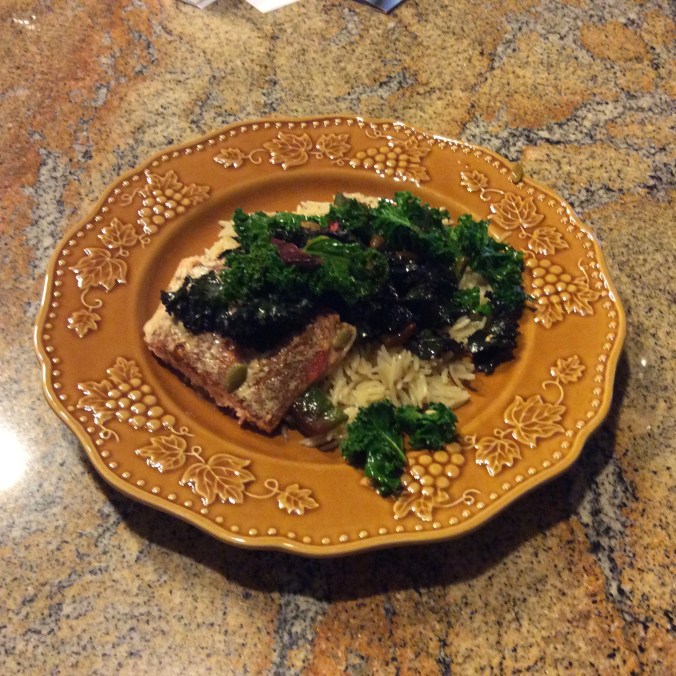
-Cooking dinner.  Here’s the recipe:

Fillet of salmon–keta

4-5 garlic cloves, coarsely chopped

1 poblano pepper, seeded and coarsely chopped

1/2 medium beetroot, thinly sliced and then diced

Bebere to taste or other spice if you do not have this

Several bunches kale, spine removed, and coarsely chopped.  I used two kinds–one green and one purple.

Saute the garlic and beetroot in olive oil until nearly cooked.  Add the poblano pepper and salmon.  Sprinkle a coating of bebere to cover the salmon.  Saute until salmon is nearly done and pepper is cooked but still bright green.  Add kale, occasionally stir, and saute until kale is slightly wilted. Serve over rice.  I used basmati from Pakistan.

Note:  bebere is a spice from Ethiopia.  I use homemade from my Ethiopian friends who have it special made.  Her blend is complex but not very hot.  Some commercial blends are mostly hot.

img_2505

A Week of Gratitude


Negatives emerged lately in my life,  the events in the last two posts, two good friends with health issues and a lot of pain.  Nevertheless, yesterday, I started thinking of so many things for which I feel grateful.  Then I said to myself, I am going to work on a week of gratitude, a week where everyday I make a list of things for which I feel grateful.  Out of years of habit, I make a mental gratitude list every night as I drift off to sleep.  This is more formal, a list I write down.

Yesterday’s list includes these:

-pure water from a deep well

-healthy food I cook myself

-children who live good, productive lives

-my own good health

Today’s list includes:

-a job I really enjoy in spite of paper grading tasks

-students who make me laugh and tell me they love me–who knows whether they mean it and honestly it’s ok either way

-outside chores, e.g feeding horses morning and evening.  I cannot imagine life without this even when it is cold and miserable

-singing–after I post this, I will head to my weekly chorale practice.  Currently, we are singing all these touching songs, poems by Octavio Paz and Pablo Neruda put to music.

-taxes–crazy, I know.  I recall someone once telling me he was happy to pay taxes because it meant he was making decent money and was not poor.


IMG_2337