While wandering around Barnes and Noble looking for something new to read, I read the blurb for An Imaginary Life by David Malouf, an Australian writer. I bought it. Of course, I had heard of Ovid, seen parts of Metamorphosis, his most famous work, but knew little about him. Emperor Augustus exiled him to the remote regions near the Black Sea for reasons not totally known but perhaps due to the nature of Ovid’s erotic poetry which was very popular. Written in the first person, this book relates Ovid’s experiences, thoughts, and feelings while in exile. The urbane and educated Ovid now has to learn to live with superstitious, illiterate, poverty stricken people whose language he does not know, who possess none of amenities to which he is accustomed, who live in a bare survival mode. They find a “wild child” and Ovid becomes determined to catch him and teach him. The Child has lived with the animals and speaks their language, seems immune to weather even though naked, knows nothing of humans. As Ovid lives with and teaches the Child, he begins to question what it means to be human, to be civilized, to be different. What is the true meaning of life?
Note: If you look up Ovid, you will find a birthdate but no date of death. No one knows exactly when or where he died or where he was buried.
One book a week? To date this year it has been more like 3-4, depending on the book and week. I wrote reviews for four books today on Goodreads including The Sea of Tranquility, Little Fires Everywhere, An Imaginary Life, The Woman They Could Not Silence. I mentioned the first one in my last post.
I noticed that Little Fires Everywhere is now a series, streaming. I will not watch it because it is one of the few books that made me cry. I rarely cry. Is it worth reading? Yes. I view it as recommended reading for parents. How do you treat your child who is different, the child who is not how you want your child to be? Is conforming the best way to live? And at what cost? Is a poor minority child better off with wealthy parents from a different ethnicity who can provide everything?
Next I read a non-fiction book, The Woman They CouldNot Silence, The Shocking Story Of A Woman Who Dared To Fight Back, by Kate Moore. Apparently I did not know as much about women’s history in the US as I had thought. This is the true story of the life of Elizabeth Packard. Here are some of the things I learned:
In the mid 1800s if a woman was married, her husband could place her in a mental asylum as insane and she could do nothing about it even if she was sane. She could not get out even if relatives and friends tried to come to her rescue.
Her husband could confiscate all her property and do with it whatever he pleased. She and everything she owned now belonged to him.
People in mental asylums were terrorized and treated with methods now considered even illegal treatment for actual terrorists, e.g. water boarding.
A common, accepted treatment for “difficult” and “emotional” women was clitoridectomies, female genital mutilation. Prominent psychiatrists viewed female genitalia as the cause of female insanity. Dr. Isaac Brown, a prominent London surgeon, stated that it was easy to cure female insanity, just cut off her clitoris. This was practiced in both the US and England.
Elizabeth Packard’s husband placed her in an asylum because she disagreed with his religious views and her outgoing nature. This book details her life in the decades she struggled to be released from the asylum and her struggles to make life better for those who were placed in asylums. It is a must read for anyone interested in the history of women in the 1800s and the treatment of those deemed insane.
In my last blog post about reading, I promised to address the prophecies of Octavia Butler in my next post. The best way is to quote some passages from Parable of the Talents which was published in 1998. This book is the sequel to Parable of the Sowers. In that book the main character creates a new religion with CHANGE as a major focus. In fact, one of the main tenants of that religion forms the words on Octavia Butler’s tombstone which I quoted in an earlier post. Here are some passages from Parable of the Talents:
I couldn’t help wondering, though, whether these people with their crosses, had some connection with my current least favorite presidential candidate, Texas Senator Andrew Steele Jarrett. It sounds like the sort of thing his people might do—a revival of some nasty out of the past….So now we have another group that uses crosses and slaughters people. Jarrett’s people could be behind it. He insists on being a throwback to some earlier ‘simpler’ time. Now does not suit him. Religious tolerance does not suit him. He wants to take us back to some magical time when everyone believed in the same God, worshipped Him in the same way, and understood that their safety in the universe depended on completing the same religious rituals and stomping anyone who is different.
Jarrett’s supporters have been known to burn people at the stake for being witches….a Moslem, a Jew, a Hindu, a Buddhist, or in some parts of the country, a Mormon, a Jehovah’s Witness, or even a Catholic. A witch may also be an atheist or an eccentric…anyone who does not fit into Jarrett’s version of Christianity. He condemns the burnings but in very mild language.
He has a simple answer: ‘Join us! Our doors are open to every nationality, every race.! Leave your sinful past behind, and become one of us. Help us make American great again.”
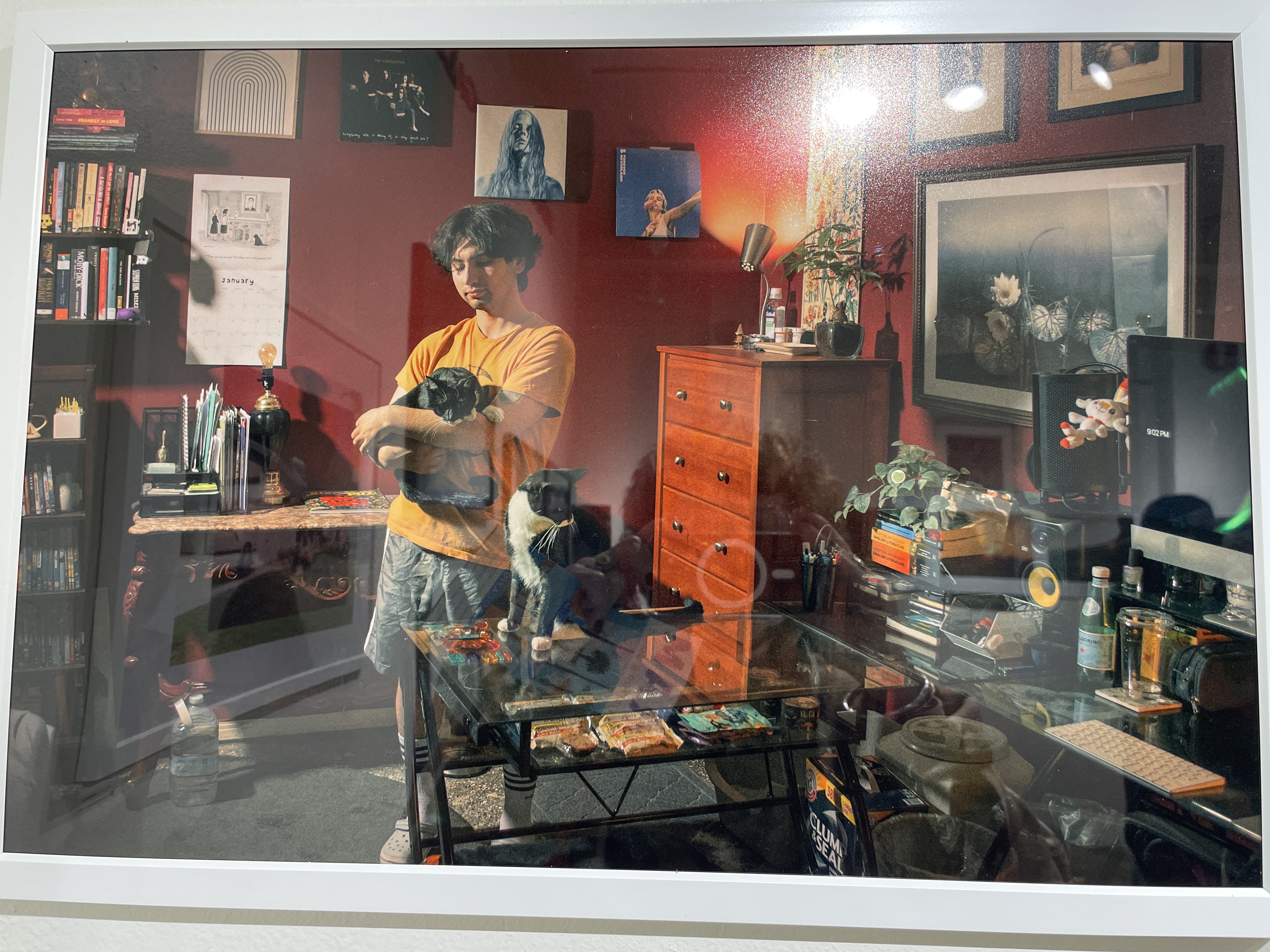
Note: If you are interested in Octavia Butler books, the stack at the right bottom of the photo are mostly her books. Some are series and need to be read in a certain order.
After finishing Tolstoy and the Purple Chair, by Nina Sankovitch, who sets out to read a book each day for a year in order to alleviate her grief over her sister’s death, I decided to commit to reading a minimum of one book a week for a year. As of today, I have already read three, the first of which was The Sea of Tranquility by Emily St. John Mandel. Previously I had read my last Octavia Butler novel, Parable of the Talents in which the main character creates a religion with the ultimate goal of establishing human colonies in “the stars”. Then I discover that the title of The Sea of Tranquility refers to a specific area of the Moon where in this book there are two human colonies. Additionally, there are other colonies, the Far Colonies. Their specific location is never cited.
What is the likelihood that I would pick up a book at the library where the goal of the main character in the last book I read is fulfilled in the second book? Coincidence? Serendipity?
And, by the way, a pandemic occurs in both novels. Butler’s book, written in the 1990s, contains a number of prophetic statements and events which sound like today’s news. More about that in the next post.
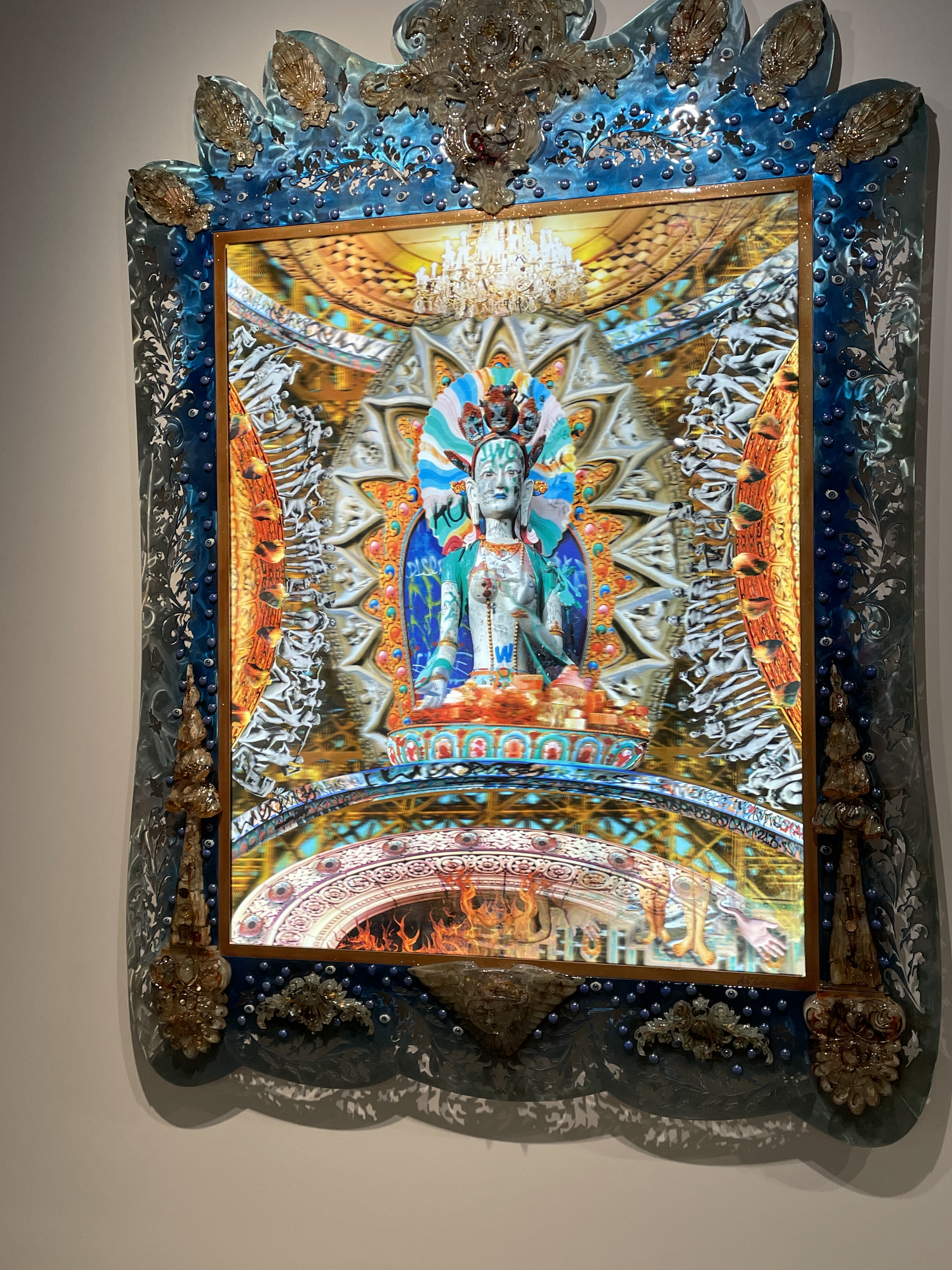
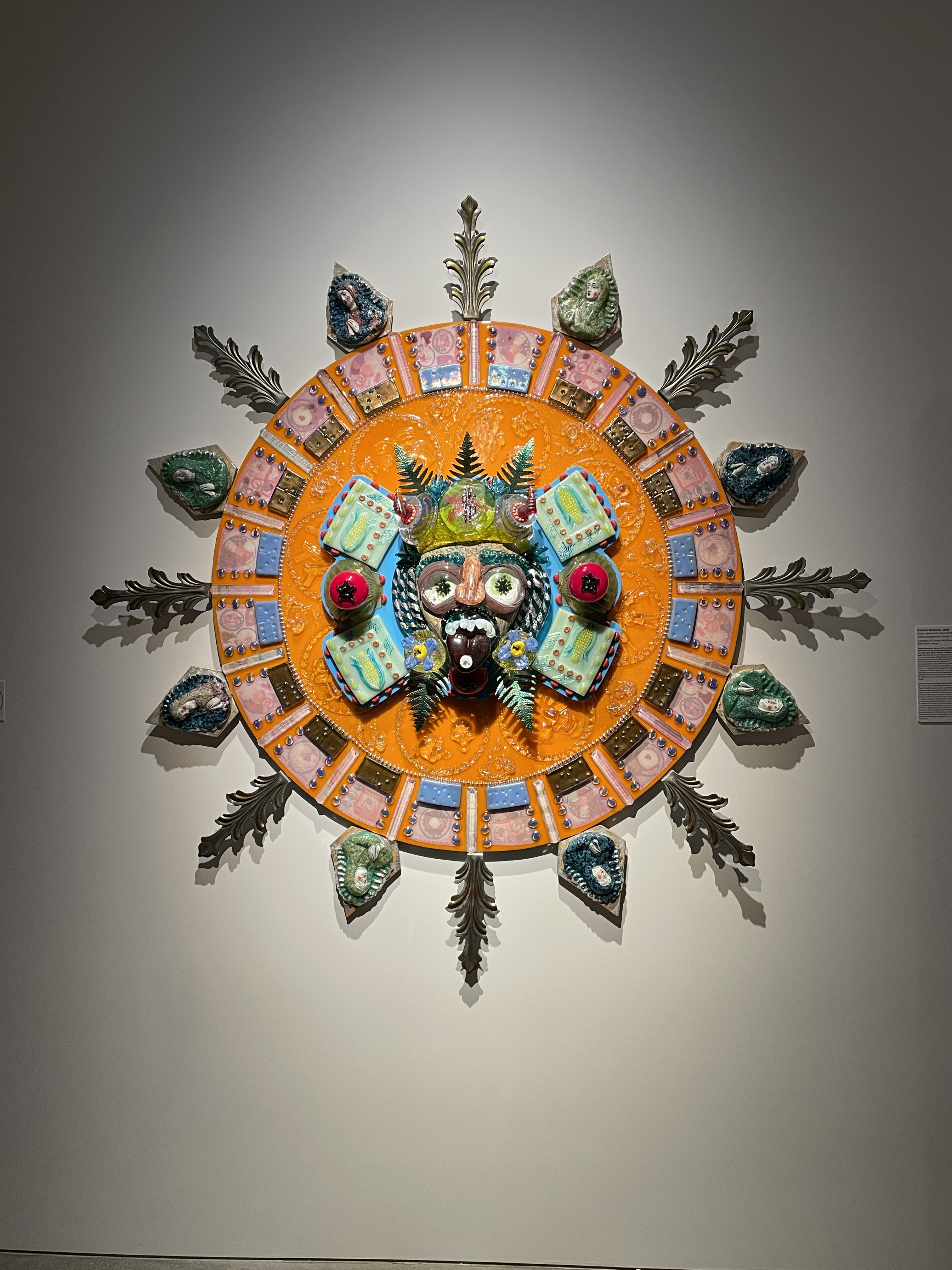
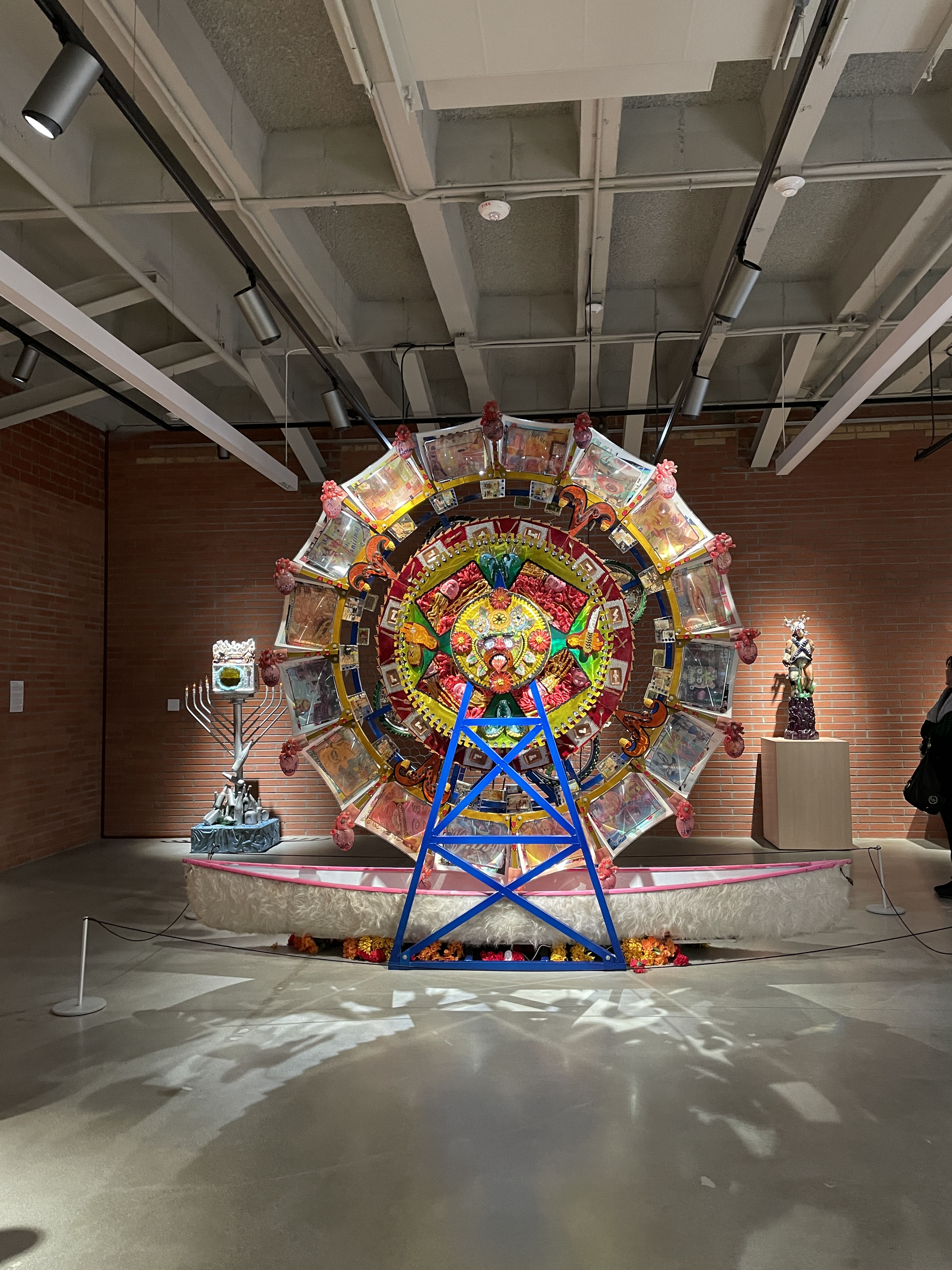
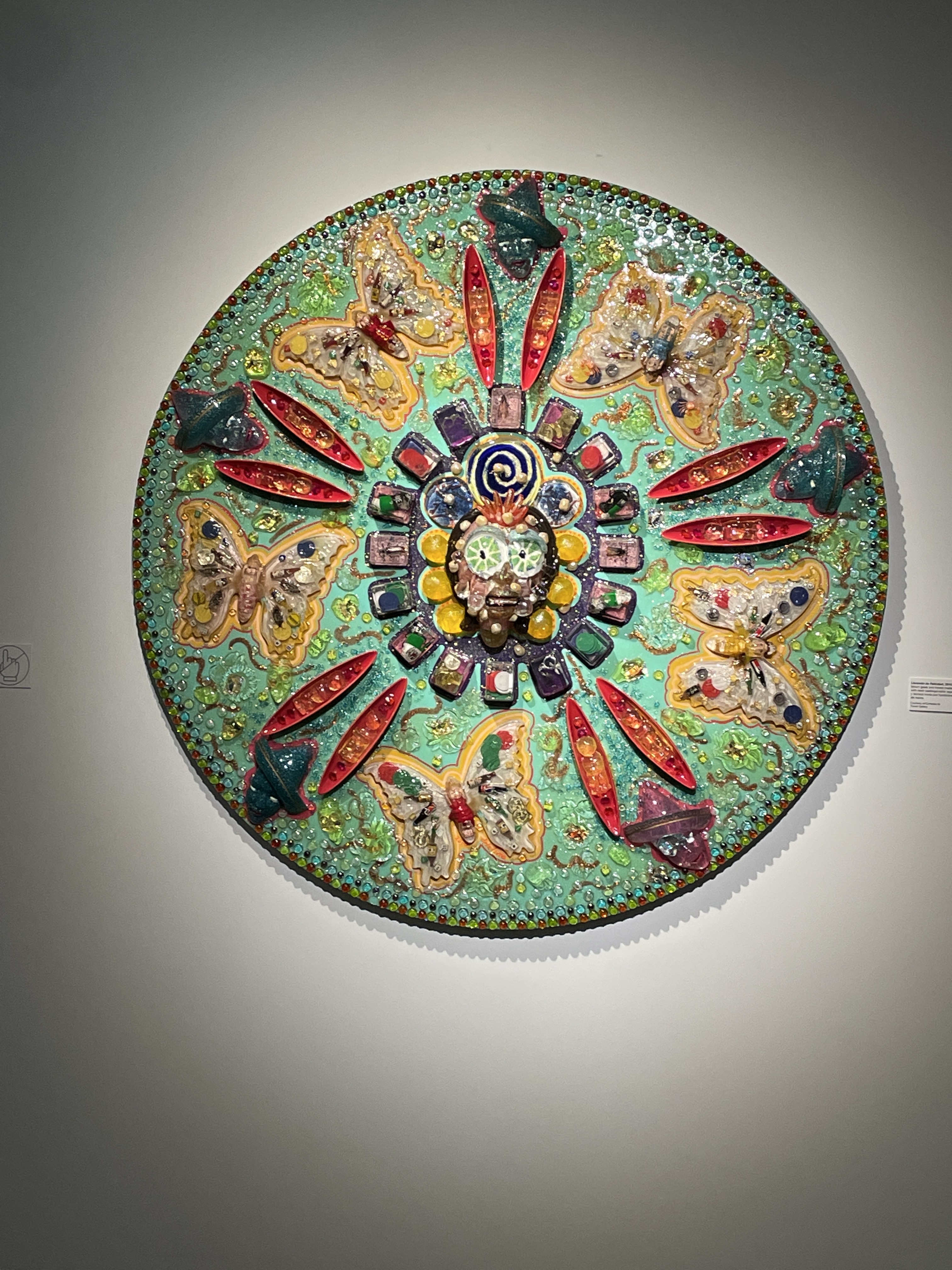
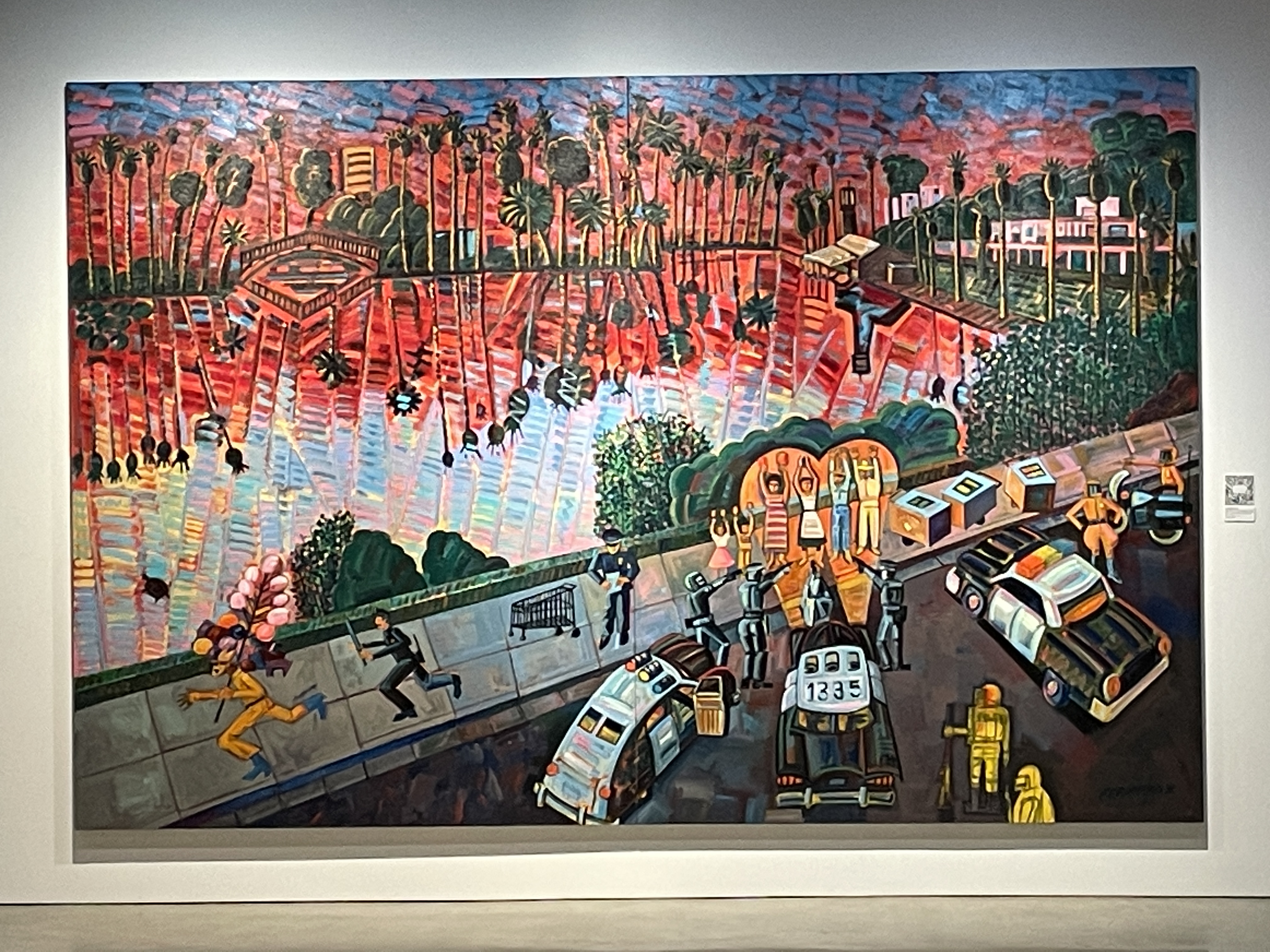
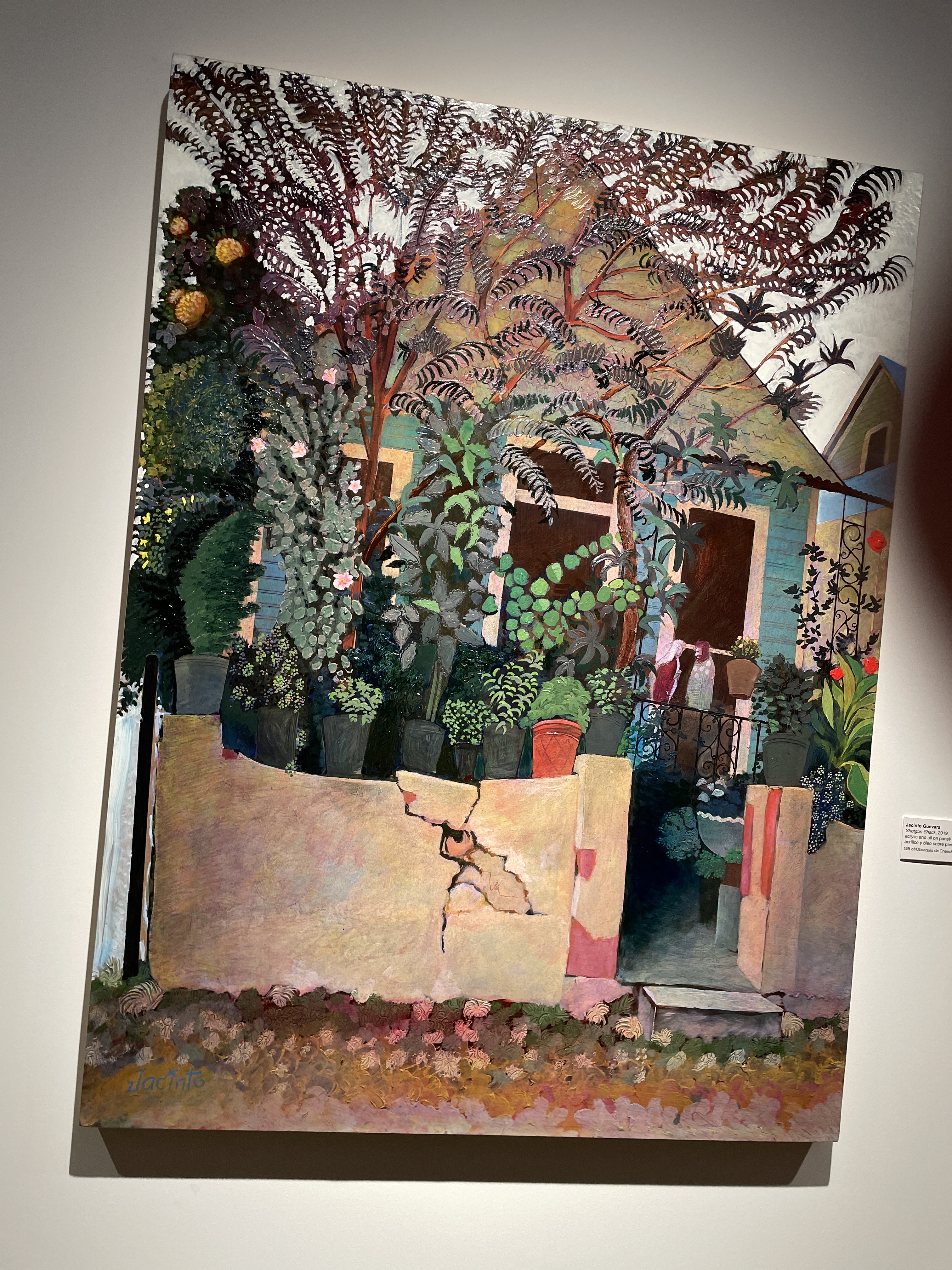
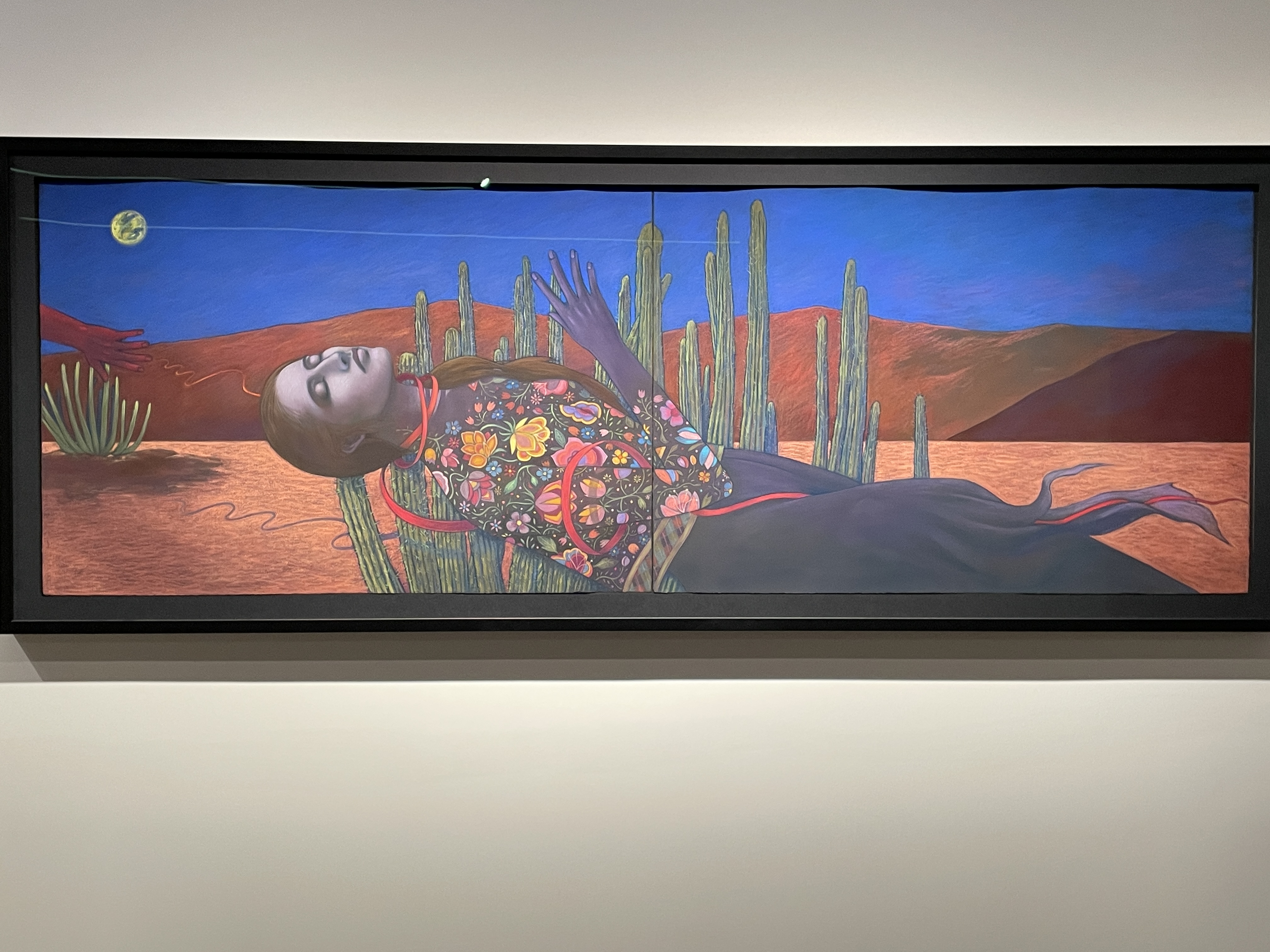
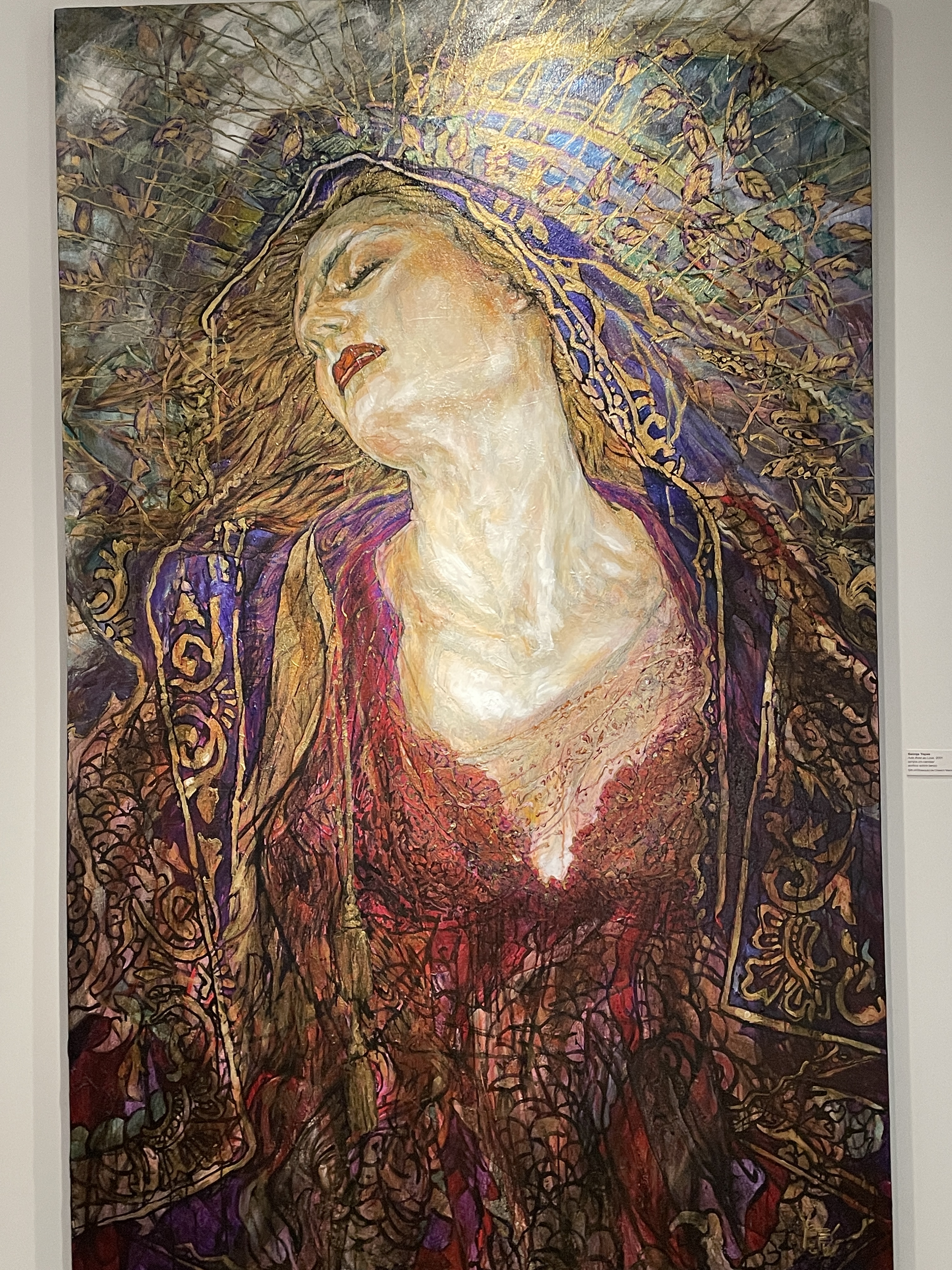
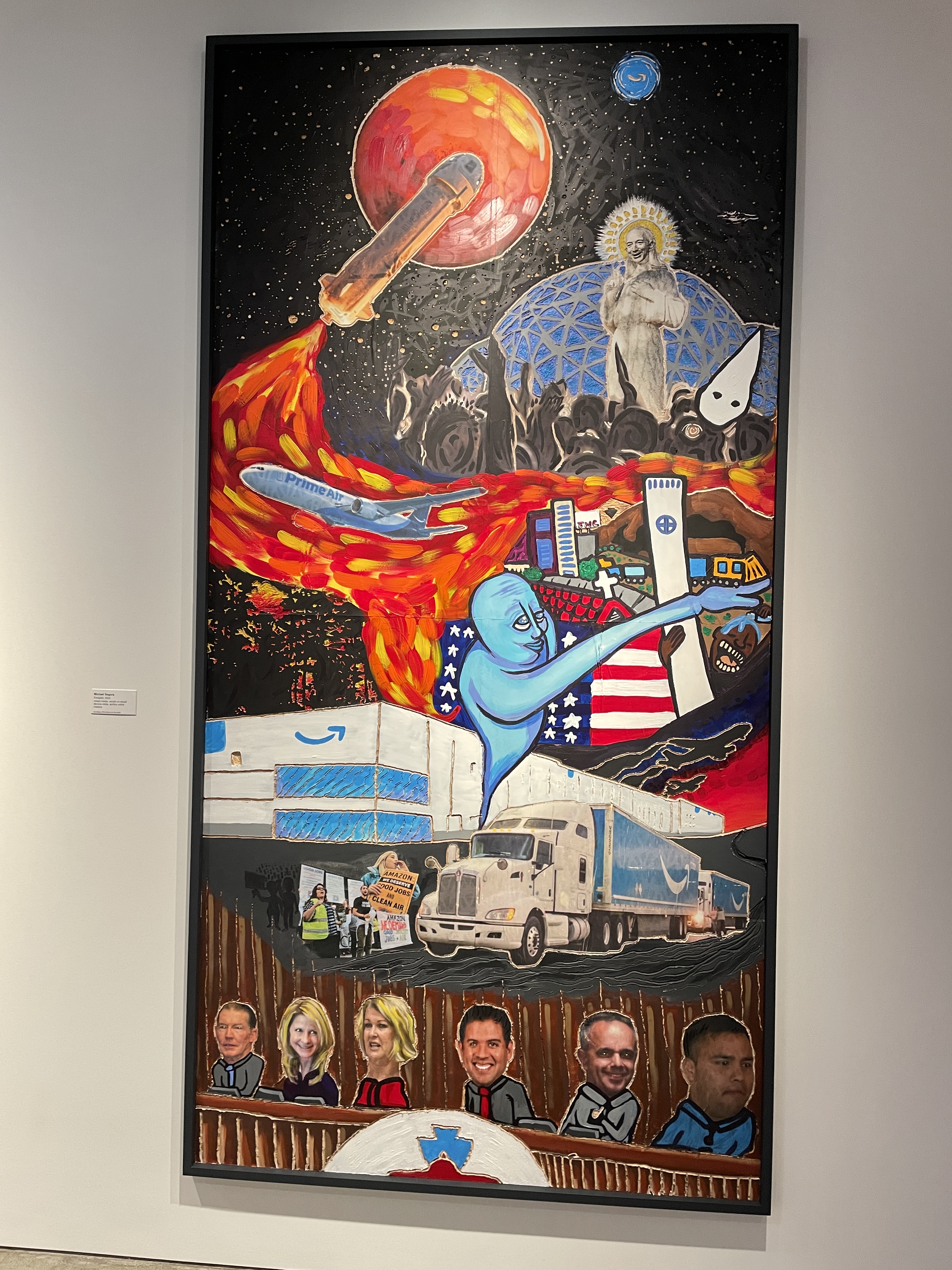
The second floor of the Cheech contains even more astonishing art including more multidimensional pieces except smaller than the giant one you see when you enter the building.
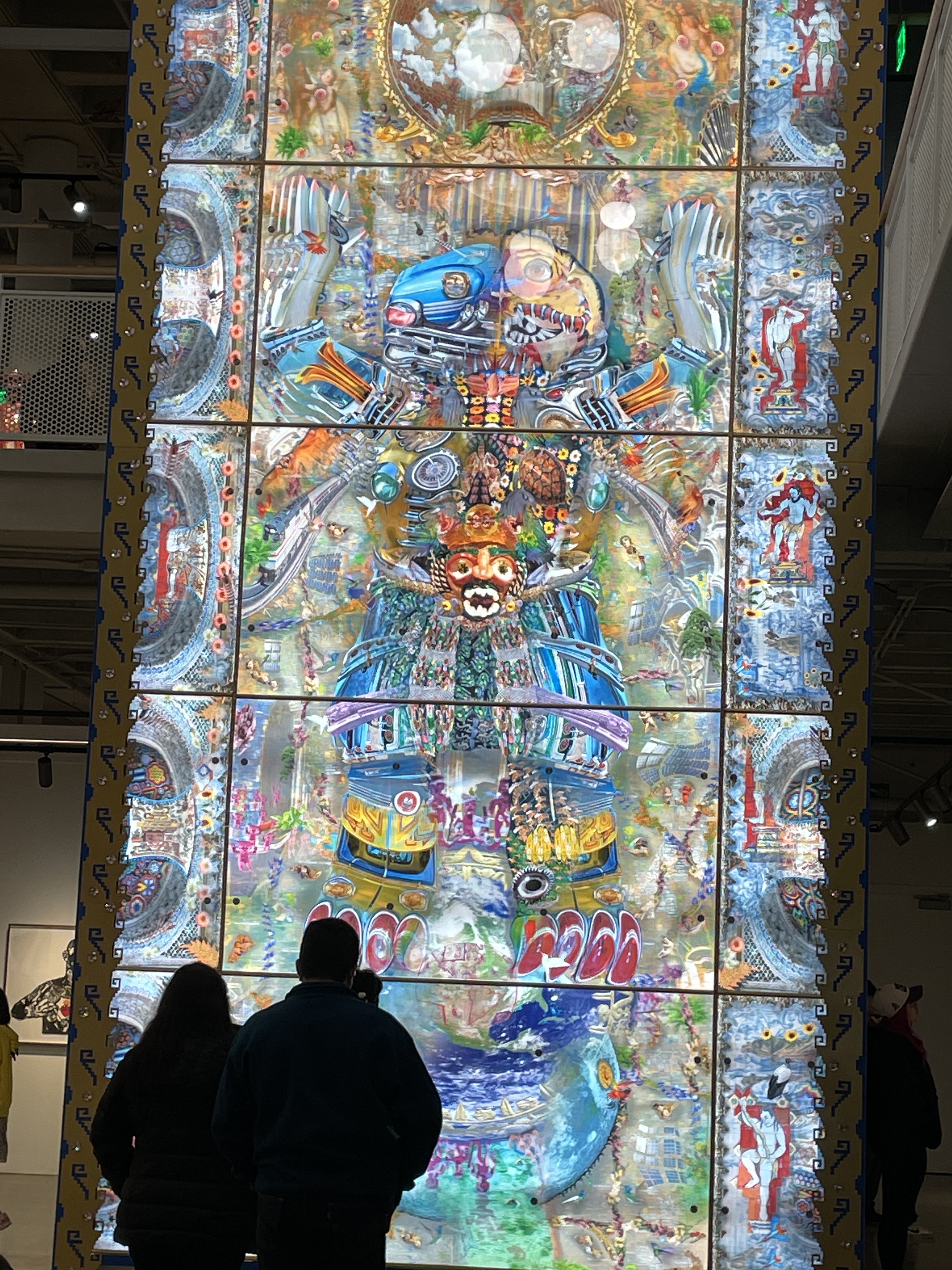
Depending where you stand in front, to either side, what you see is quite different. I kept thinking some old Flemish art or Hieronymus Bosch meets modern technology.
Much of the art makes a social or political statement especially about colonization, culture, poverty.
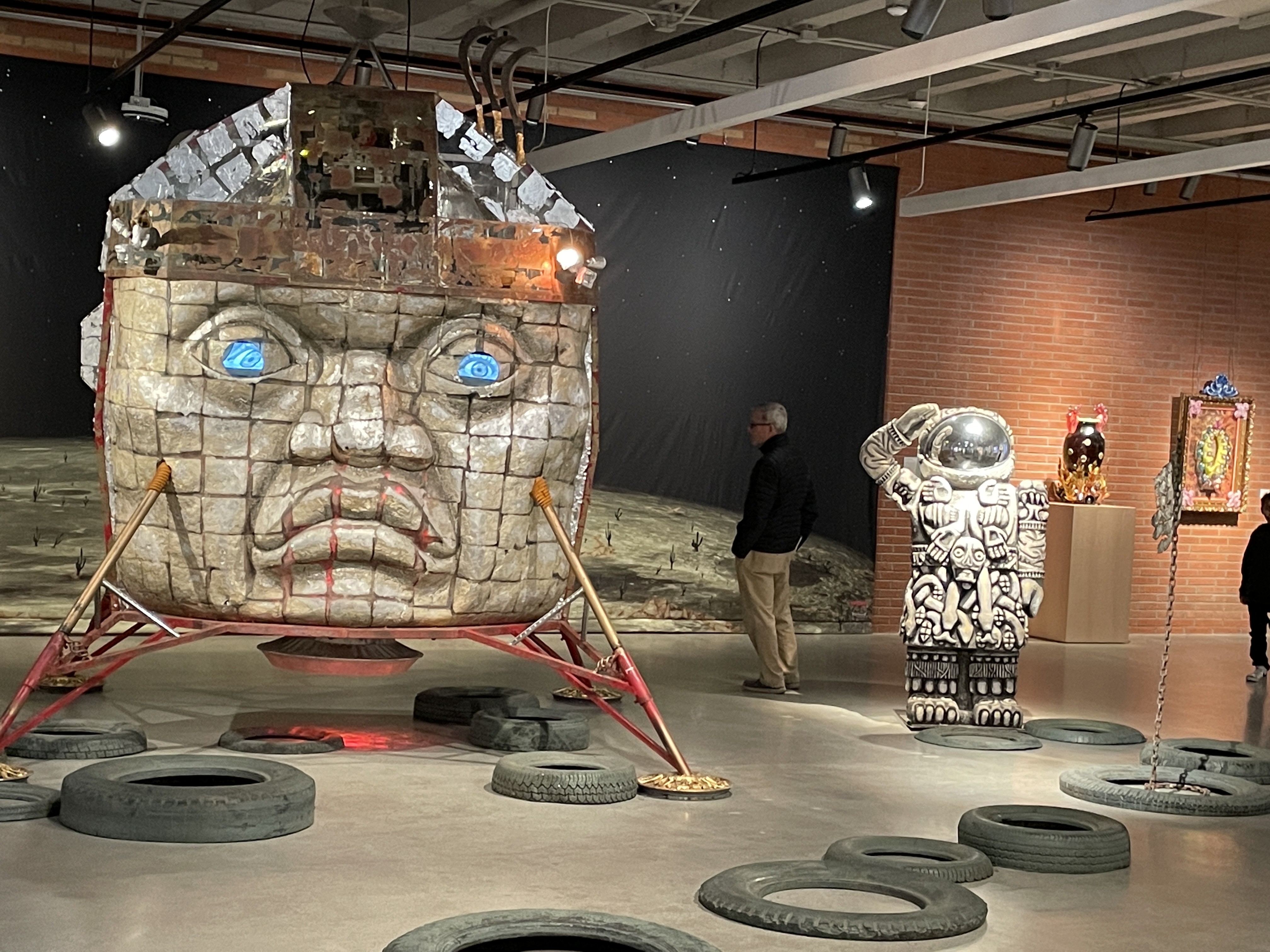
Some of the art is reminiscent of Mayan and Aztec calendars.
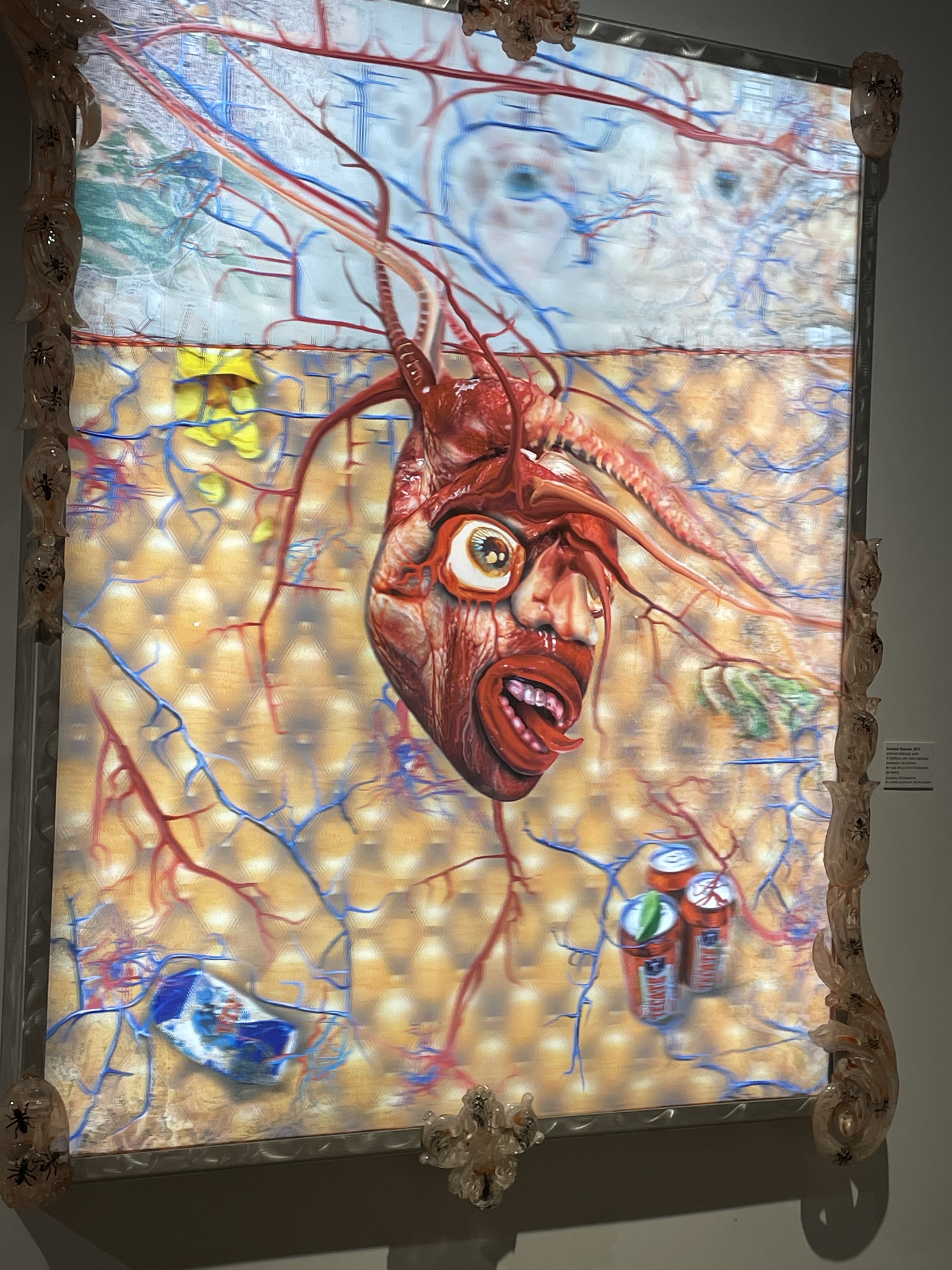
Hearts appear in many of the paintings.
And of course Frida.
This is a space ship with changing eyes. If you walk around the back there is a creature inside watching everything with monitors.
Some of you may remember the comedy duo Cheech and Chong way back in the day. Cheech has spent his life collecting Chicano and Chicana art. This year he gave a lot of his art collection to open a new museum in Riverside, California. Earlier this week my grandson, his girlfriend and I went to visit the museum. Photos and videos are allowed without flash. The following is the first set of photos I took. Please note that you need to see this art for yourself. Photos do not do it justice. Much of it is multidimensional and looks very different depending on where the viewer stands.
This is what you see when you enter the door; it is two stories high and multidimensional. Look how different the next photo of it looks from this one.
Walk farther to the side and it looks totally different again.
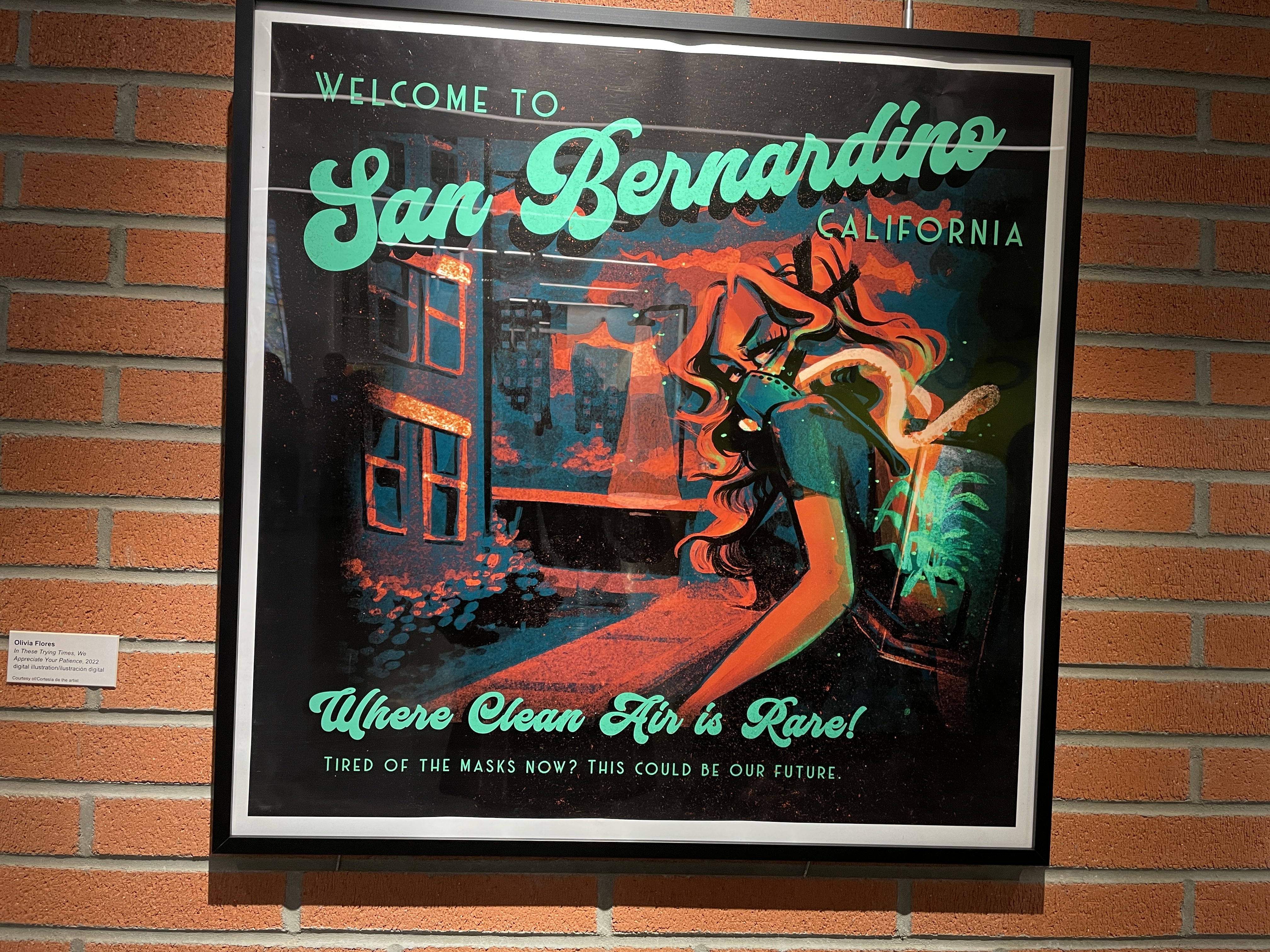
This speaks for itself. Right now where I live the air is clean enough that unless it is foggy, I can see all the way to downtown LA 30 plus miles away.
All the art at this museum has a message; much of it illustrates the ills of society.
The influence of indigenous art, e.g. Aztec, Mayan, can be seem in much of the art and the statements the art makes.
The woman above and the woman below hang next to each other.
On January 2, my grandson, D’mitri, his girlfriend, Landri, and I went to The Riverside Art Museum and the Cheech in Riverside, California. This post includes what we saw at this museum. Later I will share photos of the art at the Cheech.
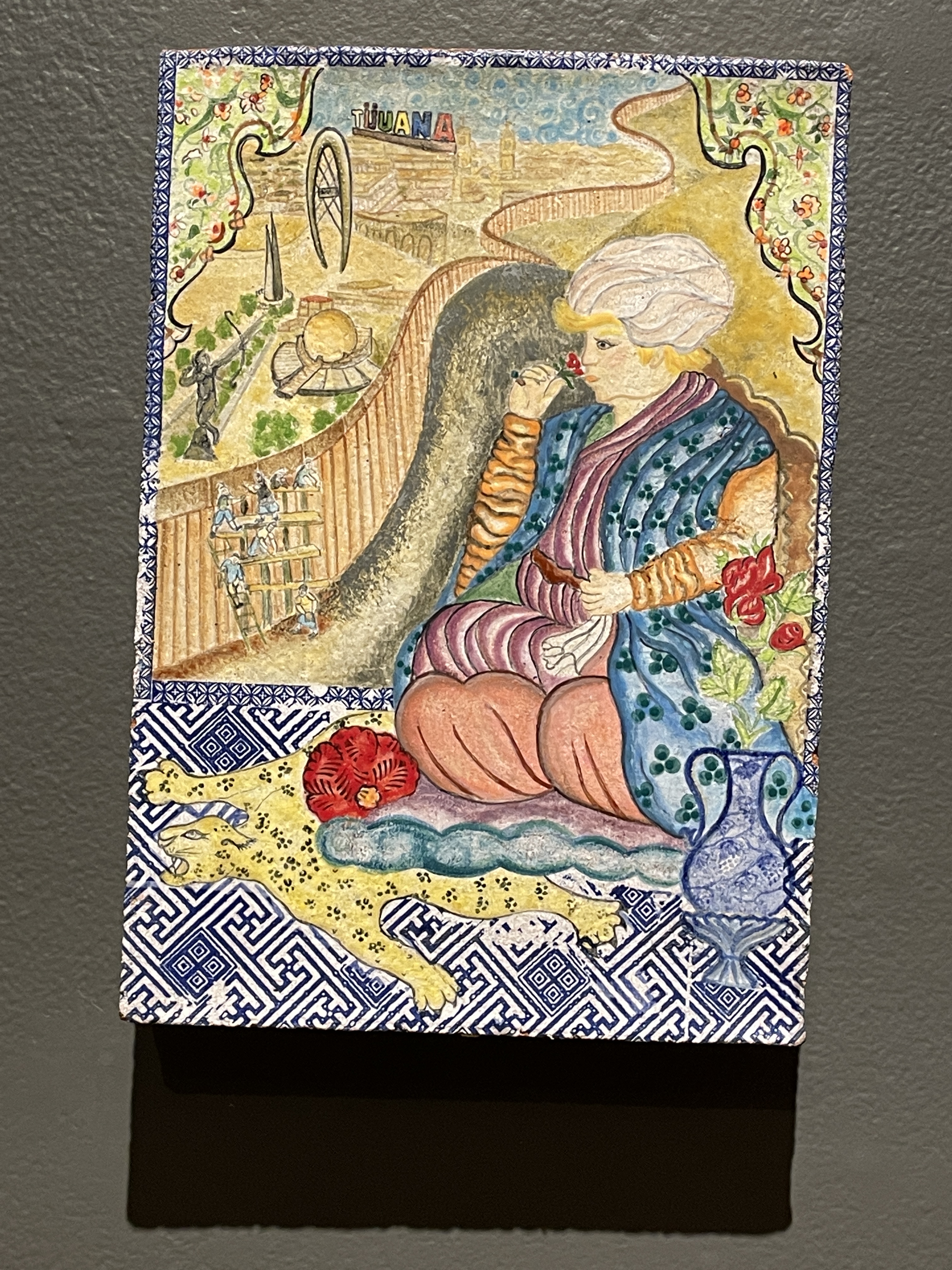
All the art seen in these first photos is by this Turkish-Mexican American artist. Here she explains how and why she interweaves the various parts of her heritage.
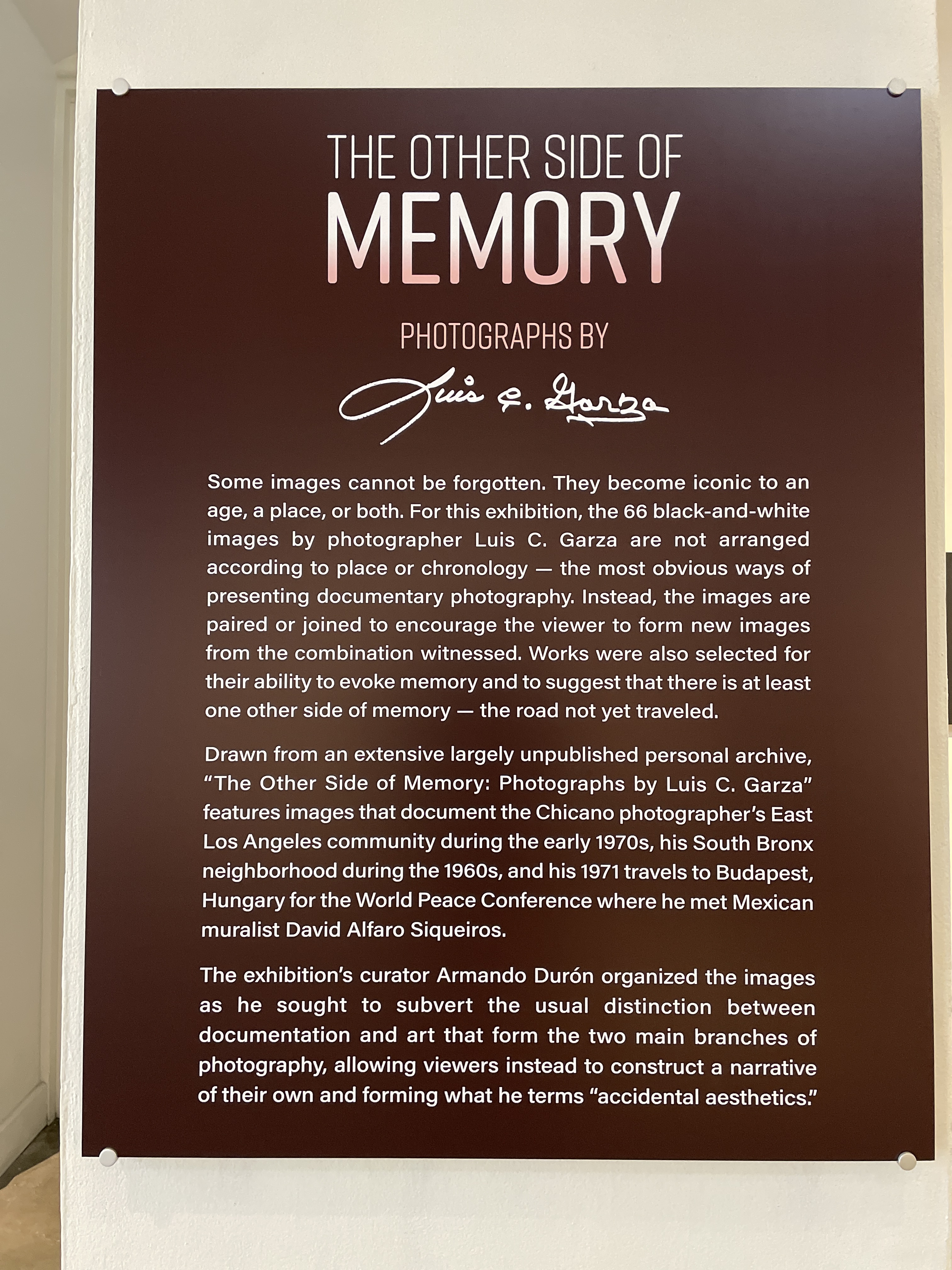
The next gallery room contained hundreds of photos from the 1970s in LA and surrounding areas. Although LA certainly is not the perfect place, improvements since that time are evident in the photographs. Here is a photo about that exhibit.
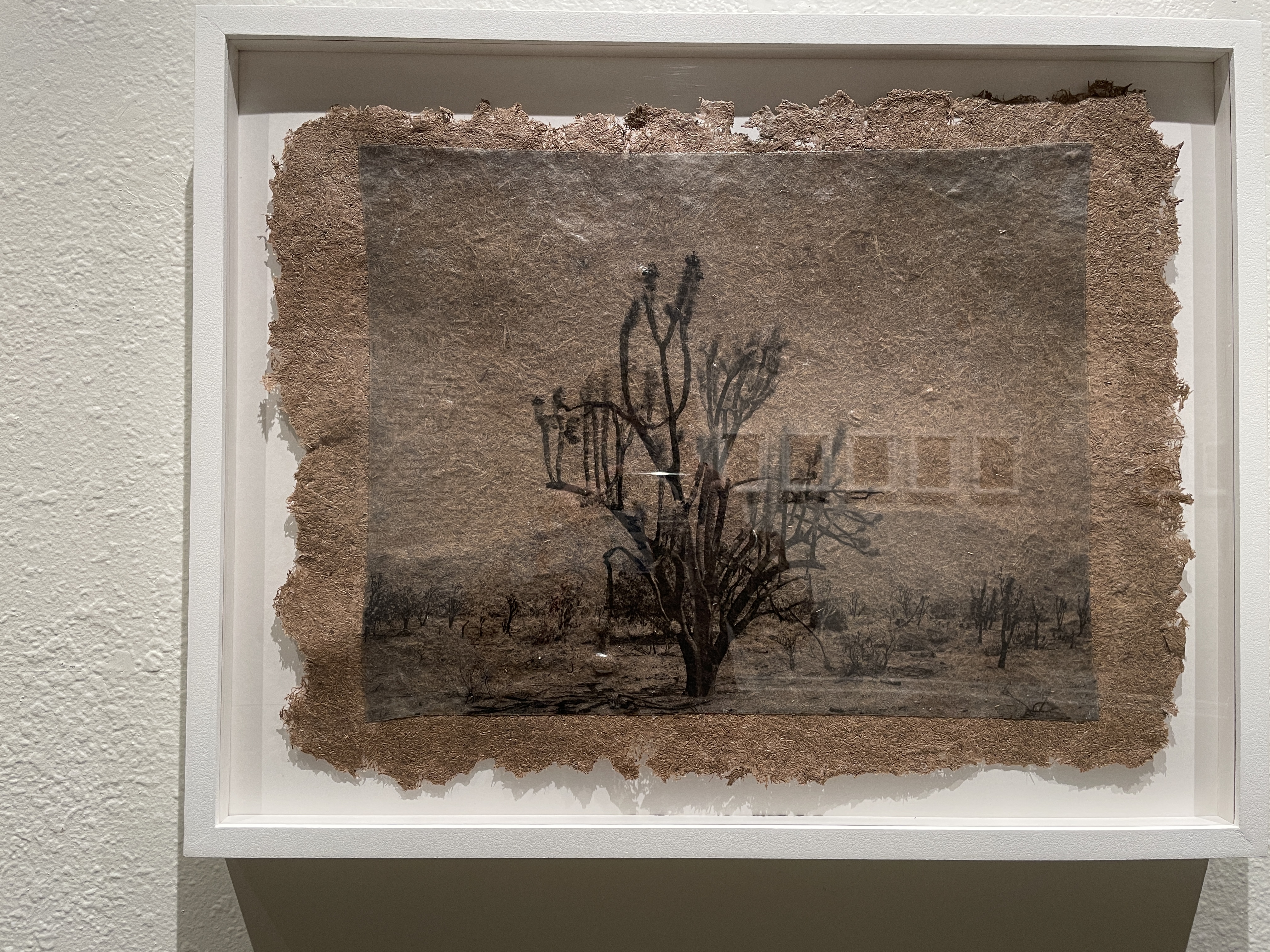
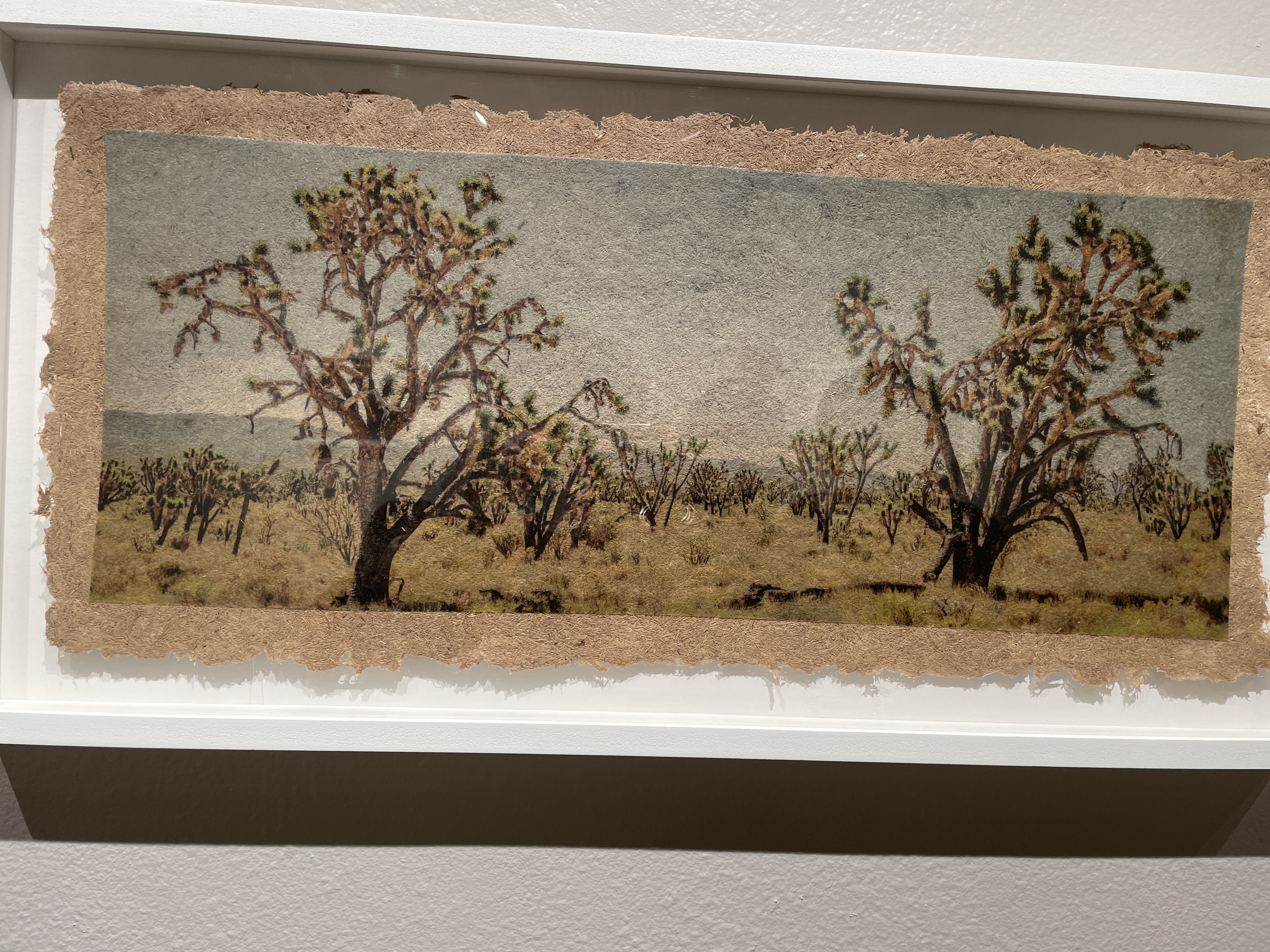
The next gallery contained art of the Joshua trees. The paper used was made of Joshua trees.
The following photos were taken in a hallway above the patio garden and in a smaller adjoining gallery.
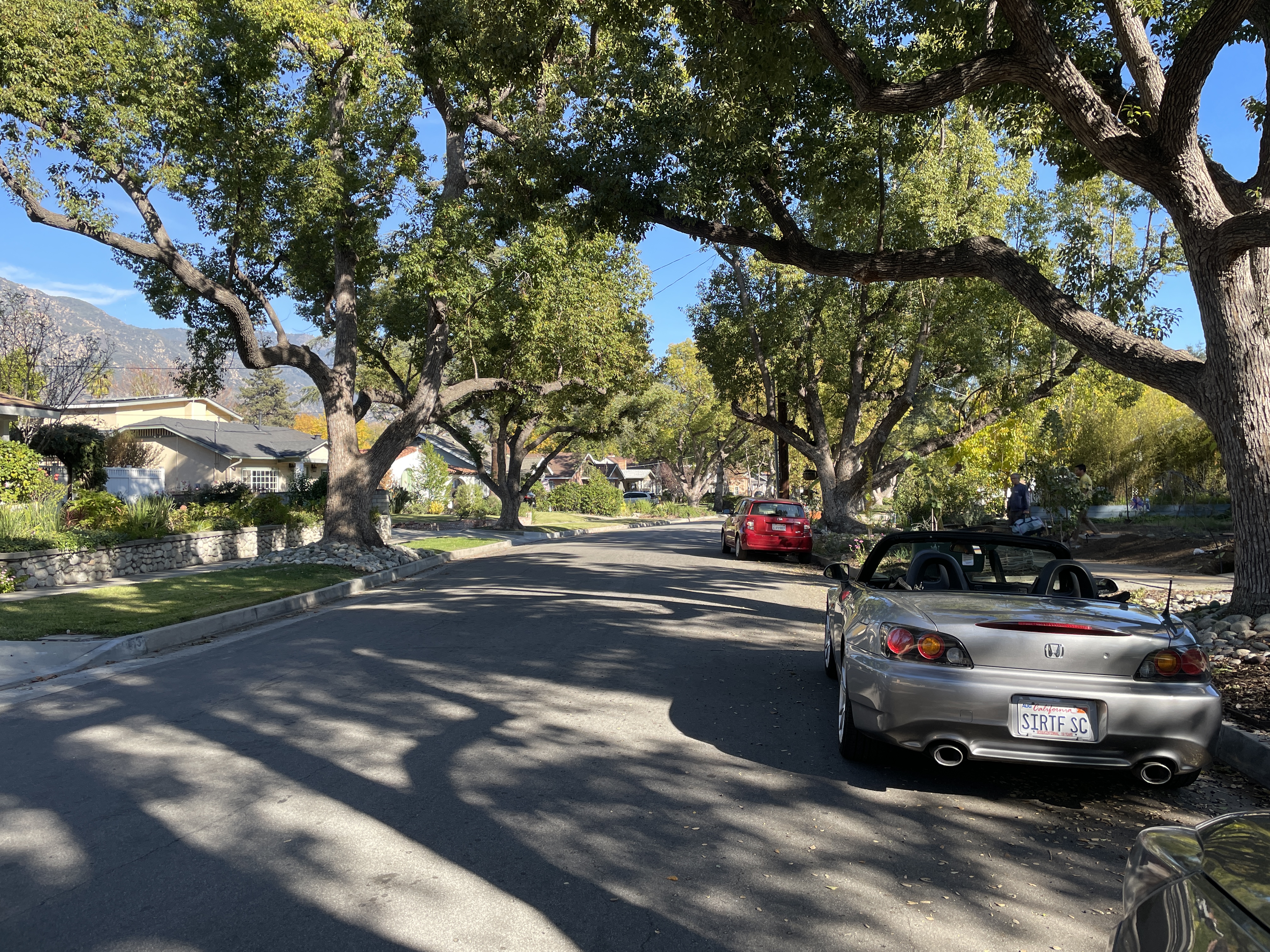
In a recent post I mentioned walking in her footsteps. This is the rainy season so we have not been able to go on that walk yet.. However, this morning I finished reading the last novel of hers that I had not read–Parable of the Talents. It is the sequel to Parable of the Sower. Now I have read all of them. She is buried at Mountain View Cemetery in Altadena, CA, Eagles View Lot 4517. The inscription on her gravestone is the theme of both the books above:
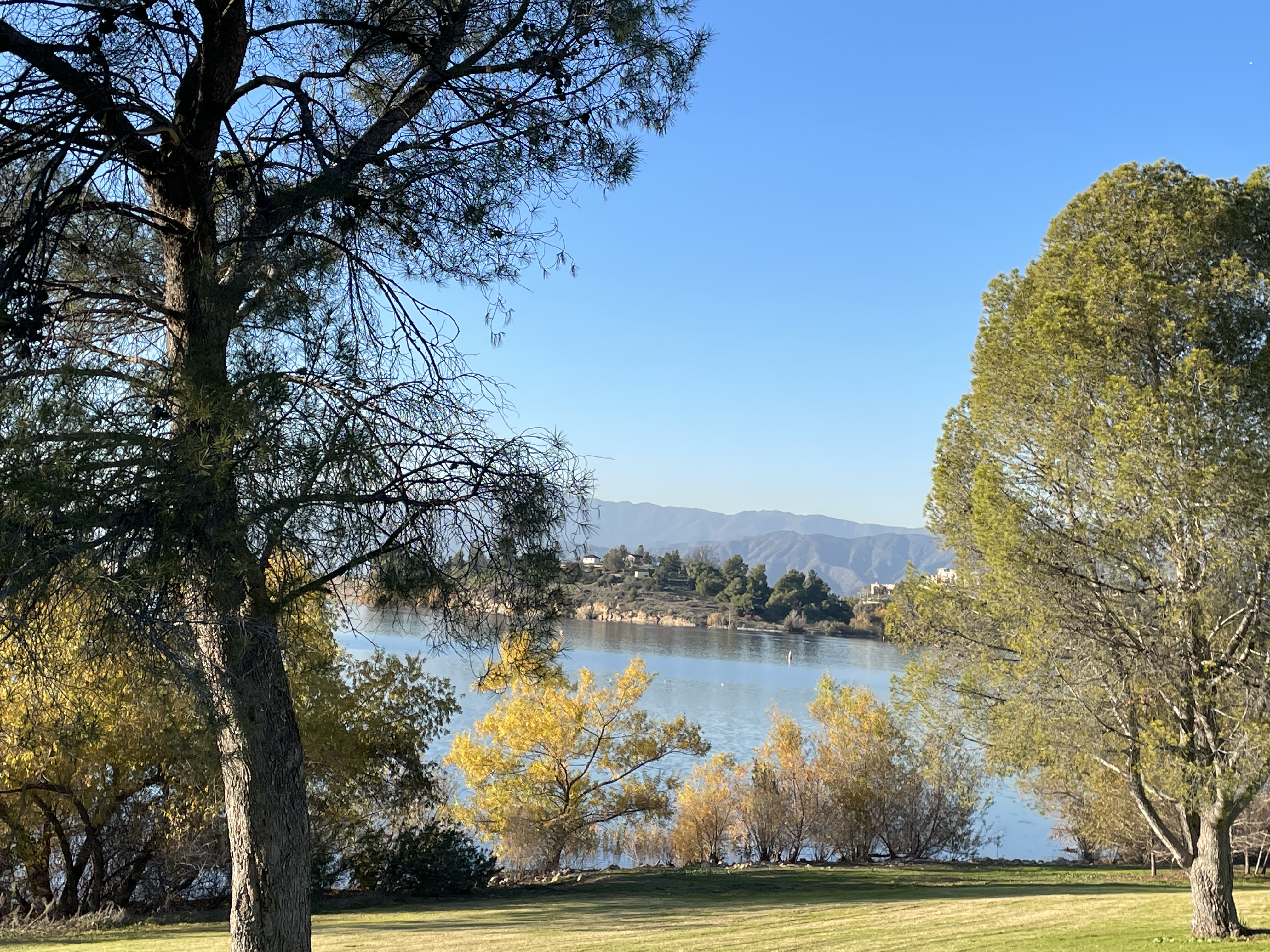
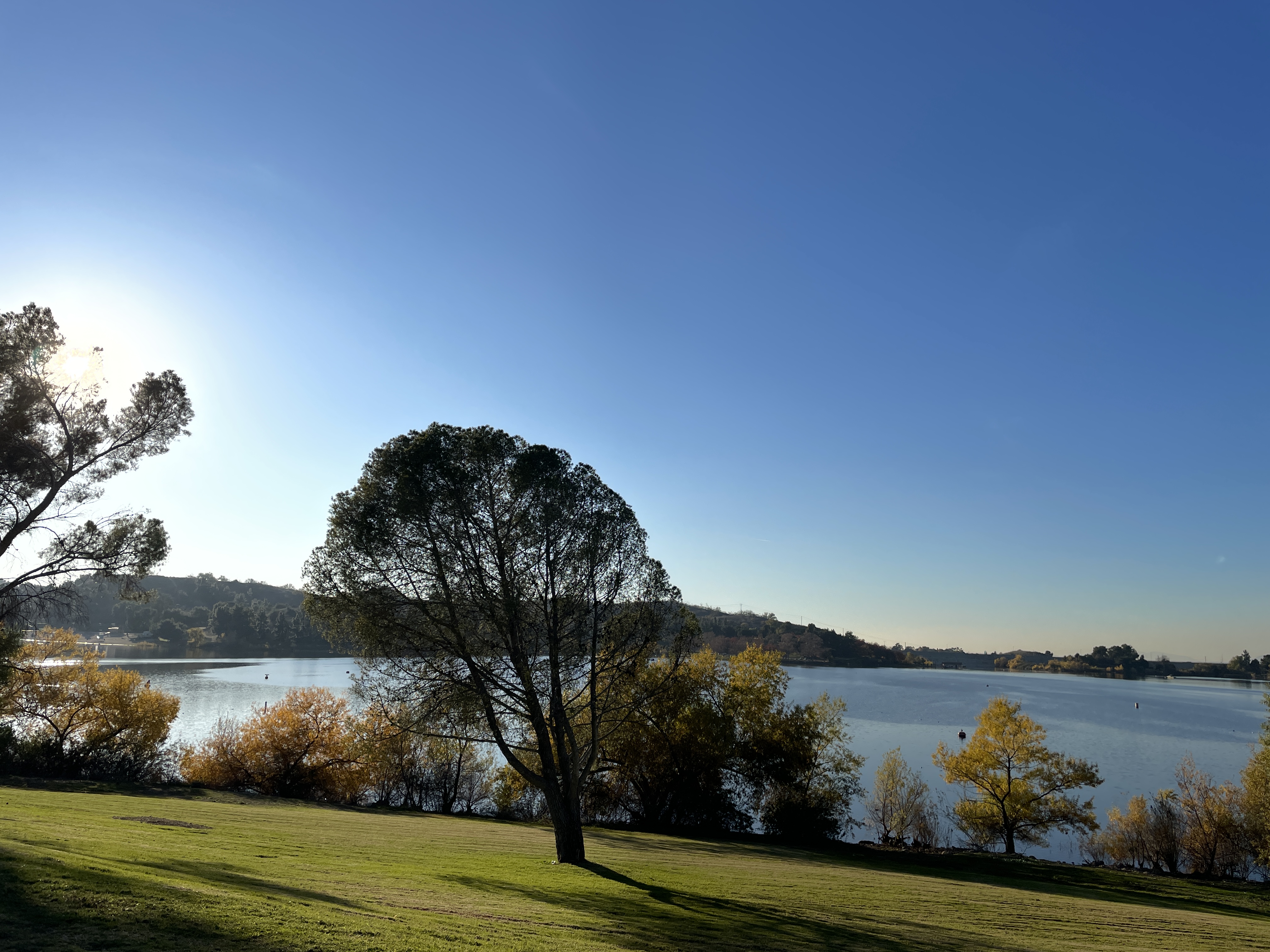
Instead of walking around the neighborhood, today my neighbor and I took a long walk along one of the paths in Bonelli Regional Park ten minutes from where we live. There are over 30 miles of hiking and bike trails in the park. We took the easy paved walk overlooking the lake.
In summer people swim and boat here. Now it is mostly hiking, dog walking, biking, and fishing.
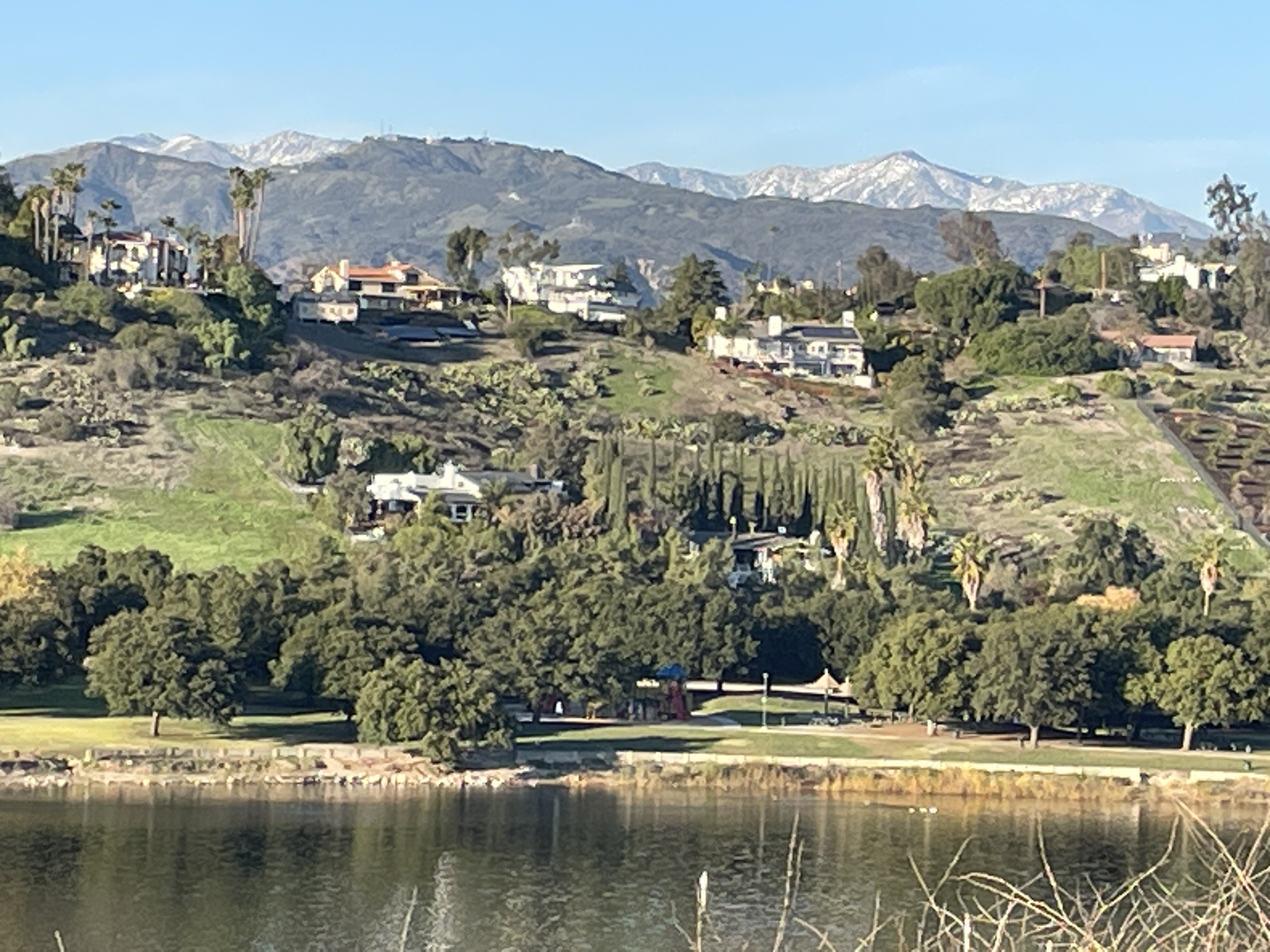
On this side of the lake many houses, some very large, overlook the lake. A few have vineyards or orchards on the slope near the houses.
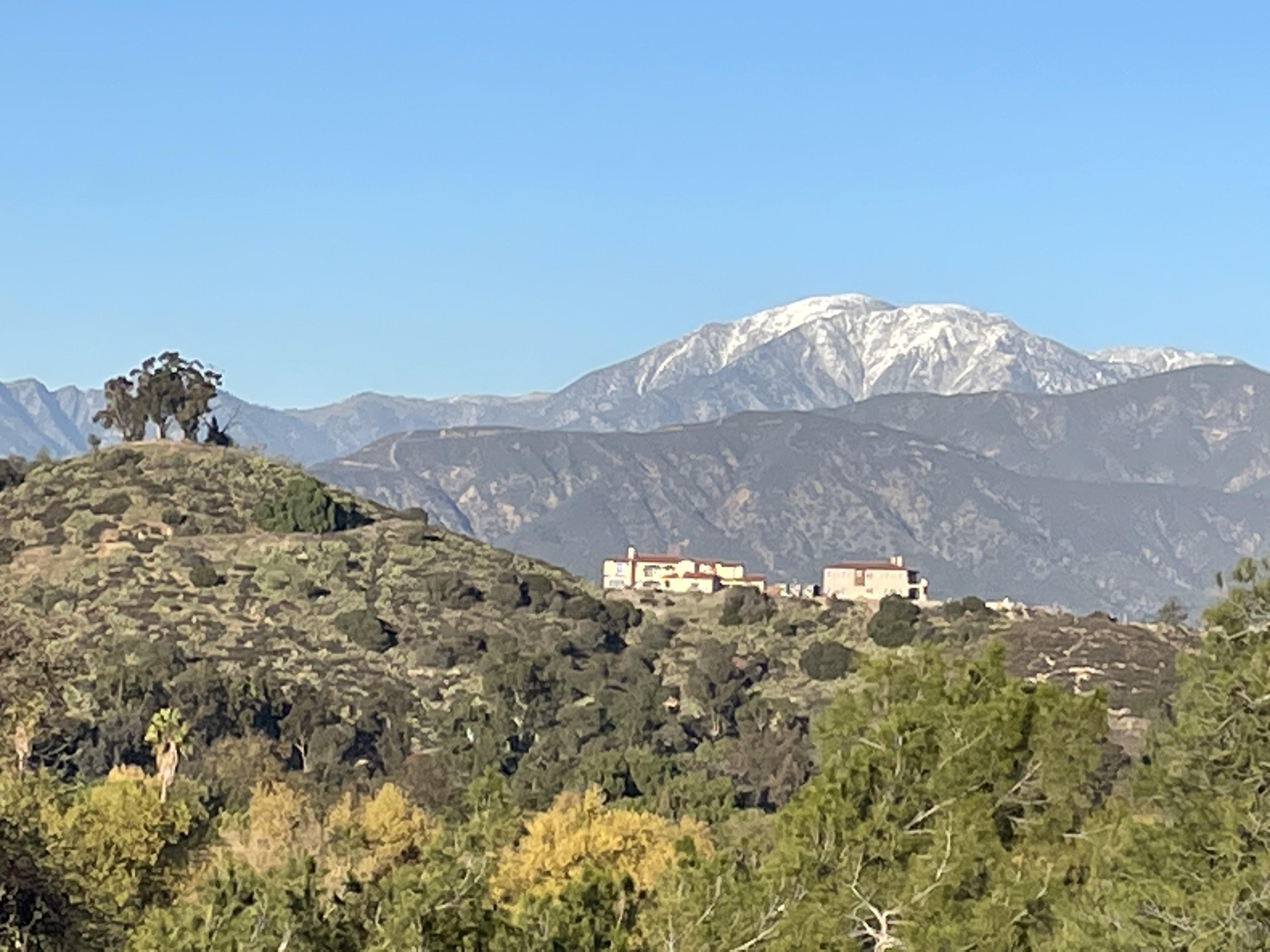
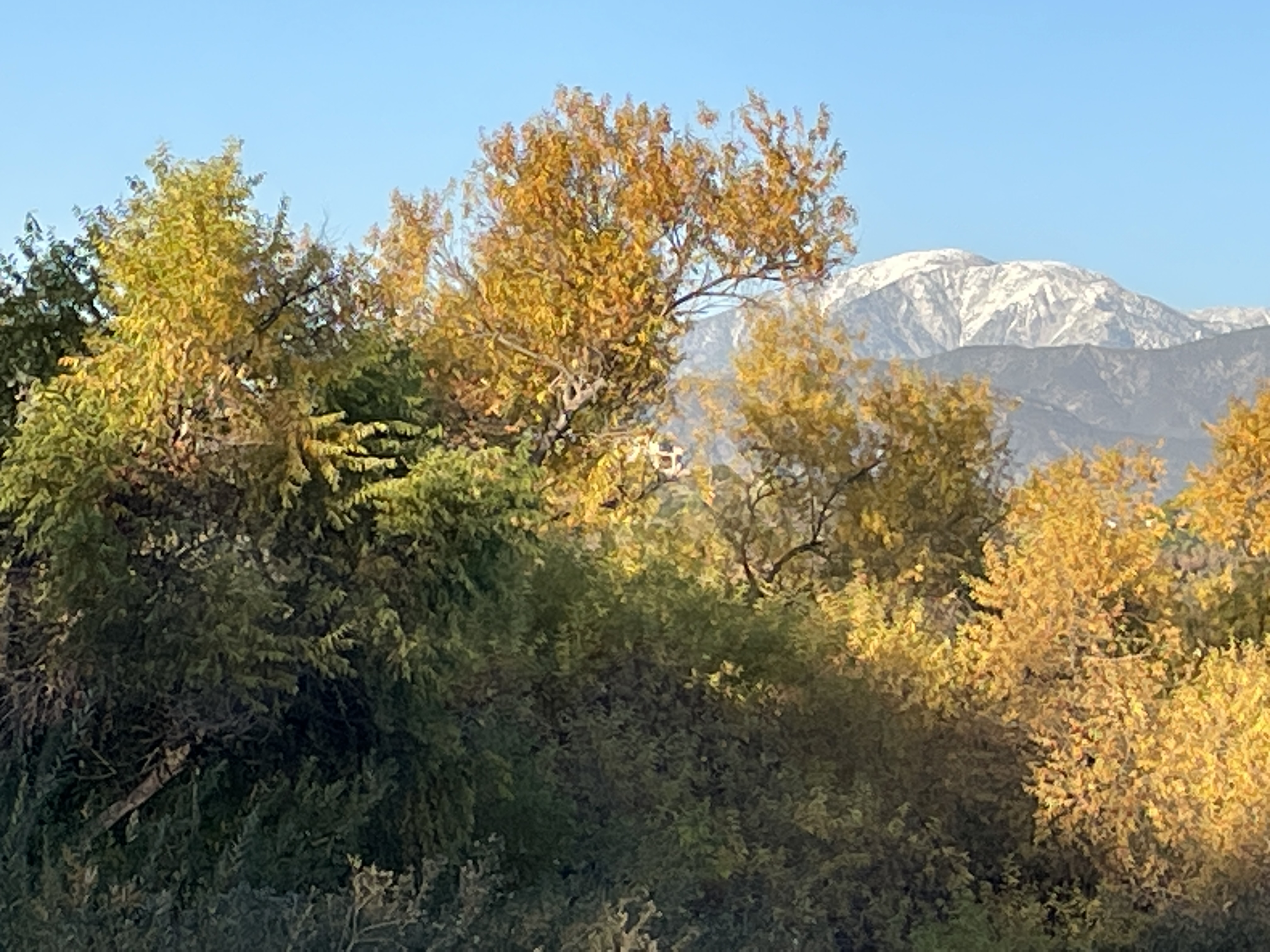
Mt Baldy rises in the background. Several of the mountains remain snowcapped.
Several species of ducks, but mostly mallards, and a few geese reside here. In this area we saw a man fishing.