Imagine a world with no hunger.

Imagine a world with no hunger.
Taste the honey on your tongue
avocado, dark brown
clover, golden
so many shades, textures
sweetness
pleasure
Feel the breeze caress your cheeks
bringing scents
honeysuckle
lilacs
peach blossoms
pleasure
Touch the silken fabric of your scarf
wind softness around you
midnight and snow
rainbows
desert sunsets
pleasure
Listen to the birds outside your window
mockingbird love songs
a rapture’s scream
the whir of hummingbird wings
emerald, indigo, grey
pleasure
Look at flowers blooming everywhere
crimson bougainvillea
roses, sunshine colors
pale pink, vermillion
beauty
pleasure
Sing a song of Gratitude

A tiny book by the author of “Braiding Sweetgrass” envisions a totally different economy than the kind we have now. She uses a plant, the serviceberry, as a symbol for what she calls the “gift” economy. Instead of everything being focused on maximizing profit, it focuses on sharing and exchange and the idea that natural resources are gifts from Earth, from nature, rather than commodities to be exploited for profit.
She notes that capitalist economies hinge on the concept of scarcity and personal accumulation of wealth often at the expense of others. Gift economies, which occur in many indigenous cultures, focus on the mutual benefit of all which encourages gratitude and trust. Later in the book, she discusses how gift economies can be implemented and flourish alongside the current capitalist economy.
There must be considerable appeal for her concepts because this book has been on the non-fiction best seller list for weeks.

If you have ever felt enchanted by a trip to Rome, you will find this memoir delightful and informative. It made me want to return just to stay a while, wander around, visit the more obscure places Doerr describes, people watch, eat, and drink local wine.
In 2007, Anthony Doerr, the 2015 Pulitzer Price Winner, won the Rome Prize to become a fellow at the American Academy in Rome. He and his wife, Shauna, moved to Rome with their newborn twins, Owen and Henry. This memoir memorializes the four seasons they spent living there. They learn to care for babies; wander throughout Rome visiting tourist sites, local restaurants, the butcher, the baker, the toy store; learn enough Italian to acknowledge all the Italians who stop to admire the babies; and attend the vigil for the dying Pope John Paul II.
While there intending to write his later novel (the one that eventually won the Pulitzer) and failing to do so, he does manage to write a short story which I have read in one of his collections and to read everything by Pliny the Elder. His discussions about his readings makes me want to read some of Pliny the Elder myself. As in his short stories and novels, Doerr’s descriptions, language, and observations delight and enchant. This is a wondrous book about one of the world’s oldest and most fascinating cities which he calls, “a Metropolitan Museum of Art the size of Manhattan with no roof, no display cases…


Some probably would not call this a real chili. Nevertheless, it is healthy and vegan unless you garnish it with shredded cheese.
1 cup chopped purple onion
3 garlic cloves, coarsely chopped
Olive oil
2 cups black beans–either use canned or cook your own. I prefer to cook my own.
I can corn, drained
1/2 red bell pepper, seeded and chopped
1 cup canned salsa–I used one that was fine and medium heat. Add more depending on your preferred texture for chili.
1-2 Tablespoons berbere or chili powder. I used berbere.
Saute the onion and garlic in olive oil. Add bell peppers and saute until tender. Add the black beans and corn. Stir and add salsa and spices. Heat through and serve with condiments and shredded cheese of your choice.
The Puerto Rican Ramirez family lives on Staten Island. The book begins years after one of the three daughters, Ruthy, disappears at the age of 13 while on her way home after her school track practice. Twelve years later while watching TV, Jessica, the oldest daughter, sees someone on a reality show who looks like Ruthy. The woman on the TV has red hair like Ruthy and the same birthmark mole. Jessica tells her younger sister, Nina. They concoct a plot to go to the reality show site and bring Ruthy (if she is really Ruthy) home. They avoid telling their mother, Delores, who has never ceased struggling over Ruthy’s disappearance. Delores discovers their plot and insists on not only joining them, but also bringing her older Pentecostal friend who frequently falls into spiritual spells on the floor at church. Eventually, they all head to Boston where the show is located and all kinds of turmoil occurs.
The novel is told from the viewpoint of each sister and their mother, providing endless details about their Puerto Rican culture, their jobs, their views, and how they feel about each other, all done with dialogue. Sometimes it is loving, sometimes snarky as it deals with their experiences with racism, sexism, family secrets, and violence. As a reader, I, too, wanted to know what happened to Ruthy. Definitely worth the read.
The request for Thanksgiving was for a pecan pie. I think the usual pecan pie recipe is too sweet so I made this version. If you prefer walnuts to pecans, you can use walnuts.
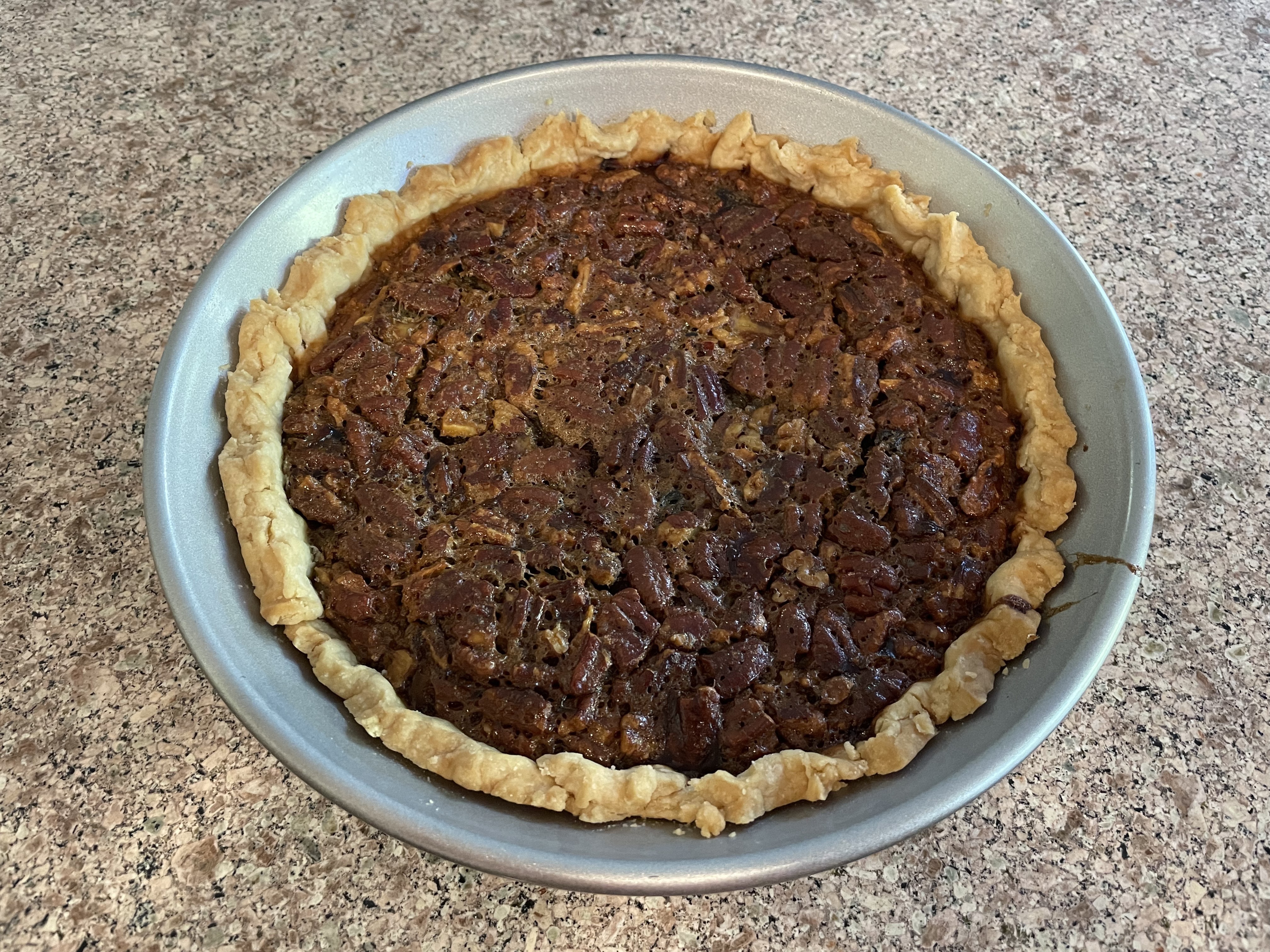
3 eggs
3/4 cup dark corn syrup–I used to the new Karo which claims to not be high fructose
1/2 cup light brown sugar
1/4 cup butter, melted
1 tsp. vanilla
1 cup broken pecans
1/2 cup golden raisins
1 unbaked pie shell
Melt butter. Beat eggs slightly. Stir in corn syrup, brown sugar, butter, and vanilla. Add nuts and raisins. Pour into pastry shell and bake at 350 for 40-45 minutes.
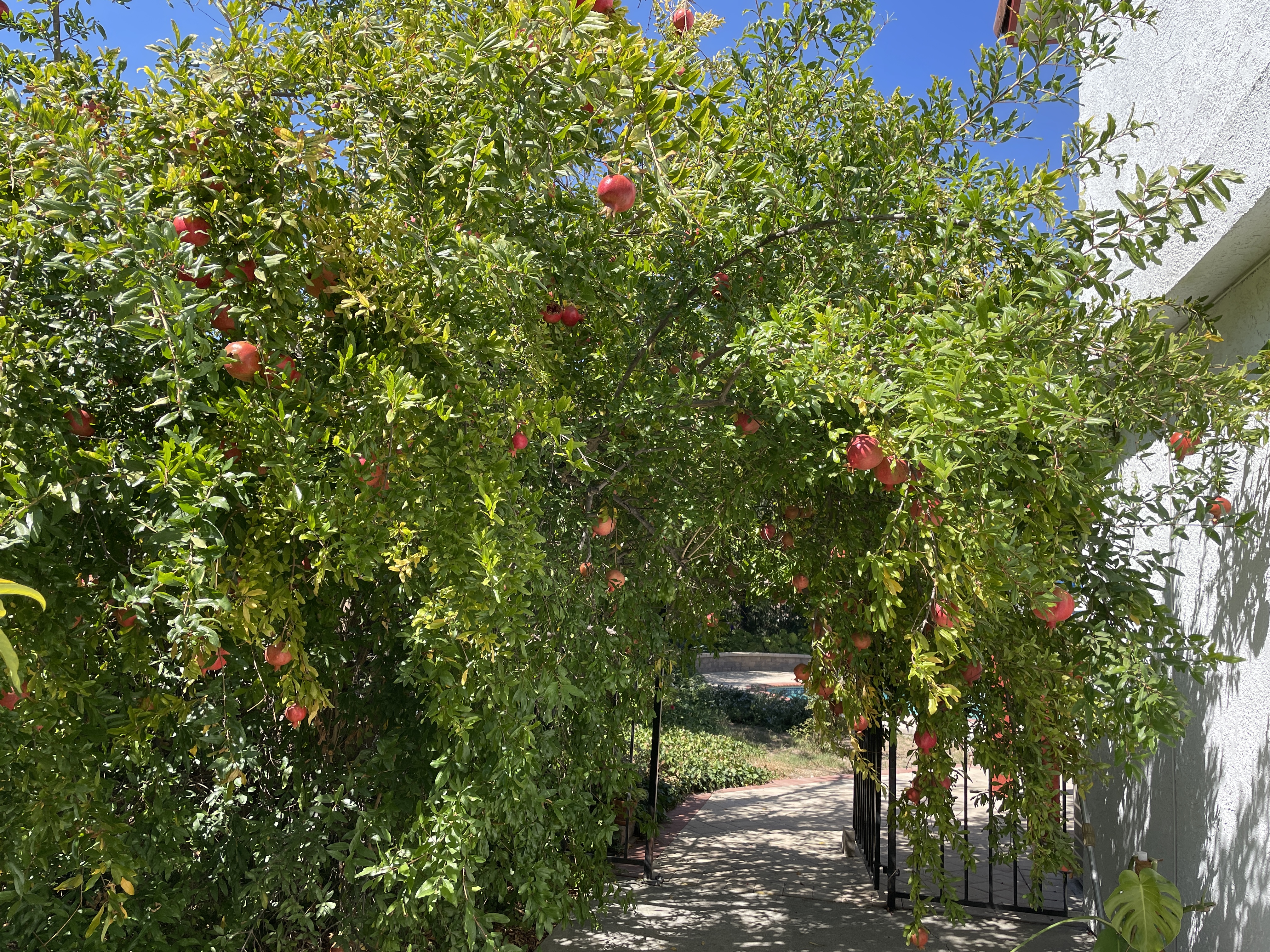
bountiful autumn
pomegranates
scarlet lusciousness
This memoir tells the tale of an unusual tour for a specific purpose, to follow the path of Mennonites who left Europe to escape conscription into the army since the Mennonites are pacifists. The author’s own life is unusual. Her mother was a Swiss Mennonite missionary to Somalia. Her Muslim Somali father taught the Mennonite missionaries Swahili. The two met and married. Samatar grew up and lives as a Mennonite. She teaches African and Arabic literature at James Madison Un. She is most famous for her fantasy novels and short stories which is how I discovered her writing.
In the late 19th century a group of German speaking Mennonites left Russia for Central Asia where their leader believed Christ would return. They suffered many hardships, rejection, abuse, but finally found a place that welcomed them in the Muslim Khanate of Khiva in what is now Uzbekistan. There they built a white church which the locals called Ak Metchet, the White Mosque. Their village lasted 50 years.
If you go online, you can find tours today that follow the route of these Mennonite travelers, trace their route. This book details Samatar’s experiences on the tour, the tour guides, the food, the architecture, the culture and the history: a 15th century astronomer king, the first Uzbek photographer, Mennonite martyrs. She also discusses her own unique upbringing, local beliefs and culture, how people develop their own personal identity, and the surprising interconnections people sometimes discover.

Rio, a young Black woman, and her husband, Gibraltar, academics living in Boston, become concerned and disillusioned with their current lives. She finds an abandoned restaurant on top of a hill in western Massachusetts. Heartbroken after the death of her newborn, she is determined to create a safe, new, underground society beneath the restaurant. She finds a benefactor and her dream begins to take place. Via word of mouth, others hear about this safe place for the “lost” and disillusioned and head there. These include two homeless men from Chicago, a successful, young journalist, and a former soccer player.
Can such a society work? What happens if they run out of money? Regardless, can the care individuals have for each other save them?
Note: Depending on what kind of novels you prefer, this may or may not be a book for you. Several of the characters have serious mental issues, some think it is ok to resort to violence to save what they believe in and find ways to justify their actions, some seem very, very “lost”.
Travel the World 4 Less
A Glimpse into My Life & Passions
Ceto-Magoism, the Whale-guided Way of WE in S/HE
Exploring the F-word in religion at the intersection of scholarship, activism, and community.
ANCESTRAL FOOD. HERBAL WISDOM. MAGICAL COOKERY. SEASONAL CELEBRATION.
inesemjphotography
politics, engineering, parenting, relevant things over coffee.
Food is the best expression of every emotion. Explore through my reviews, recipes, events and more.
Smile! A Site for Friends Wherever You Are!
inspiring personal growth through poetry and writing
Combining atheism with whimsy. This is a Fair and Balanced blog based on opinion unencumbered by fact.
Odds and ends ~ My Life
Original poetry, commentary, and fiction. All copyrights reserved.
bripike@gmail.com
A wildlife filmmaker in Africa
A Geeky Feminist's Musings On Pop Culture
"5 minute walks"

