The Puerto Rican Ramirez family lives on Staten Island. The book begins years after one of the three daughters, Ruthy, disappears at the age of 13 while on her way home after her school track practice. Twelve years later while watching TV, Jessica, the oldest daughter, sees someone on a reality show who looks like Ruthy. The woman on the TV has red hair like Ruthy and the same birthmark mole. Jessica tells her younger sister, Nina. They concoct a plot to go to the reality show site and bring Ruthy (if she is really Ruthy) home. They avoid telling their mother, Delores, who has never ceased struggling over Ruthy’s disappearance. Delores discovers their plot and insists on not only joining them, but also bringing her older Pentecostal friend who frequently falls into spiritual spells on the floor at church. Eventually, they all head to Boston where the show is located and all kinds of turmoil occurs.
The novel is told from the viewpoint of each sister and their mother, providing endless details about their Puerto Rican culture, their jobs, their views, and how they feel about each other, all done with dialogue. Sometimes it is loving, sometimes snarky as it deals with their experiences with racism, sexism, family secrets, and violence. As a reader, I, too, wanted to know what happened to Ruthy. Definitely worth the read.
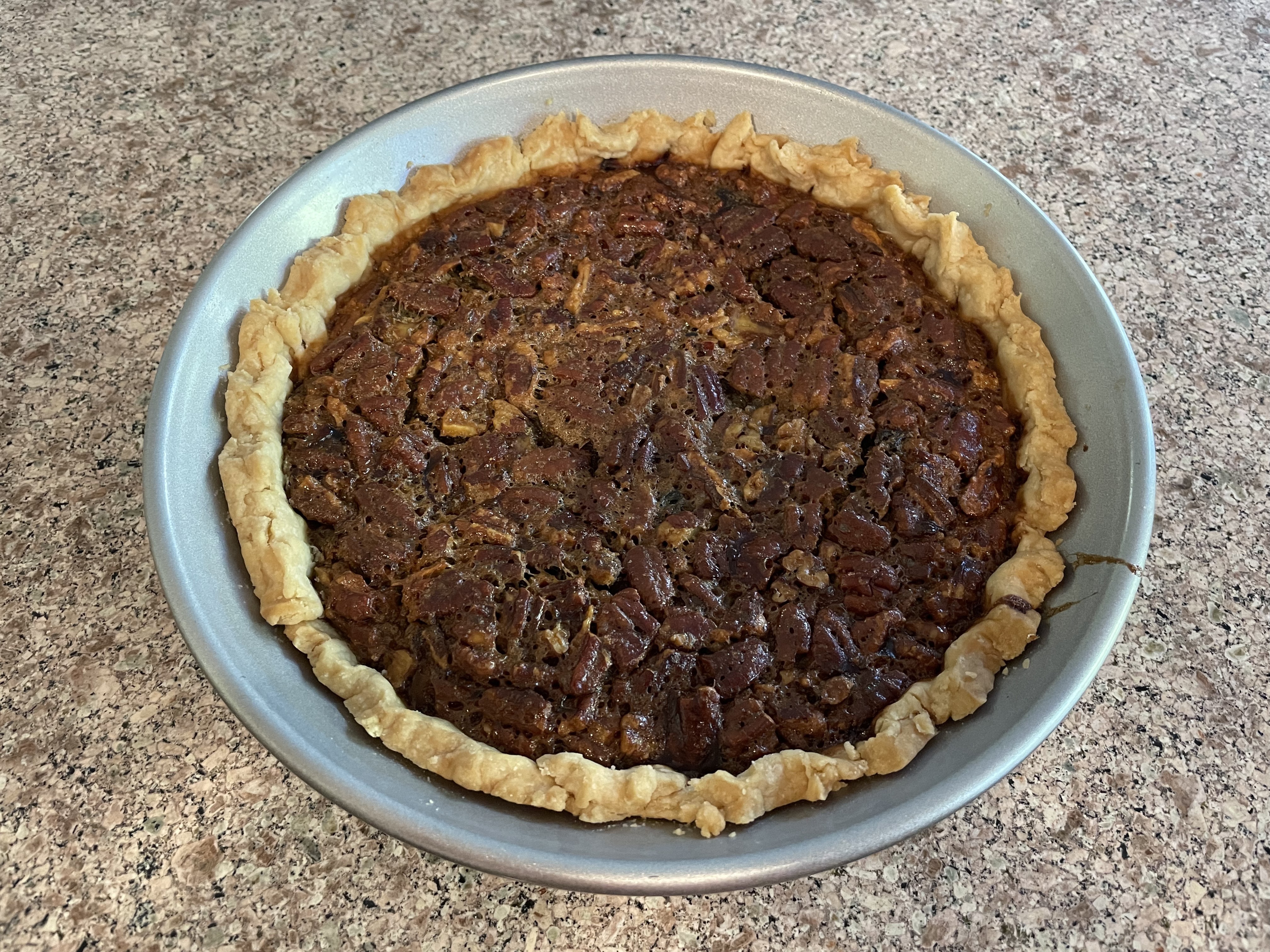
The request for Thanksgiving was for a pecan pie. I think the usual pecan pie recipe is too sweet so I made this version. If you prefer walnuts to pecans, you can use walnuts.
3 eggs
3/4 cup dark corn syrup–I used to the new Karo which claims to not be high fructose
1/2 cup light brown sugar
1/4 cup butter, melted
1 tsp. vanilla
1 cup broken pecans
1/2 cup golden raisins
1 unbaked pie shell
Melt butter. Beat eggs slightly. Stir in corn syrup, brown sugar, butter, and vanilla. Add nuts and raisins. Pour into pastry shell and bake at 350 for 40-45 minutes.
This memoir tells the tale of an unusual tour for a specific purpose, to follow the path of Mennonites who left Europe to escape conscription into the army since the Mennonites are pacifists. The author’s own life is unusual. Her mother was a Swiss Mennonite missionary to Somalia. Her Muslim Somali father taught the Mennonite missionaries Swahili. The two met and married. Samatar grew up and lives as a Mennonite. She teaches African and Arabic literature at James Madison Un. She is most famous for her fantasy novels and short stories which is how I discovered her writing.
In the late 19th century a group of German speaking Mennonites left Russia for Central Asia where their leader believed Christ would return. They suffered many hardships, rejection, abuse, but finally found a place that welcomed them in the Muslim Khanate of Khiva in what is now Uzbekistan. There they built a white church which the locals called Ak Metchet, the White Mosque. Their village lasted 50 years.
If you go online, you can find tours today that follow the route of these Mennonite travelers, trace their route. This book details Samatar’s experiences on the tour, the tour guides, the food, the architecture, the culture and the history: a 15th century astronomer king, the first Uzbek photographer, Mennonite martyrs. She also discusses her own unique upbringing, local beliefs and culture, how people develop their own personal identity, and the surprising interconnections people sometimes discover.
Rio, a young Black woman, and her husband, Gibraltar, academics living in Boston, become concerned and disillusioned with their current lives. She finds an abandoned restaurant on top of a hill in western Massachusetts. Heartbroken after the death of her newborn, she is determined to create a safe, new, underground society beneath the restaurant. She finds a benefactor and her dream begins to take place. Via word of mouth, others hear about this safe place for the “lost” and disillusioned and head there. These include two homeless men from Chicago, a successful, young journalist, and a former soccer player.
Can such a society work? What happens if they run out of money? Regardless, can the care individuals have for each other save them?
Note: Depending on what kind of novels you prefer, this may or may not be a book for you. Several of the characters have serious mental issues, some think it is ok to resort to violence to save what they believe in and find ways to justify their actions, some seem very, very “lost”.
While I found her first book, “The Tiger’s Wife” fascinating, I remain uncertain regarding this one. First it is long, 374 pages (I do read long books); second, it tells two different stories which do not interconnect at all until the end of the book. I kept wondering, asking myself, “What?” For me at least, the story picked up about half way through and my interest greatly increased.
One storyline is the life of one homesteading family in rural Arizona in the 1850s told mostly from the viewpoint of the wife. Her husband tends to wander off for long periods of time leaving her on her own with their children. His latest adventure is not only their homestead but also owning and running the local newspaper in the nearest town. The reader also meets some rather powerful but unsavory characters who want to own all the cattle and all the land.
The second storyline deals with the men who were hired by the government to bring camels to the West and manage them, one of whose story–a real historical person–is told. His name was Ali, a Syrian cameleer, who died in 1902. He was called Hi Jolly because people in US seemed unable or unwilling to pronounce his real name correctly. This part is told from the viewpoint of another cameleer, Hi Jolly’s friend, who has a criminal history and is trying to elude the law. Camels were brought to the US by the United States Camel Corps in the 1850s. At that time few roads existed in the Southwest, water was scarce, and camels were known to be able to go long periods without water. The experiment failed so camels were left either in the hands of the individuals who rode and cared for them or left to roam wild. Some of the men, including Hi Jolly, were able to open businesses transporting goods to remote areas via camel. This book details part of that history.
In both storylines one recurring theme is the lack of water. At one point the homesteading family have no water at all. In the other storyline people hire the cameleers to take them to places not realizing that even camels need water occasionally. I find it telling that 175 years later we continue to struggle with water issues in exactly the same part of the country.
The author of this book, Guadelupe Rivera, is the daughter of Diego Rivera by the woman to whom he was married before he married Frida. Diego went on a trip to Russia and his then wife, the author’s mother, became attached to her previous boyfriend, the poet Jorge Cuesta. She and Diego divorced and then he married Frida. Eventually, the two couples became friendly and at one point they all lived in the same house.
Thirteen years after Diego married Frida, the author moved in with them. This book details her life living with Frida and her father, how Frida learned to cook, how she decorated the Blue House in Coyoacan, the fiestas, the food, the adventures. The book includes photos and recipes of Frida and Diego’s favorite foods, photos of the house, and places the author visited with Frida. It is also a story of many of Mexico’s famous people at the time.
I own several books about Frida but this one is the most revealing and intimate in many ways. If you like Mexican food and find the life and art of Frida and Diego of interest, read this book.
Note: It was also written by the journalist Pierre Marie-Colle with photos by Ignacio Urquiza.
Who would have thought a person could write an entire book about a hyper market? I never heard of Auchan until I read this book. For those not in the know, located in France, it is described as a hyper-market on search engines. From Ernaux’s description and those on the Internet, I think there is nothing like it in the US. The author refers to it as a Supermarket, but it is nothing like what we call a supermarket here. It is a superstore, somewhat like the big box stores here but much more. It sells food, clothes, books, you name it, but not like Target or Costco. The bookstore is a separate area, as are many other little shops within the giant store, e.g the fishmonger. It is three stories, open 24/7, and according to the Internet, works toward being something for everyone while caring about the environment and such. The employees wear a uniform so in that regard they all look the same. The store attends to the needs of all the various religions of the people of France, Muslims, Jews, Christians, everyone. This is especially true when it comes to food. During certain holidays, the preferred food for that religious holiday becomes available.
Ernaux decides to go shopping there in 2012 and 2013 over a span of a year. She deliberately goes at different times of day to see if there are differences. There are. Certain groups of people shop early in the morning–like older people. Young singles go later, mom’s with children at a different time. When there is a no school day, gangs of teen girls show up to hang out and shop. When the weather is bad, people go there to escape. Once in a while someone recognizes her, tells her they love her writing, and they have a conversation. At the first floor entry where there are places to sit, she notices that older North African men seem to like to hang out there and watch the passerby’s.
She notices that while a person can shop in a sort of anonymity that is impossible while standing in the checkout line. Here your eating habits, what method you choose to pay, whether you have elderly people at home or babies or children are all on full display laying there on the conveyor belt for all to see. If you have to ask for help with the money, it exposes you as a foreigner. Yet people pretend they do not notice or care–perhaps they do not.
I occasionally go to Target, never to Walmart or Costco. Nevertheless, reading this book has made me notice things I never noticed before, and normally I am quite observant. Now even when I go to smaller grocery stores, I notice who is there, what they are buying. Sometimes people will ask me a question about something in the store. At places near my house, I sometimes see people I know and chat.
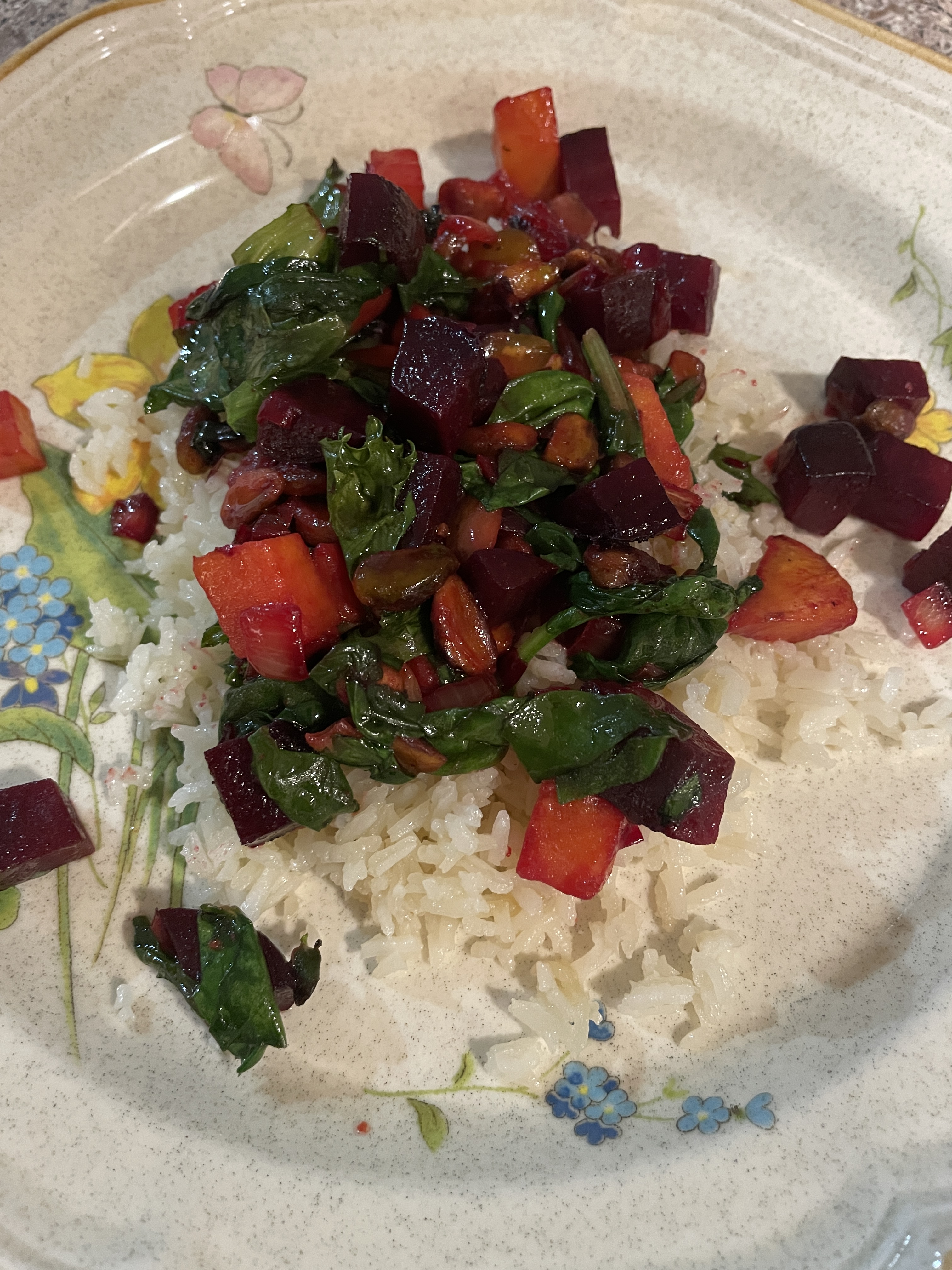
This recipe is vegan if you do not sprinkle grated cheese on top. It serves two. I used it as a main dish but it would also make an excellent side dish.
1/2 large beet, cut in small cubes
1/2 large sweet potato, peeled and cut into cubes
1/2 sweet onion, coarsely chopped
1/4 cup pistachios
2 cups greens
Sauté onion and beets in olive oil until tender. Add sweet potatoes and cook until soft. Stir in pistachios and 2 cups mixed greens. Stir until greens wilt. Serve over rice. Due to the flavors in the ingredients, I did not add any spices, but you could use your favorite spices.
1 medium sized beet cut into pieces and steamed until tender
4 gloves garlic, chopped
1/2 medium sized onion, chopped
2-3 drops basil essential oil or use 1/4 cup leaves
Milk or cream–use plant based milk to make vegan
Saute onion and garlic until tender in enough olive oil to cover bottom of pan. Drain the beets and put into blender, add the sautéed onions and garlic, add basil. Add enough cream or milk to make a thick sauce–put in a little at first, blend, and then adjust to make a thick sauce. Pour back into skillet, and add cooked pasta of your choice. I used gigli from Italy. Stir until well mixed or pour the sauce on top of the pasta when you serve it. I topped with grated asiago cheese.




 writingontherim