Book 24 for 2024: “Inland”, Téa Obreht


While I found her first book, “The Tiger’s Wife” fascinating, I remain uncertain regarding this one. First it is long, 374 pages (I do read long books); second, it tells two different stories which do not interconnect at all until the end of the book. I kept wondering, asking myself, “What?” For me at least, the story picked up about half way through and my interest greatly increased.

One storyline is the life of one homesteading family in rural Arizona in the 1850s told mostly from the viewpoint of the wife. Her husband tends to wander off for long periods of time leaving her on her own with their children. His latest adventure is not only their homestead but also owning and running the local newspaper in the nearest town. The reader also meets some rather powerful but unsavory characters who want to own all the cattle and all the land.

The second storyline deals with the men who were hired by the government to bring camels to the West and manage them, one of whose story–a real historical person–is told. His name was Ali, a Syrian cameleer, who died in 1902. He was called Hi Jolly because people in US seemed unable or unwilling to pronounce his real name correctly. This part is told from the viewpoint of another cameleer, Hi Jolly’s friend, who has a criminal history and is trying to elude the law. Camels were brought to the US by the United States Camel Corps in the 1850s. At that time few roads existed in the Southwest, water was scarce, and camels were known to be able to go long periods without water. The experiment failed so camels were left either in the hands of the individuals who rode and cared for them or left to roam wild. Some of the men, including Hi Jolly, were able to open businesses transporting goods to remote areas via camel. This book details part of that history.

In both storylines one recurring theme is the lack of water. At one point the homesteading family have no water at all. In the other storyline people hire the cameleers to take them to places not realizing that even camels need water occasionally. I find it telling that 175 years later we continue to struggle with water issues in exactly the same part of the country.

A Visit to Arcosanti


Arcosanti, an innovative village 70 miles north of Phoenix in the high desert, houses between 80-100 people who currently live there full-time. To become a resident, a person has to apply, take a five week course, and be able to contribute to the community. Their major business is making bronze bells in their foundry. They also host conventions. The week before I arrived, they hosted a convention of the executives of a corporation.

A few rooms of varying sizes are available to rent. They are pleasant with a view and modern amenities but not luxurious in the way some top hotels are. Here are views from my room.

After I arrived and unpacked, I took a walk up the hill and around the buildings.

This is a sort of giant classroom where it appeared they had been teaching how to make ceramics. The buildings are unique with the concept to fit in with the surroundings and take as little energy and resources from nature as possible.

This is the other side of the building in the previous photo. It is very hilly here and the buildings are build on the side of a steep hill.

The same building from a different angle. It was very windy when I was there and part of the area was closed due to the wind. There are bells everywhere and all were ringing in varying musical tones.

I walked down the road from my room, on a long trail, and up a steep incline to arrive across from the buildings so I could take these photos.

A closer view from across the arroyo.

This is across the arroyo from the main buildings. In the shadow, there is a door. I never learned what all this is for or what might exist behind the door.

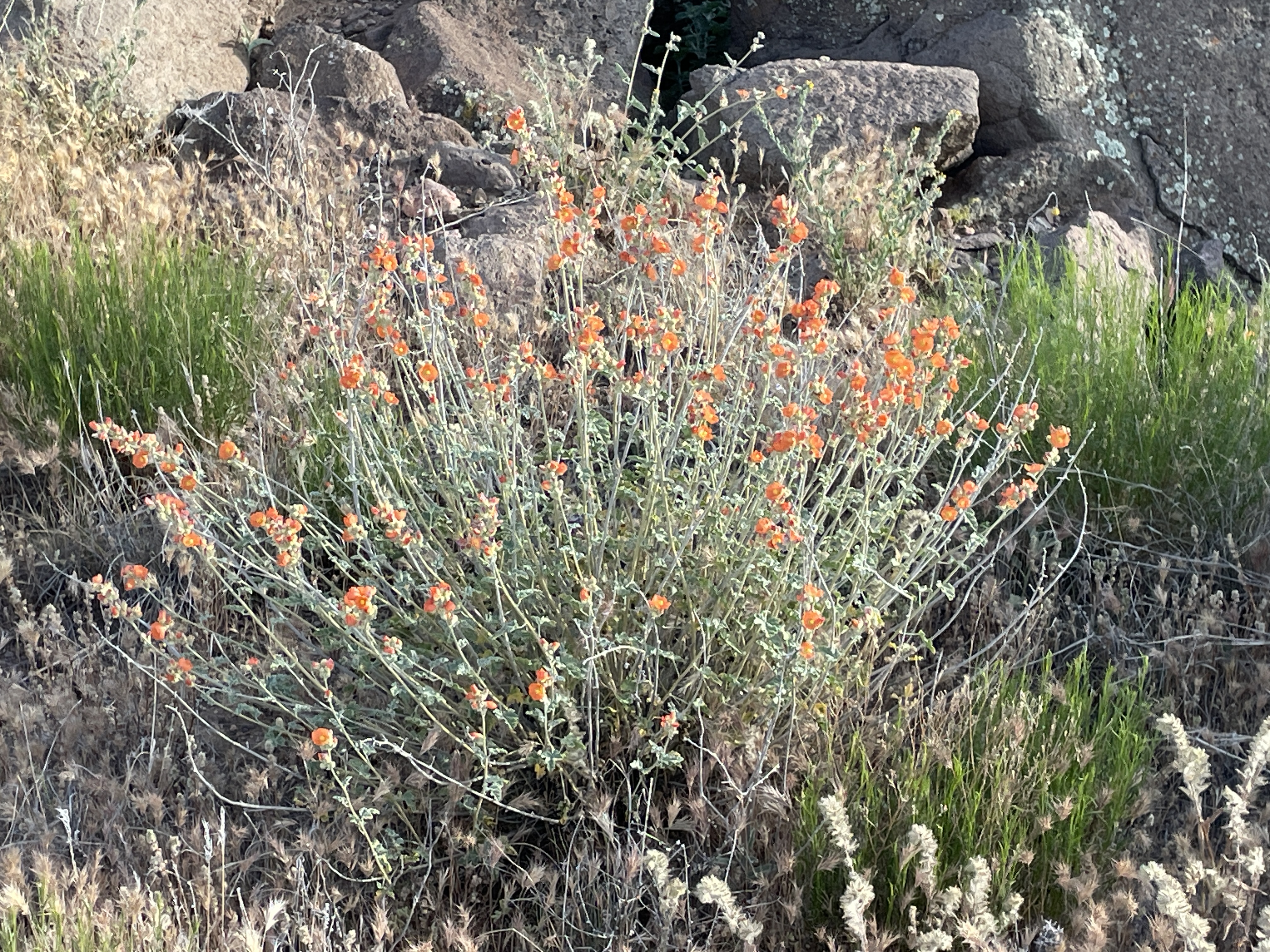
All sorts of wildflowers were blooming when I was there in May.

The restaurant is unique and delightful. They serve excellent coffee–one day some was lavender infused–and various other simple dishes and pastries they make on site. The orange column you see is installed in winter to provide natural heating using natural airflow and taken down in late spring. This is a unique and pleasant place to visit. You can take tours. If you stay there, you can wander around freely. And, of course, you can purchase bells from the very small to some that are quite large and like metal works of art.

Canyon de Chelley–Part One


One of the most famous canyons in the country resides inside the Dine (Navaho) Nation. While administered by the National Park service, it is also the home of several Dine families. You can drive through the roads on the top freely, stop at various viewpoints, take photos, etc. Here are the various views I saw last week while there. The bottom of the canyon is restricted. To go there, you need a permit and a Dine (Navaho) guide. More about that in the next post.

Several families live in the bottom of the canyon, especially during the summer months. You cannot go into the bottom of the canyon without a permit and a Navaho guide.

Book 14 for 2024: “The Invisible Hour”, Alice Hoffman


This is a book for those who believe in the power of books to transform life, who are fans of Alice Hoffman, and who like time travel. It also about how a charismatic man can ruin the lives of many, especially women, by controlling everything around him through fear and coercion. In his Community books and contact with the rest of the world are banned. Mia is a young woman who sneaks into a local library and finds Hawthorne’s “The Scarlet Letter”. She realizes the life she is living in the Community is like the lives in the book. Through this book she manages to attain the courage to escape such a man, the man who destroyed her mother, Ivy. She makes her way back in time to the period in the book, has a love affair with Hawthorne, and finally escapes the horrible man who tracks her everywhere she goes.

Book Seven for 2024: “After Eden, A Short History of the World”, John Charles Chasteen


Want to learn a lot in less than 400 pages? Read this book. Published this year, it is the most recent book by a prominent Latin American scholar and historian. After humans learned agriculture and built cities, most of the population of the world became increasingly patriarchal and warlike. The divide between rich and poor increased. Egalitarian foragers and wandering hunters existed only in more remote areas. A few still exist in those remote and less modern corners of the world, often places where few others want to even go. This quote says a lot about the current state of affairs:

“Our civilization has thousands of years practice making war. We have almost NO practice making global peace, but without it we are doomed. Today’s pervasive nationalism and rearmament is unlikely to help us make global peace.”

And a page later:

“Only a true unanimous global effort has any chance to preserve our common home.”

He notes that saving Earth will take huge social transformations, including curbing the excessive consumer capitalism that currently pervades plus overcoming a world wide history where half of humanity mistreated the other half, a practice that still continues.

One Book a Week-49: “Anything Is Possible”, Elizabeth Strout


Her books are deceptively simple with so much to say about people and life. This is the fourth book I have read of hers this year. It interweaves many of the characters in the books I previously read back to the towns where they were born and grew up. One part of the book discusses one family who were so poor the children dug food out of dumpsters and everyone made fun of them at school. Only one truly escapes and finds success. One lives a lonely life at the home place, and the other is filled with anger and resentment. Much of the book is about how even if persons escape a horribly poor and dysfunctional family and find success later in life, the terrible things that happen to them as children are always there lurking in the shadows. This includes a lot of resentment and anger from some family members who do not manage to escape. Other parts of the book detail the lengths to which people will go to find solace often secretly with few or no one having a clue about how their lives really are. How well can we really know another person?

One Book a Week-46: “Road Fever”, Tim Cahill


After reading two intense, somewhat depressing novels, I decided to read a lighter non-fiction work. An article I read mentioned a tale of two guys, Tim Cahill and Garry Sowerby, who drove a GMC Sierra pickup truck from Tierra del Fuego, Argentina, to Prudhoe Bay, Alaska in less than 25 days. I like adventures and the best vehicle I ever owned was a Sierra 4 by 4 Off Road. I sold it to a former student when I moved. It was still going strong at over 300,000 miles.

In order to follow along on their adventure, I dug out my atlas and followed their trip through 13 countries, finding cities, little towns, rivers, mountains. When they traveled in 1987, the only place with no road was the Darien Gap on the border between Colombia and Panama–today still no road and now famous for all the migrants who labor through this dangerous, swampy, jungle area on foot on their way north. Since no road there, Tim and Garry had to load the truck onto a container ship in Cartagena and unload it in Panama. They also rode on the ship as passengers. This lead to their meeting some of the most colorful characters on their trip.

Along the way, they meet all sorts of people, e.g. sadistic police, kind employees of international GMC, a weird consulate employee, and helpful women, describe them and the landscape in detail. Procuring the right documents and proceeding across borders is sometimes easy and sometimes grueling, again described in detail. Of course, political leaders, ease of travel, etc. have changed in many places–I’ve been to or lived in five of the countries they traverse.

Want to explore new places, meet all sorts of folks?? Then this is the book for you and a fun read.

One Book a Week-44: “The Unsettled”, Ayana Mathis


To say this novel is intense is an understatement. It begins with Toussaint, a 13 year old boy left to survive on his own then switches to Ava, his mother, who grew up on the road following her mother’s singing in Southern clubs until her mother settles down with Caro in a Black country Alabama town where all the Black people own acreage and are not only self sufficient but also sell their goods in many places. The nice life they have in this town changes suddenly when disaster occurs and her mom, Dutchess, goes into a prolonged mourning period. Eventually, Ava goes to college, obtains various jobs, wanders all over the country, and meets Cass, a doctor and Black Panther whose charisma draws people to him. He disappears, she and their son, Toussaint, wander from place to place as she goes from job to job. She marries, Cass reappears, and one bad event after another occurs.

This is a story of mother and son love, women who become ensnared with the wrong men, self sufficiency in spite of many obstacles, angry men, hope, and redemption. It is a story of this country.

One Book a Week-42: “Where There Is Fire”, John Manuel Arias


Before and since my two trips to Costa Rica, I thought Costa Rica had miraculously escaped the Banana Republic fate of many other Central American countries. This historical novel enlightened me to just how wrong I’ve been and how some of this continues today–huge US agricultural corporations controlling much of the agriculture.

In the 1960s, large US corporations invaded Costa Rica and controlled large blocks of land to raise bananas and cause havoc among large segments of the population. To increase yields the American Fruit Company doused their giant, lucrative, banana plantations with Nemagon, a pesticide that causes cancer and sterility. The novel includes letters indicating that both this company and Dow, the producer of the pesticide, knew this, did nothing about it, did not inform workers (until they had no choice), and continued its use.

The novel contains the story of one family’s history who lived near the largest plantation, the father and grandfather who worked there, a devastating fire, and the effects of this company’s policies on several generations.

Note: As recently as last year, the BBC reported on the use of this pesticide and its effects on workers and people living near plantations where it is still being used. Online you can find numerous articles about how these practices (the American Fruit Company is now Chiquita) fueled neocolonial exploitation and drug cartels.

One Book a Week-40: “Wifedom”, Anna Funder


I found this new non-fiction book both fascinating and disturbing. Like Funder, I’ve always considered George Orwell (not his real name) a great writer and appreciate his insights into the methods used to gain power and control people plus the clever ways those who wield power draw masses under their influence.

After reading several biographies of Orwell, Funder began to wonder about his wife whom these authors barely mention. What Funder discovers is both enlightening and dismaying. Did Orwell love her or just use her as an editor and fancy typist? Did he even like women or just use them? Would “Animal Farm” and “1984” even have been written without her help? The subtitle of Funder’s work is “Mrs. Orwell’s Invisible Life”. Her real name was Eileen O’Shaughnessy. She married him in 1936.

What does it mean to be a writer” What does it mean to be a writer’s wife?

In many ways this work is a tribute to the unrecognized contributions of women though out time and everywhere.

Note: While reading about Orwell and his wife and family, the reader also learns about what it was like to live in the middle of nowhere in the English countryside without adequate heat and even sometimes a lack of food. It also details Orwell’s stay in Spain during the Spanish Civil War and his travels to France as a journalist toward end of WWII. He also suffered from TB about which he continually lied to everyone.