The title of this non-fiction book explains what this book is about. The author is emeritus professor of biological science at Southeastern Oklahoma State University and of Cherokee heritage. He cites all the historical findings and current research regarding how natives used fire to control forests and grasslands, the numerous large native cities found both in US and Latin America using lidar technology, and how the colonists were totally mistaken when they thought they had found a land that lacked the influence of humans regarding forestry, farming, orchard keeping, etc.
He notes that the way the indigenous people in the US farmed and maintained orchards was not like those of the Europeans so they thought no one was doing anything and they were incorrect. He also goes into a lot of the history about how European diseases especially brought about the demise (genocide) of millions of native peoples even often those who had not themselves seen Europeans. Many European diseases spread from domesticated animals to humans (he provides a long list) and natives had no immunity. He cites of only one Western Hemisphere disease (syphilis) that went from the Americas to Europe. He claims that there were so few native diseases in this hemisphere because there were no large animals to domesticate.
The way Native Americans farmed, maintained forests, established orchards, etc. was so different from the European way that Europeans thought no one was doing anything productive with the land. To the contrary, they were affecting the land greatly but in ways that were more sustainable. Currently, he notes in the US forest management people have begun to recognize Native American forestry expertise and use it in many places.
Fascinated since childhood by the lands surrounding the Mediterranean Sea, I accidentally discovered this book when I had to go to a new LA County library because the one near me is closed for renovations. The book describes in detail the life of Mohammed and the controversy that ensued after his death as to who should be in charge. This dispute ultimately caused the division into Sunni and Shia which continues today. It also covers other less well known groups such as Ismailis, a missionary sect of Shia Islam, and Sufiis, Muslim mystics.
I found the book extremely informative in describing how a small group of Arabs managed to conquer most of the land south of the Mediterranean and the lands to the east and eventually convert Central Asia and a substantial portion of West Africa. It also details the reign of many of the more famous caliphs, wars among various Muslim ruling families, and the building of Alhambra. While most of Europe was still feudal and in the Dark Ages, many Muslim cities such as Cairo and Damascus were centers of scientific research and learning as well as the arts and literature. Unlike what many continue to believe, Muslim women often held jobs and sometimes positions of considerable power and had legal guarantees to property and inheritance when women in Europe did not.
As I mentioned in a previous post, his books on delights were mentioned to me by two different people in two totally different settings so I decided to stay sane in all the seriousness of my life, reading something lighter might be a good thing to do. I guess I was thinking delights like flowers, food, etc. but this is more like a series of short essays about life all written in the span of one year–his gardening, experiences strolling around his neighborhood and favorite coffee shops, food, his parents, his wife, some personal history, his experience as a college professor, children. However, he also addresses serious issues–his meeting a homeless veteran just out from a stint in a mental facility and how he was compelled to help out after first driving off, racism he has experienced, his issues with the government and social media, family death, and life in general. And above all, what it means to him to identify as a poet.
This recently published book is one of the latest in a bookclub to which my grandson belongs. Although an historical novel based on the reporting of an actual event in 1701, much of it applies to today’s world. In 1701, Dr. John Friend reported to the the Royal Society of England about a “rumuor spread” which discussed a report that young girls in the Oxfordshire country side had “been seized with frequent barking in the manner of dogs.”
Five sisters live with their grandfather on an affluent farm in the country. Due to the recent death of their grandmother, they go around dressed in black as was the custom. Because they stay to themselves a lot, roam freer than most girls, they are often looked upon with suspicion by the villagers. One man, who ferries everyone to and fro over the nearby river, has issues with women and loathes these girls because he thinks they are too independent and views them as defiant and thinks they ridicule him because they do not chat with him when they use the ferry. He also has a severe drinking problem and spends all of his free time in the village pub. He is about to be married to a local woman but has severe anxiety over this because he thinks his new wife might try to boss him around.
Most of the men in the village spend their evenings drinking in the pub and often resort of fights and various forms of violence when issues arise. They see this as manly behavior. They view with suspicion any man who does not behave as they do. The woman, Temperance, who serves them hates alcohol and goes so far as to wear leather gloves so the alcohol will not touch her hands. She is one of few in the village who does not believe in rumors and supports rational behavior.
Everything goes awry when during a severe drought, the river dries up, the heat overcomes everyone, and Pete, the ferryman, insists he has seen the five sisters bark and turn into dogs and incites fear in many in the village. It seems to matter little that the two young men who work for the girls’ grandfather, proclaim that the girls are perfectly normal and none of this is true.
This novel raises various issues that continue as issues hundreds of years after the above incident:
-What does it take to make a man? What characteristics define real manhood? Is manhood defined by violence or kindness and compassion?
-How much freedom is okay for women? How much independence and who determines this?
-When is drinking ok and how much? Should people stop people who become violent when drunk?
-What happens to a neighborhood, a society, when people start to believe all sorts of stuff that is not true? Can it be stopped and how?
Two days ago I drove to the local library to return “The Historian” and inquire about a book an acquaintance had recommended. The library houses a used book section at its front hall entrance. I usually only glance at it because mostly it contains books in which I have zero interest. I glanced once again. There in nonfiction I saw NERUDA painted in big, bold bright colors-blue, red, green, purple–across the top half of a book cover. Just below this was a parade of flowers marching across the middle of the cover in the same bold, bright colors. Finally, at the bottom painted in bright red on a black background in capital letters it read, “MEMOIRS.” Inside the O is printed in the same red these words,”confieso que he vivido.” I snatched it up. The little sign said 25 cents. Although I’ve read Neruda poems mostly translated into English, I had no idea he had written anything about his own life. I knew I had to read this. I knew some things about his fascinating life. I wanted to know more. I dug around in my wallet, found a quarter, and deposited in the little brown box one of the librarians had indicated.
Later at home, I read the beginning, his brief introduction, explaining there are gaps here and there. He also explains, “What the memoir writer remembers is not the same as what the poet remembers.” He goes on to explain this. I will need to contemplate this more. Then in the beginning of the first chapter, “The Country Boy”, he describes “The Chilean Forest”. It starts, “Under the volcanoes, beside the snow-capped mountains, among the huge lakes, the fragrant, the silent, the tangled Chilean forest…” What continues is a prose poem describing this forest with intense sensory detail so clear the reader can see the details, the mystery, the lushness. He ends with this poem with the words, “Anyone who hasn’t been in the Chilean forest does not know this planet. I have come out of this landscape, that mud, that silence to roam, to go singing through the world.” Reading this beginning instantly linked me to his poetry I had read, to its sensory detail, to its lyricism.
They say we are all products of the environment in which we grew up whether we like it or not. Reading this is making me view this truism in a new light.
After reading about the nutritional value of dates for the brain, I headed to the nearby farmer’s market where they sell everything you can imagine from the Middle East as well as other international foods. At the dried fruit section, I studied the different kinds of dates. Medjool and deglet were familiar. Then I saw a box with three kinds of dates I had never heard of: piarom, zahedi, rabbi. They even looked a bit different. Tired of the same ole stuff to eat, I bought the box then went home and decided to research the origin and characteristics of each one.
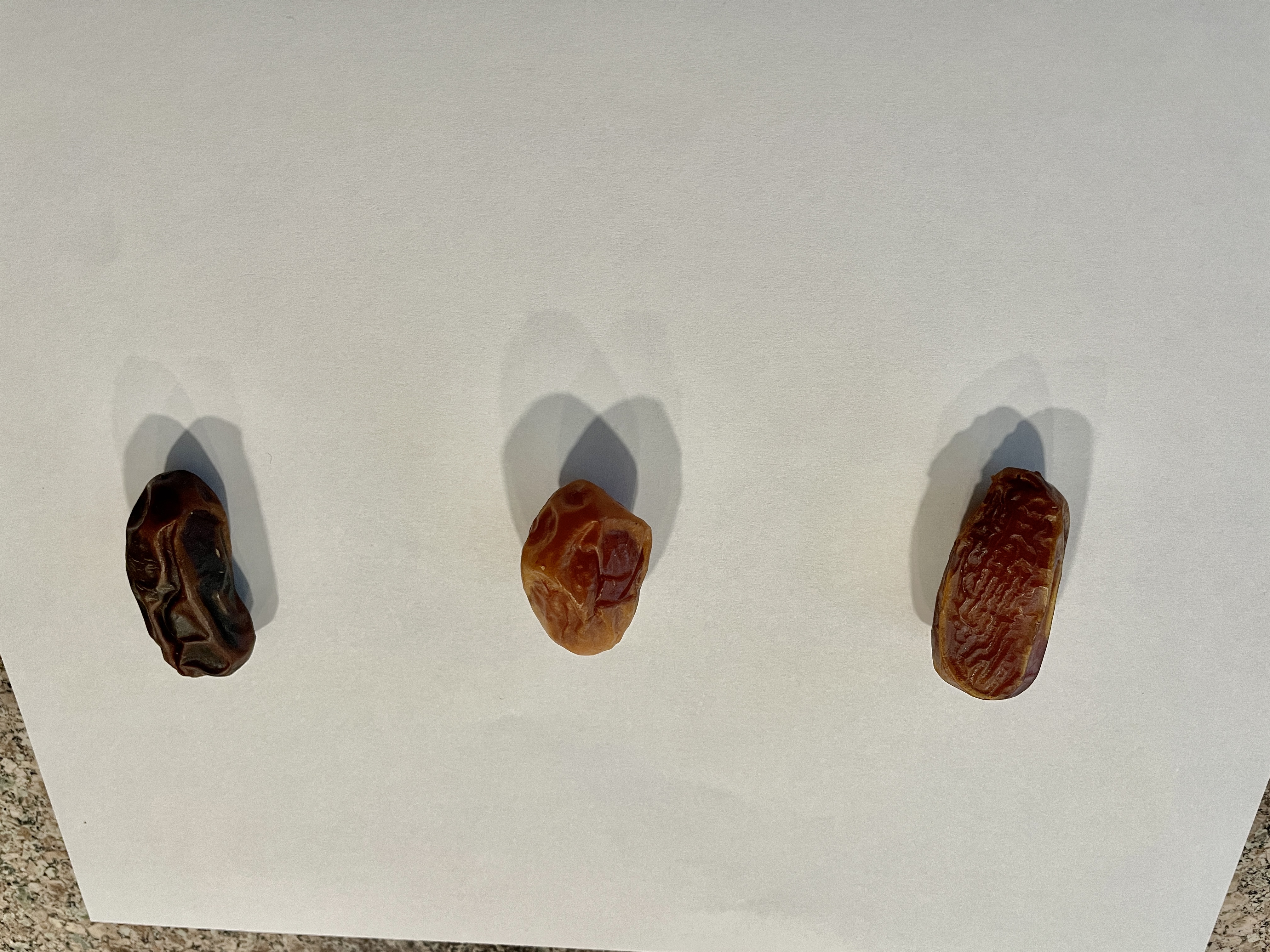
Unlike medjool dates which are considered wet, these three are considered semi-dry. The piarom are grown primarily in southern Iran. Some depending on exact origin and harvest are one of the most expensive dates in the world. They are longer and thinner and a dark chocolate color so often referred to as chocolate dates due to both color and flavor. Another common name for them is maryami. The pits are smaller and so there is more flesh per date. They contain less sugar (lower glycemic) than the wet dates like medjool.
Zahedi dates even look really different. They are shorter, a bit fatter, and golden colored. The pit is easier to remove than most dates too. They have less sugar content than most other dates and therefore can be eaten in moderation by diabetics. They are primarily grown in Iraq and Iran but some are grown in certain areas of North Africa and Asia.
Although the majority of rabbi dates are grown in Pakistan, their origin is Iran. They too contain less sugar than wet dates like medjool. They are reddish brown and usually a bit fatter than piarom dates. Their flavor depends on the soil and the weather conditions under which they are grown. Generally their flavor tends to be caramel-like and nutty.
Like most dates, these support gut health and provide electrolyte balance due to high levels of potassium and magnesium. One big advantage is their lower sugar levels. In addition to the above, like all dates they contain high levels of polyphenols. I will buy them again.
On the left is piarom, then zahedi, and finally rabbi. Some of the zahedi are very light colored.
This novel surprised me by being a page turner. Once I read through the first couple of chapters, I had to keep going. In Southern California the Salton Sea, once much larger and the home of a thriving resort, now has shrunk and only a few people live there. Not far away lies the Imperial Valley, one of the largest agricultural regions in the US which is close to the Mexican border. This is the setting of the story of the little town of El Valle, the surrounding areas, and the tale of two families, one rich, white landowners, the other Mexican-indigenous. Mal, one of the main characters, has always lived on El Valle, worked hard, tried to forget the disappearance of her sister, and raised two daughters alone. Another local girl goes missing, then a week later her youngest daughter also goes missing. Frantic, she searches for answers, wonders if there is a link, and keeps dreaming of the local, indigenous legend of the horse headed woman, El Siguanaba. Meanwhile readers learn about the long friendship and affair between Mal’s oldest daughter, Griselda, and the son of the valley’s largest, white landowner, Mal’s difficult, disabled mother, her father, and brother’s, one of whom is running for office after going to Stanford, and the youngest brother, Benny, who is now a detective. Not only does this work of fiction combine Latinx and indigenous cultures, it also addresses environmental collapse, family secrets, and the complex relationships between mothers and daughters.
Translated from French and written by a Senegalese author, this novel takes place during the time of colonialism and the slave trade. In Paris of 1806, a famous botanist, Michel Adanson, is dying. He never has finished the botanical work to which he dedicated his life, and as he lays dying, his last words are the woman’s name “Maram”.
His daughter finds an unpublished memoir hidden in a cabinet. It is the story of his younger life, what happened to him in Africa, all addressed to his daughter so she can understand his story and the meaning of his last word. It is a tale both strange and sad, filled with healers and magic and tragedy. Maram, a fabled revenant, a woman of noble birth from the kingdom of Waalo, was captured and sold into slavery but managed to escape. While working on his quest to find new plants, Adanson hears about this woman and becomes obsessed with finding her. His guide, Ndiak, the son of a chief, accompanies him everywhere and they become friends. This is a story of adventure, romance, and the horrors and cruelty of the slave trade.
Note: The author won the International Booker Prize for his other novel, “At Night All Blood Is Black”. Readers of this will miss several books I am reading because I am a judge for a literary context and cannot discuss what I am reading for the next several weeks.
This is a sort of travelogue, memoir, and recipe book. The author begins in Odessa and travels south from there to the port of Constanza in Romania as well as various other seaside towns in Bulgaria, then to Istanbul. After spending more time there she heads east to all the ports and some inland cities near Turkey’s Black Sea coast.
I hope to learn new information and become a little more enlightened when I read–especially when reading non-fiction. This book did not disappoint. Here are a few of the things I learned:
-Odessa is a very old and once a very international city. At one point it had the second largest Jewish population in Europe. Now only about 1/3 of the residents are Jewish. Many of the restaurants serve traditional Jewish food even if not Jewish. Once in the past, Mark Twain visited there and made it famous for its ice cream.
-In Constanza, Romania, she witnessed a huge Navy Day celebration with booming gun salutes. Once upon a time, this city was famous for its Casino which now is just a glorious ruin. Here a breakfast mainstay is polenta with a mushroom topping. The author apparently liked the food because this section contains more recipes.
-Varna is the main seaport city in Bulgaria. The author’s main quest here was to see the gold, yes, gold. Once upon a time, this city was a major Roman port. Now the Museum of Archeology houses a spectacular collection of ancient gold. “Breastplates, bracelets, burial gifts, regal-looking head pieces, figurines, and pendants–all gold–shone for attention. The silent Midas room was deafening, ringing out with finery, treasure and opulence. And the loudest, biggest treasure of all, was the smallest. Tiny pendant earrings, almost inconceivably old, dating back 6000 years….these earring are the oldest ‘worked gold’ in the world. They belonged to the first known culture to craft golden artifacts, and they lived here, on Bulgaria’s section of the Black Sea in what some archeologists consider the oldest prehistoric town. But it was not gold that made this area wealthy; it was salt which was mined nearby. The world salary comes from the Latin word ‘salarium’–a Roman soldier’s stipend to buy salt.
-She goes to Istanbul and then on to Turkey’s Black Sea towns, Amasra, several a bit inland, Sinop, Trabzon, and Rize. Sinop has a particularly good harbor. There is a saying that the Black Sea has three safe harbors, July, August, and Sinop. This is in an area often targeted by Cossacks who crossed the Black Sea to raid these more prosperous areas. The town also houses an infamous prison where Russian convicts taught Turkish cellmates how to make model ships for which the town is now famous.-More than 3/4 of the world’s hazelnuts are grown in this area of Turkey. However, that did surprise me as much as the tea, yes, tea. When I think of Turkey, I think of that thick, strong Turkish coffee. However, Turkey is the fifth largest grower and exporter of tea in the world. The tea grows in the fog and mist on steep slopes that end at the sea. Several photos in the book illustrate the lush green mountains covered in tea bushes.
-When I think of Hagia Sophia, I think of the spectacular building in Istanbul, the one that has withstood invasions and earthquakes. But there is another one. On the western edges of the city of Trabzon, there is a smaller, more tranquil Hagia Sophia, one of the Black Sea area’s most spectacular monuments. It was built as a church in the 13th century, converted to a mosque, then to a cholera hospital, then a museum and finally back to a mosque in 2013. The ceiling and walls are covered with frescoes that for a long time no one knew existed until they were restored.
In addition to all the tales of her adventures and the ordinary people she meets, the book is filled with recipes that are specialties of the areas she visited. I’ve taken some ideas from several to experiment with new dishes like combining Swiss chard and sultanas (golden raisins) with chopped onions and garlic sautéed in olive oil and served over Basmati rice.
I enjoyed the previous book by Caroline Eden so much I searched for this one. I doubt I will ever make it to Samarkand or Tashkent, places sort of on my bucket list, so what I do is read everything I find about these fabled cities on the Silk Road. The sub-title of this one is “Recipes and Stories From Central Asia and The Caucasus”. It starts with Samarkand and the story of Tamerlane, the legendary hero who conquered a lot of this area and a large portion of surrounding areas in 1370. He was a military genius who loved chess and made up his own chess game with twice the number of pieces.
What foods show up in both the stories and recipes? Beets, fruit–dried and fresh for which the area is famous, tomatoes, cucumber, pomegranates, cabbage, lentils, rice, lamb and mutton, and all sorts of kebabs and flatbreads. I learned there is a huge beach on Lake Issyk-Kul in Kyrgyzstan. It is one of the world’s largest alpine lakes and in summer people from Russia and all over Central Asia flock to its shores. People who own guest houses there make all their money for the entire year in the brief summer between mid-July and mid-August.
In the remote mountains of Azerbaijan lies the small town of Gyrmyzy Gasaba above the Qudiyaleay River, a town where all the people are Jewish. Even though Azerbaijan is a predominantly Shia Muslim country, the people in this town have peacefully lived here for hundreds of years. This town is considered the last surviving pre-Holocaust Jewish town untouched by WWII.
If you are a lover of apples, then consider this country, Kazakhstan, the place where apples originated. All apples in the world today come from the original apples here. The name of the largest city, Almaty, whose older name was Alma-Ata means fatherland of apples. In Ile-Altalan National Park on the northern slopes of the Tien Shan mountain chain thousands of acres of wild apples flourish.
Even though this book was published less than ten years ago in 2016, a lot of people must have been interested in reading the stories and recipes because the copy the library found for me is not in the best condition. Before I return it, I will copy some of the recipes to try.

 writingontherim