Barbie Doll


Barbara Lewis Duke, pretty, petite, blue-eyed and blond, my mother, one

fearless, controlling woman.  Long after Mom’s death, Dad said, “Barbara was

afraid of absolutely no one and nothing!”  They married late:  34 & 38.  He

adored her unconditionally.  She filled my life with horses, music, love,

cornfields, hay rides, books, and ambition.  Whatever she felt she had missed,

my sister and I were going to possess:  books, piano lessons, a college

education.  Her father, who died long before I was born, loved, fancy,

fast horses.  So did she.  During my preschool, croupy years she quieted my

hysterical night coughing with stories of run away horses pulling her in a

wagon.  With less than one hundred pounds and lots of determination, she

stopped them, a tiny Barbie Doll flying across the Missouri River Bottom,

strong, willful, and free.

Blackwater Draw–Part One


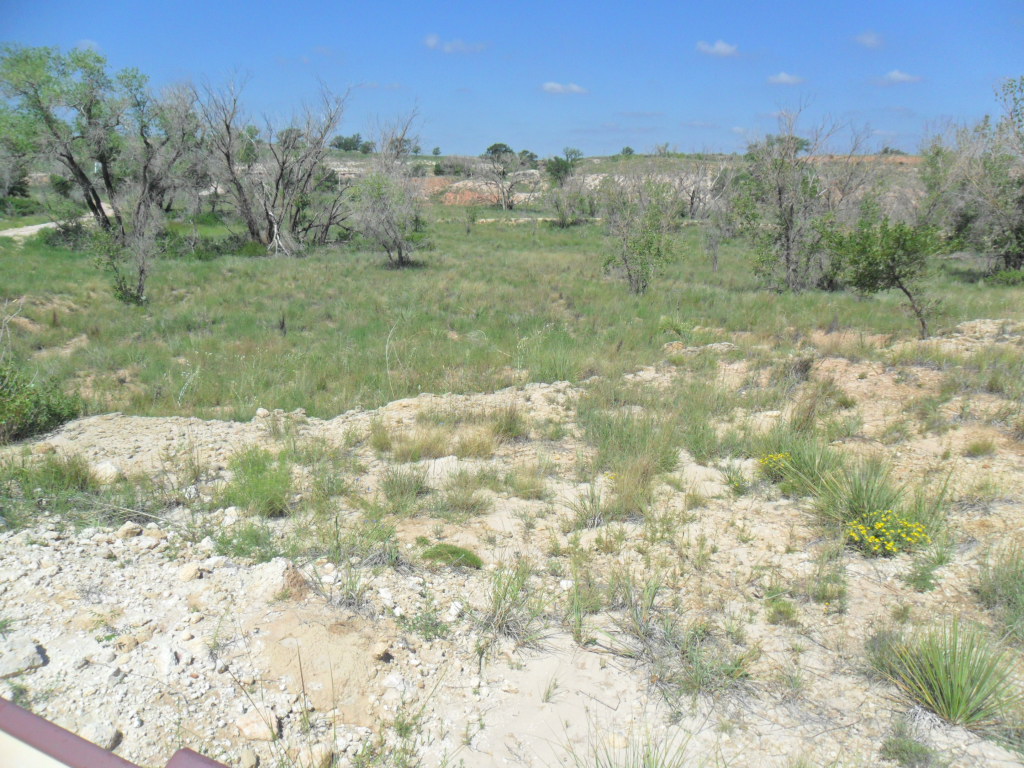
Annually, I make a pilgrimage to this ancient place where people hunted on the shores of a lake nearly 12,000 years ago.  It continues to be the oldest evidence of human habitation in the Americas.  For a large part of the twentieth century it was a gravel pit.  The gravel mining created both positive and negative consequences.  Without it, the bones of giant bison, mammoths, dire wolf, saber toothed cat and camels might never have been discovered at all.  However, because the owners of the quarry refused to stop mining, some portions of the site were destroyed by big swoops of the excavator machines.  Frequently archaeologists worked simultaneously along with mining operations, continuing within sight of each other.    Various groups, including some private individuals, attempted repeatedly to buy the site to save its precious stash of bones, artifacts, and ancient wells.  The owners refused to sell.  Finally, in 1978, Eastern New Mexico University purchased the site and continues archaeological excavation there.  They also run the nearby museum adjacent to the university football stadium.

If you expect something wondrous and grandiose, you will be severely disappointed.  A small building houses a teensy museum, restrooms, a few sweat shirts and posters and books for purchase.  An individual sits by the door to take your meager entrance fee–at most five dollars–and answer questions.  These individuals explain they are majors in disciplines related to the site, archaeology, paleontology, anthropology, that sort of thing.  A simple gravel trail traverses the site and a smaller trail goes to an ancient well–16 have been found at or near the site–and to a dig inside a building where you can observe the layers unearthed, which group of people left which type of artifacts, and actual bones of mammoths, giant bison, and other animals from the end of the last Ice Age.

People react differently to such sites.  I always remain entranced, overwhelmed, reflective, thinking to myself, “I am walking where people walked and hunted and went about their lives more than 11,000 years ago.”  The most ancient evidence of people is labeled Clovis Man–Clovis, NM, is just up the road.  They never found human bones of these people here , just their spearheads stuck in the ribs and shoulders of mammoths which stood 15 feet at the shoulders.  The people who came later made a different type of spear, called Folsom points.  These people, Folsom Man, lived later by 1-2 thousand years.  Another site, called Folsom, is near the tiny town of Folsom, NM, farther north at the edge of the mountains.  This site is on private land and tours are available only twice a year.  Although I visited the town last year, I have not visited this site.  Other people arrived later and although the collection is smaller, their spearheads remain available for viewing at the nearby Blackwater Draw Museum on the main road between Clovis and Portalis, NM.

When I look at the list of animals who lived here at the end of the last Ice Age, I feel amazed because they include both camels and horses as big as our horses now.  Both of these became extinct as did the saber toothed cat with the humongous canine teeth and the dire wolf.  Giant sloths lived until modern times but nowhere near New Mexico.  How could all these animals live here?  It was wet and green then.  Until the last couple of decades, bodies of water of varying sizes have drawn animals and people to this area.  Giant fields of irrigated corn and dairy farms lowered the water table sufficiently to eliminate any evidence of water.  At the time of Clovis Man a large lake covered the site.  Later, during a 3000 year drought, people dug the ancient wells to reach water.  Because this remained the only place for hundreds of miles with a supply of water, people came.

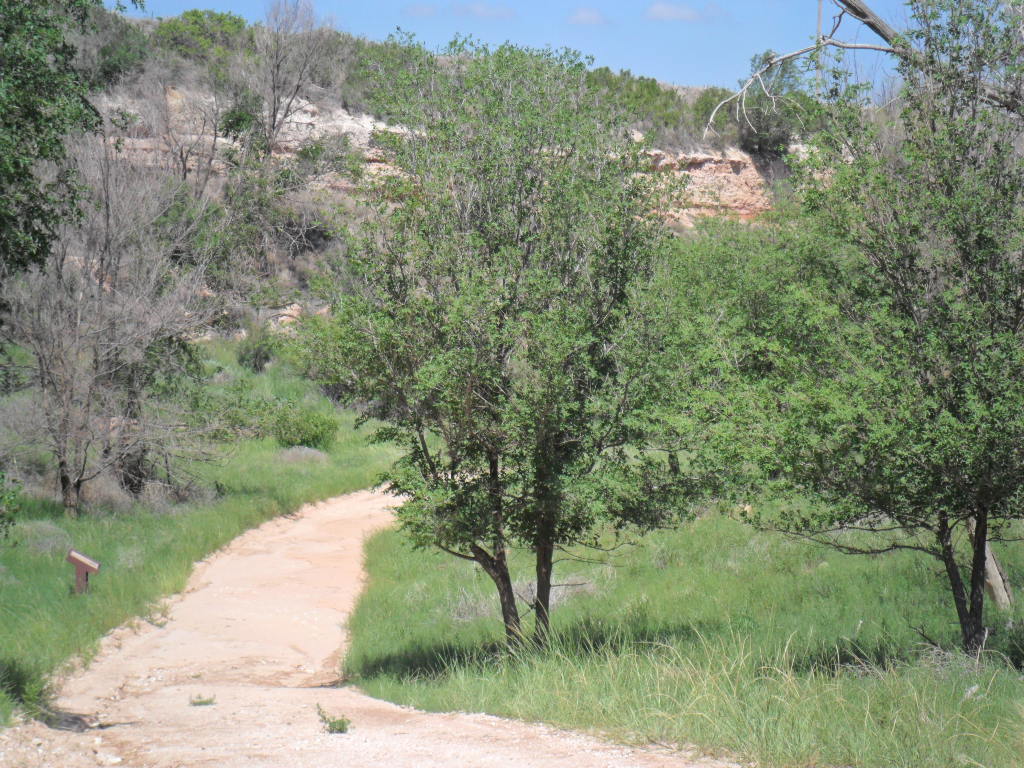
The trail begins just to the northwest of the tiny building and goes along the top for a couple of hundred feet before it drops down into the gravel pit remains.  The gravel was below all the layers containing human artifacts and ancient animal bones so the pit is wide and deep.

SAM_1302

SAM_1301

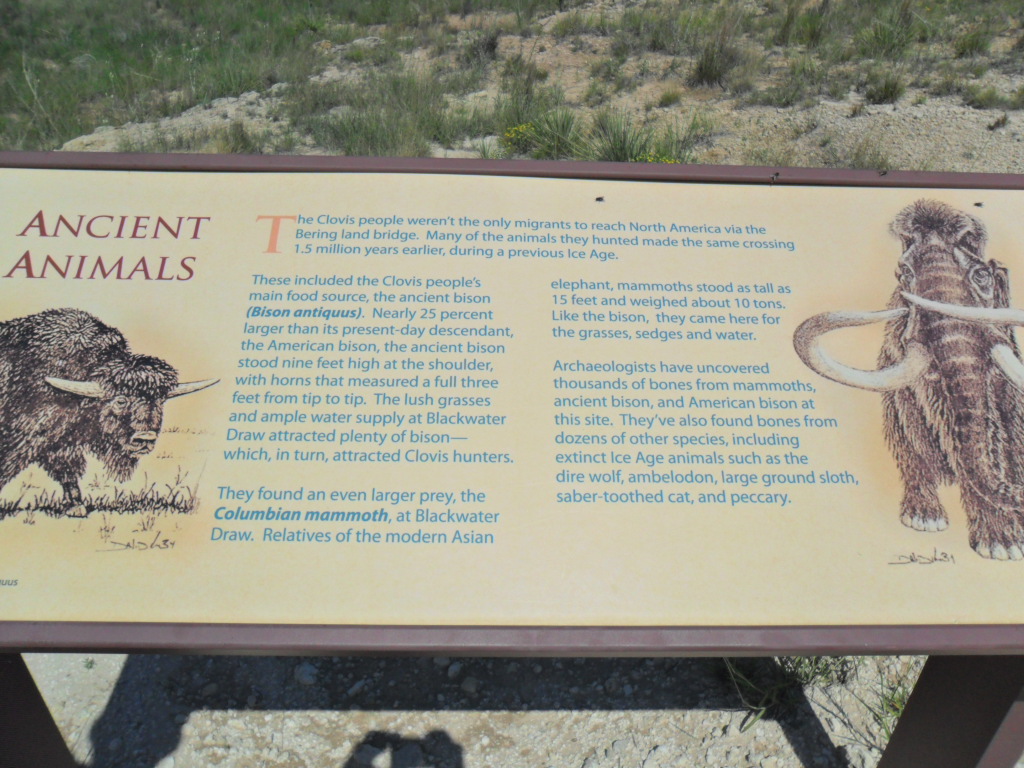
If your sight is good, you can read this.  The primary source of food for Clovis Man, giant bison and Columbian mammoths, came here for the water.  Archaeologists  theorize that hunters often killed these huge animals while they were in the water where it was more difficult for them to escape and move quickly.  In one place on the trail, evidence of a five bison kill complete with spearheads makes one think just how difficult and dangerous this hunting activity must have been.  I stand there, think about my own 5’4″ height, and wonder what it would be like to have a Columbian mammoth close to me.  Doubtless many died from injuries during such activities.

SAM_1304

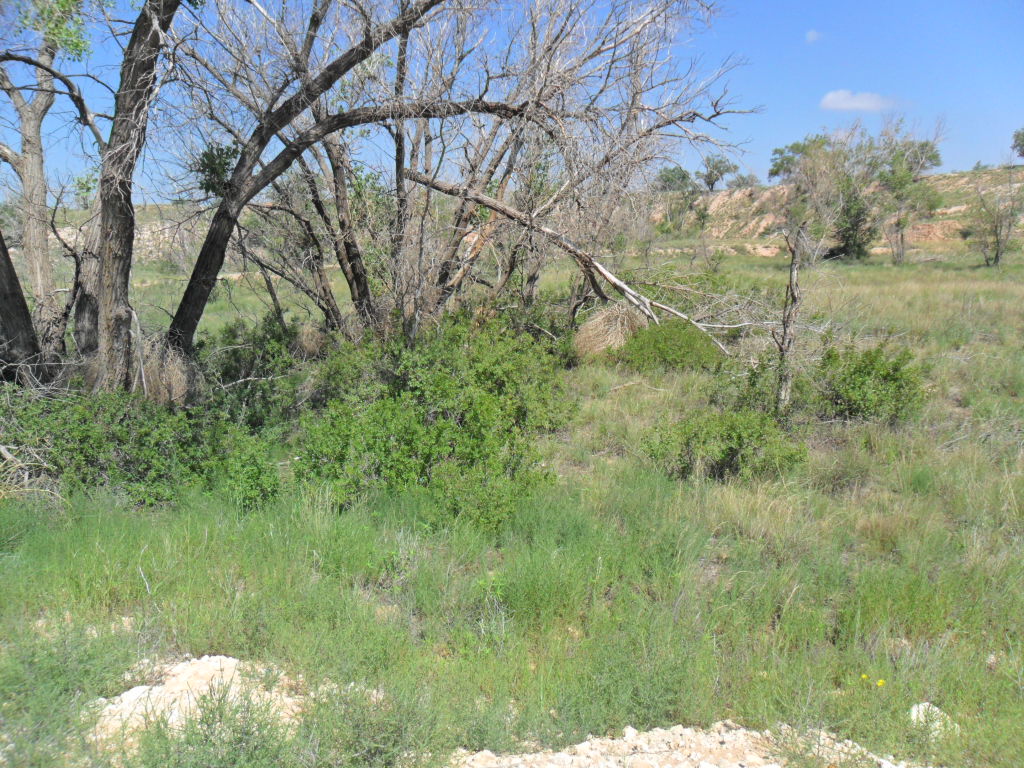
The train meanders along the bottom of the gravel pit.  This year, plentiful rain grows abundant grass.  During the last several years, little rain has fallen as evidenced by all the dead trees and bushes scattered around the site.  Normally, this area is semiarid with less than 18 inches of rain per year.

SAM_1303

If spectacular scenery appeals to you, do not go here.  Most of the bones and artifacts were found in the layers at the sides of the pit.  As you walk the trail, markers indicate the location of findings.  Few human remains are found at such sites because these were not permanent settlement places.  Ancient peoples roamed the land in search of water and food.

SAM_1305

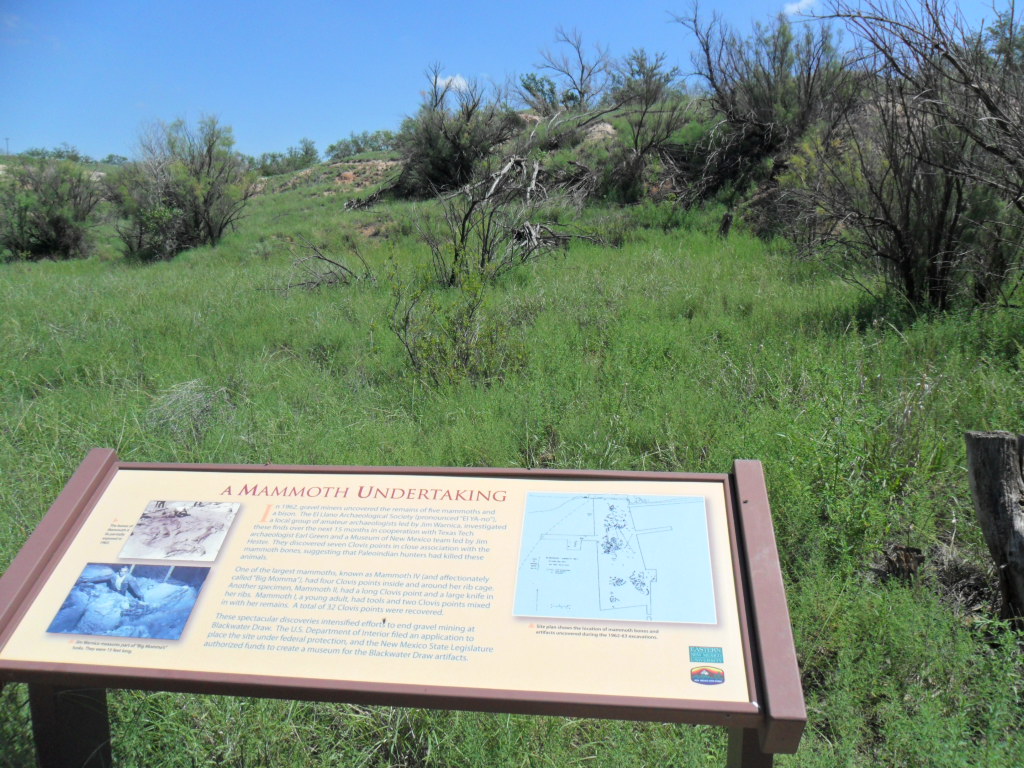
Signs, such as this along the trail, illustrate different places where specific bones and artifacts were found.  They also explain the different types of artifacts, their specific uses, and the history of the site.  Maps, like the one on this sign, help the viewer hone in on specifics in relation to where one is standing.  The photo illustrates archaeologists in action during site digs.

SAM_1307

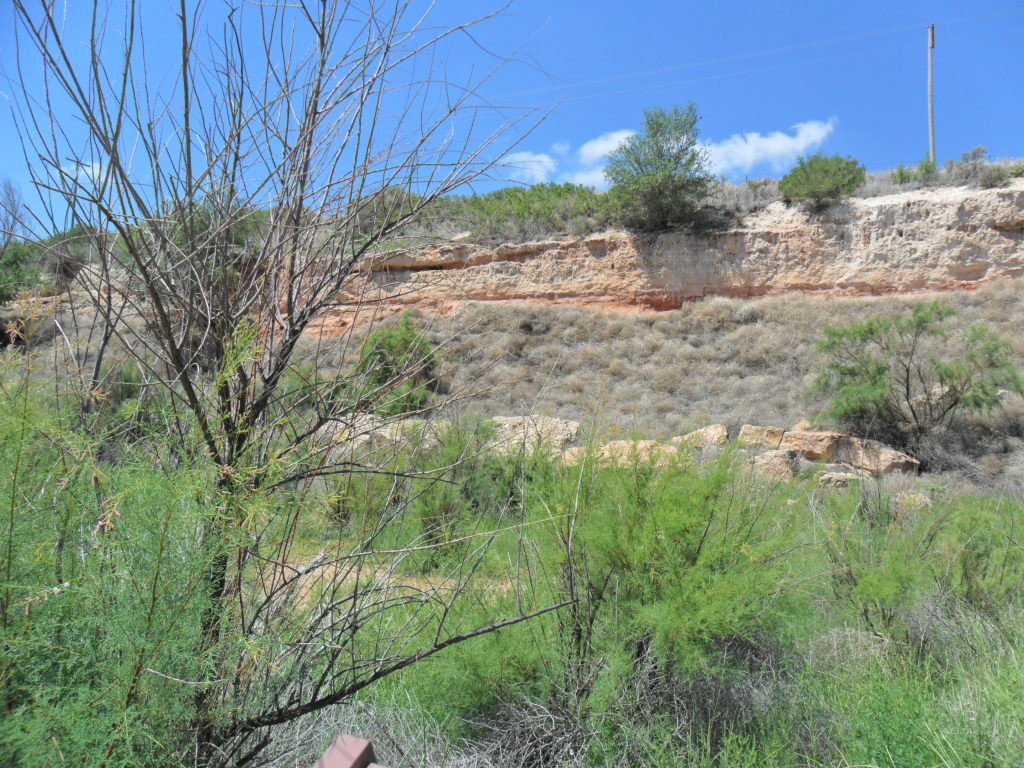
Cliffs, like the one here, surround the site.  In these small cliffs each layer indicates a different age of human activity by not only the type of sediment but also by the type of artifacts and animal bones found.  Just beyond this particular cliff at the west edge of the site, irrigation pivots run in a huge corn field.  The grey at the bottom of the cliff indicates an immense pile of dead, dried, tumble weeds.  This is dry country.

SAM_1308

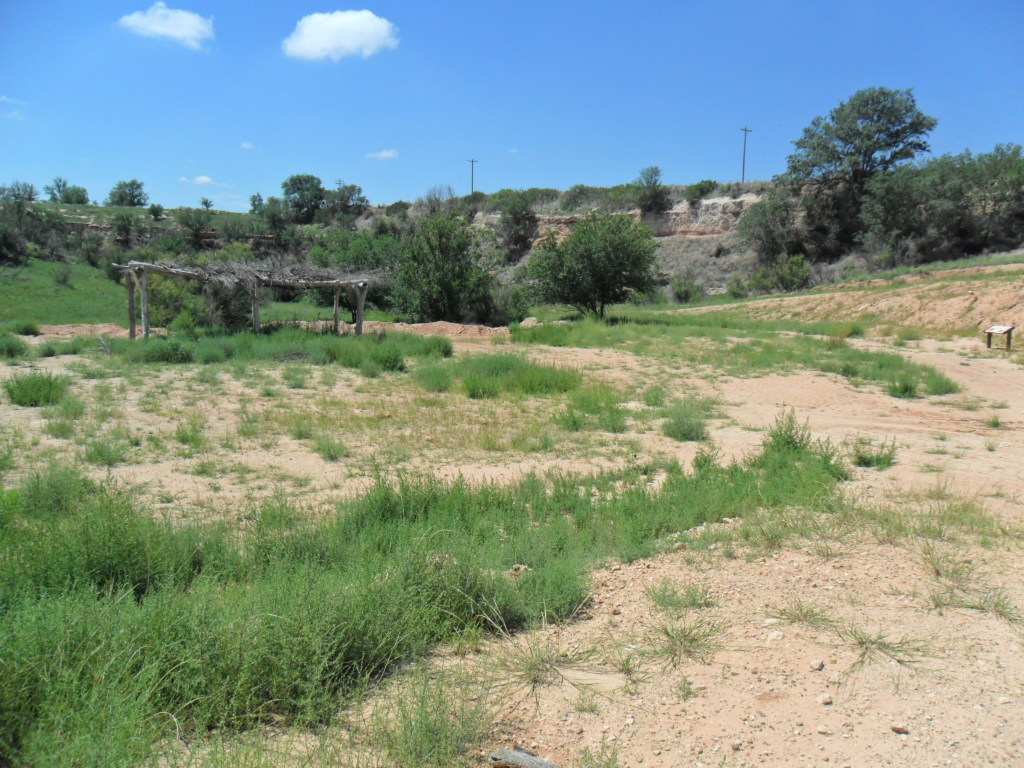
Approximately three fourths through the trail, the site mangers have erected several structures.  This one is the most primitive.  Others are modern with picnic tables and in one place I saw a giant sand box.  Guessing, I think it must be used to illustrate how one sifts through layers of soil to carefully remove spearheads, bones, pottery, etc.  This is the perfect place for a field trip, not too long, but full of geological and paleontological information.

I go here usually once a year.  If you ask me why, I may articulate something about how it has the oldest artifacts and bones found in North America.  The real reason??  I am not quite sure.  This place fascinates me, connects me with something ancient and wondrous, something undefined and mysterious.

The Gift


On the wall for forty years,

a copy of some famous painting.

Almost everything a strange dark

shade of blue, a blue not quite

blue, the merest hint of green:

antique cupboard, curved table

base, ladder back chair, window

frame, even the tree outside.

The only exceptions:

white table cloth,

newspaper in the lady’s hands,

her pale pink floral dress with tiny

darker pink flowers,

large copper antique teapot

in the cupboard, the black and copper

pots on top.  Her teacup, saucer, plate

of toast, white and blue, an old Danish pattern.

I’ve kept this gift,

hung on too many walls to count.

My college roommate, the giver, said,

“This reminds me of you.”

I look at it; all these years

have wondered why.

We’re still friends.

I’ve never asked.

The Farrier


He looks like the typical cowboy

with no cowboy hat.

A cowboy hat would get in the way

up against a horse.

Pale blue eyes,

grey, handlebar mustache,

pack of Camels

he chain smokes,

Australian shepherd, Chili, by his side.

After the trimming

he sits and talks to me

for two hours.

He tells me a story

he told me the last time.

I listen as if it were the first time.

People call him from Oklahoma City.

They want a shoer.

He tells them,

“Too far unless

there’s ten head at 85 a head.”

They agree.

He gets there with Chili,

a pup then.

He starts to tie her up.

“No need;

let her play with our puppy.”

He does.

They invite him out.

It is New Year’s Eve.

“The dive they took me to

was real rough, real rough,

so rough I’d worry about

my safety even with two 45s.

They had a friend singing there

somewhere in Southeast Oklahoma City.

Real rough.

Next morning I’m ready

for the other six horses.

There’s none.”

He packs up,

comes home.

Chili won’t eat,

won’t play.

He sits and waits at the vet.

It’s parvo.

She’s had the vaccine

but not enough time.

“The people in Oklahoma City

lied about the horses

about the parvo.

Chili stayed on IVs for five days.”

Today, Chili’s a dog dynamo,

no longer a puppy but

with puppy energy.

She and Isabella play

constantly for the two hours.

He says,

“You must be rich to build this place.”

I laugh.

“Rich, I’m not rick.

Lucky maybe,

no, not lucky.

I don’t believe in luck.”

A person makes her own luck.

Smart helps, sometimes.

Family Roadtrips


During my childhood, my father took us on regular road trips.  The first one occurred when I was three.  He actually drove all the way from northwestern Missouri to Monterey, Mexico, via Padre Island and back.  Every year we took at least one, sometimes two.  Later in life, I truly realized the value and magic of these family road trips.  Although my daughter, grandson and I take short road trips to New Mexico in particular, we had never taken a really long one until two weeks ago when we left Amarillo, Texas, headed for Carmel, California.

At our first stop, Old Town, Albuquerque, for lunch, we experienced a most refreshing and delightful drink which I plan to duplicate the next time I invite friends over for dinner.

SAM_1176

This feast for the eyes and mouth consists of water infused with pineapple and strawberries.  It tastes best after letting it set to allow the fruit to meld into the water.

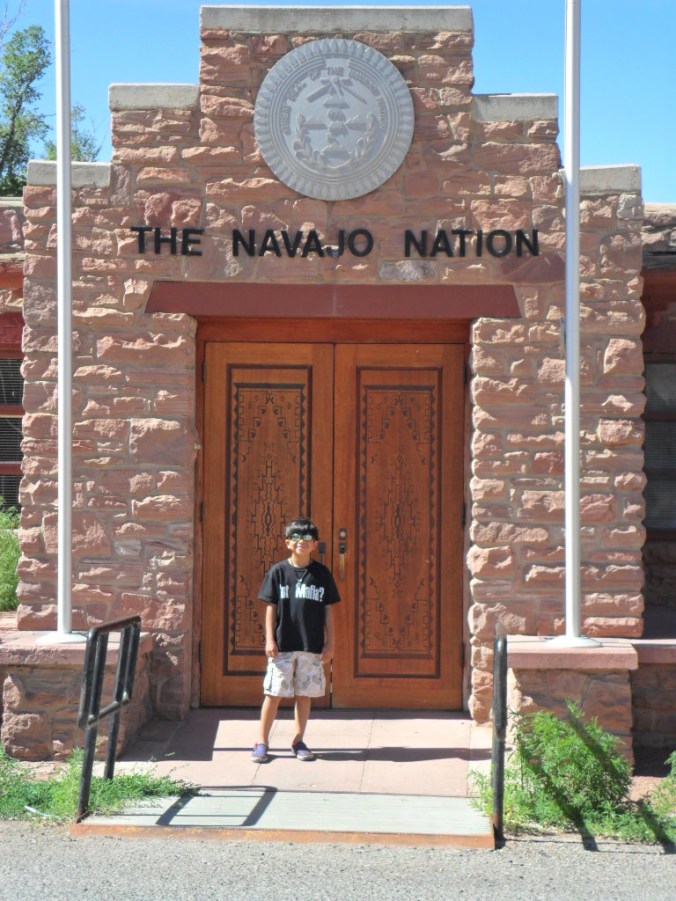
We spent the night in Gallup, but arrived too late to visit the galleries and shops so headed to a little Italian restaurant where my grandson, D’mitri, donned a black shirt which reads Got Mafia.  Friday morning we headed to Window Rock, capital of the Navaho Nation.  Since D’mitri’s great grandfather was Navaho, D’mitri’s interest in this stop remained high.

SAM_1178

SAM_1179

SAM_1180

After strolling around the park here, we stopped to visit the ladies selling the jewelry they were making on site.  As a person a bit obsessed with corn plants, I could not resist a pair of turquoise earrings that look exactly like tiny ears of corn.  D’mitri had to have a necklace with a soccer ball pendant which he wore the rest of the trip.
SAM_1183

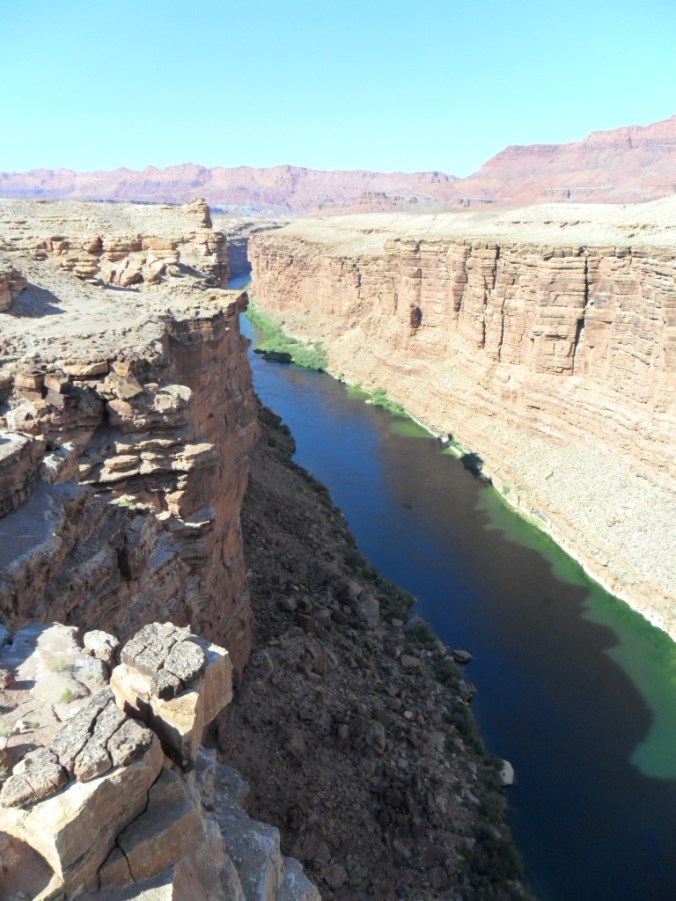
After the morning at Window Rock, we drove off across the Navaho Nation and the Hopi, headed for the North Rim.  We stopped off and on to visit vendors along the side of the road.  The dwellings throughout the Navaho Nation seemed scattered across the landscape with many hogans next to or close to what appeared to be a main house.  Horses roamed in the semi-arid fields.  The Hopi area, however, held a different view with no scattered dwellings.  Everyone seemed to live in villages along the way and I never saw a horse in Hopi country.  Finally, we crossed the mighty Colorado River at Navaho Bridge from which I took this photo.
SAM_1186

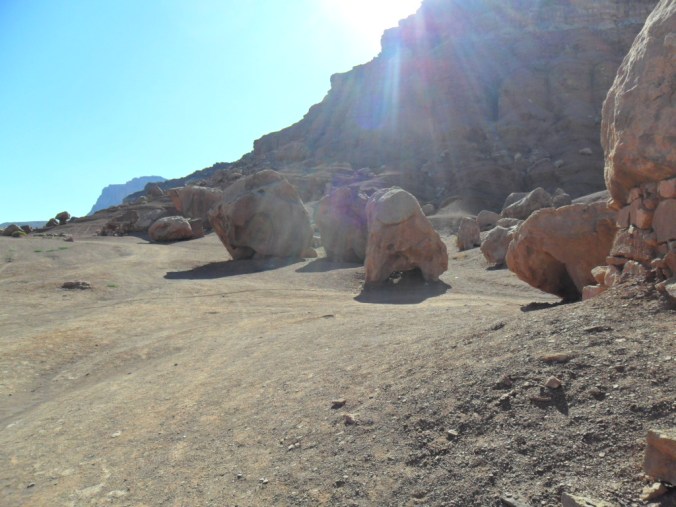
The road follows the base of the cliffs of Vermillion Cliffs National Monument.  We could see them looming large long before we arrived.  Huge rocks appeared to have tumbled off the cliffs and lay near the road.  I kept wondering if they ever fall and hit cars.

SAM_1188

SAM_1190

SAM_1189

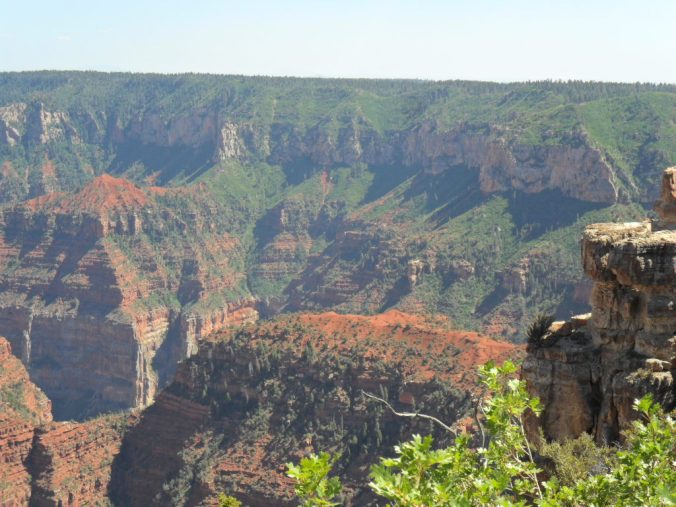
We finally made it to the Jacob Lake Inn near the North Rim of the Grand Canyon.  We arrived too late to go to the Grand Canyon  so took a hike through the ponderosa pines supposedly headed to a lake.  Dry, hot weather apparently turned the lake into a mere puddle.  We barely made it back before dark, disappointed.  The next morning we drove the forty some miles through heavy woods interspersed with giant meadows to the North Rim.  If you have never been to the Grand Canyon, its size and grandeur remain impossible to convey via photos.  Perhaps due to the rather warm, dry conditions, a heavy haze hung over the Canyon all day.  We took a few tiny hikes, only to discover just how very much out of shape we are.  Additionally, the altitude affected D’mitri quite negatively, making him more tired than customary.  Nevertheless, determined to not miss out too much, I took several photographs from Imperial Point.

SAM_1191

SAM_1192

SAM_1193

SAM_1195

SAM_1197

SAM_1196

Flowers exactly the same as grow where I live on a little canyon in the Panhandle of Texas grew along the path.  We spent another night at Jacob Lake and then continued toward Las Vegas.  The fastest route drops off the Kaibab Plateau rather dramatically with spectacular long views, the depth and breadth of which no ordinary camera can capture.  We ate a late breakfast in Hurricane, Utah, a bit after the infamous Colorado City, Arizona,  where the houses appeared quite large with high walls around many of them.  Then off to Las Vegas, Nevada, to meet an elementary school classmate, Craig Prater,  whom I had not seen in years.  He treated us to a fabulous lunch at the Mandalay Bay, took us to a shopping area down road, and he and I attempted to catch up for all those years while Ema and D’mitri shopped.  We marveled how two children who attended a rural school (at first it had only one room and then later two) eighteen miles from any town of more than a couple of hundred could attain what we have attained.  He produces films and travels all over the world.  I have lived, worked,  and traveled to many different places.

SAM_1198

SAM_1200

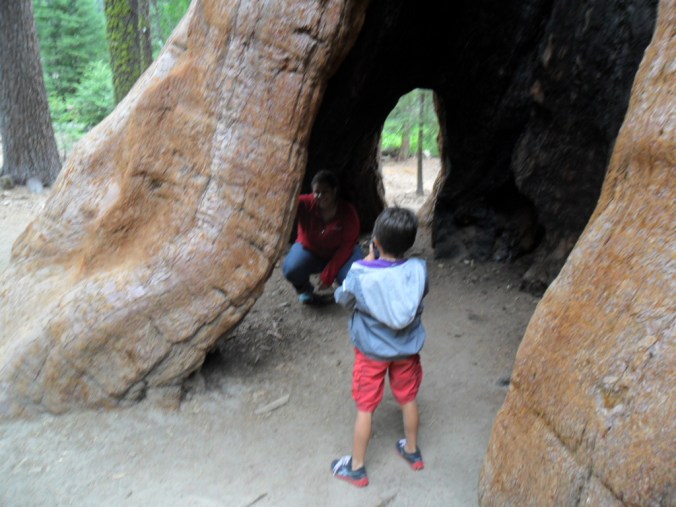
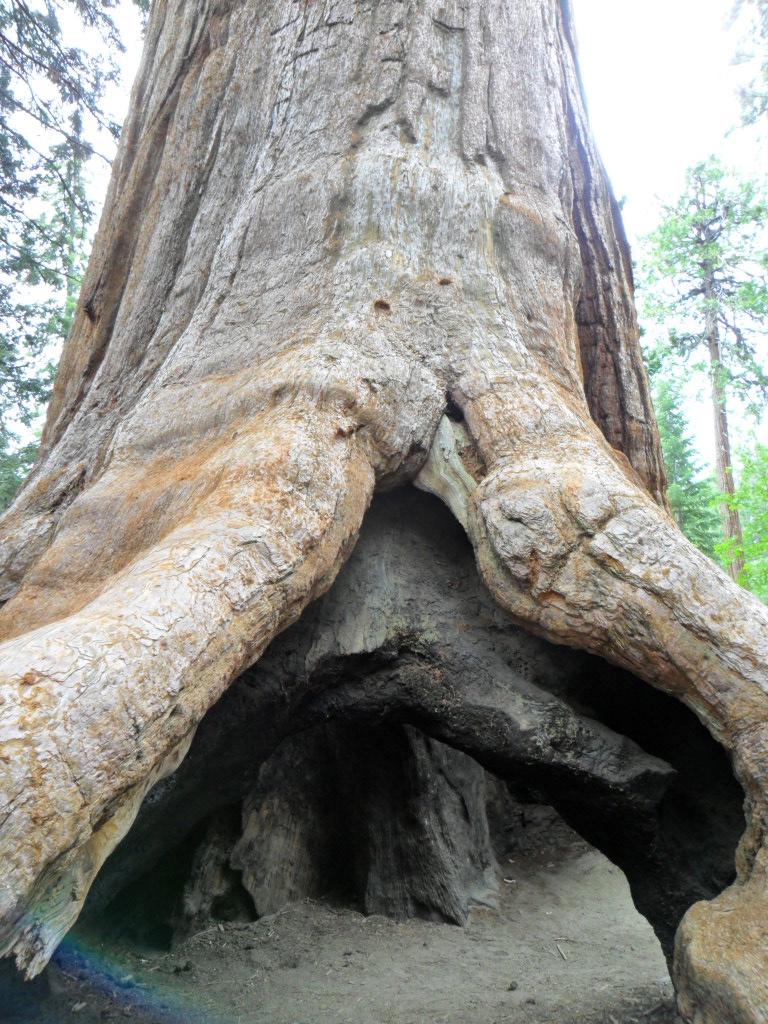
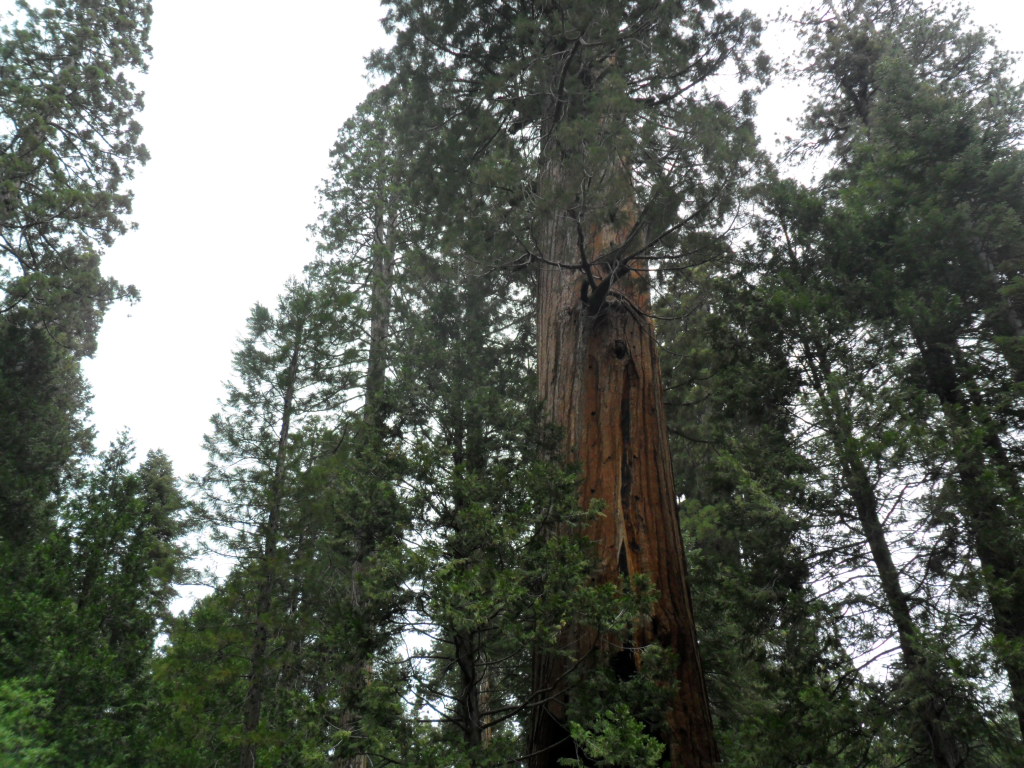
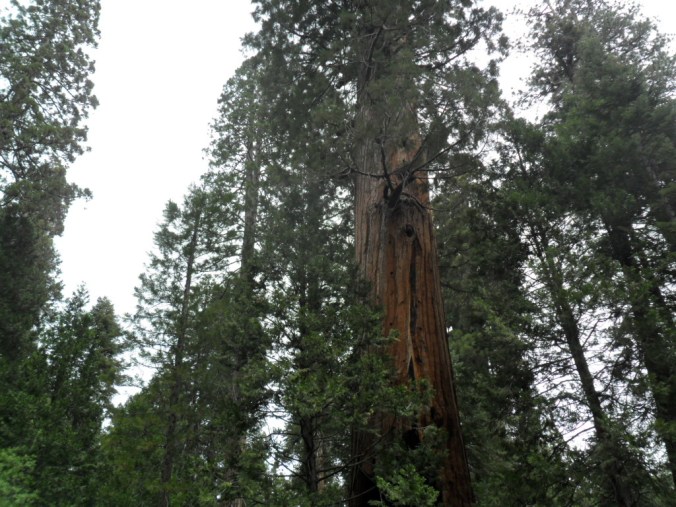
After Las Vegas, we drove to Mojave, California, for the night. The only  scenery on this drive is through a canyon on the Interstate.  We experienced high winds and a sand storm and arrived after dark.  The next morning we solved the mystery of the hundreds of red blinking lights on the hillsides, wind turbines.  From there it is a rather short drive,  a couple of hours, to the Trail of 100 Giants in Sequoia National Monument.  To say we experienced amazement is an understatement.  What a magical forest so wet and dark and alluring after miles and miles and miles of hot desert.

SAM_1204

SAM_1205

SAM_1207My daughter, Ema, and her son, D’mitri really enjoy clowning around and what better place than surrounded by the largest trees in the world.  The squirrels here also “talked” a lot and we tried to get close.

SAM_1209

Usually, I frequently dislike photos of me, but this one is an exception.  Although not large, this tree stood out as so unique I could not resist a photo shot.  Even with the best camera, I doubt a photo of an entire sequoia tree is possible.  You have to see them to obtain the full effect.
SAM_1210

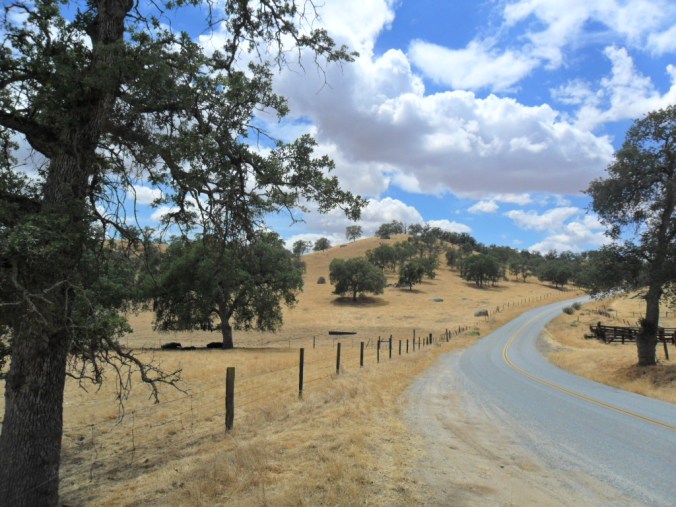
We wanted more time with the trees, but needed to make it to Carmel by evening so headed down the mountain toward California Hot Springs.  Altitude is everything here.  In ten minutes the golden hills replace giant trees.
SAM_1218

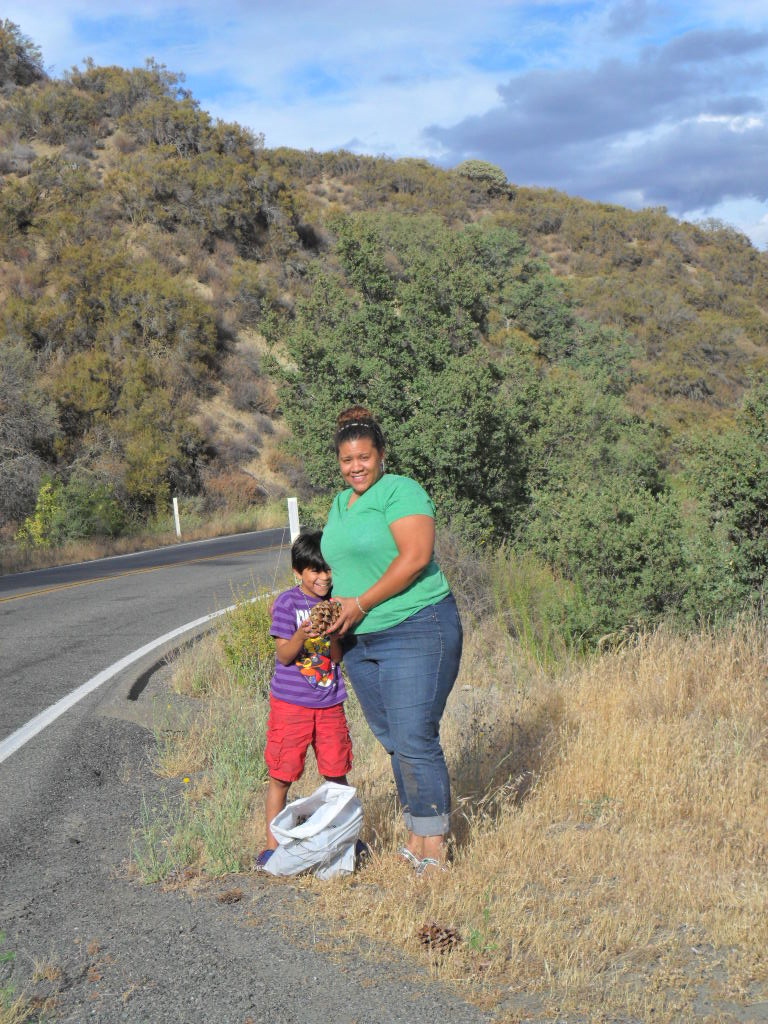
Then, in an hour or less, we were driving across the Central Valley past miles of vegetables and at least three types of trees in huge orchards or groves.  The only tree species I was able to identify was almonds.  I wanted to take pictures, but did not desire to arrive in Carmel at my college roommate’s house in the dark so I kept driving.  No quick road exists that crosses California except way to the south.  This still astonishes me.  Two lanes with heavy truck traffic take a long time to get from one destination to another.  We decided to cross on 198 through Coalinga to San Lucas which resulted in a fun, scenic drive with lots of twists and turns.  Much to our surprise, huge pine cones lay everywhere beside the road.  It seemed strange that these cones came from a tree much smaller than the Sequoia.  Ema and D’mitri collected some to display at home.

SAM_1219

Finally, just before dark we arrived at the Rinaldo’s.  Suzy and I roomed together at Grinnell College at the ages of 18-19.  David attended Grinnell also.  We only see each other once or twice a year but can pick up conservations as if it were a few moments ago.  They live in the Santa Lucia Preserve.

SAM_1268

SAM_1258

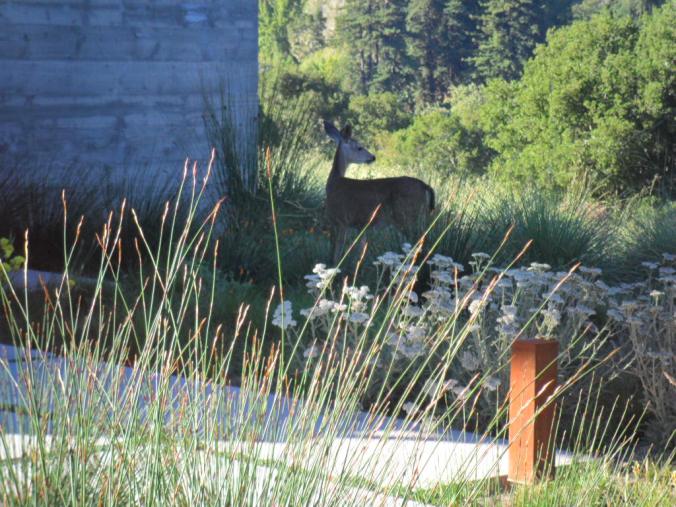
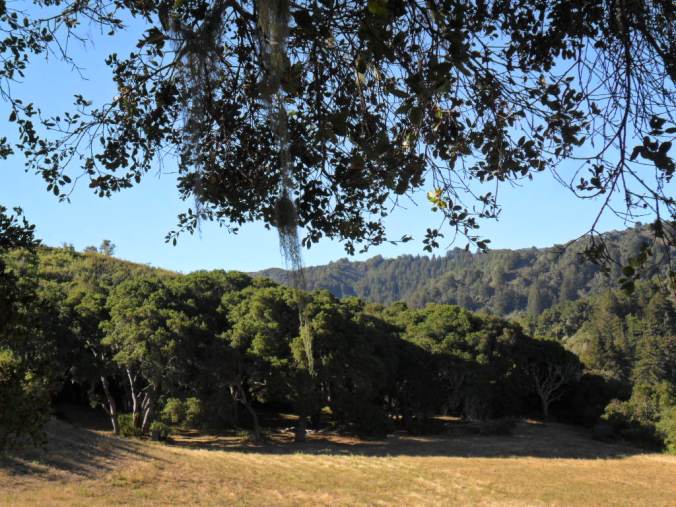
Every morning this deer casually ate California poppies and ran away only if I went outside too quickly.  One morning I took a long walk up one of the few roads on the Preserve.  I love the live oaks and learned they are very fire resistant so residents are allowed to let them grow close to their houses.  Everything else, except for a few native grasses and plants–no trees or brush, must be cleared for 150 feet all around any house.

SAM_1259

SAM_1265

SAM_1264

SAM_1262

SAM_1261

I commented on the radiant red colors I saw in the leaves of an attractive plant only to find out it is poisonous oak and if I touched it, the result would not make me very happy.  It must love this particular environment because it grows everywhere.

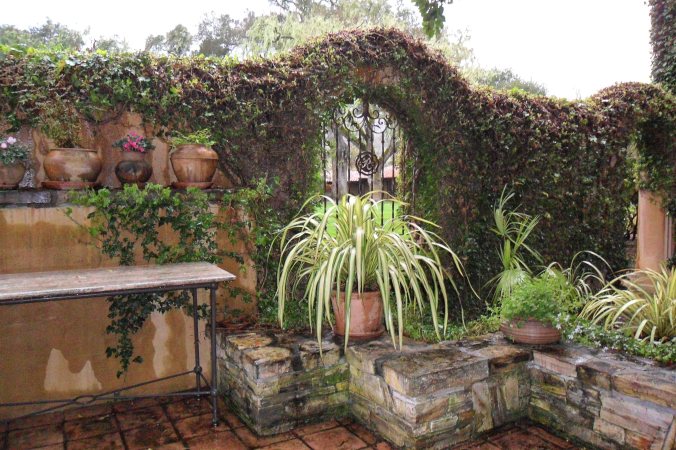
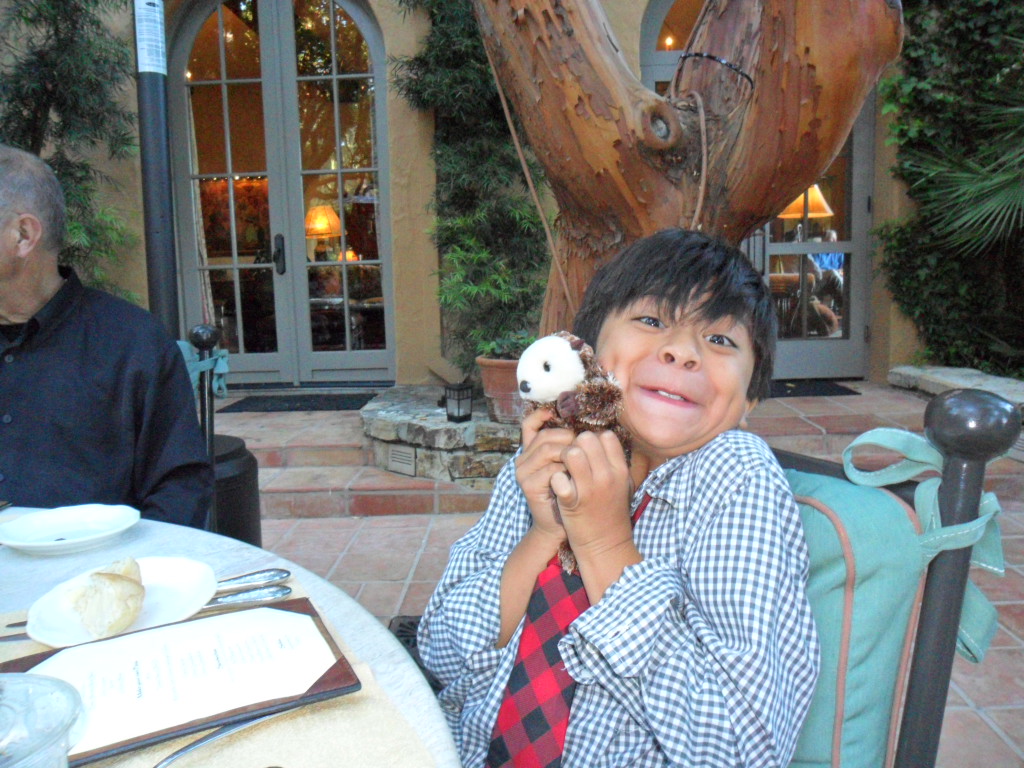
One of my favorite restaurants is at the Hacienda at Santa Lucia Preserve, not because of the food, but due to the impeccable service and enchanting atmosphere, what I imagine to have existed in old California.  D’mitri says it is his favorite fancy restaurant on the trip.

SAM_1221

SAM_1223

SAM_1228

SAM_0103

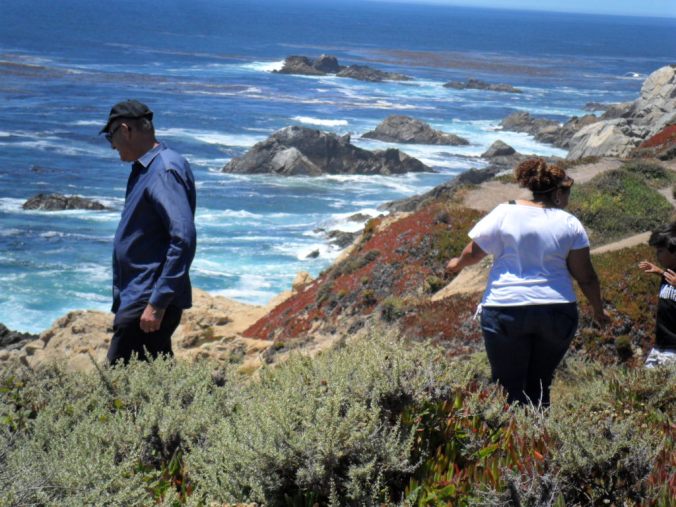
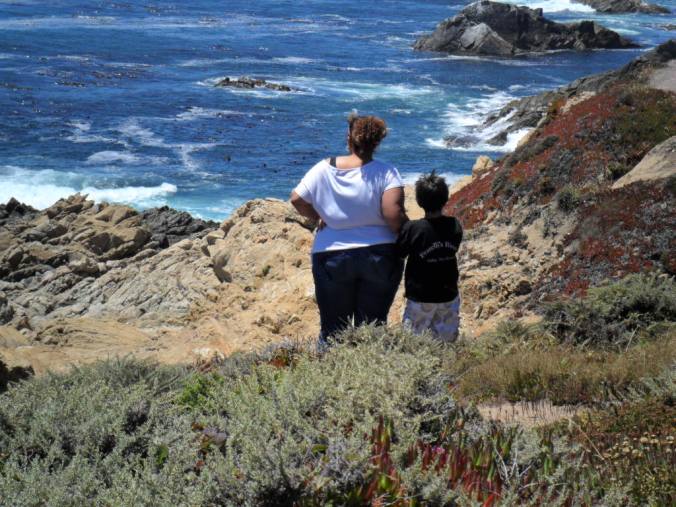
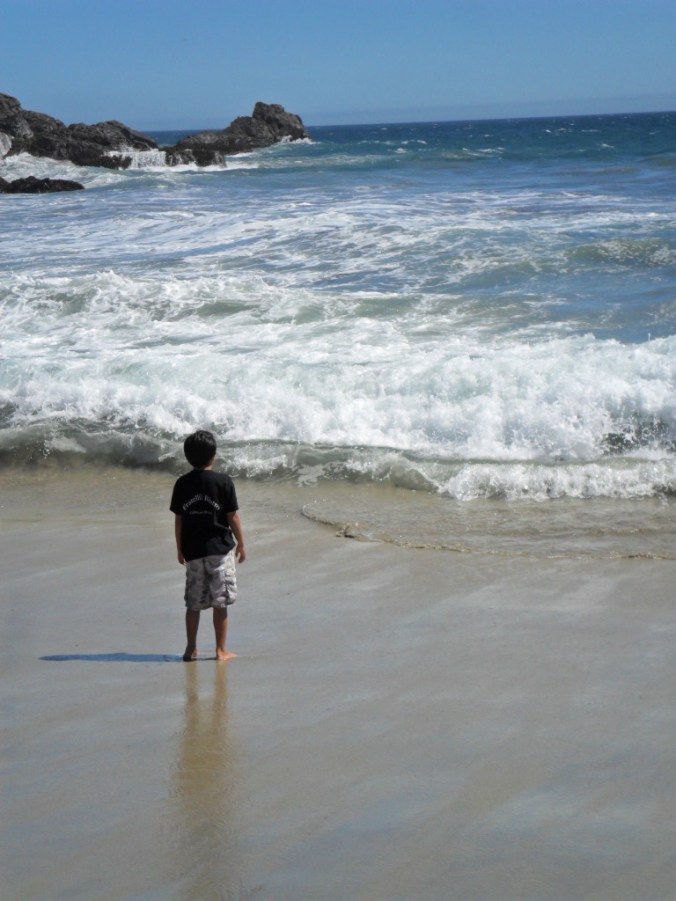
In the dark, driving back home to David and Suzy’s, we saw a bobcat, several deer, wild turkeys, a skunk, and another animal we could not identify.  The next day we ladies went shopping in Carmel while David and D’mitri took a ride in the Porsche and swam.  No one can go near Carmel surely and not drive the glorious drive south to Big Sur.  D’mitri loves water so we stopped at two different places along the way.
SAM_1238

SAM_1239

SAM_1241

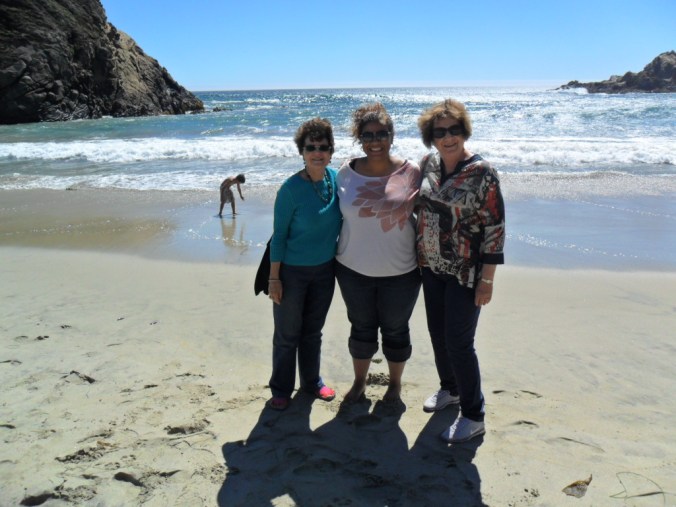
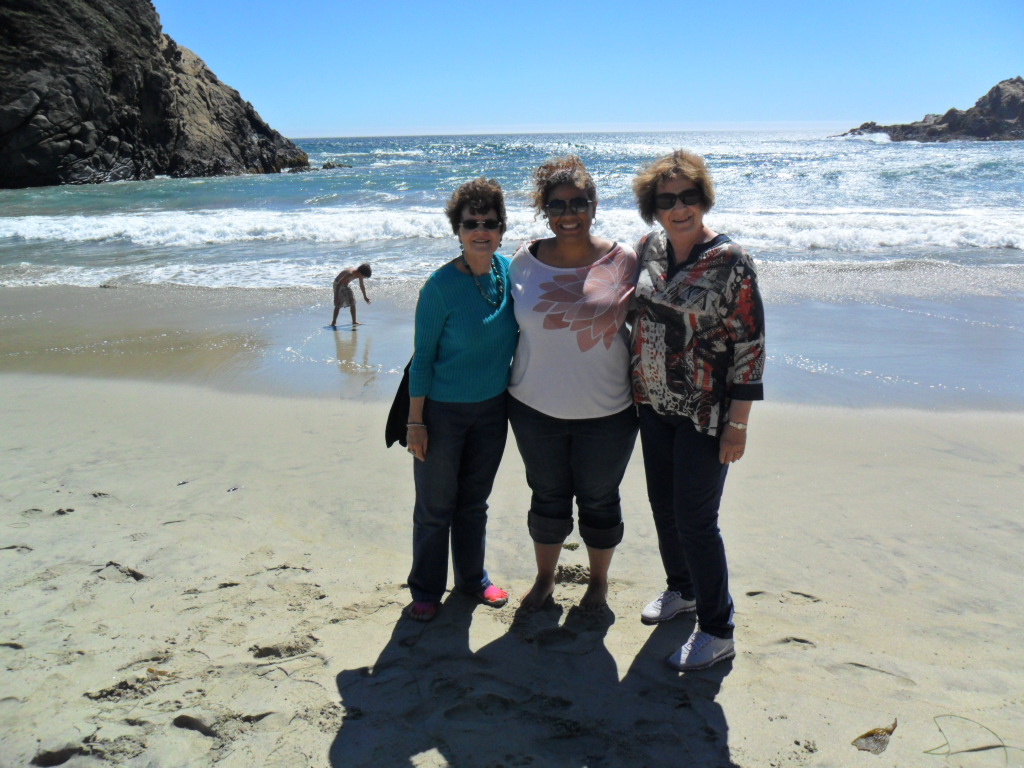
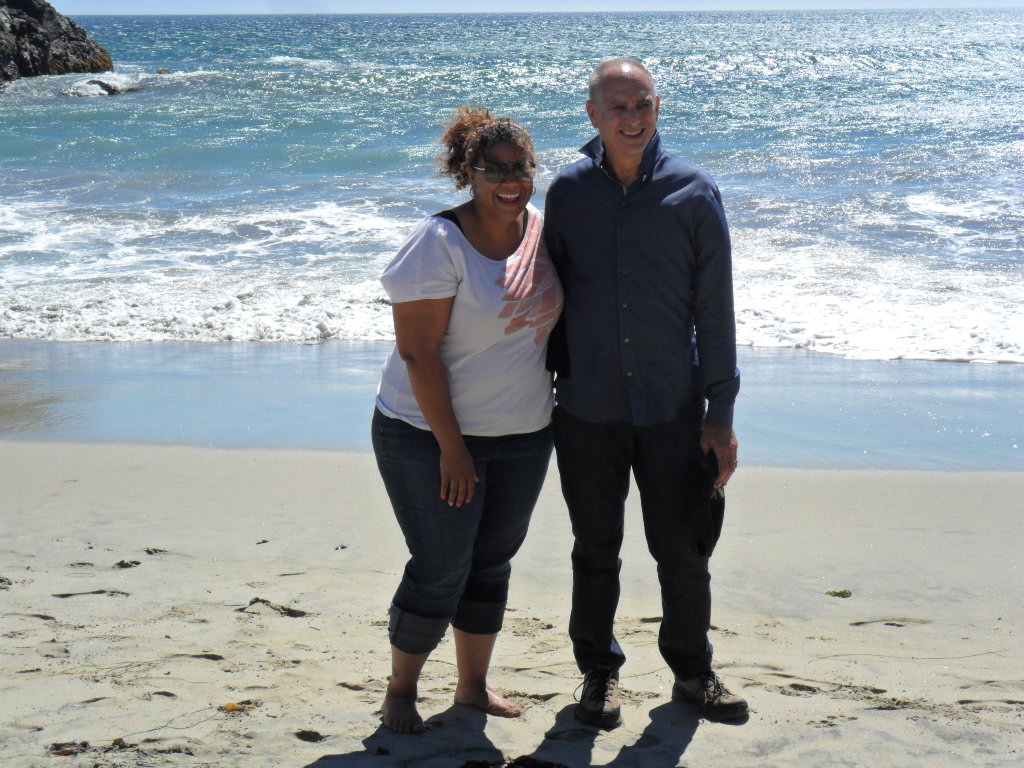
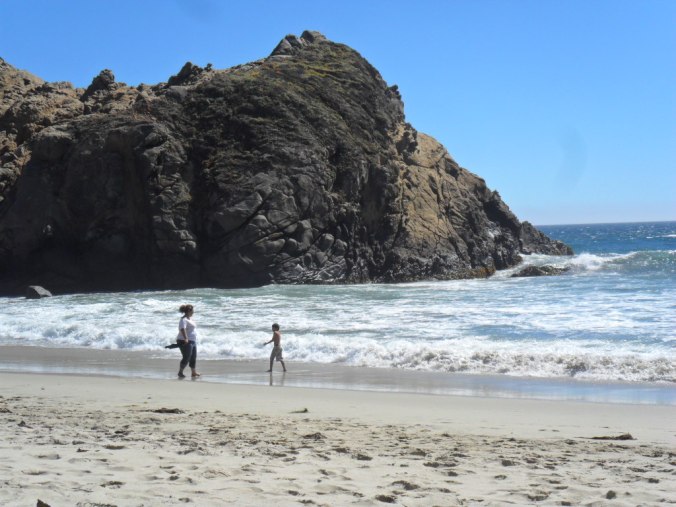
D’mitri became quite alarmed when Suzy told him many of the bushes along the path are poison oak.  David informed us that a really wonderful beach existed down the road if we could get in.  Off we drove to Julia Pfeiffer Burns State Park.  They only allow so many cars into the park at once so we had to wait until someone left.  It was worth the wait.  This beach does not allow swimming; people have drowned here.  Nevertheless, who cares; the drama of crashing surf, giant holes in rocks worn by water, and trees shaped by wind and erosion make it magical.
SAM_1245

SAM_1252

SAM_1251

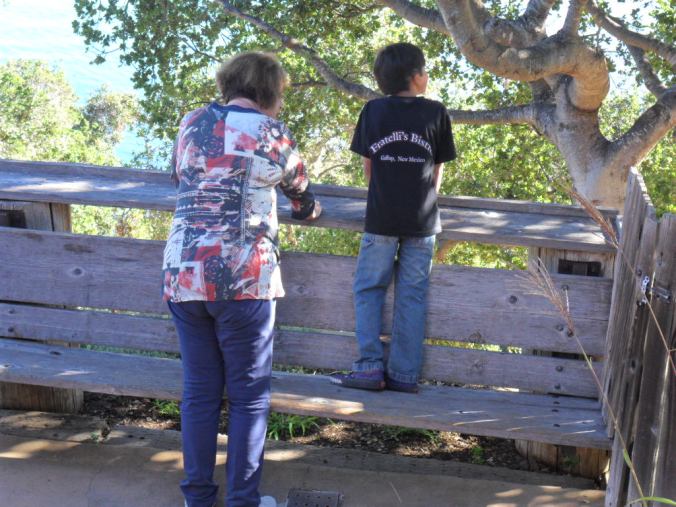
SAM_1250You cannot go down highway 1 without stopping at Nepenthe.  This restaurant’s views alone are worth going there, plus a gift shop full of finds from all over the world.  The wine list and hamburgers finish off the list of why you must stop here if you are anywhere near Big Sur.
SAM_1255

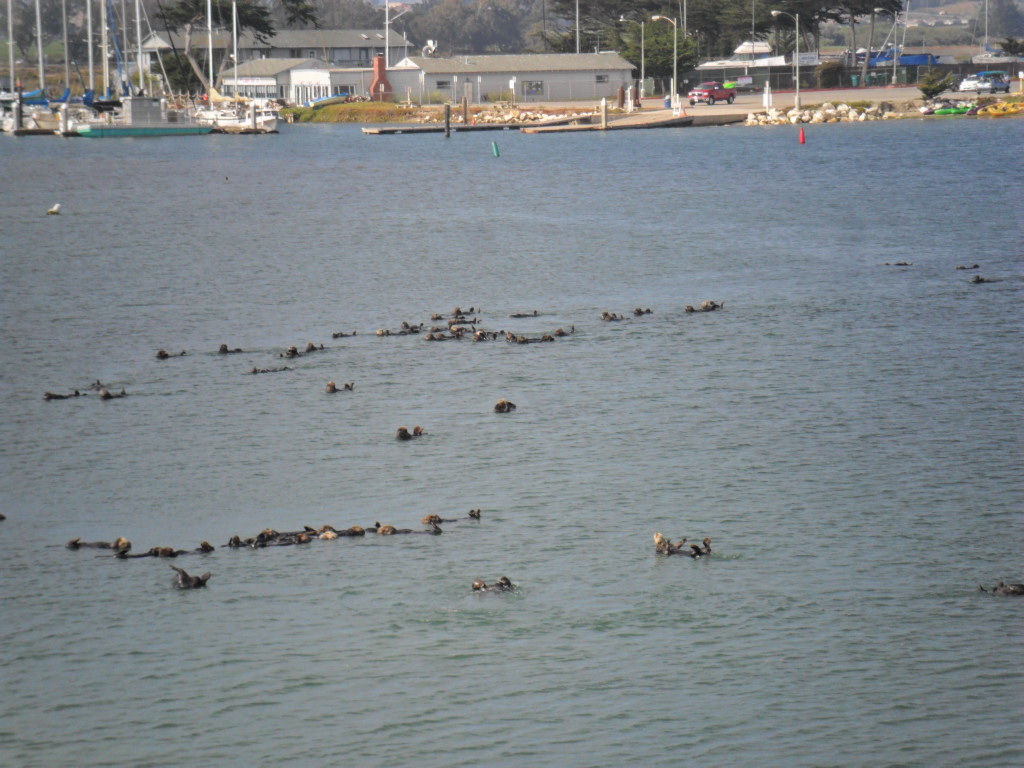
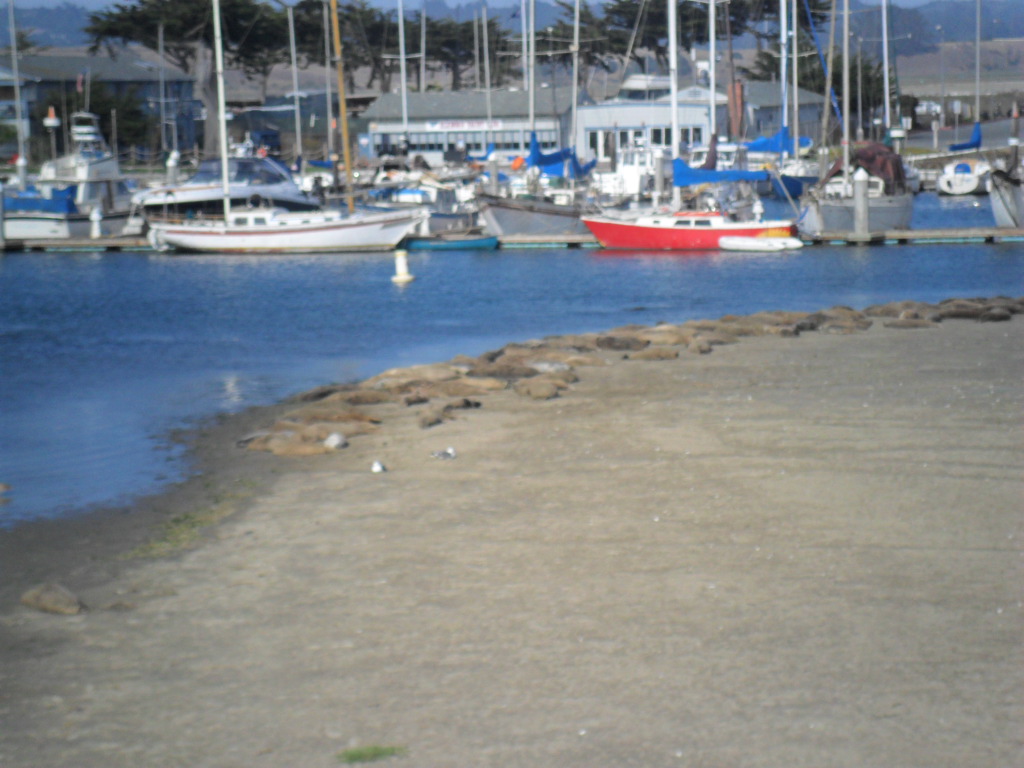
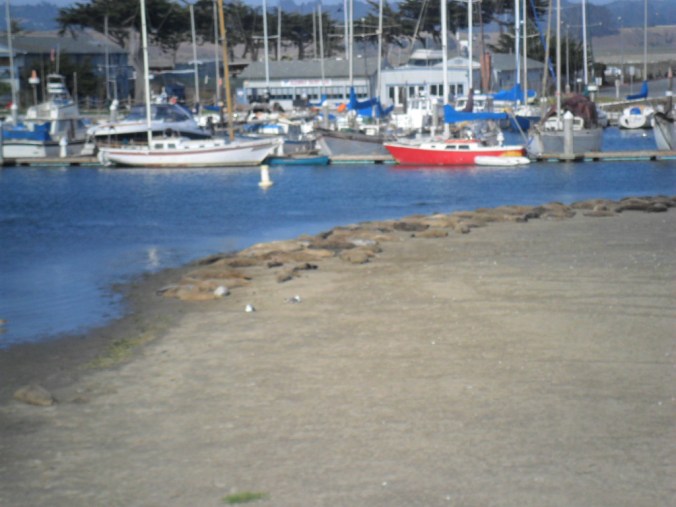
Time seemed to run rapidly; with only one day left, we decided to head to Moss Landing to see the seals.  Much to David’s astonishment, not only did seals lay all along the beach, but a large number of sea otters were playing in the water, rolling over and over, splashing.  David had been there many times and never seen anything like this.  The sea otters delight the watcher with their playful antics.

SAM_1271

SAM_1272

Unlike the ever playful sea otters, the seals just lay still like large rocks along the beach.
SAM_1274

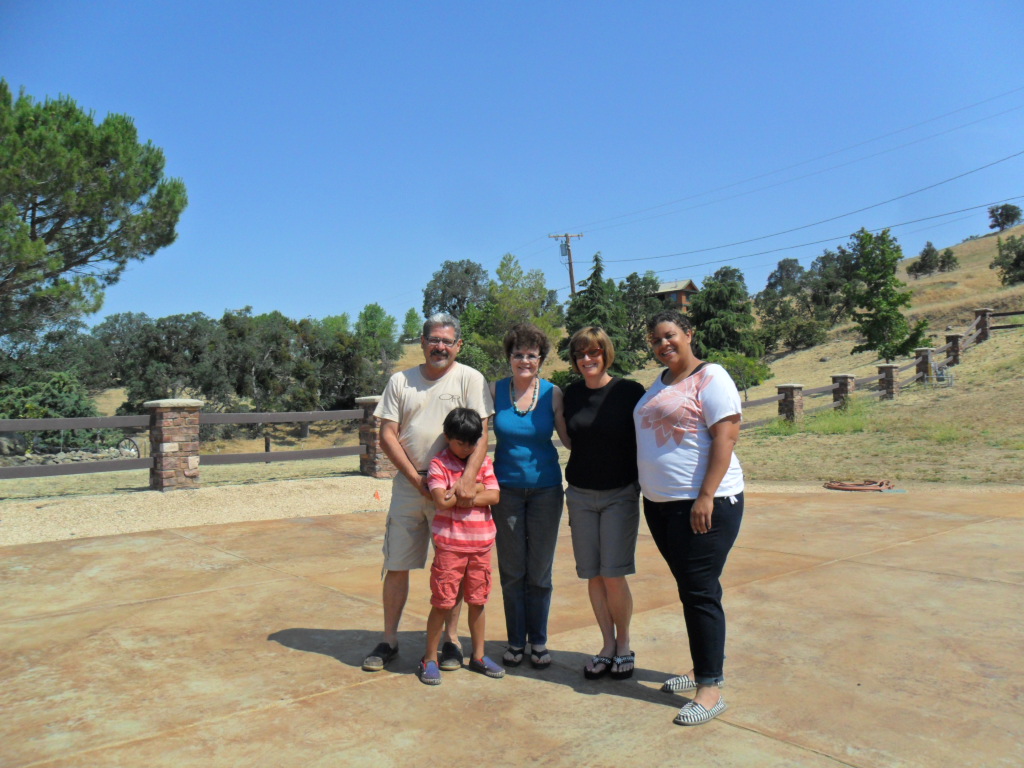
Early on a Saturday morning, Suzy and David fed us waffles to fortify us for the long drive to Flagstaff, nearly 700 miles.  We crossed over to Salinas, then down 101 and finally through Bakersfield where we found a delightful, rather elegant Italian restaurant for lunch.  The good looking waiter chit chatted and provided excellent service, three pluses when you go out to eat.  As we cut across the middle of California, headed for I-40 eventually and neared Tehachapi, Ema decided to call D’mitri’s other grandparents who have a house there. When we went the other direction almost a week before, they had been vacationing in France.  To our surprise, they answered and asked us to stop for the night.  D’mitri’s excitement was contagious.  He expressed special delight to have his grandfather to himself for hours instead of needing to share him with other grandchildren.  The Herreros live on a hillside with a breathtaking view for miles.  Unfortunately, the haze prevented proper photography so I gave up on the idea of capturing the endless panorama.   However, this presented itself as the perfect opportunity for family photos.

SAM_1278

SAM_1280

SAM_1285

The California desert never comes to mind when I think of California.  I always fly to San Francisco or Oakland and visit friends or conduct business.  Unlike the glorious red rocks and drama of southern Utah and northern Arizona or the saguaros of  southern Arizona, the California desert maintains an endless pale tan color with only a few tiny plants.  Thanks to air conditioned automobiles, you can drive for miles, escaping the intense heat.  When we finally stopped at a Dairy Queen for a refresher, D’mitri and I stepped out of the car and were nearly knocked over by the hideously hot wind.  In general, I like heat, but this seemed overwhelming.  When we drove off, I asked Ema about the temperature.  She looked it up on her smart phone, 118.  The only truly beautiful I sight I saw (and I think nearly everywhere possesses some sort of loveliness) occurred when I drove over the mighty Colorado River, surrounded by the only green for miles.  After this heat, the cool, green beauty of Flagstaff enchanted us.  We settled into our hotel room, then drove off to our third Italian restaurant in two days, Oregano’s.  Instead of the usual coloring books, puzzles, etc. offered to children, this place gives them pizza dough to mold.

SAM_1287

As we drove home, I noticed how terribly dry it is once we dropped out of the mountains around Flagstaff.  Off and on we crossed areas where there had been enough rain to create a pale green.  Apparently, it had not rained west of Albuquerque because it still looked like brown winter just as it had eleven days before on the first day of the trip.  East of Albuquerque we encountered such an intense downpour with some hail that I could not see to drive.  I pulled off the road and waited. From Albuquerque to Amarillo, in the eleven days we were gone, it had rained enough to make the mountains, foothills, and high plains a lovely soft emerald.   We had missed the hot, 100 plus week and came home to rain and cooler weather that lasted several days.  In one week, the weather had changed from record highs to record lows, the typical extremes one learns to live with on the Llano Estacado.
Going Home Again


Last weekend I returned to the county where I grew up and the family farms in Andrew and Holt County, Missouri.  It had been at least six years since I had returned to the place my great grandfather homesteaded over a hundred years ago.  Strangers live in the house where I grew up and my father lived 80 of his 90 years.  On the site where he was born, only the old carriage house still stands, a sentinel to a lifestyle long gone.  Repeatedly, I tried to write a poem about all this, but have not been able to do so–perhaps the experience is still too close.  Additionally, for the first time, I attended my high school reunion and chatted with individuals I had not seen since I was 18.  Decades truly change people; I would have recognized only a couple without the name tags.  Northwest Missouri this year presents an intense emerald landscape.  Having travelled there from the semi-arid land where I now live, I suffered “green” shock.  And tree shock.  The Panhandle of Texas grows few large trees outside of towns and cities.  Even with my very ordinary camera, these photographs capture the beauty I witnessed and family memories I want to remember and share with my children and friends.

SAM_1167

This is the house where I grew up and Dad lived 80 years.  The building in the foreground was built during the depression.  Before it was put to its final farm use–for hogs and chickens at various times in my childhood–Dad held dances here.  Because of prohibition, the sheriff always sent someone to make sure no illegal alcohol consumption occurred.

SAM_1097

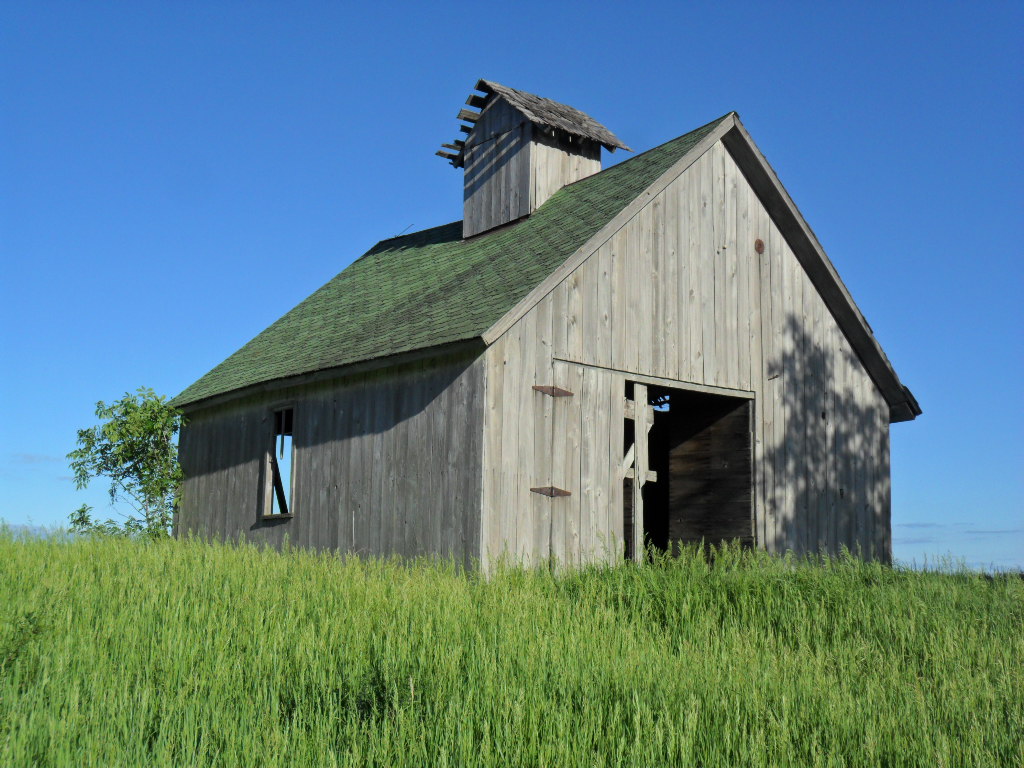
The old carriage house, just south of the site where a large house stood during my childhood, still stands.  The stained glass transom window hanging in my own house now and an etched glass hunting scene are all that remain of the house where Dad lived as a small child.  Emptiness and raccoons finally destroyed it.   When he gave me the windows over thirty years ago, Dad said it was impossible to keep an empty house in good shape forever.

SAM_1165

At the age of 18, my great grandfather, Gottlieb Werth, came to the United States to avoid being drafted into the Swiss army which hired out soldiers as mercenaries.  My father told me what his mother told him:  my father’s mother stood on the roof of her house in Switzerland and waved until she could no longer see her son; she never saw him again.  This photograph shows his grave in the Fillmore, Missouri, cemetery.

SAM_1094

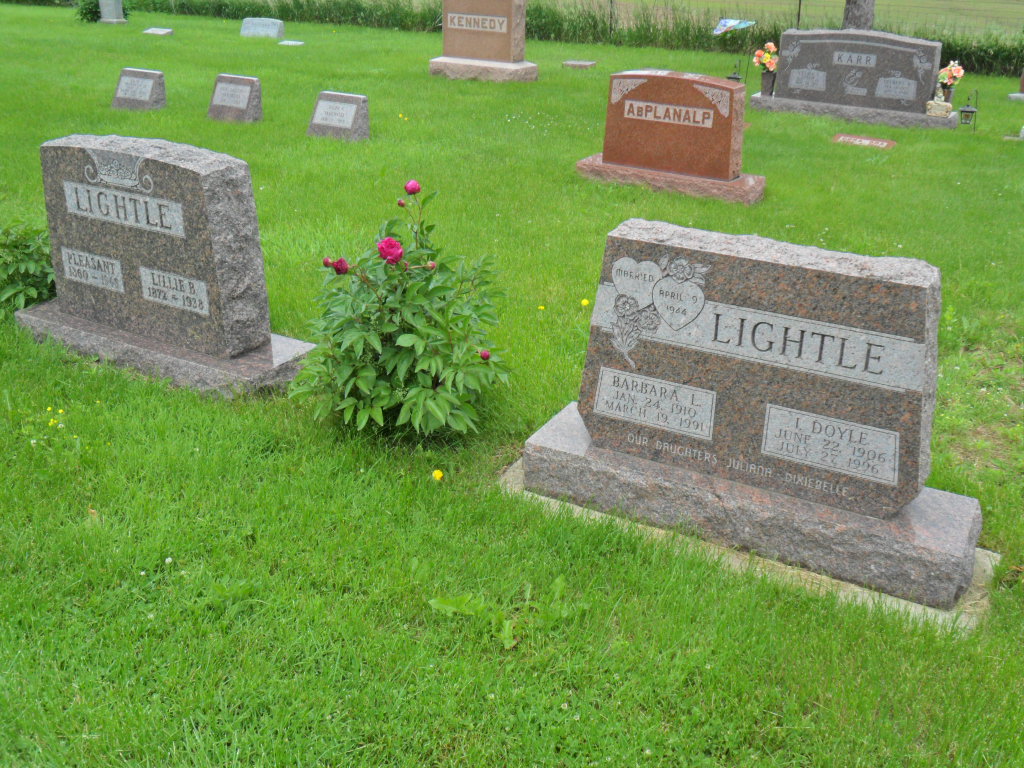
Nearby, perhaps fifty feet away, lay the graves of Mom and Dad and my grandparents.  I never knew this grandmother; she died long before I was born.  My grandfather died when I small and sadly I do not remember him.  The family stories tell that he taught me to talk at a very early age, nine months, because he held me on his lap and told me about everything occurring outside the windows.  My first word was “tractor”.

SAM_1090

Another family story tells that this grandfather walked to Andrew County, Missouri, from Illinois.  Andrew County’s rolls are full of Lightles.  It remains the only place I have ever lived where I am not the only person with my last name in the phone book.  Dad claimed there would be even more Lightles except for the fact that several brothers died when they tried to walk across the Nodaway River on winter ice and it broke.  They all drowned.

SAM_1106

Dad built the large pond in this photo and stocked it with fish.  Until a few years ago when someone bought the land and destroyed all the trees, a small forest of ancient oaks, black walnuts, and chestnuts grew between the house and pond.  Dad kept it mowed and groomed–a park.  Sadness filled me when I saw the trees all gone.

SAM_1107

All my childhood we attended Antioch Christian Church.  Although I could not see it from my house, if I walked across the road to where the carriage house still stands, it looms across the distance.  Potlucks were a very popular activity here.  Mom made such fabulous pies that everyone would get her pie first to make sure they got a piece.

SAM_1114

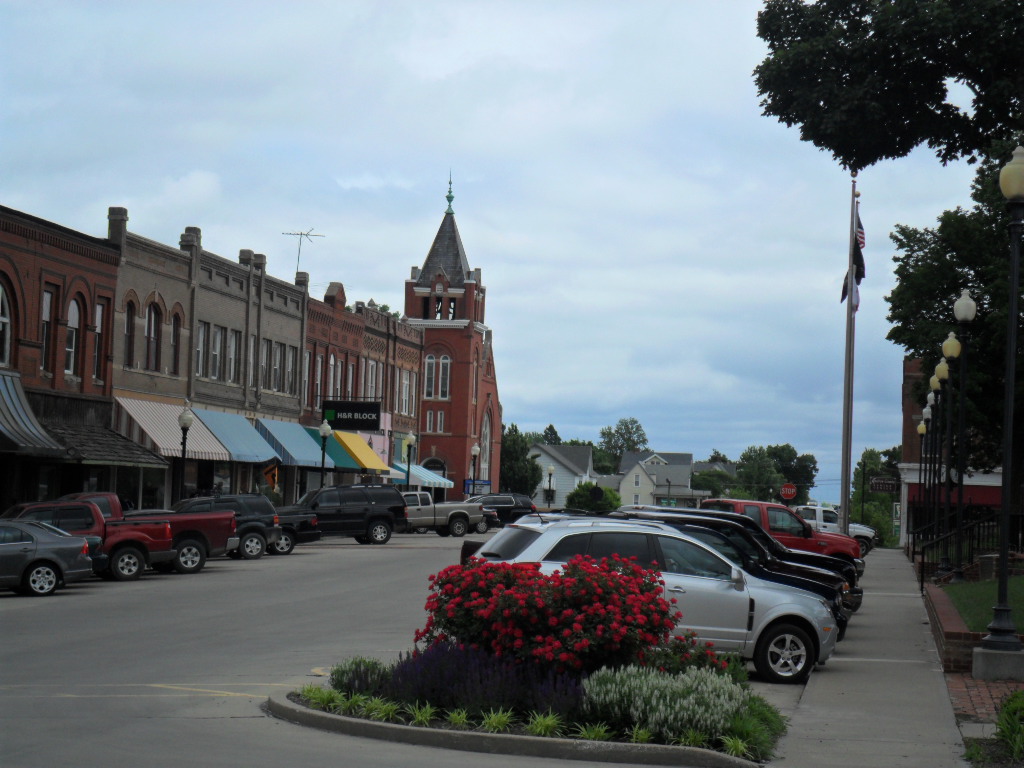
The sign in front of the Andrew County Courthouse.  This county remains filled with people of Swiss descent to the point they have celebrations commemorating their heritage. The following include photos of the courthouse and some of the restored buildings on the courthouse square.

SAM_1112

SAM_1116

SAM_1113

Several reasons exist for my returning “home” at this time, including attending my high school reunion for the first time.  The following photos show several people I had not seen since I was 18, including Melanie Eisiminger, who was the valedictorian when I was salutatorian so many years ago, and Jim Ahillen and his lovely wife.  Melanie is in the middle.

SAM_1127

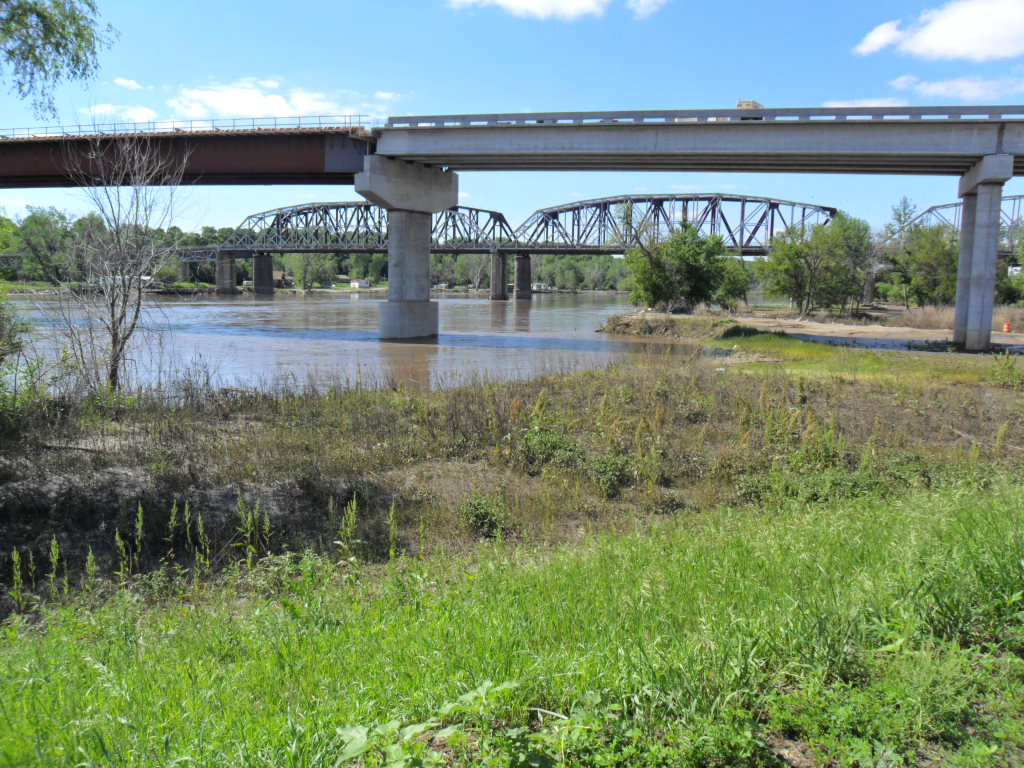
My mother grew up in Holt County, Missouri,  in the town of Fortesque and her family farm next to the Missouri River still remains mostly in the family.  In my childhood, Fortesque was still relatively prosperous.  Now fewer than fifty people live there.  The farm lays right next to the Missouri River.  I walked down the levee and took photos of this mighty river, the Rulo, Nebraska bridge, and the farm.  If I turned one direction, I faced the bluffs where White Cloud, Kansas, resides and the other direction is Nebraska.

SAM_1134

SAM_1128

SAM_1139

Between the Missouri River and the bluffs lays one of the largest wildlife refuges in the United States, Squaw Creek National Wildlife Refuge.  It is especially important for migratory birds, bald eagles, wading birds, and various mammals.  One can drive the new road ten miles through it to observe birds in particular but also other species.  The huge cottonwoods and oaks fascinated me.  It appears I had totally forgotten just how grand these trees can grow if given adequate water.  In one area I drove for at least four miles through a tree tunnel, then several raptors screamed at me while I tried to photograph them, and finally I managed to photograph a red winged black bird and geese.  After several days of semi constant rain, it felt fabulous to experience a perfect sunny day for my tiny trip to the wild.

SAM_1150

SAM_1148

SAM_1151

SAM_1149

SAM_1152

SAM_1155

After I left Squaw Creek, I drove to Mound City to find the graves of the Duke side of my family.  The last time I had been there was when we buried my aunt, mother’s sister.  I also remember going with her there more than twenty years ago.  I recalled the general location but had to hike around a bit to find them.  Because Grandfather Duke was much older than Grandmother, I never knew him.  Aunt Julia came to visit me at least once a year until she neared ninety and could no longer travel easily.    She never married and remained admirably independent until she became too feeble to get around on her own.

SAM_1160

SAM_1161

The E stands for Evelyn.  She was named after a woman Grandmother worked for on the White Cloud Reservation, Evelyn Le Clair.  On my previous visit to Missouri, I went to the White Cloud Reservation and inquired about the Le Clairs but had been told they had moved away a long time ago.  Grandmother had to work because her father went blind and could no longer work.  His name was Kaiser and he, too, came from Switzerland.  The following is the gravestone of my great grandmother.  Mother frequently recited sayings from her, e.g. you can’t tell by the looks of a frog how far he can leap.

SAM_1159

In  my childhood, we cut across the country side to go from the Andrew County farm where we lived to Grandmother’s Holt County farm.  I remained unsure whether I could recall exactly how to do this but tried and met with success, feeling very happy with myself, remembering something I had not accomplished in decades.  Because it had rained six inches the previous week, unlike last year during the drought, knee high grass grew along the backroads, corn was coming up, ponds were full.  I drove by the houses of people I remember from childhood, not knowing who lived there any more except a few.  People change, life proceeds, but the country still holds endless promise and beauty.  Finally, with a few hours left before flying back to Texas, I stopped by a new area north of Kansas City, Briarwood, strolled around, visited an excellent natural food market, ate a rather exotic lunch, and took a few photographs of huge new houses and the Kansas City skyline.

SAM_1173

SAM_1175

Everyone asked me to bring some rain back to the Panhandle of Texas.  It has rained three times since I returned home.  A coincidence, of course, but very welcome.

Star


The phone rings.

“Star’s dead.  There’s blood everywhere.

He’s hanging from the gate.

Blood is all over Rosie’s face.

It’s dreadful.”

A tear choked voice.

“You can’t bring D’mitri home.”

D’mitri’s nine.  Star belongs to him.

Shock, tears, disbelief.

Last night he ran, bucked, reared,

chased around, playing.

How?

The pen’s all pipe, no sharp edges,

nothing harmful, consistently inspected.

D’mitri goes home with me.  He says,

“Nana, I have to see him;

I have to know what happened.”

Slowly, in dread, we walk behind the barn.

Star’s hanging by one hoof in the three inch

space between the gate and fence,

ankle broken.

The blood covered fence, gate, and ground

stare at me.

It’s hot, his body’s stiff.

He must be moved.

The coyotes will come in the night,

drawn by the smell of blood, of death.

The neighbor brings his big, red tractor;

a wench pulls Star’s young body free,

and gently lays him on the cold, grey, barn floor.

His shining copper coat no longer shines.

D’mitri and I remember bottle feeding him

after Miracle died, teaching him to lead.

We stare at Star’s body in disbelief.

Kindly, the neighbor says,

“He died quick, femoral artery cut by bone,

bled out.”

For hours Rosie and Cool stand at the spot

where Star died.

They do not even leave to eat alfalfa.

It takes me hours to wash away the blood.

It took D’mitri ten months to go back to the barn,

to ride Rosie again.

Miracle and Star as a newborn


Note:  This is a photo of Star and Miracle in July 2010 shortly after Star’s birth.  Miracle died of colic three days later.  Star died last May.

Variety is the Spice of Life


Here I go again taking classes.  This one is Part III of the series on modern women poets taught by Lorraine Mejia-Green through the Story Circle Network.  We read poems by a variety of women and use their works and related assignments for inspiration.  This week features Julia Alvarez and even though I have already read all her novels, etc. and a book of prose poetry, the selected poems are new to me.  It seems I always take a different route from a lot of the others enrolled in the class.  The following show cases draft two of my first assignment:

I keep coming to this part

where I’m happy

95 per cent of the time.

It’s my story

dictated by

ME.

“Variety is the Spice of Life.”

Cliche?

Yes, but true.

Four marriages

Lovers-I lost count

Activist in “love” with

Che and other South American

Revolutionaries.

Feminist for forty years

Up to maybe four careers.

Big city apartments

Ranches

Old houses by the bay

Bricks with arched windows

A tree lined street.

Can I settle?

For what, with whom, where?

Variety is the Spice of Life.

Gaston Luis Zulaica del Sueldo


Gaston Luis Zulaica del Sueldo walks toward me after disembarking from the plane.  Although I have never met him, I know exactly who he is.  Tallish, thin body; long, handsome, light tan face; smiling, perfect teeth; arms open.  A teenage Latin Lover, bouncing on the balls of his feet, rushing to me.  Those arms wrap around and squeeze me tight.  My new son has arrived from Argentina.

Every night while I fix dinner, he sits at the brown Kanabe piano my parents gave me thirty years ago and plays and plays:  Beethoven, the theme from Twilight, Chopin…I look up from chopping onions and see the short, dark ringlets on the back of his neck and watch his gliding, long-fingered hands.  He plays until salad making time arrives.  He tells me he makes salads for his grandmother back home.  Now he makes them for us:  layers of emerald lettuce, red peppers, black olives, orange carrots, green onions, a kaleidosope of appetizing color.

Gaston Luis Zulaica del Sueldo.  It curls around my tongue when I introduce him.  Images of tango dancers, gauchos–he is a champion rider, malbec wine–at seventeen he brought me some in his luggage, snow capped mountains where he skis, and cattle grazing on the endless grass his family owns.  We speak Spanlish at home, we laugh, we cook.  On my birthday he insists on paying for everyone.  When I tell him I did not expect that, he looks at me as if to say, “What kind of man do you think I am?”

Gaston Luis Zulaica del Sueldo.

Note:  One of the assignments in the prose poetry class was to write about a name, real or imagined.  This one is real.  Gaston lived with me a couple of years ago and I still keep in touch with him and his family.

Destino


Week two of the prose poetry class:

“It is a blessing to live out your destino.”  Julia Alvarez

Long ago, in the hot summer, I could hear the corn grow at night with the windows open in northwest Missouri.  Rolling hills of corn and soybeans still clad the dark brown earth left by glaciers thousands of years ago.  So much time has gone without my returning to this land:  colleges in different states, marriages, jobs in cities.

My father lived ninety years on this farm his Swiss grandfather homesteaded.  He yearned for distant lands, to explore, to learn.  He loved the West, endless space, rugged mountains, canyonlands, wildness.  When it snowed too much for school, he loaded us in the car, turned wheelies, and headed for Kansas City.  His yearning to be a doctor died when very young–the only child left at home, caring for a diabetic mother, recovering from a failed youthful marriage before he met Mom.

He gave me his love of questioning, traveling, reading, trying the untried, a pride in the land and work, and a sense of wonder.  This night, after shoveling out from a dangerous blizzard, I sit in front of a fire, write on a Western canyon rim, look at his parade saddle and the photo of the farm for which he felt so much pride, and cry:  my destino.