Going Home Again


Last weekend I returned to the county where I grew up and the family farms in Andrew and Holt County, Missouri.  It had been at least six years since I had returned to the place my great grandfather homesteaded over a hundred years ago.  Strangers live in the house where I grew up and my father lived 80 of his 90 years.  On the site where he was born, only the old carriage house still stands, a sentinel to a lifestyle long gone.  Repeatedly, I tried to write a poem about all this, but have not been able to do so–perhaps the experience is still too close.  Additionally, for the first time, I attended my high school reunion and chatted with individuals I had not seen since I was 18.  Decades truly change people; I would have recognized only a couple without the name tags.  Northwest Missouri this year presents an intense emerald landscape.  Having travelled there from the semi-arid land where I now live, I suffered “green” shock.  And tree shock.  The Panhandle of Texas grows few large trees outside of towns and cities.  Even with my very ordinary camera, these photographs capture the beauty I witnessed and family memories I want to remember and share with my children and friends.

SAM_1167

This is the house where I grew up and Dad lived 80 years.  The building in the foreground was built during the depression.  Before it was put to its final farm use–for hogs and chickens at various times in my childhood–Dad held dances here.  Because of prohibition, the sheriff always sent someone to make sure no illegal alcohol consumption occurred.

SAM_1097

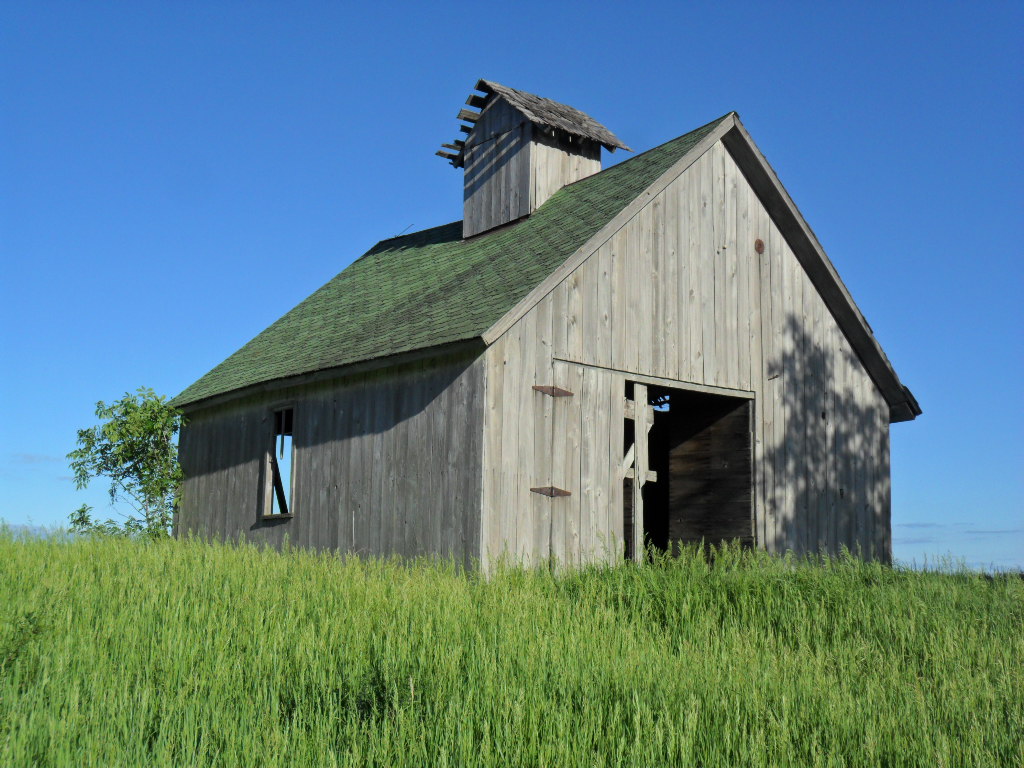
The old carriage house, just south of the site where a large house stood during my childhood, still stands.  The stained glass transom window hanging in my own house now and an etched glass hunting scene are all that remain of the house where Dad lived as a small child.  Emptiness and raccoons finally destroyed it.   When he gave me the windows over thirty years ago, Dad said it was impossible to keep an empty house in good shape forever.
SAM_1165

At the age of 18, my great grandfather, Gottlieb Werth, came to the United States to avoid being drafted into the Swiss army which hired out soldiers as mercenaries.  My father told me what his mother told him:  my father’s mother stood on the roof of her house in Switzerland and waved until she could no longer see her son; she never saw him again.  This photograph shows his grave in the Fillmore, Missouri, cemetery.

SAM_1094

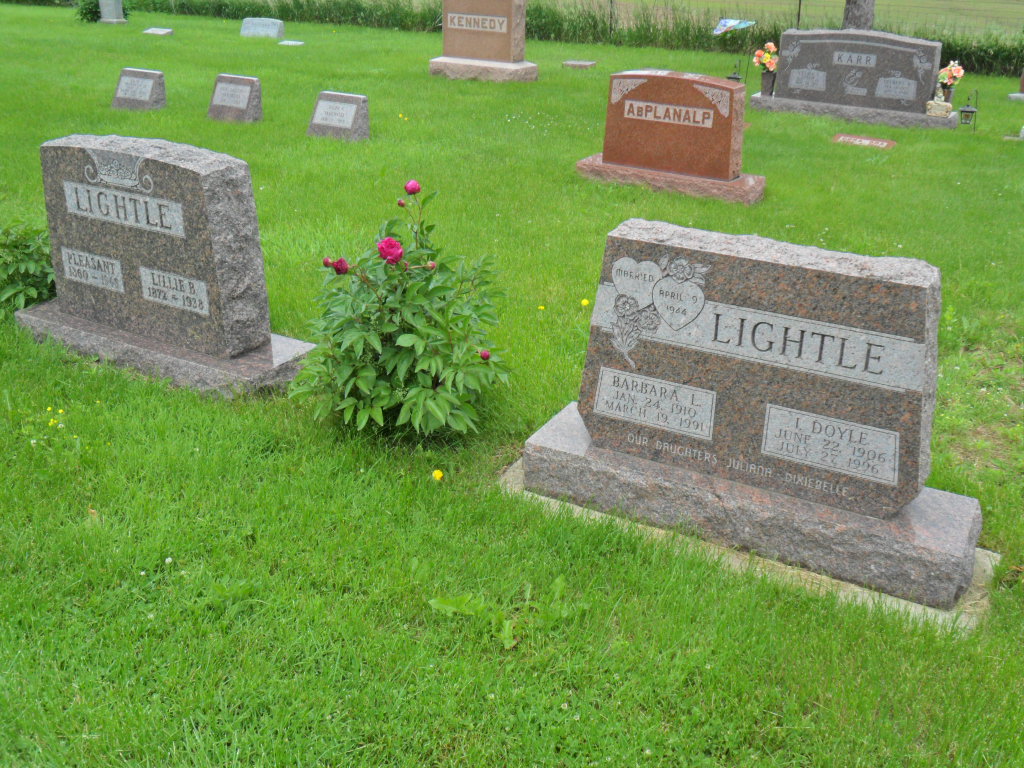
Nearby, perhaps fifty feet away, lay the graves of Mom and Dad and my grandparents.  I never knew this grandmother; she died long before I was born.  My grandfather died when I small and sadly I do not remember him.  The family stories tell that he taught me to talk at a very early age, nine months, because he held me on his lap and told me about everything occurring outside the windows.  My first word was “tractor”.
SAM_1090

Another family story tells that this grandfather walked to Andrew County, Missouri, from Illinois.  Andrew County’s rolls are full of Lightles.  It remains the only place I have ever lived where I am not the only person with my last name in the phone book.  Dad claimed there would be even more Lightles except for the fact that several brothers died when they tried to walk across the Nodaway River on winter ice and it broke.  They all drowned.

SAM_1106

Dad built the large pond in this photo and stocked it with fish.  Until a few years ago when someone bought the land and destroyed all the trees, a small forest of ancient oaks, black walnuts, and chestnuts grew between the house and pond.  Dad kept it mowed and groomed–a park.  Sadness filled me when I saw the trees all gone.

SAM_1107

All my childhood we attended Antioch Christian Church.  Although I could not see it from my house, if I walked across the road to where the carriage house still stands, it looms across the distance.  Potlucks were a very popular activity here.  Mom made such fabulous pies that everyone would get her pie first to make sure they got a piece.

SAM_1114

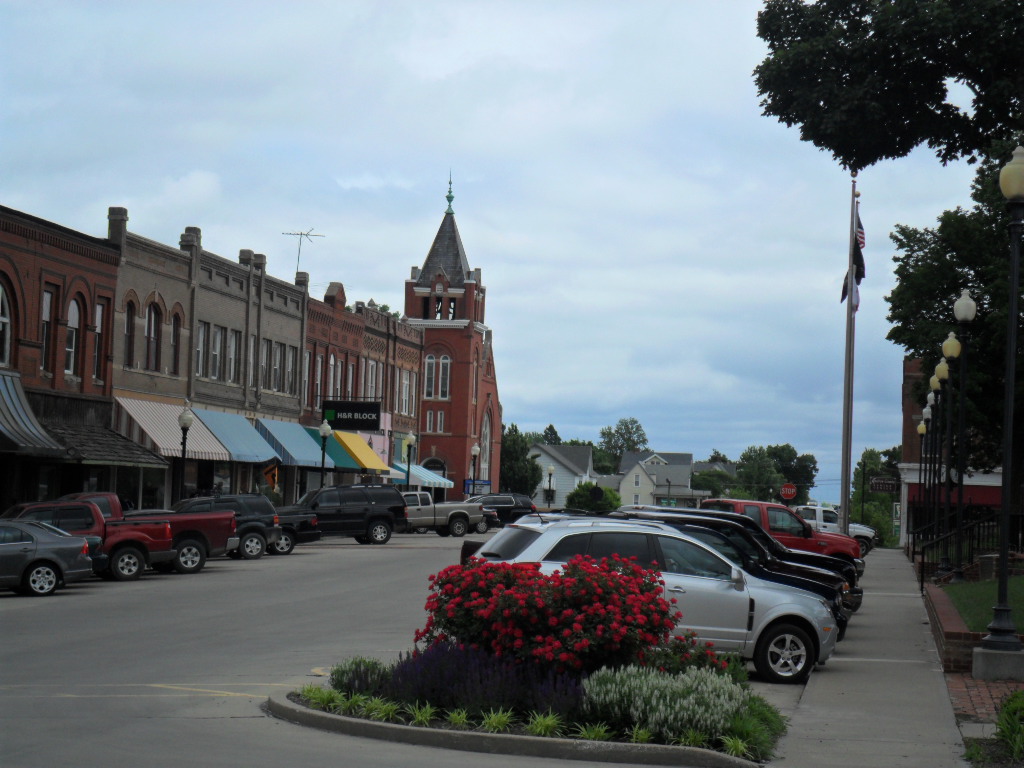
The sign in front of the Andrew County Courthouse.  This county remains filled with people of Swiss descent to the point they have celebrations commemorating their heritage. The following include photos of the courthouse and some of the restored buildings on the courthouse square.

SAM_1112

SAM_1116

SAM_1113

Several reasons exist for my returning “home” at this time, including attending my high school reunion for the first time.  The following photos show several people I had not seen since I was 18, including Melanie Eisiminger, who was the valedictorian when I was salutatorian so many years ago, and Jim Ahillen and his lovely wife.  Melanie is in the middle.

SAM_1127

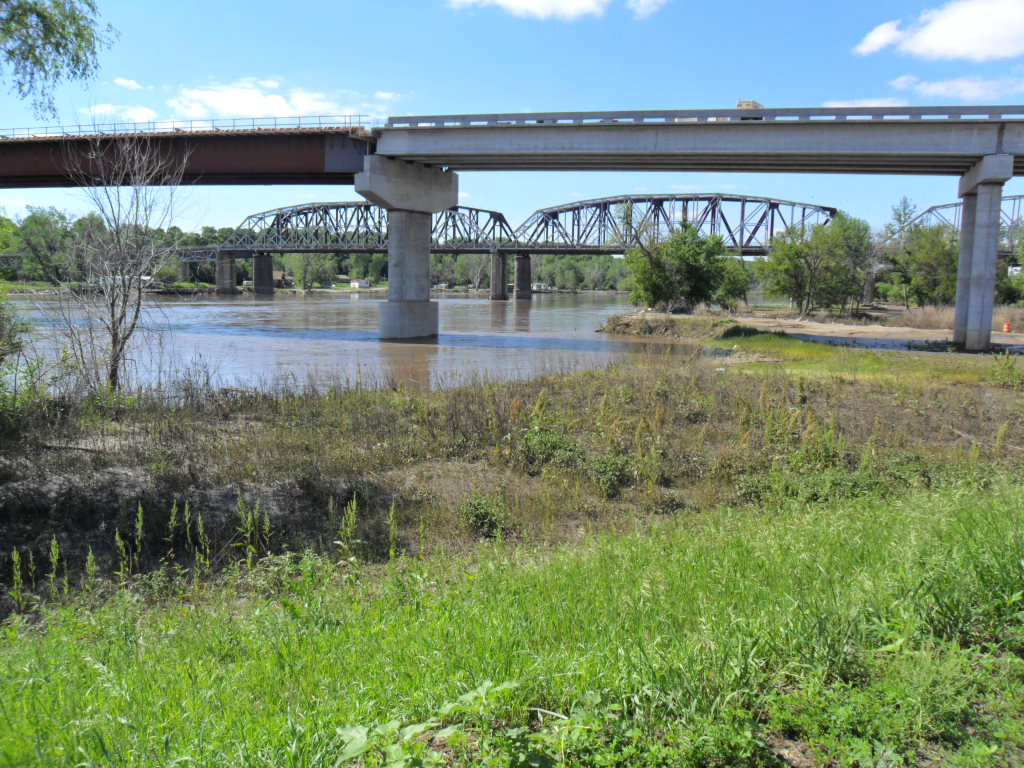
My mother grew up in Holt County, Missouri,  in the town of Fortesque and her family farm next to the Missouri River still remains mostly in the family.  In my childhood, Fortesque was still relatively prosperous.  Now fewer than fifty people live there.  The farm lays right next to the Missouri River.  I walked down the levee and took photos of this mighty river, the Rulo, Nebraska bridge, and the farm.  If I turned one direction, I faced the bluffs where White Cloud, Kansas, resides and the other direction is Nebraska.
SAM_1134

SAM_1128

SAM_1139

Between the Missouri River and the bluffs lays one of the largest wildlife refuges in the United States, Squaw Creek National Wildlife Refuge.  It is especially important for migratory birds, bald eagles, wading birds, and various mammals.  One can drive the new road ten miles through it to observe birds in particular but also other species.  The huge cottonwoods and oaks fascinated me.  It appears I had totally forgotten just how grand these trees can grow if given adequate water.  In one area I drove for at least four miles through a tree tunnel, then several raptors screamed at me while I tried to photograph them, and finally I managed to photograph a red winged black bird and geese.  After several days of semi constant rain, it felt fabulous to experience a perfect sunny day for my tiny trip to the wild.

SAM_1150

SAM_1148

SAM_1151

SAM_1149

SAM_1152

SAM_1155

After I left Squaw Creek, I drove to Mound City to find the graves of the Duke side of my family.  The last time I had been there was when we buried my aunt, mother’s sister.  I also remember going with her there more than twenty years ago.  I recalled the general location but had to hike around a bit to find them.  Because Grandfather Duke was much older than Grandmother, I never knew him.  Aunt Julia came to visit me at least once a year until she neared ninety and could no longer travel easily.    She never married and remained admirably independent until she became too feeble to get around on her own.

SAM_1160

SAM_1161

The E stands for Evelyn.  She was named after a woman Grandmother worked for on the White Cloud Reservation, Evelyn Le Clair.  On my previous visit to Missouri, I went to the White Cloud Reservation and inquired about the Le Clairs but had been told they had moved away a long time ago.  Grandmother had to work because her father went blind and could no longer work.  His name was Kaiser and he, too, came from Switzerland.  The following is the gravestone of my great grandmother.  Mother frequently recited sayings from her, e.g. you can’t tell by the looks of a frog how far he can leap.

SAM_1159

In  my childhood, we cut across the country side to go from the Andrew County farm where we lived to Grandmother’s Holt County farm.  I remained unsure whether I could recall exactly how to do this but tried and met with success, feeling very happy with myself, remembering something I had not accomplished in decades.  Because it had rained six inches the previous week, unlike last year during the drought, knee high grass grew along the backroads, corn was coming up, ponds were full.  I drove by the houses of people I remember from childhood, not knowing who lived there any more except a few.  People change, life proceeds, but the country still holds endless promise and beauty.  Finally, with a few hours left before flying back to Texas, I stopped by a new area north of Kansas City, Briarwood, strolled around, visited an excellent natural food market, ate a rather exotic lunch, and took a few photographs of huge new houses and the Kansas City skyline.

SAM_1173

SAM_1175

Everyone asked me to bring some rain back to the Panhandle of Texas.  It has rained three times since I returned home.  A coincidence, of course, but very welcome.

Gaston Luis Zulaica del Sueldo


Gaston Luis Zulaica del Sueldo walks toward me after disembarking from the plane.  Although I have never met him, I know exactly who he is.  Tallish, thin body; long, handsome, light tan face; smiling, perfect teeth; arms open.  A teenage Latin Lover, bouncing on the balls of his feet, rushing to me.  Those arms wrap around and squeeze me tight.  My new son has arrived from Argentina.

Every night while I fix dinner, he sits at the brown Kanabe piano my parents gave me thirty years ago and plays and plays:  Beethoven, the theme from Twilight, Chopin…I look up from chopping onions and see the short, dark ringlets on the back of his neck and watch his gliding, long-fingered hands.  He plays until salad making time arrives.  He tells me he makes salads for his grandmother back home.  Now he makes them for us:  layers of emerald lettuce, red peppers, black olives, orange carrots, green onions, a kaleidosope of appetizing color.

Gaston Luis Zulaica del Sueldo.  It curls around my tongue when I introduce him.  Images of tango dancers, gauchos–he is a champion rider, malbec wine–at seventeen he brought me some in his luggage, snow capped mountains where he skis, and cattle grazing on the endless grass his family owns.  We speak Spanlish at home, we laugh, we cook.  On my birthday he insists on paying for everyone.  When I tell him I did not expect that, he looks at me as if to say, “What kind of man do you think I am?”

Gaston Luis Zulaica del Sueldo.

Note:  One of the assignments in the prose poetry class was to write about a name, real or imagined.  This one is real.  Gaston lived with me a couple of years ago and I still keep in touch with him and his family.

2012 in review


The WordPress.com stats helper monkeys prepared a 2012 annual report for this blog.

Here’s an excerpt:

600 people reached the top of Mt. Everest in 2012. This blog got about 2,800 views in 2012. If every person who reached the top of Mt. Everest viewed this blog, it would have taken 5 years to get that many views.

Click here to see the complete report.

I started this blog 11 months ago.  I want to thank all my followers, commenters, and friends who follow me via WordPress, Facebook, etc.  for making this a success.  Thank you and Happy New Year.  May this new year bring joy and prosperity to all of you.

Albuquerque


Sitting in the Children’s Museum,
trying to make time fly faster,
waiting on my daughter and grandson.
Still shocked and excessively annoyed:
This is New Mexico and
Laguna Pueblo is just down the road
more or less
and I can’t find a single Silko
book except Ceremony which
I already own and have
read repeatedly.
What’s the matter with people?
They don’t know a thing about
their own heritage except maybe
turquoise and Kachina dolls
probably made in China.
Then there’s me:
not a drop of Indian blood I know of,
obsessed with
corn maidens
puma fetishes
Indian fry bread
Navaho paintings.
The xeroscape garden between me and
the dinosaurs beckons.
If I leave this seat and
my grandson’s and daughter’s
stuff gets stolen…

So

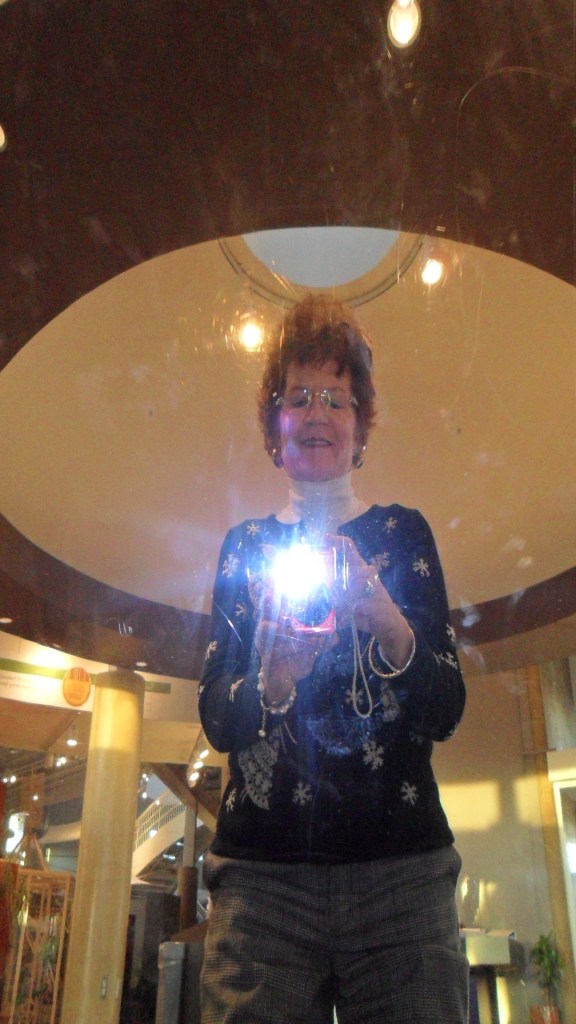
I photograph myself in the distortion mirrors,

I read Yo, a book about family truth

if there is such a thing,

and think about how much

my sister hates me.

SAM_0986 

Faith, Lies, and the War on Terror


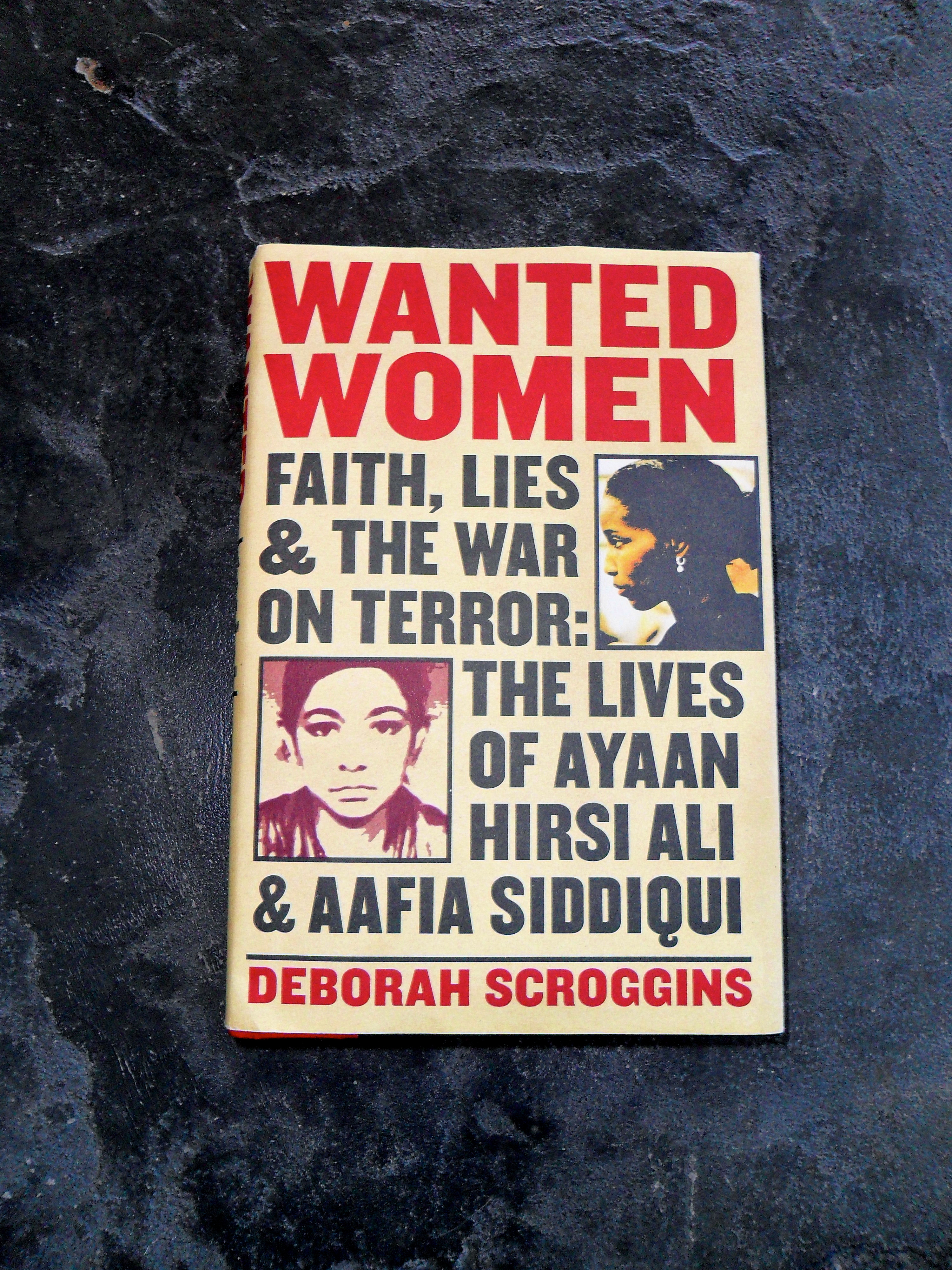
This blog began as a vehicle to “make” me write more and share my writings, e.g. poetry, flash memoir, essays, with others and to learn from reader responses.  Along the way, it morphed into my recipes—starting with friends requesting them, my travels and adventures, inspirations, and thoughts.  This post will morph me into something I fear may be far more controversial, but also feel I must explore. Several years ago, a couple of friends and I enrolled as continuing education students in a course about Islamic thought and literature.  Our hope was to learn more about exactly what the title indicated.  Although I had already read quite a lot of Middle Eastern literature, especially Iranian, and also some Turkish novels as well as memoirs and nonfiction books, I had no one with whom to discuss my readings and thoughts.  This presented an ideal opportunity.  After a couple of weeks, it became quite clear that the teacher had a definite agenda.  Although she never overtly discussed her own religious beliefs, she generally chose parts of readings to discuss to promote a certain, anti-Islamic bias.  We read the Quran (in translation because none of us spoke or read Arabic—mine was a Pakistani translation), Ayaan Hirsi Ali—various works including Infidel, Benazir Bhutto’s autobiography, and short stories by Iranian, Palestinian, and other Middle Eastern authors.  None were from Southeast Asia where the majority of the world’s Muslims live.  None were from India.  When we discussed the Quran, she chose very specific passages that zeroed in on what she perceived to be Islam’s oppression of women and promotion of violence and war.  When the rest of us tried to also discuss passages about ones duty to the oppressed, the orphans, the poor, she would channel the discussion back to her chosen agenda.  Some dropped out.  The rest of us decided to stay because we wanted to read and discuss the writings in spite of the situation.  Over time, our insistence on a broader based view seemed to affect her strong bias slightly.  In the end, she even showed the Iranian movie, “Children of Heaven”, which presents the plight of a poor Iranian family in a very sympathetic light.  The father overtly loves his wife and struggles valiantly to help her and his family in any way he can. This class has led me to further pursue my readings of literature from Iran, Egypt, Turkey, Pakistan, India, etc., both fiction and non-fiction and to learn as much as I can about the past and present as it relates to issues in these parts of the world.  Since then, I have also experienced the privilege of hosting exchange students from Thailand, Brazil, and Argentina.  One of my closest friends grew up Muslim in Indonesia.  I also have Christian, Jewish, Muslim, Buddhist, Pagan and atheist friends from many parts of the world, and some who have little interest in religion. Recently, the librarian where I teach asked me to read Wanted Women, Faith, Lies, and the War on Terror:  The Lives of Ayaan Hirsi Ali and Aafia Siddiqui.  I finished it recently and highly recommend reading this book.  The author, Deborah Scroggins, spent six years following the lives of these two women, including interviewing their colleagues, family members, self proclaimed jihadists, and government officials from several countries.  She delineates an incredible amount of information and data.  If you care about the political and spiritual future of this planet and the ongoing controversies surrounding Islam, Christianity, and Judaism, this book provides an excellent opportunity to explore history and the events of the last 20-30 years, and then to develop your own insights.  My hope is that this post will encourage others to explore new avenues of knowledge and open wider venues of thought that encourage a better, kinder world in which we respect and value each others’ differences.

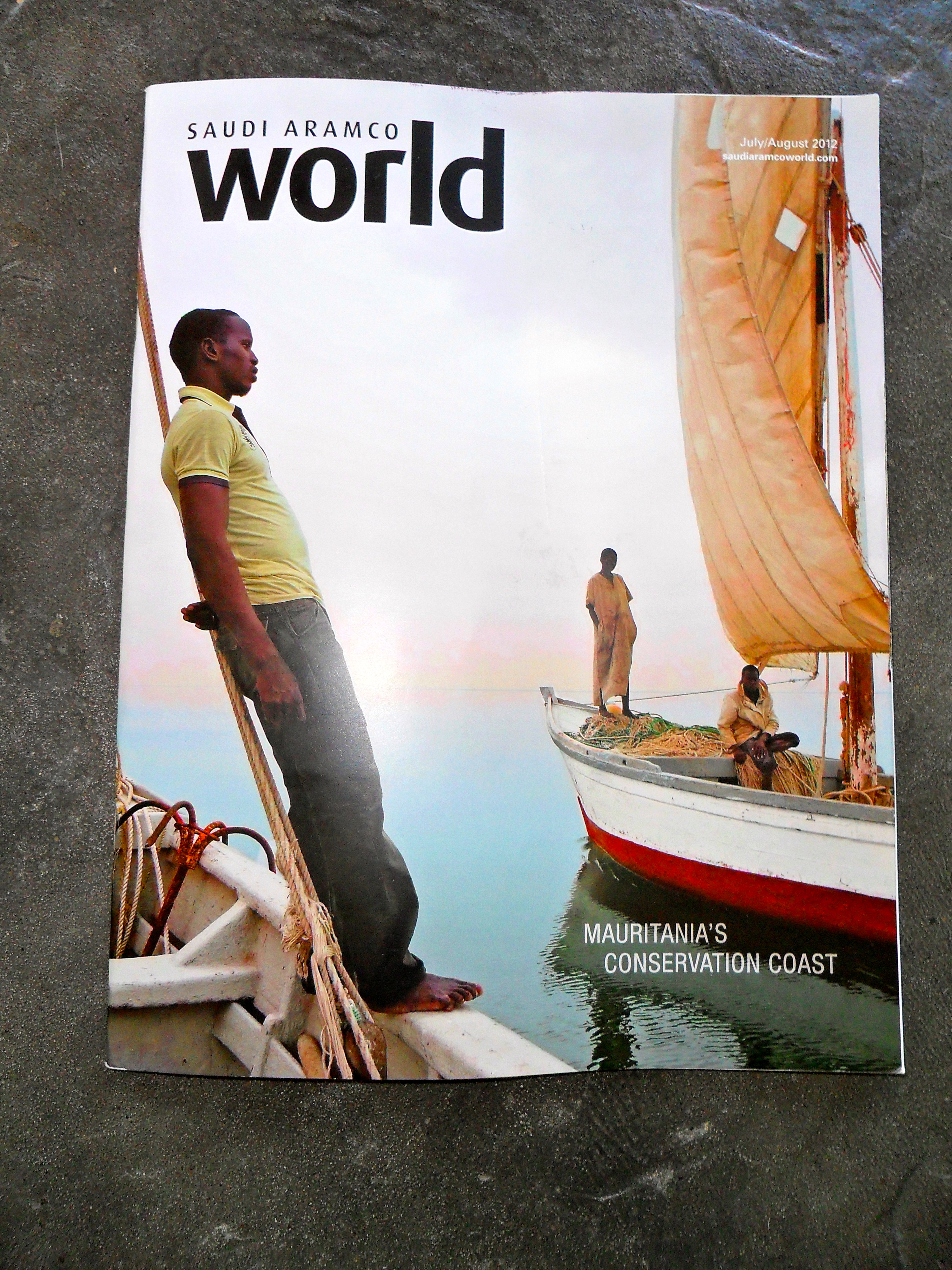
Recommended additional readings:   This is one of my favorite magazines.  It is free and covers art, cuisine, nature, history, literature, geography, just about everything imaginable.  For teachers, they have suggested uses and additional materials at the back.  It comes out six times per year.

If you are unfamiliar with literature from the Arab world, this is a good place to start.  Mahfouz won the Nobel prize for literature.  Although his novels take place in Egypt, the themes are universal.

In spite of the word jihad in the title, this is more of a “fun” read.  The Iranian American author, a journalist, decided to go to the Iran of her roots and work and live there for a while.  This book describes her adventures as a journalist in Iran.

Other books I recommend are Moonlight on the Avenue of Faith by Gina B. Nahai                   (this is one of my all time favorite books), No God but God by Reza Aslan, another Iranian journalist, The Forty Rules of Love by Elif Shafak (this book is a novel about Rumi, whose beliefs Islamists do not find acceptable), and Shattering the Stereotypes:  Muslim Women Speak Out edited by Afzal-Khan.

Another source of information about events, literature, art, etc. in the Middle East is a blog entitled “Sugar Street Review”.  One of their latest blog posts, Top Five Female Arab Writers provides a list of these women with photos, brief bios, and some critique.

Costa Rica 6: Adventures and Views


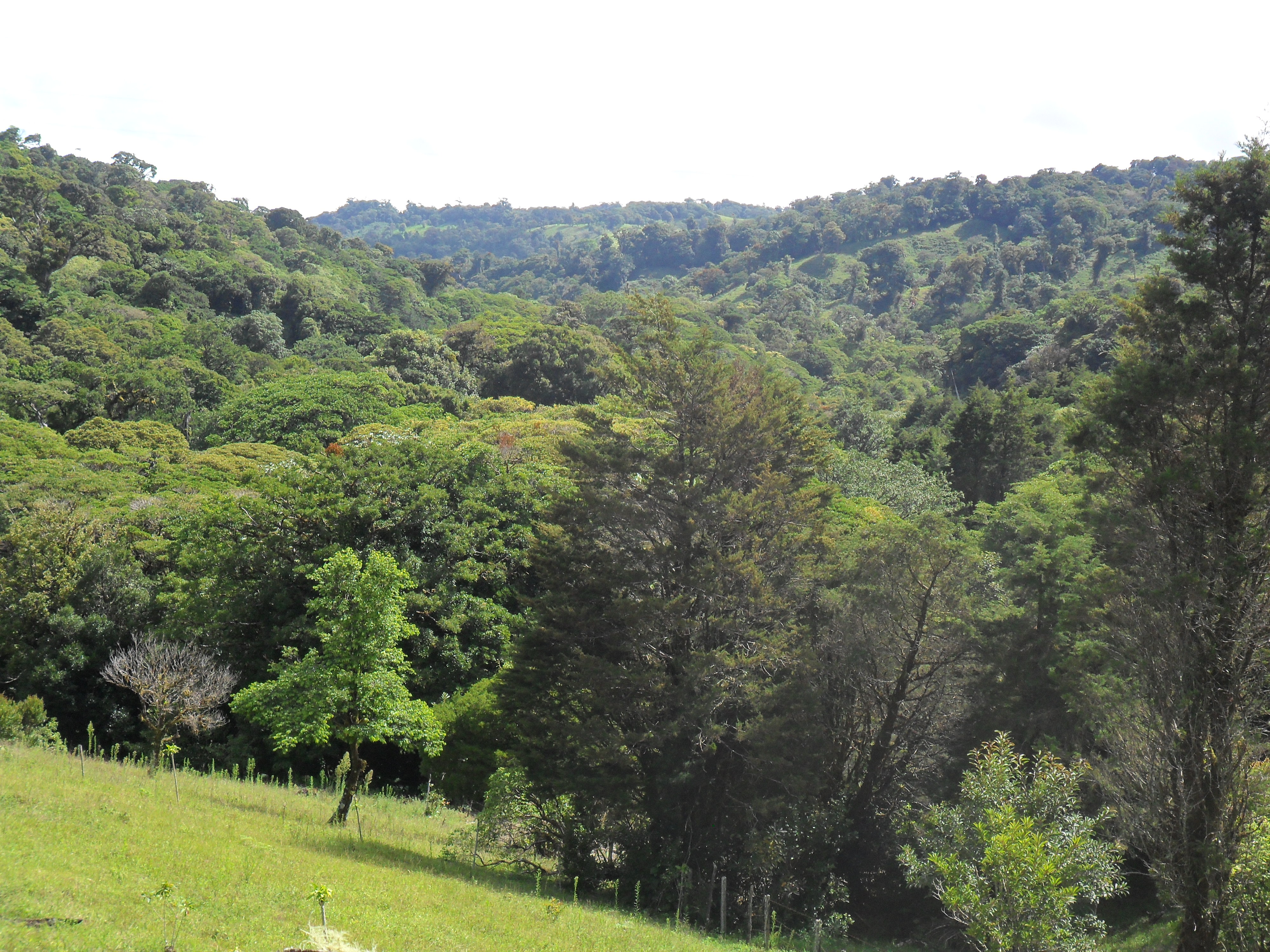
Without a doubt Costa Rica holds my vote for most photogenic and greenest country.  From the Caribbean and Pacific rain forests to the high mountain town of Monteverde, the words lush, exotic, verdant do not even begin to describe how incredibly rich the landscape is.  One of the first spectacular views lay before me across the parking lot from a combination restaurant and souvenir shop where we stopped for snacks.

I did not expect to see multiple mountain streams like in the Rockies, but it seemed we were crossing one nearly constantly.  This abundance of water explains their nearly total dependence on hydroelectric power with a little help from wind and thermal energy.

Several of my traveling companions decided to raft this river with class 4 rapids. Something told me I should not do this.  After flipping over several times, banged up and bruised, they decided to hike out.  In  the meantime, I experienced my own adventure, eating a raw turtle egg in salsa at a family restaurant on the top of a nearby mountain.

Beautiful mountain scenery seems endless.  I kept 00hing and awing.

This view shows the Bay of Nicoya in the distance from my hotel room in Monteverde.  The following photos all show views in the mountains near this little remote town.  There is only one road in and out and it is not paved and it is narrow.  The town was originally settled by Quakers from Canada who still believe a paved road will ruin the peaceful lifestyle.  Both the Quakers and the town are famous for their cheese which was served both plain and fried for breakfast.

This area provides both zip lining and horseback riding for tourists.  I elected to ride.  However, these horses did not seem well fed and certainly did not want to go very fast.  Although I saw a lot of horses in Costa Rica, these were by far the thinest.

The guy who lead us did not ride one of these.  He was riding a fancy, prancing, grey Paso Fino.

Look closely and you can see someone zip lining across the forested canyon hundreds of feet below.

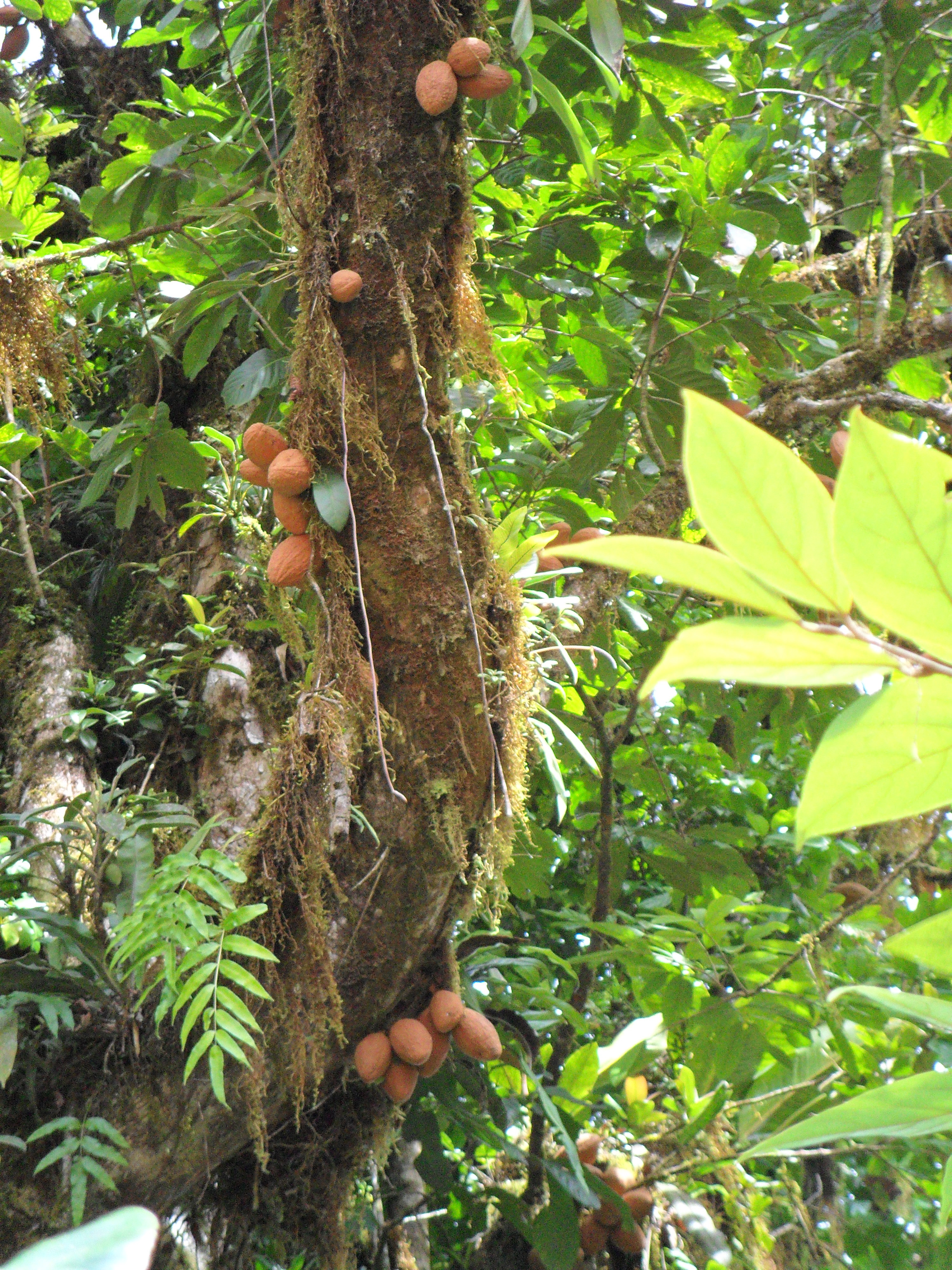
When I asked about this tree, I was told it is related to cacao, but not eaten, not by humans anyway.

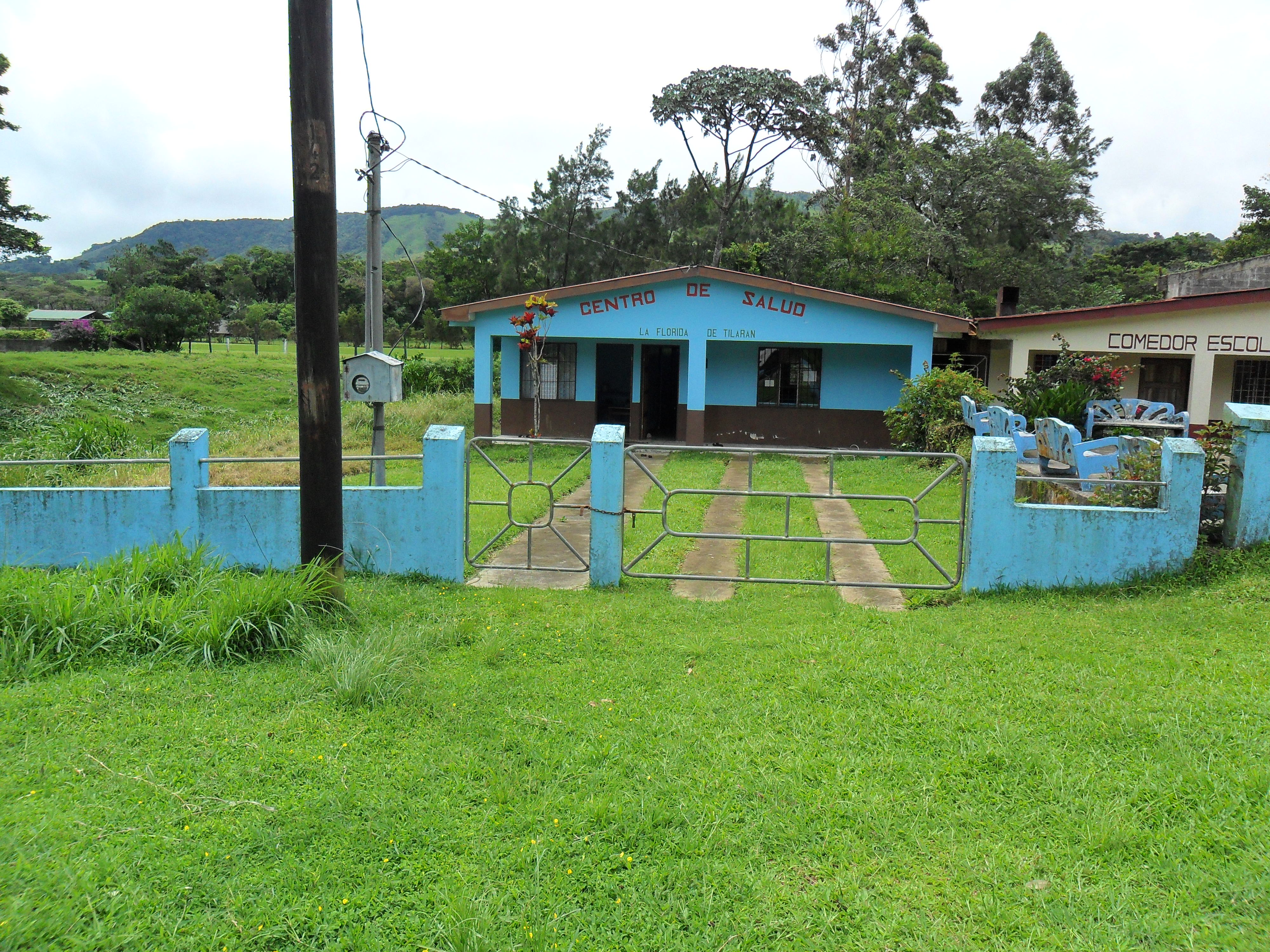
We traveled down the mountain on another dirt road to visit this elementary school.  It housed grades 1-6 with one teacher who is also the principal.  The literacy rate in Costa Rica is 98.5.

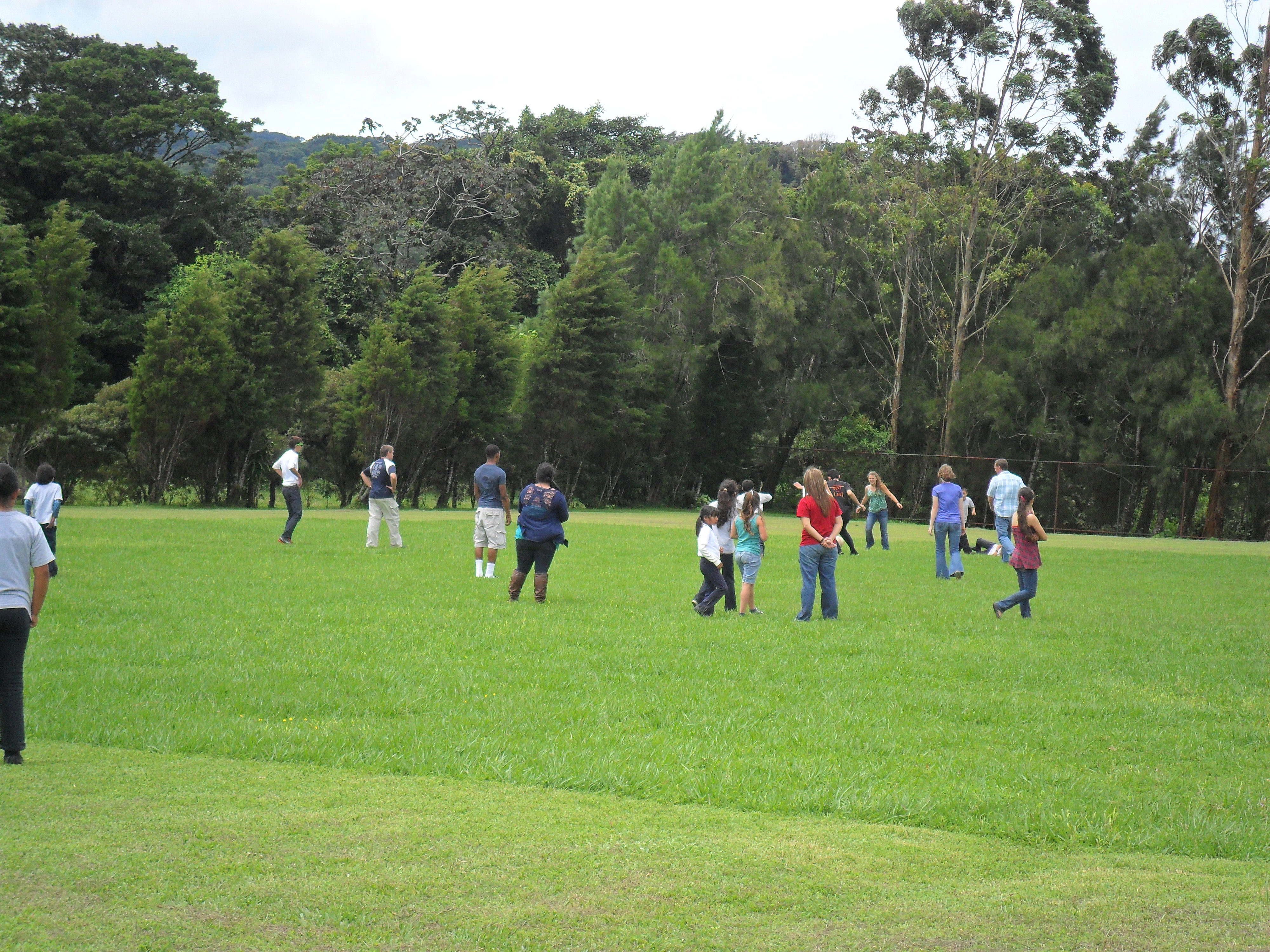
Playing soccer with the students.

A port on the Pacific on the way to the surfing town of Jaco.  Costa Rica exports many agricultural products from both its Pacific and Caribbean ports.  This includes bananas, pineapples, hearts of palms, and many tropical flowers.

While many beaches remain unsafe for swimming due to a strong undertow, the beaches at Manuel Antonio National Park are perfect.

To get into Manuel Antonio you have to walk and no parking exists really close.  Hiking out we crossed an area where the water rushed around our knees and the sign said, “No Swimming, Crocodiles”.

As a farmer, I like to look at and photograph crops.  With all the rain and heat, Costa Rica is the perfect climate for many tropical fruits and rice.  On the way back from Manuel Antonio we passed miles of rice fields and Aftican palms which produce palm oil.

Rice.

Coffee, the main export of Costa Rica.  In the highlands, coffee grows everywhere even along the berms in places so steep I wondered how the person picking the beans did not fall over.  Of course, I wondered the same thing about the dairy cattle grazing on the mountain slopes.

We did stop in Sarchi, the town famous for its furniture and oxcart industry.  Oxcarts remain the national symbol of Costa Rica.  Because of the mountainous terrain, when Costa Rican coffee initially became famous and its most successful crop, the only way to get the coffee to the coasts for export was to use oxcarts.

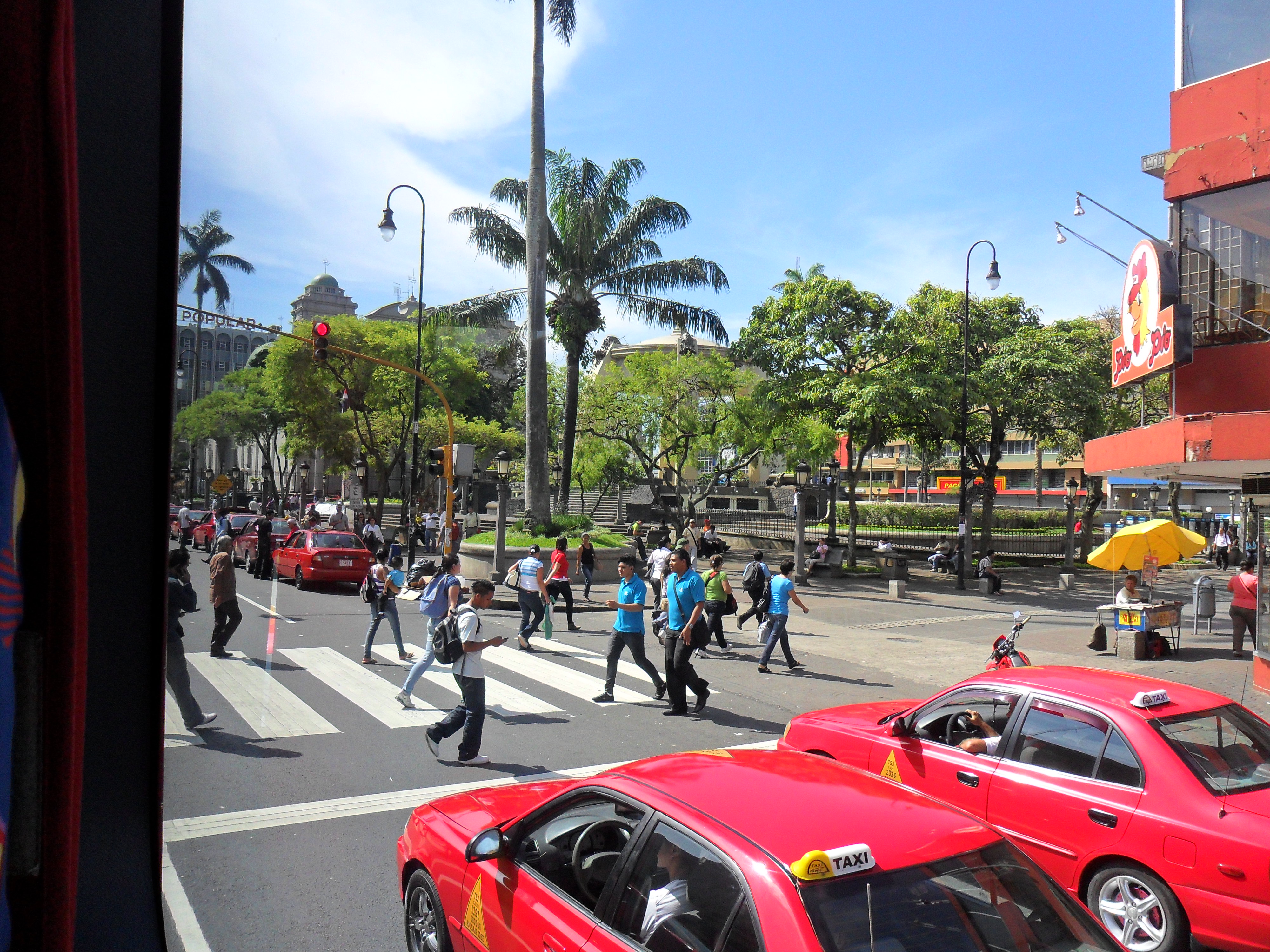
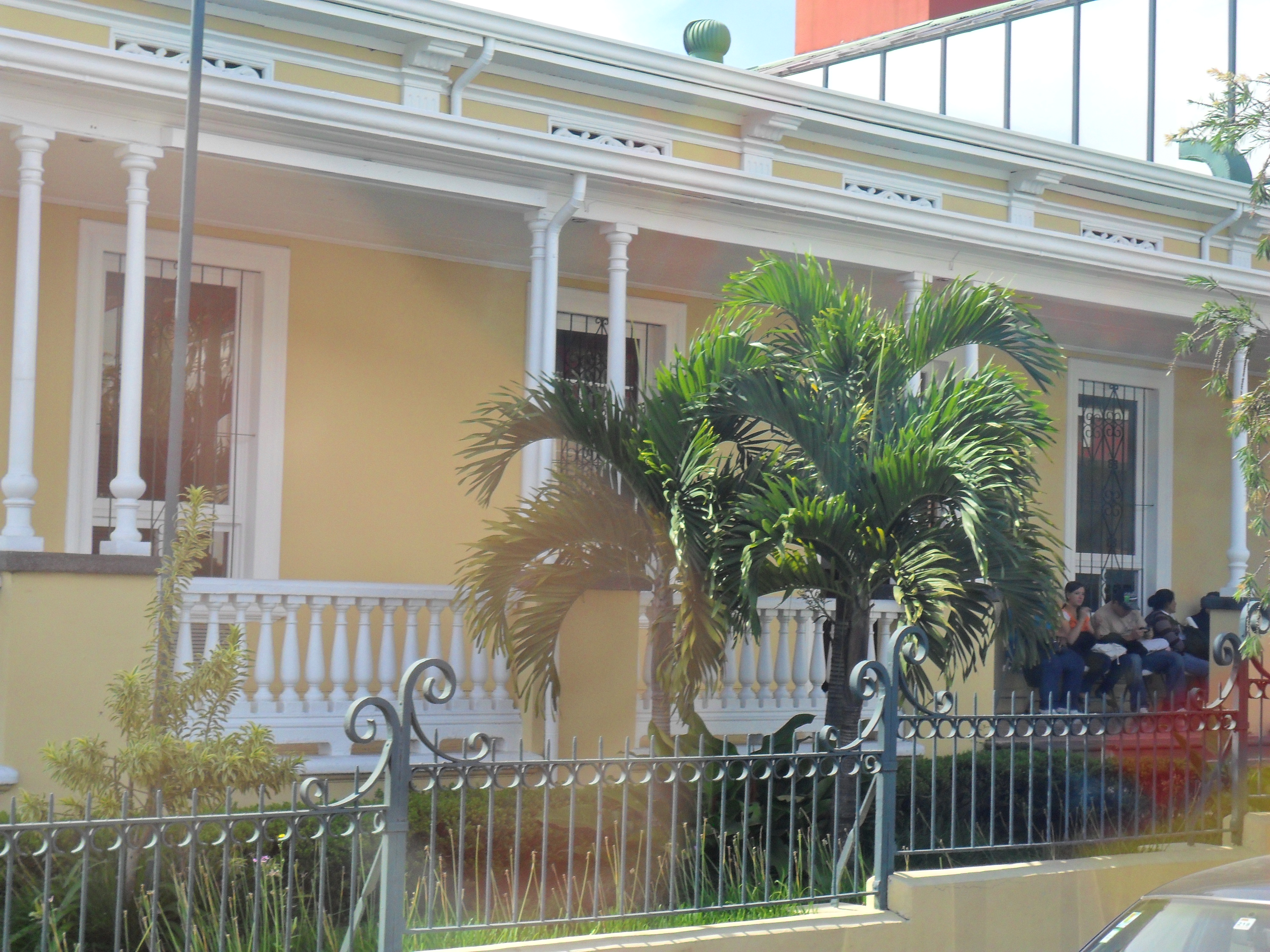
We spent very little time in cities.  However, as we left San Jose near the end of the trip and headed for the Caribbean side, I took some hurried photographs out the window.

My first and last hotel window view in San Jose included these stately coconut palms.

PURA VIDA

Pura Vida: 2, Comida (Costa Rican food)


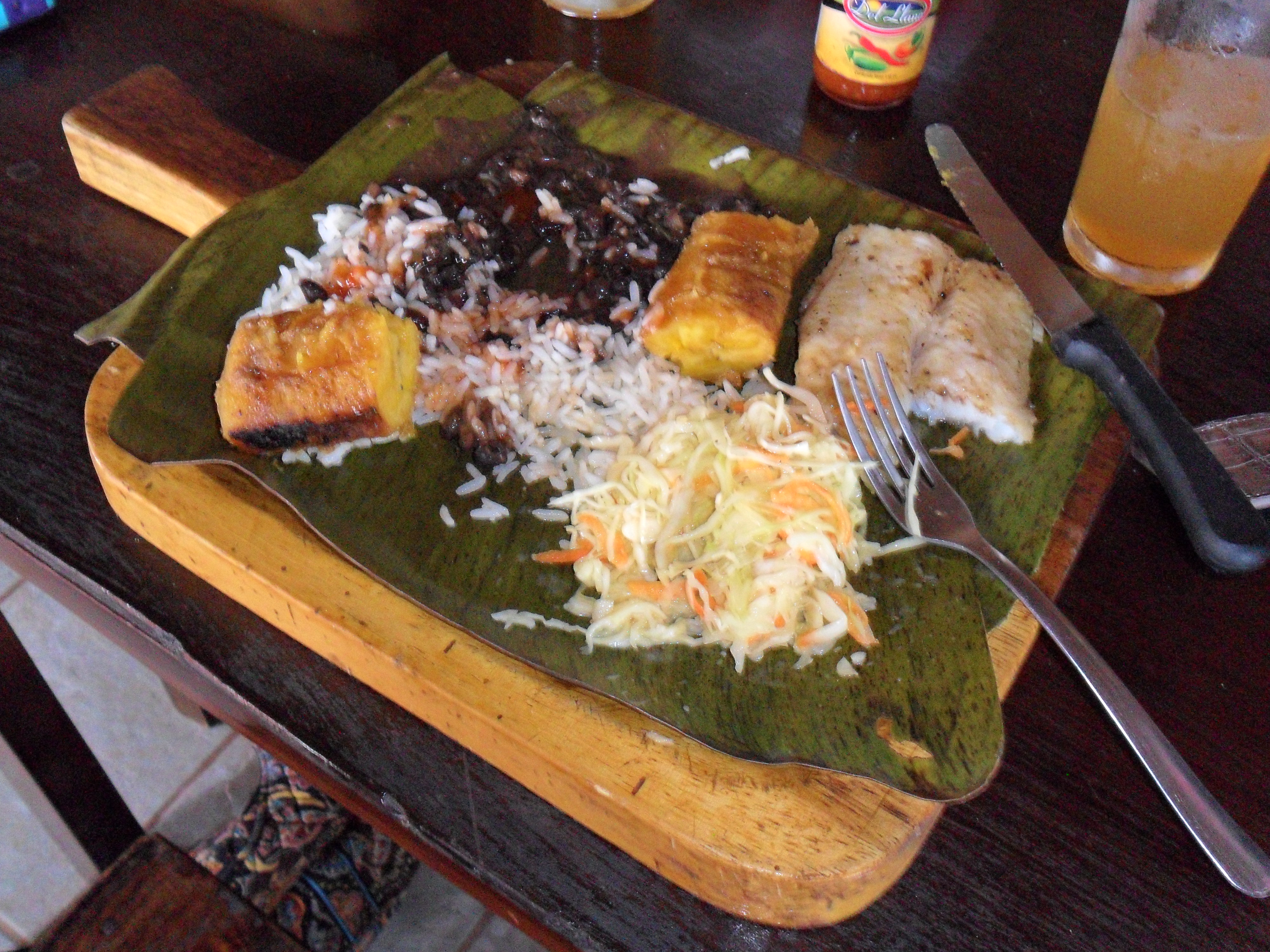
Costa Ricans appear to be very, very healthy.  Their food mainly consists of rice, black beans, salad, cooked vegetables, chicken or fish, fruit (usually pineapple, papaya, mangoes) and sometimes fried plantain.  In fact fried plantain was the only fried food, except occasionally cheese.  The food is plain with few spices, even though hot sauce, especially their version of tobasco,  is often available if you want it.  The national dish is gallo pinto:  left over white rice mixed nearly equally with black beans and sometimes a little chopped onion and bell peppers sautéed in oil.  This is a breakfast staple, but frequently served three times a day.  Sometimes, although black beans and rice are usually served at lunch and dinner, they are not mixed together then.  Often salad is their version of cole slaw, but tastes nothing like cole slaw here.  Usually both cabbage and carrots are very finely shredded and mixed together.  I never did quite figure out the dressing, in part because it varied greatly.  When the salad was with lettuce, it was also more finely chopped than we usually do here in the US and served with various dressings including olive oil.  The freshness of the salads stood out–no little bits of brown edges in Costa Rica.

The coffee, well, just lets say, I miss it.  Pitchers of steaming, strong, mountain grown coffee served with pitchers of steaming, rich milk.  In the mountains everywhere Jersey, Guernsey, and Holstein cows roamed up to their tummies in grass.  Happy cows for sure, producing rich milk for coffee and rich white cheese, which is served for breakfast.  Yes, breakfast, sometimes plain and sometimes fried.  Oh, and I cannot forget the ice cream.  Beyond creamy and smooth and rich.

There are sweets, usually made as snacks with coconut especially.  This was my favorite.

Obesity appeared to be non-existent.  I did see a few chubby people but no one really excessively over weight.  Perhaps diet is one reason, but they walk a lot even though most have cars.  They appear to drive them only if going some distance.  In the mountains I saw a lot of people riding horses.

The biggest food adventure for me occurred while waiting around near a little family owned restaurant at the top of a mountain.  All but four of us and the bus driver had gone river rafting.  We disembarked from the bus and walked around to kill time, chit chatting about this and that in Spanish.  Suddenly the restaurant owner came out with his grandson, unlocked the fence gate, and invited us in.  While sitting at the bar conversing with him and Hector, the bus driver, I noticed the menu posted on the wall.  It included huevo de tortuga.  Previous information given to us indicated that Costa Rican law protected turtles (tortugas).  I asked how he could serve this.  He told me it depended on the species of turtle and that he could acquire only a limited amount of them.  Suddenly, in front of me, Lisa, the other woman who did not go rafting and is pregnant, and Hector appeared three glasses that looked like giant, triple sized, shot glasses.  Each one contained a raw turtle egg immersed in red hot sauce the consistency of tobasco sauce.  Instructions and gestures indicated this was to be downed like a shot of tequila.  Lisa stuck her tongue in the sauce and said it was ok.  She downed hers first and said, “This is not all that bad.”  The restaurant owner told her it held great nutrition for her unborn baby.  I translated.  It became very clear to me that I had no choice but to down mine as well.  Hector downed his; then I mine.  Lisa’s assessment was correct; it was ok inspite of the turtle egg feeling like a rather solid but squishy mass as it slid down my throat.  The hot sauce made it possible.  Lisa downed a second one; Hector and I declined.  This experience remains one of the highlights of my trip:  relaxing in the middle of nowhere with a local family in their little restaurant.  Pura vida!!!!

Ten Little White Indians, Final Volume! (Spoilers Already Spoiled!)


This post by a fellow blogger says a lot about what I think regarding certain movies in which American Indians are portrayed or in which they act. It also relates in some ways to my own previous posted poem, “Blood Quanturm”.

danielwalldammit's avatarnorthierthanthou

Bet y’all didn’t notice!

I am one short on my promise of 10 Little White Indians. Well, it turns out that my three-part series on White Indians has four parts, and there is surely a good Monty Python reference in there somewhere, but maybe we’ll save that for another day

***

Let us start with a brief consideration of the near misses.

WIND TALKERS (2002): I remember when this movie was on its way to the theaters, rumor had it that the flick was about the Navajo Code Talkers. Working as I did then on the Navajo Nation, I was (like a lot of my students and colleagues) really excited to see this part of American history portrayed on screen. My enthusiasm waned considerably when I realized it wasn’t about a Code Talker so much as a white guy who might have to kill a Code Talker if things took…

View original post 1,713 more words

Blood Quantum


This poem is dedicated to Sherman Alexie whose poem, “13/16” begins with:

“I cut my self into sixteen equal pieces…”

My grandson cuts himself into 16 equal pieces:

4/16 Urhobo from Africa

4/16 Spanish from Spain

4/16 other European—two Swiss

German great great-grandfathers

(Werth and Kaiser), Irish, English

and who knows what

3/16 Mexican—whatever  mixtures that may be

1/16 Navaho


Who am I?  What am I?

Who are you? What are you?

Do we really know?

Who sets the rules?

-white men

-black

-Indian

-Native American

-Irish

-English

-German

from where and for whom?

He looks Navaho:

-blue black straight hair,

-pale brown skin,

-obsidian eyes.

One four year old girl asks him,

“Are you an American Indian?”

His six your old self says nothing.

She repeats,

“Are you an American Indian?”

He says, “It’s complicated.

The Navaho won’t claim him, too little blood.

He needs ¼ , not 1/16.

Caddo and Fort Sill Apache allow 1/16, not Navahos.

¼ blood is for

-Sioux

-Cheyenne

-Kiowa

-Navaho

1/8 works for Comanche and Pawnee.

Some Cherokees only want a Cherokee ancestor.


But he is none of those.

Is he Navaho?

Is he white?

The Old South goes by the one drop rule:

one drop of Negro…

Is a person with 99/100 percent white

and 1/100 black , black?

Who says?

Kids at school ask, What are you?”

He tells them.

They say, “You’re lying!”


I only know specifically about two ancestors,

the Swiss Germans.

Another great grandfather disappeared during the Civil War.

I don’t even know his name.

Who am I?

Who are you?

I think I’ll get a DNA test.

Then I’ll know how many pieces I need to cut myself into.