Apocalyptic Planet-Part Two: Hadley Cells, Weather and Drought


Hadley cells, the wind systems in each hemisphere , form patterns of atmospheric circulation in which warm air rises near the equator, cools as it travels poleward at high altitudes, sinks as cold air, and then warms as it travels back to the equator.  They are named after George Hadley, an English scientific writer.  Tropical regions receive more heat from solar radiation than they radiate back to space and such areas have constant temperatures.  More simply, warm air rises (heat rises) and then flows poleward at high altitudes, cools, drops, and flows back toward the equator at lower altitudes.   Then the process repeats itself.  When the air rises and leaves these tropical areas, it loses moisture as it heads to subtropical areas.  The majority of the worlds large deserts lay in these subtropical areas.

Hadley cells are expanding.  Precipitation has declined in tropical areas since 1970.  As I mentioned in yesterday’s post, Southern Asia, the Sahel, Southern Africa, the Mediterranean, and the US Southwest are getting drier and drier.  Even wetter areas now experience long dry spells between extreme events of rain and snow.  Examples in the US include the cold and snowfalls in the Midwest and Eastern Seaboard this past winter.  Texas and New Mexico continue to experience a prolonged drought.  In the next thirty years scientists predict a 30 per cent decline in water resources.

In some places both governments and individuals create innovative and sometimes simple measures to counteract desertification.  In India near the Thar Desert, the government mandated the dispersal of grass seed to hold the ground.  Studies indicate that the grass seed grew better when planted by hand than when dispersed from airplanes.  Also in India orans, small sacred groves, have helped preserve shrubs and grasses and even trees, a genetic bank that would otherwise have been lost.  Childs describes how his friends who live on the outskirts of Tuscon have coaxed their water table fifteen feet higher, using ordinary shovels and hard work.  They built contour traps and “massaged” the ground.  Hardly worth noticing except when it rained, the rain sank into underground catches.  Their properties now look like small areas of refuge in the vast desert.  In some areas of the Sahel people have been able to plant and nurture trees in such a way that areas of green exist where they had disappeared.

Archeologists and geologists know that periods of drought occurred repeatedly for millions of years.  For humans and the animals we know, drought has never been easy.  Large areas of civilization cannot exist without water.  We can affect our future in positive ways and prepare ourselves if we choose.

Apocalyptic Planet–Part One


Usually I read only one book at a time.  Lately, I am reading several, one of which is Apocalyptic Planet:  Field Guide to the Future of the Earth by Craig Childs.  Childs is a sort of combined explorer/adventurer/scientist.  He goes to places few go to see what occurs there, the wind, the flora and fauna, the weather, the climate.  The next couple of days I intend to share some of his most pithy observations and ruminations.  We will start with the desert.  He and a friend literally wandered around the most arid and hostile portion of the Sonoran Desert in northwestern Mexico.  This desert has enlarged and become more arid due to an extended drought.

Deserts come and go.  If you live in a lovely lush green landscape, wait long enough and it, too, may become a desert.  Six thousand years ago lakes, marshes, and grassland lay where the Sahara is today.  A slight orbital change in earth’s relation to the sun caused nearby oceans to heat up, changing atmospheric conditions.  Humans living there had no choice but to move.  Forty per cent of the earth’s population lives in semiarid regions.  Even a small drought changes survival chances for the people who live there.  The Sahara, the Gobi, and the Taklimakan are growing, arable farmland decreasing.  Vulnerable areas include southern Spain, Greece, Bolivia, Australia, central Asia, and our own West.  The entire American High Plains (I live in the southern part) sits on top a giant desert.  Without pivot irrigation, only grass grows here.  In the last decade many irrigation wells have dried up or gone too saline.  The giant bulges you see in places like the sand hills of Nebraska are really a sand dune sea covered with grass.  Take away a little rain and here comes the desert.

Childs and his friend carried water with them and buried them with markers in the sand so they could find them later.  As the desert grows in parts of India, women carry water farther and farther, an average of six miles a day, four gallons at a time.  In the Sahel just south of the Sahara a difference in rainfall of just an inch or two can mean the difference between survival and starvation.  Without water, there is no civilization.

What causes these changes?  Human behavior and the increase in greenhouse gases are  part of the reason.  Humans are creating enough changes that we are moving toward more deserts, not fewer.  One climate expert, Jonathan Overpeck, thinks we are seriously underestimating the severity of drought we will face in the not so distant future.  Forget five and seven year droughts and think fifty years.  Hadley cells also affect climate change.  Tomorrow I will explain Hadley cells and how they affect our weather.

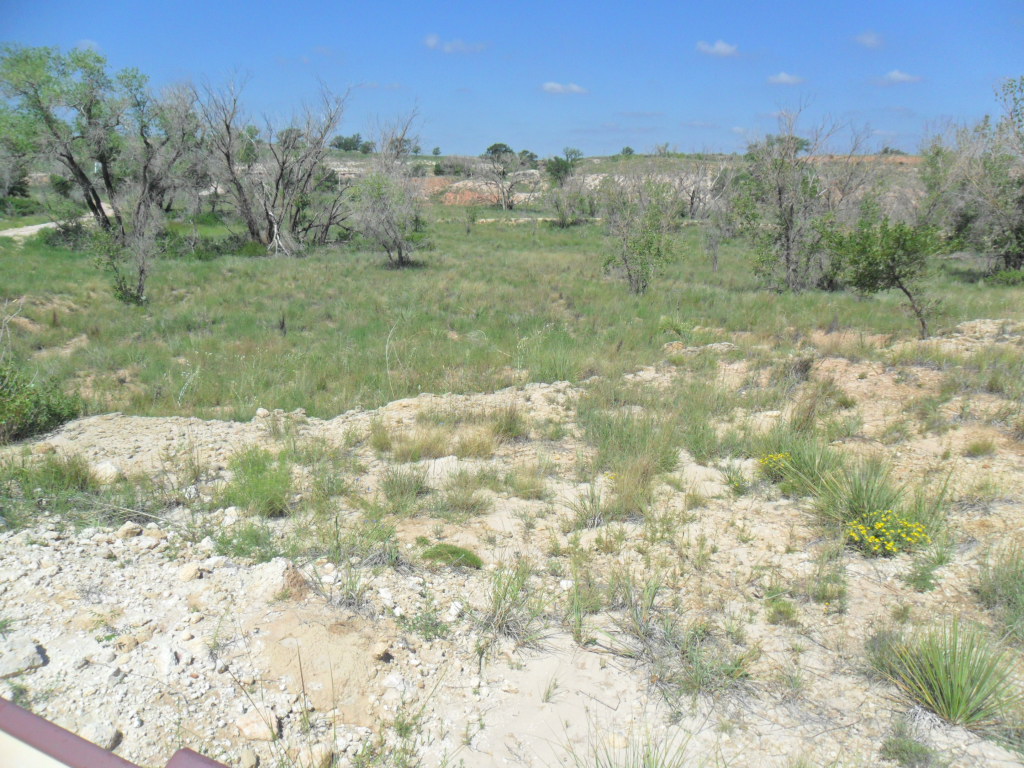
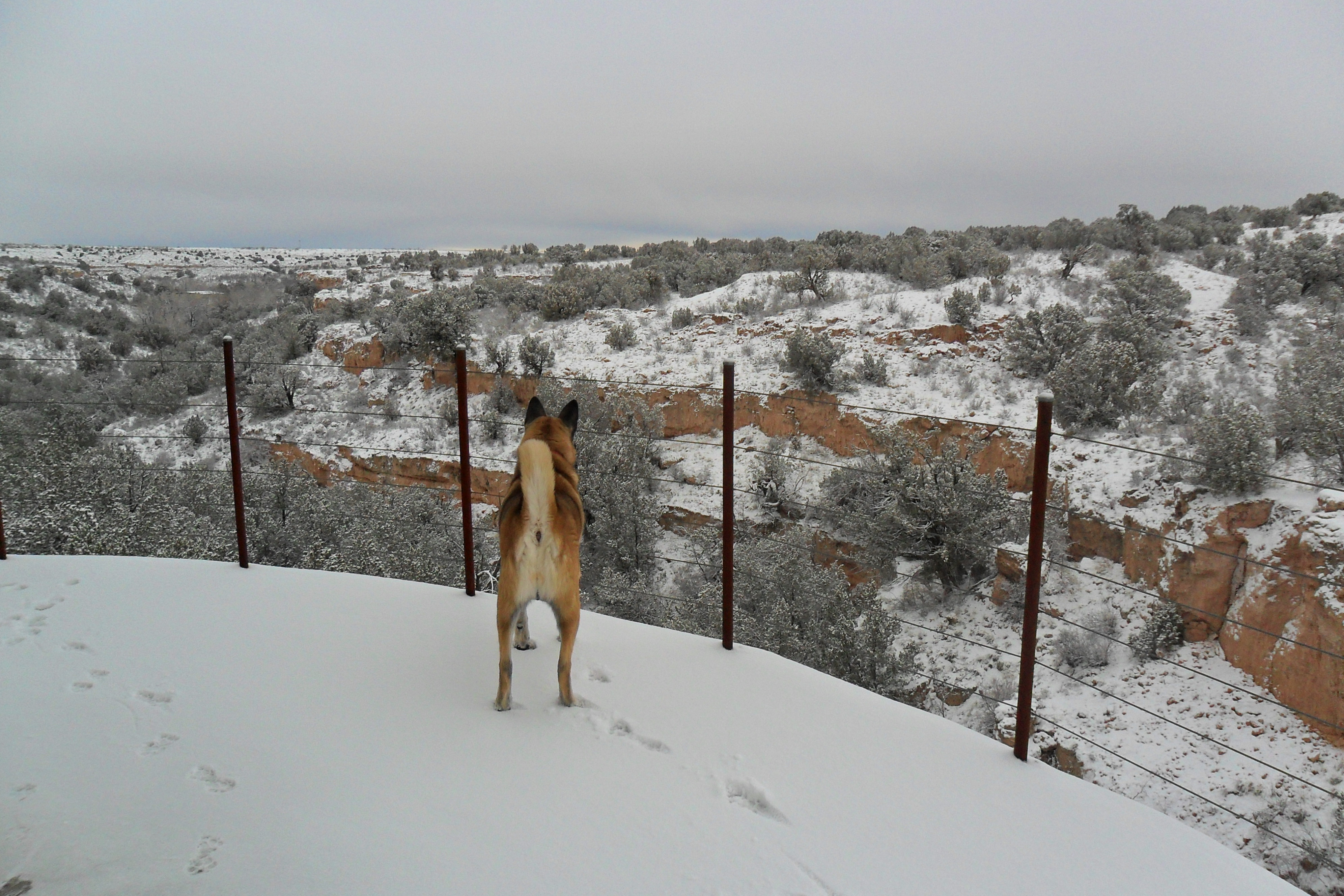
SAM_1190


Northern Arizona

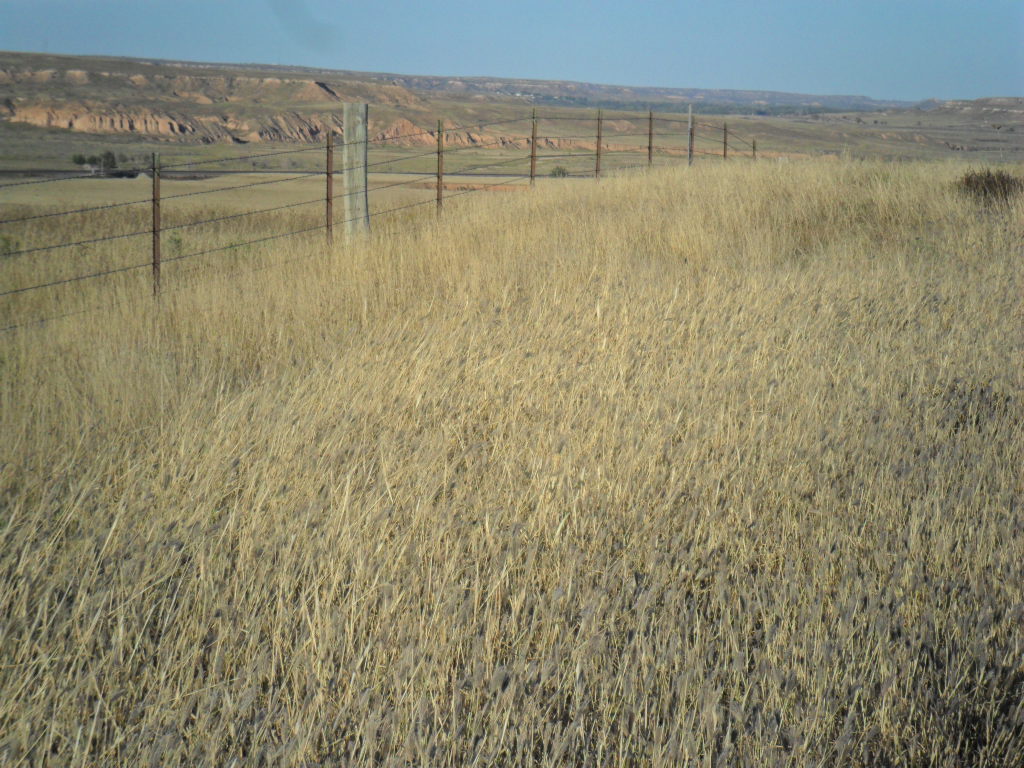
SAM_1302


Eastern New Mexico


SAM_1370


Texas Panhandle

The Story Circle Network Conference and My Commitment: This Is What I Know


ad_scnconfWhen I first started blogging more than two years ago, I committed to blogging once a week.  That I managed for a year or so and then since that time, it became more sporadic.  Full time job, writing poems for my book, visitors, mini vacations, all sorts of stuff got in the way.  Really, I let it lapse, but refused to give up.  Last Thursday, I drove to Austin with my daughter and grandson for the biannual Story Circle Network Conference.  The plan:  while I conferred, they played.  The Story Circle Network is an organization for women which encourages women to write, to tell their stories, to share these stories, and when possible and desired, publish those stories in various forms from memoir to poetry.  This was my second time to attend and my first time to attend as a new board member.  A former mentor/teacher of mine, Len Leatherwood, facilitated  a workshop entitled “Transforming Your Writing Life in Just 20 Minutes a Day”, the last workshop I attended.  She blogs everyday.  I follow her blog.  No matter what, she sits down and writes 20 minutes minimum a day separate from the writing she does with her students–she teaches writing privately in southern CA.  One of her recent blogs has been accepted for publication–a piece of flash fiction.  She nearly begged us to commit to this kind of writing practice.  Previously, I had refused, flat out refused, partly thinking that if I tried it, more than half the resulting writing would be crap.  Nevertheless, she and her workshop convinced me that at least for one month I must try this.  Now all of you following my blog will be inundated with daily blog posts.  I am filled with curiosity as to how people will respond.  Maybe it will be like my Facebook posts–yes, I am an almost addict–the posts I consider most meaningful for the universe at large are the ones people ignore and the ones I consider personal trivia receive the most response.  Maybe I will track what appeals to my readers.  Some I won’t know because with blogging I share to Facebook and to a couple of professional networks, I have no clue who read what.  Once I received an email regarding a poem I posted. Although it never showed up as a like, the lady actually told me she read my poem in church!  Who would have guessed. I forgot to time myself so have no idea how long I have been here writing.

Here I am writing about why I am writing.  On the stove I smell Jasmine rice cooking.  I love Jasmine rice from Thailand.  I am a very picky rice eater and prefer to mix equally white Jasmine rice with black and red.  For one thing, it looks lovely when done–a sort of dark reddish purple.  Since I sautéd chopped garlic in olive oil, then added the rice and sautéd for about 15 more seconds, then added water and some broth just before I started writing this, the smell of Jasmine rice fills the house.  I piled a bunch of paper towels on the top before I put on the lid or you can use some cloth towel–a habit I picked up from my Iranian ex-husband.  Iranians really know how to cook rice.  I am also drinking a glass of Cupcake Shiraz which I bought on the way home from work.  And yes, Shiraz is also the name of a city in Iran where they actually grow grapes or at least used to. But of course, drinking wine is no longer acceptable in Iran or at least not publicly.  Good Muslims do not drink at all.

I did write something worthwhile while in this workshop and will share–doing this last because it won’t count as my daily writing since I wrote it yesterday.


This Is What I Know


My parents loved me, really loved me.

My mom was proud of my accomplishments.

Dad gave me a love of books, intellectual curiosity, and a

sense of wonder.

Mom gave me a love of music, beauty, and cooking.

Happiness is a choice.

I do not believe in luck.  You make your own luck.

Life is an exciting adventure.

Horses give me joy.

Singing gives me joy.

Dancing gives me joy even if I rarely have the opportunity.

Family relationships can be distressingly complicated.

I am proud of my children and their accomplishments.

Religion matters much less to me than 99 per cent of the people I know.

Ethnic and religious prejudice distress me and I do not

understand those kinds of attitudes.

I am a good writer.

I want to make a real difference in the world.

I am happy 99 percent of the time.

Blessings flood my life.

My close friends and children and grandson are more

important to me than they know.

Writing has enriched my life.

I have few regrets:

One I have rectified;

the other I cannot–

my dad is dead.

From The Guardian: Ten Rules on Writing Fiction from 14 Authors


The best list of rules for writing almost anything. If you are an English teacher these are musts to teach writing.

lenleatherwood's avatar20 Minutes a Day

Get an accountant, abstain from sex and similes, cut, rewrite, then cut and rewrite again – if all else fails, pray. Inspired by Elmore Leonard’s 10 Rules of Writing, we asked authors for their personal dos and don’ts

Elmore Leonard, Diana Athill, Margaret Atwood, Roddy Doyle, Helen Dunmore, Geoff Dyer, Anne Enright, Richard Ford, Jonathan Franzen, Esther Freud, Neil Gaiman, David Hare, PD James, AL Kennedy

Elmore Leonard: Using adverbs is a mortal sin

1 Never open a book with weather. If it’s only to create atmosphere, and not a charac­ter’s reaction to the weather, you don’t want to go on too long. The reader is apt to leaf ahead look­ing for people. There are exceptions. If you happen to be Barry Lopez, who has more ways than an Eskimo to describe ice and snow in his book Arctic Dreams, you can do all the weather reporting you want.

2…

View original post 3,420 more words

A Happy Birthday with Three Penny Opera


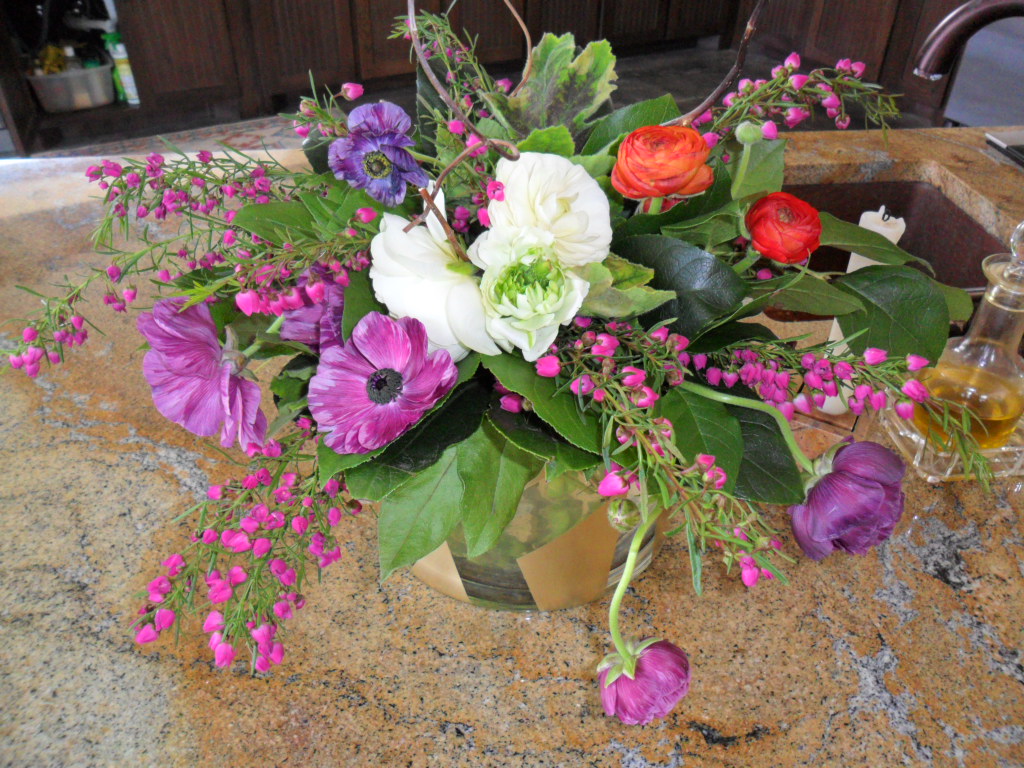
After a certain age many of us do not expect all that exciting a birthday, but mine this past week was a huge exception to anything I could have expected.  First, on the day before, these spectacular flowers arrived from my son, Erik Karlsson.   Parie Designs in Amarillo, Texas, really knows how to do flowers out of the ordinary.


SAM_1478


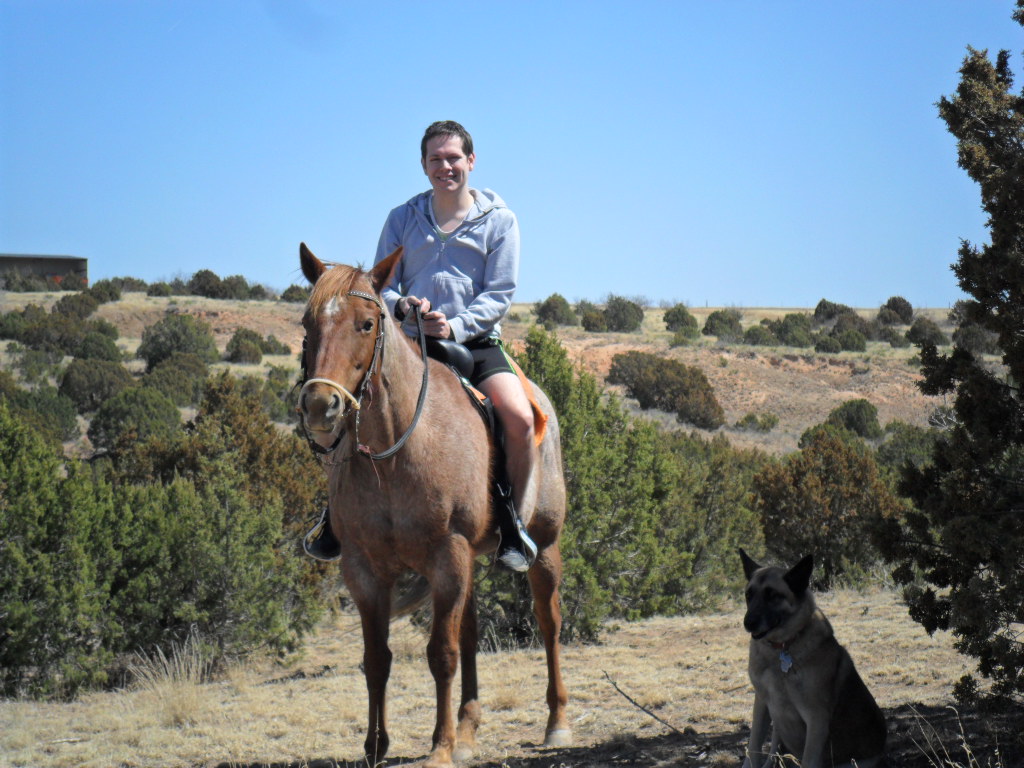
Almost two weeks ago, Walker Lewis, the Director, and Jeromy  Hunt, the Production Stage Manager, of the upcoming production of Three Penny Opera (Amarillo Opera Company) arrived to stay with me for three weeks.  Yesterday, my birthday, was an off day for them.  Chad Armstrong, one of the baritones, came over to ride my  horse, Rosie.  Romy and Walker gave me a bottle of good cab and bought me a birthday cake.  We relaxed on the rim of wonder (my patio), ate, and rode Rosie.  Then last night we all went to the annual opera gala.  Unfortunately, one of the opera performer’s husband became ill so now I will have my tiny fifteen minutes of  glory playing the madame of the brothel, pretending to smoke a cigarette, counting money, and watching “my girls” and the customers, or so they tell me.  Later today, I go for a fitting and start the one week of rehearsals remaining until the first performance on Saturday night.

I could not have ordered a better birthday.

SAM_1463

Chad Armstrong on Rosie, Walker on the left and Romy on the right.

SAM_1466

While Romy, Walker, and I hiked around, Chad rode off here and there, disappearing for a while and then showing back up.  Rough riding in canyon country.  Neither Romy nor Walker had ridden since childhood.

SAM_1471

Walker Lewis learning to ride–on Rosie.  He loved it and will ride again this coming week.  He kept smiling all over!!!

SAM_1474

Romy on Rosie with my dog, Isabella resting in the shade of a juniper tree.

Apparently, riding Rosie produced so much fun that the other singers want to come over later this week and ride.  Nothing beats fun friends, fabulous food, and pretty well broke horses for a day to remember!!!


Gypsies, Deserts, and Random Thoughts on a Cold Sunday Morning


In less than 15 hours, it has dropped from low 70s to 9 here on my canyon rim–one of the joys of living in the Panhandle of Texas where a mere change in wind direction can dictate the weather.  Yesterday afternoon, I was helping my daughter clean her back yard and ready the ground for planting some shrubs and a tree and now 60 degrees colder.  This type of drastic weather change has occurred repeatedly in the last few weeks.  Perhaps it has muddled my brain which keeps hopping back and forth from this to that.  First, the “this”.

Mostly, I read Latin American, American Indian, and Middle Eastern authors.  When I recently stopped by the library, I could find none of these that I had not already read so I picked up a book from a Dutch author of whom I had never previously heard, Margriet de Moor.  The book, a novel, The Duke of Egypt, tells the tale of a Gypsy man who meets this young Dutch woman.  They marry and lead a quite unusual life:  in the winter he lives with her on the family horse farm; in summer he leaves and lives with the Gypsies, wandering around Europe in their caravans.  When he is “home” with her, in the evenings he tells her tales of his Gypsy family and friends, centuries of history.  These tales shocked me:  centuries of discrimination, hangings–even Gypsy women hanged publicly for no other reason than they happened to be Gypsy in the wrong country at the wrong time, sick children whom no doctor would treat, starvation, driven from country to country.  Of course, like many people I have heard stories about Gypsies:  as a child my grandmother telling me that Gypsies stole other people’s children, a friend telling me the police said it was Gypsies when someone stole some silverware from her house, but I never really believed it.  Reading this book caused me to delve a bit more into Gypsy/Roma history only to learn even more tales of horror.  Hitler and his Nazis hated Gypsies almost as much as they hated Jews.  It is estimated that the Nazis sent at least ten per cent of the Gypsy population in Europe to the gas chamber.  On the positive side, I learned that many Gypsies were hired by people who raised horses to help them with their horse care because Gypsies were considered expert horse trainers and traders.  In addition, some hired them for their music to play for social events and festivals.

When several friends came over for dinner, I mentioned the book to them and my shock.  I wondered aloud as to why so many hated the Gypsies.  The general response was this:  Gypsies consistently live as they wish and refuse to follow the social norms of the rest of the population.  They refuse to settle down and live in one place, they enjoy life, dancing, drinking, roaming.  If you refuse to live like everyone else, the rest of the world will  punish you.

Then I moved on to the book I am reading now, Apocalyptic Planet:  Field Guide To The Future Of The Earth.  I am only on page 27 of 327, and already I have learned:  “Deserts generate most of the world’s airborne dust, contributing to a global migration of surface minerals.  Dust blowing from the southern Sahara is the single largest producer of iron for the mineral-poor soils of the Amazon in South America.  Half of this dust originates in the Bodele Depression north of Lake Chad, which produces about one hundred storms a year, each sending 40,000 tons of dust across the Atlantic to South America.”  And a bit further in the book:  much of the fertile High Plains here in the US (Kansas, eastern Colorado, Oklahoma, Nebraska, Texas, basically from Canada to Mexico) sit on top of a desert, e.g. the Sand Hills.  Currently, these sand hills remain stabilized by miles and miles of grass–our native short grass steppe.  It does not take much to imagine what would occur if drought continues and the grass disappears.  Once desertification occurs as it is now occurring in many places in the world, e.g. the Sahel, deserts consume.  Jonathan Overpeck, a leading climate researcher claims, “…we are significantly underestimating the severity of drought we could get in the future.”  He predicts many places now inhabited will become uninhabitable unless we initiate drastic changes in our water management.  People will be forced to move from places of little to no water to places “wherever there is no desert”.  He adds, “We are contributing enough change to the planet that we are moving toward more droughts instead of away from them.”  In the Sahel alone it is estimated that 500 million people will have to move to survive.  I think over this information and about the current drought here and look at the beautiful place where I write and live, wondering will it be habitable in one hundred years.

Now on to the “that”:  grateful I live here in the United States in spite of all our “problems”.  I could have been born in Ukraine, Syria, Central Aftican Republic, any of those places experiencing turmoil, fear, religious hatred, genocide, torture–the list goes on and on.  Instead here I am happy, relatively safe, warm in spite of the 9 degrees outside, well fed–you get the picture.

Much as Love and Murder, Freedom is a Many-Splendored Thing


danielwalldammit's avatarnorthierthanthou

17711-series-header Yapto Soerjosoemarno is a middle-aged man. He is the leader of Pankasila, an Indonesian youth group three million strong. The camera follows him out onto a golf course where he explains; “Gangsters are free men. They want to live life in their style. Relax and Rolex.” A moment later he tells his young caddy she has a mole on her pussy.

And she smiles.

Of course all of this comes after Yapto explains that Pankasila had killed all the communists in Indonesia. It comes after he has spoken at a Pankasila rally, one in which he calls himself the biggest gangster of all.

What else could the young girl do but smile?

KillingAs he and his friends try on colorful gangster outfits, Anwar Kongo waxes on about his inspirations; Al Pacino, John Wayne, and others like them. He goes on to relate the story of how he once placed the…

View original post 1,449 more words

On a cold winter evening


This post displays my occasional propensity for pensiveness and reflection.  The highest temperature today was 8 degrees.  The weather forecaster predicted a low of zero, very cold for here with more snow.  In  a few months, it is likely we will hit 100.  Who would want to live in such a place?  Yet people do, worldwide.  Some in places much colder and hotter.  How and why did they all get to wherever they are?  Millennia ago we all migrated from Africa and look at us now.  We think we are smarter, better, but are we?  Perhaps technologically, but psychologically??  War rages over differences in ethnicity and religion.  Clashes for thousands of years change little, just the nature of the weapons, the use of advanced technology.  The intent remains the same.

Sunday, I finished a book by the Turkish writer, Elif Shafak.  I have read all her books translated into English.  This, her latest, Honor, details the effects of the belief in honor of above all else.  To paraphrase one of the main characters, a poor man:  rich men possess money, fancy cars, lavish houses, travel, but poor men have nothing but their honor.  Acting on this belief leaves one family devastated.  For those who desire to learn about other cultures and to understand the behavior of the individuals in them, I highly recommend this novel.

Earlier, I donned two pairs of gloves and socks, four layers of clothes, and ventured out.  If you own horses, you have to feed them regardless of the weather.  Unlike me, my dog, Isabella, fares well in this weather.  Her part wolf blood gives her an undercoat perfect for winter extremes.  Inside, I viewed my larder–what to cook on a frigid winter night?  A simple chicken curry with onions, brussels spouts, jalapeño peppers, and chicken with Jasmine rice, red, white, and black.  And a glass of red wine, cabernet franc, from a local winery, the only wine I have ever seen from only this one grape.  It is usually added to blends.  Definitely haram–still thinking about that book.

SAM_1428

As the temperature drops, building a fire in the wood stove seems like a reasonable endeavor.  I love fires but hate to build them.  Nevertheless, sitting in front of the fire reading brings a silent joy, a paradise.  I feel at peace:  chores done, warm house on a frigid winter night, satisfying dinner homemade, and the knowledge that my book of poetry lays in its final stages with the editors and photoshoppers who will make it publication ready.  I feel extremely grateful, looking forward to dazzling dreams on the rim of wonder.

sam_0303.jpg

The Story Circle Network


This month, January 2014, is the anniversary of my becoming a STAR BLOGGER with the Story Circle Network, an organization of women writers from all over the world headquartered in Austin, Texas.  This month, I became a member of their board.  Every other year they hold a conference in Austin, Texas.  This year the conference will be April 11-13 at the Wyndham Hotel in Austin.  You do not have to be a writer to attend the conference.  I attended for the first time nearly two years ago and it changed my life.  Yes, I had published a book previously, a book about preventing sexual harassment, co-authored with an attorney–written years ago when sexual harassment was a particularly “hot” topic in corporate America.  It was even translated into Spanish.  I had been paid to write technical manuals, paid to speak at a technical conference, that sort of thing.  I wanted to write something different, something creative.  This conference lead me to a new writing path for which I am very grateful.

The Story Circle Network provides all sorts of classes as well, memoir writing, travel writing, poetry, flash fiction, blogging, as well as editing services and advertising.  First, I took a blogging course and started this blog–that anniversary will be next month–two years blogging.

Now to the big news:  within the next couple of months my book of poetry, On the Rim of Wonder, will be published.  Some of the poems or versions thereof were first published right here on this blog.  Do you want to become inspired, change your life, meet fantastic women writers, visit Austin?  Attend this conference!!!  You will not regret it.

ad_scnconf

Fun, Food, and Community with Vegetarian Enchiladas


A couple of weeks ago, one of the blogs I follow, getsetandgo, created a post about “community” with photos of an Indian festival where all sorts of people come together to celebrate–a community.  She requested others post photos of their community events.  After reading her blog post,  I decided to tell about my attempt to start a monthly “community” :

Several months ago, I reached way out of my comfort zone and started a monthly potluck.  When and where I grew up, inviting people over for a potluck was socially unacceptable.  If you invited people over, you cooked everything yourself.  If people wanted to bring something, insisted, well, ok, but otherwise, no, no, no.  Because of work, writing, and singing, I invited a number of friends over only every few months.  In September, I decided it would be far nicer to see people  more often and invited some friends over for potluck.  They asked if we could do this regularly so a monthly ritual began.  More and more friends keep asking to join.  It remains a type of hit and miss thing.  Sometimes 16 people show up, sometimes only five.  My most recent event was a week ago.  Because some of these friends are vegetarian, I invented a recipe, vegetarian enchiladas, just for them.  I also made pork roast and chicken enchiladas.  The vegetarian enchiladas disappeared quickly and everyone wanted the recipe.

Vegetarian Enchiladas

Six tortillas (I used whole wheat)

1/2 purple onion, chopped finely

1 large poblano pepper, chopped finely

1/2 medium sized red bell pepper chopped finely

1 package cream cheese

Olive oil

1 tsp Mexican spice mix

1/2 tsp chipotle pepper, ground (I used Spice Appeal-adjust to hotness desired)

Shredded monterey jack cheese

Red enchilada sauce–I used canned because my cooktop is awaiting repair

Saute onions and pepper in just enough olive oil so they will not stick or become too dry.  Mix in cream cheese and spices until thoroughly blended.  Fill the tortillas, roll up, and place in an 8 inch casserole dish.  Cover with a light layer of enchilada sauce.  Sprinkle enough shredded cheese on top to cover.  Cover with aluminum foil.  Place in a 350 degree oven for 30-40 minutes.

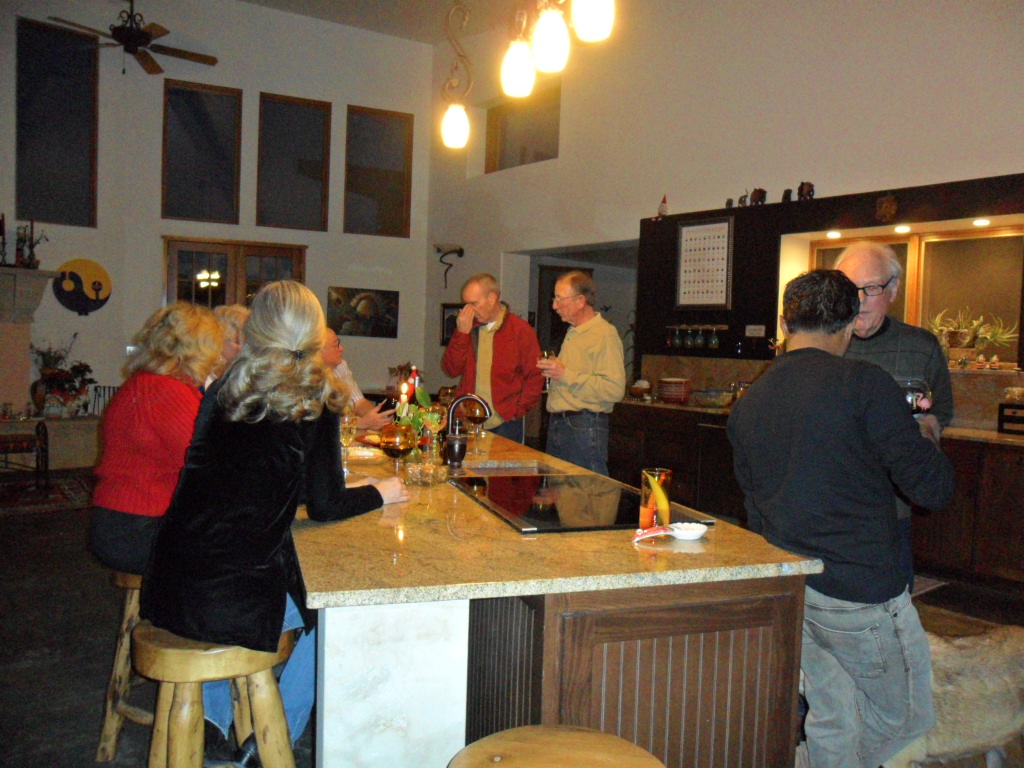
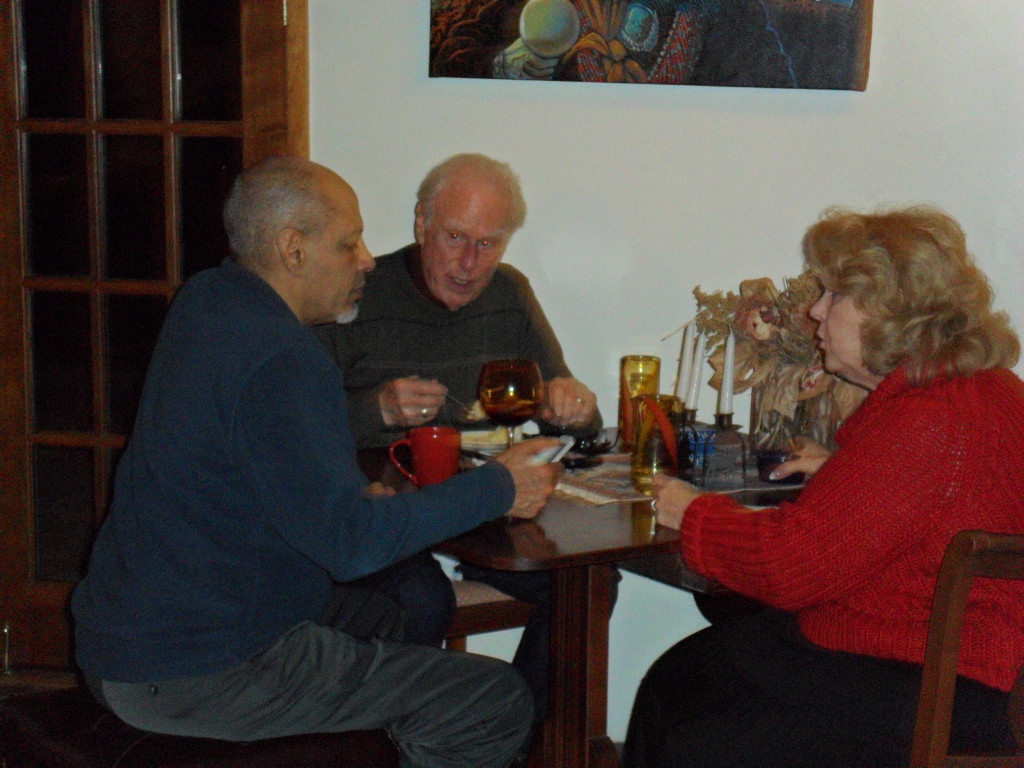
In the spirit of the getsetandgo blog, I took photos of my friends as we talked and ate.  The enchiladas were all gone before it occurred to me that it would be nice to have a photo.

SAM_1385

SAM_1387

SAM_1388

SAM_1392

Additionally, I regretted not taking a photo of three of my women friends with long hair.  Another friend who has spectacular, very dark grey, long hair and just turned 70 recently told me a story about how a mutual acquaintance came up to her and told her no woman over 60 should have long hair.  It annoyed me so much in an odd sort of way that I now wear my hair longer than usual.