Rio, a young Black woman, and her husband, Gibraltar, academics living in Boston, become concerned and disillusioned with their current lives. She finds an abandoned restaurant on top of a hill in western Massachusetts. Heartbroken after the death of her newborn, she is determined to create a safe, new, underground society beneath the restaurant. She finds a benefactor and her dream begins to take place. Via word of mouth, others hear about this safe place for the “lost” and disillusioned and head there. These include two homeless men from Chicago, a successful, young journalist, and a former soccer player.
Can such a society work? What happens if they run out of money? Regardless, can the care individuals have for each other save them?
Note: Depending on what kind of novels you prefer, this may or may not be a book for you. Several of the characters have serious mental issues, some think it is ok to resort to violence to save what they believe in and find ways to justify their actions, some seem very, very “lost”.
Arcosanti, an innovative village 70 miles north of Phoenix in the high desert, houses between 80-100 people who currently live there full-time. To become a resident, a person has to apply, take a five week course, and be able to contribute to the community. Their major business is making bronze bells in their foundry. They also host conventions. The week before I arrived, they hosted a convention of the executives of a corporation.
A few rooms of varying sizes are available to rent. They are pleasant with a view and modern amenities but not luxurious in the way some top hotels are. Here are views from my room.
After I arrived and unpacked, I took a walk up the hill and around the buildings.
This is a sort of giant classroom where it appeared they had been teaching how to make ceramics. The buildings are unique with the concept to fit in with the surroundings and take as little energy and resources from nature as possible.
This is the other side of the building in the previous photo. It is very hilly here and the buildings are build on the side of a steep hill.
The same building from a different angle. It was very windy when I was there and part of the area was closed due to the wind. There are bells everywhere and all were ringing in varying musical tones.
I walked down the road from my room, on a long trail, and up a steep incline to arrive across from the buildings so I could take these photos.
A closer view from across the arroyo.
This is across the arroyo from the main buildings. In the shadow, there is a door. I never learned what all this is for or what might exist behind the door.
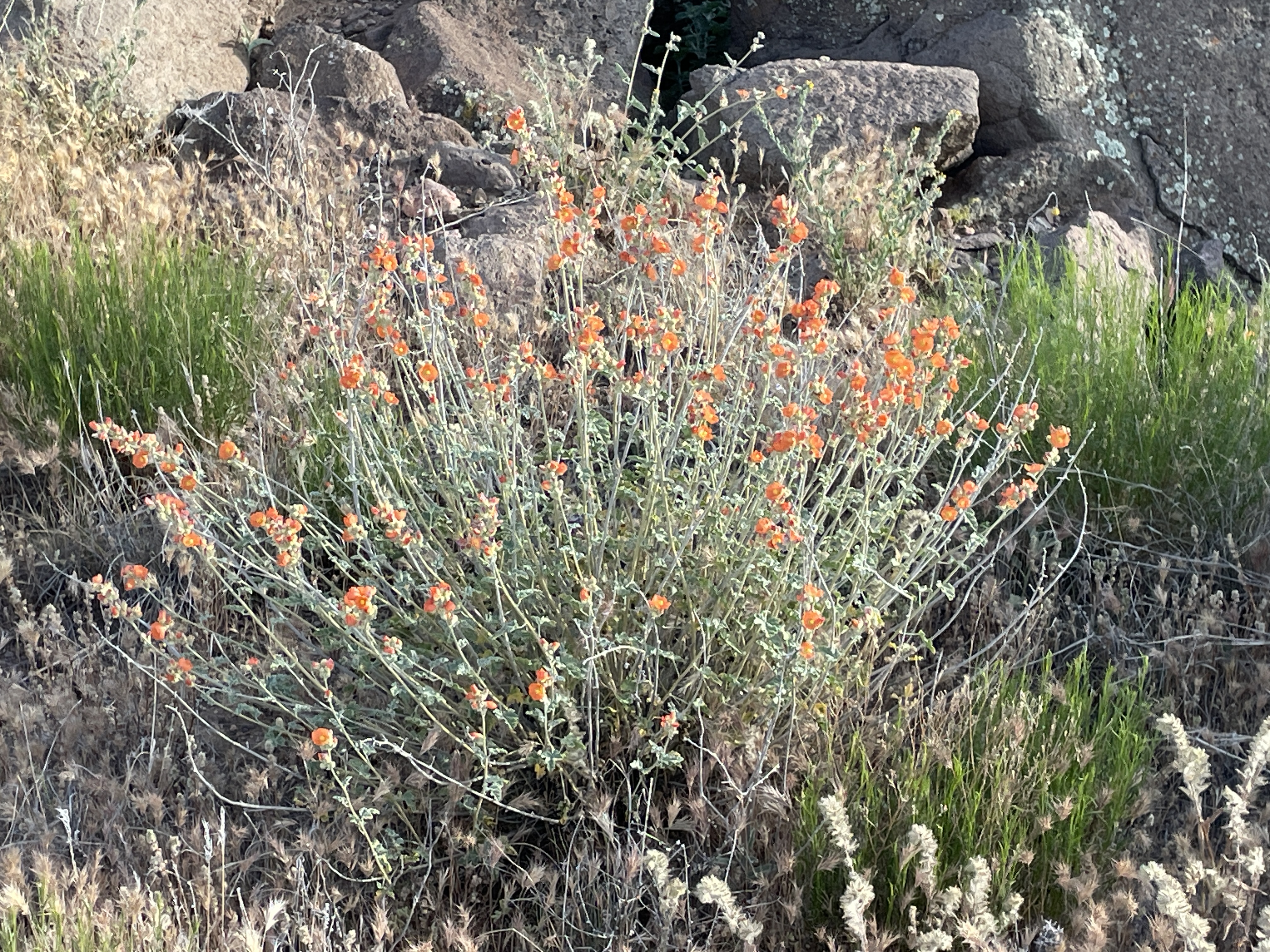
All sorts of wildflowers were blooming when I was there in May.
The restaurant is unique and delightful. They serve excellent coffee–one day some was lavender infused–and various other simple dishes and pastries they make on site. The orange column you see is installed in winter to provide natural heating using natural airflow and taken down in late spring. This is a unique and pleasant place to visit. You can take tours. If you stay there, you can wander around freely. And, of course, you can purchase bells from the very small to some that are quite large and like metal works of art.
Several weeks ago, I spent a day wandering around the ancient sites where native peoples gathered over a thousand years ago.
This explains the extensive influence this place, located in the northwestern New Mexico desert, held for people from as far away as Central America. To reach this park, you have to drive on a dirt/gravel, rough road for more than 25 miles north of Crownpoint, NM. It is definitely worth the effort. However, it is impassable in rainy or snowy weather. The rangers who care for the park live there.
One of the first things you see as you get closer to the park is this rock tower, Fajada Butte.
Archeologists climbed to the top and discovered petroglyphs, “Sun Daggers”. Created between rock slabs, they align with each solstice and equinox and at these events the light projects to other sites, e.g. Pueblo Bonito. Other petroglyphs on a section of the canyon wall represent a supernova that occurred in 1054 CE.
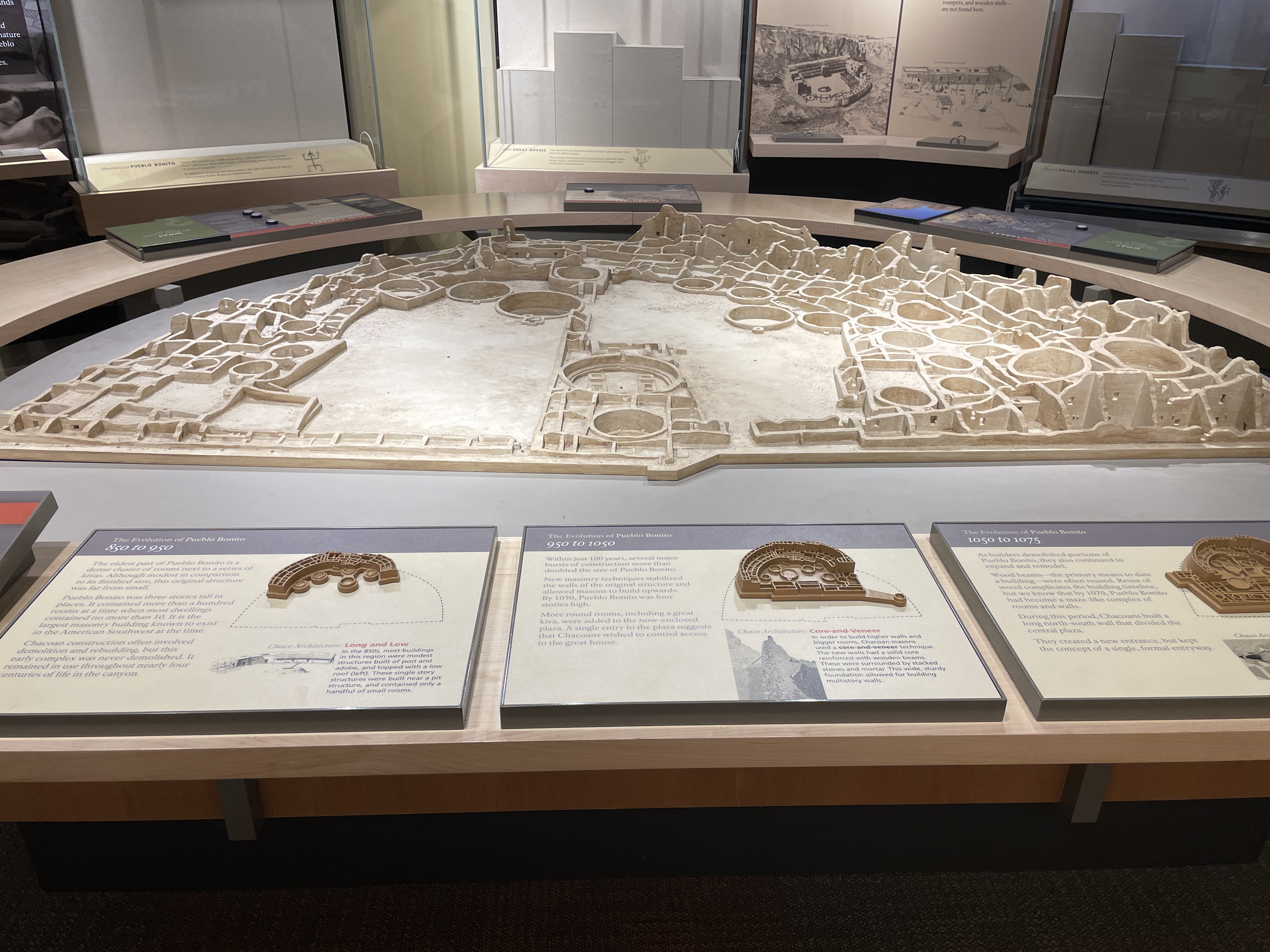
The following depicts an overview of the site as it would have been in the past. In the 1940s part of the wall of rock behind the site collapsed onto it and destroyed some of the buildings.
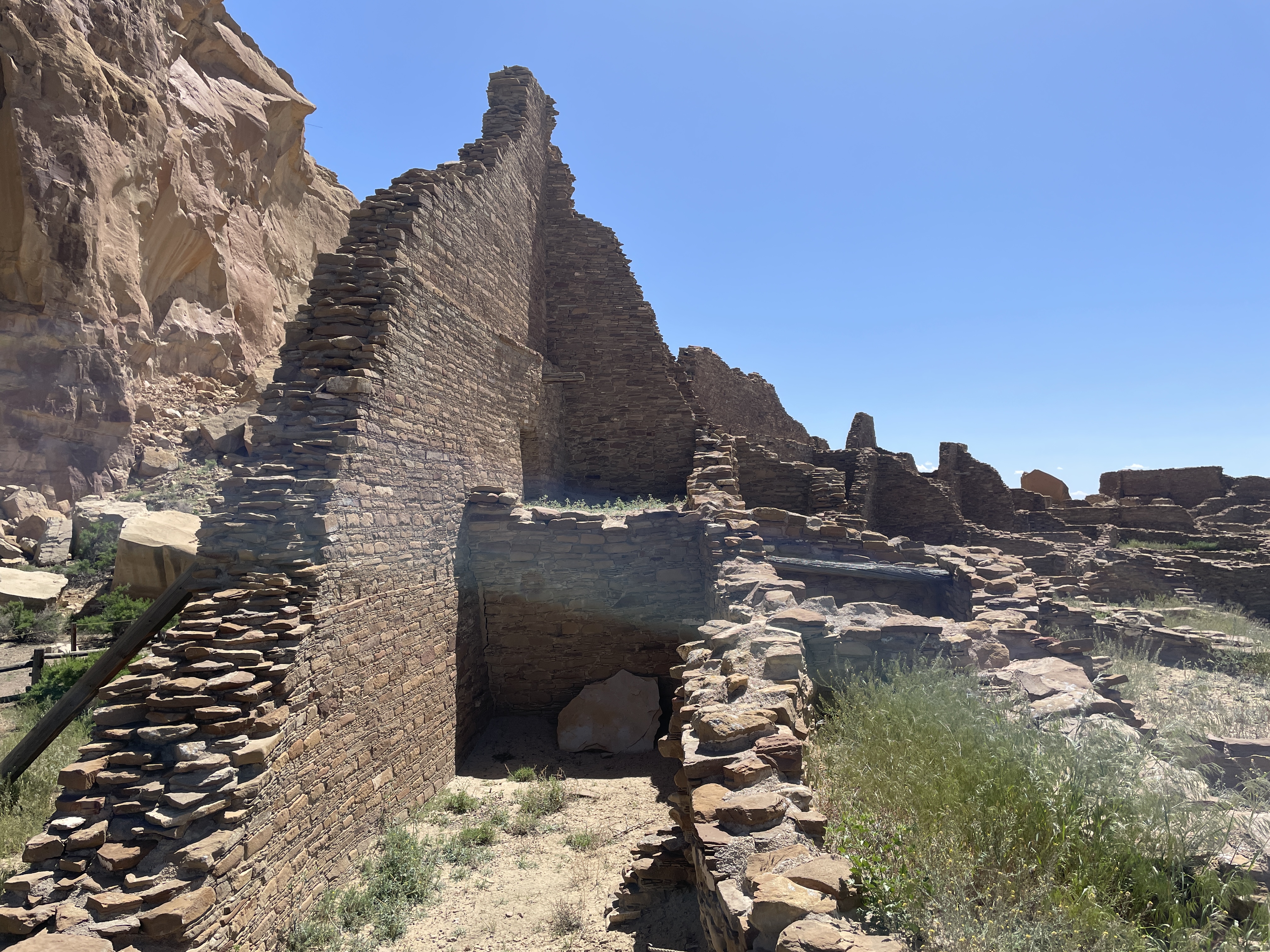
Here is how it looks today. Many of the doors and windows align with astronomical events, e.g. solstices, the two equinox, and astronomical events that occur only every 17 years.
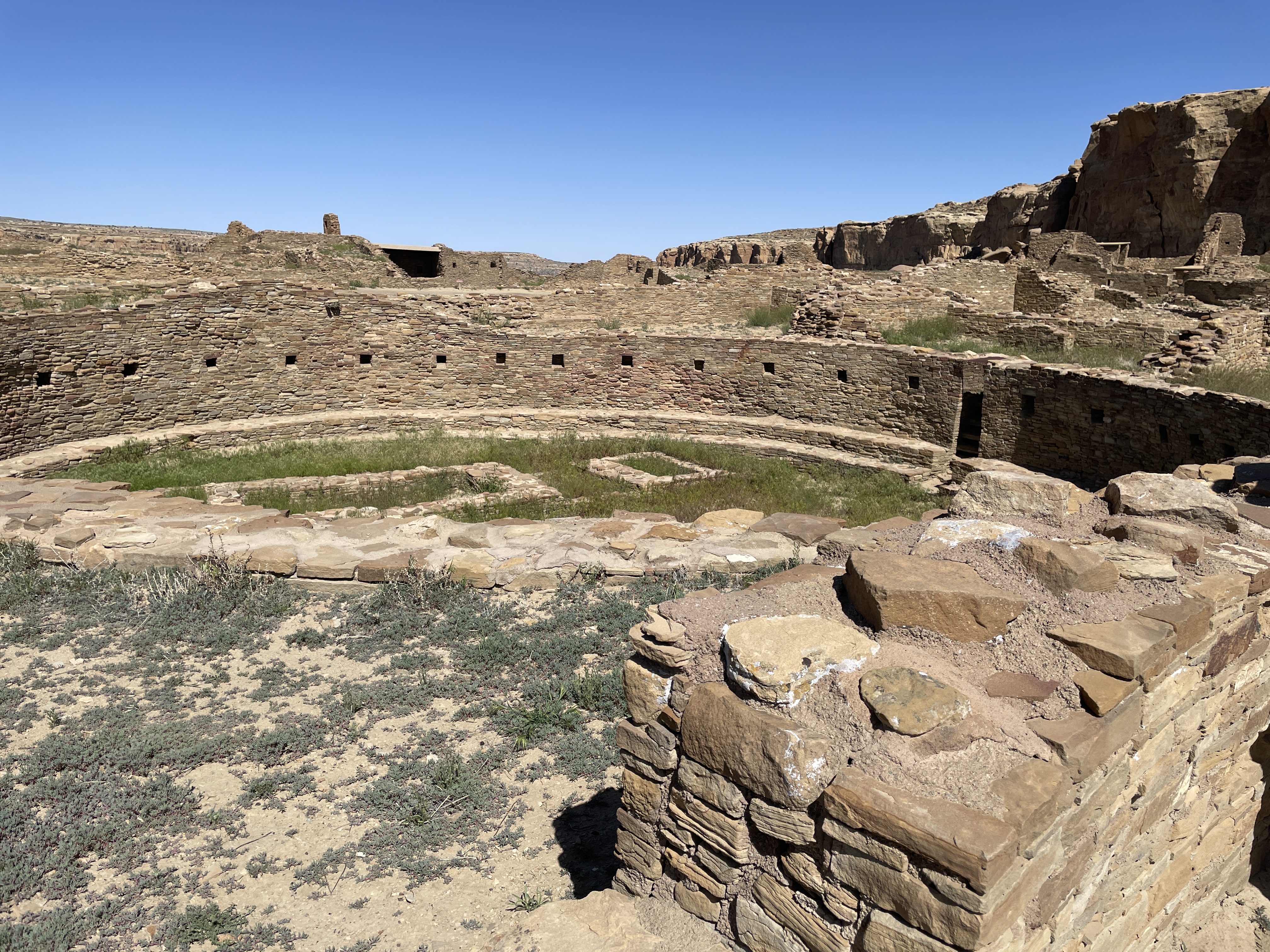
All sites here contain many kivas, many of which are very large. It is speculated that these were used for various sorts of ceremonies, including religious events.
In this view you can see how the rocks that fell from the cliff have destroyed parts of the structures.
Many of the buildings were several stories high. In their heyday, they did not look like this. They were covered with something like stucco and painted white. What an impressive site they must have been–large white structures in the middle of the brown desert. Archeologists think few people lived here. It was a place for gathering, for ceremonies, for trade, for people from long distances to meet.
Across from Pueblo Bonito is the largest kiva found in the area.
Behind the bars on the far side of the photo is an area that was used for ceremonial dancers to don their costumes. At the bottom you can see a depression with a small door. Before centuries of sand filled it in, this place would have be large enough for the ceremonial dancers to enter through it.
If you follow a trail along the cliff from Pueblo Bonito, you will find another area built at different times hundreds of years ago.
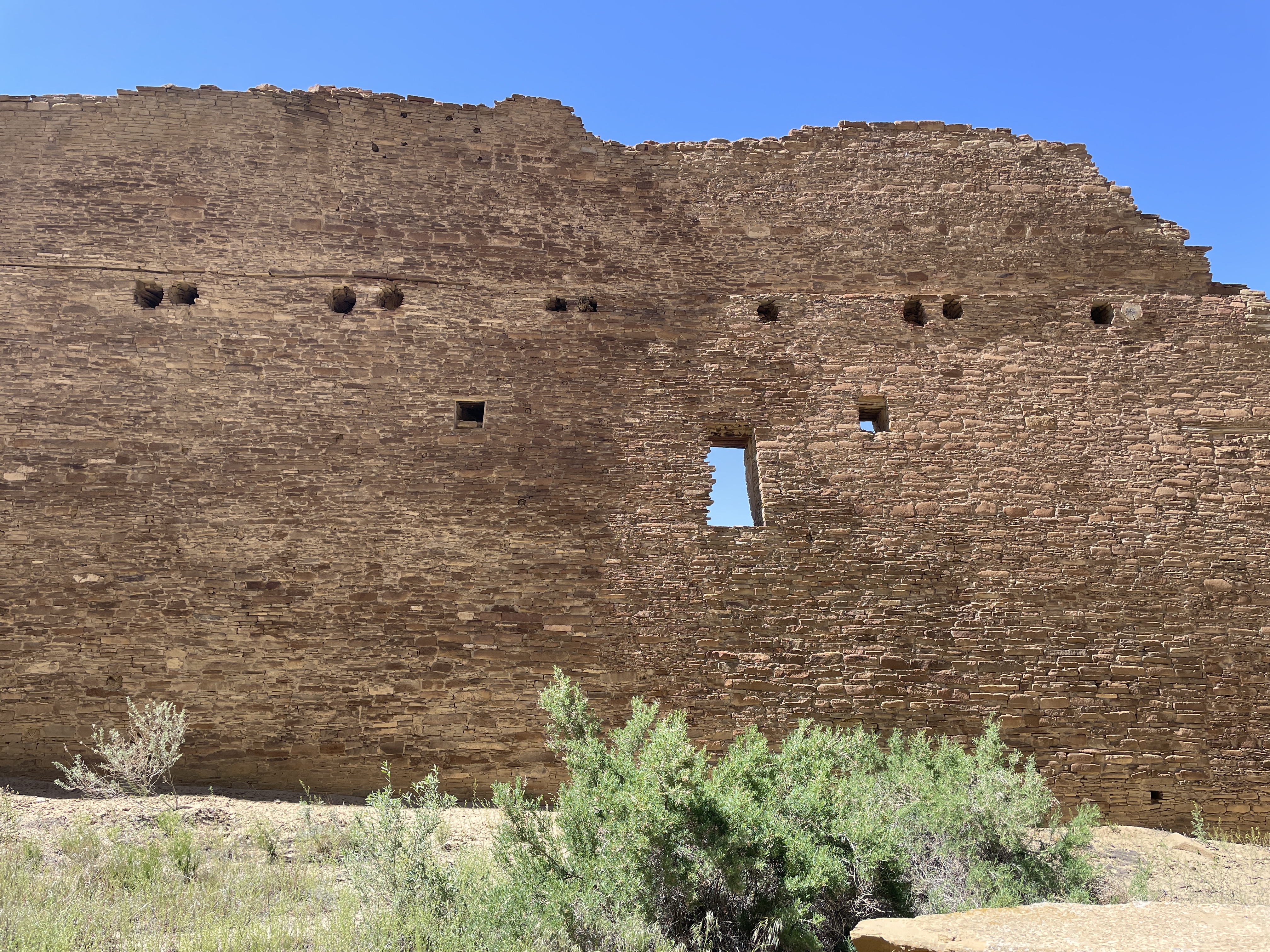
Another large kiva and many smaller ones are located at this site, including this famous long wall built at two different times.
The following shows where at some point the wall stopped, then later it was continued using somewhat different building material and techniques.
The top photo is considered the newer part of the wall.
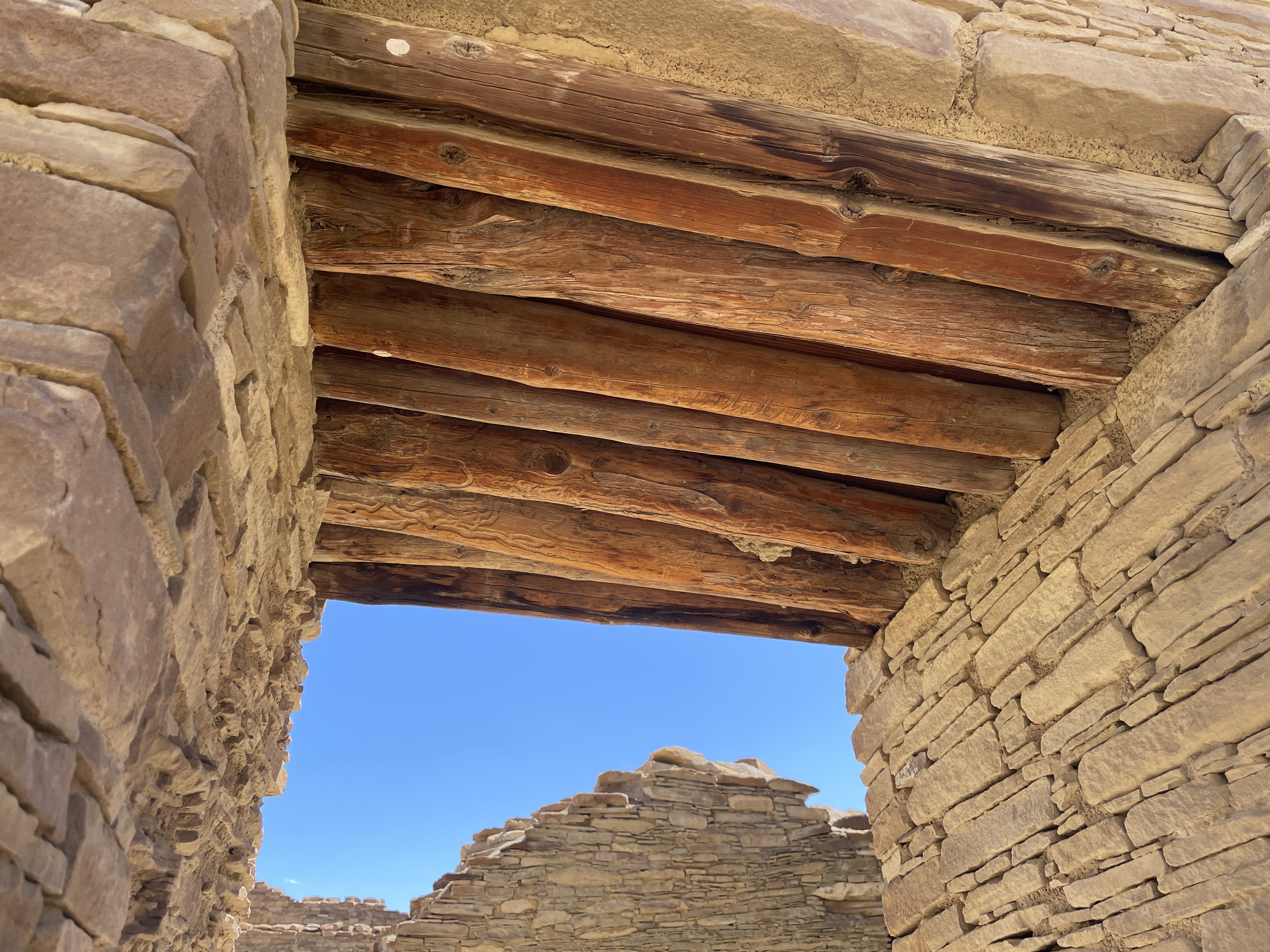
The wood used for tops of windows and doors was brought from forests hundreds of miles away. The desert air has enable it to be preserved.
When you walk the trails, you see wild flowers and native plants. This is desert rhubarb and it is edible.
While these are photos of the more impressive structures at Chaco Canyon, more than two hundred ceremonial and meeting sites can be found in this area of NM and AZ.
Written in an unusual style, the narrator, the main character, tells his story to an American visiting Pakistan. While they are sitting eating dinner and later walk to a hotel, the narrator relates his life as an immigrant who found US life too shallow, too focused on profit. The narrator, a young, Pakistani man with an Ivy League degree, attains the heights of success in the US, working in a highly desirable career position where he is the star. After 9/11 occurs, he questions who he is, what working in this sought after career means, whether it is even ethical to work in a position for a firm whose job it is to investigate companies, their profits, and ruin the lives of the people who work there. He is sent to Chile to investigate a literary firm, meets the manager who takes him under his wing and helps him look at what he is doing in a totally different light. Is money everything? Do the lives of ordinary workers matter? In addition, it is a love story. He meets a beautiful, young, wealthy, US woman, they develop a close friendship, and he discovers she is not mentally stable and does everything he can to help her.
While on the surface this appears to be a story of a young immigrant who does not ultimately fit in with US life, it is much more. It raises the questions of the definition of success, of what love is, of profit over humanity.
Want to know how the top 1 percent, the super wealthy live and control nearly everything in the US? Read this book. In a mere 117 pages, McDonell explains his own life and that of fellow 1 percenters. He details his early life, the private school he attended, the family connections, summers taking sailing lessons in the Hamptons, and vacations using private jets to places like the Galapagos Islands. At 18, he was able to get his first novel published in part because of his family connections to a famous publisher. Eventually, he left this life behind to become a foreign correspondent in Iraq and Afghanistan.
In this book he details how the super wealthy hoard wealth, pass it from one generation to another, and how outsiders, the poor and those not white, are kept out. Here are a few quotes from the book:
“I began to see how, in the United States of America and elsewhere, success almost always, and predominantly, depends upon wealth–and frequently comes at the expense of the less wealthy.”
“We in the one percent like to believe in meritocracy, even fairness.” At this point he lists several of famous people who rose to wealth and power from poorer circumstance and explains how this is used to make the “one percenters feel good, they distract from the possibility of a more humane distribution of wealth.”
Why do the one percenters behave as they often do? He interviews several whom he knows through his private school connections. “The fear they share was loss of wealth. Without ever saying so, they were very much afraid of losing their country houses, the barn converted for their kids sleepovers, the space for the grand piano, the green houses, pied-a-terre where their mother-in-law stayed without interfering in everyone’s business, the airport lounge that allowed them to enjoy pleasures among their own, in quiet. They were afraid of supermarket processed cheese, preferred organic stuff which they believed would keep them alive longer….they were afraid of losing their Prada bags…the cashmere….They feared losing wealth not for its own sake but because it was justified, in their own minds, by intelligence, hard work, determination—that is by character.” They truly seem to believe they are smarter and harder working than other people.
Before reading this book, I thought of French society as relatively egalitarian. Apparently, it is not if this book mirrors reality. One main character Renee, 54, lives and works as a concierge in a high class building containing eight, large, luxury apartments which the residents own. As she tells her story, she notes that this is her 27th year at this job. She describes herself as “short, ugly, plump”. She rarely says anything nice about herself or any of the residents. She notes she is uneducated, insignificant. She has one friend, Manuela, a cleaning woman originally from Portugal. Renee thinks it is her duty, her lot in life, to pretend to be something she is really not, a person totally lacking in intellectual and artistic acumen. She runs the television to make the residents think she watches mindless melodramas when she is actually reading Tolstoy as well as all sorts of literature and Marx, history, well every genre. After all, her cat is named Leo for a reason. She goes to art galleries, listens to all sorts of classical music, is basically an intellectual in the true meaning of the word, but works very hard to hide this, because she thinks she must stick to her station in life as she sees it. This works until one resident dies and a wealthy Japanese man buys the deceased man’s apartment. Both he, who notes her cat is named Leo, and a young girl, the other main character who lives in one of the apartments and plans to commit suicide and set their apartment on fire, suspect Renee is not as she appears to be. I do not want to give it all away, but this is a book with many life lessons, including that adage about not judging a book by its cover.
This is a book for those who believe in the power of books to transform life, who are fans of Alice Hoffman, and who like time travel. It also about how a charismatic man can ruin the lives of many, especially women, by controlling everything around him through fear and coercion. In his Community books and contact with the rest of the world are banned. Mia is a young woman who sneaks into a local library and finds Hawthorne’s “The Scarlet Letter”. She realizes the life she is living in the Community is like the lives in the book. Through this book she manages to attain the courage to escape such a man, the man who destroyed her mother, Ivy. She makes her way back in time to the period in the book, has a love affair with Hawthorne, and finally escapes the horrible man who tracks her everywhere she goes.
This book raises these questions: Can women gain true safety and equality without violence? Can we end misogyny without fighting back?
The book details the stories of three women, one from Alabama, a woman from northern India, and a Kurdish fighter in northern Syria. All use a form of violence to overcome abuse and mistreatment they have experienced and see other women experiencing. The author personally interviewed all of these women and others close to them and visited them repeatedly.
The first is Brittany Smith, who shot the man who had raped her and was trying to kill her brother. Her story details how Stand Your Ground laws work for men, but often fail for women, especially in areas of the US South where men are protected by their beliefs in a male Code of Honor.
The second is the story of Angoori Dahariya, a Dalit woman, from Uttar Pradesh, India. Fed up, she creates a group called the Green Gang (they wear green saris) dedicated to defending poor, under caste, female victims of abuse. Note: Dalit refers to the lowest caste.
The third is the story of Cicek Mustafa Zibo, a Kurdish fighter in the female militia that fought ISIS in northern Syria. She and many others follow the teachings of Ocalan, a Kurdish leader imprisoned by the Turks for leading the Kurdish militia who for years have fought the Turks for independence. He teaches equality between men and women and women’s rights, which is anti the general cultural beliefs in this area of the world. Note: Ocalan is labeled a terrorist by many.
Judith Heumann contracted polio as a child and was subsequently confined to a wheel chair. Doctors suggested to her parents that they send her off to live in a place for the disabled. Having escaped Nazi Germany, her parents were horrified and refused. There were no laws protecting disabled people when she was a child. Her parents, especially her mother, fought for her to go to regular school. This is how her story begins as she tells it. The rest is the story of her activist life.
When the Rehabilitation Act of 1973 was passed, it took months for Section 504 regulations to be signed into law. At this time the author was a young woman living in the SF Bay area. She lead a days long sit-in at the federal building in San Francisco. When this did not work, she went to DC. The entire book is her account of her life as an activist for the rights of disabled persons, beginning with her childhood, her becoming a certified teacher after attending college, and her endless activism for Section 504 and the ADA.
This is an important book for anyone interested in the history of civil rights for the disabled.











 writingontherim