Friends


This day, like many, has flown by in a whirl wind.  On May 3, I am hosting a benefit for a local senior citizens’ center.  We will have a silent auction, food, and drinks.  Over one hundred invitations have been sent, but only a few have actually bought tickets in spite of the fact that quite a few people have told me they plan to attend.  Customs vary in different parts of the United States.  When I lived east of the Mississippi River, people actually religiously responded to request for an RSVP.  Here in the Texas Panhandle, not so much.  At this juncture, I have no clue how many people will show up.

About two and on half hours ago, my friends showed up with the forks and spoons and plates and wine and auction items.  These items currently reside in one of the guest bedrooms and the garage.  We decided to have some wine and then I dug out cheese and crackers and some more wine and more cheese and crackers.  And we visited.

A downside of United States life for me is the pace.  Everything is done in a huge hurry.  People even gulp their food.  I especially notice the difference when I spend time with people from other cultures who take hours to eat dinner and visit.  When one of my best friends from India lived here and I invited others over, we took hours to eat and visit.  Recently, when a US friend brought his exchange student from Italy over to ride my horse and his daughter and wife showed up as well, we rode, and then fixed dinner.  We cooked, visited, and ate leisurely.  The young woman said she felt so at home because we were spending time, visiting, cooking, everything leisurely.  I frequently cook dinner very late by US standards, e.g. eight o’clock at night.  When my exchange students from South America lived with me, they thought this was normal.  People there eat late by standards here.  My daughter tells me I have become more and more like all these people from other countries with whom I spend time.  I laugh.

Tonight’s experience further validated my belief in the value of friends and time spent with them.  This was not one of those planned, elaborate events.  We just sat, drank, ate, and enjoyed the pleasure of each other’s company.  It was wonderful.


Myanmar Then and Now-Part One


More than twenty years ago, I went to Myanmar when it was still called Burma.  I flew there from Katmandu.  Compared to the cool, crystalline mountain air of Nepal, the hot, moist, Burmese air felt stifling, thick.  Day one, we left the Inya Lake Hotel and traveled to downtown Yangon to purchase tickets to Pagan.  We never left Yangon because the first of many revolts against the military government started.  Everyone strongly opposed going there by the night train and the last plane headed that way had been shot down.  Personally, I was willing to take the risk but could find no one else willing to go with me.  Everyone was under a 6 pm to 6 am curfew.  Unexpectedly, hundreds of hotel guests were confined to the hotel and its grounds, thankfully rather expansive.  This unusual circumstances provided unexpected opportunities.   To accommodate feeding everyone dinner, the hotel staff asked guests to share tables.  I shared a table with a man from South Korea there to build a sport shoe factory, two women from Germany headed to a medication retreat, and a gentleman with an English accent.  We shared life stories except the “Englishman”.  His sharing seemed a little “off”.  Later, when the rest of us chatted and put together what little he shared, we decided perhaps he was an arms dealer.  One evening guests experienced the privilege of watching the guests for an elaborate Burmese wedding, complete with traditional wedding clothing.

Although clean and orderly, this “one of the best hotels in Burma” looked more like photos of Russian army barracks than the hotels to which most of the guests were accustomed and absolutely nothing like anything else near Yangon.  Few cars roamed the streets.  The most common vehicles were small pickup trucks in which the bed had been transformed into an open air van complete with seats and a cloth roof.  The populace exuded an air of dejection.  Those who bothered to save money saw it devalued to nearly nothing.  The once elegant, ornate buildings showed signs of disrepair and decay.  A country which was once the world’s largest exporter of rice was rationing it as well as gasoline.

Unless you sleep twelve hours a day, curfews present challenges.  What do you do with yourself for all those evening hours after 6 pm hits besides eat a leisurely dinner.  I walked the glorious hotel gardens repeatedly and became acquainted with the hotel gardener who spoke perfect English and whose father had attended Columbia University.  His roses were as tall as I am.  He asked me repeatedly, ” How does my garden measure up to modern standards?”  When I offered tp send him horticulture magazines, he told me they would be confiscated as evil, foreign influences.  Paddle boats lined the lake’s edges.  Guests could use them free but  guests were told not to go far out because we might get shot at.  The luxurious villas of the ruling military elite lay readily visible on the distant opposite shoreline.

During the day, everyone rushed out to make the most possible out of the 12 free hours.  Mainly, I recall an overwhelming sense of gold, glitter, and glass tiles reflecting the tropical light.  At first, it induced a feeling of slight nausea, so much sensory input I felt slightly sick.  But I adjusted.  As if scattered, glittery golden temples were not enough, there rose the Shwedagon Pagoda, 99 meters covered in gold, real gold.  I spent an entire day there, wandering its environs and still missed some of it. Saffron clad monks, vendors selling “sacred” items and snacks, nearly a city within itself,  old, originally  built in 1372 and 344 feet high, repeatedly rebuilt after earthquakes and foreign raids.  Impressive is an understatement.

If Burmese history and culture interest you, I recommend three fascinating novels:

To Save Fish From Drowning by Amy Tan

The Piano Tuner by Daniel Mason

The Glass Palace by Amitov Ghosh

All three focus on one or more of the ethnic groups that inhabit Myanmar and on their relationships with each other.  The latter two are historical novels and in particular Ghosh’s book provides a fascinating history of that part of Asia.


Apocalyptic Planet-Part Five: Civilizations Fall


Whether it is my innate ambition, something my parents instilled in me, or something else unknown, I try to learn something new every day.  Craig Childs starts this chapter of his book by talking about a Phoenix landmark.  Back when I travelled to Phoenix regularly, I knew this place as Squaw Peak.  Now its name Is Piestewa Peak.  The name change is probably a good thing.  I never knew before reading this how dreadfully pejorative the word squaw is.  Basically, it means Indian bitch as well as other things related to the privates of women.  All languages seem to possess an accumulation of dreadful words geared to putting women down one way or another.  Slang words for the private parts of a man rarely mean anything pejorative, at least not that I know of.  The new name, a Hopi name, a blessing word, is a word that calls water to this place.  Not a bad idea in Phoenix or most of the Southwest for that matter.

The name Phoenix fits.  Underneath modern day Phoenix, an ancient city lays buried, a quite sophisticated city with ball courts, temples, irrigation canals.  This city existed at least a thousand years ago.  Its inhabitants grew corn, cotton, beans, and agave.  Farmers, hunters, carvers, all sorts of artisans and merchants apparently lived there.  Now they are called Hohokam taken from an O’odham word meaning “ancestors”, the “ones who have gone”.  We find forgotten cities all over the world, Palmyra, Machu Picchu, Angkor Wat.  What causes these sophisticated civilizations to fall?  If you read a bit, look further, you find common themes:  environmental decay, resource depletion, conflict, disease, social problems.  Angkor Wat fell because it could not maintain its complex irrigation network.  Ur in Iraq fell because a drought caused its port to dry up.  Usually, the demise of particular civilizations occur over time, e.g.Rome.

Childs notes that human patterns often follow animal patterns, or at least mammalian patterns.  For example, when over population occurs, behavior changes.  Parental care and cooperation become replaced with aggression, violence, competition for resources, dominant behaviors.  These types of behaviors are particularly detrimental to females and the young without whom the society (or animal population) cannot replace itself.  Generally, in animal populations, when this occurs, reproduction slows for several generations and the imbalance corrects itself.  For humans, it is not so simple.  Hohokam bones indicate mass starvation and malnutrition.  Other civilizations, e.g. the Anasazi, seem to have disappeared without a trace.

Today, most of the world’s largest cities have immense infrastructures that keep them going, miles of underground sewage tunnels, water mains, etc.  Here in the US in our oldest cities, much of what we take for granted is very old and deteriorating.  New York City and Chicago have water main systems that some experts claim are near collapse or at the very best badly in need of repair.  Doubtless such conditions exist in old cities throughout the world, most of which are much older and larger than the majority of cities in the US.  Yet, they continue to prosper.  Have we passed a point when civilization cannot fall?

Childs completes this discussion by describing his visit with his wife to Guatemala.  They visited all the best known Mayan sites, visited with natives.  His wife managed to get invited to a Mayan fire ceremony, a renewal ceremony.  History books tell us the Mayan civilization is dead, ended.  But it is not.  The Mayan culture still exists.   At least six million still live in the Central America.  What would have happened to Mayan cities if the Europeans had not brought epidemic diseases and better fire power?  We will never know, of course, but no matter how many civilizations rise and fall, change continues and humans continue to inhabit the earth.

The new question is this:  can this planet we live on sustain the ever increasing numbers of humans who inhabit it??

Sacred Corn


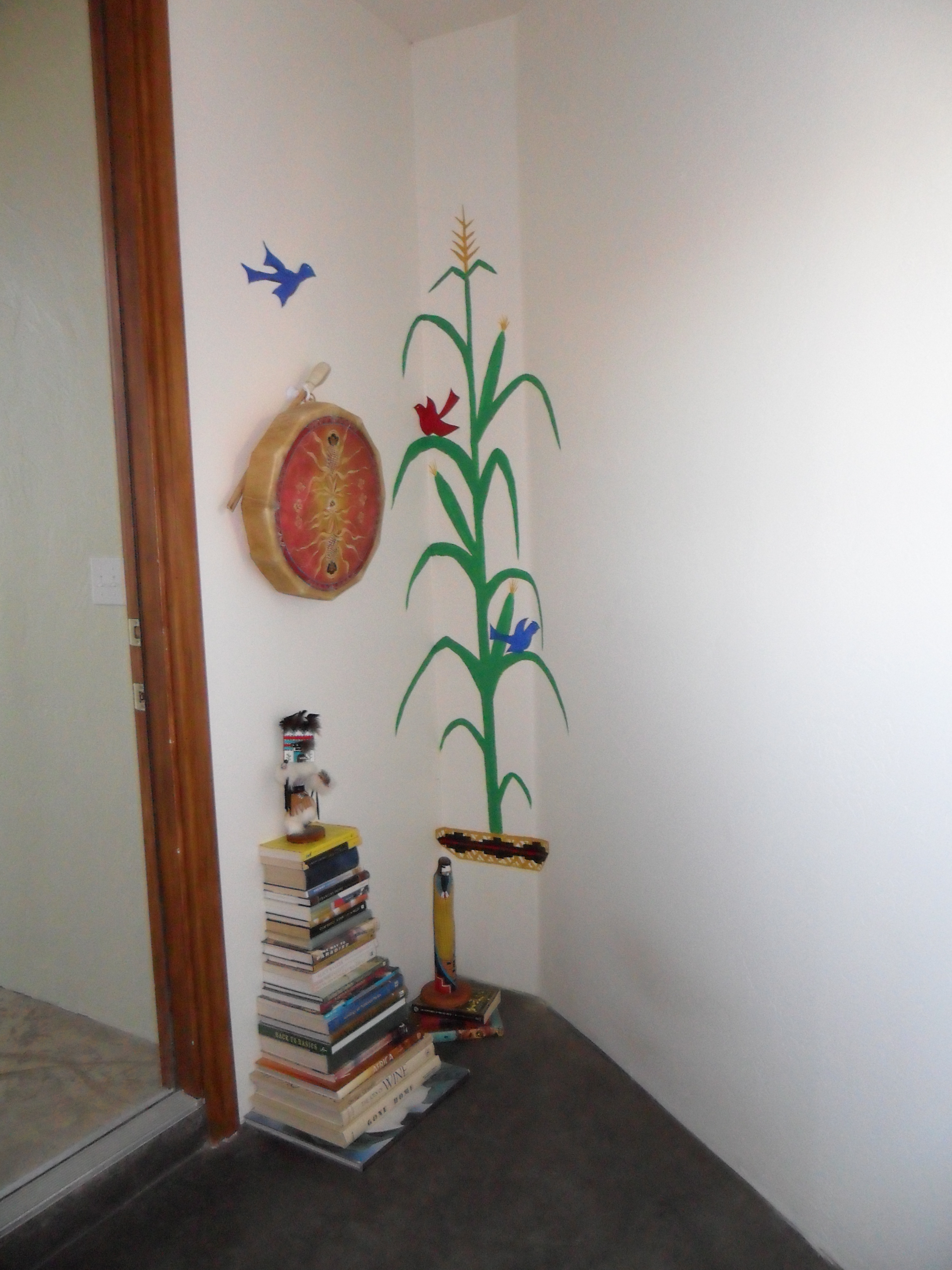
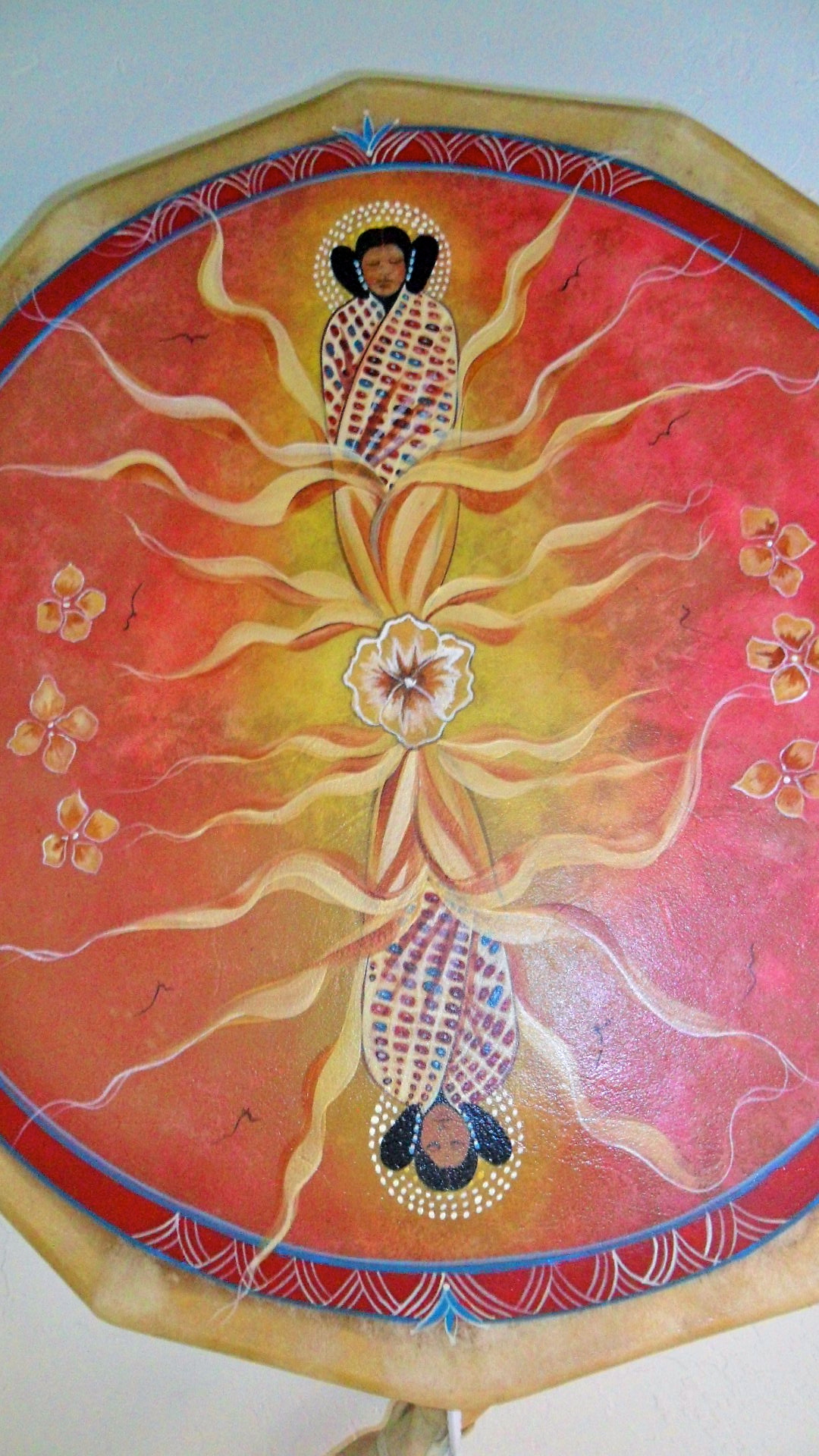
SAM_0035   In the summer on hot, humid nights, you can hear the corn grow.  My great grandfather, my grandfather, and my father grew corn.  I grow corn in that same rich loess soil of Northwestern Missouri.  Soil laid down by Ice Age glaciers thousands of year ago.  Only on a few hill tops, here and there, will you find non glacial soil. Repeatedly, daily, I walk by the sacred corn plant of life painted on my hall corner.  This sacred corn corner houses three corn maiden kachinas and a drum decorated with corn maidens.  I give thanks to corn for my house and the life I lead.

Corn Song

I sing the song of ancients:

pueblo peoples,

Anazazi, Hopi, Zuni.

I sing the song of an America long gone.

Maya, Aztec, Tolmec.

I sing the song of life:  colors of the rainbow

golden, red, white, blue.

I sing the song of now:  thick, endless

identical rows.

Pioneer, Monsanto,

anhydrous ammonia,

atrazine.

I sing the song of hope and joy:

an ancient reclaiming,

a klaidescope of colors,

butterflies and fireflies.

I sing the eternal human song.

SAM_0913

SAM_1489

This is a Navaho kachina.  Kachina are actually Hopi, but Navaho artists now make kachinas as well.  The first corn maiden kachina I bought.

SAM_1490

Spotted corn kachinas, on the left, are unusual.  It took me years to find one.  The kachina on the right was created by R Pino, who is both Hopi and Navaho.

SAM_1491

Every year Pendleton runs an art contest among Native American students.  The winner’s art work is transformed into saddle blankets.  This design, created by Mary Beth Jiron, is the latest in this Student Series. There are three corn  maidens  on each side of the blanket, representing the different varieties of corn grown by native peoples, yellow, red, blue, white, black, and spotted.

The Story Circle Network Conference and My Commitment: This Is What I Know


ad_scnconfWhen I first started blogging more than two years ago, I committed to blogging once a week.  That I managed for a year or so and then since that time, it became more sporadic.  Full time job, writing poems for my book, visitors, mini vacations, all sorts of stuff got in the way.  Really, I let it lapse, but refused to give up.  Last Thursday, I drove to Austin with my daughter and grandson for the biannual Story Circle Network Conference.  The plan:  while I conferred, they played.  The Story Circle Network is an organization for women which encourages women to write, to tell their stories, to share these stories, and when possible and desired, publish those stories in various forms from memoir to poetry.  This was my second time to attend and my first time to attend as a new board member.  A former mentor/teacher of mine, Len Leatherwood, facilitated  a workshop entitled “Transforming Your Writing Life in Just 20 Minutes a Day”, the last workshop I attended.  She blogs everyday.  I follow her blog.  No matter what, she sits down and writes 20 minutes minimum a day separate from the writing she does with her students–she teaches writing privately in southern CA.  One of her recent blogs has been accepted for publication–a piece of flash fiction.  She nearly begged us to commit to this kind of writing practice.  Previously, I had refused, flat out refused, partly thinking that if I tried it, more than half the resulting writing would be crap.  Nevertheless, she and her workshop convinced me that at least for one month I must try this.  Now all of you following my blog will be inundated with daily blog posts.  I am filled with curiosity as to how people will respond.  Maybe it will be like my Facebook posts–yes, I am an almost addict–the posts I consider most meaningful for the universe at large are the ones people ignore and the ones I consider personal trivia receive the most response.  Maybe I will track what appeals to my readers.  Some I won’t know because with blogging I share to Facebook and to a couple of professional networks, I have no clue who read what.  Once I received an email regarding a poem I posted. Although it never showed up as a like, the lady actually told me she read my poem in church!  Who would have guessed. I forgot to time myself so have no idea how long I have been here writing.

Here I am writing about why I am writing.  On the stove I smell Jasmine rice cooking.  I love Jasmine rice from Thailand.  I am a very picky rice eater and prefer to mix equally white Jasmine rice with black and red.  For one thing, it looks lovely when done–a sort of dark reddish purple.  Since I sautéd chopped garlic in olive oil, then added the rice and sautéd for about 15 more seconds, then added water and some broth just before I started writing this, the smell of Jasmine rice fills the house.  I piled a bunch of paper towels on the top before I put on the lid or you can use some cloth towel–a habit I picked up from my Iranian ex-husband.  Iranians really know how to cook rice.  I am also drinking a glass of Cupcake Shiraz which I bought on the way home from work.  And yes, Shiraz is also the name of a city in Iran where they actually grow grapes or at least used to. But of course, drinking wine is no longer acceptable in Iran or at least not publicly.  Good Muslims do not drink at all.

I did write something worthwhile while in this workshop and will share–doing this last because it won’t count as my daily writing since I wrote it yesterday.


This Is What I Know


My parents loved me, really loved me.

My mom was proud of my accomplishments.

Dad gave me a love of books, intellectual curiosity, and a

sense of wonder.

Mom gave me a love of music, beauty, and cooking.

Happiness is a choice.

I do not believe in luck.  You make your own luck.

Life is an exciting adventure.

Horses give me joy.

Singing gives me joy.

Dancing gives me joy even if I rarely have the opportunity.

Family relationships can be distressingly complicated.

I am proud of my children and their accomplishments.

Religion matters much less to me than 99 per cent of the people I know.

Ethnic and religious prejudice distress me and I do not

understand those kinds of attitudes.

I am a good writer.

I want to make a real difference in the world.

I am happy 99 percent of the time.

Blessings flood my life.

My close friends and children and grandson are more

important to me than they know.

Writing has enriched my life.

I have few regrets:

One I have rectified;

the other I cannot–

my dad is dead.

Much as Love and Murder, Freedom is a Many-Splendored Thing


danielwalldammit's avatarnorthierthanthou

17711-series-header Yapto Soerjosoemarno is a middle-aged man. He is the leader of Pankasila, an Indonesian youth group three million strong. The camera follows him out onto a golf course where he explains; “Gangsters are free men. They want to live life in their style. Relax and Rolex.” A moment later he tells his young caddy she has a mole on her pussy.

And she smiles.

Of course all of this comes after Yapto explains that Pankasila had killed all the communists in Indonesia. It comes after he has spoken at a Pankasila rally, one in which he calls himself the biggest gangster of all.

What else could the young girl do but smile?

KillingAs he and his friends try on colorful gangster outfits, Anwar Kongo waxes on about his inspirations; Al Pacino, John Wayne, and others like them. He goes on to relate the story of how he once placed the…

View original post 1,449 more words

On a cold winter evening


This post displays my occasional propensity for pensiveness and reflection.  The highest temperature today was 8 degrees.  The weather forecaster predicted a low of zero, very cold for here with more snow.  In  a few months, it is likely we will hit 100.  Who would want to live in such a place?  Yet people do, worldwide.  Some in places much colder and hotter.  How and why did they all get to wherever they are?  Millennia ago we all migrated from Africa and look at us now.  We think we are smarter, better, but are we?  Perhaps technologically, but psychologically??  War rages over differences in ethnicity and religion.  Clashes for thousands of years change little, just the nature of the weapons, the use of advanced technology.  The intent remains the same.

Sunday, I finished a book by the Turkish writer, Elif Shafak.  I have read all her books translated into English.  This, her latest, Honor, details the effects of the belief in honor of above all else.  To paraphrase one of the main characters, a poor man:  rich men possess money, fancy cars, lavish houses, travel, but poor men have nothing but their honor.  Acting on this belief leaves one family devastated.  For those who desire to learn about other cultures and to understand the behavior of the individuals in them, I highly recommend this novel.

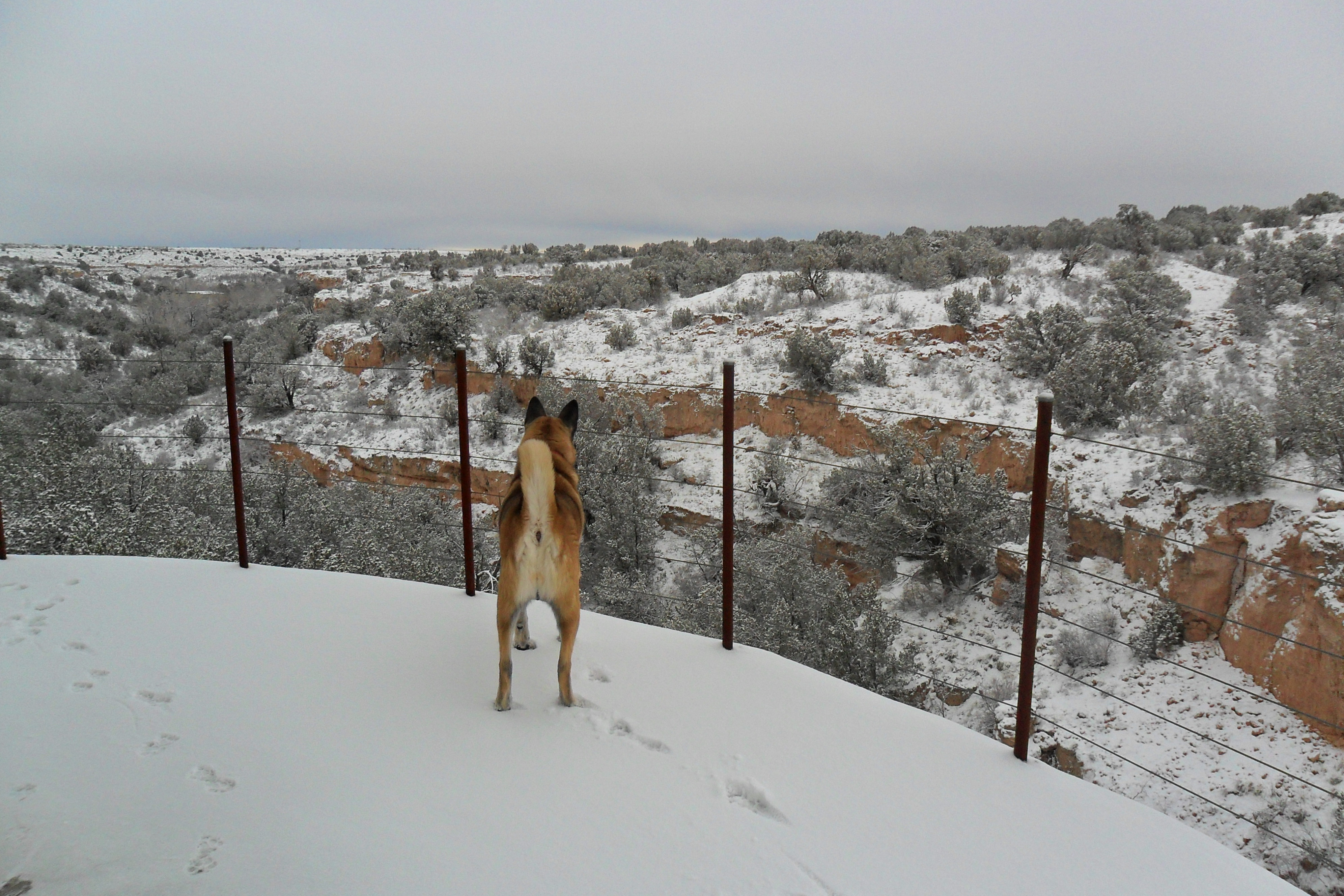
Earlier, I donned two pairs of gloves and socks, four layers of clothes, and ventured out.  If you own horses, you have to feed them regardless of the weather.  Unlike me, my dog, Isabella, fares well in this weather.  Her part wolf blood gives her an undercoat perfect for winter extremes.  Inside, I viewed my larder–what to cook on a frigid winter night?  A simple chicken curry with onions, brussels spouts, jalapeño peppers, and chicken with Jasmine rice, red, white, and black.  And a glass of red wine, cabernet franc, from a local winery, the only wine I have ever seen from only this one grape.  It is usually added to blends.  Definitely haram–still thinking about that book.

SAM_1428

As the temperature drops, building a fire in the wood stove seems like a reasonable endeavor.  I love fires but hate to build them.  Nevertheless, sitting in front of the fire reading brings a silent joy, a paradise.  I feel at peace:  chores done, warm house on a frigid winter night, satisfying dinner homemade, and the knowledge that my book of poetry lays in its final stages with the editors and photoshoppers who will make it publication ready.  I feel extremely grateful, looking forward to dazzling dreams on the rim of wonder.

sam_0303.jpg

Day Trip to Marvin Lake and Canadian, Texas–Part One


Two weeks ago, I joined the local Native Plant Society group for a trip to Lake Marvin east of Canadian, Texas, near the Oklahoma border.  Lake Marvin is located in the Black  Kettle National Grassland  which includes land in both Texas and Oklahoma. This national grassland’s name comes from the Southern Cheyenne Chief by the same name.  An aging chief, he had attempted to make peace with whites and had been guaranteed protection by the head officer at a nearby US Army Fort.  He, along with old men, children, and women was massacred by Lt. Colonel Armstrong Custer and his troops in Custer’s first great “success” as an Indian fighter.  It was an easy battle; the Indians had been assured their safety at this encampment.  They were totally unprepared.  Black Kettle attempted to meet the soldiers and flew a white peace flag as well as a US flag over his teepee. He and his wife were mowed down in a barrage of bullets.  The massacre is called the Battle of the Washita because the Indian encampment was on the Washita River which flows through the grassland.

Those of us who live in the Panhandle of Texas become accustomed to the lack of trees and semi arid climate.  It is always a huge surprise to find those rare spots with numerous trees, water, and thick vegetation. Lake Marvin and much of the area near Canadian provide a total contrast to what we usually see.  JR  Bell, an expert on native grasses and plants, lead the hike around Lake Marvin, a manmade lake constructed for conservation purposes in the 1930’s on Boggy Creek.   Regretfully, I failed to carry a pen and pad to write down the name of all the grasses, some of which exist in the area where I live and others I had never seen before.  Perhaps some of you who read this will be able to identify the various grasses which include blue grama, side oats grama–the state grass of Texas, little blue stem, and two other species of blue stem, switch grass, buffalo grass, and wheat grass.  Unfortunately, Johnson grass, a non-native,  invasive species, also grows near the edges of the lake.

SAM_1321

The hike began near what was once the water’s edge before silt and drought made the lake half its original size.  Johnson grass, the outsider, is not too difficult to identify because of the bright maroony red on the leaves.  This enables an non-expert like me to differentiate among Johnson grass and a few other similar looking species.  While I tried to listen and watch grass identification, rather quickly I realized that without pen and paper remembering all of them would be impossible so I focused on photographing the natural beauty surrounding me.

SAM_1326

SAM_1323

No one told me the origin or purpose of the abandoned buildings up the hill from the lake.  The change in flora one sees by facing the hill rather than toward the lake is amazing.  One could almost draw an imaginary line with certain grasses and shrubs on one side and totally different ones on the other.  The magic key, as always, is water.  Where I live, two hours away, no sage brush grows.  Here on the hillside, it grows everywhere with various grasses, some rather small and semi hidden, interspersed.

SAM_1328

I learned several keys to identifying grasses:  seed heads, texture of leaves and stems–some rough and others smooth, size of leaves and stems, some variations in color.  Height helps but does not necessarily determine differences because the same grass species can vary depending on amount of water and type of soil.  The amount and size of the trees continually astonished me, like this tunnel through the trees, something I never expected to see in the Panhandle.

SAM_1330

Where I grew up in northwestern Missouri, huge black walnut trees grow everywhere.  I recall exploring the walnut grove on the farm repeatedly as a child.  I certainly never expected to see them on this little trip.  Suddenly, astonished me stood there surrounded.

SAM_1334

While these trees never reach the size of the ones where I grew up and the nuts remain considerably smaller, here they stood, their distinctive leaves giving them away.  Before I went away to college, every autumn, we picked up the nuts, cleaned them–while the outside is a lovely lime green, the area between the seed and outside, is a sticky, dark brown mess which makes excellent natural dark brown dye, and cracked them to retrieve the meat inside.  Black walnut nuts are much harder than English walnuts and cracking them requires a hammer and something really hard on which to place the nut. After I left home, every year Mom spent hours working on these nuts and brought me at least a pound at Christmas, a true labor of love.  They are especially tasty with in recipes with chocolate or bananas.

SAM_1331

SAM_1332

The hike provided continual surprises, a boggy pool, persimmon trees, a plant whose leaves resembled miniature spectacles, a grass so fine and thick in a glade between the trees that it looked like a tiny patch of fog on the ground, and poison ivy.

SAM_1336

Persimmons.

SAM_1343

This particular tree was loaded with persimmons.

SAM_1339

SAM_1340

Cattails in the background.

SAM_1341

SAM_1342

SAM_1344

When I first walked up to this spot, the fine grass toward the back of the photo looked exactly like a tiny patch of fog nestled in a miniature glade among the trees.

SAM_1346

We took off from the main trail especially to come to this cottonwood tree, one of the oldest, if not the oldest, in the Panhandle. Over a hundred years ago this tree stood as the sentinel for the overland trail that went through this area.  The military, ranchers, and Native Americans all used the trail across this area of the plains.  The tree’s height enabled it to be seen for miles and helped travelers keep on their way with accuracy.  Once we reached the end of the main trail, some of the group took off in their vehicles while a few went on around the lake.  It saddened me to see so much of it dried up and old tires sticking out of the dried mud.  However, along the way, we saw numerous trees I could not identify.  The bark of this tree is particularly distinctive.

SAM_1347

This field trip coincided with the fall festival held annually in the small town of Canadian which gets its name from the Canadian River which flows beside the town.  The town is unique in the number of large, elaborate Victorian houses there.  Several of us ended the trip at the local elementary school with a big craft fair and a barbecue lunch.

Bedtime Reading or Not–the Hazara


A lifelong habit that helps me settle down to sleep remains reading.  However, occasionally I delve into a book that turns out not to be so wonderful to read just before going to bed.  The topic turns to the disturbing and then, suddenly, my mind churns.  By that time, it is too late to go back.  Or, like the book I am reading now, parts of it consist of stories inspiring, amusing, enlightening, parables for life.  Then there are the other parts:  the abuse of an entire people by the other ethnicities surrounding them, genocide, turmoil, invasion.  I remain a lifelong lover of libraries.  Recently, while browsing through new books, I found this one:  The Honey Thief  by Najaf Mazari and Robert Hillman.  Mazari grew up in a Hazara village in the northern part of Afghanistan, the area known as Hazarajat, became a master rug maker and fled from the Taliban to Australia in 2000 where he met his now close friend and coauthor.  For several days now, it has been my bedtime reading.

The Hazara people speak a dialect of Farci, the language of Iran.  Data varies, but they number approximately seven million in Afghanistan and remain one of the largest ethnic groups there.  Nevertheless, in spite of this, other groups discriminate against them for various reasons, including the fact that most Hazara are Shia Muslims surrounded by Sunnis.  Until 1893, they were the majority when half were massacred and many fled to live in Iran, Pakistan, and India.  Some believe the Hazara are the descendants of Genghis Khan’s warriors.  Many resemble the people who live in Mongolia today and in many ways parts of their culture resemble that of Mongolia, e.g. their tents look like yurts; no one knows for sure.  They have lived in what is now known as Afghanistan for hundreds of years.  They are people of the mountains who have learned to cultivate beauty and farm in high, inaccessible places.  They are famous for poetry and story telling.  Unlike other women in Afghanistan, they shunned burkas, fought along side men as soldiers, and believed in education for women.  These attributes fueled discrimination by other groups there.

Now back to bedtime reading.  Several stories in particular contain what I consider the necessary qualities for bedtime perusal:  entertaining and instructive without gore, controversy.  They also hold an unusual quality of something you cannot quite quantify, a hint of the mystery of life, of a particular kind of not quite describable beauty.  Hoping that at least some of you will find the book and actually read it, I will first list the stories to read without dread or worry if you want to read at bedtime:  “The Wolf Is the Most Intelligent of Creatures”, “The Music School”, and the “Snow Leopard”.  Under no circumstances read “The Life of Abdul Khaliq” and “The Death of Abdul Khaliq”.  You will, indeed, learn a considerable amount of Afghan history, but unless you are quite heartless and insensitive, you probably will not be able to drift off to a pleasant dreamland for hours.

If all this stokes your curiosity, here are two websites to learn more about the Hazara:  www.joshuaproject.net and http://www.hazarapeople.com.

My Father


Recently I decided to try writing poems about a few family members.  Months ago on this blog I published a poem about my Grandmother along with the marriage photo of her and my grandfather, who was so much older than she  (22 years) that I never knew him at all.  In June I posted photos of the trip I took back to Missouri where I grew up.  While a few things remained the same, I felt very sad about some changes and kept thinking how my dad must feel if he were watching.  He died in 1996, lived in the same house for 80 years and on the same farm all his life.  He labored long and hard to make the homeplace beautiful.

He watches:

The house where he was born

gone

Only the old carriage house stands.

The young man who farms the land cannot bear to tear it down.

He watches:

The ancient burr oaks and black walnuts

gone

bulldozed into waste piles or sold for greed.

He watches:

The house he lived and loved in for eighty years

still stands on land his family owned for more than 100.

Strangers live there:

He sees the well trimmed lawn,

new picket fence,

children playing.

He watches:

The pond he proudly built and stocked with fish reflects the summer sun.

The tree filled park between the pond and house

gone

He wonders why someone would destroy such beauty.

He watches:

The walnut grove where he ran cattle

gone

The pond where his grandson caught the giant turtle

gone

plowed over and planted to corn and soybeans.

He watches.

SAM_1165