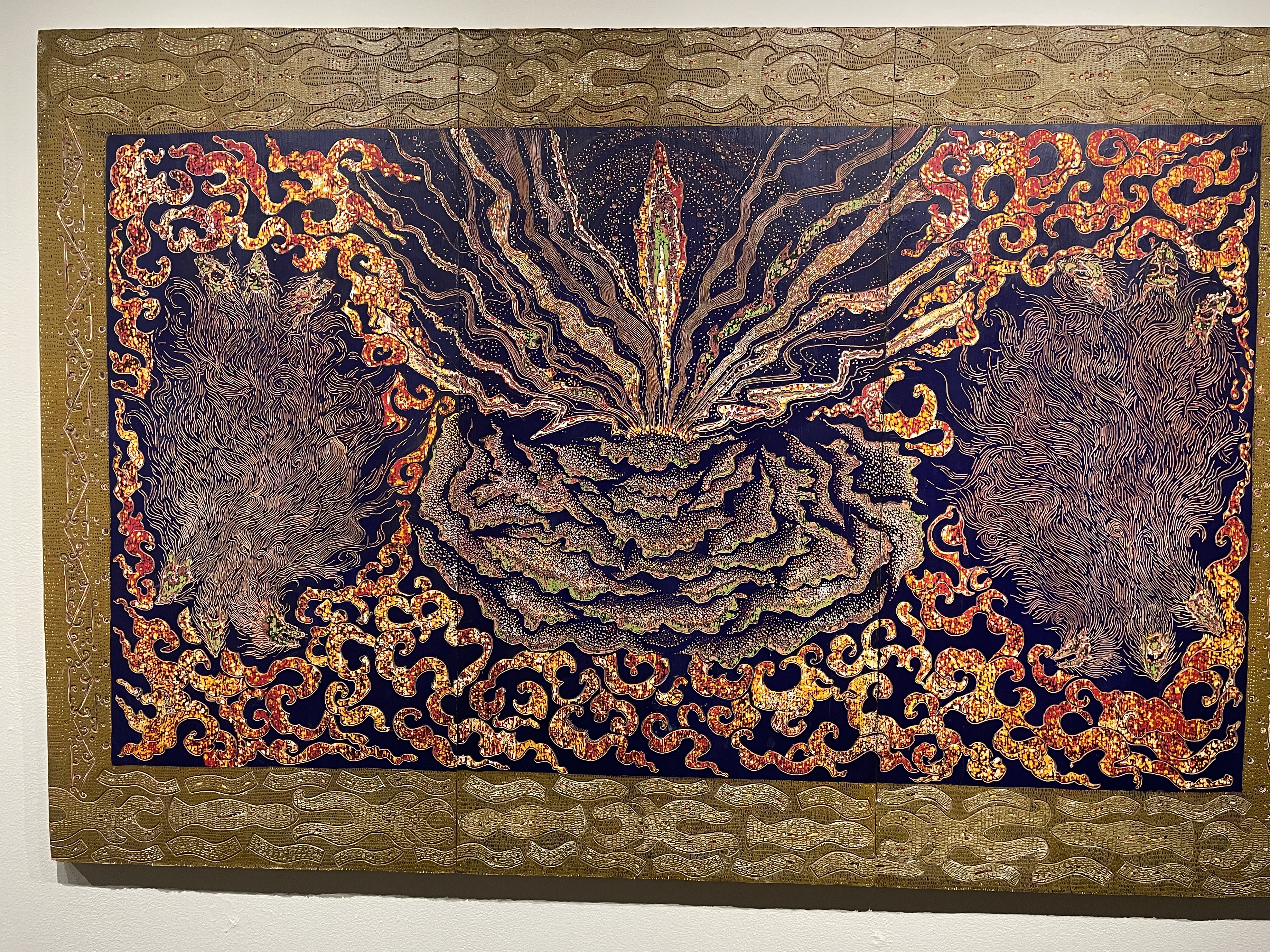
Book 16 for 2025: “The Blue Hour”, Paula Hawkins


Given the nature of the previous book I read by this author and this novel, I have come to the conclusion that she likes to create seriously disturbed, dysfunctional characters. The setting helps with the “mystery”–a somewhat remote island which really is not an island except when the tide comes in. Only one house with only one inhabitant, a steep wooded slope that ends in a rock outcrop with a long plunge to the sea, the disappearance twenty years before of the philandering husband of the famous artist who lived there, and now a lonely, strange, old woman living there alone add to the atmosphere. The relationships among several other characters reveal the continued class structure of British society, its effects. and add to the unsettling nature of the story. To top it all off, a gruesome discovery is made about an art exhibit of the deceased, famous artist who once lived on the island. Although not classified as a mystery, this really is several bizarre mysteries combined. If you like British stories, art, and mystery novels, you will like this novel.

Book 15 for 2025: “Jack”, Marilynne Robinson


Last year I read her novel “Gilead” which takes place in fictional, small, Iowa town in which the main character is the father of the main character in this novel, “Jack”. John Ames Boughton, Jack, is the wayward son of a Presbyterian minister. Previously, he has been wrongly imprisoned for a theft he did not commit. He loves literature, especially poetry. He lives off of odd jobs, drinks too much, smokes, and is somewhat of a lost soul who continuously philosophizes about live, religion, and societal rules. One day he sees a woman walking in the rain. When she drops her bundles on the sidewalk, he helps her. She thinks he is a preacher because of the way he is dressed and invites him in for tea. She is Della Miles, a teacher and the daughter of a Black Methodist minister. This is the story of interracial love when it was still illegal in the US, the lengths they go to resist and hide it, and the reactions of her family. Reading this, one realizes how it was not that long ago that most of the US was not only segregated, but sometimes even talking to someone on the sidewalk from another race could get a person into trouble with the police.

Book 11 for 2025: “The Serviceberry”, Robin Wall Kimmerer


A tiny book by the author of “Braiding Sweetgrass” envisions a totally different economy than the kind we have now. She uses a plant, the serviceberry, as a symbol for what she calls the “gift” economy. Instead of everything being focused on maximizing profit, it focuses on sharing and exchange and the idea that natural resources are gifts from Earth, from nature, rather than commodities to be exploited for profit.

She notes that capitalist economies hinge on the concept of scarcity and personal accumulation of wealth often at the expense of others. Gift economies, which occur in many indigenous cultures, focus on the mutual benefit of all which encourages gratitude and trust. Later in the book, she discusses how gift economies can be implemented and flourish alongside the current capitalist economy.

There must be considerable appeal for her concepts because this book has been on the non-fiction best seller list for weeks.

Book Eight for 2025: ” The Thirty Names of Night”, Zeyn Joukhadar


While his previous novel, Book Seven for the year, focused on map making, what it is like to be a refugee, and the stories of two, strong girls centuries apart, one of this novel’s main focus is birds. One narrator, at first no name and then later Nadir, relates part of the novel. His mother was an ornithologist who died in a tragic fire. Her ghost often speaks to him. The other main character, Laila, was a famous artist, an illustrator and painter of birds who mysteriously disappeared decades ago. She and a Black ornithologist insisted they had seen a new species of ibis, and she is supposed to have made drawings and paintings of this rare bird but all evidence disappeared with her.

This is also the story of various non-cisgender characters, some of whom hid their true identities from even those closest to them. Additionally, it is the tale of the lives of Syrian Americans in a NYC neighborhood, plus its destruction and renewal. As in his previous novel, the language and descriptions are poetic, often haunting, and sometimes heartbreaking. It also illustrates how our lives are often interrelated even when we are unaware, only to be discovered after years of searching.

I am guessing that the novel is at least somewhat autobiographical given that Nadir, born a girl, knows inside that he is really a boy. Between this novel and the first one, the author transitions from female to male.

Both books are beautifully written and I highly recommend reading them.

Book Seven for 2025: “The Map of Salt and Stars”, Zeynab Joukhadar


Two young heroines dominate this fascinating novel which switches back and forth between the Syria of 2011 and the 12th century. The latter is a girl who disguises herself as a boy to join the quest of a famous mapmaker. Nour, the first girl, lost her father to cancer in NYC. Then her mother, a mapmaker, decides to move herself and the three daughters back to Homs, Syria. They barely settle into their new life when the civil war breaks out and a bomb destroys their house. They become refugees. This is the tale of their harrowing journey from Syria to Jordan to Egypt to Libya to Algeria, then Morocco and finally to Cuenta, the Spainish city on the north coast of Africa, where their uncle lives.

To keep sane, Nour repeatedly tells herself the story of Rawiya, the disguised girl who is an apprentice to the map maker. When he was alive, this was the favorite traditional story her father told her. The book alternates between what is really occurring to Nour and her refugee family and this ancient story. At the beginning of the section for each country through which they travel, there is a touching and beautifully written poem in the shape of the map of that country. The poem for Jordan/Egypt is printed below.

Book Three for 2025: “”A Psalm for the Wild-Built”, Becky Chambers


This book is part of a group read at the church where I sing. Classified as science fiction because it occurs in a society on the moon of a different planet far into the future, it is the cheeriest science fiction I have ever read. One of the main characters, Sibling Dex, is a tea monk who travels from town to town, village to village, dispensing the right herbal tea and “advice” to the people who come to see him. He becomes frustrated and bored with this life and decides to head out into the countryside, out into the untouched nature where all the old roads are overgrown or now non-existent.

Due to past experiences, these humans have freed all the robots after they became sentient, and they have an agreement as to where each lives. In addition, humans have decided to live very differently, leave a lot of nature to nature and so live only in certain areas, in bigger towns and small villages with some nature here and there, but most of nature is now untouched and left to do whatever nature does.

Dex heads out in his tea house wagon which he pedals to generate electricity. It is self containing and he has everything he needs for at least two weeks. At one campsite not too far into the wilderness, a robot named Mosscap appears. Mosscap has volunteered to go into human territory per the ancient agreement between humans and robots and learn about humans. Dex finds this a mixture of frightening, intriguing, and confusing. Yet he agrees to allow Mosscap to accompany him on his adventure. The rest of the book is about what they discover, what they learn from each other, and the future they plan.

Book Two for 2025: “Memory Wall Stories”, Anthony Doerr


While wandering around in the library, I found this book. His two more recent novels, ” All the Light We Cannot See” and “Cloud Cuckoo Land” remain two of the most touching and fascinating novels I have ever read so decided to try what he started with, short stories. These stories do not disappoint.

The title of the book comes from the first of the stories. It is a combination of science fiction and paleontology. Via an operation to his head a young boy in South Africa possesses the memories of an old woman. Through her memories he learns of a her deceased husband’s interest in rocks and fossils. This allows him to make a discovery that changes lives. In the next story, due to the death of her parents, a young girl in Kansas has to move to Lithuania to live with her grandfather and makes a myth come true. The following story, “Village 113”, won the O. Henry Prize. It details what happens to one woman, a keeper of seeds for an entire village, when the Three Gorges Dam was built in China. Another story tells what happens to a couple in Wyoming when they desperately want a child but cannot conceive. The shortest of the stories, “The Demilitarized Zone”, is well about that–sort of. The final story, like several others, is about memory, in this case the memories of a Holocaust survivor, who like many who survive horrible events when others they know do not, wonders why her.

I liked these stories so much that I ordered his earlier collection of short stories, “The Shell Collector.” He has won the O. Henry Prize for short stories five times and the Pulitzer for “Cloud Cuckoo Land” in 2015. I keep wondering how he knows so much about so many places. His short stories and novels are set in countries all over the world. The research must never end.

Book One of 2025: “The Heaven and Earth Grocery Store”, James McBride


This is another great novel by one of my favorite authors. The book begins with the finding of a skeleton in a well in 1972. Since it is located near the site of an old synagogue, the police start to question a local, elderly Jewish man, Malachi, but get nowhere. Before they can come back to ask him more questions, Hurricane Agnes washes away the skeleton and many houses in the lower, wealthier part of town. When they do finally get around to hunting for him again, he has disappeared.

Then the novel goes back 47 years in this nondescript Pennsylvania town where the white people live in the lower, nicer part of town, and the Jews and black people live in or near an area called Chicken Hill, a poor area with little water and no plumbing. It is the story of a Jewish couple, Chona and Moshe. She runs the grocery store in the title, and he runs a dance theatre where he hosts dances, sometimes showcasing very famous musicians, mostly Jewish or black or Latino. It is also the story of some of their black neighbors, one of whom was Chona’s best friend in school, Jewish immigrants from Europe like Malachi, and a deaf black child, Dodo. When the state comes for Dodo because his mother has died and they think he should be institutionalized, Chona’s kindness and the courage of a local black worker, Nate Timblin, bring the black and Jewish people together to save him. While all this can be sad and serious, I also found myself frequently laughing. This novel reveals the quirks of all sorts of people, how they relate to one another, the dangers of racism, and ultimately the meaning of community, courage, and friendship and how much these things matter.

Book 50 for 2024: “Teddy and Booker T”, Brian Kilmeade


I finished this book on New Year’s Eve, missing my goal of reading a book a week all this past year, but not by much. No excuses except one book I read was nearly 800 pages which took a bit longer.

This last book was full of surprising information. I had no idea that Teddy Roosevelt and Booker T. Washington were friends. This book is very detailed with loads of historical information about the lives of both of these men. Born worlds apart in terms of freedom, economics, and race, they both had a goal to further the status of Black people. In terms of his political future, Roosevelt made a big mistake when he invited Washington to the Whitehouse for a family dinner. Once this event became known, white people in the South were outraged. Jim Crow incidents, e.g. lynching, increased. Roosevelt felt he had to backtrack some to save himself and this included one his worst decisions in terms of racial equality. Meanwhile, they tried to hide their relationship more, did not visit each other as often, and Washington had to go to great lengths to appease some whites in the South to keep Tuskegee growing and flourishing. W.E.B. Du Bois viewed Washington negatively and thought he went too far to appease white people and did not do enough for his own race. Du Bois who had grown up free in the North did not understand Washington’s viewpoints and did not know what he did secretly to help Black people. If you are interested in the actual history of this period and how these three men affect the present, I highly recommend this book. There are 35 pages of references, notes, and documentation at the end of the books for those who want to read further on this topic and time period.