Sacred Corn


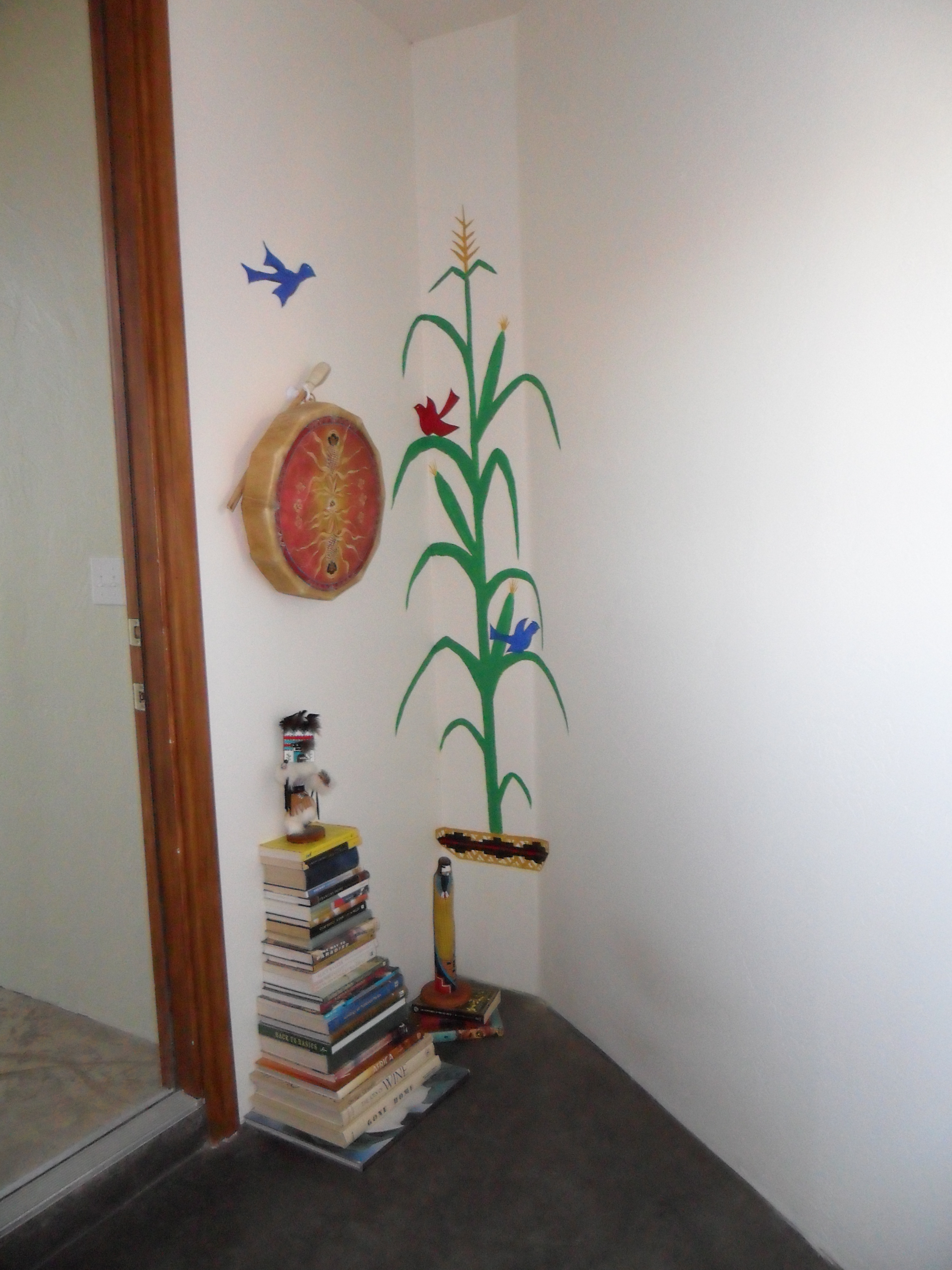
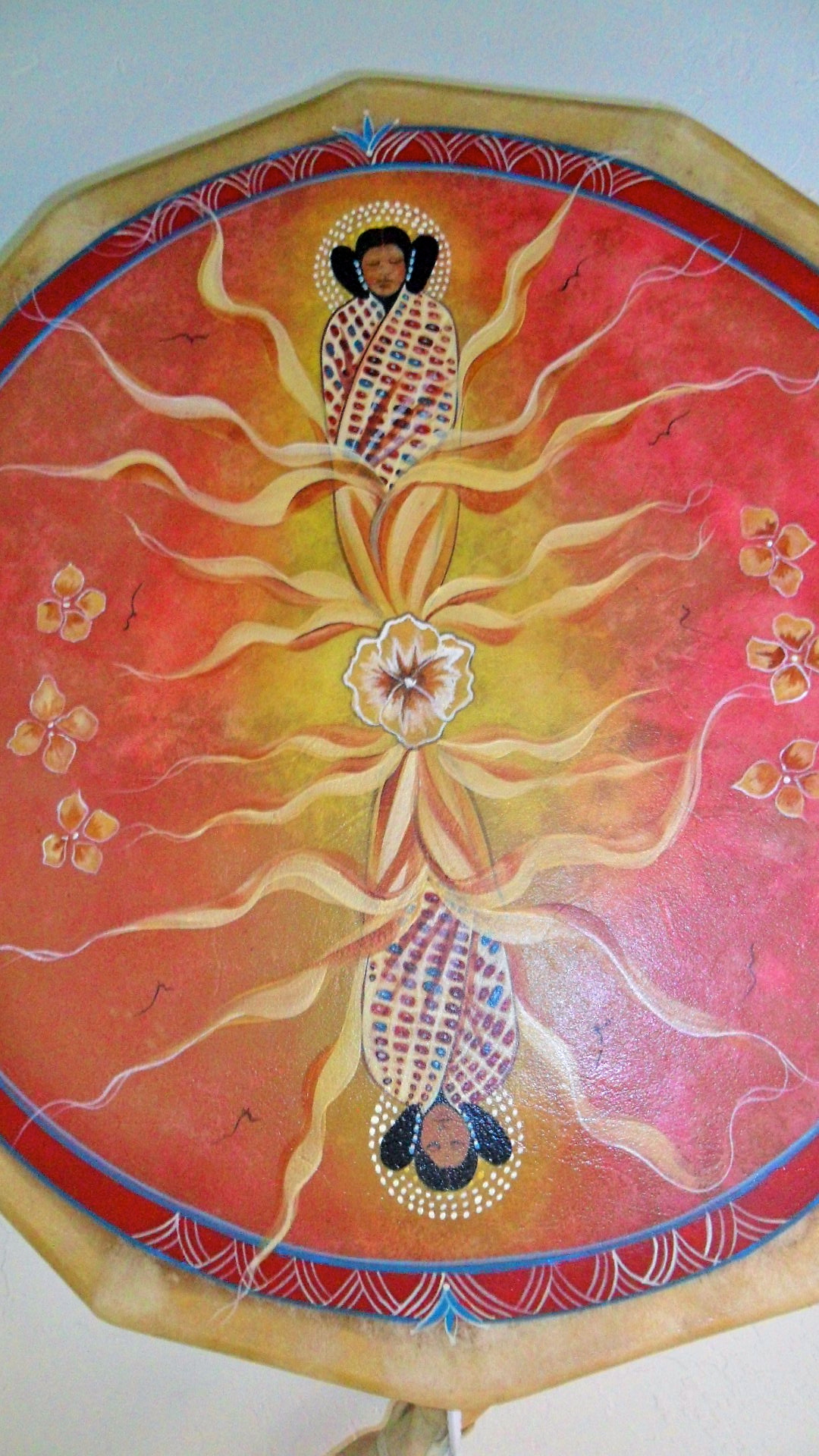
SAM_0035   In the summer on hot, humid nights, you can hear the corn grow.  My great grandfather, my grandfather, and my father grew corn.  I grow corn in that same rich loess soil of Northwestern Missouri.  Soil laid down by Ice Age glaciers thousands of year ago.  Only on a few hill tops, here and there, will you find non glacial soil. Repeatedly, daily, I walk by the sacred corn plant of life painted on my hall corner.  This sacred corn corner houses three corn maiden kachinas and a drum decorated with corn maidens.  I give thanks to corn for my house and the life I lead.

Corn Song

I sing the song of ancients:

pueblo peoples,

Anazazi, Hopi, Zuni.

I sing the song of an America long gone.

Maya, Aztec, Tolmec.

I sing the song of life:  colors of the rainbow

golden, red, white, blue.

I sing the song of now:  thick, endless

identical rows.

Pioneer, Monsanto,

anhydrous ammonia,

atrazine.

I sing the song of hope and joy:

an ancient reclaiming,

a klaidescope of colors,

butterflies and fireflies.

I sing the eternal human song.
SAM_0913

SAM_1489

This is a Navaho kachina.  Kachina are actually Hopi, but Navaho artists now make kachinas as well.  The first corn maiden kachina I bought.

SAM_1490

Spotted corn kachinas, on the left, are unusual.  It took me years to find one.  The kachina on the right was created by R Pino, who is both Hopi and Navaho.

SAM_1491

Every year Pendleton runs an art contest among Native American students.  The winner’s art work is transformed into saddle blankets.  This design, created by Mary Beth Jiron, is the latest in this Student Series. There are three corn  maidens  on each side of the blanket, representing the different varieties of corn grown by native peoples, yellow, red, blue, white, black, and spotted.

The Story Circle Network Conference and My Commitment: This Is What I Know


ad_scnconfWhen I first started blogging more than two years ago, I committed to blogging once a week.  That I managed for a year or so and then since that time, it became more sporadic.  Full time job, writing poems for my book, visitors, mini vacations, all sorts of stuff got in the way.  Really, I let it lapse, but refused to give up.  Last Thursday, I drove to Austin with my daughter and grandson for the biannual Story Circle Network Conference.  The plan:  while I conferred, they played.  The Story Circle Network is an organization for women which encourages women to write, to tell their stories, to share these stories, and when possible and desired, publish those stories in various forms from memoir to poetry.  This was my second time to attend and my first time to attend as a new board member.  A former mentor/teacher of mine, Len Leatherwood, facilitated  a workshop entitled “Transforming Your Writing Life in Just 20 Minutes a Day”, the last workshop I attended.  She blogs everyday.  I follow her blog.  No matter what, she sits down and writes 20 minutes minimum a day separate from the writing she does with her students–she teaches writing privately in southern CA.  One of her recent blogs has been accepted for publication–a piece of flash fiction.  She nearly begged us to commit to this kind of writing practice.  Previously, I had refused, flat out refused, partly thinking that if I tried it, more than half the resulting writing would be crap.  Nevertheless, she and her workshop convinced me that at least for one month I must try this.  Now all of you following my blog will be inundated with daily blog posts.  I am filled with curiosity as to how people will respond.  Maybe it will be like my Facebook posts–yes, I am an almost addict–the posts I consider most meaningful for the universe at large are the ones people ignore and the ones I consider personal trivia receive the most response.  Maybe I will track what appeals to my readers.  Some I won’t know because with blogging I share to Facebook and to a couple of professional networks, I have no clue who read what.  Once I received an email regarding a poem I posted. Although it never showed up as a like, the lady actually told me she read my poem in church!  Who would have guessed. I forgot to time myself so have no idea how long I have been here writing.

Here I am writing about why I am writing.  On the stove I smell Jasmine rice cooking.  I love Jasmine rice from Thailand.  I am a very picky rice eater and prefer to mix equally white Jasmine rice with black and red.  For one thing, it looks lovely when done–a sort of dark reddish purple.  Since I sautéd chopped garlic in olive oil, then added the rice and sautéd for about 15 more seconds, then added water and some broth just before I started writing this, the smell of Jasmine rice fills the house.  I piled a bunch of paper towels on the top before I put on the lid or you can use some cloth towel–a habit I picked up from my Iranian ex-husband.  Iranians really know how to cook rice.  I am also drinking a glass of Cupcake Shiraz which I bought on the way home from work.  And yes, Shiraz is also the name of a city in Iran where they actually grow grapes or at least used to. But of course, drinking wine is no longer acceptable in Iran or at least not publicly.  Good Muslims do not drink at all.

I did write something worthwhile while in this workshop and will share–doing this last because it won’t count as my daily writing since I wrote it yesterday.


This Is What I Know


My parents loved me, really loved me.

My mom was proud of my accomplishments.

Dad gave me a love of books, intellectual curiosity, and a

sense of wonder.

Mom gave me a love of music, beauty, and cooking.

Happiness is a choice.

I do not believe in luck.  You make your own luck.

Life is an exciting adventure.

Horses give me joy.

Singing gives me joy.

Dancing gives me joy even if I rarely have the opportunity.

Family relationships can be distressingly complicated.

I am proud of my children and their accomplishments.

Religion matters much less to me than 99 per cent of the people I know.

Ethnic and religious prejudice distress me and I do not

understand those kinds of attitudes.

I am a good writer.

I want to make a real difference in the world.

I am happy 99 percent of the time.

Blessings flood my life.

My close friends and children and grandson are more

important to me than they know.

Writing has enriched my life.

I have few regrets:

One I have rectified;

the other I cannot–

my dad is dead.

From The Guardian: Ten Rules on Writing Fiction from 14 Authors


The best list of rules for writing almost anything. If you are an English teacher these are musts to teach writing.

lenleatherwood's avatar20 Minutes a Day

Get an accountant, abstain from sex and similes, cut, rewrite, then cut and rewrite again – if all else fails, pray. Inspired by Elmore Leonard’s 10 Rules of Writing, we asked authors for their personal dos and don’ts

Elmore Leonard, Diana Athill, Margaret Atwood, Roddy Doyle, Helen Dunmore, Geoff Dyer, Anne Enright, Richard Ford, Jonathan Franzen, Esther Freud, Neil Gaiman, David Hare, PD James, AL Kennedy

Elmore Leonard: Using adverbs is a mortal sin

1 Never open a book with weather. If it’s only to create atmosphere, and not a charac­ter’s reaction to the weather, you don’t want to go on too long. The reader is apt to leaf ahead look­ing for people. There are exceptions. If you happen to be Barry Lopez, who has more ways than an Eskimo to describe ice and snow in his book Arctic Dreams, you can do all the weather reporting you want.

2…

View original post 3,420 more words

Publication!


A writing colleague posted this on her blog today. It expresses so much of what I feel about so many things that I just had to reblog it. As soon as I finish this reblog, I am going to look for one of these statues for myself. Here’s to a fabulous today and a creative, adventurous future.

lenleatherwood's avatar20 Minutes a Day

I am pleased to report that my flash fiction piece, “A Brother’s Gift” has been accepted for publication at the Provo Canyon Review, a print literary journal. I am especially pleased about this because I rather impulsively submitted it when I saw the Provo Canyon Review’s Call for Submissions. This is a very short piece, but the editors said they liked the tone and also thought it was “A refreshing and moving look at grief and the true emotional impact of such a loss.”

I am happy. Here it is in case you missed it first time round.

A Brother’s Gift

Mary Lou Holder sank down next to her brother, the one who was dying of cancer, and started pulling on the bright red bow of the gift he had just handed her. “This is sweet, Jake, that you’ve gotten me a present. You know you didn’t have to…”

Jacob…

View original post 491 more words

Much as Love and Murder, Freedom is a Many-Splendored Thing


danielwalldammit's avatarnorthierthanthou

17711-series-header Yapto Soerjosoemarno is a middle-aged man. He is the leader of Pankasila, an Indonesian youth group three million strong. The camera follows him out onto a golf course where he explains; “Gangsters are free men. They want to live life in their style. Relax and Rolex.” A moment later he tells his young caddy she has a mole on her pussy.

And she smiles.

Of course all of this comes after Yapto explains that Pankasila had killed all the communists in Indonesia. It comes after he has spoken at a Pankasila rally, one in which he calls himself the biggest gangster of all.

What else could the young girl do but smile?

KillingAs he and his friends try on colorful gangster outfits, Anwar Kongo waxes on about his inspirations; Al Pacino, John Wayne, and others like them. He goes on to relate the story of how he once placed the…

View original post 1,449 more words

On a cold winter evening


This post displays my occasional propensity for pensiveness and reflection.  The highest temperature today was 8 degrees.  The weather forecaster predicted a low of zero, very cold for here with more snow.  In  a few months, it is likely we will hit 100.  Who would want to live in such a place?  Yet people do, worldwide.  Some in places much colder and hotter.  How and why did they all get to wherever they are?  Millennia ago we all migrated from Africa and look at us now.  We think we are smarter, better, but are we?  Perhaps technologically, but psychologically??  War rages over differences in ethnicity and religion.  Clashes for thousands of years change little, just the nature of the weapons, the use of advanced technology.  The intent remains the same.

Sunday, I finished a book by the Turkish writer, Elif Shafak.  I have read all her books translated into English.  This, her latest, Honor, details the effects of the belief in honor of above all else.  To paraphrase one of the main characters, a poor man:  rich men possess money, fancy cars, lavish houses, travel, but poor men have nothing but their honor.  Acting on this belief leaves one family devastated.  For those who desire to learn about other cultures and to understand the behavior of the individuals in them, I highly recommend this novel.

Earlier, I donned two pairs of gloves and socks, four layers of clothes, and ventured out.  If you own horses, you have to feed them regardless of the weather.  Unlike me, my dog, Isabella, fares well in this weather.  Her part wolf blood gives her an undercoat perfect for winter extremes.  Inside, I viewed my larder–what to cook on a frigid winter night?  A simple chicken curry with onions, brussels spouts, jalapeño peppers, and chicken with Jasmine rice, red, white, and black.  And a glass of red wine, cabernet franc, from a local winery, the only wine I have ever seen from only this one grape.  It is usually added to blends.  Definitely haram–still thinking about that book.

SAM_1428

As the temperature drops, building a fire in the wood stove seems like a reasonable endeavor.  I love fires but hate to build them.  Nevertheless, sitting in front of the fire reading brings a silent joy, a paradise.  I feel at peace:  chores done, warm house on a frigid winter night, satisfying dinner homemade, and the knowledge that my book of poetry lays in its final stages with the editors and photoshoppers who will make it publication ready.  I feel extremely grateful, looking forward to dazzling dreams on the rim of wonder.

sam_0303.jpg

The Girl and The Woman


The Girl

She stands alone by the train tracks.

Watching and waiting and dreaming.

Hobos no longer exist.

She remembers reading stories of life

when her great grandmother lived:

hobos begging for food, gypsies stealing

children and telling fortunes, long days

working in the corn fields, chopping weeds.

Her own family praises:

tractors, riding lawn mowers, herbicides, pesticides,

electricity, TVs, dishwashers, muscle cars, MacDonalds,

diet Coke, cell phones, computers, DVDs, iPADs.

Now the only excitement lays in Grand Theft Auto,

guns, and sex.  She watches and waits and dreams.

Canyon photo 1 anabel

The Woman

She stands alone on the rim,

watching the moon rise,

wondering.

Life flies by on wings

outstretched.

She remembers rich years

filled with long joys, living,

loving,

and temporary sadness, divorces,

moving here and there,

Narrangansett Bay, Utah mountains,

Veracruz,

babies held to breast,  blond

and chubby, cafe con leche.

She remembers girlhood longings

for far horizons, traveling

around the world, lovers,

husbands, shades of brown

beauty.

She’s learned to make

her own excitement,

singing Goddess songs,

dancing on the rim of wonder.

SAM_0901

Photograph by Anabel McMillen and Painting by Lahib Jaddo

Bedtime Reading or Not–the Hazara


A lifelong habit that helps me settle down to sleep remains reading.  However, occasionally I delve into a book that turns out not to be so wonderful to read just before going to bed.  The topic turns to the disturbing and then, suddenly, my mind churns.  By that time, it is too late to go back.  Or, like the book I am reading now, parts of it consist of stories inspiring, amusing, enlightening, parables for life.  Then there are the other parts:  the abuse of an entire people by the other ethnicities surrounding them, genocide, turmoil, invasion.  I remain a lifelong lover of libraries.  Recently, while browsing through new books, I found this one:  The Honey Thief  by Najaf Mazari and Robert Hillman.  Mazari grew up in a Hazara village in the northern part of Afghanistan, the area known as Hazarajat, became a master rug maker and fled from the Taliban to Australia in 2000 where he met his now close friend and coauthor.  For several days now, it has been my bedtime reading.

The Hazara people speak a dialect of Farci, the language of Iran.  Data varies, but they number approximately seven million in Afghanistan and remain one of the largest ethnic groups there.  Nevertheless, in spite of this, other groups discriminate against them for various reasons, including the fact that most Hazara are Shia Muslims surrounded by Sunnis.  Until 1893, they were the majority when half were massacred and many fled to live in Iran, Pakistan, and India.  Some believe the Hazara are the descendants of Genghis Khan’s warriors.  Many resemble the people who live in Mongolia today and in many ways parts of their culture resemble that of Mongolia, e.g. their tents look like yurts; no one knows for sure.  They have lived in what is now known as Afghanistan for hundreds of years.  They are people of the mountains who have learned to cultivate beauty and farm in high, inaccessible places.  They are famous for poetry and story telling.  Unlike other women in Afghanistan, they shunned burkas, fought along side men as soldiers, and believed in education for women.  These attributes fueled discrimination by other groups there.

Now back to bedtime reading.  Several stories in particular contain what I consider the necessary qualities for bedtime perusal:  entertaining and instructive without gore, controversy.  They also hold an unusual quality of something you cannot quite quantify, a hint of the mystery of life, of a particular kind of not quite describable beauty.  Hoping that at least some of you will find the book and actually read it, I will first list the stories to read without dread or worry if you want to read at bedtime:  “The Wolf Is the Most Intelligent of Creatures”, “The Music School”, and the “Snow Leopard”.  Under no circumstances read “The Life of Abdul Khaliq” and “The Death of Abdul Khaliq”.  You will, indeed, learn a considerable amount of Afghan history, but unless you are quite heartless and insensitive, you probably will not be able to drift off to a pleasant dreamland for hours.

If all this stokes your curiosity, here are two websites to learn more about the Hazara:  www.joshuaproject.net and http://www.hazarapeople.com.

My Father


Recently I decided to try writing poems about a few family members.  Months ago on this blog I published a poem about my Grandmother along with the marriage photo of her and my grandfather, who was so much older than she  (22 years) that I never knew him at all.  In June I posted photos of the trip I took back to Missouri where I grew up.  While a few things remained the same, I felt very sad about some changes and kept thinking how my dad must feel if he were watching.  He died in 1996, lived in the same house for 80 years and on the same farm all his life.  He labored long and hard to make the homeplace beautiful.

He watches:

The house where he was born

gone

Only the old carriage house stands.

The young man who farms the land cannot bear to tear it down.

He watches:

The ancient burr oaks and black walnuts

gone

bulldozed into waste piles or sold for greed.

He watches:

The house he lived and loved in for eighty years

still stands on land his family owned for more than 100.

Strangers live there:

He sees the well trimmed lawn,

new picket fence,

children playing.

He watches:

The pond he proudly built and stocked with fish reflects the summer sun.

The tree filled park between the pond and house

gone

He wonders why someone would destroy such beauty.

He watches:

The walnut grove where he ran cattle

gone

The pond where his grandson caught the giant turtle

gone

plowed over and planted to corn and soybeans.

He watches.

SAM_1165

Blackwater Draw-Part Two


The ancients hunted here at the shores of a lake

nearly 12,000 years ago.  In 1929, an amateur

archeologist discovered an ancient spear

point lodged in bone.  I walk the mile long trail

down into the depths.   Caliche, gravel,

larger rocks strewn by millennia.  For

thousands of years Clovis, Folsom, and Portales

Man left remnants of their hunting life.

The scattered cottonwoods whisper in the wind,

timeless voices call me, beckoning.

Who were these people?

What did they look like?

Where did they come from?

In whose gods and goddesses did they believe?

Doubtless hunger drove them to this place of water

and plenty.  Columbia Mammoths, giant sloths, dire wolves,

saber toothed cats  gathered here for thousands of years.

The diggers found an obsidian spear head with a

bison whose horns spanned seven feet and

mammoths twice the size of elephants.

Saber toothed cats competed with these

ancient ancestors at this place, all driven by

hunger, thirst, and instinct.  I wonder how

these people overcame danger, fear?

I walk the mile long path, stand in the shade

of these cottonwood trees , read the signs that

tell me what diggers found at specific spots along the trail.

The cottonwoods whisper to me.  They

tell me ancient tales of hunger, strife, fear,

beauty, love, endurance.  I hear the ancient voices

calling.  They tell me ancient tales of woe, war,

weaponry, courage, and community.  My

skin tingles strangely in the summer heat.  Now

this land is dry, a desert, the water that sustained

teeming life evaporated in the crystalline air.

Twelve thousand years from now who will stand here?

Will this place exist?  Will someone wonder the meaning

of our bones, who we were, what we believed?