“All Children Are Our Children” by Carol P. Christ


This is a rather long read the gist of which is this: what if “we were taught to love and nurture and be generous to others” and these were the primary values in the world rather than the current values. “What if we were taught to open our hearts to the world? Would domination, violence, and war be possible?”

Carol P. Christ's avatarFeminism and Religion

Carol P. Christ by Michael Bakas high resoultion“All children are our children.” As I was posting my recent blog about the shooting of black men by the police, these words came into my mind with the force of revelation. At the time I was looking at a photograph of Philando Castile, taken at his place of work. Yes, I thought, my heart opening: “he is my child too.” This widening of the heart is at the center of the maternal values of ancient and contemporary matriarchal cultures around the world. It is a feeling some of us who were mothered well enough or who mothered children—including children not our own—carry within us. Is this the healing balm our world needs today?

Maternal  values?  So many of us turn up our noses at such a “gendered” term. Perhaps we were not mothered enough in our families of origin. Perhaps we still feel un-mothered. Perhaps we don’t want…

View original post 814 more words

Ethiopian Journey–Ancient Churches of Lalibela


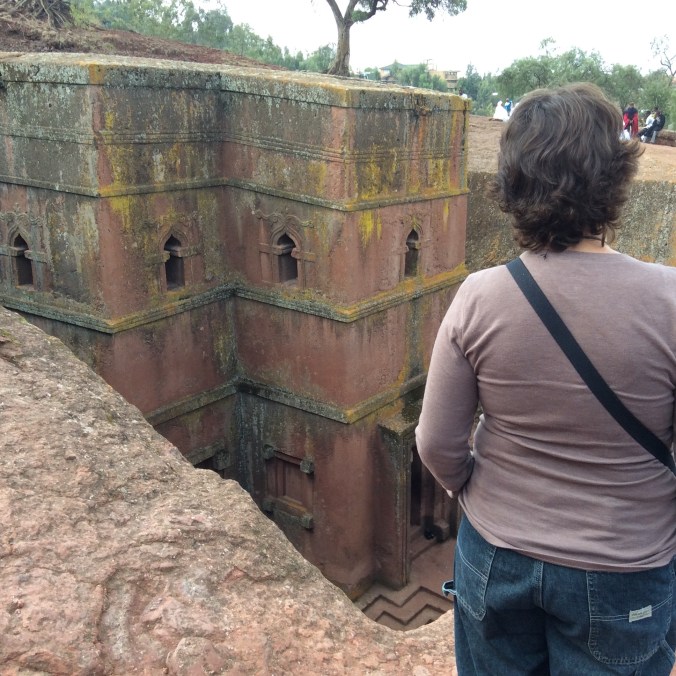
In the 12th century the king of Ethiopia decided to build a New Jerusalem.  Eleven churches were carved out of solid rock on the mountain top in the village of Lalibela.  A UNESCO World Heritage site, these churches remain intact and in use.

IMG_0428

They were all carved from the rock top of the mountain down into the earth so that they remain invisible unless the person is only a few feet away.  This protected them from the vision of potential invaders, usually Muslims from what is now Sudan.  The above is probably the most photographed of these churches and stands separate from the others.
IMG_0429

My friend is standing near where the stairs lead down to the bottom where visitors and worshippers can enter the church.  Visiting all these churches in one day is not an activity for the faint of heart or for one terrified of heights.

IMG_0401

This is the first church we visited.  It still mystifies many as to how such incredibly intricate structures could me carved by hand out of solid stone.  Even these columns are carved out of the rock.  The “official” Ethiopian Orthodox Christian story relates how angels helped the builders.

IMG_0402

This and most of the other churches are connected by “waterways” where in the rainy season a sophisticated system of drainage keeps all of them from flooding and makes it possible for visitors and worshippers to walk along from church to church.
IMG_0407

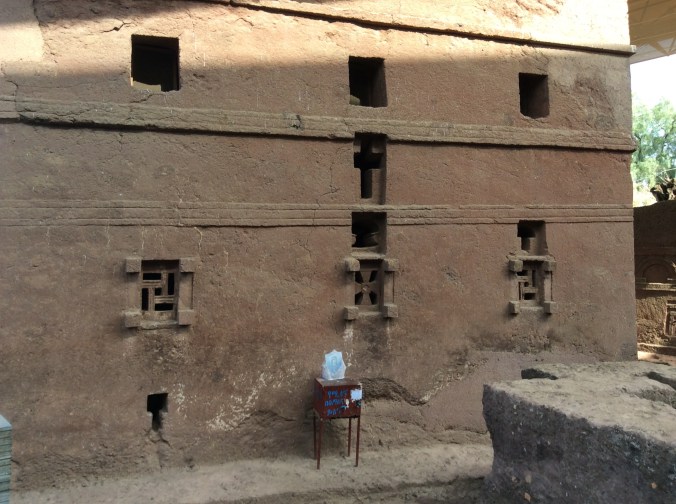
Everything in the Christian churches in Ethiopia  symbolizes something related back to Jerusalem and the Bible.  Even though the guide explained it all in detail, keeping up with all the symbolism proved a daunting task.  Notice the swastikas.  They are ancient symbols of the eternal circle of life and death.  Hitler turned them backwards and into a totally different meaning.  There are also many different styles of crosses there, two of which can be seen in the windows of this church.

IMG_0408

This is a fertility pool.  In the past a priest got in the water–it is very deep–with a woman who could not conceive and bless her in the water.  At one point when it began to fill too much, they cleaned out the bottom and found many treasures buried there, apparently dumped into the pool to protect them from enemy invaders.

IMG_0412

The inside of the churches are intricately carved and sometimes painted.
IMG_0417

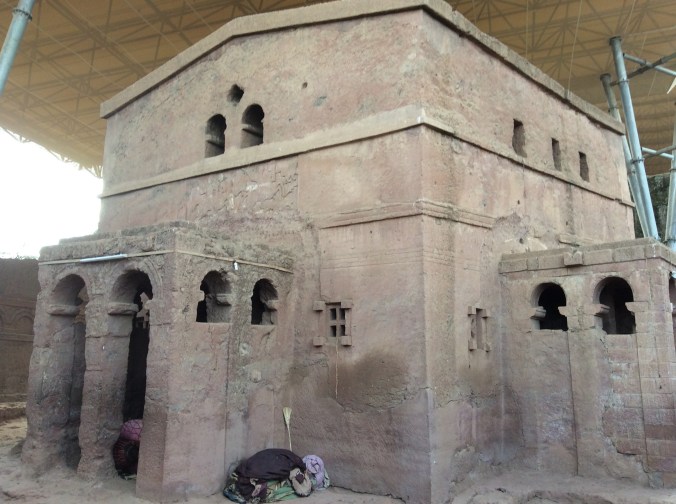
Two types of basalt exist on this mountain, soft and hard.  Churches carved out of the soft basalt have begun to deteriorate and as a consequence are covered.  As can be seen here, people still come to these churches to pray and attend services.
IMG_0419

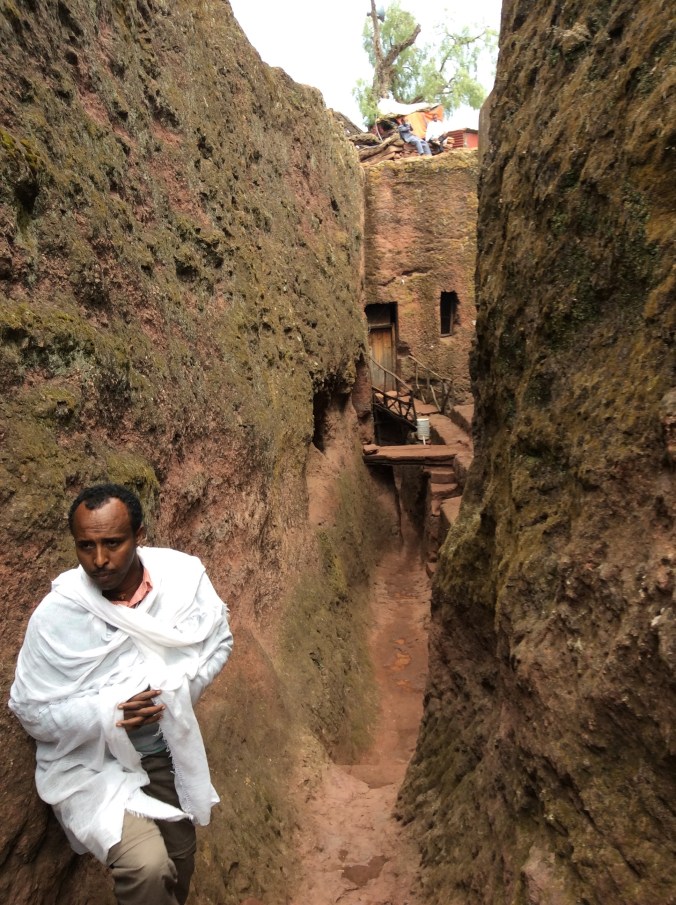
Our guide lead us from church to church through these narrow passageways which are, as previously mentioned, used to drain water away from them in the rainy season.  If Ethiopia had a national color, it would be white.  It is not only worn to go to church and for religious purposes but in daily life as well.  It mystifies me as to how they keep whites so very white.
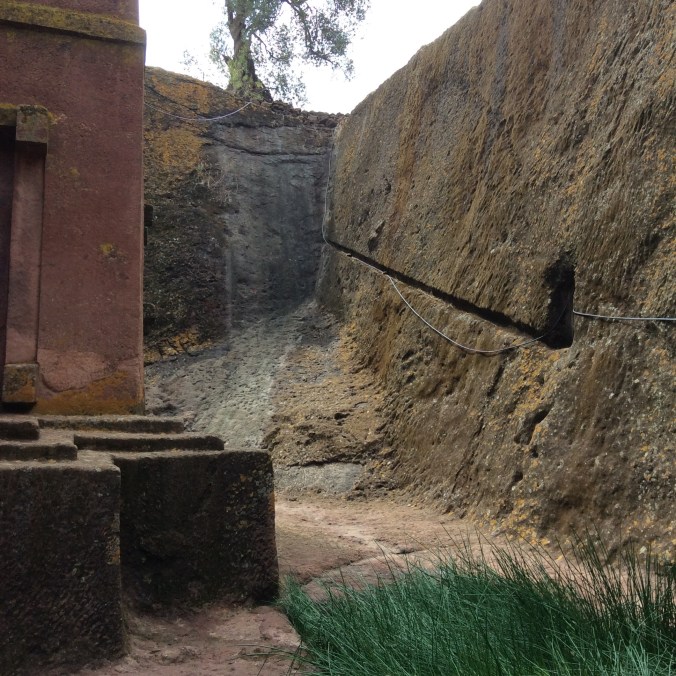
IMG_0430

The slit dug in the rock is part of the system of drainage.  The grass in the foreground grows out of a pool of holy water.  While we were there, a boy filled a plastic bottle with the water and left.
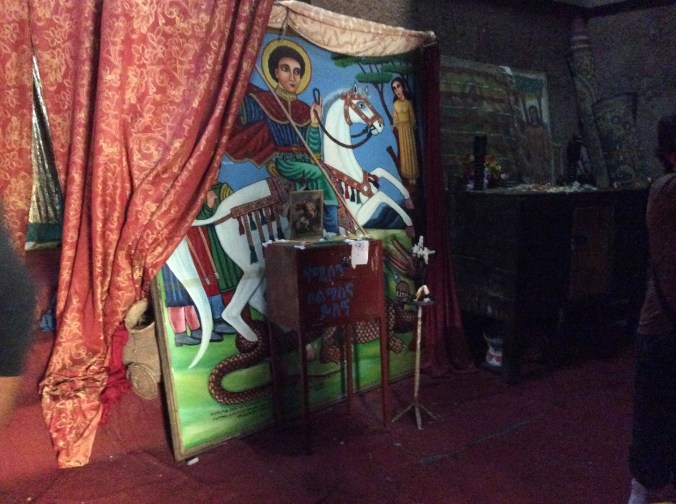
IMG_0435

St. George and the dragon are everywhere, not only in churches but also on beer.  He is the patron saint of the country, symbolizing the triumph of Christianity over paganism as symbolized by the dragon.

IMG_0448

The carving in many of the churches reveal a sophisticated knowledge of how to work in stone.  It is difficult to believe that this was carved by hand downward into solid basalt centuries ago.

IMG_0491

The road to Lalibela is rather daunting, climbing  higher and higher with no guard rails, nothing.  As you can see from this photo, patchwork quilt  fields cover even the mountainsides.


To learn more about Lalibela, see detailed information and explanations of their River Jordan and other religious symbolism, go to my blog posts from August 2014.

Book Review by Mary Sharratt: ESTHER by Rebecca Kanner


I am reblogging this because it fits with my next book project: poems from the viewpoint of the ancient mother goddess and others from the viewpoint of women in the Bible.

Mary Sharratt's avatarFeminism and Religion

esther

We have been lost to each other for so long. My name means nothing to you. My memory is dust. This is not your fault or mine. The chain connecting mother to daughter was broken and the word passed into the keeping of men, who had no way of knowing. That is why I became a footnote, my story a brief detour between the well-known history of my father and the celebrated chronicle of my brother.

-Anita Diamant, The Red Tent

To a large extent, women have been written out of history. Their lives and deeds have become lost to us. To uncover the buried histories of women, we must act as detectives, studying the clues left from ages lost.

At its best, historical fiction can write women back into history and challenge our misconceptions about women in the past. Anita Diamant’s novel, TheRed Tent, became such an…

View original post 777 more words

Toxic Masculinity: “Masculinity Must Be Killed” by Carol P. Christ


Very thought provoking. I definitely will look for the pamphlet by Abdullah Ocalan.

Carol P. Christ's avatarFeminism and Religion

Carol Molivos by Andrea Sarris 2A few days ago I watched the movie An Unfinished Life starring Morgan Freeman, Robert Redford, and Jennifer Lopez. Though it was recommended as a sensitive psychological drama, and though on the surface level it criticizes (male) violence against women and animals, on a deeper level, it confirms the association of masculinity with violence, suggesting that violence is the way men resolve their problems with each other.

At the beginning of the film, Robert Redford, who lives on a ranch in Montana, picks up his rifle with the intention of shooting a bear who mauled his friend Morgan Freeman. This act of violence is stopped by local authorities who arrive to capture the bear. However, the bear is not removed to a more remote area, but rather is given to a local make-shift zoo where it is kept in a small cage. At the end of the movie, Redford frees…

View original post 1,003 more words

Making a Difference: Kiva Loans


To honor the death of a best friend’s father, I did as she asked, made a Kiva loan.  After looking through dozens of potential individuals and groups, I loaned 100 dollars to a group of women in the Democratic Republic of Congo to help fund their poultry raising operation.  Even though it has been less than six months, they have paid back more than half, paid on time regularly.

Some loan opportunities require even less money.  People often think their efforts don’t count, they are too small to make a difference.  Everything each person does makes a difference for better or worse.  Make a difference, act, speak out, contribute however you can to make our world a better place for all of us.

Garden of Eden Retold by Trelawney Grenfell-Muir


A delightful, grown-up retelling of the old story.

Trelawney Grenfell-Muir's avatarFeminism and Religion

Trelawney bio pictureToday, I came up with a less patriarchal Garden of Eden story:

Endelyn (age 7): “When I think of my soul, in my name “fire-soul,” I think of a powerful wind.”

Me: “That makes sense, since one of the names in the Bible for God/ess is Ruach, which means “breath” or “wind”, but we call it the Holy Spirit. God/ess is also symbolized by the other elements: fire, air, and earth – like when she shaped Eve and Adam out of clay.”

Endelyn, “What? I don’t remember that story.”

Me: “Oh, ok, I’ll tell you.” ……

Here’s the part where I froze momentarily, thinking “how can I tell my children that misogynist failed mentor story? how? how?” <deep breath>

View original post 787 more words

Sacred


Warm summer raindrops on my face

Crimson cardinal drinking in blue birdbath

Feather grass waving in the wind

Last lavender and white iris before first frost

Cups of coffee from Chiapas at 6 in the morning

The sunning rattlesnake lying by my feet

Horses running wild and free

Facebook messages from friends far away

Waterfall’s roar after the thunderstorm

Night songs–coyote, cricket, nighthawk, frogs, hoot owl

Life

Sunday Sunrise ©Dawn Wink


Four Reasons We Need To Reclaim The Power of the Divine Feminine Now by Mary Petiet


Why is the divine feminine so important? What does it promote that values others, our planet? This says everything I could have said myself.

Guest Contributor's avatarFeminism and Religion

Mary Petiet photo(Spoiler alert:  She’s already here)

The power of the divine feminine taps into the power of life. The power is accessible to everyone as the equal opportunity energy surrounding and connecting all living things. The power is ancient, and meditative practices such as yoga, which in Sanskrit means linking to the divine, can connect us to this power. When we make the connection, we find the balance we need to realize our highest selves, and through that balance we can realize the highest self of the larger society.  To reclaim the divine feminine, we need only remember, and as more and more of us remember, we heal first ourselves, and ultimately the planet.

1. She is the route back to the self.

In her mother aspect the divine feminine offers a route back to the self and She is all-inclusive. She embraces all of creation, men, women and nature, and we…

View original post 501 more words

Jesus and Easter


Yesterday, I learned several new aspects of the religious debates surrounding the teachings of Jesus, Christianity, Mormonism., and how Easter is viewed.  Mostly, it followed a discussion on a post about Jesus, Good Friday, and Christian politics.  Whether most modern Christians want to believe it, Jesus’ teachings were radical, revolutionary.  However, most modern Christians pay much more attention to the teachings of the misogynist Greek, Paul.  The debate centered on comments after this particular post about the politics of Christianity.

It centered on Mormon beliefs about Easter.  According to the comments, Mormons do not use crosses because they focus on the teachings of Jesus and his life.  They use these teachings and his life as a guide.  I thought to myself:  what a good idea.  If the whole world followed his teachings, the world would be a much better place full of peace, equality for all, not just the powerful few, tolerance, understanding–the list is long.

The contention of many of the so-called Christians commenting is that true Christianity focuses on the death of Jesus and his subsequent rising from the dead, that what matters is that he died for their sins, and rose on the third day, that Mormons are not Christians because they focus on his life.  Really??  Not only did I find this information new–and perhaps this is what many Christians believe–but astonishing.  Although my family celebrated Easter in a big way, I was always taught that Jesus’ teachings held the center of belief.

I will admit that although I grew up in a mainstream Protestant, Christian denomination, I no longer consider myself a Christian.  I firmly think (notice I did not use the word believe) the world would be a much better place if everyone followed the teachings of Jesus!!!!  Religion, as most practice it, is ruining the world.  Perhaps if everyone focused on Jesus’ teachings instead of arguing over who is right, we could attain some sort of mutual respect and peace.  As Jesus taught:

-respect one another

-love one another

-share

-treat others as you hope to be treated

May your day be filled with joy and peace!!!