Apocalyptic Planet-Part Five: Civilizations Fall


Whether it is my innate ambition, something my parents instilled in me, or something else unknown, I try to learn something new every day.  Craig Childs starts this chapter of his book by talking about a Phoenix landmark.  Back when I travelled to Phoenix regularly, I knew this place as Squaw Peak.  Now its name Is Piestewa Peak.  The name change is probably a good thing.  I never knew before reading this how dreadfully pejorative the word squaw is.  Basically, it means Indian bitch as well as other things related to the privates of women.  All languages seem to possess an accumulation of dreadful words geared to putting women down one way or another.  Slang words for the private parts of a man rarely mean anything pejorative, at least not that I know of.  The new name, a Hopi name, a blessing word, is a word that calls water to this place.  Not a bad idea in Phoenix or most of the Southwest for that matter.

The name Phoenix fits.  Underneath modern day Phoenix, an ancient city lays buried, a quite sophisticated city with ball courts, temples, irrigation canals.  This city existed at least a thousand years ago.  Its inhabitants grew corn, cotton, beans, and agave.  Farmers, hunters, carvers, all sorts of artisans and merchants apparently lived there.  Now they are called Hohokam taken from an O’odham word meaning “ancestors”, the “ones who have gone”.  We find forgotten cities all over the world, Palmyra, Machu Picchu, Angkor Wat.  What causes these sophisticated civilizations to fall?  If you read a bit, look further, you find common themes:  environmental decay, resource depletion, conflict, disease, social problems.  Angkor Wat fell because it could not maintain its complex irrigation network.  Ur in Iraq fell because a drought caused its port to dry up.  Usually, the demise of particular civilizations occur over time, e.g.Rome.

Childs notes that human patterns often follow animal patterns, or at least mammalian patterns.  For example, when over population occurs, behavior changes.  Parental care and cooperation become replaced with aggression, violence, competition for resources, dominant behaviors.  These types of behaviors are particularly detrimental to females and the young without whom the society (or animal population) cannot replace itself.  Generally, in animal populations, when this occurs, reproduction slows for several generations and the imbalance corrects itself.  For humans, it is not so simple.  Hohokam bones indicate mass starvation and malnutrition.  Other civilizations, e.g. the Anasazi, seem to have disappeared without a trace.

Today, most of the world’s largest cities have immense infrastructures that keep them going, miles of underground sewage tunnels, water mains, etc.  Here in the US in our oldest cities, much of what we take for granted is very old and deteriorating.  New York City and Chicago have water main systems that some experts claim are near collapse or at the very best badly in need of repair.  Doubtless such conditions exist in old cities throughout the world, most of which are much older and larger than the majority of cities in the US.  Yet, they continue to prosper.  Have we passed a point when civilization cannot fall?

Childs completes this discussion by describing his visit with his wife to Guatemala.  They visited all the best known Mayan sites, visited with natives.  His wife managed to get invited to a Mayan fire ceremony, a renewal ceremony.  History books tell us the Mayan civilization is dead, ended.  But it is not.  The Mayan culture still exists.   At least six million still live in the Central America.  What would have happened to Mayan cities if the Europeans had not brought epidemic diseases and better fire power?  We will never know, of course, but no matter how many civilizations rise and fall, change continues and humans continue to inhabit the earth.

The new question is this:  can this planet we live on sustain the ever increasing numbers of humans who inhabit it??

Sacred Corn


SAM_0035   In the summer on hot, humid nights, you can hear the corn grow.  My great grandfather, my grandfather, and my father grew corn.  I grow corn in that same rich loess soil of Northwestern Missouri.  Soil laid down by Ice Age glaciers thousands of year ago.  Only on a few hill tops, here and there, will you find non glacial soil. Repeatedly, daily, I walk by the sacred corn plant of life painted on my hall corner.  This sacred corn corner houses three corn maiden kachinas and a drum decorated with corn maidens.  I give thanks to corn for my house and the life I lead.

Corn Song

I sing the song of ancients:

pueblo peoples,

Anazazi, Hopi, Zuni.

I sing the song of an America long gone.

Maya, Aztec, Tolmec.

I sing the song of life:  colors of the rainbow

golden, red, white, blue.

I sing the song of now:  thick, endless

identical rows.

Pioneer, Monsanto,

anhydrous ammonia,

atrazine.

I sing the song of hope and joy:

an ancient reclaiming,

a klaidescope of colors,

butterflies and fireflies.

I sing the eternal human song.

SAM_0913

SAM_1489

This is a Navaho kachina.  Kachina are actually Hopi, but Navaho artists now make kachinas as well.  The first corn maiden kachina I bought.

SAM_1490

Spotted corn kachinas, on the left, are unusual.  It took me years to find one.  The kachina on the right was created by R Pino, who is both Hopi and Navaho.

SAM_1491

Every year Pendleton runs an art contest among Native American students.  The winner’s art work is transformed into saddle blankets.  This design, created by Mary Beth Jiron, is the latest in this Student Series. There are three corn  maidens  on each side of the blanket, representing the different varieties of corn grown by native peoples, yellow, red, blue, white, black, and spotted.

On a cold winter evening


This post displays my occasional propensity for pensiveness and reflection.  The highest temperature today was 8 degrees.  The weather forecaster predicted a low of zero, very cold for here with more snow.  In  a few months, it is likely we will hit 100.  Who would want to live in such a place?  Yet people do, worldwide.  Some in places much colder and hotter.  How and why did they all get to wherever they are?  Millennia ago we all migrated from Africa and look at us now.  We think we are smarter, better, but are we?  Perhaps technologically, but psychologically??  War rages over differences in ethnicity and religion.  Clashes for thousands of years change little, just the nature of the weapons, the use of advanced technology.  The intent remains the same.

Sunday, I finished a book by the Turkish writer, Elif Shafak.  I have read all her books translated into English.  This, her latest, Honor, details the effects of the belief in honor of above all else.  To paraphrase one of the main characters, a poor man:  rich men possess money, fancy cars, lavish houses, travel, but poor men have nothing but their honor.  Acting on this belief leaves one family devastated.  For those who desire to learn about other cultures and to understand the behavior of the individuals in them, I highly recommend this novel.

Earlier, I donned two pairs of gloves and socks, four layers of clothes, and ventured out.  If you own horses, you have to feed them regardless of the weather.  Unlike me, my dog, Isabella, fares well in this weather.  Her part wolf blood gives her an undercoat perfect for winter extremes.  Inside, I viewed my larder–what to cook on a frigid winter night?  A simple chicken curry with onions, brussels spouts, jalapeño peppers, and chicken with Jasmine rice, red, white, and black.  And a glass of red wine, cabernet franc, from a local winery, the only wine I have ever seen from only this one grape.  It is usually added to blends.  Definitely haram–still thinking about that book.

SAM_1428

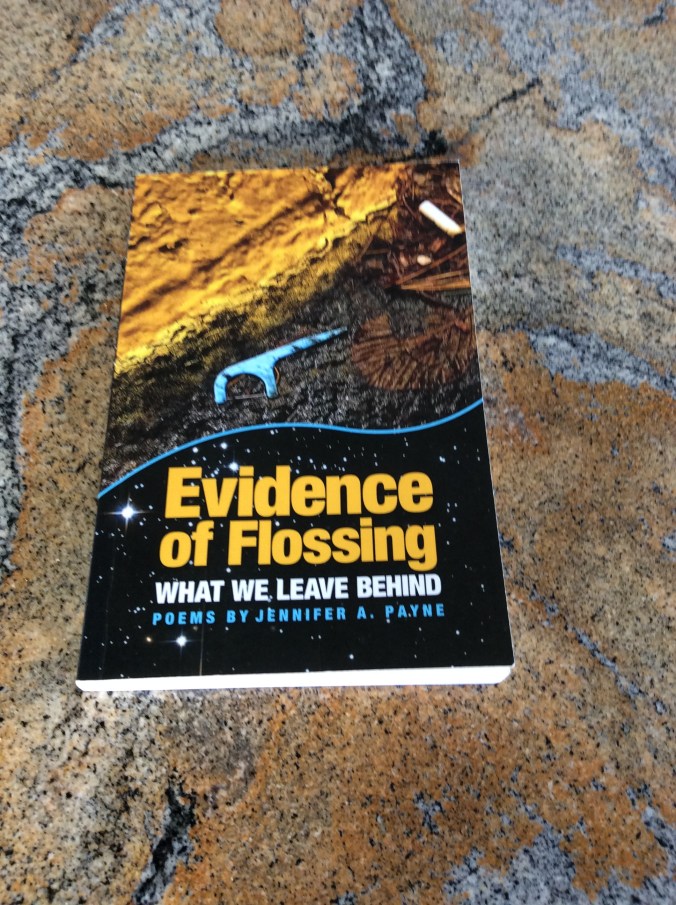
As the temperature drops, building a fire in the wood stove seems like a reasonable endeavor.  I love fires but hate to build them.  Nevertheless, sitting in front of the fire reading brings a silent joy, a paradise.  I feel at peace:  chores done, warm house on a frigid winter night, satisfying dinner homemade, and the knowledge that my book of poetry lays in its final stages with the editors and photoshoppers who will make it publication ready.  I feel extremely grateful, looking forward to dazzling dreams on the rim of wonder.

sam_0303.jpg

This Morning


It’s almost gone:

Time.

I must print poems for inspiration

before the website goes down.

The early morning sun filters

through windows, warms my back.

The printer prints.

I smear even complexion mask

over my aging face.

Where did my beautiful skin go?

Can I fix it?

Arid climate, too much suntime, what?

Must I admit to aging?

Must I see grey roots

beneath the dye?

I walk by the photo when I was 37.

What happened to that face?

I want it back!

The printer prints.

I look in the mirror, distressed.

In my family, I can expect

another twenty years.

Twenty years?

If I don’t do something to this face,

in twenty years…

The printer prints.

Mom’s Pumpkin Pie Recipe


Today, Thanksgiving Day, I will make Barbara Duke Lightle’s (my mother)  pumpkin pie, using a recipe and blender she gave me decades ago.  The recipe includes a small hand written note about her preferred way of combining the ingredients.  My grandson loves this pie and the idea that what he is eating is a recipe from his great grandmother, a woman he will never know.  He tries other pumpkin pies but likes only this one.  Dad loved this pie, too.  After Mom died and he discovered he was gluten intolerant, he taught himself to cook.  He made this for himself sans the crust–pumpkin pudding.

1 1/2 cups cooked or canned pumpkin

1 1/2 cups milk or milk combined with cream or evaporated milk

3 eggs

3/4 cup brown or white sugar

1 tsp ground cinnamon

1 tsp ground nutmeg

1/2 tsp ground ginger

(or use 1/2 tsp nutmeg and 1 tsp ginger for a more spicy flavor)

Place all ingredients in a blender.  Place your hand over the blender cover before starting the motor.  Blend just  a few seconds, until smooth, and pour into pastry lined pie shell.  Bake at 450 for ten minutes, then bake at 350 for 30 minutes longer or until firm in the center.  A piece of outer peel of orange can be blender grated into the pie mixture–if you do this, place in blender with 1/2 cup milk and blend fine before adding other ingredients.

You may use squash instead of pumpkin.

The hand written note says, “Juliana, if you use half evaporated milk it gives wonderful flavor and I like white sugar best”.

I use evaporated milk totally and white sugar like Mom recommended.  I have never used orange peel.  The cinnamon I am using today comes from a tree at my friend’s mother’s house in Ethiopia.

This seems a great day to also thank my mother for all she taught me:  cooking, singing and playing the piano, a love of beauty–flowers, wildlife, good food, the list is endless.  She taught me think positively, to believe in myself, to make the most of what life brings, to never give up.  Thank you, Mom!!!

SAM_1381

Day Trip to Lake Marvin and Canadian, Texas–Part Two


After eating lunch at the elementary school, two of us decided to go to the museum for which Canadian is famous, The Citadel.  Originally a Baptist Church, it lay in total disrepair until Dr. Abraham and his wife bought it, totally restored and converted it into their residence.  They gave it to the town as a museum and moved into another Victorian house which they totally restored.  The location of The Citadel currently contains the house, a gift shop, and another building which houses an art gallery.  First, you go to the gift shop to purchase tickets.  On this particular Fall Festival weekend, the Abrahams also open their actual residence to the public and take you on a personal tour themselves if you so desire.  Given my limited time, I purchased a ticket only for The Citadel.

SAM_1348

This door is one of the first things you will see if you walk to the entry gates from the south of the house.  Everything remains elegant, ornate and in a style one does not often see in this part of the United States.  Canadian is an exception; fancy, old houses are everywhere.

SAM_1350

The entry gate, looking across the lawn, provides a view of the property from front to back. Below is the face above the gate.

SAM_1351

SAM_1353

These columns stand one block back from the entry gate.  The property equals one square block.  This quotation is inside the entry gate to the left.

SAM_1352

After buying my ticket at the gift shop, I headed to the museum and found the current show astonishing, impressive, and frequently hauntingly sad.  The entire gallery houses the photography of one person, James Mollison.  This young man decided to go to various countries taking photos of children and their bedrooms.  The complete collection was available for purchase in a book with details about the author’s interviews with all the children he photographed.  I bought one for my grandson.

SAM_1361

Although some of the photos showed children with beautiful bedrooms, living in relative ease and occasional opulence, most of the children lived in squalor or had no place to live at all except the street.  The boy below lives in Nepal. His entire family live in this room.

SAM_1354

SAM_1356

The boy above lives in Cambodia.  They live in a shack above a river. When it rains a lot or flooding occurs, they have no place to go and everything floods.  The river provides water, food, washing, everything.

SAM_1358

This boy in Brazil lives and sleeps on the street.  If he is lucky, he finds a sofa outside on which to sleep.  To eat, he has to steal.

SAM_1359

Living in Italy remains anything but easy if you are Roma.  Although he has a family, they have no place to live so sleep on this mattress outside, the entire family.  Harassment necessitates frequent moving.  They live in a constant state of fear and desperation.

SAM_1360

From a tribe in the Amazon, this youngster actually lives with family and they do have a place to live.  However, modernization and the drive to harvest the various natural resources there threaten their traditional life and homeland.

After leaving the art gallery I headed across the lawn to the house, taking photos along the way.  This fountain is in a small side yard, just inside the gate.

SAM_1363

SAM_1365

Once in the house, you can take photos but unfortunately with no flash.  Without a fancy camera, I gave up the idea of photography while in the house and just enjoyed the beauty of the art, the furniture, the exquisite rugs, one of which especially caught my eye.  I love rugs and own a few from Iran, Afghanistan, Egypt, and a couple of Zapotec runners.  I am especially fond of rugs from the Middle East and know a little about them,  sometimes roaming  around rug shops for the joy of rug viewing somewhat like going to a museum to look at the art.  However, never have I seen a rug anything like the one that lay before me.  Entranced, I stared in awe.  First, the rug was huge; it filled the entire master suite.  In the center a shepherd and sheep stood with lions, deer, and various other animals around the border.  I found one of the ladies helping with tours; she knew nothing about the rug and sent me to the lady in the gift shop.  She didn’t either and told me to go down the street five blocks to where Dr. Abraham currently lives and ask him.  I informed her that I did not have a ticket to tour there and tour time was running out.  She told me to go anyway.

Mrs. Abraham provided a warm greeting. I explained I was ticketless and had only come to find out about the rug.  She told me an identical rug had been in the house where her husband grew up. However, the rug at The Citadel was not that rug.  Dr. Abraham’s brother  inherited the original rug when their father died.  She indicated they had bought the rug at an auction.  For more specifics, she instructed me to find Dr. Abraham in the kitchen.  When I found him, he was explaining to others about the tiles. I waited. He seemed delighted with my interest in the rug and told me about it.  His family was originally from Lebanon.  An identical rug was, indeed, in the house where he grew up.  In fact, he and his siblings used the rug for games they invented, hopping around from animal to animal. By the time his father died, the rug had become quite worn from all this use and his brother did inherit it.  Dr. Abraham loved the rug and was delighted when someone told him that they thought a similar, if not identical, rug was to be auctioned off in New Orleans. He went to the auction and purchased the rug which is in much better condition than the one from his childhood. He told me he knew little about rugs, but was quite sure he had been told it was from Damascus.  Since the trip to Canadian, I researched rugs a bit,but cannot find the origin of this rug.  I intend to keep trying.

All this exploration with the rug caused me to leave Canadian considerably later than planned. The drive from Canadian to Miami, Texas, provides somewhat dramatic scenery typical of much of the west with an occasional richness of trees and green quite unexpected and delightful.  The following photographs were taken during this drive.

SAM_1366

The Canadian River with the bluffs on the other side.

SAM_1367

SAM_1368

It appeared as if someone had built a cairn at the summit of this odd little hill.  In the middle of nowhere, who could I ask.

SAM_1370

The Girl and The Woman


The Girl

She stands alone by the train tracks.

Watching and waiting and dreaming.

Hobos no longer exist.

She remembers reading stories of life

when her great grandmother lived:

hobos begging for food, gypsies stealing

children and telling fortunes, long days

working in the corn fields, chopping weeds.

Her own family praises:

tractors, riding lawn mowers, herbicides, pesticides,

electricity, TVs, dishwashers, muscle cars, MacDonalds,

diet Coke, cell phones, computers, DVDs, iPADs.

Now the only excitement lays in Grand Theft Auto,

guns, and sex.  She watches and waits and dreams.

Canyon photo 1 anabel

The Woman

She stands alone on the rim,

watching the moon rise,

wondering.

Life flies by on wings

outstretched.

She remembers rich years

filled with long joys, living,

loving,

and temporary sadness, divorces,

moving here and there,

Narrangansett Bay, Utah mountains,

Veracruz,

babies held to breast,  blond

and chubby, cafe con leche.

She remembers girlhood longings

for far horizons, traveling

around the world, lovers,

husbands, shades of brown

beauty.

She’s learned to make

her own excitement,

singing Goddess songs,

dancing on the rim of wonder.

SAM_0901

Photograph by Anabel McMillen and Painting by Lahib Jaddo

My Father


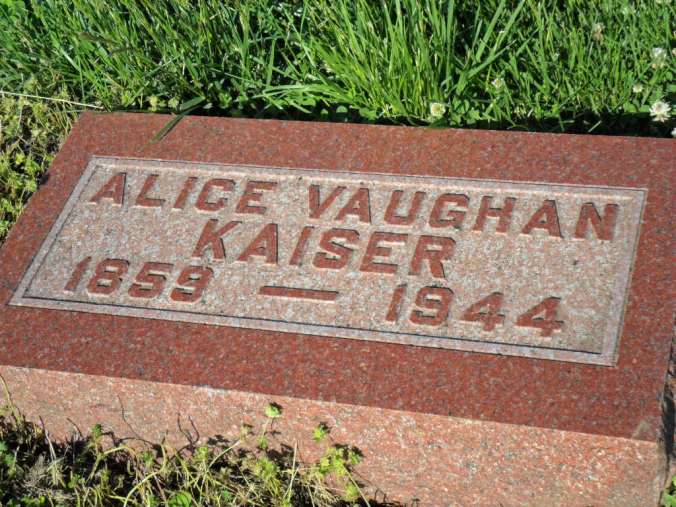
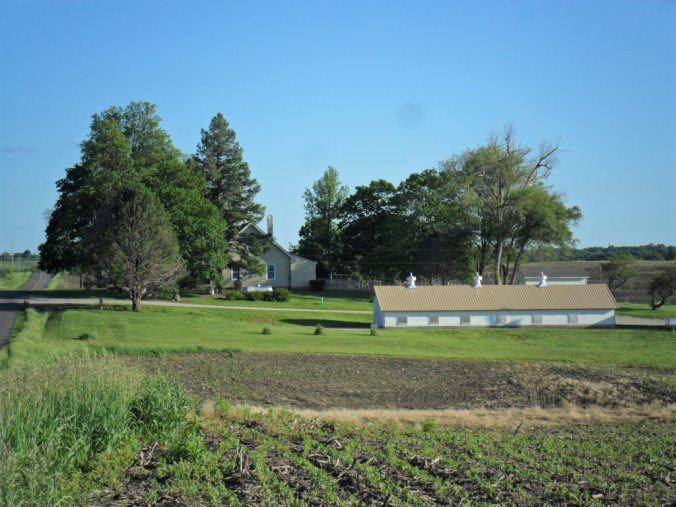
Recently I decided to try writing poems about a few family members.  Months ago on this blog I published a poem about my Grandmother along with the marriage photo of her and my grandfather, who was so much older than she  (22 years) that I never knew him at all.  In June I posted photos of the trip I took back to Missouri where I grew up.  While a few things remained the same, I felt very sad about some changes and kept thinking how my dad must feel if he were watching.  He died in 1996, lived in the same house for 80 years and on the same farm all his life.  He labored long and hard to make the homeplace beautiful.

He watches:

The house where he was born

gone

Only the old carriage house stands.

The young man who farms the land cannot bear to tear it down.

He watches:

The ancient burr oaks and black walnuts

gone

bulldozed into waste piles or sold for greed.

He watches:

The house he lived and loved in for eighty years

still stands on land his family owned for more than 100.

Strangers live there:

He sees the well trimmed lawn,

new picket fence,

children playing.

He watches:

The pond he proudly built and stocked with fish reflects the summer sun.

The tree filled park between the pond and house

gone

He wonders why someone would destroy such beauty.

He watches:

The walnut grove where he ran cattle

gone

The pond where his grandson caught the giant turtle

gone

plowed over and planted to corn and soybeans.

He watches.

SAM_1165

Blackwater Draw-Part Two


The ancients hunted here at the shores of a lake

nearly 12,000 years ago.  In 1929, an amateur

archeologist discovered an ancient spear

point lodged in bone.  I walk the mile long trail

down into the depths.   Caliche, gravel,

larger rocks strewn by millennia.  For

thousands of years Clovis, Folsom, and Portales

Man left remnants of their hunting life.

The scattered cottonwoods whisper in the wind,

timeless voices call me, beckoning.

Who were these people?

What did they look like?

Where did they come from?

In whose gods and goddesses did they believe?

Doubtless hunger drove them to this place of water

and plenty.  Columbia Mammoths, giant sloths, dire wolves,

saber toothed cats  gathered here for thousands of years.

The diggers found an obsidian spear head with a

bison whose horns spanned seven feet and

mammoths twice the size of elephants.

Saber toothed cats competed with these

ancient ancestors at this place, all driven by

hunger, thirst, and instinct.  I wonder how

these people overcame danger, fear?

I walk the mile long path, stand in the shade

of these cottonwood trees , read the signs that

tell me what diggers found at specific spots along the trail.

The cottonwoods whisper to me.  They

tell me ancient tales of hunger, strife, fear,

beauty, love, endurance.  I hear the ancient voices

calling.  They tell me ancient tales of woe, war,

weaponry, courage, and community.  My

skin tingles strangely in the summer heat.  Now

this land is dry, a desert, the water that sustained

teeming life evaporated in the crystalline air.

Twelve thousand years from now who will stand here?

Will this place exist?  Will someone wonder the meaning

of our bones, who we were, what we believed?