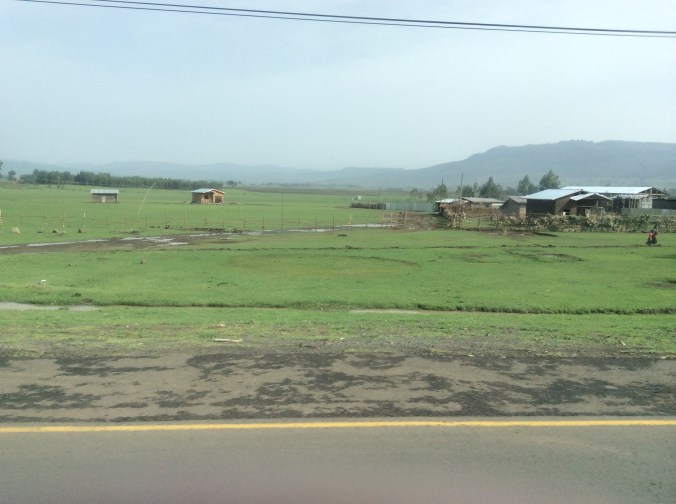
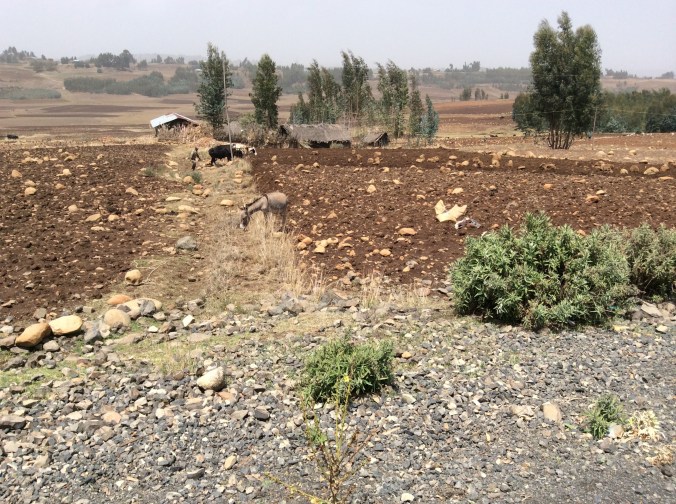
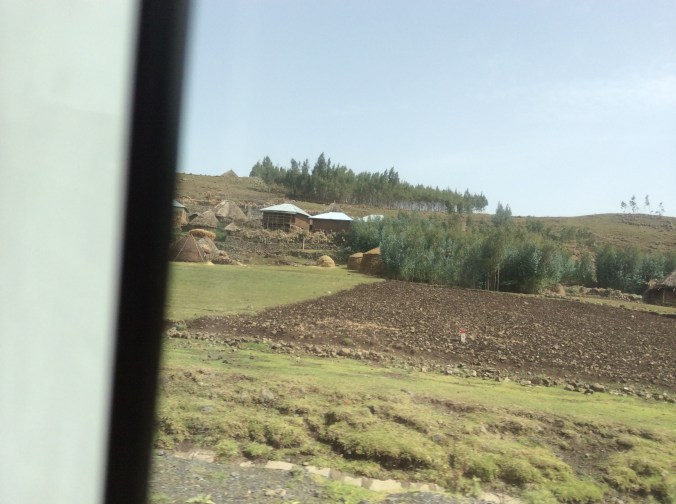
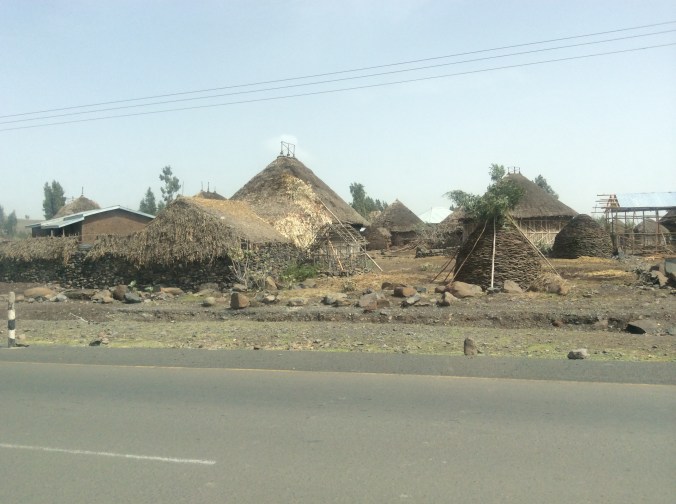
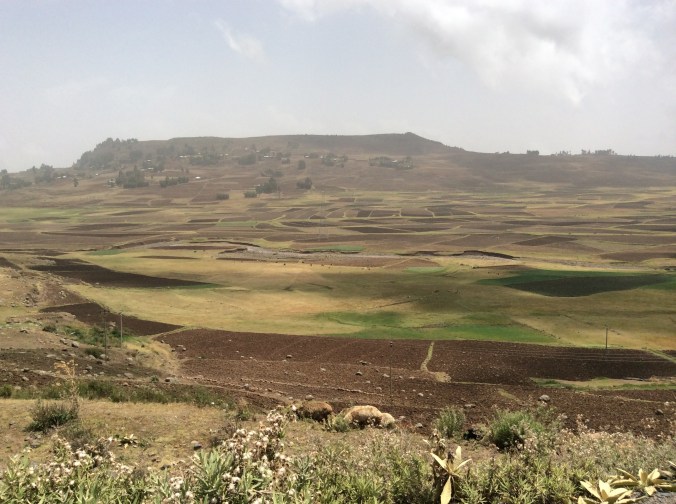
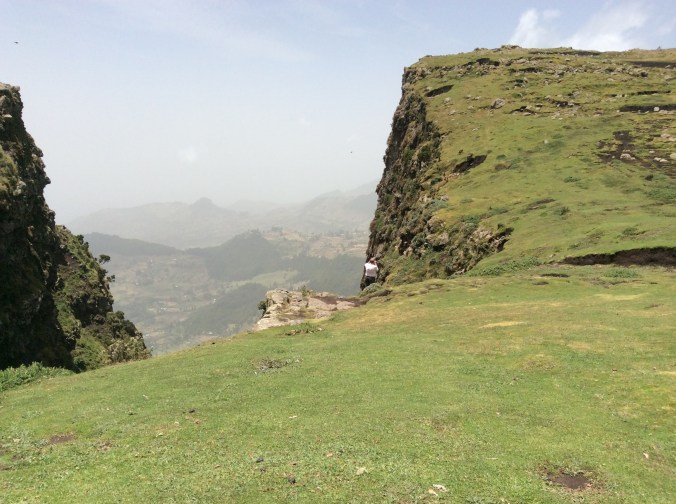
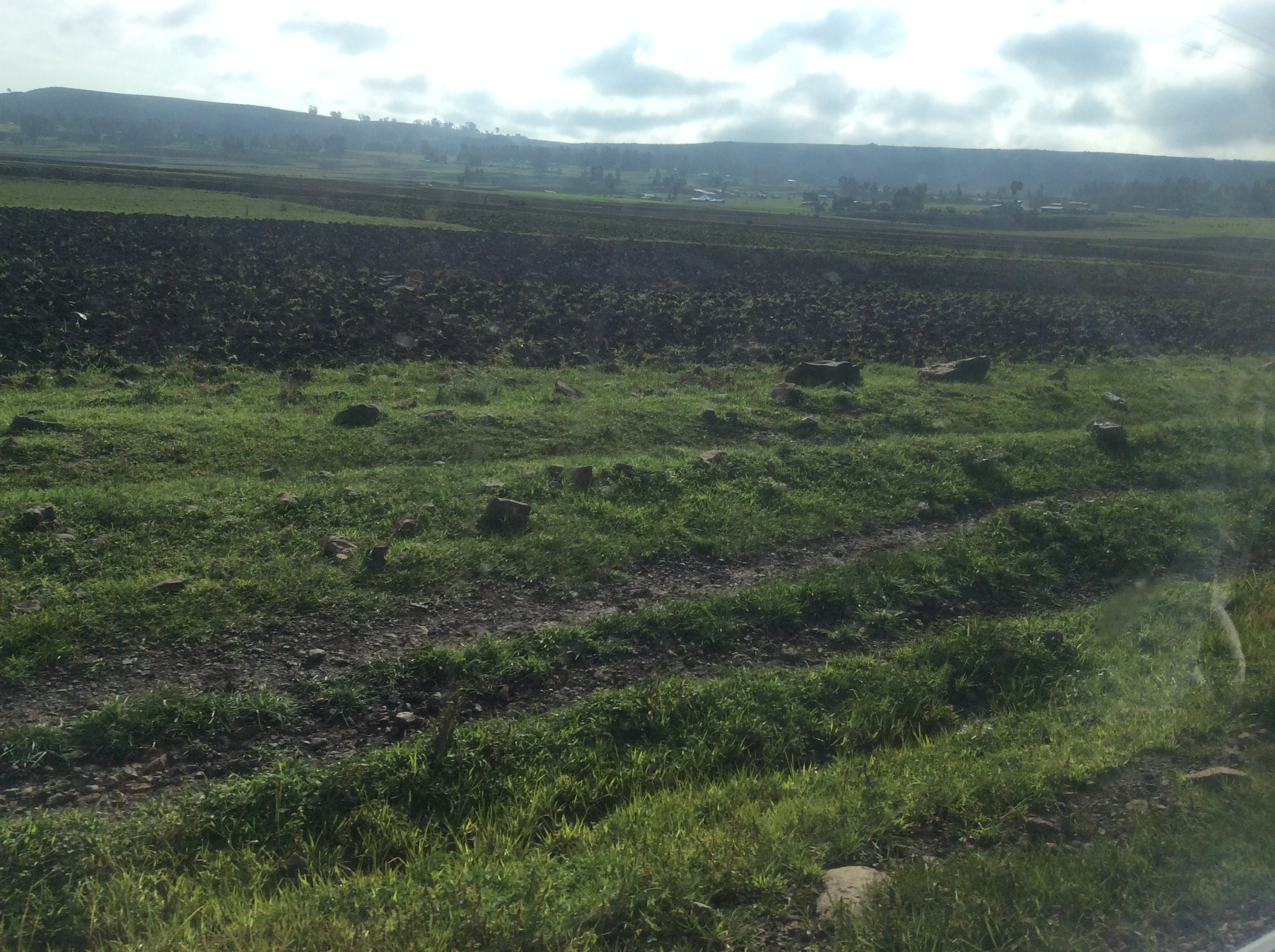
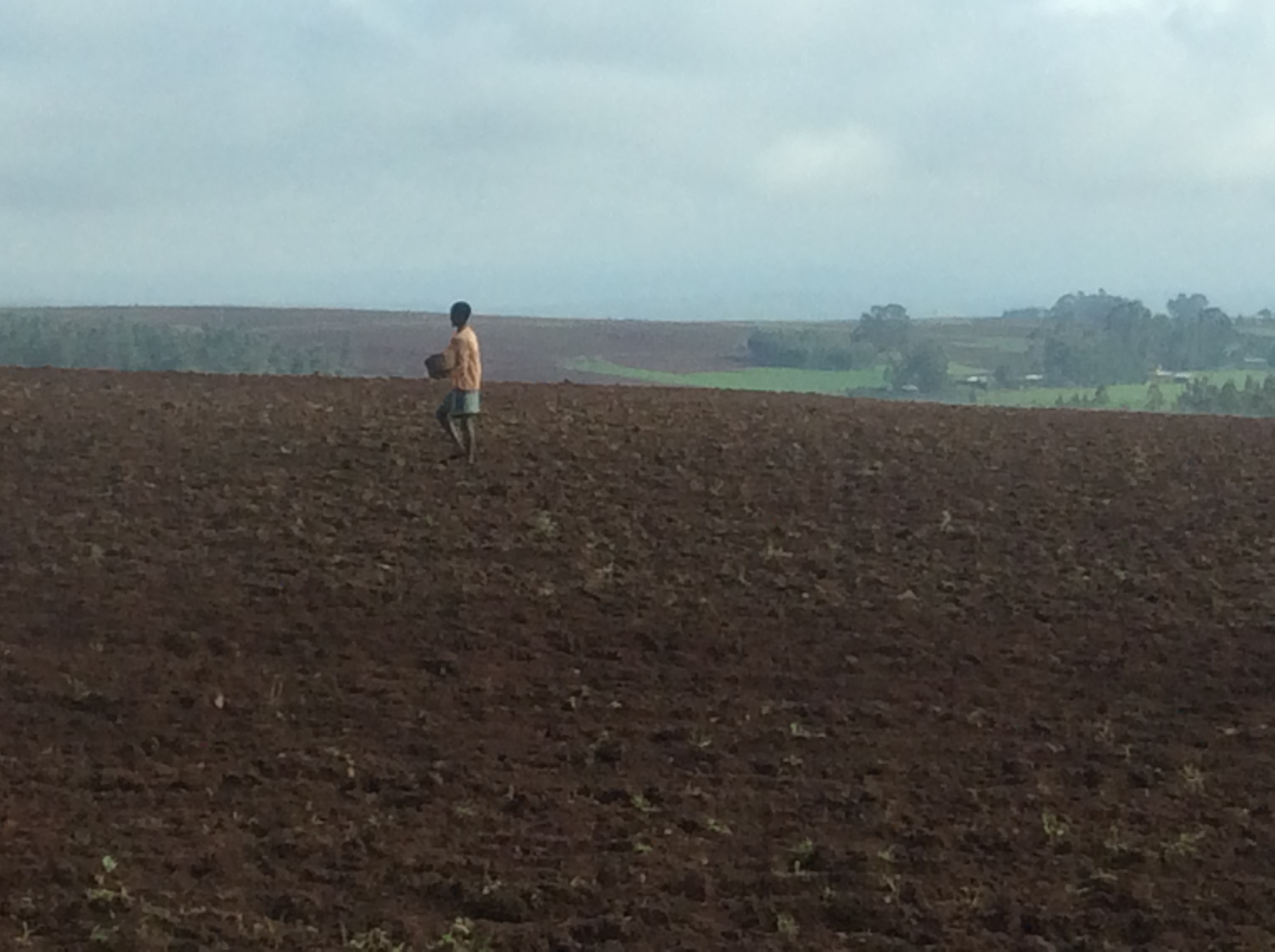
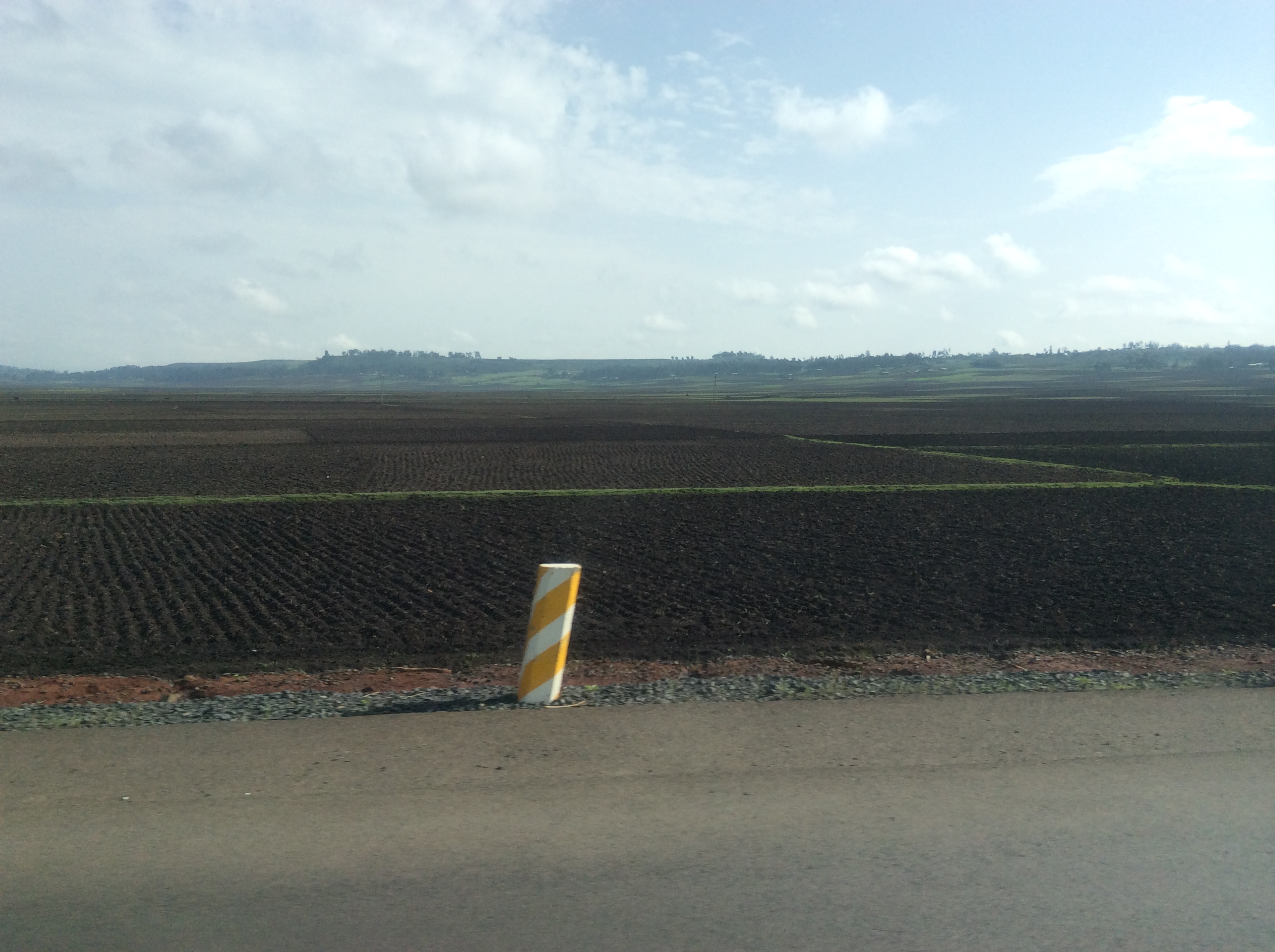
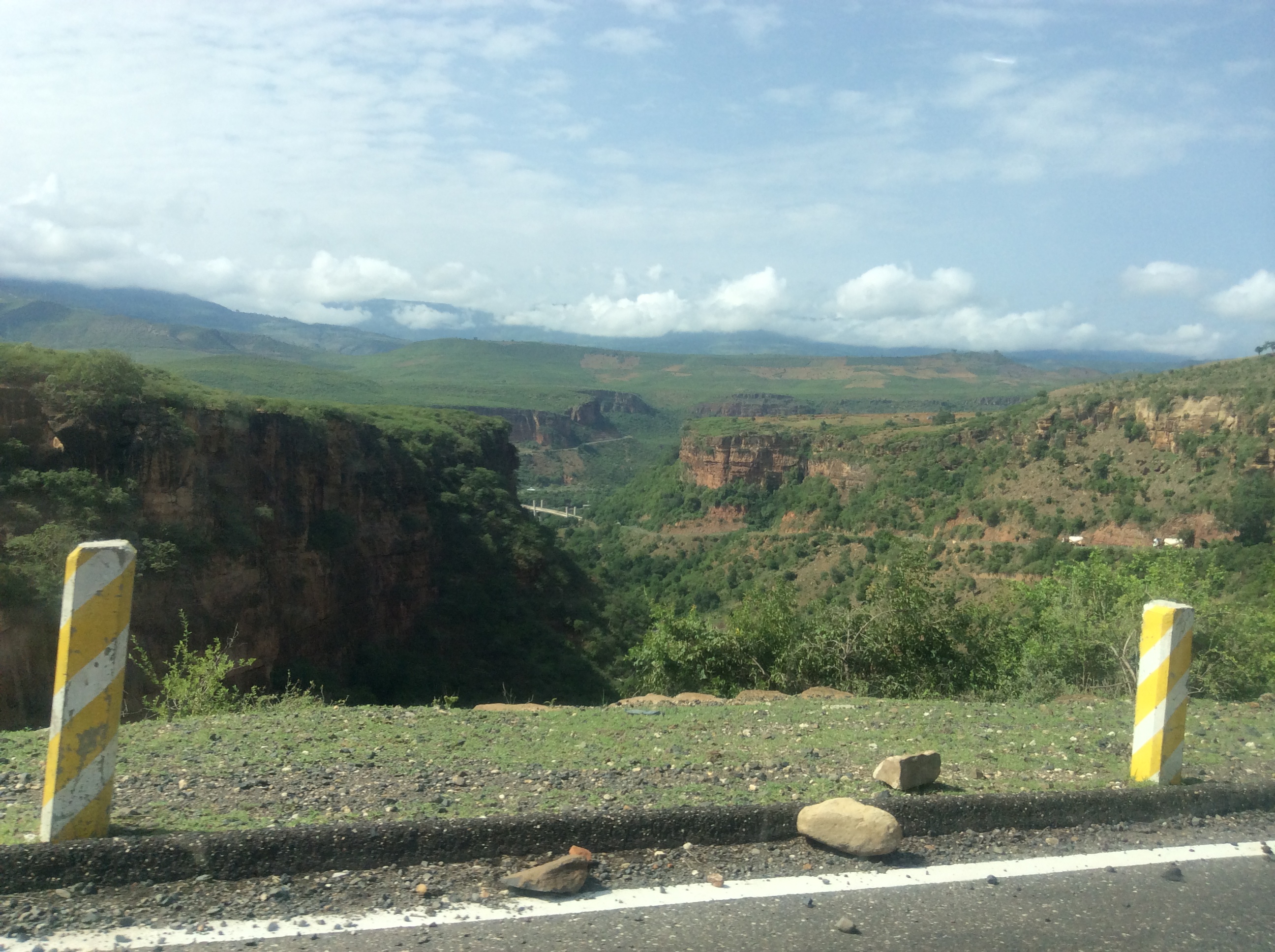
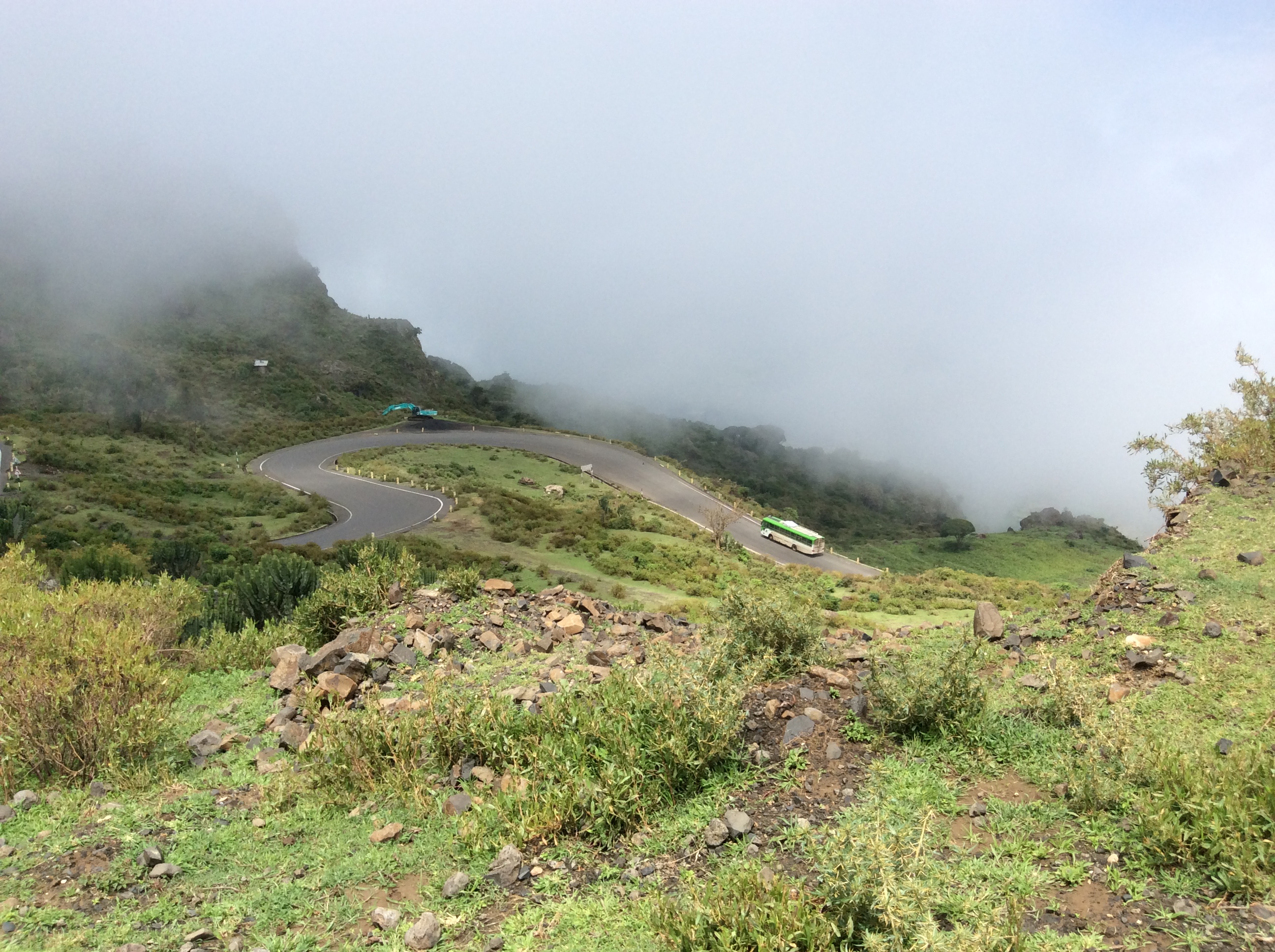
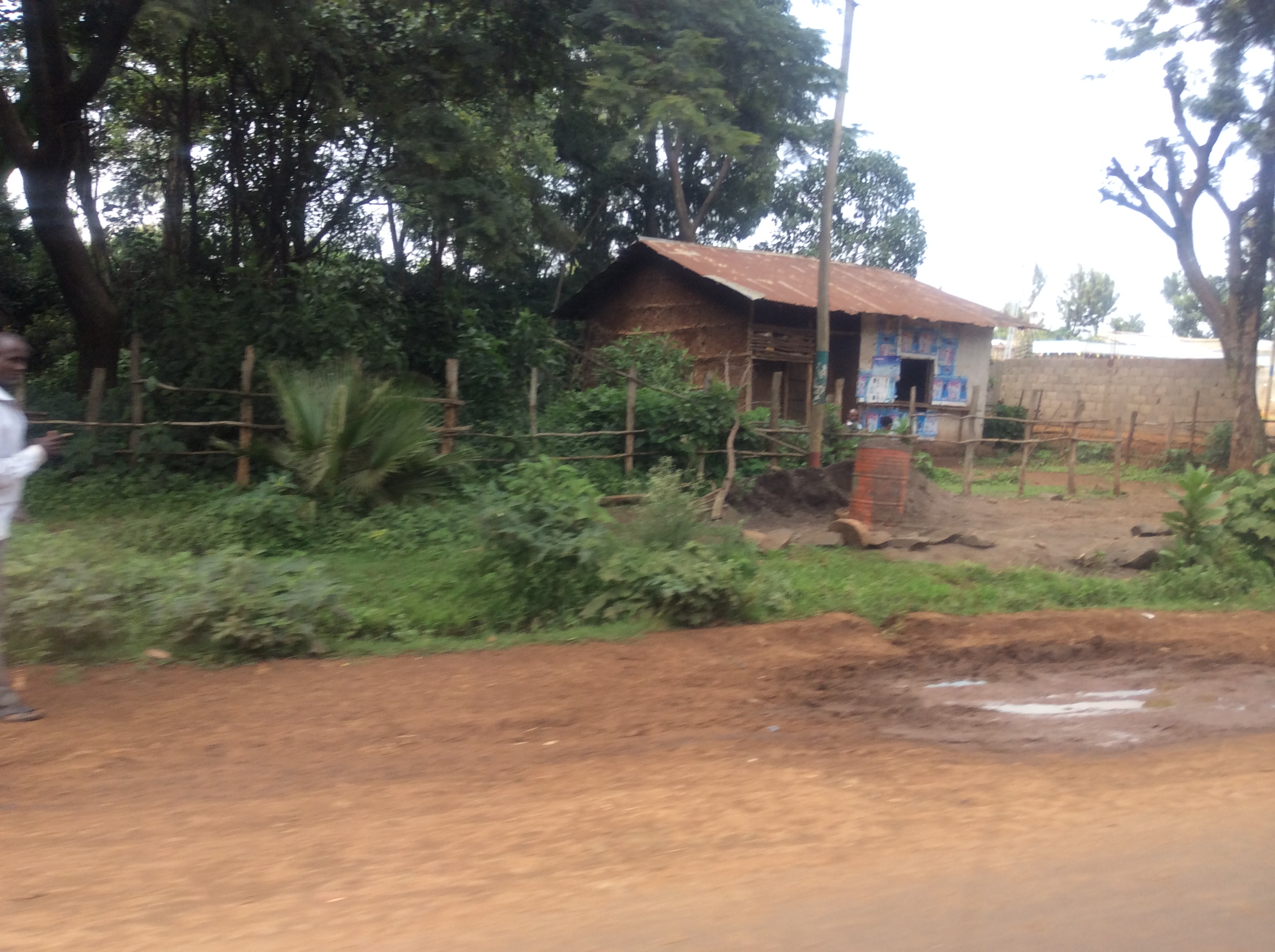
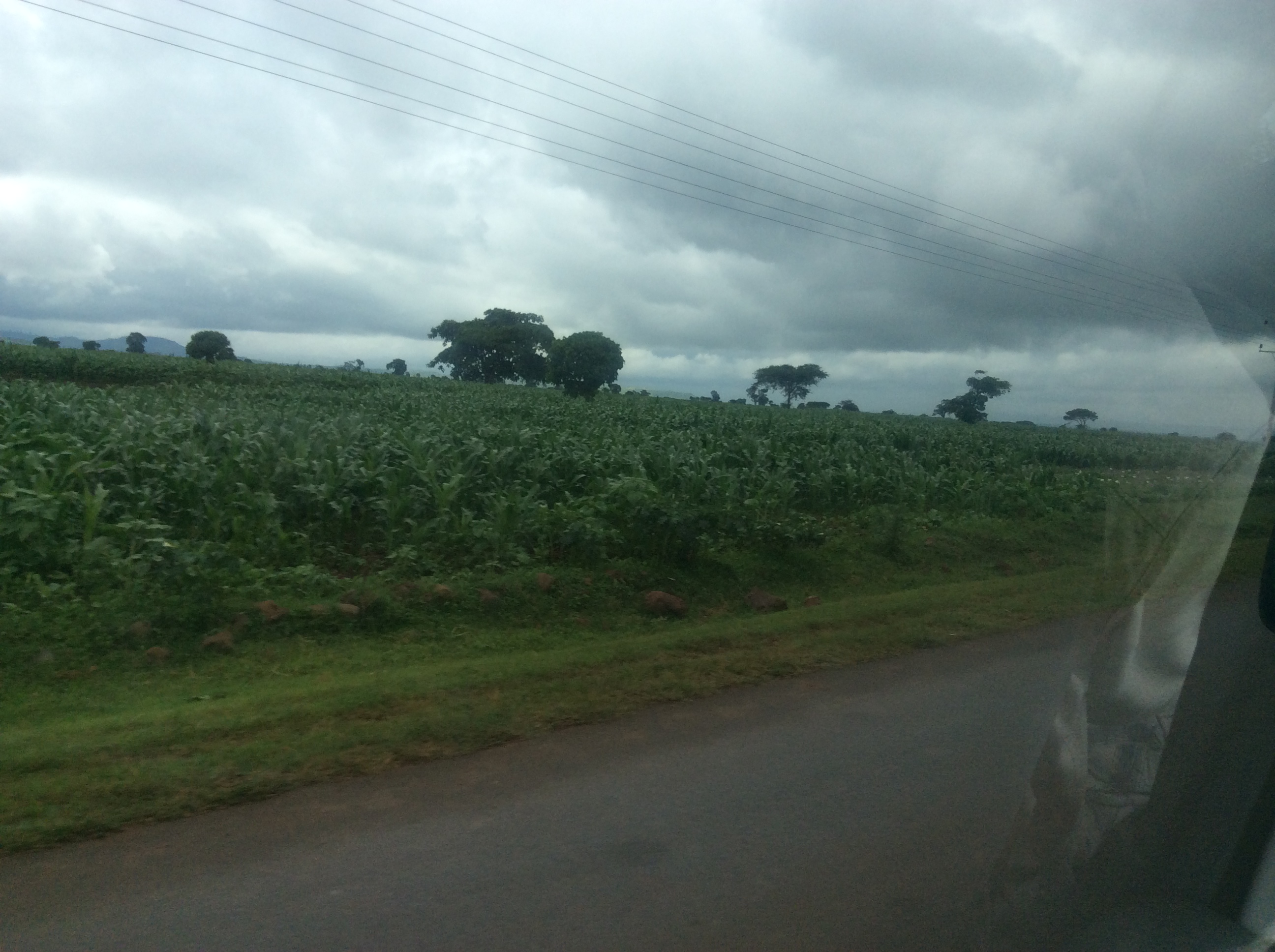
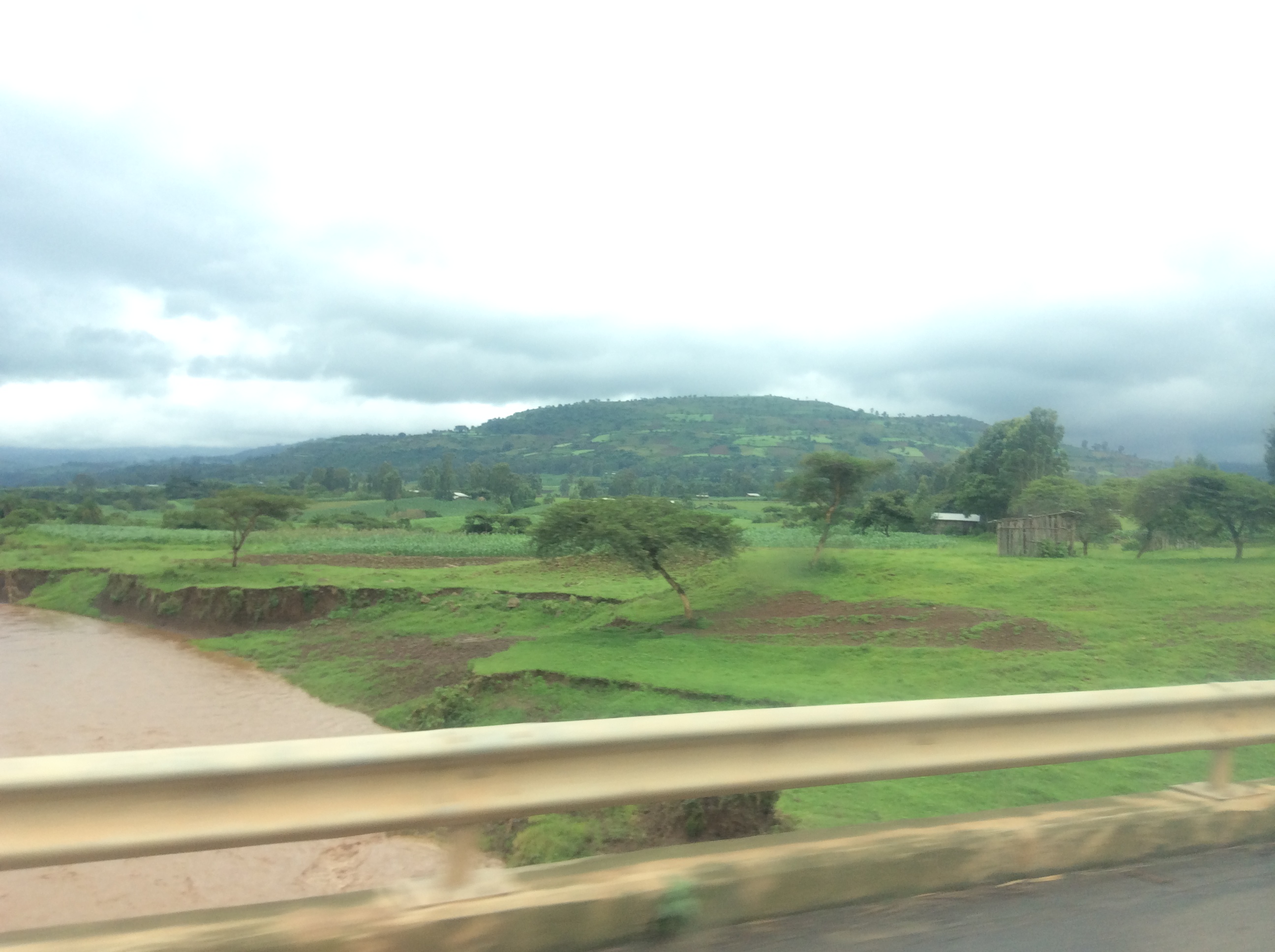
This illustrates how it is possible to farm profitably and sustain the environment including wildlife.
agriculture
Ethiopian Journey–Ancient Churches of Lalibela
In the 12th century the king of Ethiopia decided to build a New Jerusalem. Eleven churches were carved out of solid rock on the mountain top in the village of Lalibela. A UNESCO World Heritage site, these churches remain intact and in use.

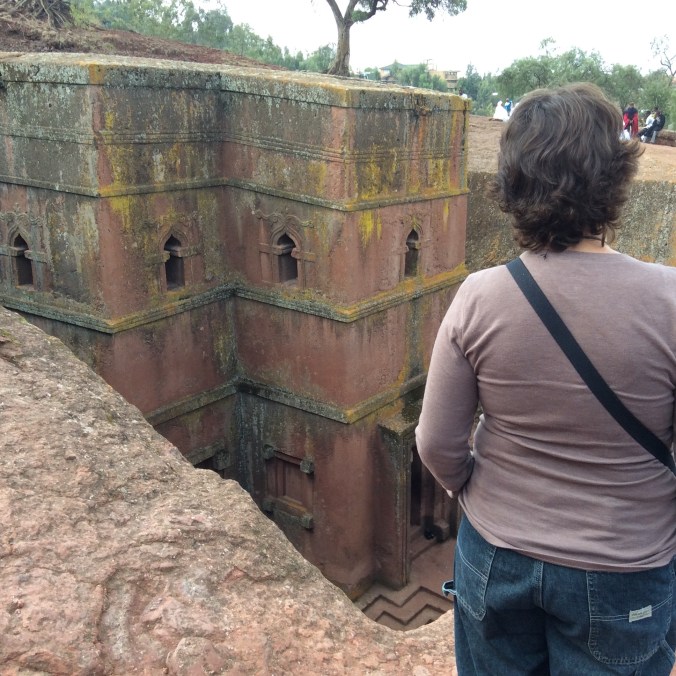
They were all carved from the rock top of the mountain down into the earth so that they remain invisible unless the person is only a few feet away. This protected them from the vision of potential invaders, usually Muslims from what is now Sudan. The above is probably the most photographed of these churches and stands separate from the others.

My friend is standing near where the stairs lead down to the bottom where visitors and worshippers can enter the church. Visiting all these churches in one day is not an activity for the faint of heart or for one terrified of heights.

This is the first church we visited. It still mystifies many as to how such incredibly intricate structures could me carved by hand out of solid stone. Even these columns are carved out of the rock. The “official” Ethiopian Orthodox Christian story relates how angels helped the builders.

This and most of the other churches are connected by “waterways” where in the rainy season a sophisticated system of drainage keeps all of them from flooding and makes it possible for visitors and worshippers to walk along from church to church.

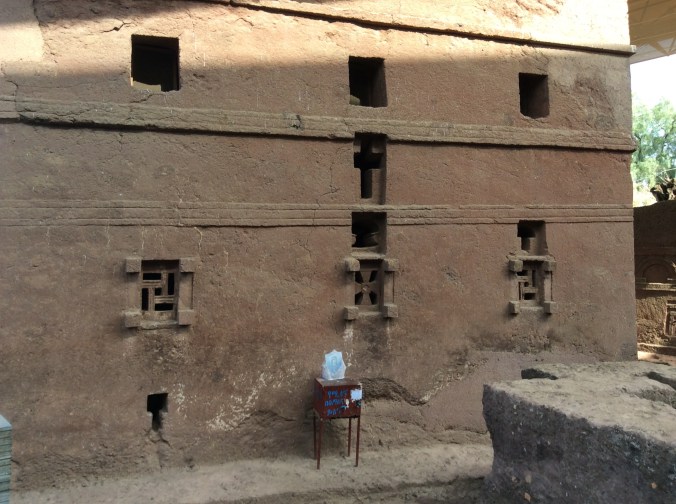
Everything in the Christian churches in Ethiopia symbolizes something related back to Jerusalem and the Bible. Even though the guide explained it all in detail, keeping up with all the symbolism proved a daunting task. Notice the swastikas. They are ancient symbols of the eternal circle of life and death. Hitler turned them backwards and into a totally different meaning. There are also many different styles of crosses there, two of which can be seen in the windows of this church.

This is a fertility pool. In the past a priest got in the water–it is very deep–with a woman who could not conceive and bless her in the water. At one point when it began to fill too much, they cleaned out the bottom and found many treasures buried there, apparently dumped into the pool to protect them from enemy invaders.

The inside of the churches are intricately carved and sometimes painted.

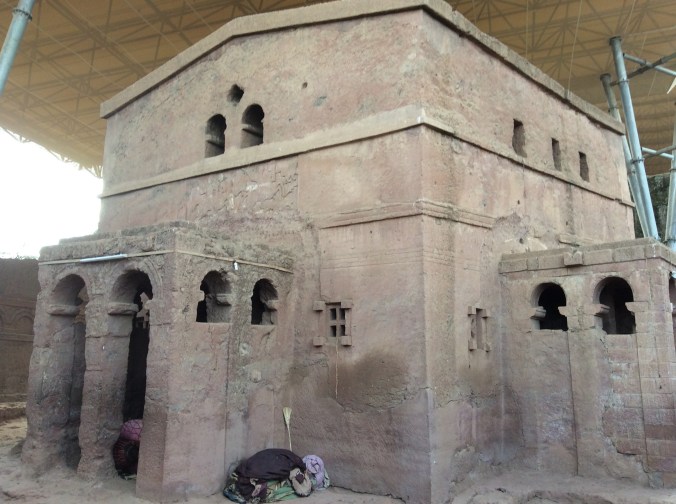
Two types of basalt exist on this mountain, soft and hard. Churches carved out of the soft basalt have begun to deteriorate and as a consequence are covered. As can be seen here, people still come to these churches to pray and attend services.

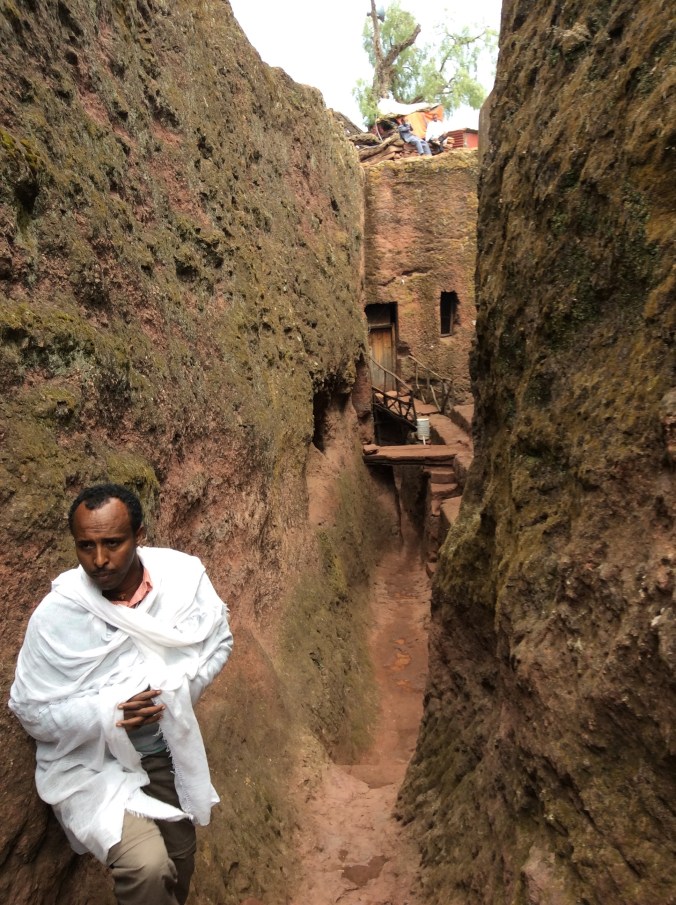
Our guide lead us from church to church through these narrow passageways which are, as previously mentioned, used to drain water away from them in the rainy season. If Ethiopia had a national color, it would be white. It is not only worn to go to church and for religious purposes but in daily life as well. It mystifies me as to how they keep whites so very white.

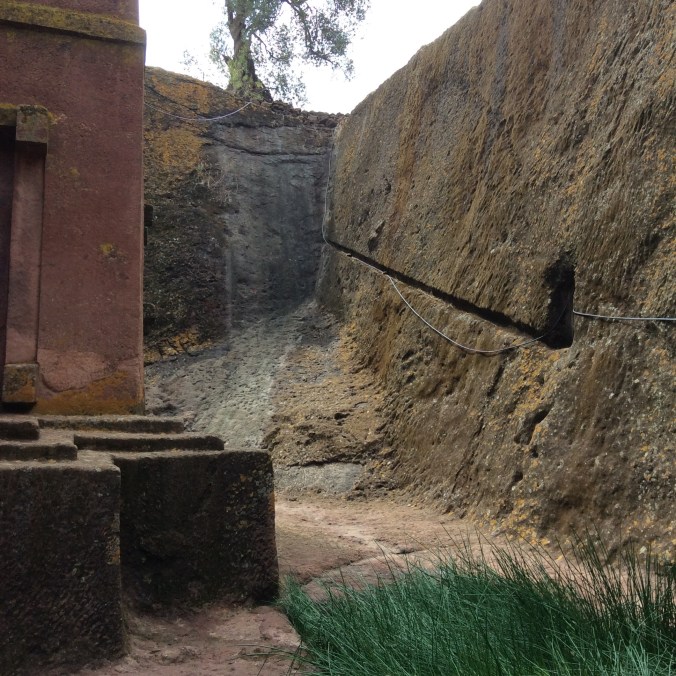
The slit dug in the rock is part of the system of drainage. The grass in the foreground grows out of a pool of holy water. While we were there, a boy filled a plastic bottle with the water and left.

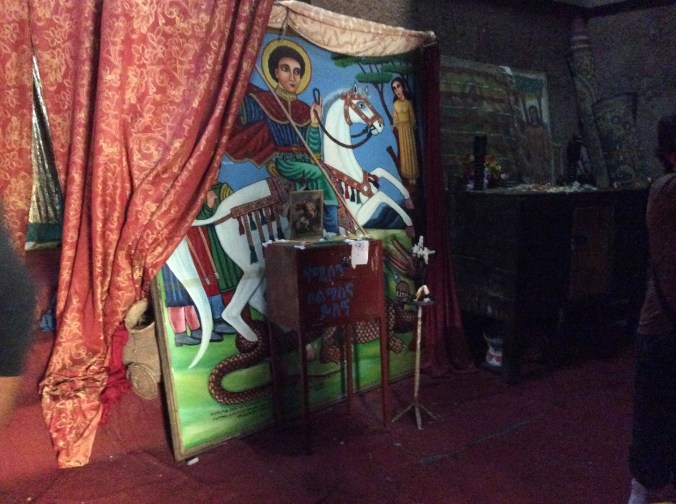
St. George and the dragon are everywhere, not only in churches but also on beer. He is the patron saint of the country, symbolizing the triumph of Christianity over paganism as symbolized by the dragon.

The carving in many of the churches reveal a sophisticated knowledge of how to work in stone. It is difficult to believe that this was carved by hand downward into solid basalt centuries ago.

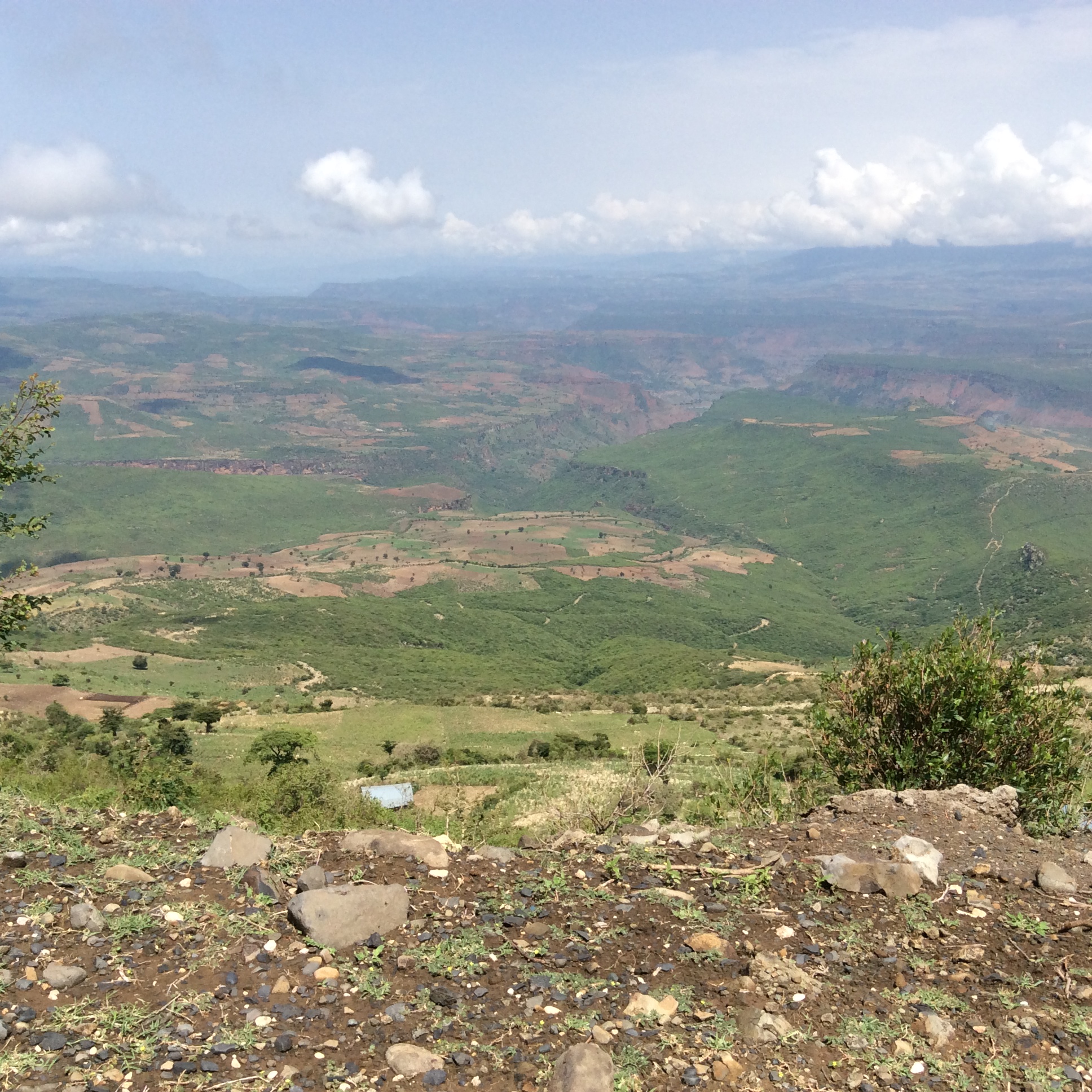
The road to Lalibela is rather daunting, climbing higher and higher with no guard rails, nothing. As you can see from this photo, patchwork quilt fields cover even the mountainsides.
To learn more about Lalibela, see detailed information and explanations of their River Jordan and other religious symbolism, go to my blog posts from August 2014.
Ethiopian Journey–From Addis Ababa to Debre Birhan
Addis is the second highest capital in the world. Only La Paz, Bolivia, is higher. To a large extent, altitude determines climate in Ethiopia. Addis and the surrounding area, much of which is high altitude farmland, receives a lot of rain this time of year and looks totally unlike what a lot of people think of when they hear the word Ethiopia–not desert but rather miles and miles of green.


We had not driven far from Addis when we crossed a river, an area of which is considered healing. Many people had come for priests to bless them and to experience the healing power of the water.

I saw only three tractors in ten days of criss crossing farmland. Why so few? One reason is rocks. Many of the fields remain rather full of rocks in spite of many having been removed.

Therefore, they farm the “old fashioned” way; horses or cattle pulling plows with a human behind.

Houses in the villages in the farming areas demonstrate old ways alongside new.


Winnowing the way we did in the USA a century ago.


Much of the farmland is a picturesque patchwork quilt of browns and greens.

Before dropping down to lower country, we drove by Menelik’s Window. The drop off here is steep and far. I did not go near it–I had not yet become used to the endless drop-offs or even realized that I would need to do so. This is one of four places in Ethiopian where you can see gelada baboons. They are extinct elsewhere. Menelik was an Ethiopian emperor. This “window” allows one to look from the high country for miles and miles to the landscape beyond.

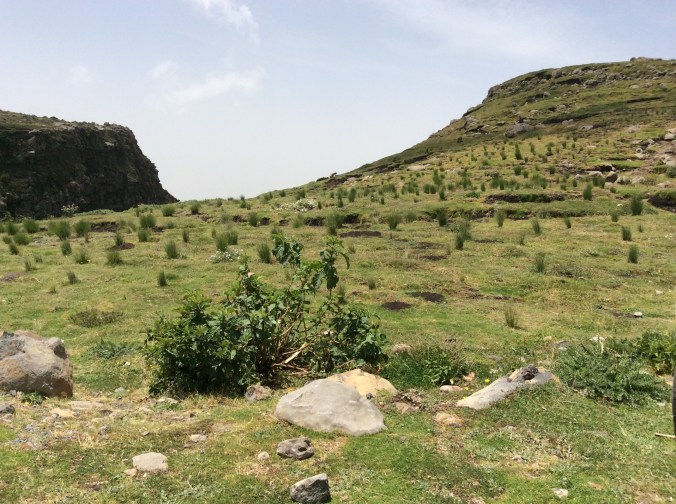
The large tufts of grass provide food for the gelada which are grass eating herbivores, the last of the grass eating primates. All others are extinct. This same grass is used by the locals for roofing material so boys stay in these areas all day chasing off the baboons.

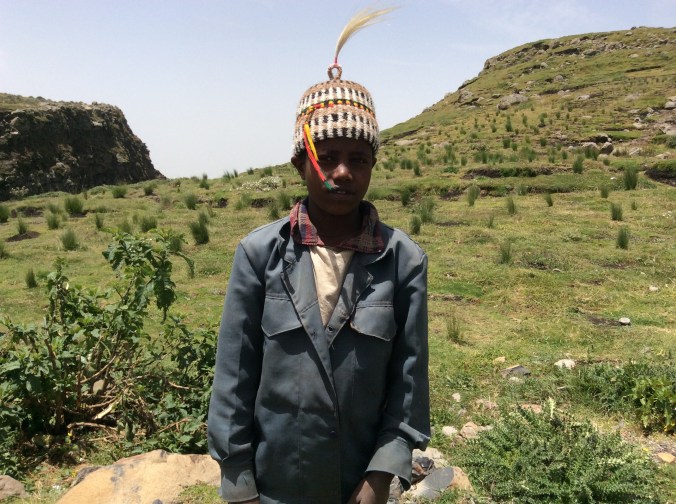
To keep themselves busy they weave woolen baskets and hats to sell which they display in the grass.

This ten year old boy happily donned the hat he had made. I bought it for my grandson who was the same age when I took the trip.

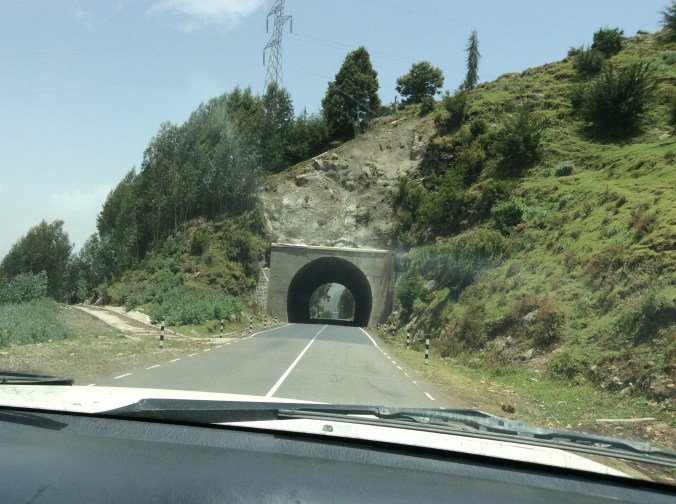
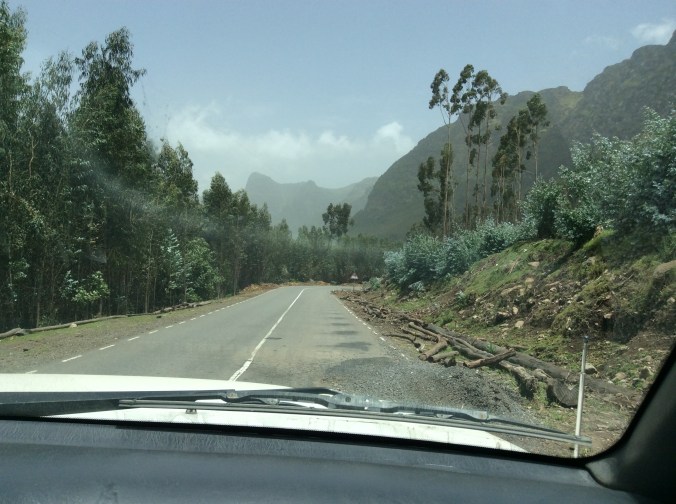
Except for the different vegetation, driving down the mountain looked a lot like driving through Colorado.


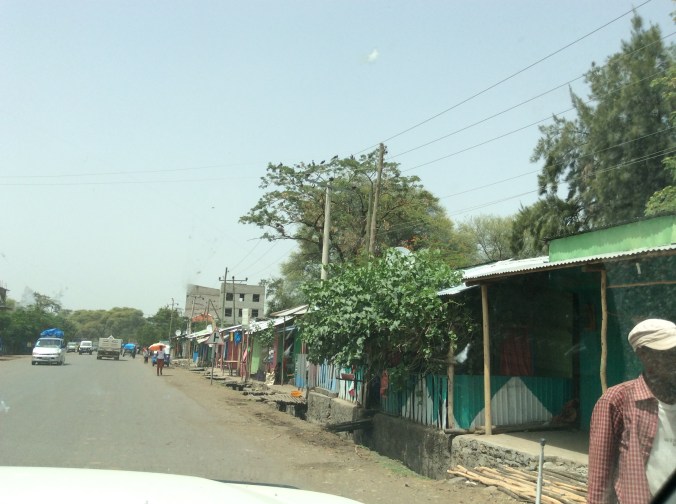
Down from the mountain the landscape appears quite different and considerably drier. We drove through several smaller towns on our way to Debre Birhan where we stayed the first night.

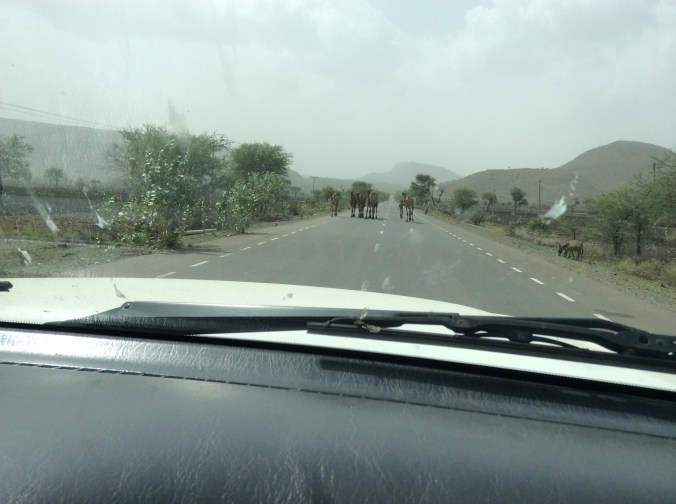
Driving in Ethiopia requires navigating around animals. Everyone drives their cattle, camels, horses, all livestock down the road whenever possible. The roads are generally very good. Many, built by the Italians, have stood the test of decades.

Along the road we saw many of these “apples”. My friend told us how they played with them as a child. However, the adults all warned the children not to touch their eyes when they did–it will make you blind. They are called Apples of Sodom–so many things in Ethiopia have symbolic meaning.

These fruit could be seen all along the road and even on the road. After driving through this drier area we rose above a huge valley with miles and miles of grass.

A semi-nomadic group brings their immense herds of cattle here in the rainy season to graze. When we drove further on above the valley, I saw the first tractor working a field as big as this grazing land.
Ranch Bones
w

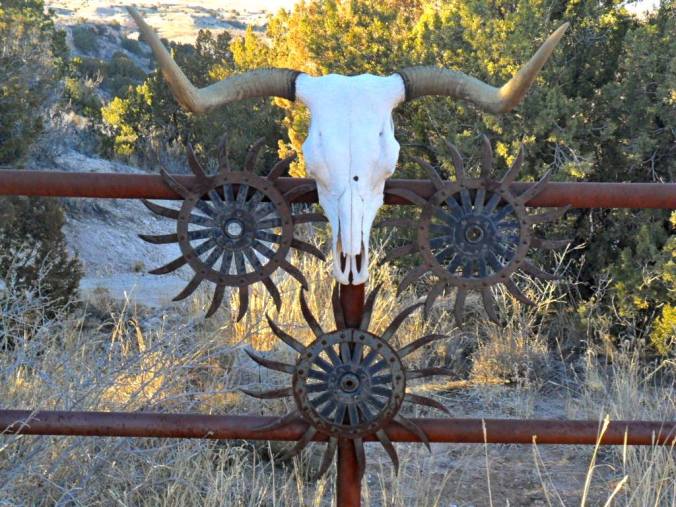
Years of bones piled up. Cattle–calves, yearlings, the old–heaped 100 yards
northeast of the ranch house, upwind from the summer, southwest prevailing
winds. Mostly black baldies, a few Charolais. Old bones bleached white,
disintegrated. Some new bloated bodies rotting, nauseating. Others just sundried
hide stretched over skeletons. Drug here by tractor, the dead. Shipping fever, parasites,
drought, extreme weather.
A ranch’s history written in bones.
Costa Rica Adventure, Day Five–Part Two: Santa Anita Rainforest Ranch
After visiting the Tony’s gallery, we headed north on mostly non-paved, narrow roads. The clouds increased; the landscape became greener if that is possible. We crossed to the Caribbean side near the Nicaraguan border.


The previous photos were taken from the bus window on the way to La Anita which is located more or less just above where the a is located in the word Cordillera at the top of the map. It lies near Rincon de la Vieja National Park (Volcano Vieja) past Volcano Miravalles–the volcano covered in clouds in the previous Costa Rica post.

As soon as we arrived, we came to the veranda of the building where they process cacao. This view overlooks the road in and a small pond.

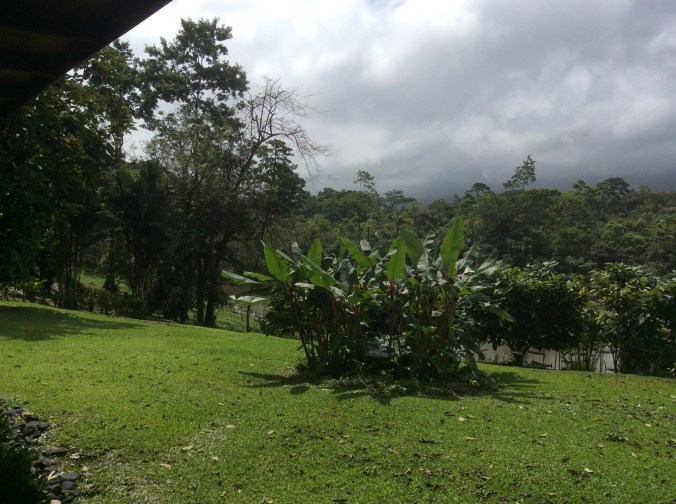
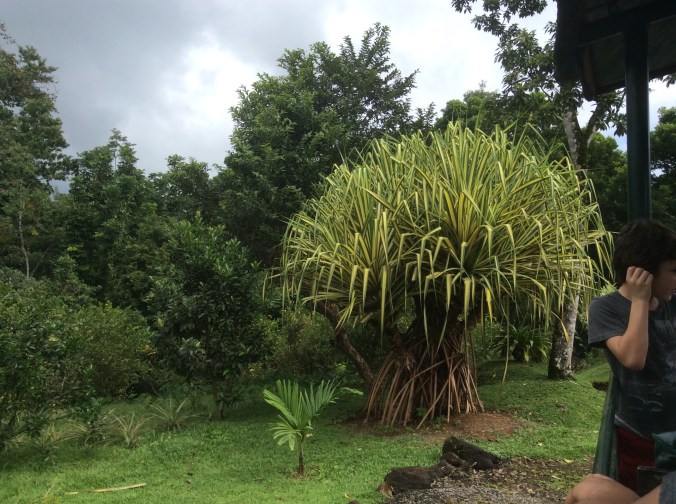
Ginger plants in front of the pond, bouquets of ginger flowers, and rain clouds greeted us.

I had no idea that the ginger roots we eat come from plants that look like this. We later ate lunch in the building in the distance. First, seated on picnic tables on the veranda, we drank pure chocolate grown on the ranch and coffee grown on another property at higher altitudes. Cacao requires lots of rain and tropical heat. This coffee is shade grown at much higher altitudes, e.g. 1500-2000 meters, by 700 families who belong to the cooperative which produces the coffee. The coffee from here (Finca la Anita, Costa Rican Dota Mountain Coffee) requires much less sugar even for those who love lots of sugar in their coffee.
The couple who own and run La Anita primarily grow organic cacao. Originally, they sold what they grew and did not process it there. They decided to accomplish what they wanted, to grow and sell the most sustainable quality chocolate in the world, they would have to control the entire process themselves. One of their specialties is a healthy replacement for Nutella, La Anita Chocolate Spread. We bought four little containers and carried them around the rest of the trip. Rather than spreading it on something, I keep it in the refrigerator and spoon out a tiny sco0p when I want a super treat.

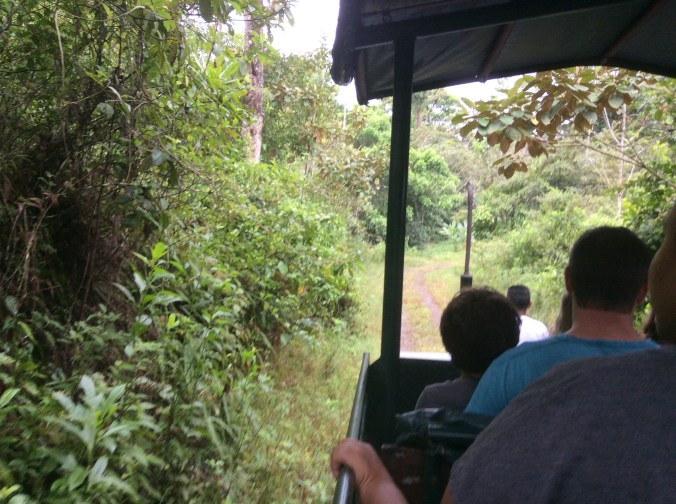
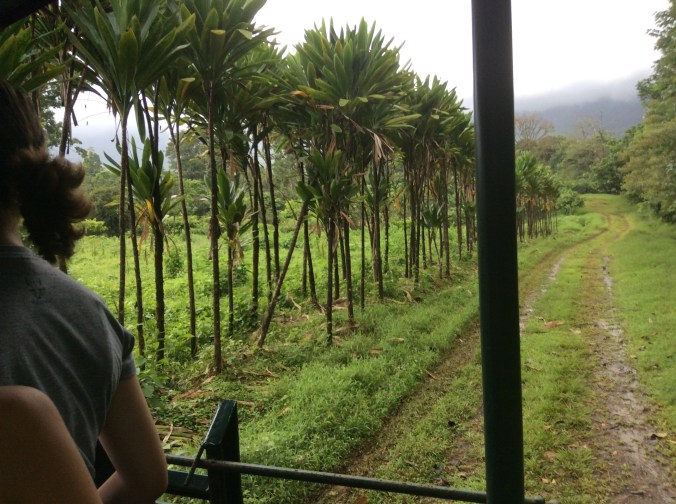
Nearly constant rain and heat produce a botanical heaven.

A tractor pulled wagon took us through the lushness to the area with the cacao trees grow.


We finally arrived where the cacao grows.

In addition to cacao, they grow other crops because cacao takes a long time to grow and the chocolate market worldwide is very unstable.

Open up cacao and you find all this fuzzy stuff inside. Yes, it is actually tasty. Like with coffee, you eat–actually mostly just suck on it–the outside. The bean is the seed inside.

If you want to walk around here, sandals are not a good idea–too many snakes, many of which are poisonous like the fer-de-lance. Yes, they live here. Like where I live, this requires looking at the ground and paying attention where you are walking. This is the owner. The name La Anita comes from his wife.

The view of the lake from the building where we ate lunch.

This is the hearts of palm plant which shortly after this photo was taken became the main ingredient of ceviche of hearts of palm which we ate for lunch.

Making ceviche of hearts of palm in the white square bowl.

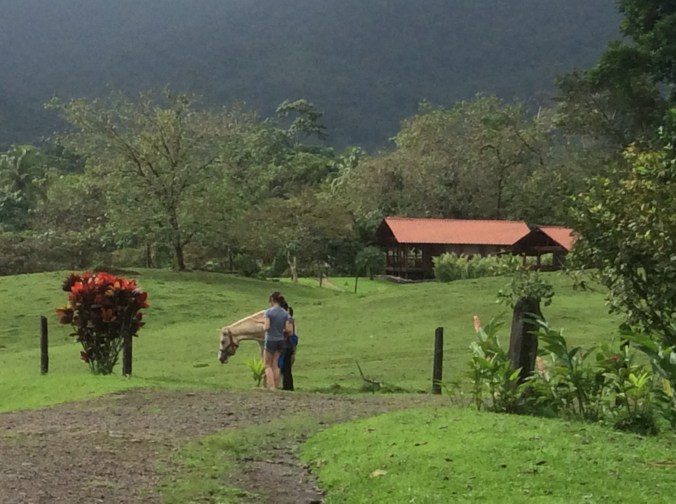
After lunch I walked down the road to the pasture with the horses. In the background are cabins they rent. From here the traveler can tour several national parks including Rincon de la Vieja National Park which is quite close.
This is one of the rainiest parts of Costa Rica, located on the northern Caribbean side. It rained several times while we were here. The rain stops for a while, a downpours arrives, it stops. This process continually repeats.
My Ethiopian Adventure: The Great Rift Valley and Awash National Park
My friend’s parents live in Nazret or Adama, depending on which Ethiopian language you speak. Nazret is the Amharic name and Adama is Oromo. After relaxing a couple of days there, we headed toward Awash National Park for a day trip. What a contrast to the previous part of our journey. Intense green and cold totally gone. What we saw here probably fits more with what most Americans picture when they hear the word Ethiopia.
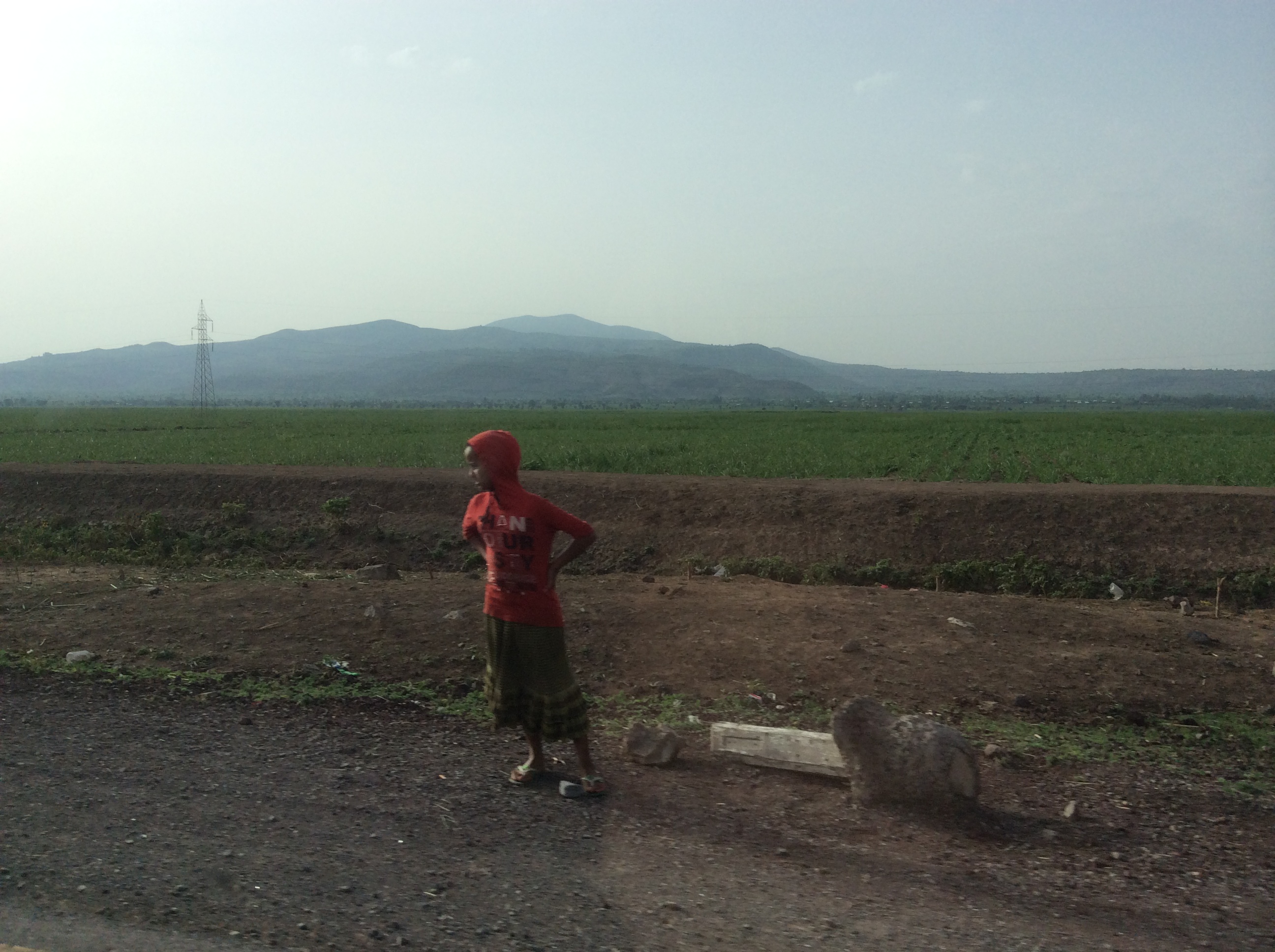
On the way out of town into the country, we passed fields of various crops including this sugar cane field.
We also saw fields cultivated for sowing teff. Since I had seen teff fields previously in the green, high mountain country, I came to the conclusion that teff successfully grows in a wide variety of climates and altitudes.
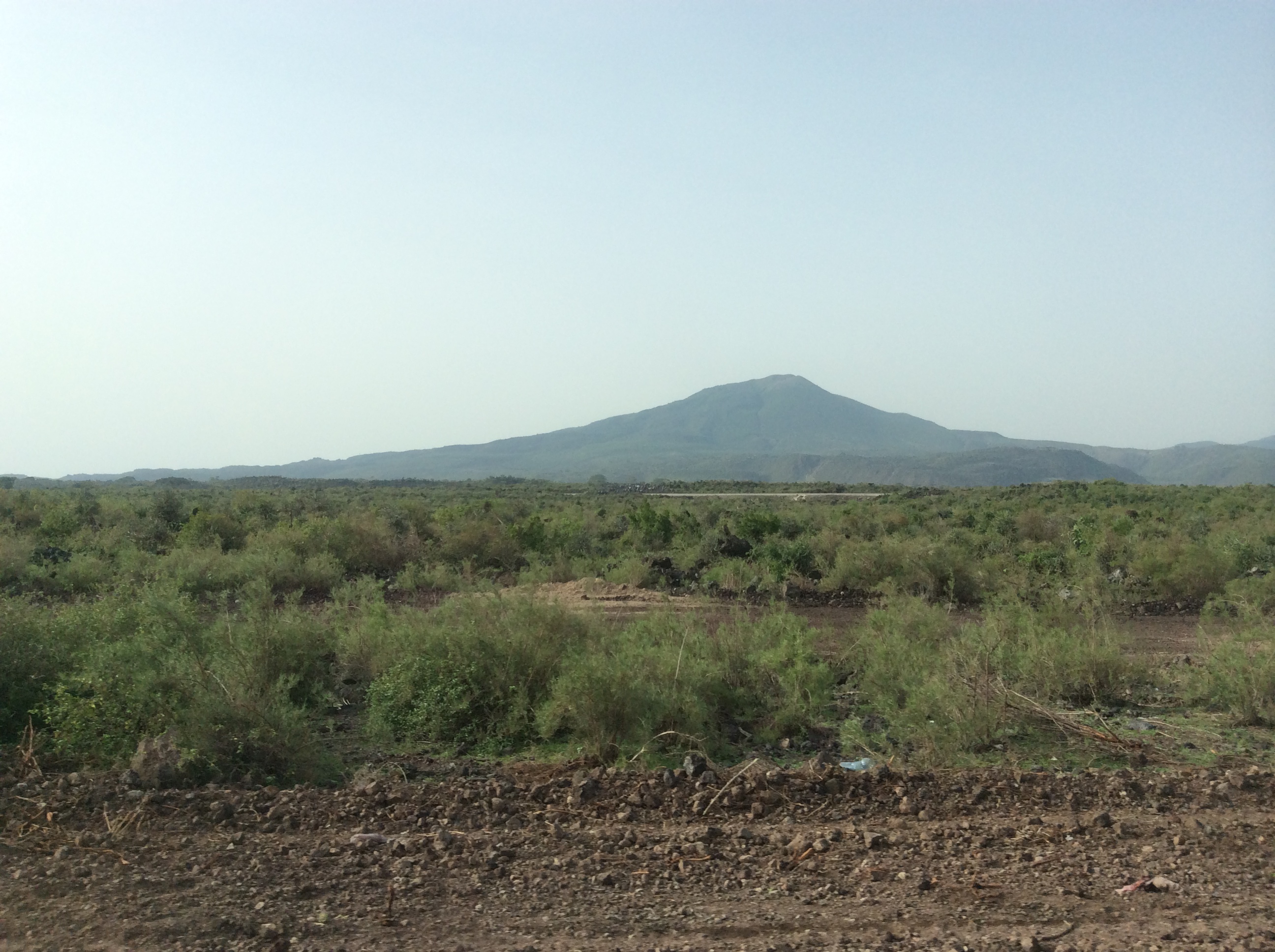
This is volcano country. Although most are extinct and have not erupted in hundreds to thousands of years, at least one in sight of the highway has erupted within recent history.
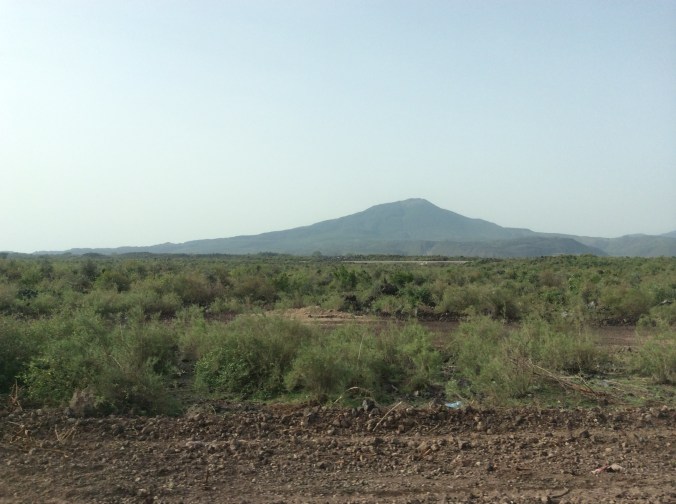
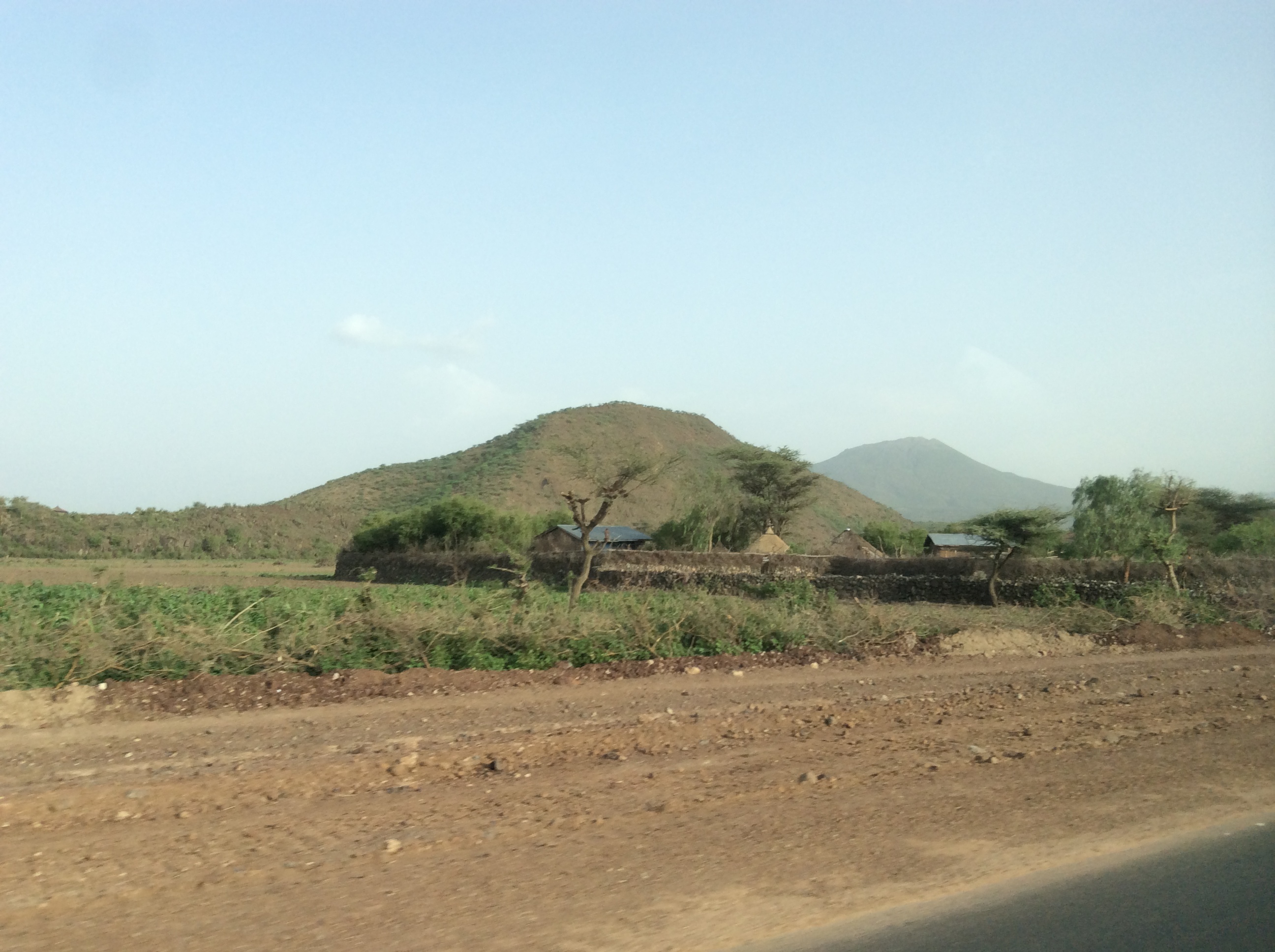
Throughout the trip we saw small villages of traditional round houses with thatched roofs, most with rock walls around them. These walls provide protection from predators such as hyenas. And then suddenly we were there, a place I so wanted to see, the Great Rift Valley, the place where the oldest totally intact hominid skeleton was found, Lucy.
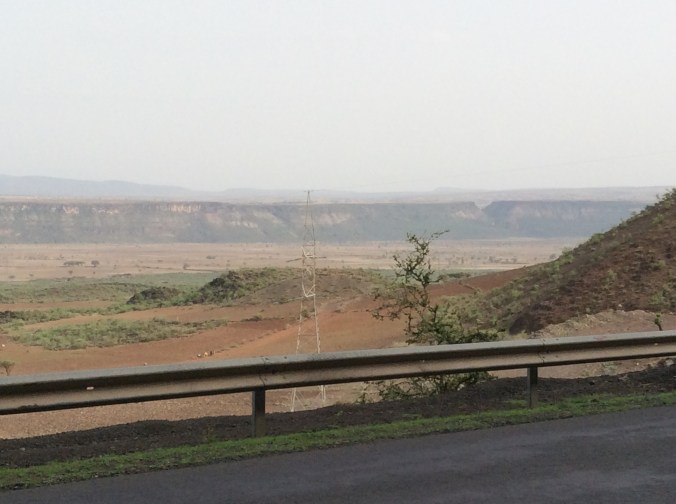
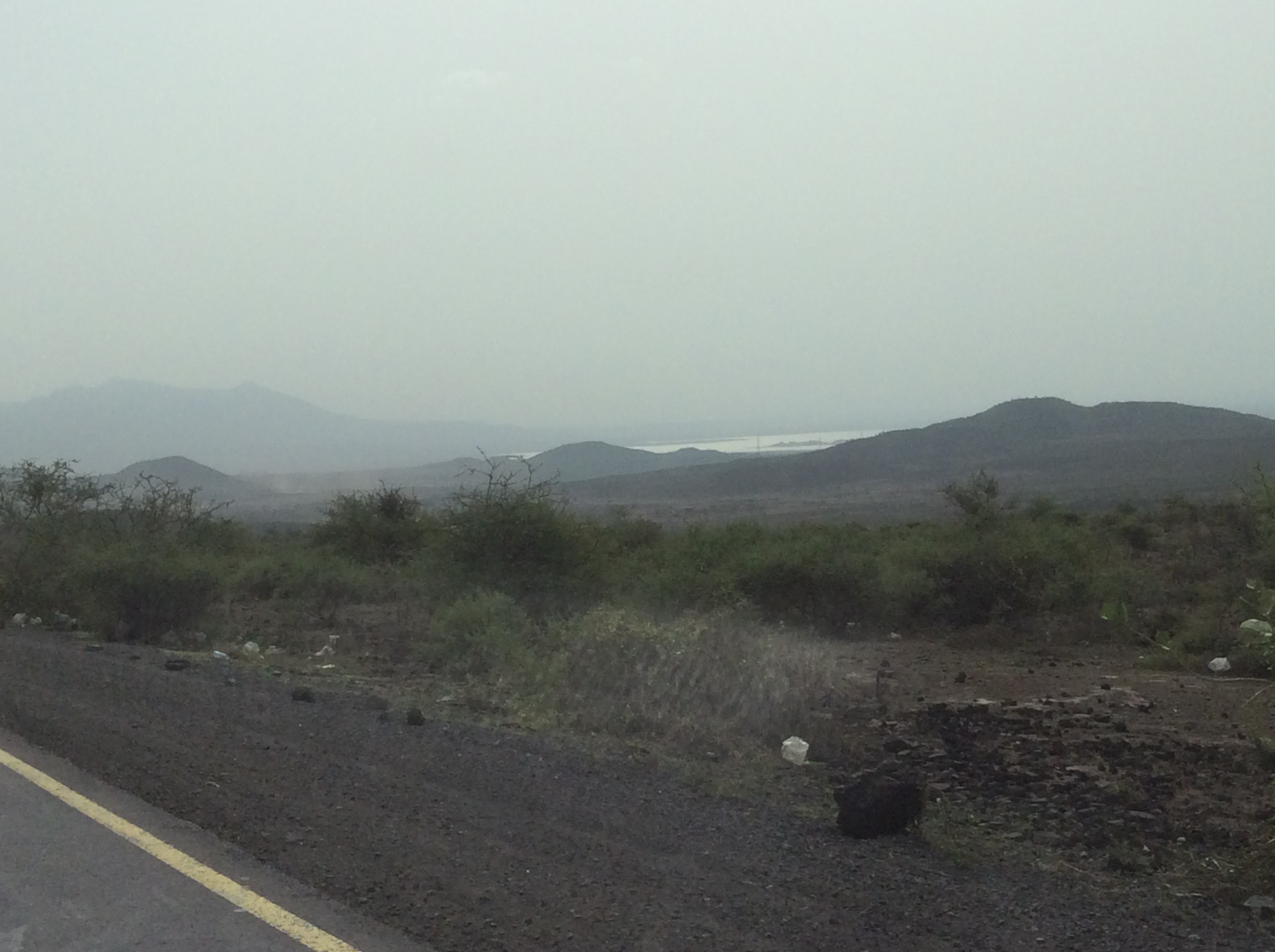
The Great Rift Valley goes for thousands of miles from farther south in Kenya up through the Red Sea and the Gulf of Aden. I was very surprised to discover they grow grapes here in Ethiopia and produce wine. We decided to try it; the merlot was good. A series of unique lakes lay in the valley. I would like to go back and visit all of them. Some are filled with so many chemicals, you cannot drink the water and no fish live there. An example is Metehara Lake. The fish are delicious, but the water cannot be safely drunk. The most amazing thing about this lake is that it grows approximately four inches annually. In the last few years, the road had to be relocated because of it.
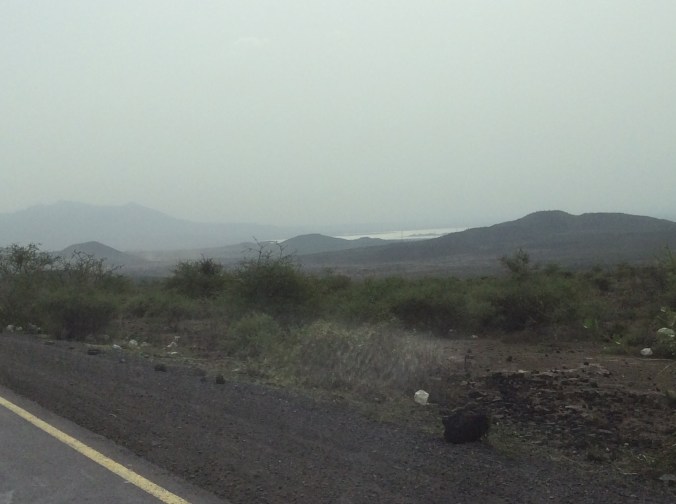
First glimpse of the lake. Then we had a flat tire which delayed the trip a few hours because not only did Dino and his dad have to change the tire, but we had to stop in the town of Metehara to buy a new spare which entailed bargaining and more bargaining. Dino’s mom hiked down the road to get rocks to keep the vehicle from rolling. If I had realized what she was doing, I would have done it myself. She is in her 70s.
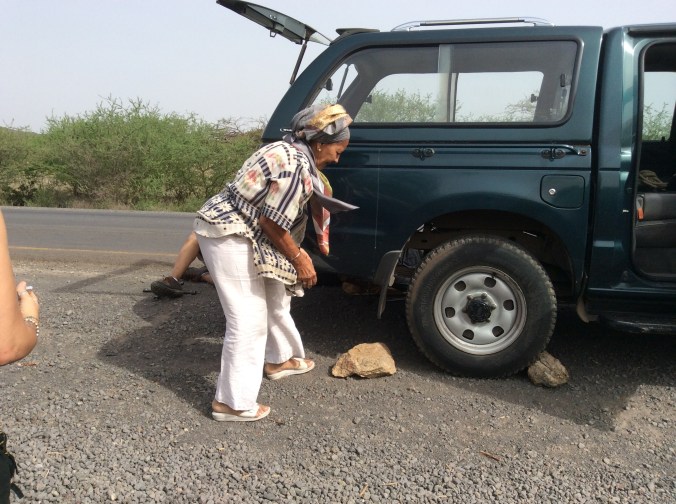
A little adventure occurred here. First, while they were working on the tire, a man came along and offered to help. His truck (this is a major highway between Adama and Djibouti) had broken down nearby. Then an Afar teenager came along and looked around, saying nothing. I realized he had a dagger in the back of his clothes when he walked off. Finally, an Afar man, maybe in his late 40s or 50s came along. The Afar are a nomadic people who have lived in East Africa for thousands of years. The men are noted for their ferocity. Their lifestyle has changed little; instead of spears, they now carry assault rifles slung across a shoulder. They herd cattle, goats, and camels. He walked around the vehicle and came up to me. Neither of us knowing the others’ language, the tiny conversation consisted of gestures. Dino suddenly told me to get in the car. At first I ignored him. A couple of minutes passed; he loudly repeated the order. I got in the car, wondering why. When I asked, he told me one never knows what the Afar are going to do and pointed out just how close the man had stood. I never noticed; I have no personal space.
Tire changed, we drove toward the town close to the lake.
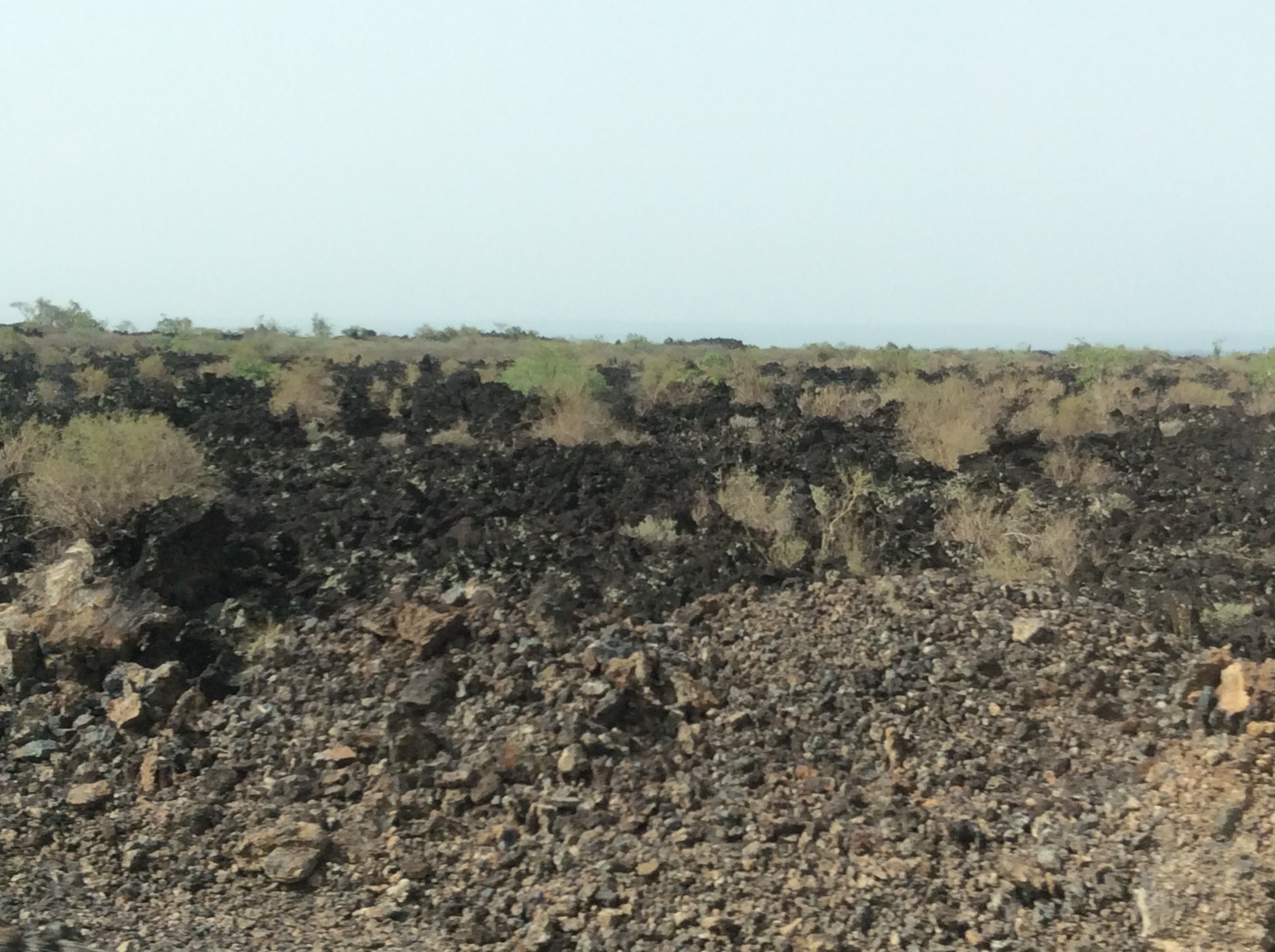
Crossing thèse lava beds would be difficult. As we dropped lower, we drove on the new road by the lake. You can see the old road crossing the middle of the photo below. It is nearly covered with water.
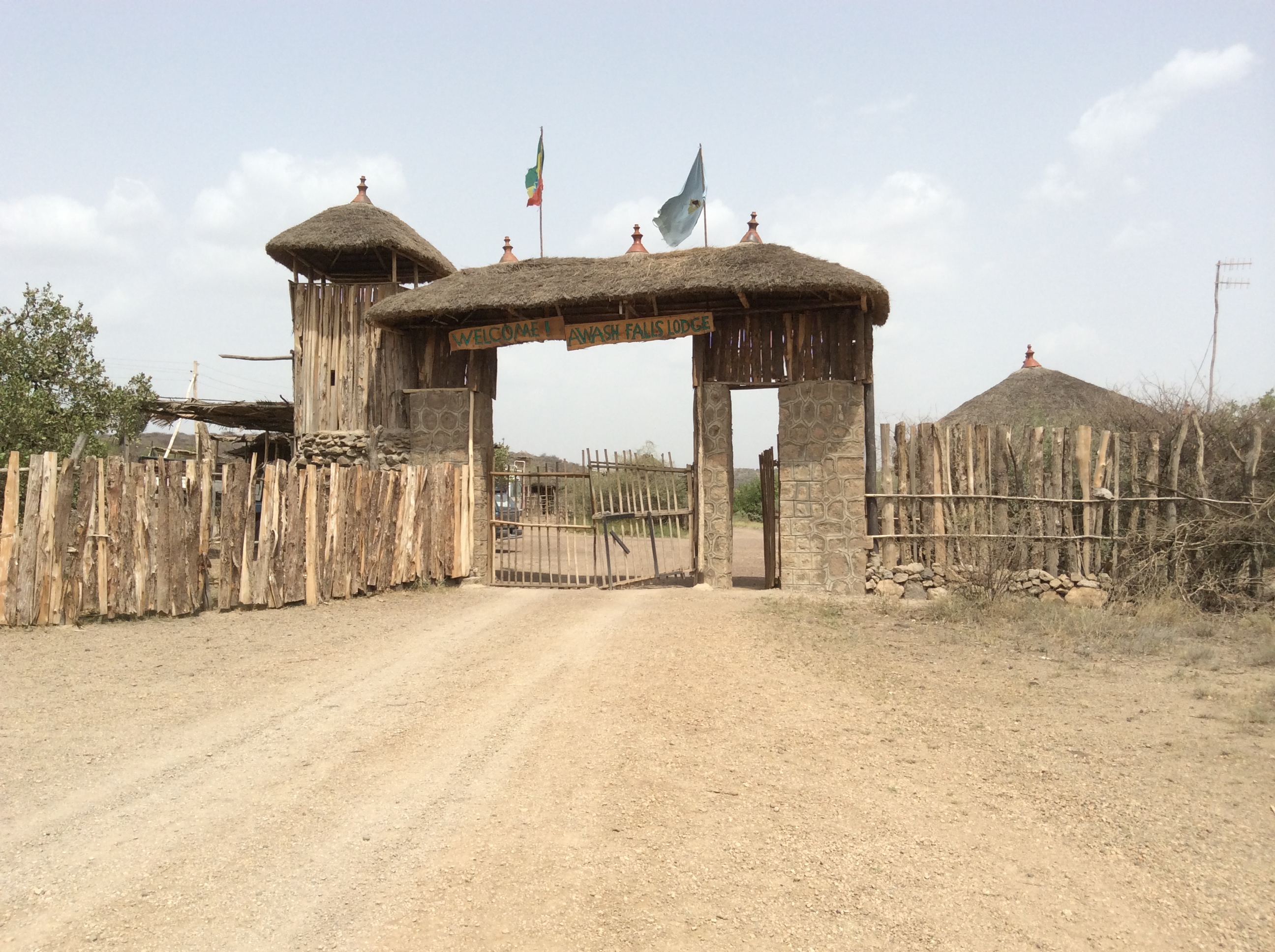
We missed the entrance to the park, realized we had gone too far, turned around, and headed back. The entrance to the lodge is more like what most people think of when they think of Africa.
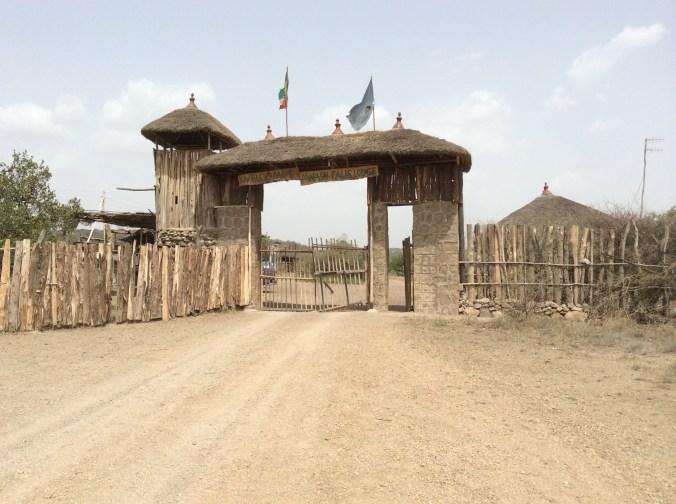
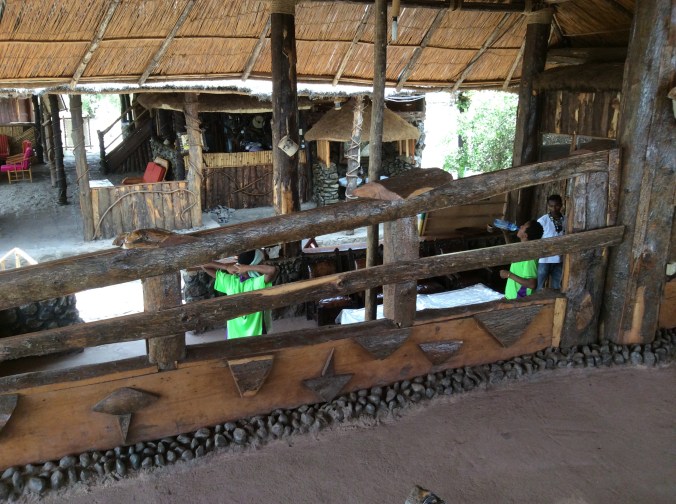
This was one of my favorite places: it was warm, almost hot. I saw lesser kudus several times, but they seemed so ordinary to the others that no one stopped so I could take a photo. The lodge was delightful and the shiro some of the best I had. Loved it. I even asked for the recipe. The resident ostriches, however, looked rather pathetic.
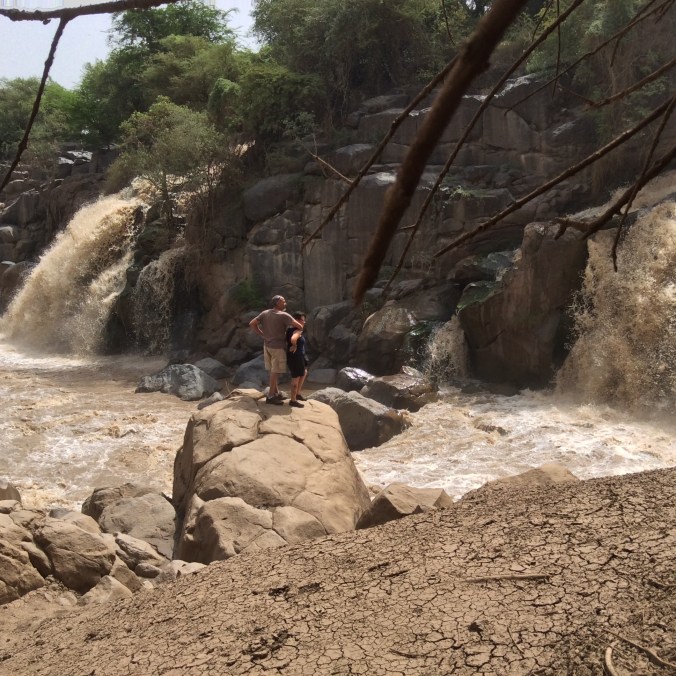
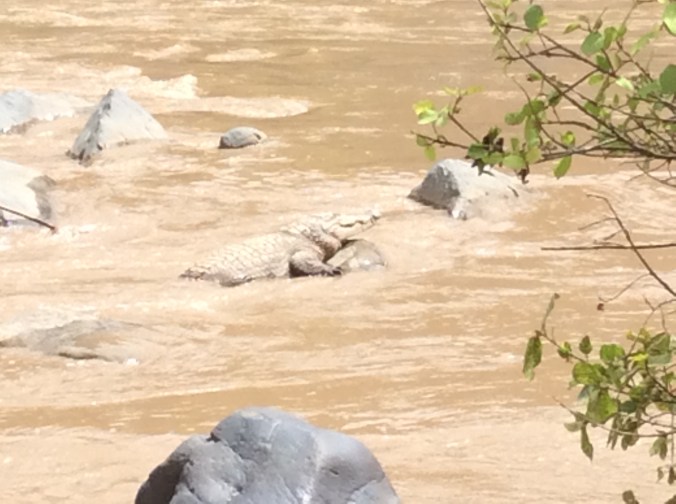
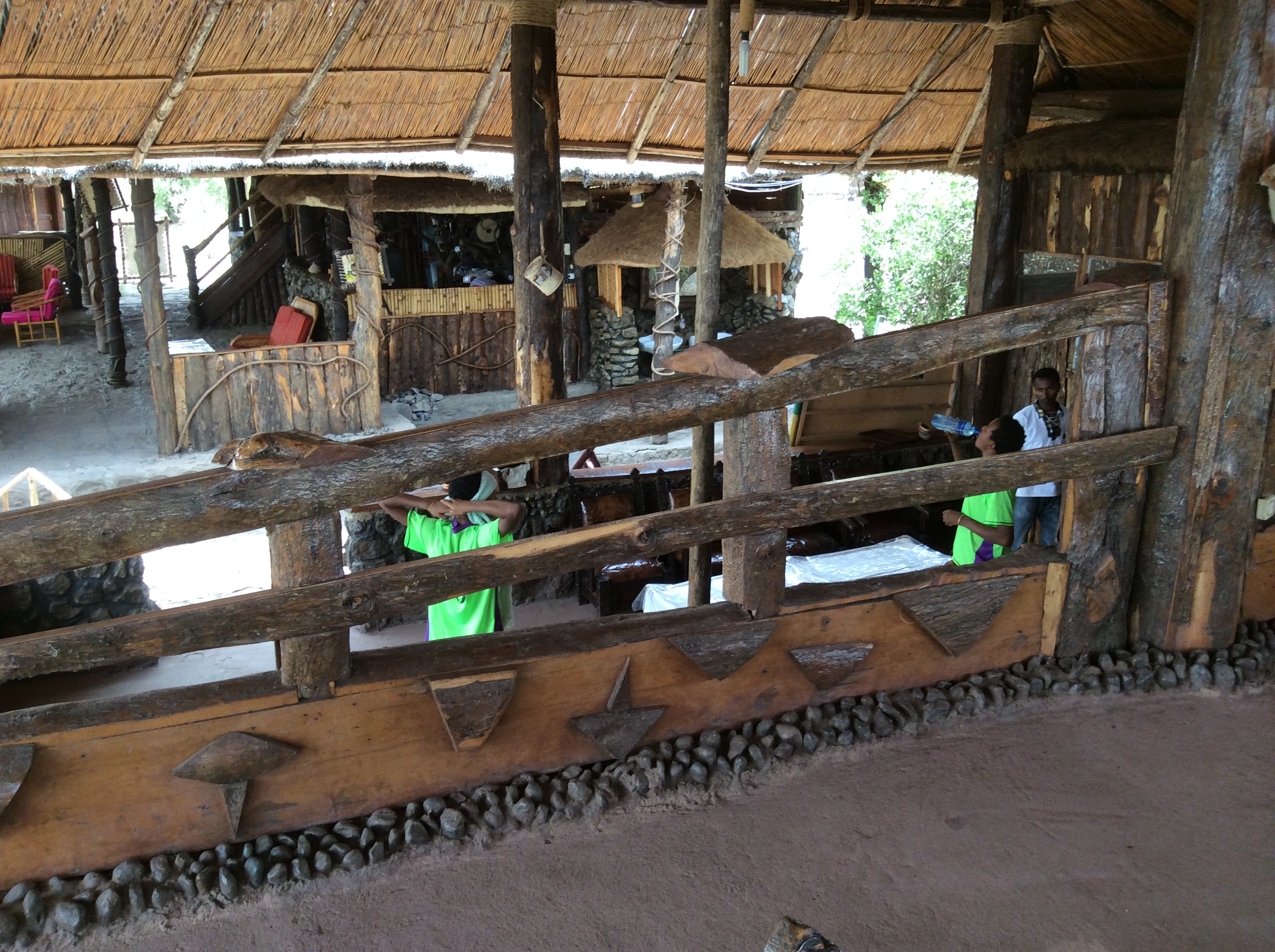
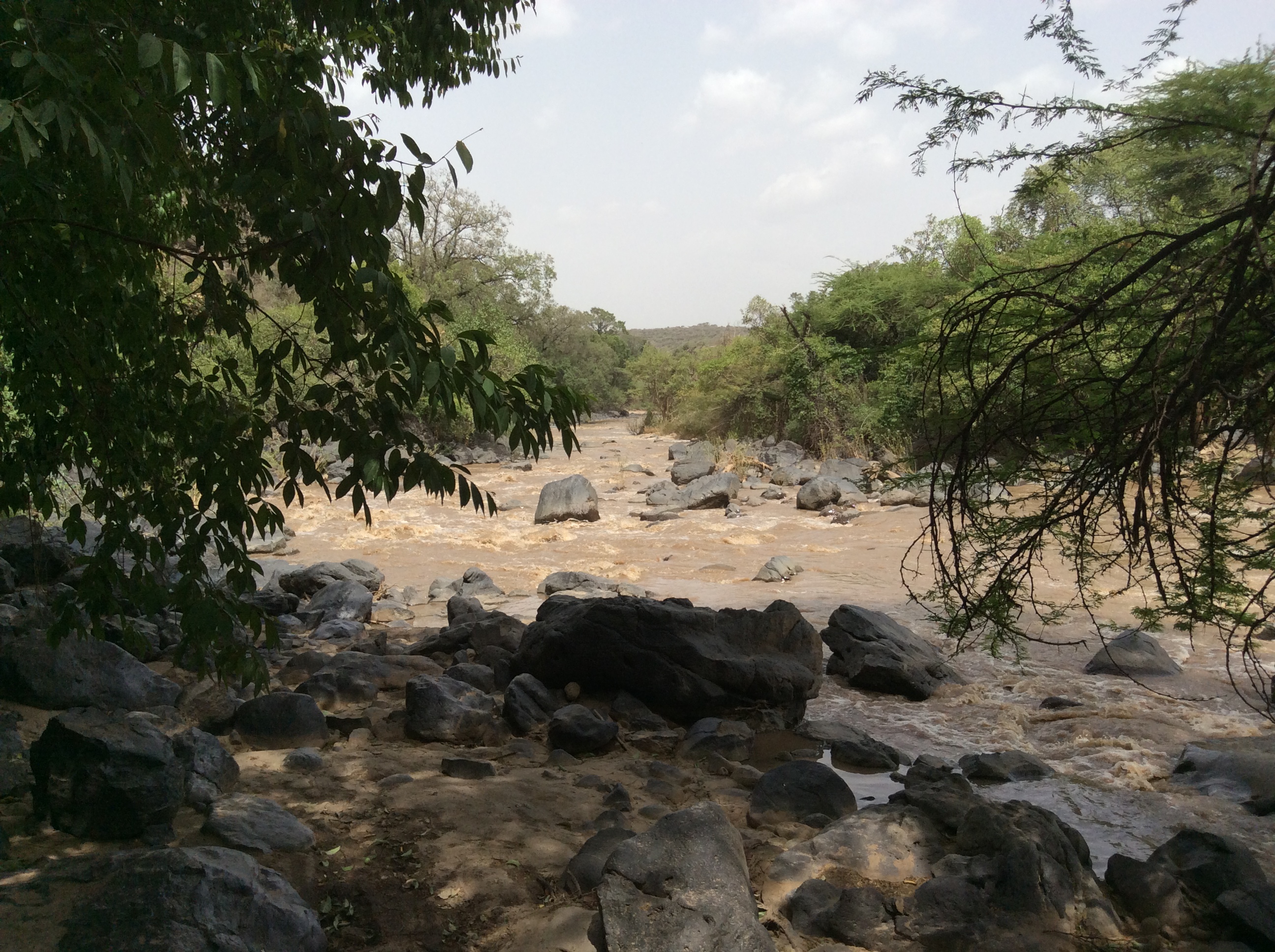
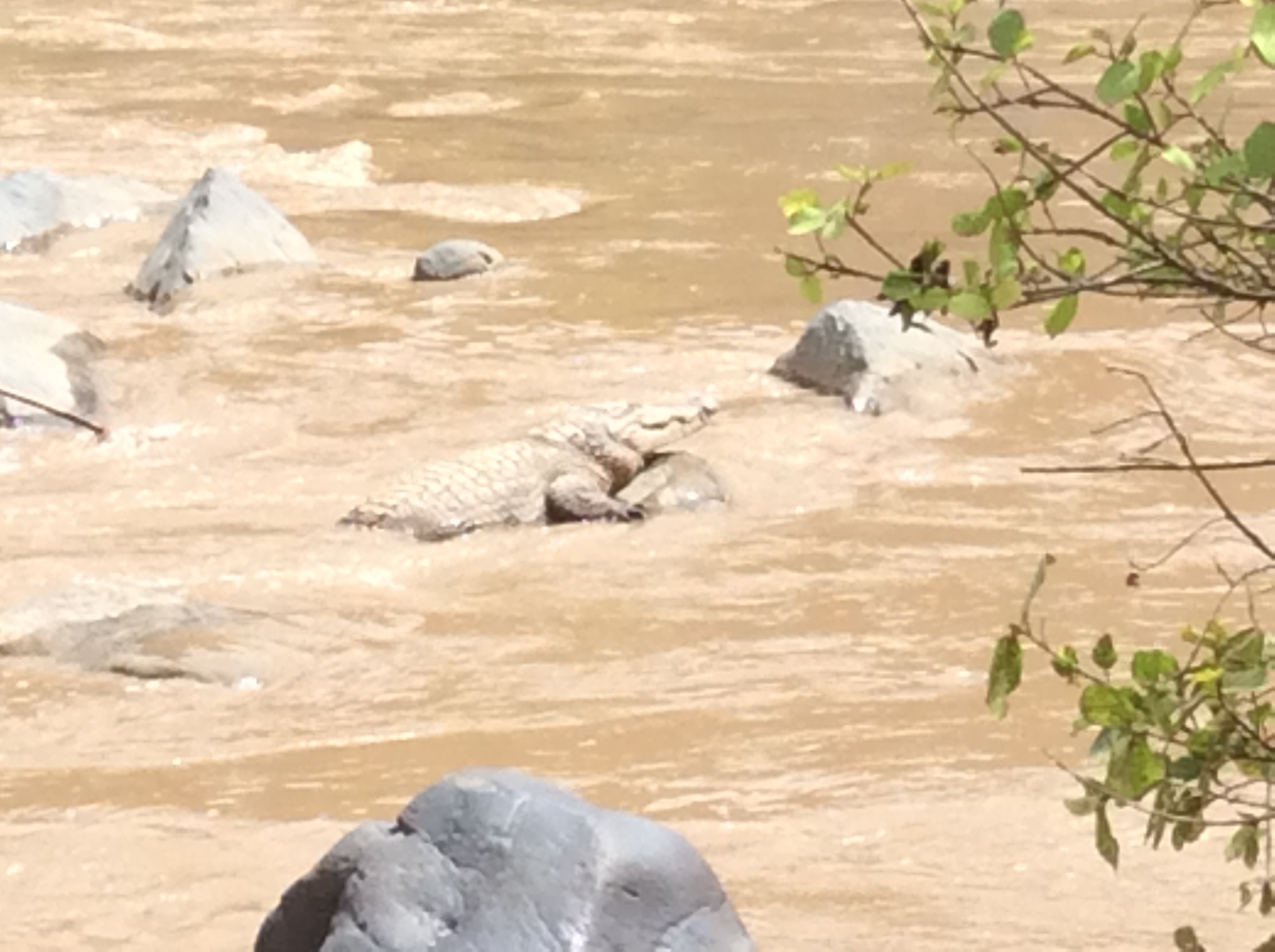
Here the Awash River is full of crocodiles. Our first glimpse was through binoculars from the lodge restaurant.
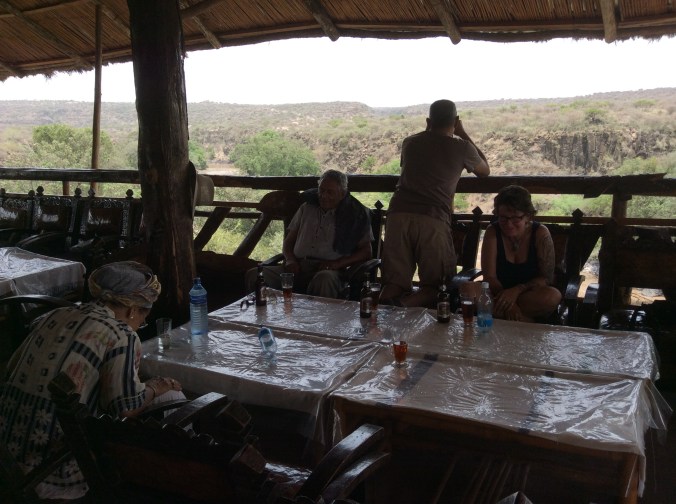
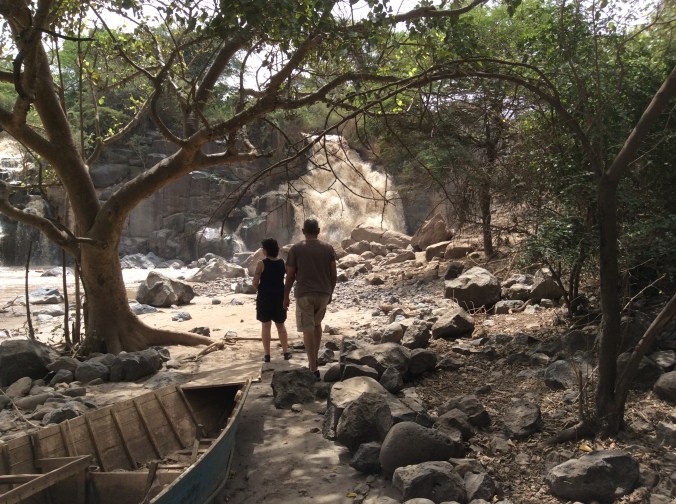
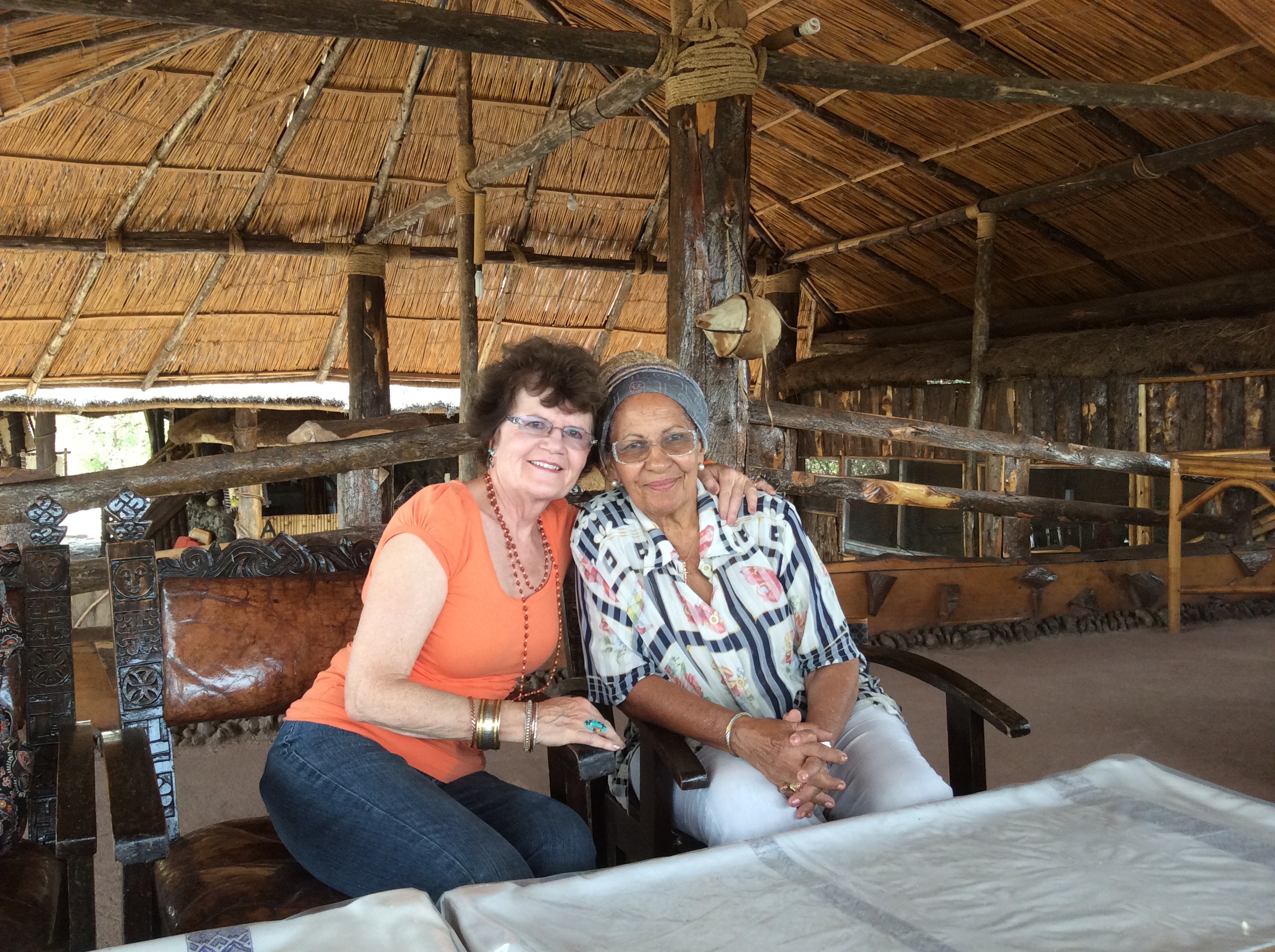
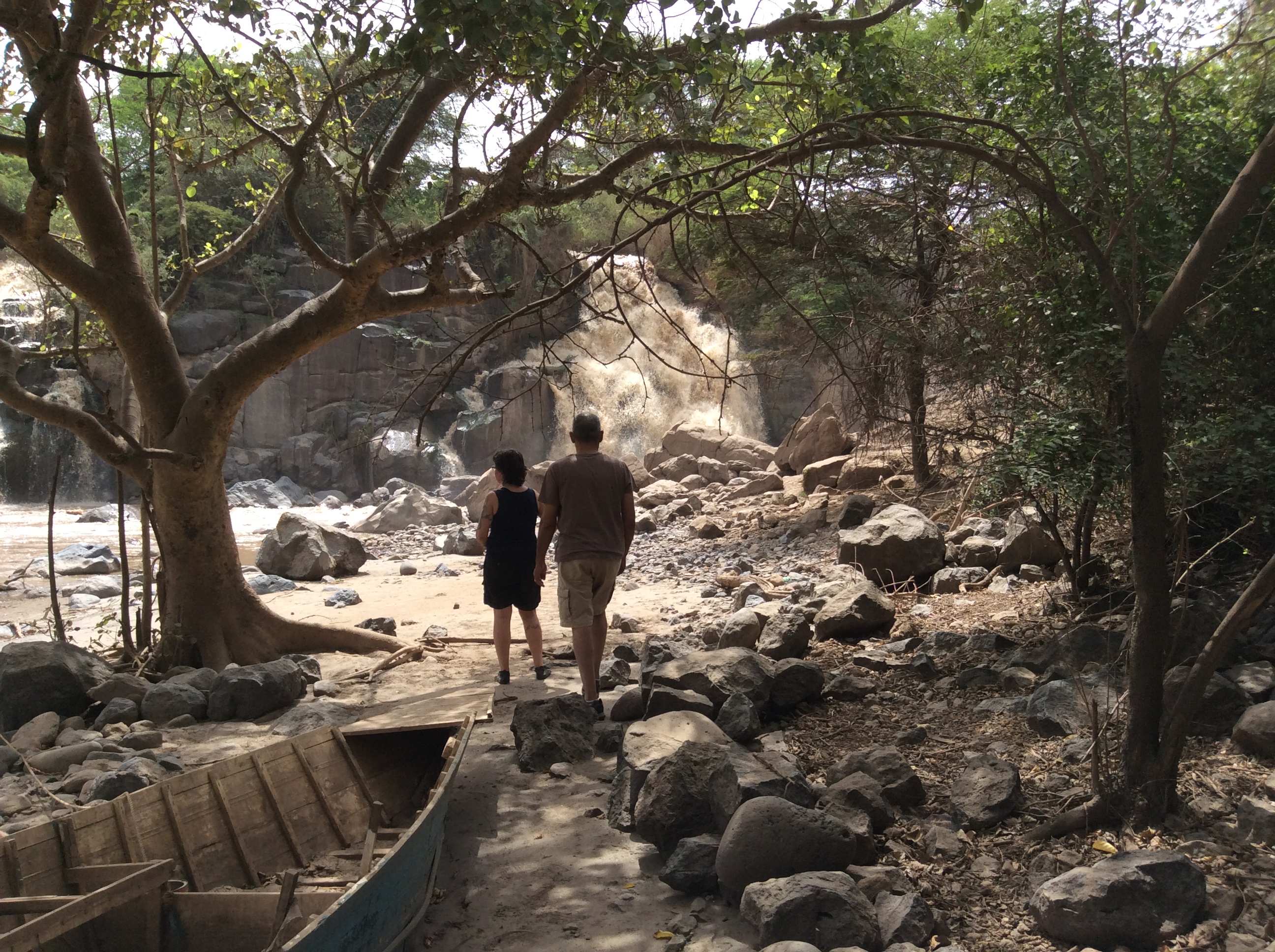
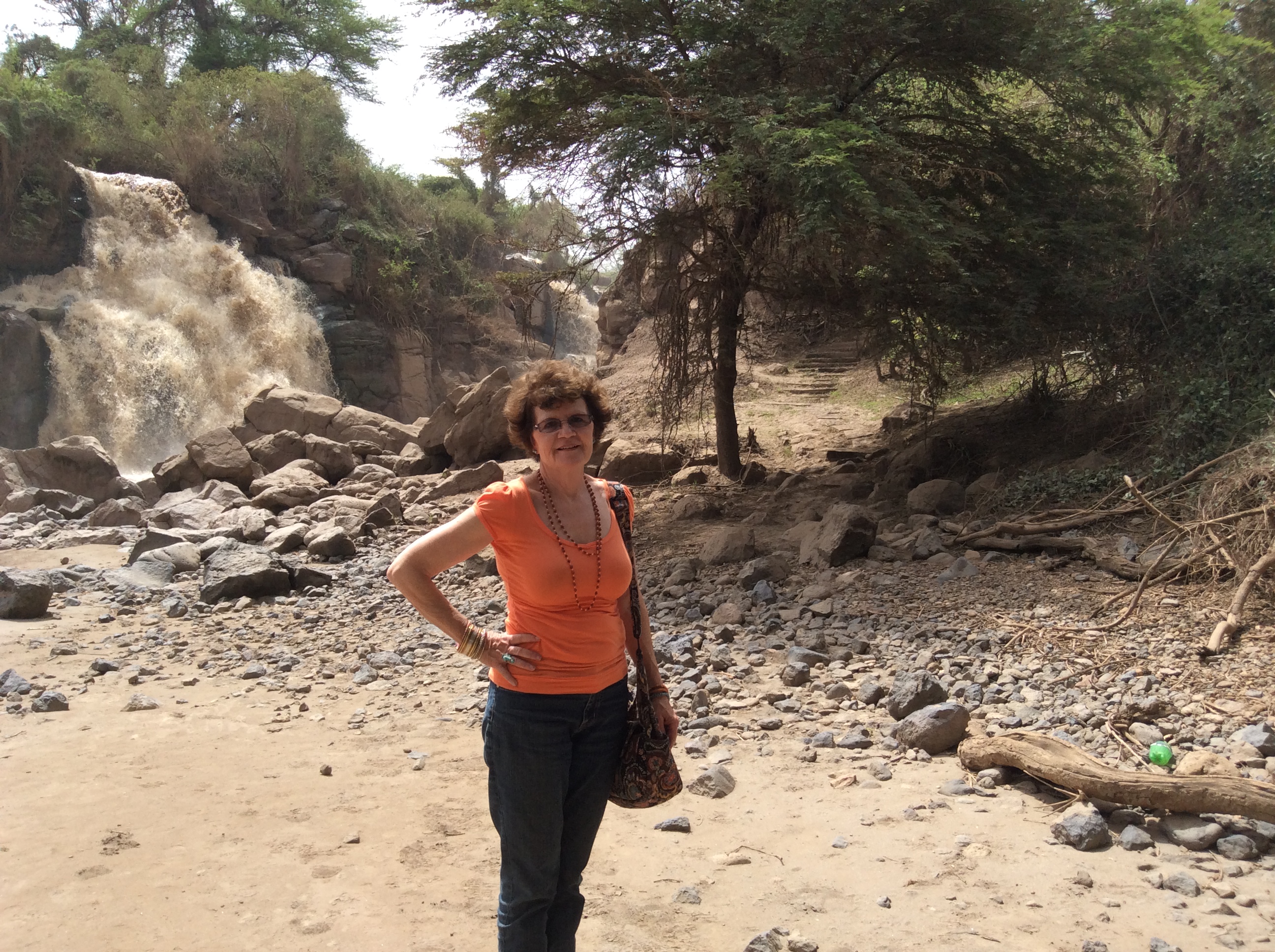
Dino’s mom posed with me while we waited for lunch. Then we hiked down to the river and the falls where we saw even more crocodiles.
The falls are so large that I could take a photo of only a portion of them at the top where the hike down begins.
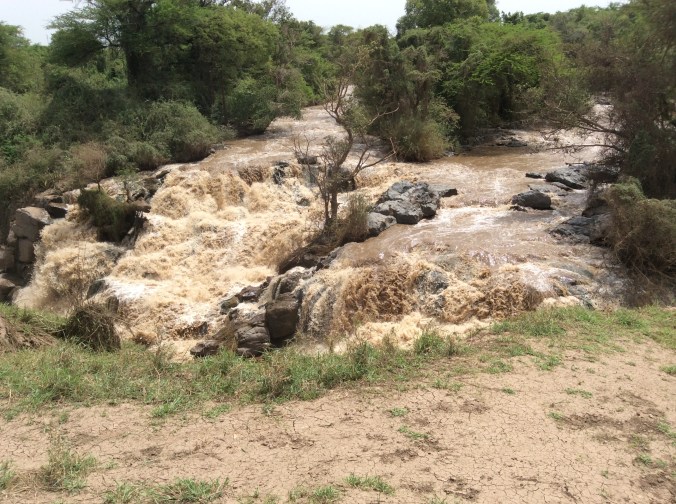
The green between the two sections of the falls was totally covered with water a few weeks later when Dino’s brother travelled there with his family.
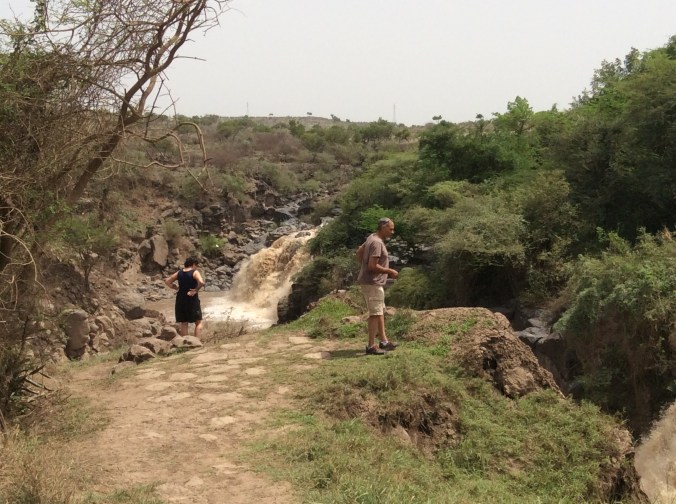
I loved walking along the river banks, careful, however, because of the crocodiles. They may look slow, but they can really move rapidly when they choose to do so.
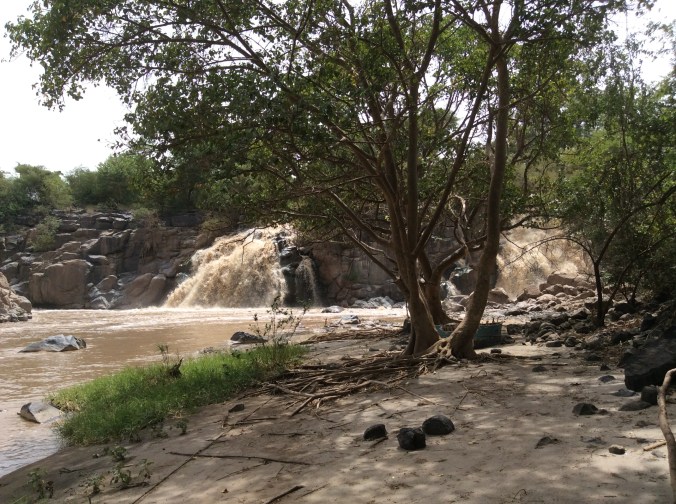
Crocodiles like basking in the sun.
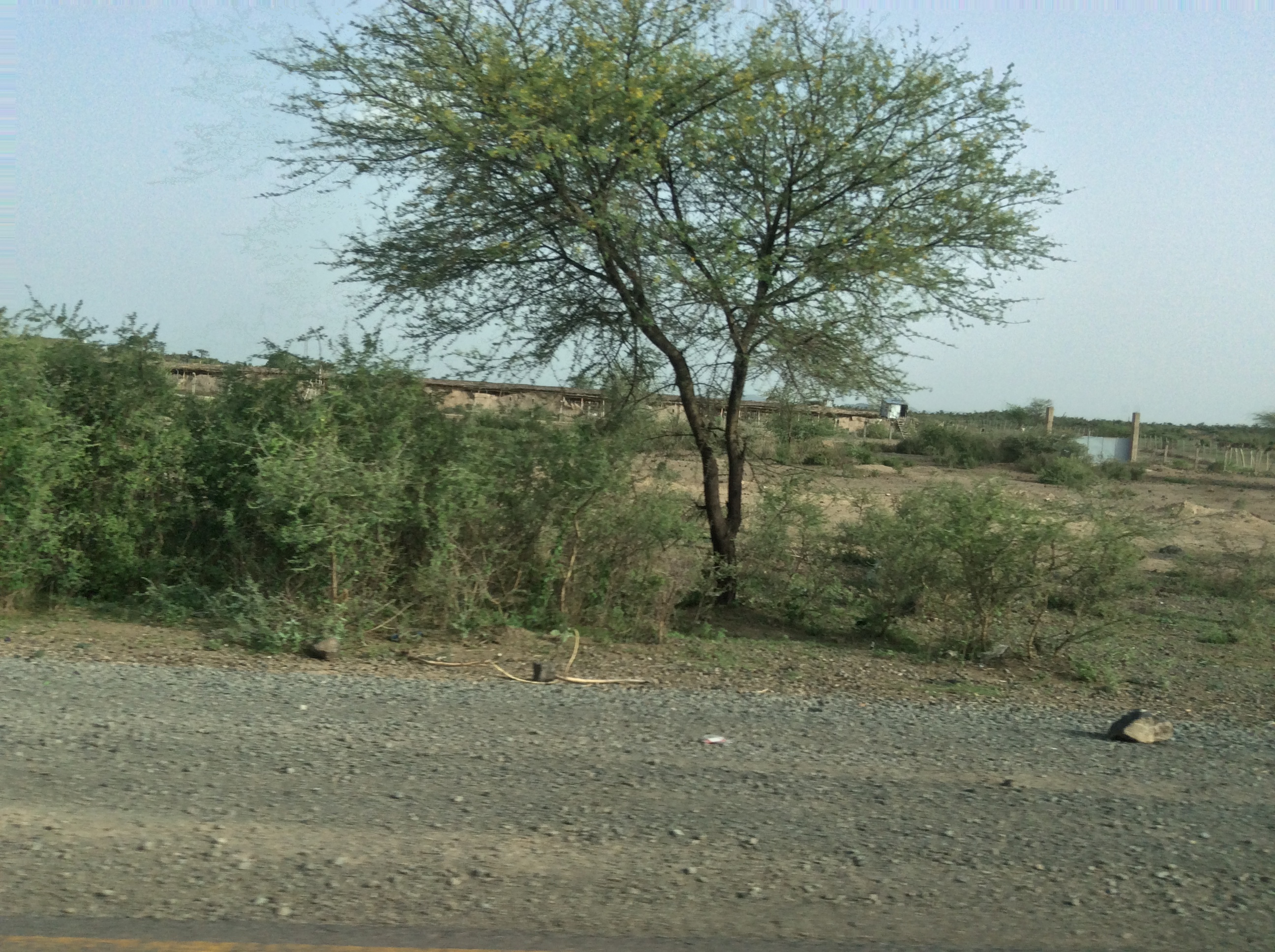
Along the highway, camels graze, boys herd large flocks of goats, and a totally different species of acacia appear.
If you look at the background of the photo below, you can see long lines of corrals–for camels to export to Yemen and other areas where camels are eaten. If you live in Amarillo, Texas, and order in advance, you can eat camel at the Somali restaurant on Amarillo Boulevard.
Unlike most of Ethiopia where we had previously travelled, here we saw fences especially around villages. They bring the livestock in for protection from not only hyenas but also lions. Yes, lions live here. I asked if they ever see them. I was told, “No, but you sometimes hear them roar at night.” They also told me that the lions like to go down to the sugar cane factory, but no one knows why.
When I want an Ethiopia “fix”, I listen a audio/video of Awash Falls.
My Ethiopian Adventure: On the Road from Debre Markos to Addis, Crossing the Nile Gorge
Once again, we drove through rain and clouds and endless fields, some of which had been cultivated ready to plant and some all green and growing.
I realize this is not what most people in the United States think when they hear the word Ethiopia. I kept thinking of photos I had seen of Ireland.
The ancient grain, teff, produces extremely tiny seeds which are ground to flour to make injera, an Ethiopia staple. It is used much like people in India use chapatis or like people in Mexico use tortillas. However, it looks nothing like either of these. It is thicker and a bit spongy like crepes but huge–more than a foot in diameter. The man in the photo below is sowing teff.
Teff fields stretch almost as far as the eye can see.
Villages are frequently set along side the good highways.
Major highways are excellent. The only really bad road we traversed was in Simien Mountains National Park where they keep the road that way on purpose. Well, that and the streets in Addis.
As we came closer to the Nile Gorge, it became more mountainous again.
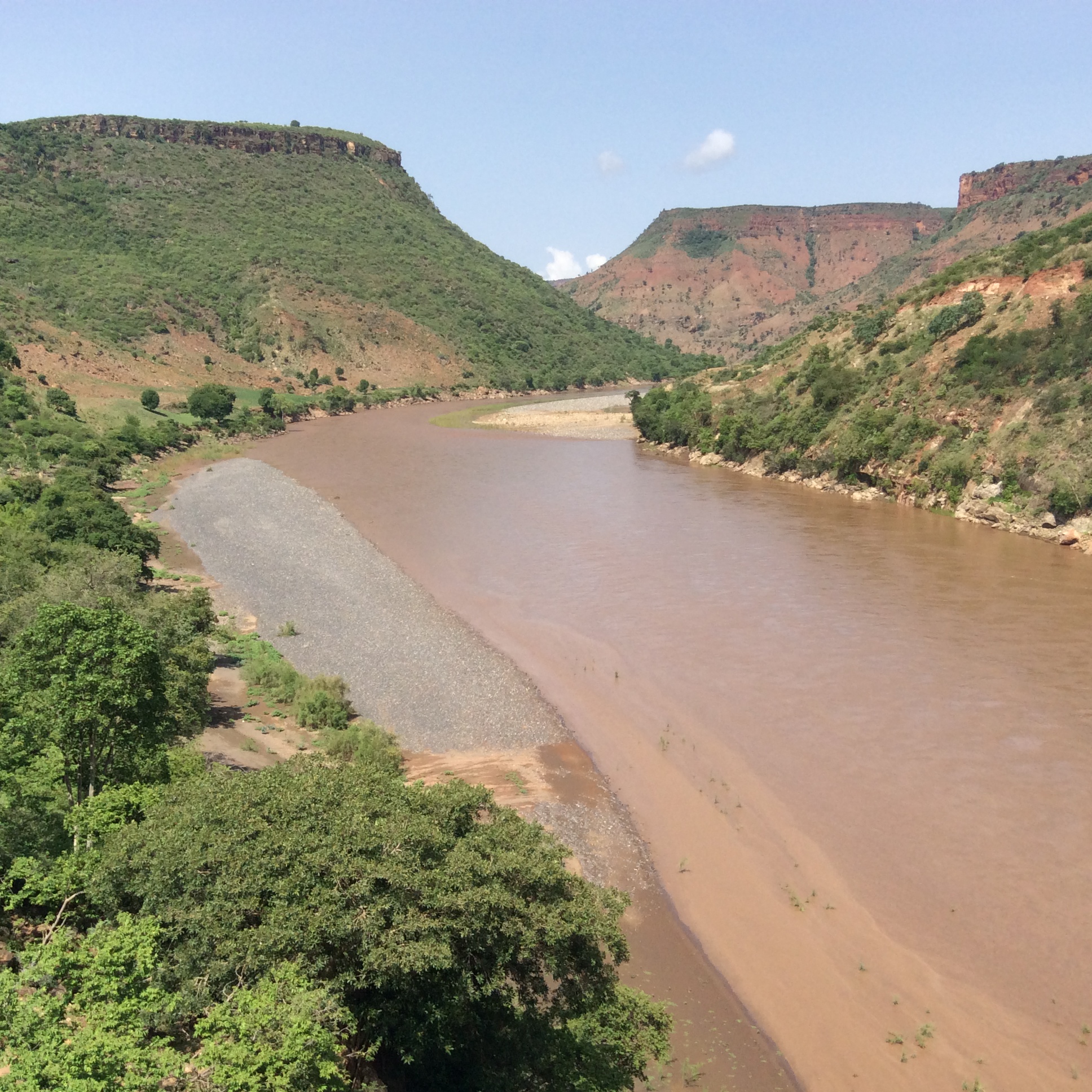
First sight of the Nile Gorge.
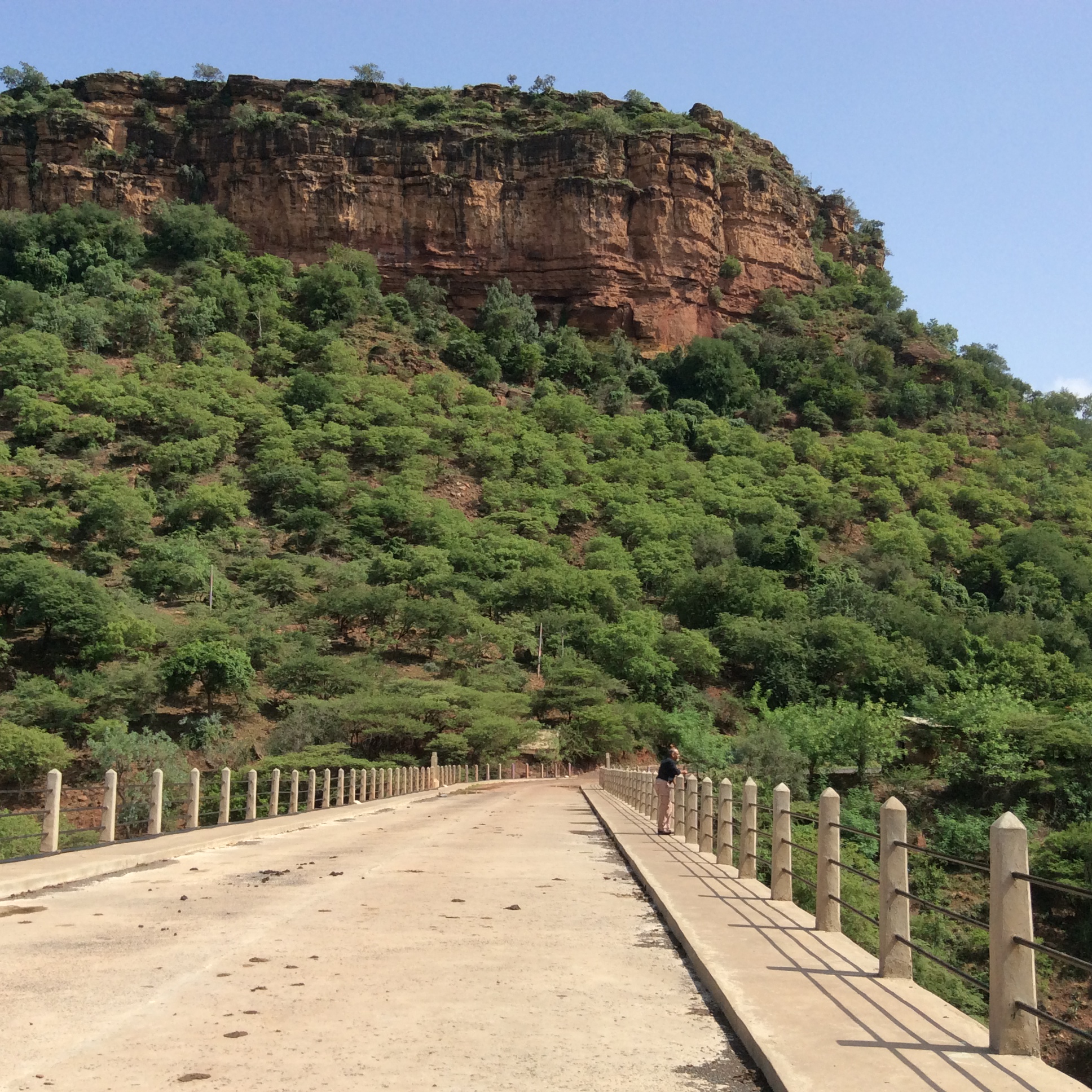
All major bridges seem to have a resident guard. Unlike the guard at the bridge in Bahir Dar, this guy told us we could walk around and take photos.
If there is a guard, he has to have a guard house.
And a house.
Even though by this time I had not only floated down the Nile but also crossed it in a boat a couple of times, I remained entranced. We walked across the old bridge built in 1948. Actual traffic now crosses the new bridge built by the Japanese.
Personally, I did not see anything wrong with this old bridge and wondered why they thought they needed a new one.
A couple of signs written in several of the languages spoken in Ethiopia commemorate the old bridge.
As we climbed out of the gorge, we saw common baboons begging. They are neither as pretty nor as friendly as gelada baboons.
I could not resist taking a variety of photos looking back down into the Nile Gorge.
Dino could not resist stopping for one long, last look at the Nile.
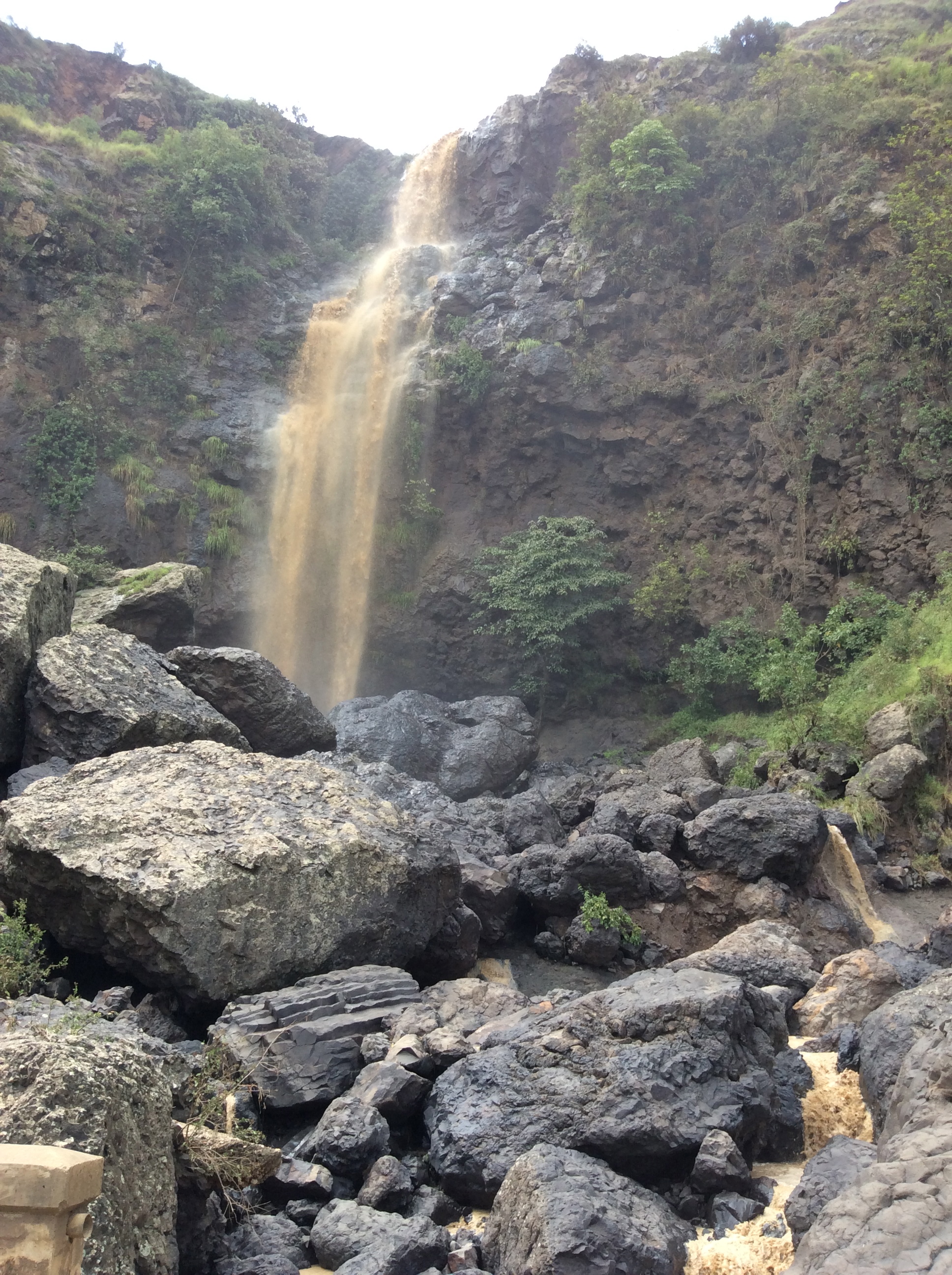
When we asked the name of this waterfall, we were told that it was just an ordinary waterfall and had no name.
The final switchback before we became immersed in the clouds.
My Ethiopian Adventure: On the Road from Bahir Dar to Debre Markos
After coffee and a walk around the grounds at Kuriftu Resort and Spa on Lake Tana–see last photos of previous post, we headed south. This was not the kind of trip where I could stop whenever I wanted to take photos so many of the photos you see on these Ethiopian posts were taken from a moving car.
A typical house along the roadside. Eucalyptus may be invasive; nevertheless, its uses here seem endless–the house, the fence.
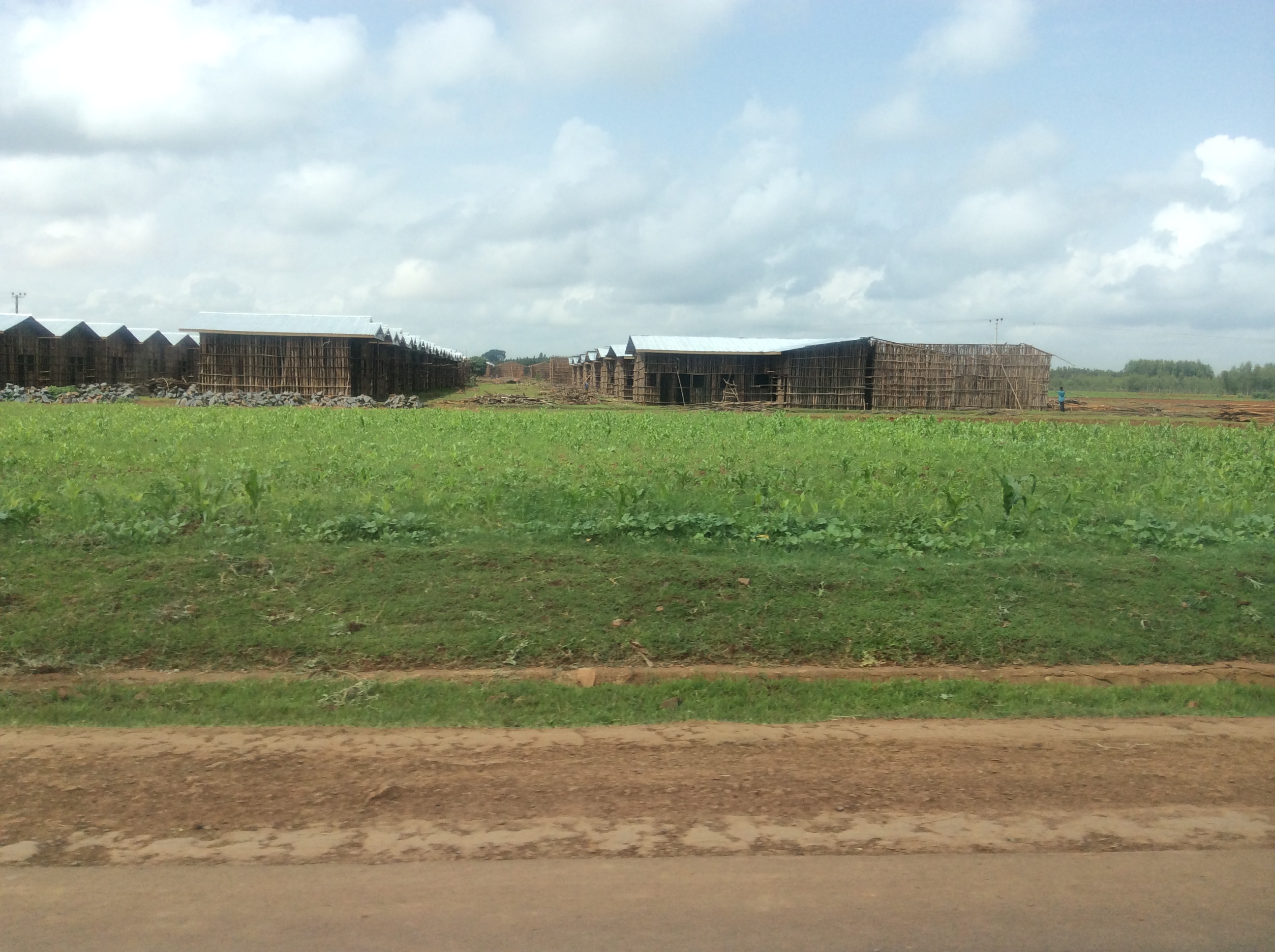
A new housing development along the road all framed in eucalyptus. In fact, nearly everything is made from eucalyptus except the metal roofs and the final coats of mud on the outside. I wondered about the advisability of the modern use of metal. Since no one heats or air conditions, metal can be both hot and cold whereas the traditional roofs act as insulation. Of course, they take a lot more work for upkeep. The land immediately south of Bahir Dar is flat. Farmers grow eucalyptus commercially. They use irrigation canals and grow onions and tomatoes as well as other vegetables.
If you want to drive in Ethiopia, you must learn to dodge people and animals because the highways remain the primary transportation routes for everything, not just modern vehicles.
Although the houses may be mostly mud plastered with dirt floors, nearly everyone has electricity.
So many rivers nearly overflowing during the rainy season, it is hard to keep track of which one is which. Even the official map does not contain all the rivers we crossed. This one is often referred to as the Little Nile (Lesser Abay). Some even claim it is the real beginning of the Nile (Abay) because this river feeds into Lake Tana from which the Blue Nile flows. However, the Lesser Abay is not the only water input into Lake Tana.
Few overweight people can be found in Ethiopia. Why? They walk; they carry heavy loads.
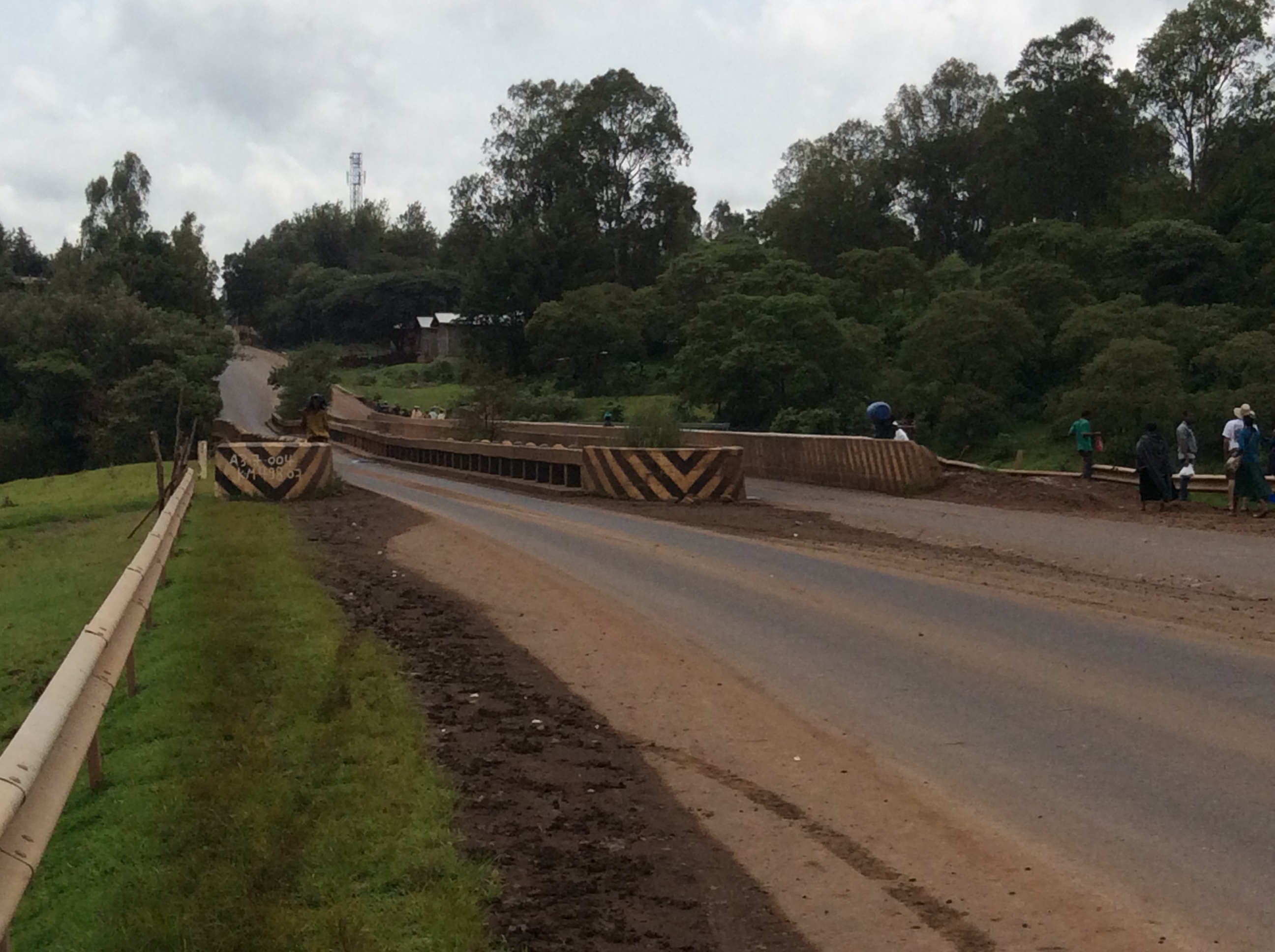
Bridge over the Little Nile.
For most of the day we drove through heavy rain. This huge rock suddenly appeared, sticking up among the grass and fields. Except for water everywhere, it reminded me of things one sees in the western United States.
When I tell people that I have never seen so much green and rain or experienced so much cold in a three week period in my life, they seem amazed this occurred in Ethiopia.
We stopped at this lovely lake, not only because it is beautiful but also because Colobus monkeys live here. I tried to photograph them and gave up; they fly through the trees with incredible rapidity.
Lake Zegena between Injibarra and Bure at 2529 meters altitude. Here it even rains during the dry season.
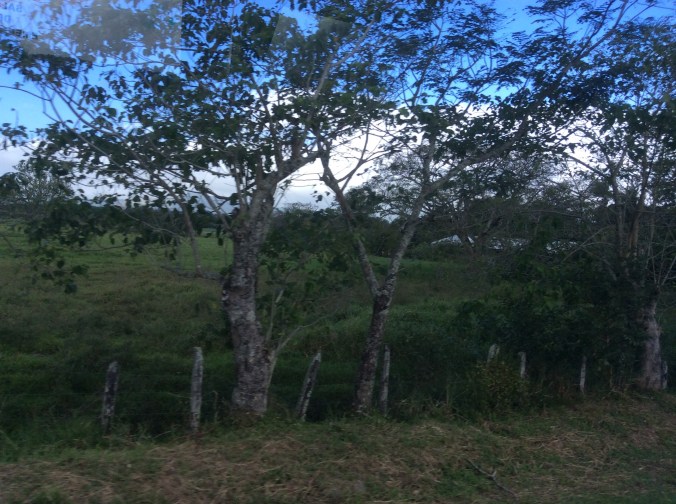
The incredible number of plants and mosses growing on the trees made me think of Costa Rica where as many as 150 different species of plants can grow on one tree.
Dino and Alemu appeared very excited to see this for sale. Yes, it is edible–tiringo. They cut up slices and ate them with big smiles on their faces. I tried it; too sour for me. The flesh is somewhat like an apple but tastes more like lemons. However, I am not a fan of citrus fruit–these are a type of citrus–so was not surprised to find I could do without this one.
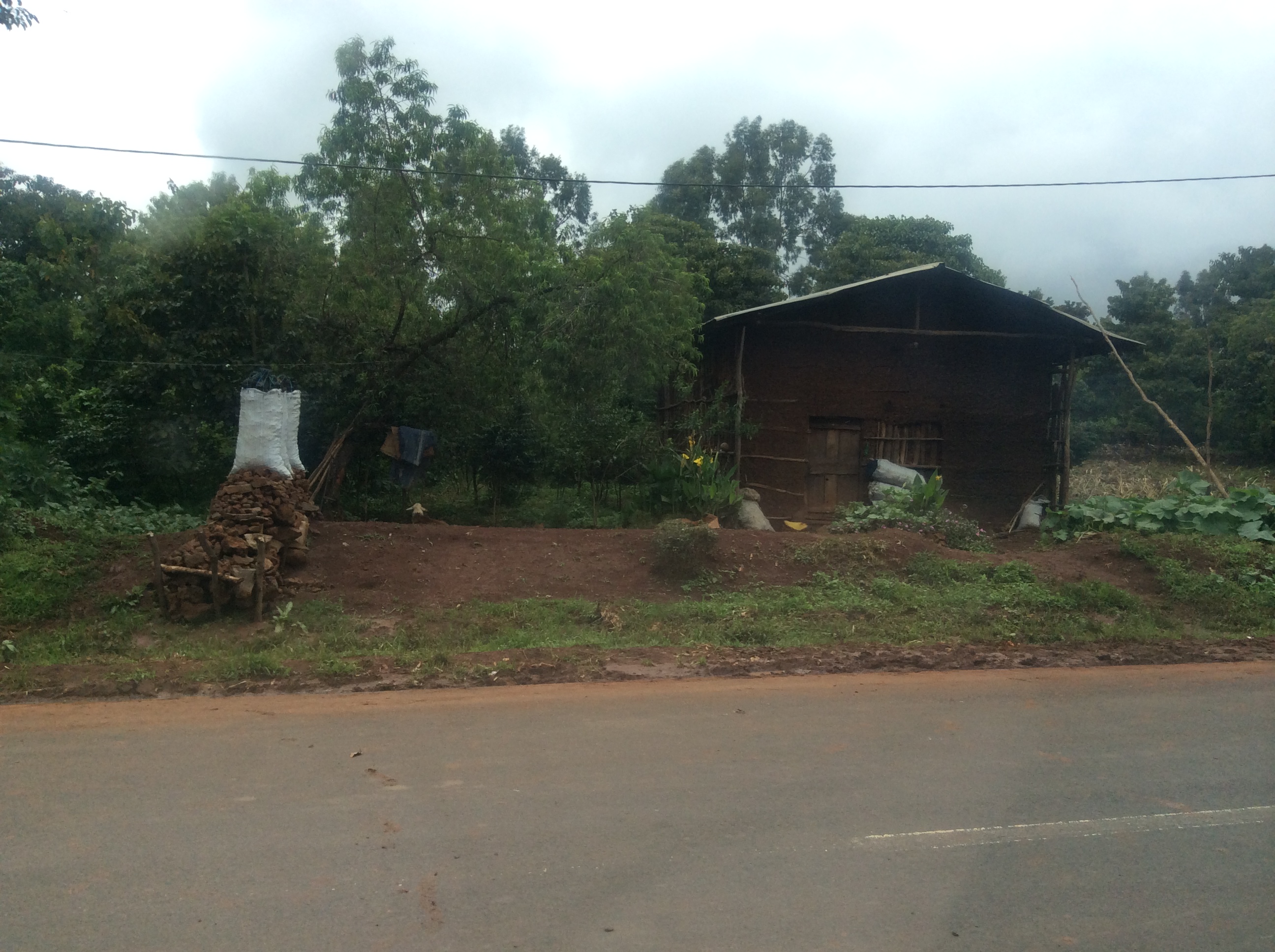
In this area charcoal is made and sold commercially everywhere along the road.
We stopped to buy a bag of limes from these girls.
Most of the day we drove through lush agricultural country.
We arrived in Debre Markos in the perpetual rain. Although the hotel where we stayed was only two months old, not everything functioned. I had to change rooms and even then, the bathroom door would not shut and a tile was missing just above the door. By this time, I had come to the conclusion that the really old things in Ethiopia, not unlike elsewhere in the world, were better made than new construction. The 1000 year old churches in Lalibela still function perfectly. This hotel definitely will not last 1000 years. Like everywhere in Ethiopia, no heat existed anywhere in the hotel. Aesthetically, the hotel received a very good score. Beautiful linens, lovely decor (everything had been painted by Dino’s sister’s company with the exquisite paint she imports from Italy), a well stocked bar. I hung out in the bar a while with Dino drinking sambuca romana trying to get warm. It failed to work. Sleep seemed impossible–too cold. Finally, after lying in bed cold for over an hour, I arose, put on two pairs of socks and tried again. Finally warm enough to sleep.
The view out my hotel room in Debre Markos demonstrates a typical Ethiopian city view–the contrast between the new and luxurious and the elemental.
My Ethiopian Adventure–on the Road from Lalibela to Gonder
Since there is only one road in and out of Lalibela, we headed back to the main road after an 8:00 breakfast. By this time, after three times on this road, the heights hardly bothered me.
We drove through mountains a large part of the day, through the large towns of Nesfas Mawcha, Debre Tabor, and turned north at Wereta. By this time, I had become accustomed to seeing endless beautiful scenery, hardly knowing when to take photos.
The invasive eucalyptus trees and pastoral mountain villages show up everywhere.
Most villages have their own church. The building with the round roof in the distant middle is one such little church.
Excellent roads, mostly built by the Italians years ago, crisscross this part of the country. Some newer roads have been built by the Chinese. Many Ethiopians made jokes about this, implying they do not expect them to last long. After reaching a high plateau, we drove through endless pastures and fields of green.
Up in this high country, farmers grow wheat, barley, and oats. Horses and cattle graze in large pastures.
The mountains appear to continue forever.
Buildings, like the one in this photo above, usually house animals at night to protect them from predators such as hyenas.
Whenever we stopped, children ran up sometimes asking for pens, occasionally for money. Dino and Alemu, the driver, usually scolded them in Amharic for begging.
Houses here seemed bigger, usually two story, with rocks used as a main building material.
We drove by two men galloping along on horseback, their horses adorned in fancy tack.
As we began a long descent into a huge valley, common baboons appeared along the road.
These huge rocks left my millions of years of erosion, provide a dramatic contrast to the intense green.
It took more than an hour to cross this valley. As usual cattle, goats., burros, people mingled with vehicles. What a surprise: Rice fields as far as I could see on either side of the road.
The villages in this area are built higher–above the rice paddies. And then as we climbed out of the valley…
The name of this rock really surprised me, the Finger of God.
A big later, suddenly Alemu turned off on a dirt road and this appeared.
The sign says: Guzara Palace, G.C. 1563-1597.
When a person goes on such a trip, sometimes places hold your heart, places unexpected. I loved this place. It seemed magical. With no other people around, it felt private and special. It becomes obvious quite quickly why a king would build a castle here. You can see forever, for miles and miles, all the way to Lake Tana in the background.
We climbed up to the second story and could see Lake Tana even more clearly in the distance. I felt a sudden rush of emotion, looking at Lake Tana, my first glimpse of where the Nile River begins.
On the other side of the castle, looking toward the mountains, the remains of the old wall around the castle show up clearly. The part of the wall on the path to the castle has been restored. This part still awaits restoration. We drove on to Gonder. We stayed there two nights at Hotel Goha, but not in sequence. I found the window coverings so unique I had to take a photo.
Fabric, stretched over a frame slides back and forth so you can slide it to cover the window. This hotel possesses fantastic, modern showers.
My Ethiopian Adventure–On the Road to Lalibela, Part Two
Mountains pervade everywhere it seems. We continually drove up and down mountainsides. Eucalyptus is not native. They were brought in by the Australians many years ago and became invasive. They are a mixed blessing–grow rapidly and have many uses, but they take a lot of water and drive out native species. When simply cut down, they grow right back. In some places, we saw preserves where the original species of trees still exist and are protected. Otherwise, eucalyptus reign.
And there are several species of eucalyptus as you can see here. Not only do the leaves differ, but also the color of the trunks.
Almost all the mountainsides are covered with fields. Ones, like this one, may have been just plowed or just planted. In the mountains barley, wheat, and oats are grown and sometimes teff. Barley seems to ripen first.
At first, I suffered minor terror because of the steep roads and huge drop-offs, sometimes thousands of feet. However, eventually I became rather used to it.
These roads, mostly built a long time ago by the Italians, remain excellent and do have guardrails. The Chinese have built some of the newer roads. The Ethiopians make jokes regarding how long they think these Chinese roads will last.
Eventually, we rose to a high plateau area across which we drove for hours.
The endless shades of green, indicating different crops, or in some cases, the gold of ripening grain.
Winnowing grain the old fashioned way.
Houses on this high plateau seemed mostly built of rocks which lay everywhere.
Amelu asked us if we wanted to see inside one of the houses and visit with some people. Of course, we said yes.
This couple had a somewhat older child who was out herding their animals–cattle as I recall. At night they bring the animals inside their house to protect them from predators, e.g. hyenas. They also provide body heat which helps them keep warm. He explained in Amharic that he did not own land, but was saving up and when he could, would build a separate house so that their animals would be able to stay in one and his family in another. I thought Amelu knew these people, but he did not. His own children had outgrown some of their clothes. He had brought them to give away so he gave them to this family.
After we crossed the plateau, we dropped down and crossed a river. Because it was the rainy season, rivers raged everywhere, running dark with mud.
The little shed is for the river guard. We did not see anyone here when we crossed, but major rivers have guards often armed with an assault rifle.
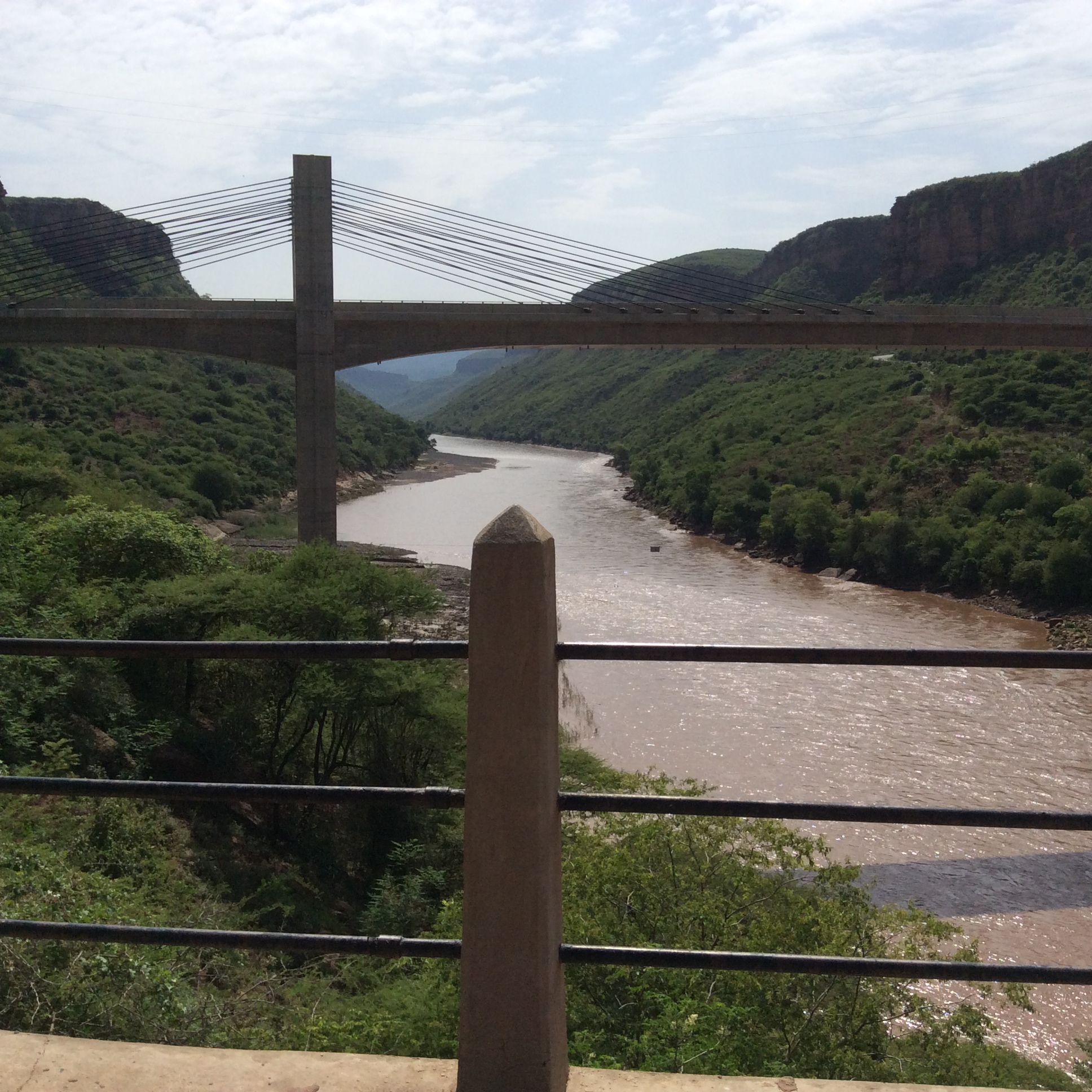
Almost to Lalibela–we discovered later that the rains were late and people were very concerned. Crops had been planted and they were waiting.
The first photo in Lalibela–the view from my room at the edge of a cliff–the Maribela Hotel.