“You cannot get through a single day without having an impact on the world around you. What you do makes a difference, and you have to decide what kind of difference you want to make.” Jane Goodall


Gelada in Simien Mountain National Park, Ethiopia
“You cannot get through a single day without having an impact on the world around you. What you do makes a difference, and you have to decide what kind of difference you want to make.” Jane Goodall
Gelada in Simien Mountain National Park, Ethiopia
behemoth bones
bleached white
African sun
grave yard for giants
some shot
others died a natural death
the living caress
bones with trunks
six thousand nerves
sensitive, searching
for answers
Whitney Plantation resides on the River Road about one hours drive from New Orleans. A recent visit there provided much enlightening information about the slave trade, crops grown near New Orleans, and the history of this area. Tours can be scheduled all days of the week except Tuesday. It is unique in that many different types of plantation buildings still exist there, including old slave cabins, a foundry, and the outside kitchen.
A German immigrant started the plantation in the late 1700s. At Habitation Haydel, its original name, he grew indigo. After his death, his youngest son converted the main crop grown to sugar cane, which is still grown there today. Both indigo and sugar cane required intensive labor for profitability.
Although, according to population data, only ten blacks lived in Louisiana in 1712, by the end of the century slavery was the main source of labor. In 1795, there were 19,926 slaves in Louisiana. Under Spanish rule the slave population steadily increased. Although many were imported from Haiti, those from Africa came from what are now the countries of Senegal, Bissau, and Guinea. After the initial importation of slaves, the United States imported few compared to islands in the West Indies and Latin America, e.g. Brazil. The preferred method in the United States to obtain slaves was breeding. Women and men were forced to breed. Their owners specifically chose certain people to produce certain types of progeny just like in breeding livestock. One woman complained of having 16 children by 16 different men.
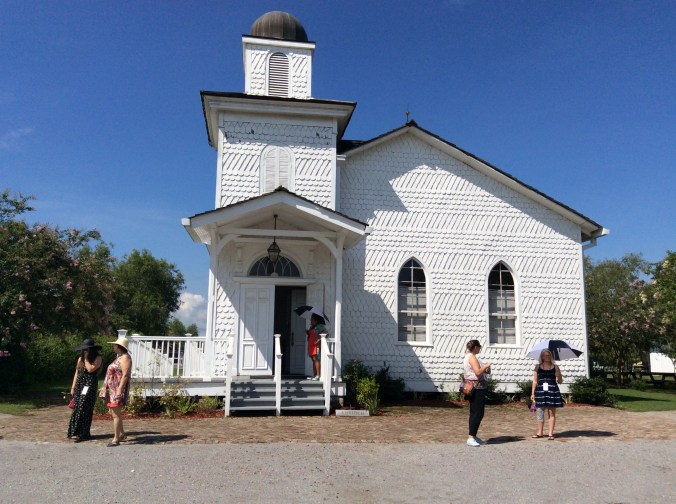
After leaving the visitor center, the first building on the tour is the church. Inside the church are statues of various children who were the products of the breeding program at the plantation.
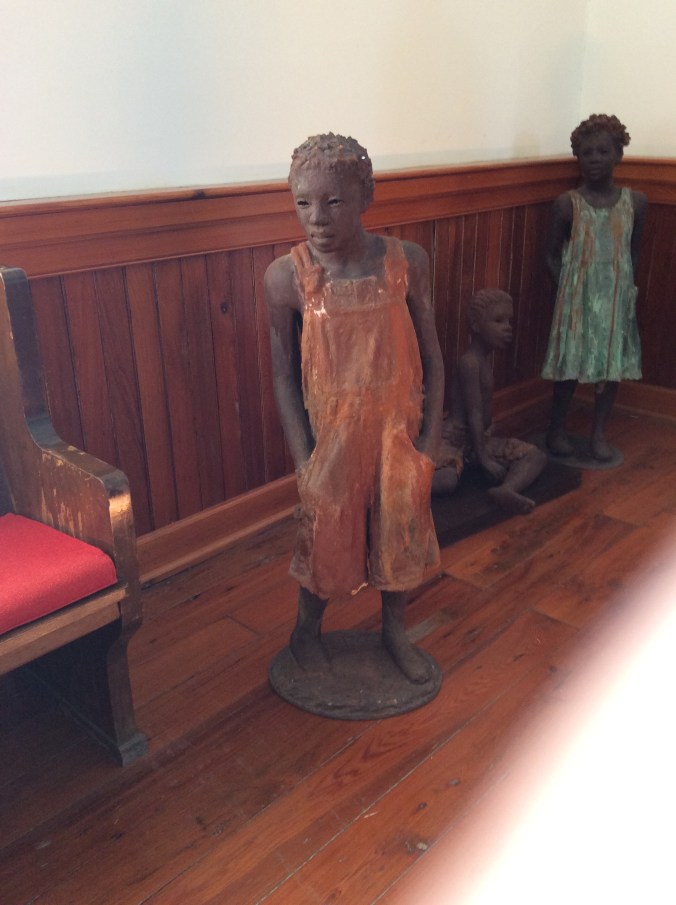
The artist created these statues from specific information about the children. The plantation owners maintained detailed inventories of all slaves and their value. This particular plantation often owned as many as 100 slaves.
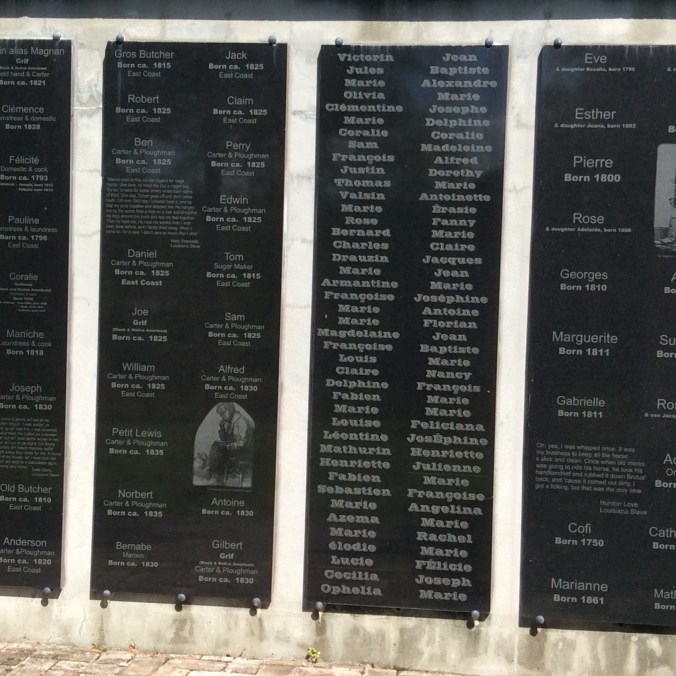
From this inventory a memorial has been created with the names of the slaves. Included are various statements made by the slaves themselves as recorded in slave narratives.
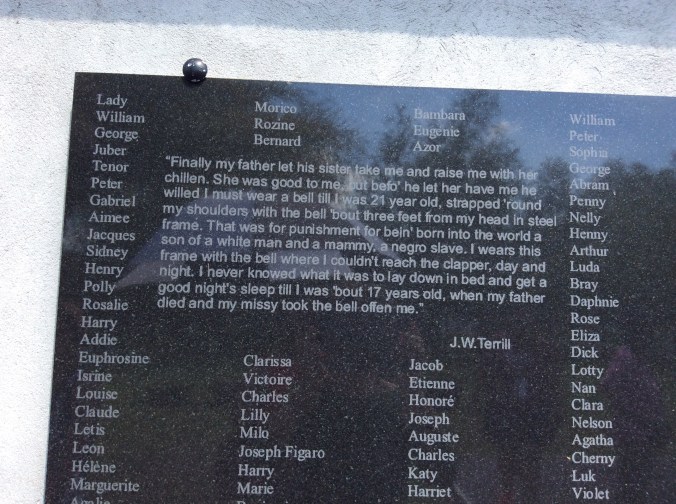
The above tells the story of a child fathered by his owner and one of the slave women and how his father treated him.
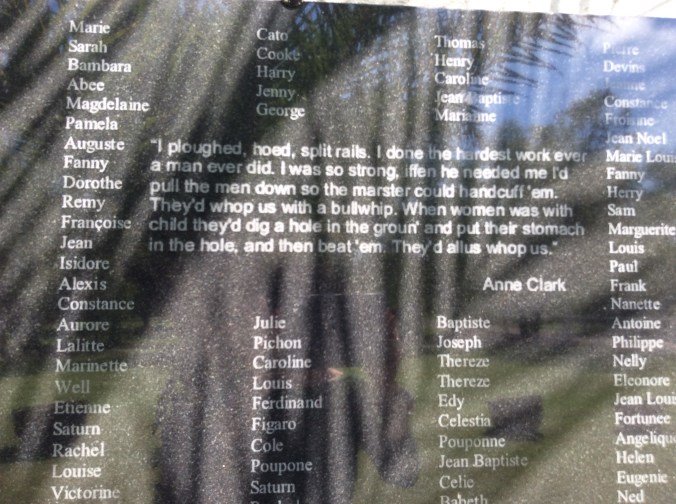
Even pregnant women could not escape beatings.
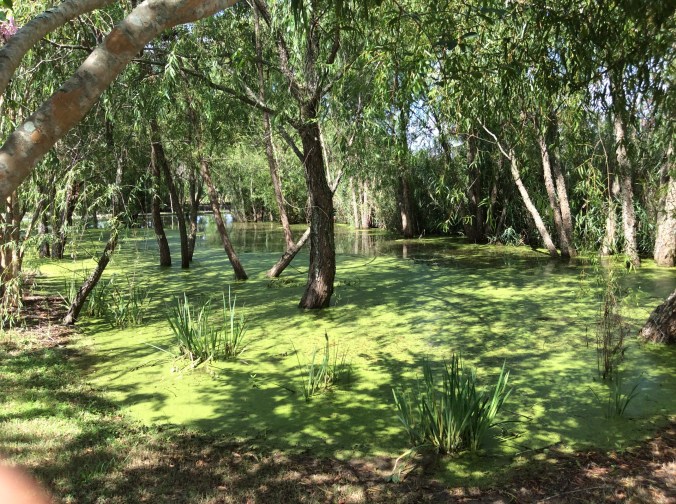 Because the area around New Orleans receives 60 inches of rain a year, the landscape everywhere is lush. This is one of several pools at the plantation.
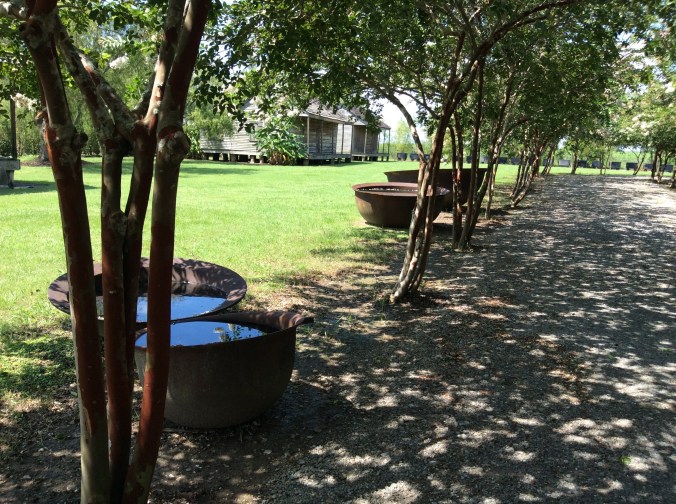
These containers cooked the sugar cane. Starting with the largest, the cane was boiled repeatedly until it cooked down and poured into increasingly smaller containers. This was especially dangerous work due to the fires, the heat, and the boiling sugar cane. Sugar cane production was much more dangerous than cotton which was grown farther north in Louisiana. The cane itself was cut with large machetes and the edges of the cane are also sharp. Many people were severely injured. The life expectancy of a sugar cane slave who worked in the fields or cooking the cane was approximately ten years from the time he or she went to work, often as young as ten. Although field slaves had a much harder life in terms of labor, they had less exposure to their owners and their families and therefore, in some ways, more freedom to talk and interact. House slaves were constantly watched and the women especially subject to sexual abuse.
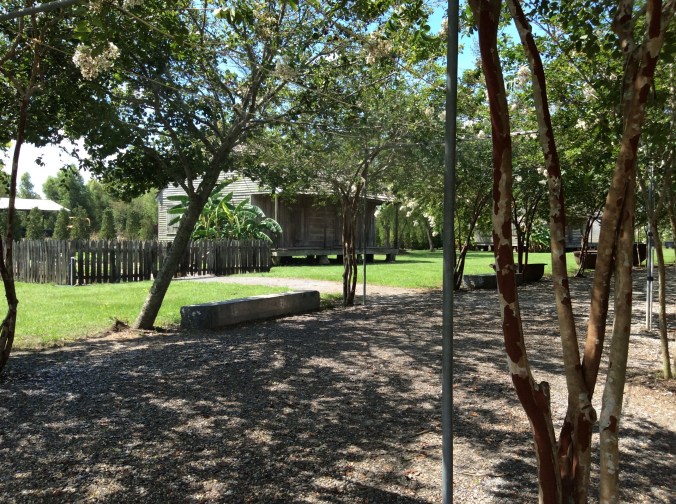
Slave cabins like this one contained four rooms. Like the main plantation house, most buildings were built off the ground. No levees existed then and the largest plantations were often built within sight of the Mississippi River and thus prone to flooding.
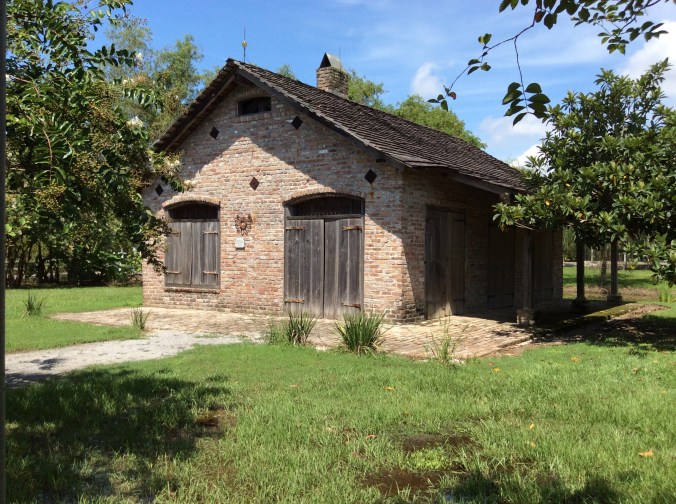
This building housed the foundry. Skilled slaves, like blacksmiths, were very valuable and received better treatment, e.g. enough food. When the movie, “Django Unchained” was filmed, part of the movie was filmed here because the adjoining plantation did not have a blacksmith shop. The branding portion was filmed at Whitney Plantation.
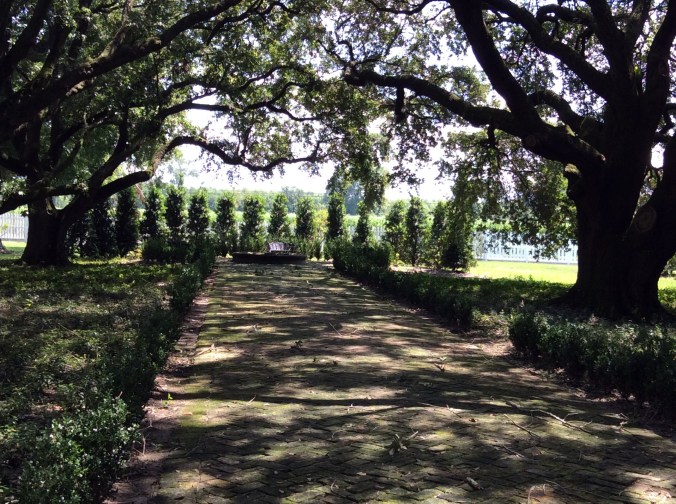
The walkway, looking from the front of the main plantation house, is lined with giant oak trees. Before the levees were built, the Mississippi River could be seen from the house.
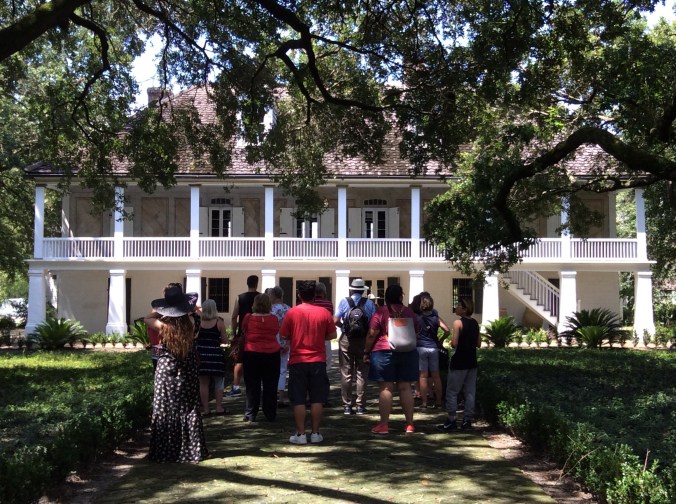
Originally, there was no first floor due to the flooding. Later, after it will built and used for dining, an office, and a living area, whenever the floods came, the slaves were required to carry everything to the second floor until the water subsided. Then they would clean the first floor of mud and debris and return the furniture there. Whitney Plantation possesses some unique characteristics, e.g. finely painted European style ceilings.
Cooking was not done inside the main house at any of the plantations due to the heat and fire danger. The cook, another skilled and valuable slave, was required to know how to cook various popular cuisines typical of the area, e.g. creole, European–French, Spanish.
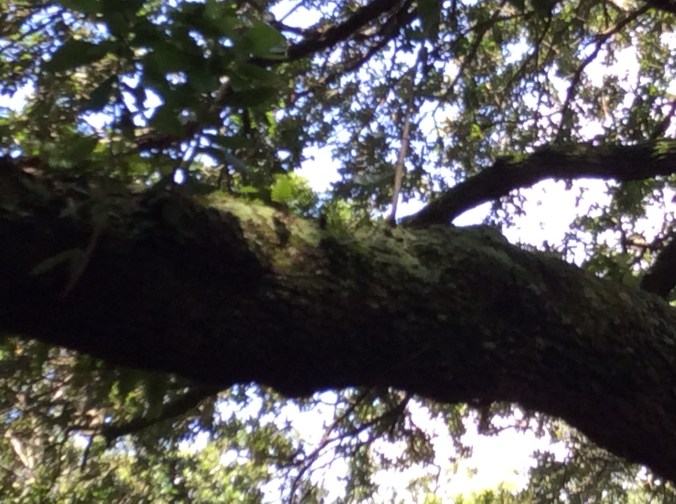
The various ferns and mosses growing from the limb of this large oak trees demonstrates the lushness and humidity typical of this area and why it is still used for sugar cane production.
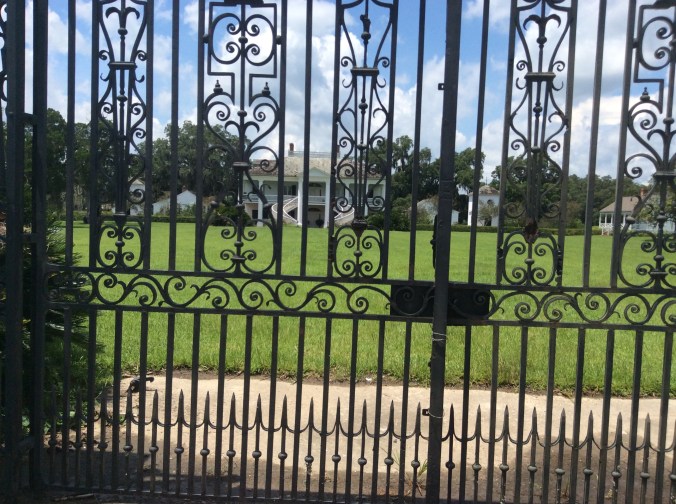
A short distance down the road is Evergreen Plantation where the main portion of “Django Unchained” was filmed. It, too, still produces sugar cane and a family lives here. Tours are available as well.
I decided the best way I should share my reverence and love for nature and this precious planet on which we live is to share photos from various countries, states, and my own little piece of wonder.
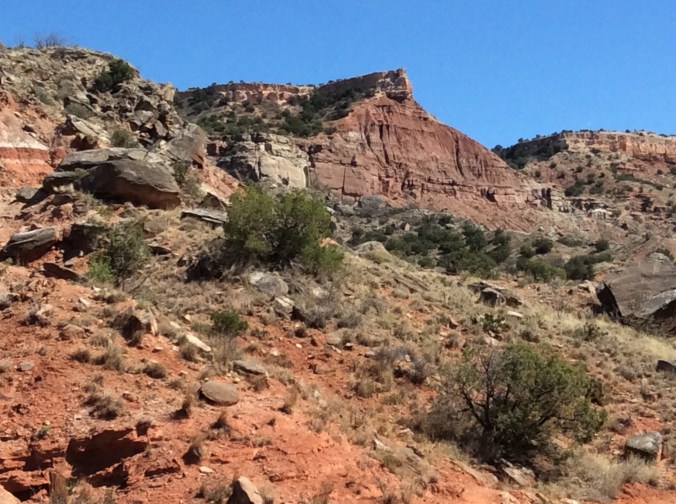


The three photos above were taken at Palo Duro Canyon State Park in Texas about ten minutes from where I live.
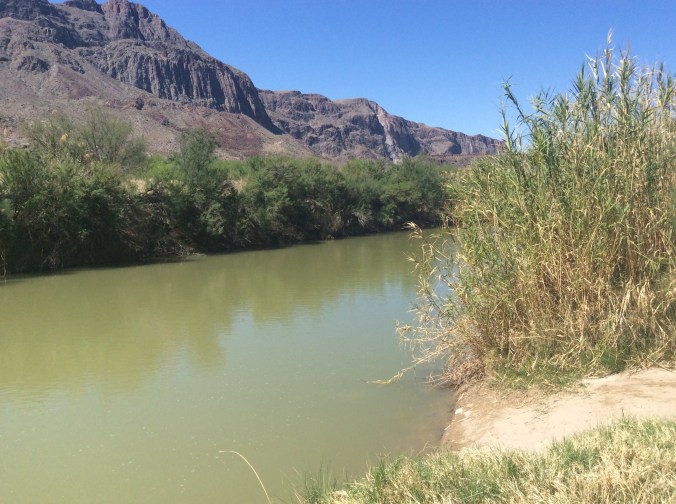
Above and below the Rio Grande looking into Mexico.


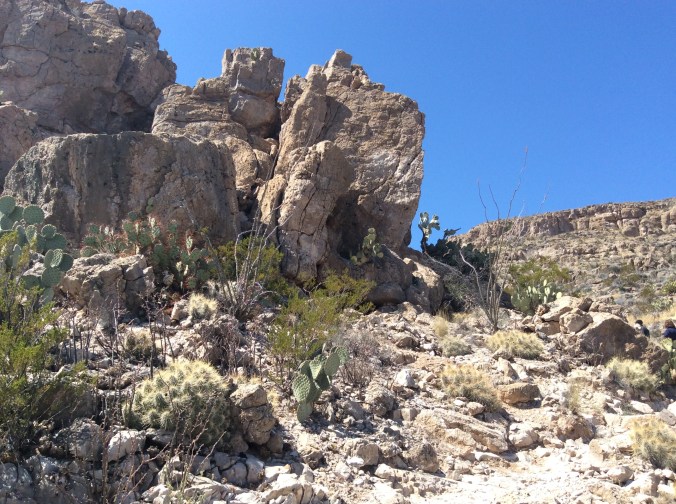
Four photos above — Big Bend National Park.
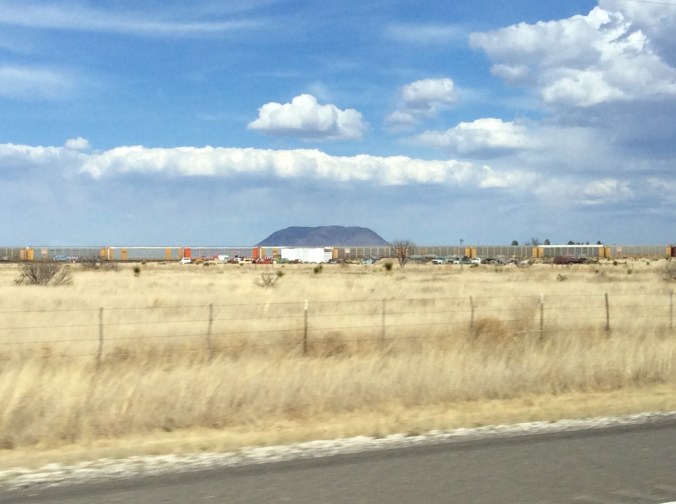
Between Marfa and Alpine, Texas.

The Rio Grande north of Albuquerque on the Santa Ana Pueblo Nation.
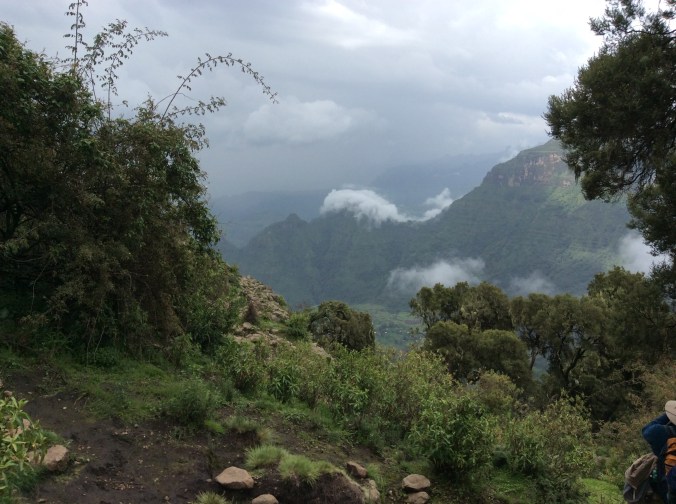


The above four photos taken in Simien Mountain National Park, Ethiopia. The animals are gelada–the only surviving grass eating primates found solely in Ethiopia. They actually “talk” to each other.
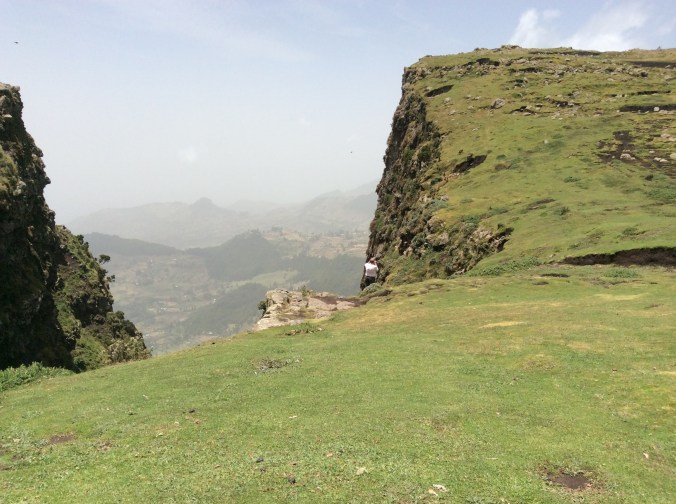
Menelik’s Window, Ethiopia
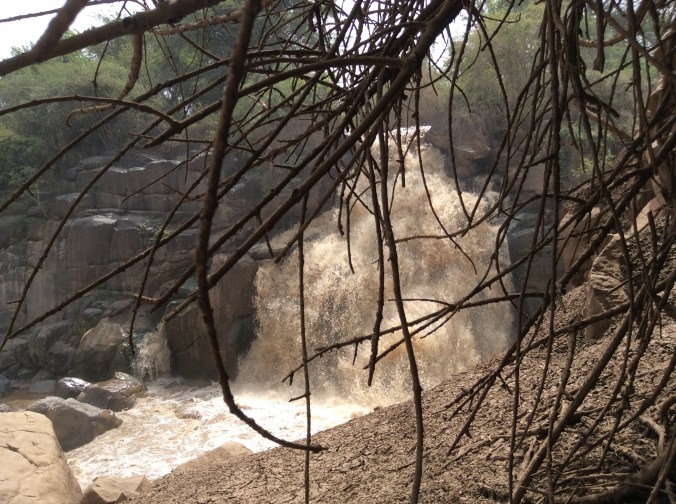
Awash Falls, Ethiopia
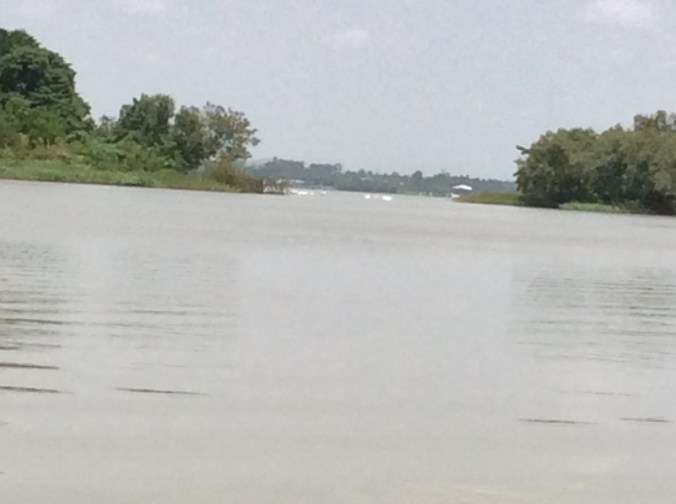
Where the Blue Nile begins draining from Lake Tana, Ethiopia


The photos above were taken at various places in Costa Rica.
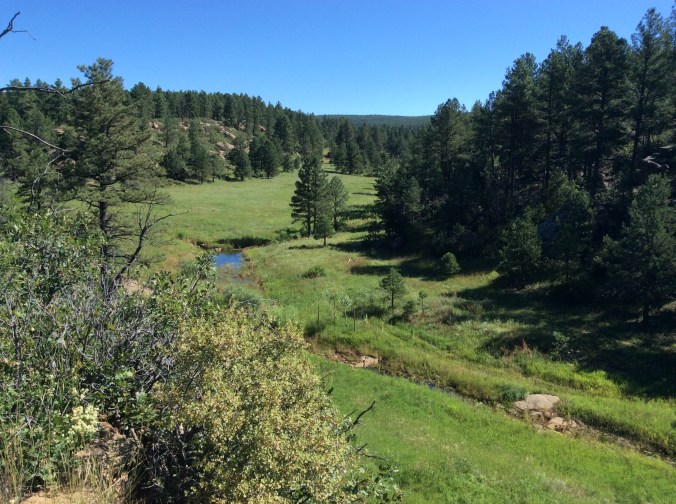
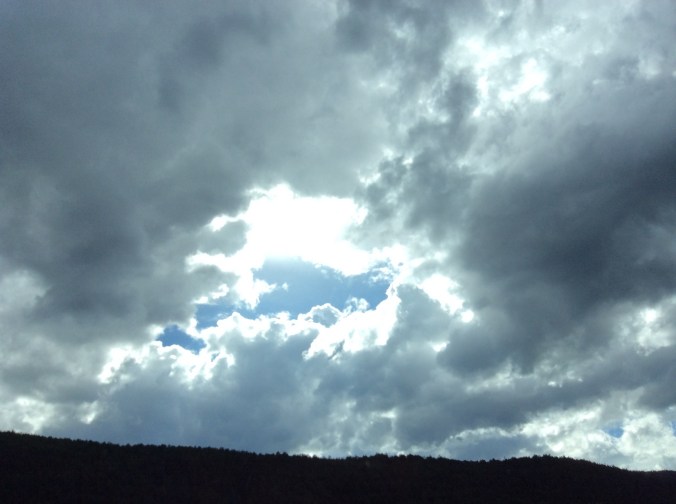
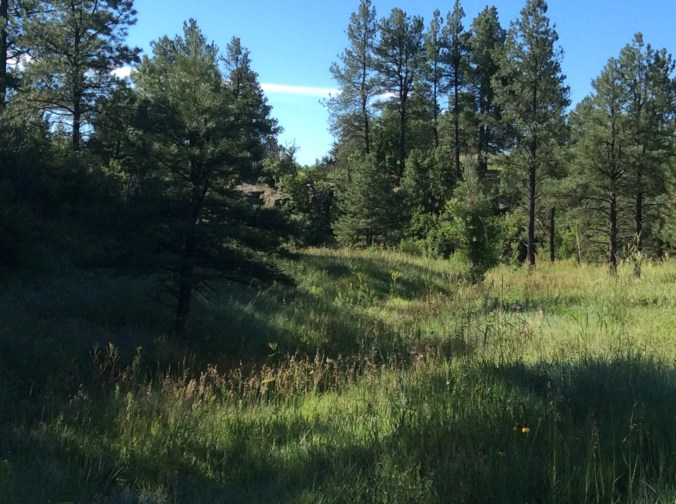
Northern New Mexico
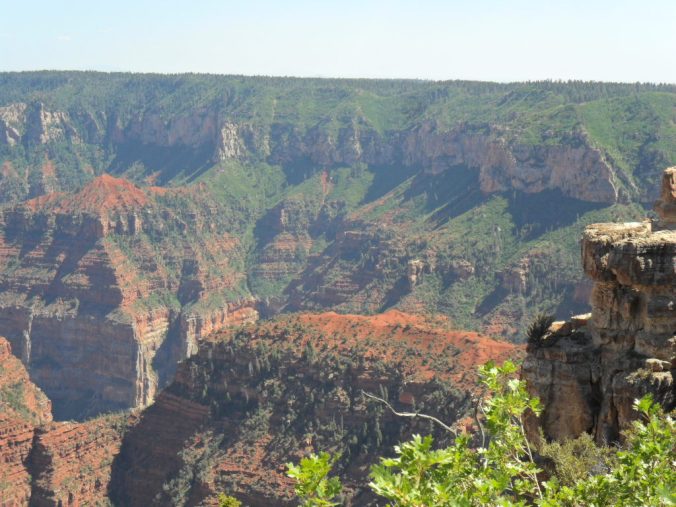
Grand Canyon North Rim
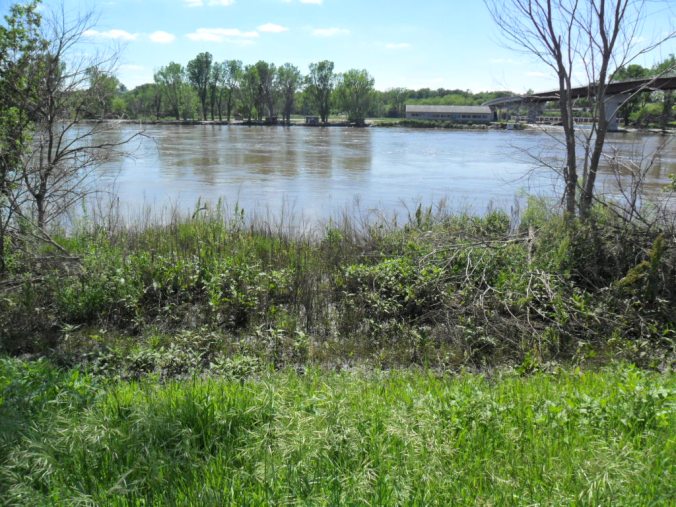
The Missouri River running full.

California dropping down from Sequoia National Monument

Near Lake Marvin, Texas


The above photos were all taken within the last year on my little rim of wonder.
And finally below, my favorite animal.
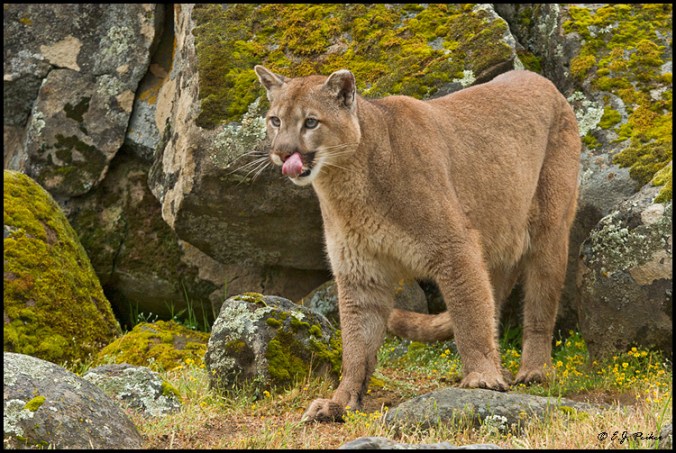
Saturday, February 18, 2017
I watched movers box up a life today, a life I thought left me thirty some years ago. I was wrong.
When our daughter and I cleaned out the refrigerator, we found a large pot filled with egusi stew, remnants of the last meal he cooked. I took the footlong, hand carved, wooden spoon, scraped the dry bits clinging to the sides of the silver pot. Scrubbing it clean, smells of memory flooded my nostrils–cayenne, bitter leaves. It took me ten minutes, ten memory laden minutes. Even after scrubbed and dried, the pot’s cayenne smell filled my nostrils, the distinct smell of West African food.
I watched movers box up a life today, a life I thought left me thirty some years ago. I was wrong.
Our daughter and I found papers and photos, items her father kept all these years, detailed memories of our life together. I could barely look at them, throat constricting, tears welling in the eyes of this woman who never cries. Our daughter, dismayed, told me to go outside. I walked down the quiet street, brown leaves scattered from autumn, unraked, a strange street both urban and rural inside a city of nearly half a million residents. Is this where he walked, attempting to improve his health? Was I walking in his footsteps?
I watched movers box up a life today, a life I thought left me thirty some years ago. I was wrong.
For those who want to explore movies, musicians, and writers many of you may never have heard of, here is a lengthy list with photos.

It’s 1pm and I’m planning my trip to Abeokuta – I leave on Wednesday. Yessss, the 2016 edition of Ake Arts and Book Festival is loading…. I’m so excited, I have butterflies, the pit of my stomach is always warm because
 That is me up there, scheduled to host a book chat with NoViolet Bulawayo and Jennifer Makumbi! Ms. Makumbi is the author of Kintu, which qualifies as the most recent addition to my all time list of favorite African fiction ever. I’m so stoked.😆😆😆.
I will also moderate this:
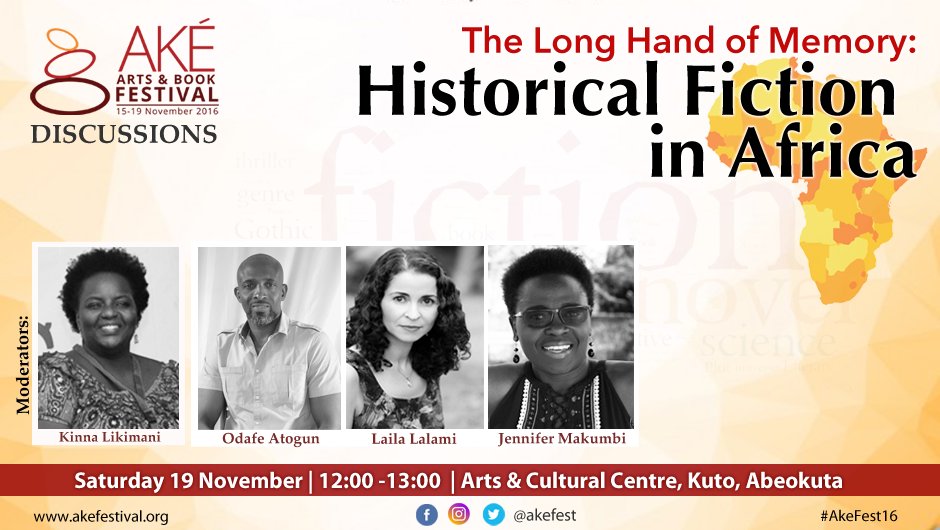 Laila Lalami, fellow book lovers!
Finally, I’m also on this:
 It’s all very glorious!
#AkeFest16 comprises 12 panel discussions, including:
 (I get to meet Sarah Ladipo Manyika (InDependence) finally…




9 Book chats such as:




 Also on the schedule are film screenings, a play and a concert:


 Ngũgĩ wa Thiong’o will headline. In boxing parlance, he is the…
View original post 168 more words
When my friend told me we were going to visit the Castles of Gondar, I thought he was kidding. It sounded too much like a movie title, plus castles in Ethiopia? Seriously. Then I looked it up and sure enough, there are a lot of them, built by a series of kings, fathers and sons, and a queen. Some remain in reasonably good repair at least on the outside. Others crumble in the rain and humidity. All are in a sort of compound arranged together.

This castle is near the entrance and in rather good condition. Restoration work is most complete here so it is safe to walk to the second floor.

The view from a second floor window. Because of the altitude and moisture–contrary to popular opinion, a large portion of Ethiopia is mountainous and green–especially during the rainy season, upkeep is not easy.

The same castle, looking out the door onto the balcony which can be seen in the first photo. The floors have been restored.

Looking in the opposite direction from the first castle, several castles and the ruins of others show the layout of the compound. Our hotel was near the top of the mountain in the distance. Many locals roamed around when we were here. It is popular to take wedding, anniversary, etc. photos here.

This photo shows the first castle–in the background–from another side.
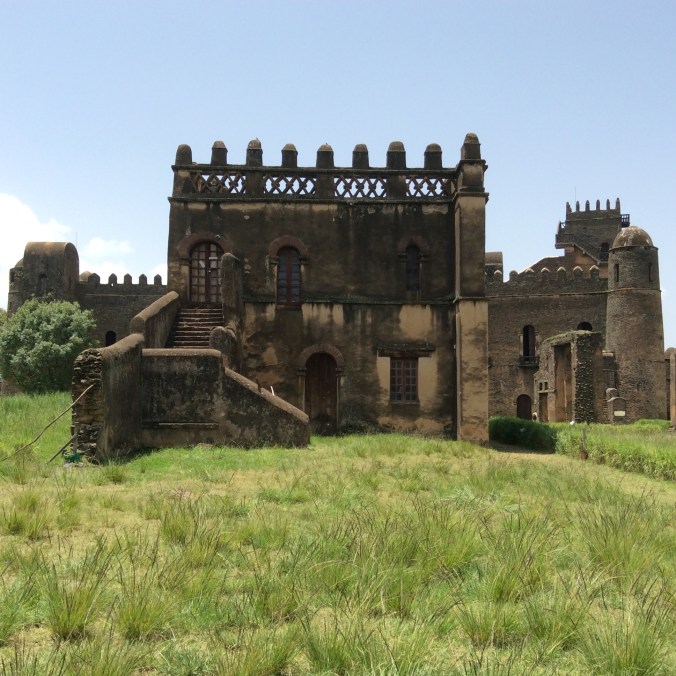
The style of some of the castles, like this one, is more intricate than others.

This building housed the royal lions. Tradition for keeping lions goes back several centuries. The last Ethiopia emperor, Hailie Selassie, was often referred to as the Lion of Judah, the latter referring to the Ethiopia tradition of believing that they are descendants of Solomon and Sheba. Ethiopian lions are a different sub-species than other African lions, smaller with darker, sometimes black, manes and tails.

These castles provide a perfect venue for photography. You can see my friends sitting on the stone wall.
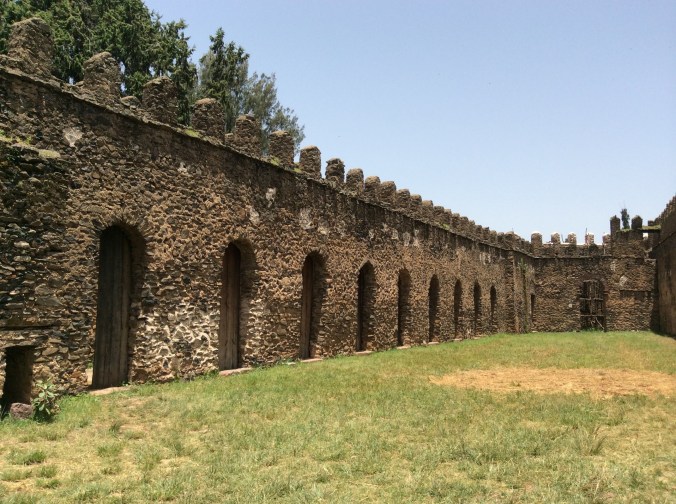
The royal stables obviously housed many horses.

The royal dining hall currently receiving restoration work.

The path to the exit.
The news the last couple of weeks from Gondar has not been pleasant. Many people have been protesting the government which they view as tyrannical and favoring one ethnic group over the others. More than ten protesters were killed during the first protest. Just this past week thousands came out in another peaceful protest.
Gondar (sometimes spelled Gonder) is a business, commercial, and education center. It is a main route for commerce between Ethiopia and Sudan. For more detailed information about Gondar, the castles, and the surrounding area, see my blog posts from Aug-Sept. 2014.
No way was I prepared for these mountains. Do you think of numerous peaks over 13,000 feet when you think of Ethiopia? Probably not. There are even a few over 14,000 feet. The whole area is often referred to as the Roof of Africa.
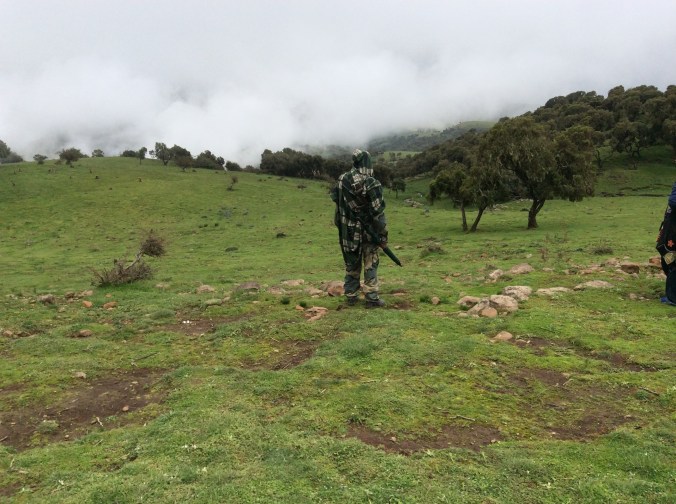
There is only one road into the park. To get in, a tourist must stop at the park office, sign in, passport number, address, etc. Plus, you will be assigned a guard and a guide. Our guard in the photo above carried an assault rifle. No, it is not to protect people, it is to protect their rare animals from people, from poachers. Wonder why he is wearing all these clothes? It is cold at 12,000 feet even if you are near the Equator.
The drop offs are terrifying, thousands of feet, the vistas endless. Even though I have lived and been all over the Rocky Mountains and been to the Himalayas in both Kashmir and Nepal, I have never seen anything like these mountains for beauty, green, and endless vistas.

My friends near the cliff are much braver than I. In the foreground stands our guide, Michael, who spoke excellent English and was super funny. He had us laughing all the time. People live and farm in these mountains–if you look closely in the middle of the photo, you can see fields. However, the government is slowly relocating people in order to make the park a refuge for rare wildlife.

The above photos were all taken on a hike early one morning. Everything was wet because it was either raining or misty or we were in the clouds.
Because I kept slipping and sliding, I decided not to walk along the cliff with my friends and the guard, who spoke the same Ethiopian language as my friend. Michael and I took off across a meadow and suddenly here we were in the middle of all these gelada baboons, who paid no attention to us at all. They were very afraid, however, of a predatory bird that decided to fly over. How do I know? They suddenly started “talking” to each other in frightened voices. Experts now think these primates actually have a language and do talk to each other. Gelada are the last primates that are herbivores. They eat grass. All other herbivorous primates are extinct. Gelada live only in the high mountains of Ethiopia and no where else on earth, a reason for a guard. At night they climb down the cliffs into caves to protect themselves from hyenas and leopards.
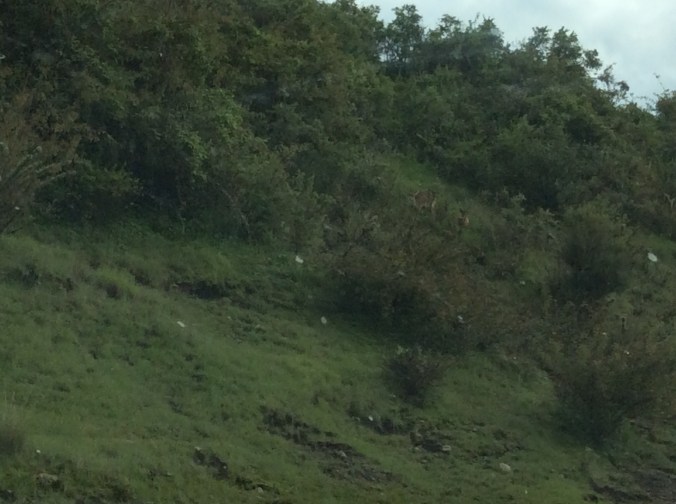
If you look very carefully in the middle of this photo, you can see several duiker which are considered so common it seems no one thought to stop to really take a look so I took the photo as we drove along.
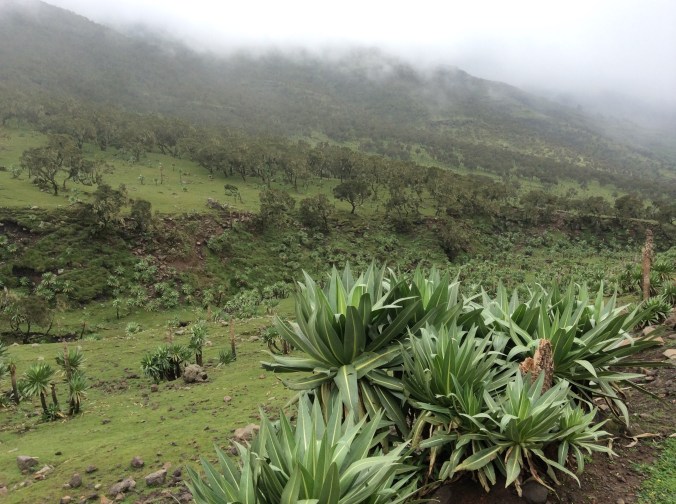
Here we are above the timberline where some very unusual plants thrive.

And some exceedingly rare animals whose camouflage makes them almost invisible until they move. At this point we are about 14,000 feet just under one of the highest peaks in Africa. Look carefully in the middle and you will see walia ibex. People come from all over the world to see these endangered animals that live only in this park. Sometimes the fog rolls in and no one sees anything. We were lucky; we saw more than twenty of them. And then the fog rolled in.

These giant lobelia thrive above timber line. Some were considerably taller than I am.

If you grow red hot pokers in your flower beds and think they are semi-arid flowers, think again. Here they are growing wild.
You can see red hot pokers in the middle of this photo by the stream. These mountain streams run down to and often across the road, making the road a muddy mess. Without 4-wheel drive and an expert driver we would have gone nowhere. In fact, at one point we did have to stop because two stuck trucks blocked the road, one of which had a flat tire.
The highest waterfall in Ethiopia is hard to hike to unless you are not at all afraid of heights. My friends did hike there. Look a bit to the right of the groove through which the water actually falls. You will see a sort of flat area. It is only a few feet wide with a drop-off on each side. Yes, that is where you hike. When I saw this view, I was rather glad I decided to wait, look for birds, and chat with the driver.

The fire pit at the highest bar in Africa is a very popular place on a cold night. Even though we had beautiful rooms, with no heat at 12,000 feet it is not exactly warm. Even the guides and guards were bundled up. The only people who seemed toasty were Scandinavian tourists with their heavy wool sweaters. The hotel staff gave us hot water bottles to put in bed with us at night. Actually, it works. Nevertheless, when you get up in the morning, it is really cold.

The guards and guides live near the park. We dropped off the guard here and watched him walk toward his house down where the trees are. We dropped off the guide near his house in the town when we left the park.
In the 12th century the king of Ethiopia decided to build a New Jerusalem. Eleven churches were carved out of solid rock on the mountain top in the village of Lalibela. A UNESCO World Heritage site, these churches remain intact and in use.

They were all carved from the rock top of the mountain down into the earth so that they remain invisible unless the person is only a few feet away. This protected them from the vision of potential invaders, usually Muslims from what is now Sudan. The above is probably the most photographed of these churches and stands separate from the others.
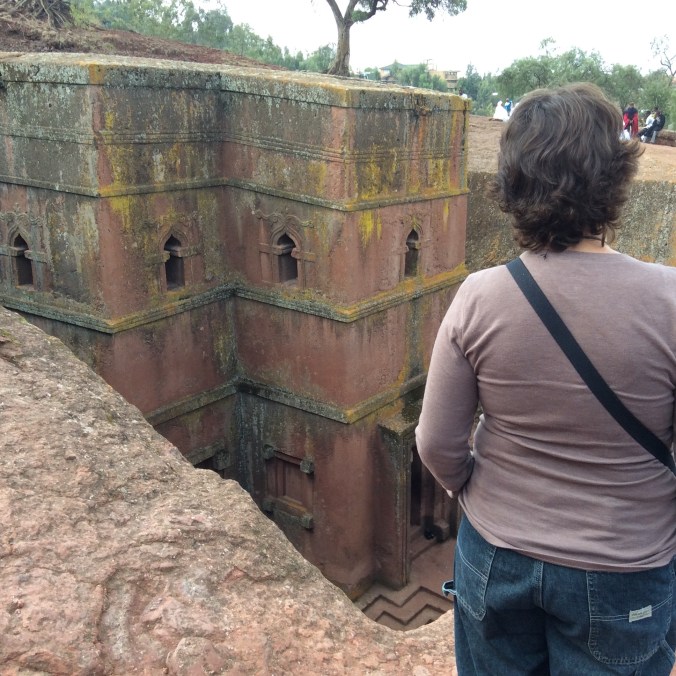
My friend is standing near where the stairs lead down to the bottom where visitors and worshippers can enter the church. Visiting all these churches in one day is not an activity for the faint of heart or for one terrified of heights.

This is the first church we visited. It still mystifies many as to how such incredibly intricate structures could me carved by hand out of solid stone. Even these columns are carved out of the rock. The “official” Ethiopian Orthodox Christian story relates how angels helped the builders.

This and most of the other churches are connected by “waterways” where in the rainy season a sophisticated system of drainage keeps all of them from flooding and makes it possible for visitors and worshippers to walk along from church to church.
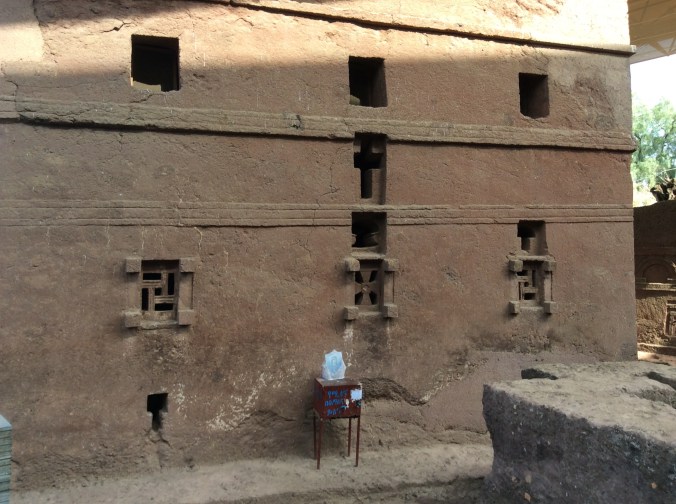
Everything in the Christian churches in Ethiopia symbolizes something related back to Jerusalem and the Bible. Even though the guide explained it all in detail, keeping up with all the symbolism proved a daunting task. Notice the swastikas. They are ancient symbols of the eternal circle of life and death. Hitler turned them backwards and into a totally different meaning. There are also many different styles of crosses there, two of which can be seen in the windows of this church.

This is a fertility pool. In the past a priest got in the water–it is very deep–with a woman who could not conceive and bless her in the water. At one point when it began to fill too much, they cleaned out the bottom and found many treasures buried there, apparently dumped into the pool to protect them from enemy invaders.

The inside of the churches are intricately carved and sometimes painted.
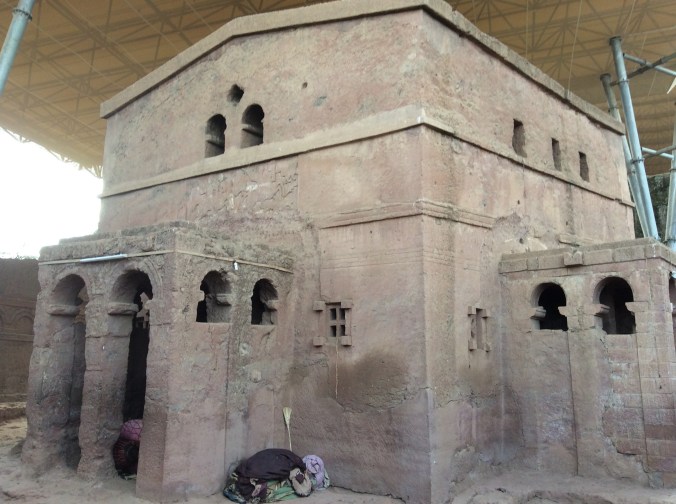
Two types of basalt exist on this mountain, soft and hard. Churches carved out of the soft basalt have begun to deteriorate and as a consequence are covered. As can be seen here, people still come to these churches to pray and attend services.
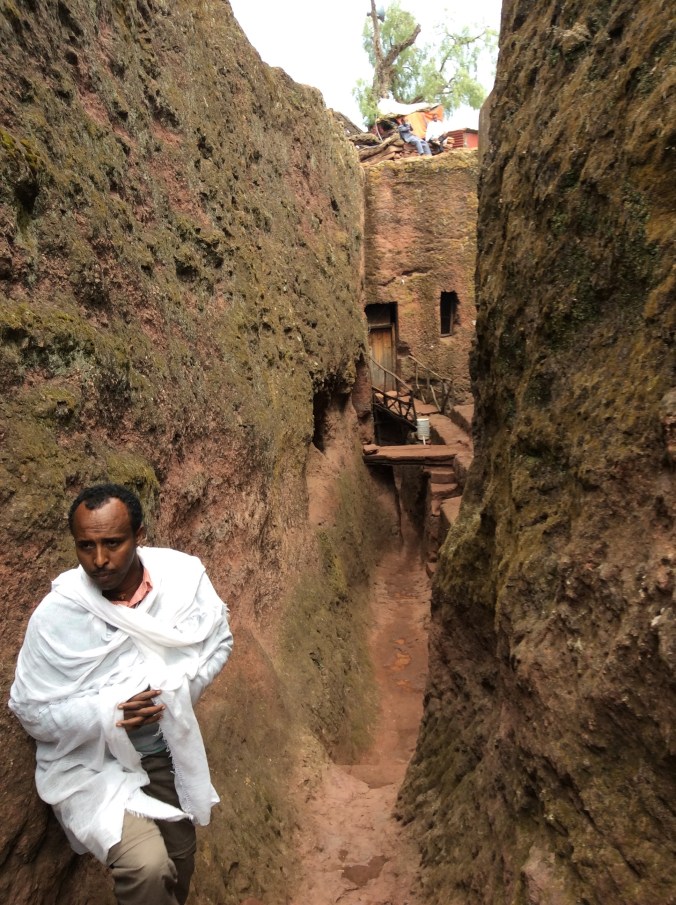
Our guide lead us from church to church through these narrow passageways which are, as previously mentioned, used to drain water away from them in the rainy season. If Ethiopia had a national color, it would be white. It is not only worn to go to church and for religious purposes but in daily life as well. It mystifies me as to how they keep whites so very white.
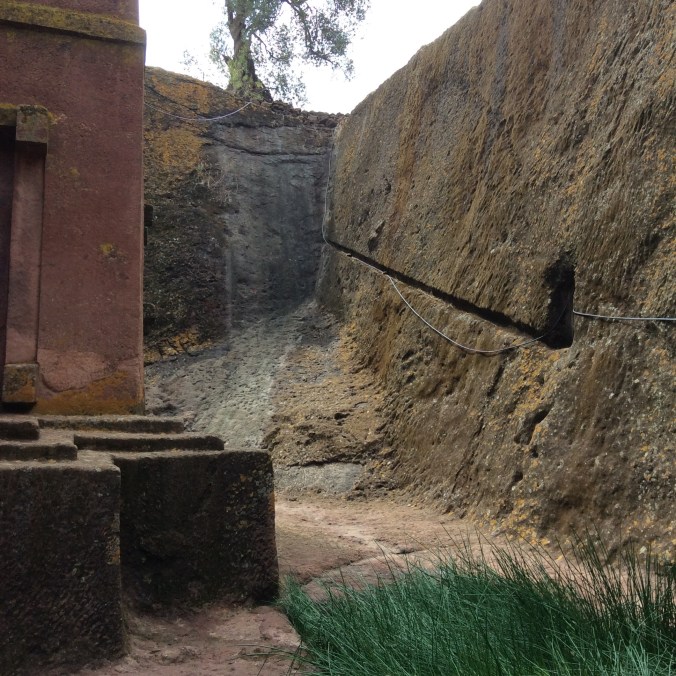
The slit dug in the rock is part of the system of drainage. The grass in the foreground grows out of a pool of holy water. While we were there, a boy filled a plastic bottle with the water and left.
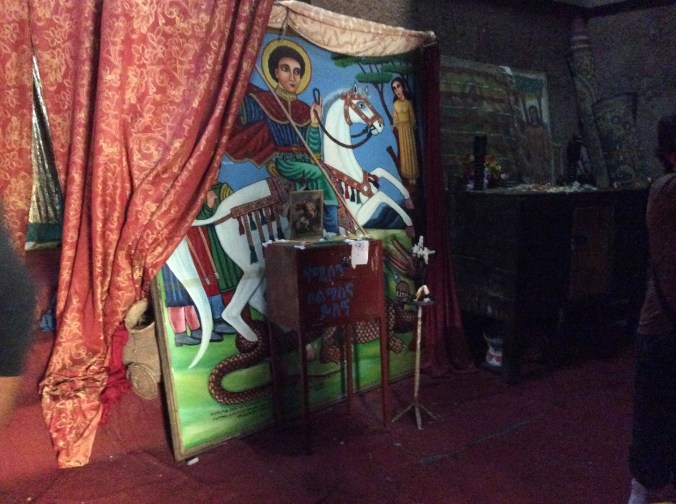
St. George and the dragon are everywhere, not only in churches but also on beer. He is the patron saint of the country, symbolizing the triumph of Christianity over paganism as symbolized by the dragon.

The carving in many of the churches reveal a sophisticated knowledge of how to work in stone. It is difficult to believe that this was carved by hand downward into solid basalt centuries ago.

The road to Lalibela is rather daunting, climbing higher and higher with no guard rails, nothing. As you can see from this photo, patchwork quilt fields cover even the mountainsides.
To learn more about Lalibela, see detailed information and explanations of their River Jordan and other religious symbolism, go to my blog posts from August 2014.
Addis is the second highest capital in the world. Only La Paz, Bolivia, is higher. To a large extent, altitude determines climate in Ethiopia. Addis and the surrounding area, much of which is high altitude farmland, receives a lot of rain this time of year and looks totally unlike what a lot of people think of when they hear the word Ethiopia–not desert but rather miles and miles of green.
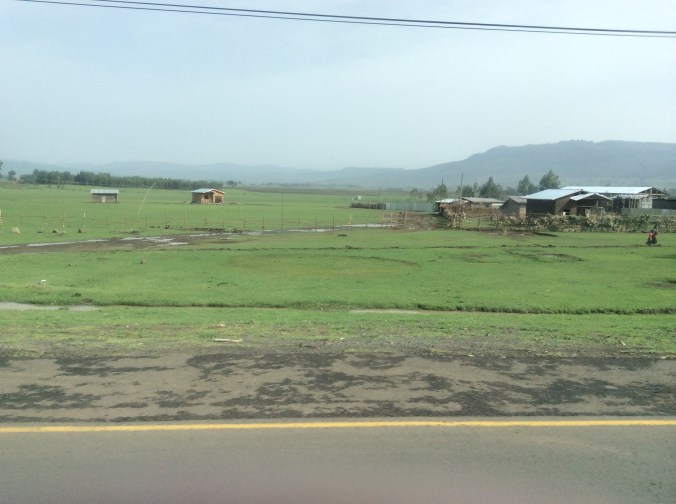

We had not driven far from Addis when we crossed a river, an area of which is considered healing. Many people had come for priests to bless them and to experience the healing power of the water.
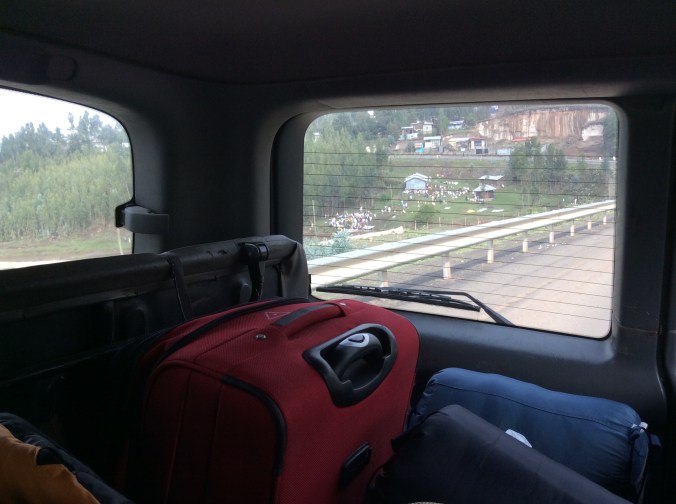
I saw only three tractors in ten days of criss crossing farmland. Why so few? One reason is rocks. Many of the fields remain rather full of rocks in spite of many having been removed.
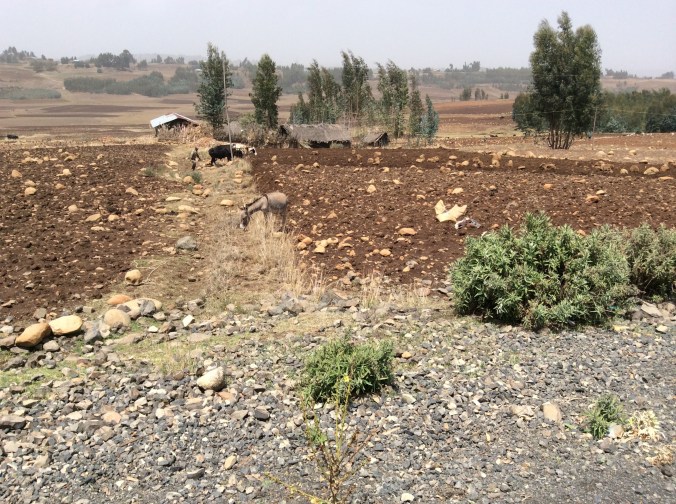
Therefore, they farm the “old fashioned” way; horses or cattle pulling plows with a human behind.
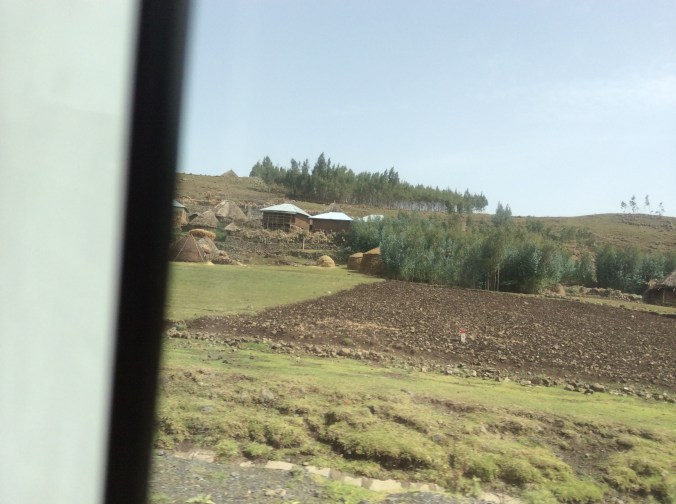
Houses in the villages in the farming areas demonstrate old ways alongside new.
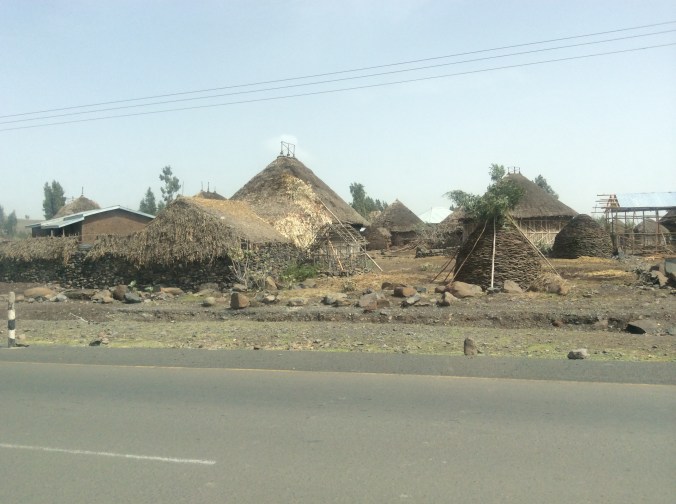

Winnowing the way we did in the USA a century ago.

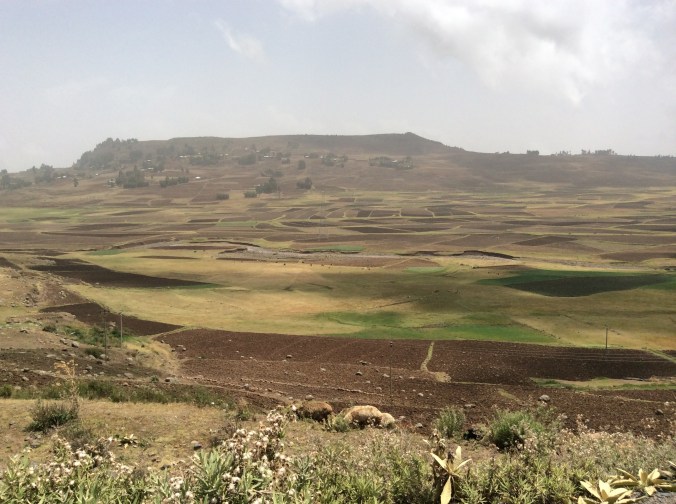
Much of the farmland is a picturesque patchwork quilt of browns and greens.
Before dropping down to lower country, we drove by Menelik’s Window. The drop off here is steep and far. I did not go near it–I had not yet become used to the endless drop-offs or even realized that I would need to do so. This is one of four places in Ethiopian where you can see gelada baboons. They are extinct elsewhere. Menelik was an Ethiopian emperor. This “window” allows one to look from the high country for miles and miles to the landscape beyond.
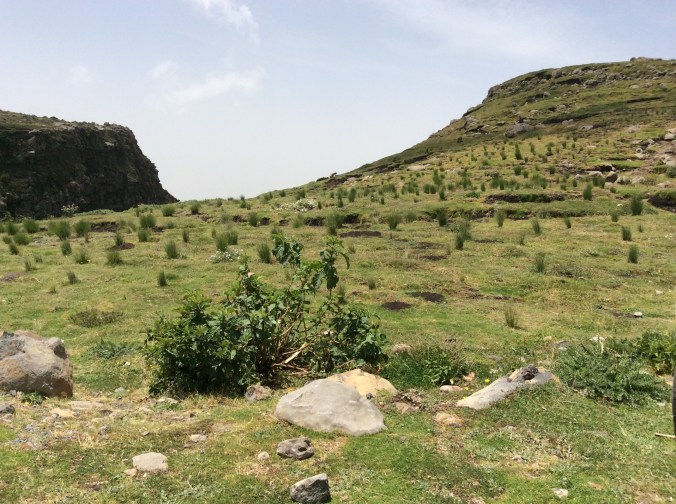
The large tufts of grass provide food for the gelada which are grass eating herbivores, the last of the grass eating primates. All others are extinct. This same grass is used by the locals for roofing material so boys stay in these areas all day chasing off the baboons.

To keep themselves busy they weave woolen baskets and hats to sell which they display in the grass.
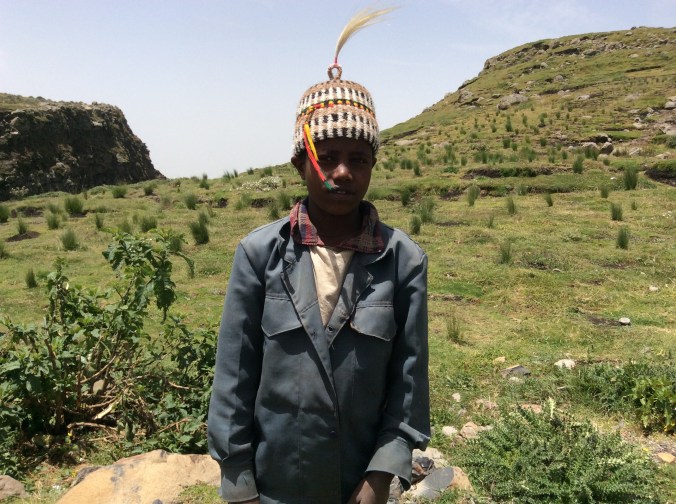
This ten year old boy happily donned the hat he had made. I bought it for my grandson who was the same age when I took the trip.

Except for the different vegetation, driving down the mountain looked a lot like driving through Colorado.
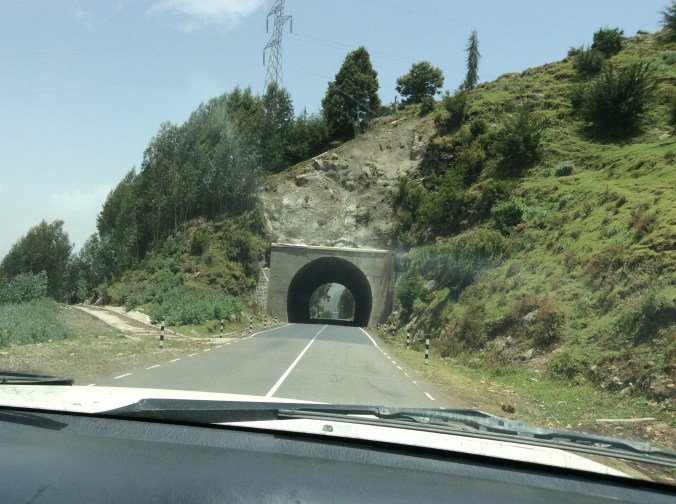
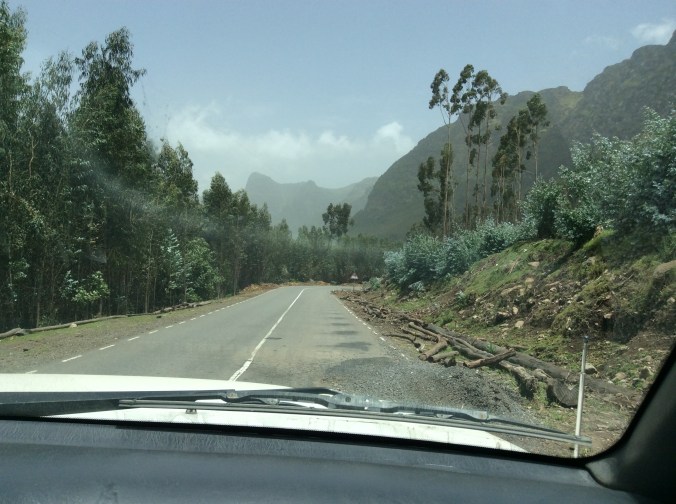
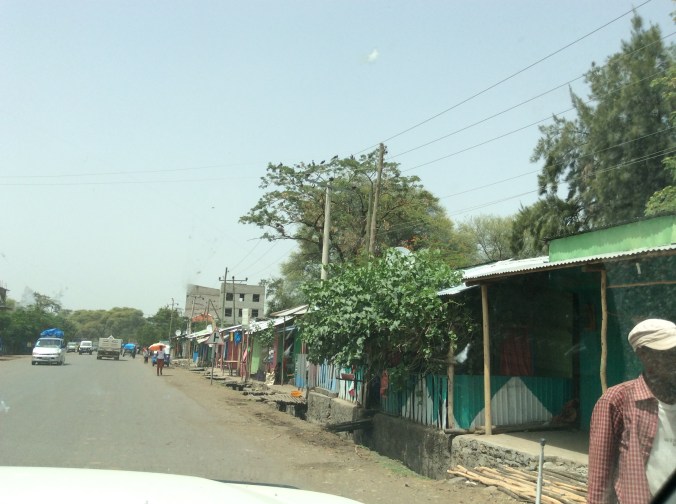
Down from the mountain the landscape appears quite different and considerably drier. We drove through several smaller towns on our way to Debre Birhan where we stayed the first night.
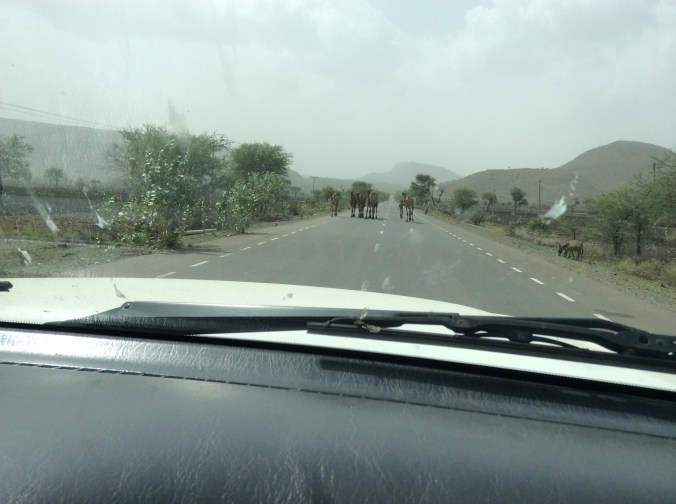
Driving in Ethiopia requires navigating around animals. Everyone drives their cattle, camels, horses, all livestock down the road whenever possible. The roads are generally very good. Many, built by the Italians, have stood the test of decades.

Along the road we saw many of these “apples”. My friend told us how they played with them as a child. However, the adults all warned the children not to touch their eyes when they did–it will make you blind. They are called Apples of Sodom–so many things in Ethiopia have symbolic meaning.

These fruit could be seen all along the road and even on the road. After driving through this drier area we rose above a huge valley with miles and miles of grass.

A semi-nomadic group brings their immense herds of cattle here in the rainy season to graze. When we drove further on above the valley, I saw the first tractor working a field as big as this grazing land.
Travel the World 4 Less
A Glimpse into My Life & Passions
Ceto-Magoism, the Whale-guided Way of WE in S/HE
Exploring the F-word in religion at the intersection of scholarship, activism, and community.
ANCESTRAL FOOD. HERBAL WISDOM. MAGICAL COOKERY. SEASONAL CELEBRATION.
inesemjphotography
politics, engineering, parenting, relevant things over coffee.
Food is the best expression of every emotion. Explore through my reviews, recipes, events and more.
Smile! A Site for Friends Wherever You Are!
inspiring personal growth through poetry and writing
Combining atheism with whimsy. This is a Fair and Balanced blog based on opinion unencumbered by fact.
Odds and ends ~ My Life
Original poetry, commentary, and fiction. All copyrights reserved.
bripike@gmail.com
A wildlife filmmaker in Africa
A Geeky Feminist's Musings On Pop Culture
"5 minute walks"

 writingontherim