Modern Literature


Gaden’s quiet.  Normally he is shouting, asking questions to which he knows the answers.

I’m thinking, “He must be sick.”

Today he is sitting quietly, feet splayed out, short ginger hair sticking out exactly like Alfalfa’s, chin balanced on his left hand, staring at the silver Apple laptop open on his desk.

We’re reading modern stories in English, stories by Kelly Link, Kevin Barry, Adam Marek, Sarah Hall, Jon McGregor, Jennifer Egan.

Ghosts, robot boyfriends, fake lovers, bull semen distributors.

Astonished reactions, “We get to read adult stories with cuss words!”

They’re seniors in high school, 17, 18, 19.

Two are pregnant; one’s a dad.


Human Trafficking


Slaves today outnumber all the past,

more than thirty million.

Eleven year old girls,

locked in motel rooms, never see light,

told you’re a whore, worthless, until

they believe it.

Respectable hotels, brothels in disguise.

Senegalese boys chained in hovels, fake

madrassas, sent to beg on streets.

Texas parents of three daughters, forcing them

into prostitution for drugs. Everyone knows;

no one can catch them.

Famous men running sex slave rings, immune

from prosecution.

Young women who think all men watch

pornography; it’s normal.

Innocence promised, endlessly betrayed.

People as commodities.


The Mabel Dodge Luhan House in Taos


For years I had read and heard about this place, even attended a lecture by a descendent of one of her frequent guests who actually knew her when he was a child.  This past weekend good friends from Rociada took me there with my best friends from college years, friends from long ago, visiting from California.

I already knew something about Mabel and her friends, famous people who frequented her salon, created the artistic mystique that still hangs over Taos.  When I returned home, I wanted to know more.  Born into Buffalo, NY, high society, she had been married and widowed by the age of 23.  As a young woman she was openly bisexual; her memoir, “Intimate Memories”, provides a frank discussion of this part of her life.  Several years after her first husband’s death, she married the architect Edwin Dodge.  They lived near Florence, Italy, for seven years where she entertained such notables as Gertrude Stein, Alice B. Toklas, and Andre Gide.  After affairs and two suicide attempts, she separated from her husband and moved to Greenich Village.  Eventually, she married her third husband, the painter Maurice Sterne and became a patron of the arts.

In 1917, she and her husband moved to New Mexico.  This changed her life; she lived there until she died 45 years later.  She preferred Taos to Santa Fe, finding the latter “too civilized”.  She found New Mexico “alive” and fell in love with Pueblo culture eventually even cutting her hair to mimic Pueblo style.  Sterne did not find New Mexico to his liking and left.  After their divorce she married her long standing love, Antonio Luhan, a Taos Pueblo man.  They remained married 40 years.

Mabel entertained a nearly endless array of famous artists, writers, and intellectuals:  D.H. Lawrence, Georgia O’Keefe, Willa Cather, Ansel Adams, Carl Jung, Emma Goldberg, Margaret Sanger, the founders of the Taos Society of Artists.  She introduced New York and the east coast to New Mexico through her columns in “The New York Journal”.  Mabel died in 1962.

IMG_2284

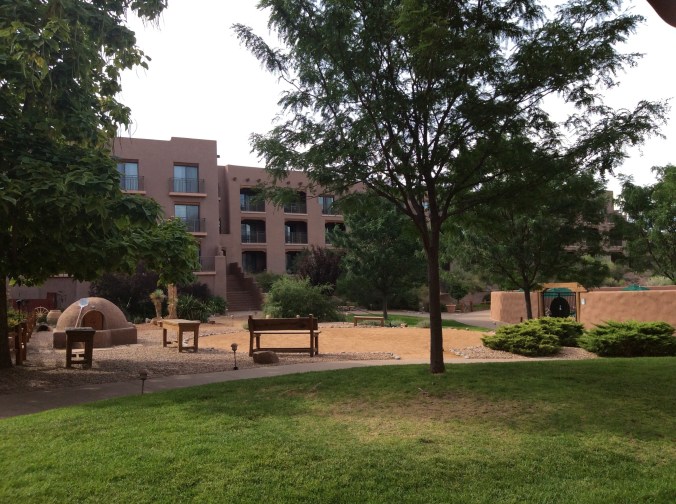
A view of the main entrance and the largest portion of the house and grounds.

IMG_2274

A small portion of the kitchen.  Cookies, coffee, fruit infused water, and tea were available in the dining room for hotel guests. Books with historical photos lay out for visitors to read in an adjoining room.

Dennis Hopper bought the house in 1970 and recreated her “salon” hippie style.  In 1977, he sold it to George Otero.  Because of years of neglect, it required extensive restoration.  The Oteros turned it into a non-profit where they held workshops.  The Attiyeh Foundation, its current owners, purchased it in 1996 and run it as a hotel and conference/retreat center.  It costs nothing to visit and wander around.

IMG_2281

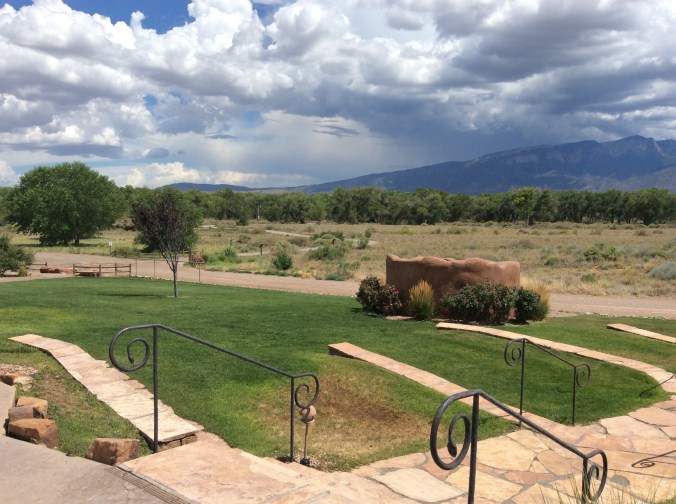
This photo was taken from the same spot as the first one, looking to the right instead of toward the entrance.

IMG_2282

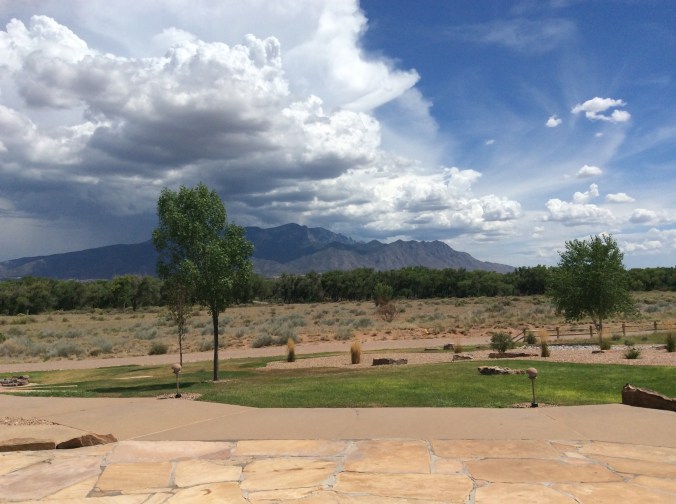
While standing there, I looked up into that incredible New Mexico sky.

IMG_2279

A close up view of the entrance.

IMG_2276

Look at all the bird houses.

IMG_2275

Beside the kitchen, out a side door–patio and horno (traditional clay oven) shaded from the afternoon sun.

IMG_2277

IMG_2280

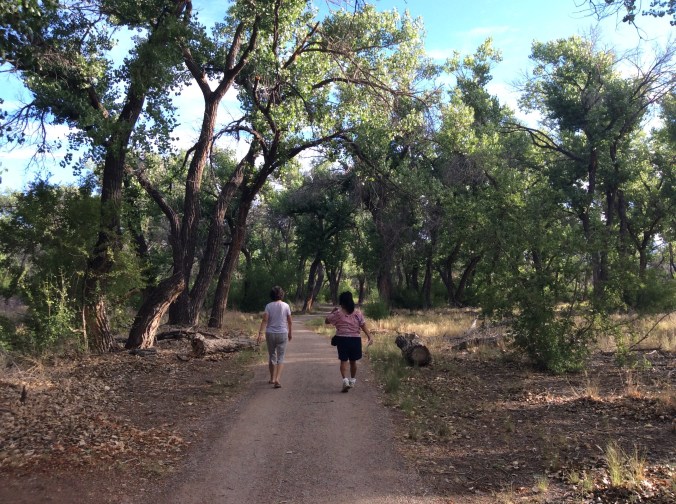
Friends chit chatting while I wander around taking photos.

For more details, go to:   http://www.mabeldodgeluhan.com.  This includes history, accommodations, workshops, etc.  The accommodations portion even tells the site visitor who slept in each room when visiting Mabel.


Sacred


Warm summer raindrops on my face

Crimson cardinal drinking in blue birdbath

Feather grass waving in the wind

Last lavender and white iris before first frost

Cups of coffee from Chiapas at 6 in the morning

The sunning rattlesnake lying by my feet

Horses running wild and free

Facebook messages from friends far away

Waterfall’s roar after the thunderstorm

Night songs–coyote, cricket, nighthawk, frogs, hoot owl

Life

Sunday Sunrise ©Dawn Wink


Feministing Sarah and Hagar by Vanessa Rivera de la Fuente


This resonates with me in part because I am working on a set of poems written from the viewpoint of these and other Biblical women rather than from the viewpoint of the males who “wrote” the Bible.

Vanessa Rivera de la Fuente's avatarFeminism and Religion

sarah_hagarOne story that has marked my life as a feminist is that of Sarah and Hagar. This is a story of pain and enmity among women under patriarchy that despite its age, is still relevant to illustrate the negative effects of the androcentric socialization. But it can also hold an inspirational feminist reading that leads us towards a reflection on the amazing possibilities of a shift in the way we women look at each other.

Feminism is a political practice, an ethics for living based in an option for women. It is not or should not be a Diploma, a chair where to work from 9:00am to 5:00pm, or an excuse to act from our own privileges against other women. In private and in public, in academia or in the street, in sexual, cultural, intellectual and religious affairs, a feminist is a feminist, without excuses or regrets.

This year I was part of…

View original post 867 more words

Contemplations, High School Seniors–May 18


Rarely do I go ten days without posting on my blog.  I teach English IV in high school.  Most people think students want to graduate, will do what it takes to do so.  Such is not always the case.  Ten days ago, at the time of my last post, at least ten per cent of my senior class members did not have passing grades.  When the school looked at all classes, including math, the percentage hit 47.  Hard to believe, I know.  After nearly harassing students about missing papers and their grade, emailing parents, and hunting students down during other classes and the hallways to remind them, I am down to only a few not passing.

Several types of students exist, including those who work hard and care no matter what, those who think a miracle will occur and they will pass no matter what, and those who really do not care all that much and think whatever, it won’t matter.  Today we had Senior Day.  As a teacher delegated to go, I spent from 8 to 4 with nearly 90 students between the ages of 17 and 19.  All the above groups presented themselves to jump endlessly at a trampoline club and later at the local university athletic center to engage in the activity of choice.

Some students demonstrate the social ability to move from group to group comfortably.  Others, like several young women with whom I walked, exercised on various machines, and then played racket ball, feel comfortable chiefly with close, at least somewhat serious friends.

This leads me to contemplate what creates career success in life.  Social dexterity helps as does a decent work ethic.  Intelligence matters also.  The more adept combine all these.  Is it possible to find success if these are lacking?  It depends on the chosen career and what the individual wants to achieve.

Last year some of the smartest students, especially females, made choices that in the short run cut off their academic life.  Some are working, some waiting for a baby to be born.  Several who demonstrated less academic acuity in high school have finished their first year of college quite successfully.  Some of their choices continue to mystify me.

Yesterday, a freshman commented to a senior that freshmen year does not matter much.  The senior, who does have ambitious college plans, immediately corrected the freshman.  He expressed regret at not taking high school more seriously sooner.  It does matter.  Choices a student makes as young as 14 and 15 can affect the rest of his or her life.

The question I keep thinking is this:  how do I as a teacher help them make wise decisions?  The literature we read aptly demonstrates the effects of both good and bad decisions.  Does that help?  How many will only learn through life’s hard lessons?


Note:  Four female students who do care walked into my classroom yesterday and presented me with a red rose bush ready for planting.  I will plant it this weekend.


Barbie Doll


This poem praises my mother.  It is page 17 of my memoir in poems, “On the Rim of Wonder”.  It seems appropriate to republish it here for Mother’s Day.


Barbara Lewis Duke, pretty, petite, blue-eyed, and blond, my mother,

one fearless, controlling woman.  Long after Mom’s death, Dad said,

“Barbara was afraid of absolutely no one and nothing.”  They married

late:  34 and 38.  He adored her unconditionally.  She filled my life

with horses, music, love, cornfields, hay rides, books, ambition.  Whatever

she felt she had missed, I was going to possess:  books, piano lessons, a

college education.  Her father, who died long before I was born, loved fancy,

fast horses.  So did she.  During my preschool, croupy years, she quieted my

hysterical night coughing with stories of run away horses pulling her

in a wagon.  With less than 100 pounds and lots of determination, she

stopped them, a tiny Barbie Doll flying across the Missouri River Bottom,

strong, willful, free.

Modern Politics and Sor Juana Ines de la Cruz


Who would think that a Mexican woman who wrote poetry more than three hundred years ago would have anything applicable to today’s political arena?  About one and one half years ago, my daughter returned from a business trip with a little gift, a translation of Sor Juana’s work.  It is not the sort of literature I sit down and read all the way through.  It is deep, questioning, the sort of literature you savor here and there.  A few minutes ago I opened the book once again to read one of her ballads–typically referred to as romances.   However, this is not exactly a romance.  It reads:

“One who is sad criticizes

the happy man as frivolous;

and one who is happy derides

the sad man and his suffering.


The two philosophers of Greece

offered perfect proofs of this truth;

for what caused laughter in one man

occasioned tears in another.


The contradiction has been framed

for centuries beyond number,

yet which of the two ways was correct

has so far not been determined;


instead, into two factions

all people have been recruited,

temperament dictating which

band each person will adhere to.”


This is only a small portion of the ballad.  It is ballad 2 in the translation by Edith Grossman.  The introduction to the book is by one of my favorite authors (I have read all her books published to date), Julia Alvarez.