Book 37 for 2026: “Women Without Men”, Shahrnush Parsipur


Shahrnush Parsipur, a renowned Iranian writer, died this summer at the age of 80. In Iran her fiction was considered subversive, so much so that she was imprisoned repeatedly (one time for nearly five years) by both the Shah and the Islamic Republic. This year, this novel, Women Without Men, was published for the first time in the UK and was long listed for the Booker Prize. Her prison memoir will be published in 2027.

“Women Without Men” is set in Tehran during the 1953 coup d’stat. It links the stories of five women who seek refuge from patriarchal oppression in a garden. However, before they “find” the garden, their varied lives from upper class to prostitute to rural peasant demonstrate the hypocrisy and oppression toward women in Iran. This novel, like several other Iranian novels I have read, contains elements of magical realism, e.g. mind reading and the ability to fly. Much of the novel also contains elements of satire. I found myself laughing .

With the exception of a somewhat eccentric gardener, the men in the novel are not portrayed in a very favorable light. For example, one 40 year old man insists on marrying a much younger woman because he thinks she must be a virgin and chaste and rejects an older woman who actually cares for him. The real virgin is the older woman, not the one he marries.

Although the novel focuses on Iranian society, many of the themes apply worldwide wherever there are issues of class, women’s rights, oppression of the poor, etc.

I Live in Beauty on the Rim


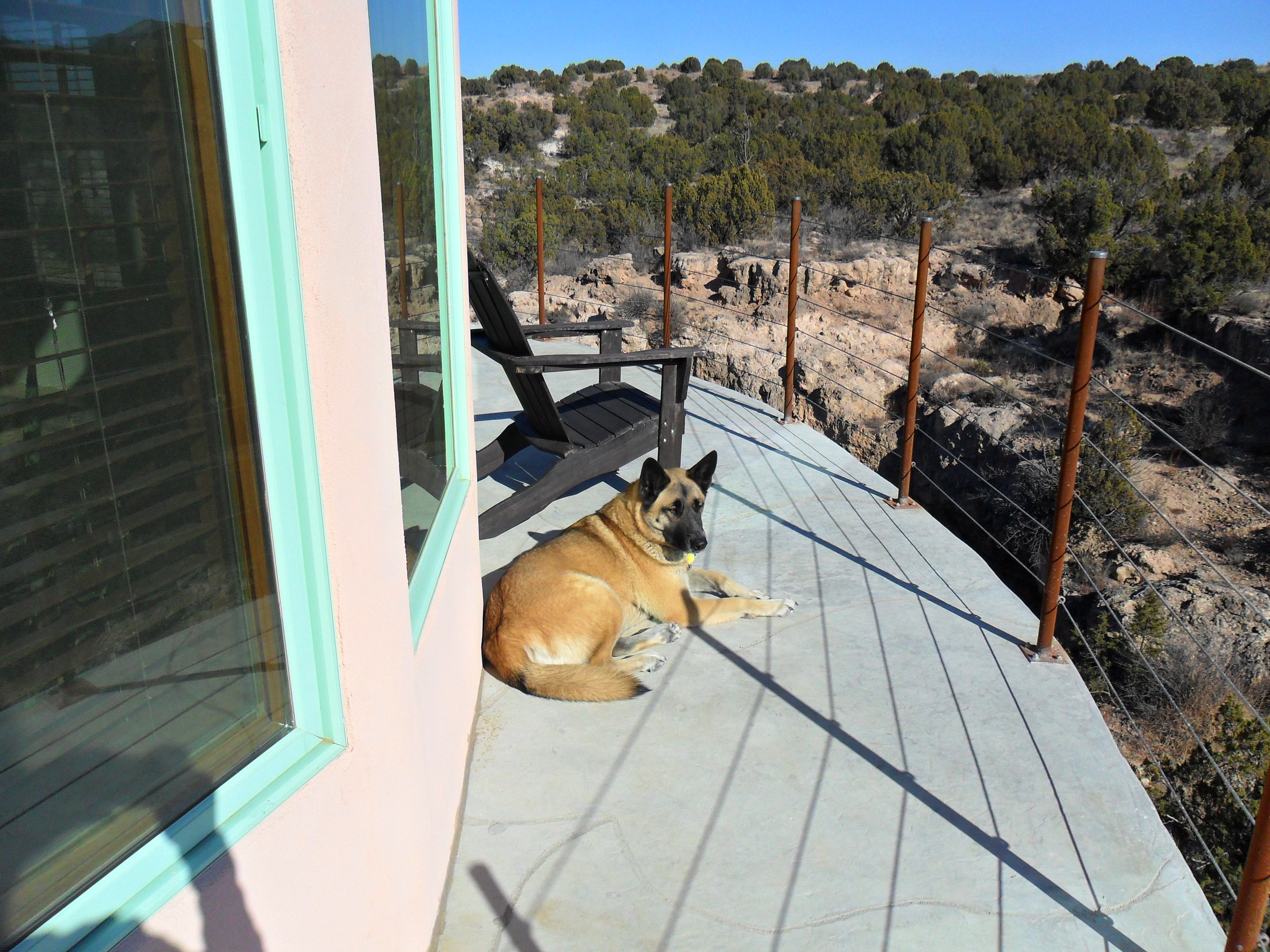
A number of years ago I lived on a canyon rim in the Panhandle of Texas, a side canyon to Palo Duro Canyon, the second largest canyon in the country. I wrote this poem when I lived there.

The canyon edge looms out my bedroom windows,

pale adobe, stark.

Fall to death or serious injury.

I will not fall; I love living on the edge.

Rain brings a one hundred foot deluge,

roar of water, red adobe, cascading, screaming.

Someone said my house is pink; it is not pink.

Color of canyon, worldwide color,

Moroccan, Pueblo, Saudi, Mali, Navaho, Timbuktu,

desert alive and lovely.

Everywhere.

Three bucks watch me through my bedroom windows.

They see me move; they stare.

Isabella stands, rigid, watching…what?

I kneel to her level, follow her eyes.

Bobcat casually climbs the canyon wall, impervious.

He marks the juniper tree, walks a deer path,

disappears, secretive, rarely seen.

The huge hoot owl’s voice echoes down the canyon,

drifting into my dreams.

A young roadrunner calls, scratchy voice,

running across the patio–on the edge.

In spring the mocking bird sings all night,

“This is my territory.”

I sing all year, full of joy!

Is the Problem Young People Are Having Global?


Earlier today I am sitting in a coffee shop in Claremont, California, drinking horchata and eating tiny donuts, a specialty of this shop. I look around and realize I must be at least 4 times older than the average age of most of the other customers–it is a college town. Three library books form a stack in front of me as I decide which one to open first. I pick up “Supersaurio” by Meryem El Mehdati, a young author who was born in Morocco but lives in the largest of the Canary Islands which is the setting of this, her first novel.

The main character is also named Meryem, just like the author. She is twenty five, a college graduate, unable to find the job of her dreams so she is stuck in an internship at the largest super market chain in the Canary Islands. She hates her boss, finds her job dreadfully boring, and wonders if life is worth it, if she would choose to be born if she had a choice. “I’m not at all what I thought I’d grown up to be. I was convinced I would…succeed. That I’d become a financially independent adult.” She’s not. “I for one don’t know where heaven is anymore, or hell.” I’ve gleaned all this in just the first seven pages as I sit here watching all these young people getting their drinks and others on their computers or chatting. The nearby Claremont Colleges are top colleges with high tuitions. I’ve heard the news, heard young people comment, their frustrations. Yesterday, on the news I heard a young woman from a good college in the Southeast with an electrical engineering degree and good grades say she had sent out over 400 applications and nothing. She’s wondering if AI is a factor. Then they interviewed some top professor who had no advice except for her to hang in there. Really. Is this supposed to make her feel better? On another bit of news I heard that 25% of those looking for employment have been looking for at least six months.

What stuck me is this: If I did not know the setting for this novel is in the Canary Islands, I would have thought it is in the US. It sounds exactly like what I hear on the news, from individual young people. What will the future hold for them and not just in the US, globally?

Book 32 for 2026: “Together Tea”, Marjan Kamali


The previous book I read is the author’s most recent novel. This one is her first novel published in 2013. Like the Lion Women novel, this one tells the story of Iranian families. When the novel begins in 1996, an Iranian couple who have lived in NYC for decades are trying to find a man for their daughter to marry. Well, the mother is, not so much the father, who is a successful doctor. He has adapted very well to the US, is into self help books, optimistic and enthusiastic. Although she has a job she likes, she misses Iran.

Part II begins in 1978 when their children are younger–they have two older sons and a younger daughter–and the Shah’s power is crumbling but its sequence is in question. Some of their relatives suddenly become so religious that they hardly recognize them. Then the revolution occurs, their daughter’s school has become all girls with mandatory hijab. Then the Iran/Iraq war occurs and the grandmother is killed by an Iraqi bomb while out buying pomegranates. They cover their windows with aluminum foil so Iraqi pilots cannot see the lights in houses. Finally, in desperation they leave for NYC after medical colleagues the father knows in NYC help them find a place there. While studying to take the test for his US medical license the dad works in a pizza parlor making pizza.

Then back to 1996, the daughter, Mina, decides she needs to visit Iran even though her father does everything he can to dissuade her. Mother, who still misses Iran and her family there, decides it is ok if she goes too. This part of the novel relates their visit to Iran, Mina’s reconnecting to her best friend who never left, how people there manage to live double lives with parties, Western clothes, and alcohol at home, but hijab and conservative behavior in public, including avoiding the morality police.

Like her other novel, this one is a good way to learn recent Iranian history while learning about Iranian food, family, friendship, love, and every day life.

Book 26 for 2026: “The Loneliness of Sonia and Sunny”, Kiran Desai


By an author whose previous novel won the Booker Prize, this novel was long listed for the most recent Booker Prize. Although 670 pages long, it did not take me as long as I expected to read this because I found I kept going because I wanted to know what was going to occur. It is the tale of two families and two young people, both of whom have studied and lived in the United States. The background city for both families is the Indian city of Allahabad. The two, retired, family patriarchs get together frequently to play chess even though their families are sometimes rivals for status and influence.. The two do not live far apart and all the older family members know each other, including those who have moved away to Delhi and other places. The youngest members do not know each other and accidentally meet on an overnight train. At that point they do not know that their two grandparents had tried to match make them in an arranged marriage. Later, this becomes an embarrassment.

Sonia wants to become a novelist and is attending college at a small liberal arts college in New England where she becomes involved with a famous but cruel artist who becomes obsessed with her and whose influence she has become unable to escape, initially literally and later psychologically. Sunny lives and wants to stay in NYC to escape the overbearing influence of his mother and the violence between her and the two brothers of her deceased husband.

Not wanting to reveal all the complexities of the lives of these two young people who come to love each other but whose lives keep tearing them apart and the challenges they face as they try to make sense of their lives, I will simply say this is a novel I recommend. The reader learns a lot of about Indian culture and its variances, about the huge differences among different parts of India, e.g. Goa and Delhi, but also how universal family and personal struggles really are.

Books 15 and 16 for 2026: “The Wrong End of the Telescope” and “The True Story of Raja the Gullible (and His Mother)”, Rabih Alameddine


This award winning author has a writing style all his own–both serious and very funny. How anyone can make serious topics so entertainingly funny is a unique gift. The setting of the first is the island of Lesbos when masses of Syrian and other refugees are landing and many NGOs go there to help the refugees. Mina Simpson is a Lebanese American doctor who goes on a two week trip there to help a friend who works for an NGO. Mina is a trans woman who has been rejected by all her Lebanese family except one brother with whom she is very close. He goes there to meet her. This is also the story of a refugee family, the mother of whom is dying from cancer, her small children, her husband, and the NGO people and others who do everything to help this family.

The second is his most recent novel and tells the life story of a philosophy teacher in Beirut. It starts in Beirut in 2023 then goes back to the Covid pandemic and the banking collapse in Lebanon from 2001 to 2021. Then it skips back to his childhood in 1960 to 1975, the Lebanese Civil War in 1975, and later to the port explosion that destroyed much of Beirut. This novel is Lebanese history from the viewpoint of this main character. We learn all about his mother, her best friend who seems to be some kind on international criminal gang leader, some of his students, classmates, and others. While much of it relates horrors of living in dire circumstances, it is also very funny. I found myself frequently laughing.

Note: I enjoyed these two books so much that I intend to read other novels by this author.

Delights – 5


reading,

listening to birds

the gurgling of water,

looking up to watch

four hummingbirds challenge

each other at the feeder, and

I notice I’m surrounded by flowers

and the scent of orange blossoms.

Book 11 for 2026: “How literature saved my life”: David Shields


I only acquired this book because the author of “Delights”, Ross Gay, recommended it as one of his favorite books. I almost quit reading it but kept going because I wondered why he loved this book. Perhaps if you watch a lot of movies (I am not a movie person), it would be better because Shields critiques a lot of movies, almost none of which I had ever even heard of. He also seems to prefer non-fiction and critiques a lot of non-fiction essay writers. To be honest even though I read hundreds of books, most of the books he mentions I have never read. His taste apparently differs greatly from mine. I have read Joan Didion, John Cheever, Gertrude Stein, Yeats, as he has and I do agree with him about the essay, “Killing an Elephant”. In this essay George Orwell describes a horrible event he experienced as a young man while working for the British in Burma (now Myanmar). I agree with Shields that this essay describes better the horrors of colonialism and racism better than most books written on those subjects.

What bothers me about this work by Shields is the relentless negativity. I consider myself to be a rather realistic person, often perhaps too blunt for my own good. Nevertheless, I do not view my life or that of others as nearly as hopeless and lonely as Shields seems to view it. Here is a quote from near the end of the book:

“I believe in art as pathology lab, landfill, recycling station, death sentence, aborted suicide note, lunge at redemption. Your art is most alive and dangerous when you use it against yourself. That’s why I pick at my scabs” and four pages later at the end: “I wanted literature to assuage human loneliness, but nothing can assuage human loneliness. Literature doesn’t lie about this–which is what makes it essential.” I know lots of folks talk about the plague of loneliness permeating society these days. He focuses on this relentlessly for 207 pages. Do most people feel this awful a lot of the time? Am I naive? How did I escape it?

Books 9 and 10 for 2026: “Hear the Wind Sing” and “Pinball, 1973”, Haruki Murakami


These are the first two books of his long career as a writer. Although the cover calls them novels, they are short and what I would call novellas. The most fascinating thing in this publication of the two novels together is his introduction which he wrote in 2014 and where he explains how he unexpectedly became a writer. He begins by explaining that most people in Japanese society follow a certain path–“graduate from school, then find work, then, after sometime has passed, get married.” He did not follow that path: he married, then found work, and finally graduated. He did not want to work for a company; the idea turned him off completely so he decided to open a business, a coffee shop where people could come, hangout, drink coffee, and listen to jazz. He and his wife did not have much money but did manage to put enough together and opened a small coffee shop in 1974. He brought his old piano from his parents’ house to the coffee shop and convinced young jazz musicians to play there for small amounts of money. Some went on to become famous musicians. He and his wife came across some money lying in the street and instead of turning it in to the police used it to pay debts. He spent his twenties running this shop, listening to the music there, making sandwiches, mixing cocktails, typical small restaurant stuff.

He also liked baseball and often went to see his favorite team which he admits was usually not very good and rarely won. Just when the team had a turn of events and seemed to be winning, he suddenly had this thought rush through his mind: “I think I can write a novel.” He claims he still can recall that exact moment and sensation. After the end of the game, he took the train to a store and bought a “sheaf of writing paper and a fountain pen.” Each night after he arrived home from the coffee shop, he went to work writing. It took him six months and a lot of work to write “Hear the Wind Sing”. He admits he had no clue how to write a novel, especially since his favorite novels were 19th century Russian novels and US detective stories. He struggled and almost gave up. He decided to try a new tactic and wrote it in English then translated it into Japanese. He says his English was very simple so that is how he wrote. He decided to submit it to a literary journal, not expecting much. He was shocked when he received a call that his novel had been short-listed for a new writers’ prize. This was a year after his attendance at the baseball game and he had just turned thirty. He had almost forgotten about even submitting the novel. An incident with an injured bird suddenly caused him to think that he was going to win the prize and go on to become a novelist. He wrote “Pinball, 1973” as a sequel. Shortly after, he decided to become a full-time writer and sold the business.

Reading this introduction enlightened me about some of his other works and certain repeating themes and especially settings. In all his novels I have read, music and coffee shops play a role. His novels have characters who know a lot about music; now I know how and why.

Book 7 for 2026: “Never Let Me Go”, Kazuo Ishiguro


Categorized as science fiction, this novel relates a story so possible, it no longer seems like science fiction. Because it is so possible, I found it one of the most disturbing stories I have ever read. The first person narrator relates her personal story, the story of two of her best friends, and that of several other students at the boarding school where they have lived all their lives until they turn 16. Her feelings, her relationships with the other students and with the guardians who run the school are described in great detail and always from her point of view. At the age of 16, they are all sent to various places called Cottages where they experience their first interactions with anything beyond the perimeter of the boarding school where they have always lived and begin the training for the rest of their lives.

As I read this novel, I kept thinking of Epstein and his international ring which seemed to be out of the public eye until recently. If he could do this for decades without the general public knowing, I kept wondering if something like what occurs in this novel is actually occurring internationally and we just do not know it. I do know there is a black market for what occurs in the novel and that little to nothing is done about it. And given how little reaction officially overall has occurred regarding the Epstein files, would the general public accept what occurs in this novel if they felt it would benefit them personally. I do not want to say too much because it might ruin the novel for those who might want to read it and find out.