I will confess that I read this book before when it first came out decades ago. This past week, I reread it because several women on the street where I live decided to start a book club and this is our first book. McBride’s mother was a remarkable woman who grew up under horrible conditions in the South. Her father, an orthodox rabbi, did not love his crippled wife and made everyone work hard. He was more obsessed with money than religion. Jews were not very welcome where they lived and McBride’s mother found more acceptance and understanding among their Black neighbors. She escapes to NYC, meets and marries a Black, Christian man, converts, and they start a church together. He dies suddenly; she is left with their many children and works hard to make sure her children are successful, sending them off to schools where they are often the only children of color. Then she marries another man and has more children so there are 12 children. This remarkable woman makes sure all of her children go to good schools, go to college, and become successful while she works at what most would consider menial jobs. In this book McBride details not only his own growing up but also the history of his mother and his siblings. It is a remarkable tale of one woman’s determination to keep going, educate her children, and never give up no matter the circumstances.
Last year I read her novel “Gilead” which takes place in fictional, small, Iowa town in which the main character is the father of the main character in this novel, “Jack”. John Ames Boughton, Jack, is the wayward son of a Presbyterian minister. Previously, he has been wrongly imprisoned for a theft he did not commit. He loves literature, especially poetry. He lives off of odd jobs, drinks too much, smokes, and is somewhat of a lost soul who continuously philosophizes about live, religion, and societal rules. One day he sees a woman walking in the rain. When she drops her bundles on the sidewalk, he helps her. She thinks he is a preacher because of the way he is dressed and invites him in for tea. She is Della Miles, a teacher and the daughter of a Black Methodist minister. This is the story of interracial love when it was still illegal in the US, the lengths they go to resist and hide it, and the reactions of her family. Reading this, one realizes how it was not that long ago that most of the US was not only segregated, but sometimes even talking to someone on the sidewalk from another race could get a person into trouble with the police.
While his previous novel, Book Seven for the year, focused on map making, what it is like to be a refugee, and the stories of two, strong girls centuries apart, one of this novel’s main focus is birds. One narrator, at first no name and then later Nadir, relates part of the novel. His mother was an ornithologist who died in a tragic fire. Her ghost often speaks to him. The other main character, Laila, was a famous artist, an illustrator and painter of birds who mysteriously disappeared decades ago. She and a Black ornithologist insisted they had seen a new species of ibis, and she is supposed to have made drawings and paintings of this rare bird but all evidence disappeared with her.
This is also the story of various non-cisgender characters, some of whom hid their true identities from even those closest to them. Additionally, it is the tale of the lives of Syrian Americans in a NYC neighborhood, plus its destruction and renewal. As in his previous novel, the language and descriptions are poetic, often haunting, and sometimes heartbreaking. It also illustrates how our lives are often interrelated even when we are unaware, only to be discovered after years of searching.
I am guessing that the novel is at least somewhat autobiographical given that Nadir, born a girl, knows inside that he is really a boy. Between this novel and the first one, the author transitions from female to male.
Both books are beautifully written and I highly recommend reading them.
The subtitle of this book is “The War of Brothers That Shattered an Empire and Made Medieval Europe”.
The empire to which they are referring is the empire created by Charlemagne which was at the height of its power in the early 800s. He had managed to combine the territories of almost all of what we now consider Europe except for the far north and southern Italy and Spain and Greece. He managed to do this through cooperation among the nobles and the elite and it held throughout his life. He helped the spread of Christianity throughout what was previously pagan areas, e.g. the Saxons. Then not long afterward chaos ensued.
This history book details what occurs when fissures develop in what was once a stable social and political network and the bloody consequences of disagreeing on facts and reality. What happened?
For some time after Charlemagne’s death one of his son’s was able to hold the empire together by deftly giving bits of power to various sons and relatives. Once he died, a chaotic blood bath arose. Fathers and sons, brothers, uncles, nephews, everyone was killing or maiming each other for power. If they felt it was too unChristian to kill you, they just blinded you and sent you off to a monastery. If that did not work, then they would declare a female relative to be a witch and we all know what happened to witches. Meanwhile while jockeying for power, all these men declared they were doing what they were doing in the name of Christianity. If one brother won a battle, then he declared himself to be a better Christian than the one that lost. Even monks and bishops and the Pope became involved.
Then came the Battle of Fontenoy in what is now a part of France. Brothers against another brother with each leading more than 10,000 troops and in some cases as many total as 100,000. Watching was a noble who also commanded a huge army, but mostly he decided to just watch. The end result was a total bloodbath with one side violating the then current rules of battle. Normally, battles before this did not include a huge amount of killings in spite of what we now see in movies. This battle left thousands dead for the wolves, vultures, and other scavengers to eat, and the nearby streams ran red with blood. None of the warring brothers were killed so their fighting continued but no one ever really won and the great Frankish Empire created by Charlemagne fell totally apart. Some claim this battle was the beginning of the separation of a lot of Europe into what we now call France and Germany. Currently there is a marker at the place where the battle occurred. Regardless, Europe was never the same again for many centuries.
Note: Many find the world a very violent place today. Currently, wars and revolutions of one kind or another are occurring in many places in the world. Generally speaking, however, we do not find fathers and sons and brothers killing each other for power. We are seeing the consequences of what was once a relatively unified populace disagreeing on the facts and reality. Will we too fall into a dark ages like Europe did?
The Puerto Rican Ramirez family lives on Staten Island. The book begins years after one of the three daughters, Ruthy, disappears at the age of 13 while on her way home after her school track practice. Twelve years later while watching TV, Jessica, the oldest daughter, sees someone on a reality show who looks like Ruthy. The woman on the TV has red hair like Ruthy and the same birthmark mole. Jessica tells her younger sister, Nina. They concoct a plot to go to the reality show site and bring Ruthy (if she is really Ruthy) home. They avoid telling their mother, Delores, who has never ceased struggling over Ruthy’s disappearance. Delores discovers their plot and insists on not only joining them, but also bringing her older Pentecostal friend who frequently falls into spiritual spells on the floor at church. Eventually, they all head to Boston where the show is located and all kinds of turmoil occurs.
The novel is told from the viewpoint of each sister and their mother, providing endless details about their Puerto Rican culture, their jobs, their views, and how they feel about each other, all done with dialogue. Sometimes it is loving, sometimes snarky as it deals with their experiences with racism, sexism, family secrets, and violence. As a reader, I, too, wanted to know what happened to Ruthy. Definitely worth the read.
Shafak is a popular Turkish writer. One of my all time favorite books is her novel about the life of Rumi.
“Three Daughters of Eve” takes place one evening in Istanbul in 2016. Peri, one of the daughters from the title, is on her way to a fancy party when a thief snatches her purse out of the back seat of her car which is stalled in traffic. She parks the car and chases him through back alleys. As she fights him for her purse, an old photo falls to the ground. It portrays three young women and their university professor. This photo jars her mind, takes her back to her time at Oxford University when she was a student there in 2000-2002, her childhood in Istanbul in the 1980s and 90s, and her life. She thinks back to her life with her two friends, Shirin, an adventurous Iranian young woman, and Mona, a devout Egyptian Muslim who word a headscarf out of choice. And then there is the famous professor Azur, whose class on God either makes students hate or love him and the scandal that caused Peri to return to Istanbul.
Until her daughter, who was in the car and eventually chases her mother down in the alley, sees the photo, no one, except her husband, seems to have known Peri even went to Oxford. Her daughter mentions it at the party while everyone is arguing about East and West and politics and who has the most money and how they acquired it. Peri tries to deflect questions, changes the subject, and keeps remembering her past: her parents, a father quite irreligious, her mother a devout Muslim, their endless arguments and hostility, her brothers, her childhood and her stint at Oxford.
Through the story of Peri’s life, this novel explores personal identity, East-West history and politics, the meaning of marriage and friendship.
A theological treatise, a family history, and a love story, this winner of the Pulitzer Prize, left me wondering. It is nothing like any of the other books I’ve previously read. As a long letter from an aging preacher to his young son, it contains family stories of his pacifist preacher father and his violent preacher grandfather, an ardent abolitionist who knew and aided John Brown, theological religious analyses and musings, personal beliefs and doubts, and his own unlikely love story only found at the age of 67, and his views and feelings toward the Iowa prairie and the tiny town where he lives.
For a substantial portion of this letter, the narrator discusses the mixed feelings he holds toward his namesake, the wayward son of his best friend, another local preacher. In the paperback version I read, the first 215 pages continue, no breaks, no chapters. Then, suddenly, there is a blank page and the narrator relates some rather unexpected new information about his friend’s wayward son and his own reactions to this information. In the last two pages, the narrator discusses his love of the prairie and the town and why he never left.
I read several reviews on Amazon and find some do not really review the book but rather rant about their religious opposing views to what the narrator relates or criticize the style and subject matter with which they disagree. For me I can read a book and even though I may disagree with some of the material, if it is well written. Well, this novel is well written. The prose is lovely, often poetic, and some of the descriptions remain memorable. However, if you want a traditional plot, do not want to think about religious views and philosophies, then this novel is not for you.
In my last blog post about reading, I promised to address the prophecies of Octavia Butler in my next post. The best way is to quote some passages from Parable of the Talents which was published in 1998. This book is the sequel to Parable of the Sowers. In that book the main character creates a new religion with CHANGE as a major focus. In fact, one of the main tenants of that religion forms the words on Octavia Butler’s tombstone which I quoted in an earlier post. Here are some passages from Parable of the Talents:
I couldn’t help wondering, though, whether these people with their crosses, had some connection with my current least favorite presidential candidate, Texas Senator Andrew Steele Jarrett. It sounds like the sort of thing his people might do—a revival of some nasty out of the past….So now we have another group that uses crosses and slaughters people. Jarrett’s people could be behind it. He insists on being a throwback to some earlier ‘simpler’ time. Now does not suit him. Religious tolerance does not suit him. He wants to take us back to some magical time when everyone believed in the same God, worshipped Him in the same way, and understood that their safety in the universe depended on completing the same religious rituals and stomping anyone who is different.
Jarrett’s supporters have been known to burn people at the stake for being witches….a Moslem, a Jew, a Hindu, a Buddhist, or in some parts of the country, a Mormon, a Jehovah’s Witness, or even a Catholic. A witch may also be an atheist or an eccentric…anyone who does not fit into Jarrett’s version of Christianity. He condemns the burnings but in very mild language.
He has a simple answer: ‘Join us! Our doors are open to every nationality, every race.! Leave your sinful past behind, and become one of us. Help us make American great again.”
Note: If you are interested in Octavia Butler books, the stack at the right bottom of the photo are mostly her books. Some are series and need to be read in a certain order.
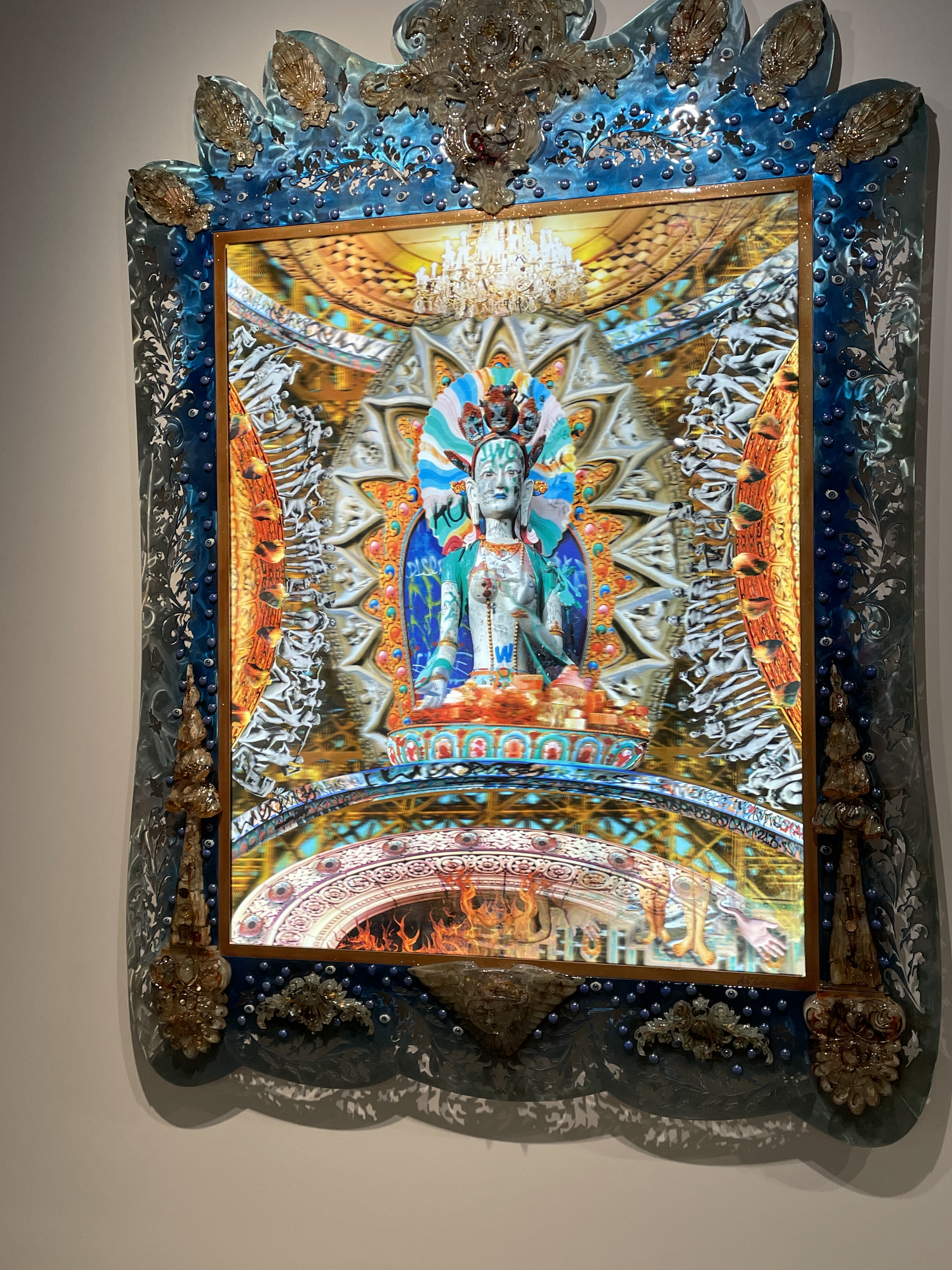
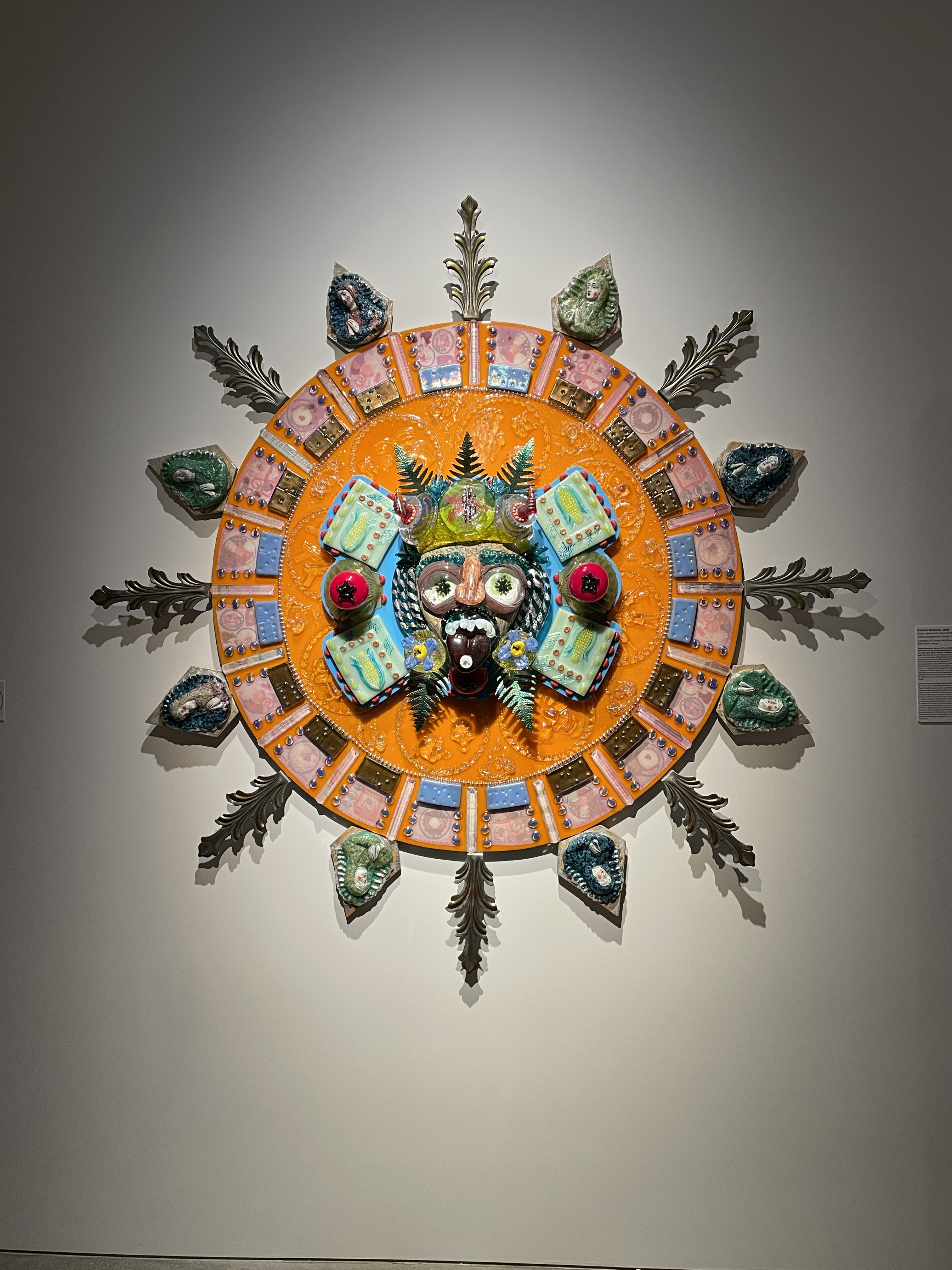
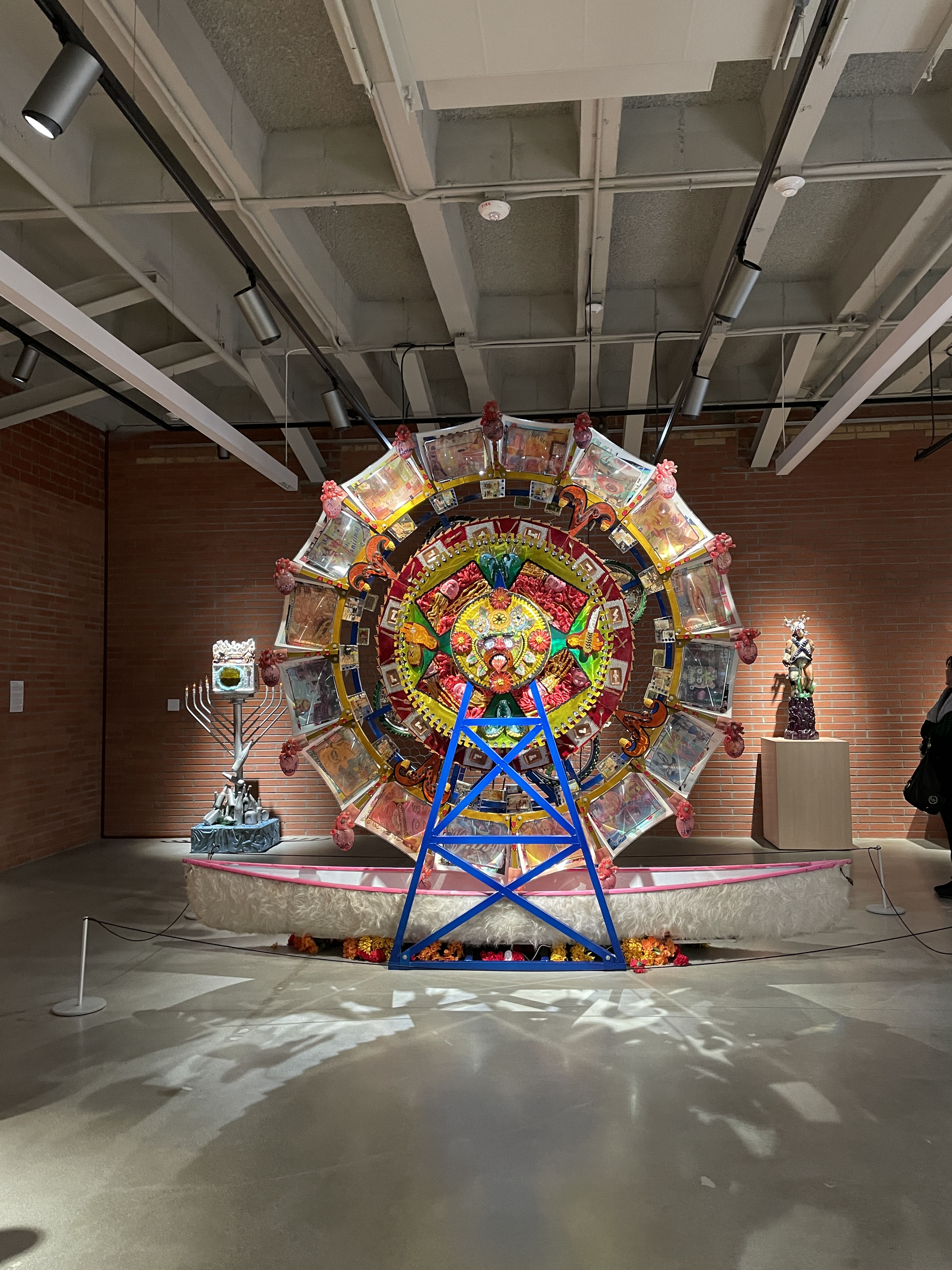
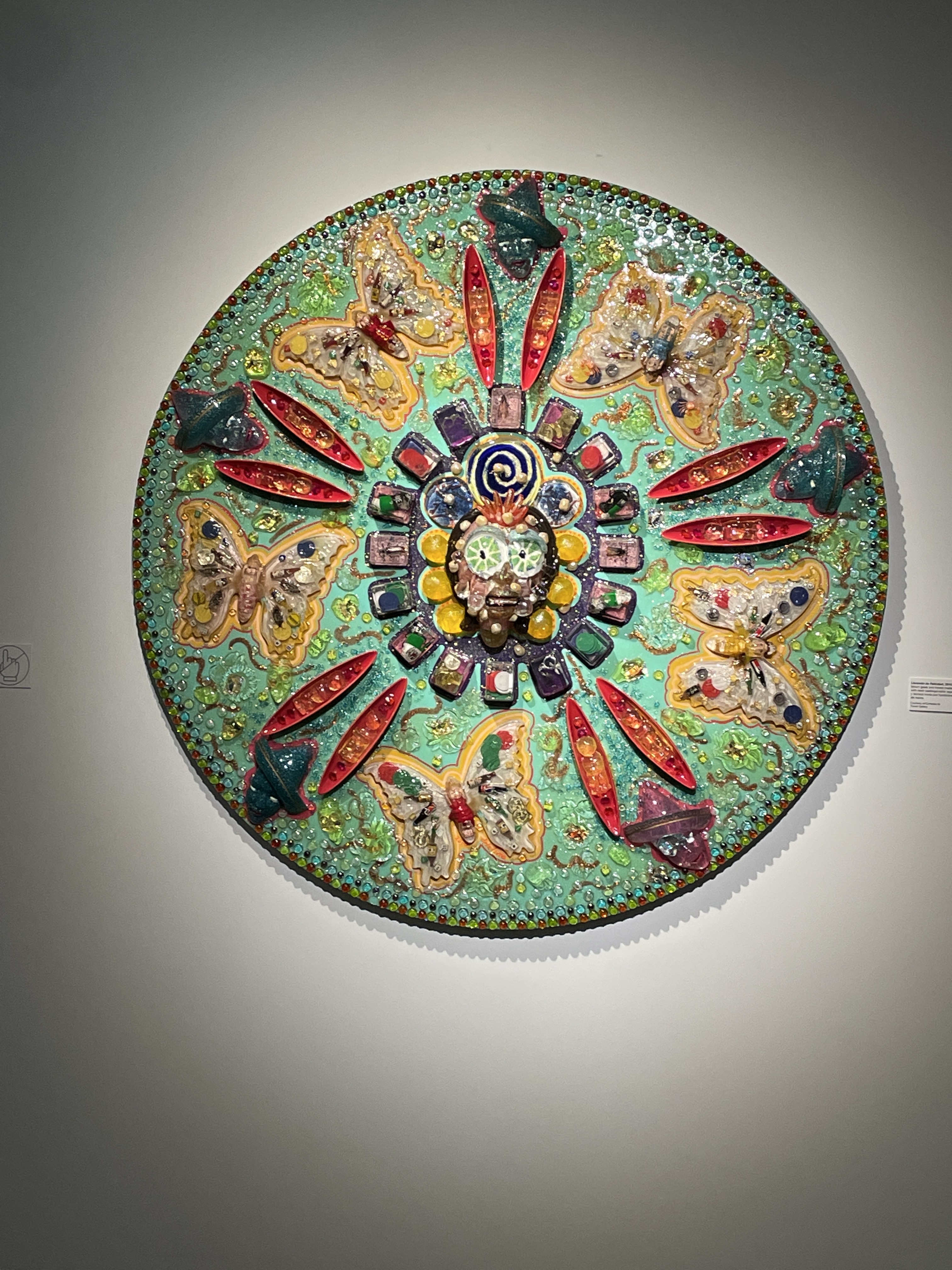
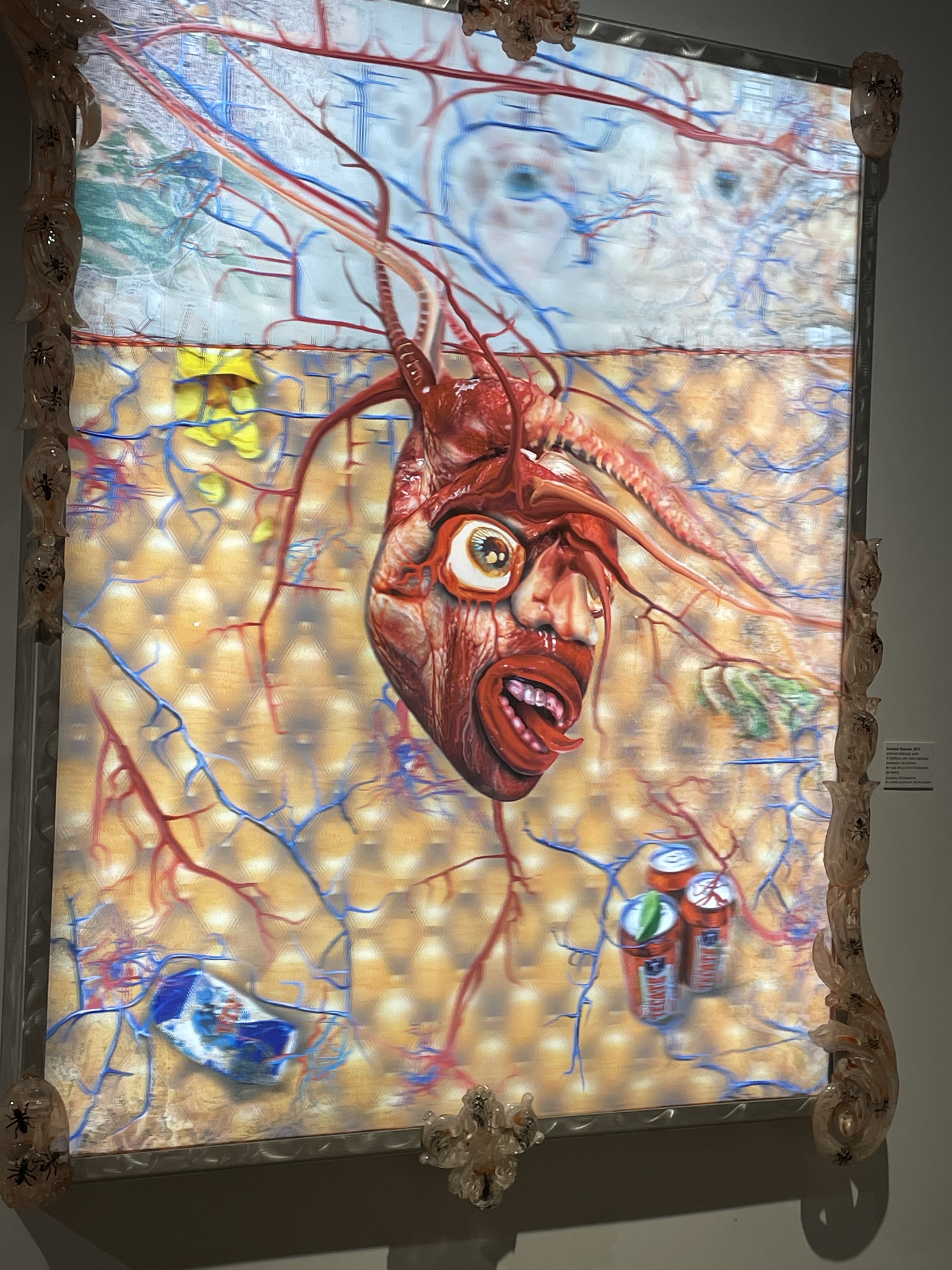
The second floor of the Cheech contains even more astonishing art including more multidimensional pieces except smaller than the giant one you see when you enter the building.
Depending where you stand in front, to either side, what you see is quite different. I kept thinking some old Flemish art or Hieronymus Bosch meets modern technology.
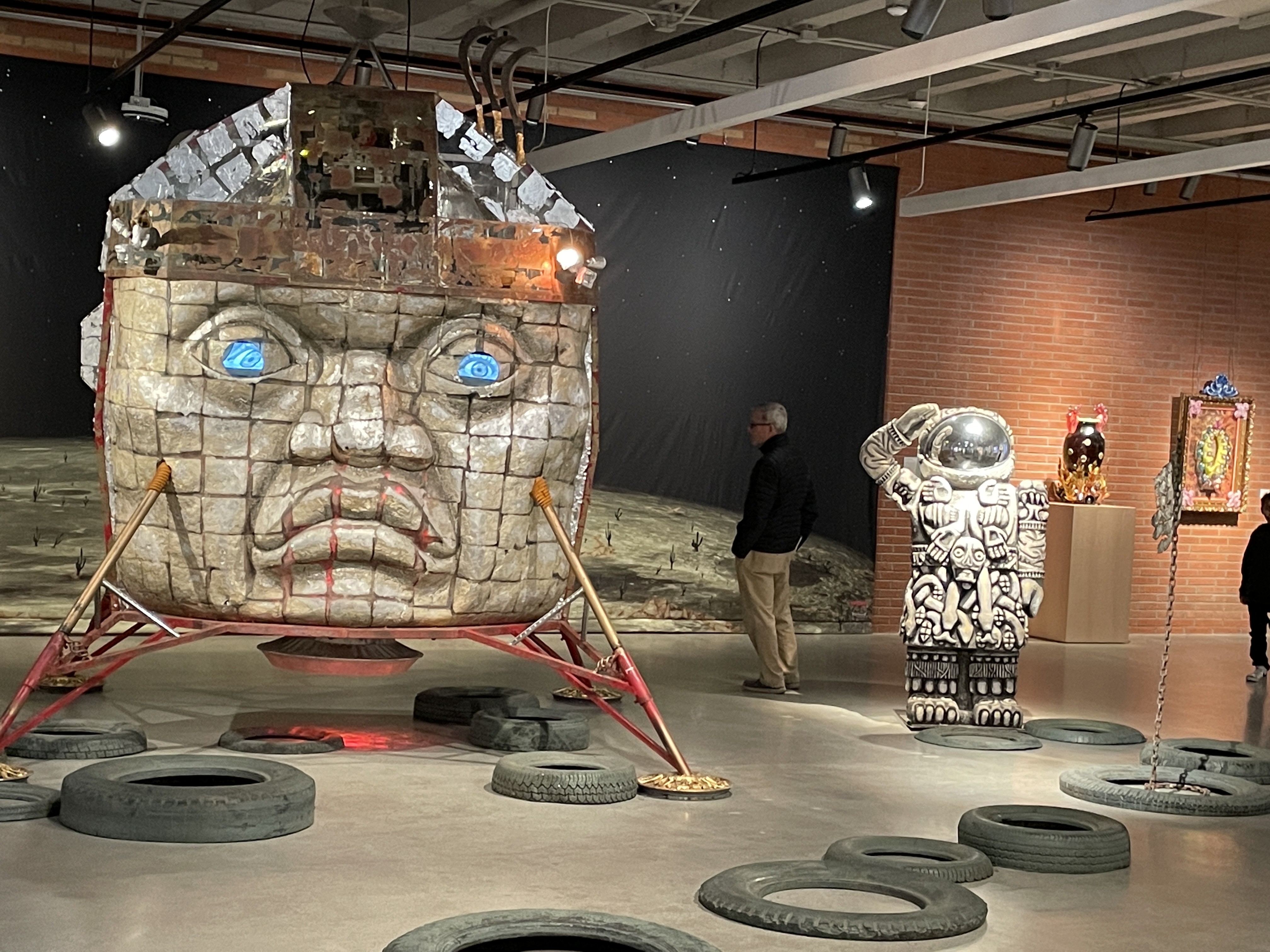
Much of the art makes a social or political statement especially about colonization, culture, poverty.
Some of the art is reminiscent of Mayan and Aztec calendars.
Hearts appear in many of the paintings.
And of course Frida.
This is a space ship with changing eyes. If you walk around the back there is a creature inside watching everything with monitors.
In a recent post I mentioned walking in her footsteps. This is the rainy season so we have not been able to go on that walk yet.. However, this morning I finished reading the last novel of hers that I had not read–Parable of the Talents. It is the sequel to Parable of the Sower. Now I have read all of them. She is buried at Mountain View Cemetery in Altadena, CA, Eagles View Lot 4517. The inscription on her gravestone is the theme of both the books above:









 writingontherim