Book Two for 2025: “Memory Wall Stories”, Anthony Doerr


While wandering around in the library, I found this book. His two more recent novels, ” All the Light We Cannot See” and “Cloud Cuckoo Land” remain two of the most touching and fascinating novels I have ever read so decided to try what he started with, short stories. These stories do not disappoint.

The title of the book comes from the first of the stories. It is a combination of science fiction and paleontology. Via an operation to his head a young boy in South Africa possesses the memories of an old woman. Through her memories he learns of a her deceased husband’s interest in rocks and fossils. This allows him to make a discovery that changes lives. In the next story, due to the death of her parents, a young girl in Kansas has to move to Lithuania to live with her grandfather and makes a myth come true. The following story, “Village 113”, won the O. Henry Prize. It details what happens to one woman, a keeper of seeds for an entire village, when the Three Gorges Dam was built in China. Another story tells what happens to a couple in Wyoming when they desperately want a child but cannot conceive. The shortest of the stories, “The Demilitarized Zone”, is well about that–sort of. The final story, like several others, is about memory, in this case the memories of a Holocaust survivor, who like many who survive horrible events when others they know do not, wonders why her.

I liked these stories so much that I ordered his earlier collection of short stories, “The Shell Collector.” He has won the O. Henry Prize for short stories five times and the Pulitzer for “Cloud Cuckoo Land” in 2015. I keep wondering how he knows so much about so many places. His short stories and novels are set in countries all over the world. The research must never end.

Book 26 for 2024: “The Burgess Boys”, Elizabeth Strout


After winning the Pulitzer for her previous book, “Olive Kitteridge”, Strout continues her stories about people and families from a small town in Maine, the town of Shirley Falls. “The Burgess Boys” focuses on one family, the Burgesses. A freak accident which occurred when the children were under the age of ten has affected all their lives in one form or another. The boys, Jim and Bob–both lawyers, escaped to NYC as quickly as they could. Only their sister remained behind in Shirley Falls in the old family home which has become a rather dark and dismal place. Jim, a hyper successful, high powered attorney, has demeaned his younger brother Bob, a Legal Aid attorney, all their lives. The lifelong family dynamic is totally upended when the sister, Susan, calls them back for a family emergency after her teenage son commits a stupid, heinous act and gets himself in serious legal trouble.

Strout possesses a simple, straight forward, unique style of writing that seems perfect for telling family stories, illuminating human personal struggles, and illustrating the good and bad of modern life. If you have not read any of her work before, I suggest looking at the publication dates and reading them in order. The same characters keep reappearing and you learn about their lives as you go from book to book.

Book 22 for 2024: “The Reluctant Fundamentalist”, Mohsin Hamid


Written in an unusual style, the narrator, the main character, tells his story to an American visiting Pakistan. While they are sitting eating dinner and later walk to a hotel, the narrator relates his life as an immigrant who found US life too shallow, too focused on profit. The narrator, a young, Pakistani man with an Ivy League degree, attains the heights of success in the US, working in a highly desirable career position where he is the star. After 9/11 occurs, he questions who he is, what working in this sought after career means, whether it is even ethical to work in a position for a firm whose job it is to investigate companies, their profits, and ruin the lives of the people who work there. He is sent to Chile to investigate a literary firm, meets the manager who takes him under his wing and helps him look at what he is doing in a totally different light. Is money everything? Do the lives of ordinary workers matter? In addition, it is a love story. He meets a beautiful, young, wealthy, US woman, they develop a close friendship, and he discovers she is not mentally stable and does everything he can to help her.

While on the surface this appears to be a story of a young immigrant who does not ultimately fit in with US life, it is much more. It raises the questions of the definition of success, of what love is, of profit over humanity.

One Book a Week-10: A Solitude of Wolverines, Alice Henderson


The perfect book for those who love suspense, Montana, wildlife, wildlife conservation, Alice Cooper, the protagonist, is a young, wildlife biologist who spends most of her life going from one remote research site to another. Here she’s located in a remote area of the high country in Montana, 26 miles from Bitterroot, studying wolverine populations for a wildlife conservancy/trust which now owns a defunct ski resort. While a few of the locals support her work and the conservancy, many more see the trust and her as endangering their way of life, and they are willing to kill anyone who gets in their way.

Filled with suspense, reading this page turner will also inform readers about wildlife biology and research, wolverine study, and life in the northern high country.

If you are looking for a fun read where you actually also learn something, this book is the perfect fit.

Note: This is one of three books I have read this month so far. I will post about the other two in the next few days.

One Book a Week-9: “Flights”, Olga Tokarczuk


How to describe this unusual novel? Here’s a possible list:

-No over all plot.

-Several stories about individuals scattered throughout, e.g. read about a person and event, then many pages later back to that person and the consequences of the event(s).

-Short philosophical musings/vignettes interspersed here and there. One reviewer counted 116.

-One common theme relates to the title, Flights, in that in most of the “stories” people are traveling or have traveled on quests for “meaning” or escape from a cumbersome reality.

I learned the following from reading this book:

-Per his request Chopin’s heart was taken from his body. His body was buried in Paris but his sister secretly transported his heart in a jar of special preservation liquid back to Poland, the land of his birth.

-A Dutch anatomist discovered the Achilles tendon after dissecting his own amputated leg.

-Plastination is the method used in anatomy to preserve bodies and body parts. Several characters in the book make their living or are obsessed with this process.

This is not a book for those who prefer relaxing reading or for the “faint of heart”.

Note: The author won the Nobel Prize in literature in 2018. This book won the Mann Booker for translated literature from all over earth in 2018. I plan to read another of her books–have now read two of them–but since the other one in English is 1000 pages long rather guess it might take more than a week for me to read it. This is actually the 11th book I have read to date in 2023 but did not start blogging about them so two are missing in the blog posts,

One Book a Week-3


While wandering around Barnes and Noble looking for something new to read, I read the blurb for An Imaginary Life by David Malouf, an Australian writer. I bought it. Of course, I had heard of Ovid, seen parts of Metamorphosis, his most famous work, but knew little about him. Emperor Augustus exiled him to the remote regions near the Black Sea for reasons not totally known but perhaps due to the nature of Ovid’s erotic poetry which was very popular. Written in the first person, this book relates Ovid’s experiences, thoughts, and feelings while in exile. The urbane and educated Ovid now has to learn to live with superstitious, illiterate, poverty stricken people whose language he does not know, who possess none of amenities to which he is accustomed, who live in a bare survival mode. They find a “wild child” and Ovid becomes determined to catch him and teach him. The Child has lived with the animals and speaks their language, seems immune to weather even though naked, knows nothing of humans. As Ovid lives with and teaches the Child, he begins to question what it means to be human, to be civilized, to be different. What is the true meaning of life?

Note: If you look up Ovid, you will find a birthdate but no date of death. No one knows exactly when or where he died or where he was buried.

One Book a Week-2


One book a week? To date this year it has been more like 3-4, depending on the book and week. I wrote reviews for four books today on Goodreads including The Sea of Tranquility, Little Fires Everywhere, An Imaginary Life, The Woman They Could Not Silence. I mentioned the first one in my last post.

I noticed that Little Fires Everywhere is now a series, streaming. I will not watch it because it is one of the few books that made me cry. I rarely cry. Is it worth reading? Yes. I view it as recommended reading for parents. How do you treat your child who is different, the child who is not how you want your child to be? Is conforming the best way to live? And at what cost? Is a poor minority child better off with wealthy parents from a different ethnicity who can provide everything?

Next I read a non-fiction book, The Woman They Could Not Silence, The Shocking Story Of A Woman Who Dared To Fight Back, by Kate Moore. Apparently I did not know as much about women’s history in the US as I had thought. This is the true story of the life of Elizabeth Packard. Here are some of the things I learned:

  1. In the mid 1800s if a woman was married, her husband could place her in a mental asylum as insane and she could do nothing about it even if she was sane. She could not get out even if relatives and friends tried to come to her rescue.
  2. Her husband could confiscate all her property and do with it whatever he pleased. She and everything she owned now belonged to him.
  3. People in mental asylums were terrorized and treated with methods now considered even illegal treatment for actual terrorists, e.g. water boarding.
  4. A common, accepted treatment for “difficult” and “emotional” women was clitoridectomies, female genital mutilation. Prominent psychiatrists viewed female genitalia as the cause of female insanity. Dr. Isaac Brown, a prominent London surgeon, stated that it was easy to cure female insanity, just cut off her clitoris. This was practiced in both the US and England.

Elizabeth Packard’s husband placed her in an asylum because she disagreed with his religious views and her outgoing nature. This book details her life in the decades she struggled to be released from the asylum and her struggles to make life better for those who were placed in asylums. It is a must read for anyone interested in the history of women in the 1800s and the treatment of those deemed insane.

One Book a Week-1


After finishing Tolstoy and the Purple Chair, by Nina Sankovitch, who sets out to read a book each day for a year in order to alleviate her grief over her sister’s death, I decided to commit to reading a minimum of one book a week for a year. As of today, I have already read three, the first of which was The Sea of Tranquility by Emily St. John Mandel. Previously I had read my last Octavia Butler novel, Parable of the Talents in which the main character creates a religion with the ultimate goal of establishing human colonies in “the stars”. Then I discover that the title of The Sea of Tranquility refers to a specific area of the Moon where in this book there are two human colonies. Additionally, there are other colonies, the Far Colonies. Their specific location is never cited.

What is the likelihood that I would pick up a book at the library where the goal of the main character in the last book I read is fulfilled in the second book? Coincidence? Serendipity?

And, by the way, a pandemic occurs in both novels. Butler’s book, written in the 1990s, contains a number of prophetic statements and events which sound like today’s news. More about that in the next post.

Hazy, Lazy Days


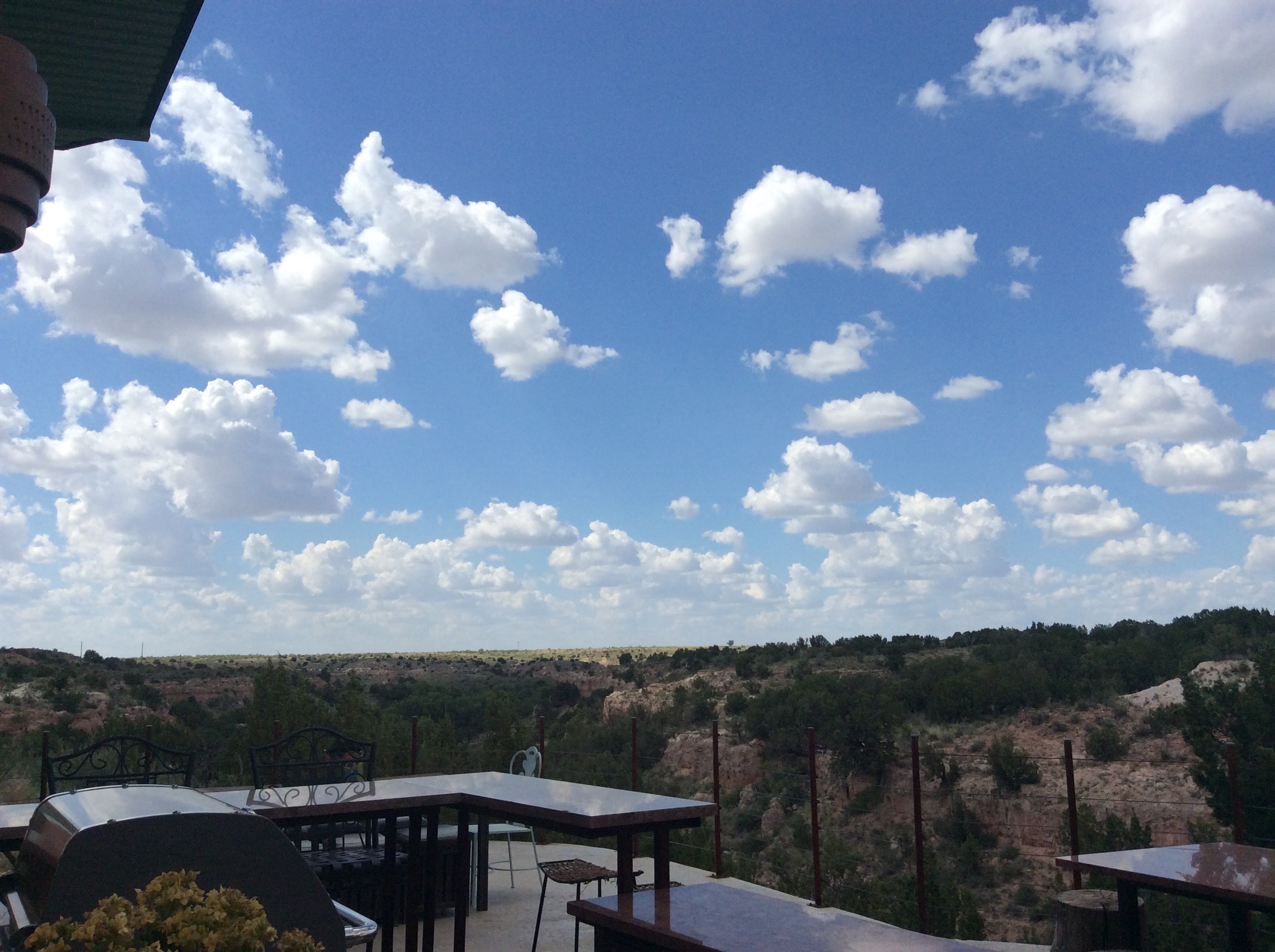
The words and tune to this old song float through my brain.  Summer.  Early morning yoga, coffee, horses fed, flowers watered, a lazy lunch:  salad with feta, black beans with caramelized onions.  Slouched, reading a book (The Return, Hasham Matar) on the sofa, feet crossed on edge of coffee table, patio doors open, I hear birdsong, the whir of black fans in the ceiling sea of white.  Summer. Nap time.  Awaken slowly, eyes watching cotton candy clouds barely move across an azure sky.  Summer.

IMG_2671

Saturday Night


Read two pages,

“Ghana Must Go”.

The wife’s Nigerian,

Yoruba, Igbo.

She sells flowers,

not in Nigeria.

The author’s name

Ethiopian?

Sip zinfandel

flowered glass.

Take a bite

chocolate filled

peppermint,

lick peppermint

fingers.

Read two pages:

“Africans…the indifference of the abundantly blessed…

who can’t accept, even with evidence, that anything native,

occurring in abundance, is exceptional without effort,

has value.”

Does anyone?


IMG_1584