The Dates You Never Heard Of


After reading about the nutritional value of dates for the brain, I headed to the nearby farmer’s market where they sell everything you can imagine from the Middle East as well as other international foods. At the dried fruit section, I studied the different kinds of dates. Medjool and deglet were familiar. Then I saw a box with three kinds of dates I had never heard of: piarom, zahedi, rabbi. They even looked a bit different. Tired of the same ole stuff to eat, I bought the box then went home and decided to research the origin and characteristics of each one.

Unlike medjool dates which are considered wet, these three are considered semi-dry. The piarom are grown primarily in southern Iran. Some depending on exact origin and harvest are one of the most expensive dates in the world. They are longer and thinner and a dark chocolate color so often referred to as chocolate dates due to both color and flavor. Another common name for them is maryami. The pits are smaller and so there is more flesh per date. They contain less sugar (lower glycemic) than the wet dates like medjool.

Zahedi dates even look really different. They are shorter, a bit fatter, and golden colored. The pit is easier to remove than most dates too. They have less sugar content than most other dates and therefore can be eaten in moderation by diabetics. They are primarily grown in Iraq and Iran but some are grown in certain areas of North Africa and Asia.

Although the majority of rabbi dates are grown in Pakistan, their origin is Iran. They too contain less sugar than wet dates like medjool. They are reddish brown and usually a bit fatter than piarom dates. Their flavor depends on the soil and the weather conditions under which they are grown. Generally their flavor tends to be caramel-like and nutty.

Like most dates, these support gut health and provide electrolyte balance due to high levels of potassium and magnesium. One big advantage is their lower sugar levels. In addition to the above, like all dates they contain high levels of polyphenols. I will buy them again.
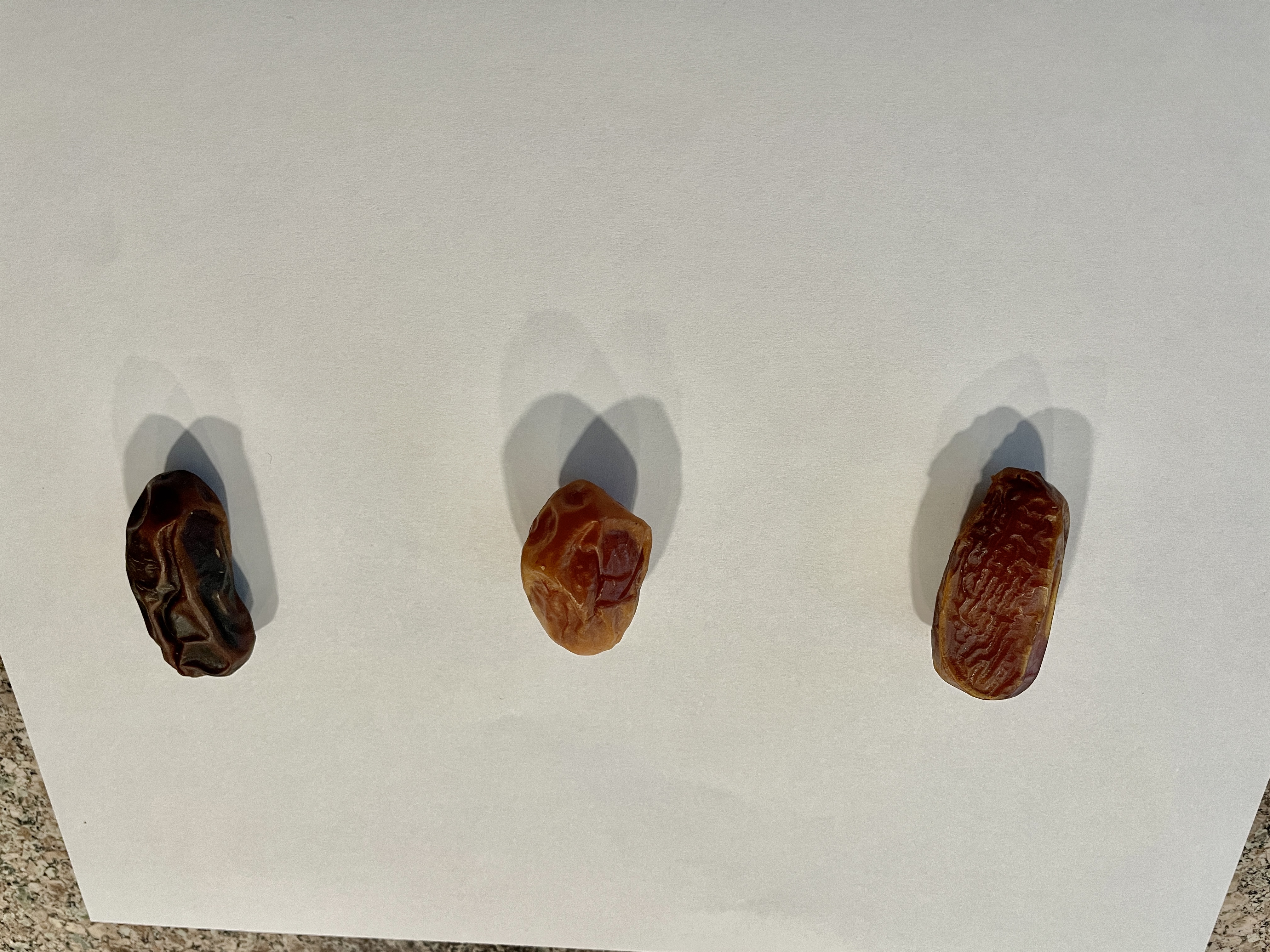
On the left is piarom, then zahedi, and finally rabbi. Some of the zahedi are very light colored.
Book Seven for 2025: “The Map of Salt and Stars”, Zeynab Joukhadar


Two young heroines dominate this fascinating novel which switches back and forth between the Syria of 2011 and the 12th century. The latter is a girl who disguises herself as a boy to join the quest of a famous mapmaker. Nour, the first girl, lost her father to cancer in NYC. Then her mother, a mapmaker, decides to move herself and the three daughters back to Homs, Syria. They barely settle into their new life when the civil war breaks out and a bomb destroys their house. They become refugees. This is the tale of their harrowing journey from Syria to Jordan to Egypt to Libya to Algeria, then Morocco and finally to Cuenta, the Spainish city on the north coast of Africa, where their uncle lives.

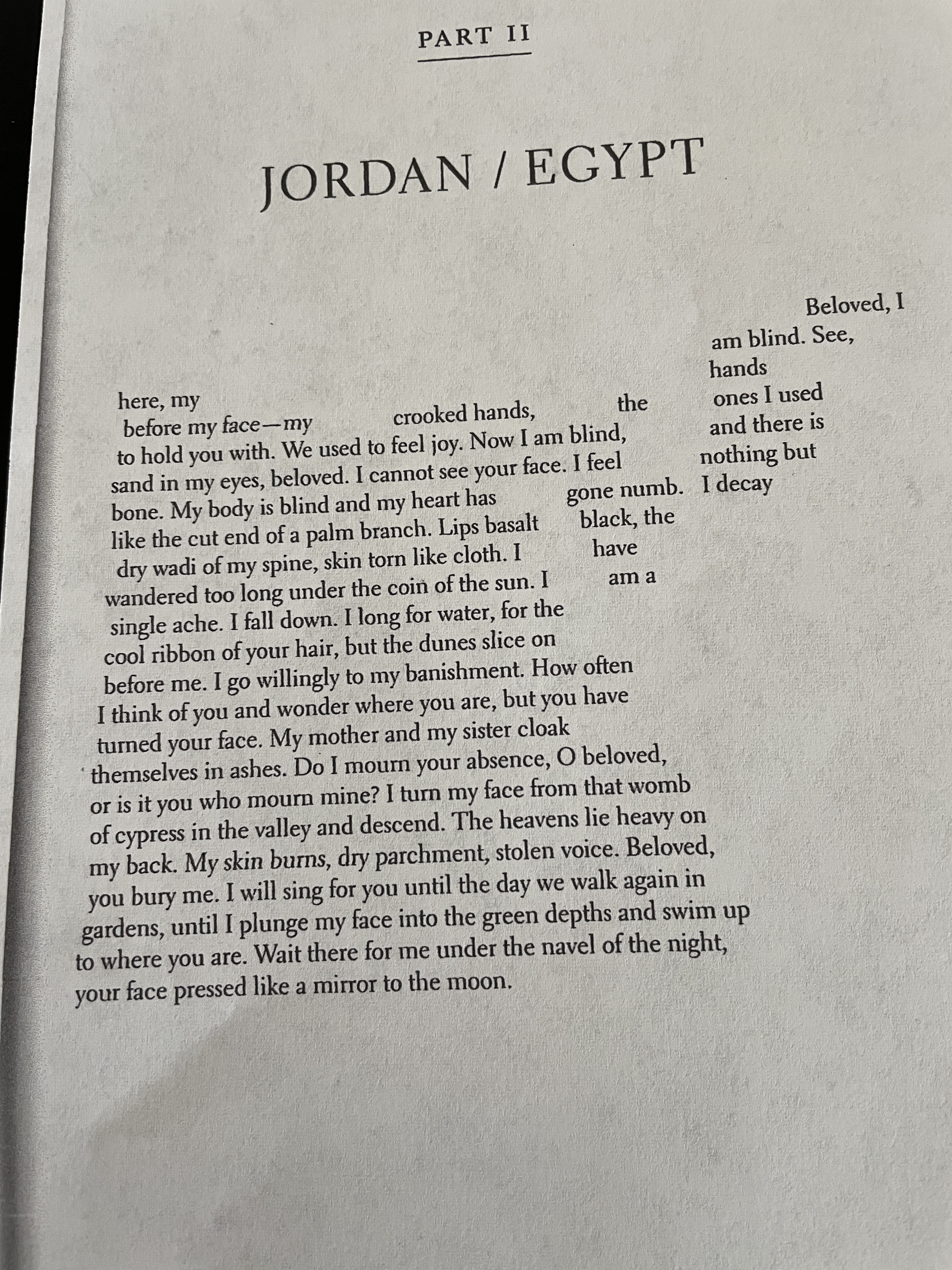
To keep sane, Nour repeatedly tells herself the story of Rawiya, the disguised girl who is an apprentice to the map maker. When he was alive, this was the favorite traditional story her father told her. The book alternates between what is really occurring to Nour and her refugee family and this ancient story. At the beginning of the section for each country through which they travel, there is a touching and beautifully written poem in the shape of the map of that country. The poem for Jordan/Egypt is printed below.

One Book a Week-13: Blue Desert, Celia Jeffries


As an ardent reader who prefers what are usually referred to as literary novels and serious non-fiction, few books impact me deeply and emotionally like this one has. As soon as I finished it, I reread parts of it several times, then sat silently stunned.

After her family moves to North Africa for her father’s work, an 18 year old British girl, rescued by a Taureg leader, is believed dead by her family until she resurfaces years later at a Catholic “home” run by nuns in North Africa. She re-enters British society, marries, leads a relatively “normal” life while keeping a secret for decades. When she receives a telegram, “Abu is dead”, everything changes. Her past comes rushing back in unexpected ways.

Large Lakes of the Sahara


Who knew?  In the literal middle of nowhere in Chad several large lakes still provide fresh water to the few animals and people who live there.  Salt water lakes reside in many deserts worldwide, but not freshwater lakes.  The May/June 2014 issue of Saudi Aramco World both astonished and enlightened me.  These lakes are not mere oases, but really large lakes, the Lakes of Ounianga.  In 2012, all eighteen of them became part of World Heritage sites.

Each lake remains different, some interconnected, some fresh water, some saline.  They are 500 miles from the nearest large body of water, Lake Chad.  To get there, you must use four wheel drive or ride a camel.  In 2001 and 2002 not far from these lakes, the fossils of extremely ancient hominids were found, hominids who lived seven million years ago, potential precursors to modern humans and chimpanzees.  Here and there camels graze in sand nearly devoid of vegetation. Near these lakes lush foliage grows, green gems in the middle of miles of varying shades of endless brown.  One of the lakes’ water is red from the algae growing in it sometimes several inches thick.  Frogs croak.

Once upon a time long ago, this Sahara grew savanna grass where the wildlife we associate with other parts of Africa lived–elephants, giraffe, hippos, antelopes, and the now extinct auroch.  Lake Boukou holds fresh water, crystalline, pure.  Around this lake one can find ancient stone hammers and scrapers dating from half a million years ago.  Because of evaporation in the dry heat, one would expect these lakes to become increasingly saline.  Only one of the eleven lakes in this area is saline. How is this possible?

Under the Sahara lies the world’s largest fossil-water aquifer beneath the countries of Chad, Sudan, Egypt, and Libya.  The maximum depth is 12,800 feet. This acquifer supplies the Lakes of Ounianga.  The mats of reeds and algae on top of the fresh water lakes keep their evaporation rate low and their water fresh.  Once these lakes covered vast distances.  Researchers use diatomic soil to study the changes in the lakes over centuries.  Diatoms are the remains of microscopic sea creatures that turn into ivory or white soil.  Studying these soils enable scientists to date the age of the lakes to approximately 6000 years ago.  Once researchers thought the Sahara suddenly became a desert about 5000 years ago, but new data reveal a more gradual change to desert taking thousands of years and only becoming the desert we know more recently.  Research around the lakes will prove important to understanding climate change and its causes.

Currently fifteen clans live in Ounianga.  These people believe their ancestors came out of the lakes when they were one giant lake surrounded with date palms.  Core studies (scientists take a core sample of the soil–in this case 16 meters) indicate that date palms came rather late in the area’s millennial history.  They have also found the roots of reeds and even trees dating back to approximately 8000 years ago.  Their goal is to drill even deeper.  Heat (122 degrees F) make this a long, torrid task, but the scientists dedicated to learning the story of these incredible lakes and the Sahara press on.


Notes:  Saudi Aramco World is one of my favorite magazines, filled with fabulous photos, historical articles, recipes, and endless fascinating information.  This issue also included an article about the Muslim Tartars who live in Poland today.  You can subscribe  by adding your name to their free subscription list.

Diatomaceous earth is found in many places.  I feed it to my horses to prevent parasites.  It is used in cleaners and even tooth paste.